U.S. Pat. No. 8,616,970
SYSTEM AND METHOD FOR MANAGING A MULTIPLICITY OF TEXT MESSAGES IN AN ONLINE GAME
AssigneePalo Alto Research Center Incorporated
Issue DateApril 7, 2008
Illustrative Figure
Abstract
A system and method for providing text of interest to a player from text messages in an online game is provided. A player profile for a player participating in an online game is maintained. Text messages from sources in the online game are received substantially simultaneously within a buffer for a limited text area of a display during an online game session. A main conversation in which the player is involved with one of the sources from the text messages is identified and removed from the buffer. The text messages in the buffer not identified as the main conversation are analyzed for text of interest to the player included in the player profile. The text of interest is provided in the limited text area in the display interspersed with the main conversation concurrent to receipt of each text message within which the text of interest was included.
Description
DETAILED DESCRIPTION Online Game Environment Conventional in-person games involve players who are physically located near one another, while online games involve players generally in remote locations who “meet” virtually over a network.FIG. 1is a functional block diagram showing, by way of example, an online game environment10. Each player11a-euses a computer12a-bthat is remotely interfaced to a server13over a public data communications network14, such as the Internet, to participate in an online game. Additionally, the computers12a-bcan be interfaced via a telephone landline, wireless network, or cellular network. Other forms of remote interfacing and network configurations are possible. Preferably, each computer is a general-purpose computing workstation, such as a personal desktop or notebook computer, for executing software programs, including Web browsers. The computer12a-bincludes components conventionally found in computing devices, such as a central processing unit, memory, input/output ports, network interface, and storage. Other user devices, systems, and components are possible, for example, Web-enabled cell phones15, Web-enabled television set-top boxes16, and gaming consoles17. Each computer12a-bis connected to a display having the capability to present text. Displays having other capabilities, such as the display of graphics, are more common. Various user input devices, for example, a keyboard, mouse, or game controller, are interfaced to the computer12a-b. Other input devices, wired and wireless, are possible. The computers12a-bconnect to the server13, which enables the players11a-eto participate in an online game. Users connect to virtual worlds in similar fashion. The server13functions as the hub of game play activity and enables the game environment10to continue, from a player's perspective, on an indefinite basis. Player information persists independently from active participation to enable players to log in or out of the game at will. Player profiles18are created and maintained by the server13in a database19. Player profiles could also be stored locally. The server13is generally a server-grade computing platform configured as ...
DETAILED DESCRIPTION
Online Game Environment
Conventional in-person games involve players who are physically located near one another, while online games involve players generally in remote locations who “meet” virtually over a network.FIG. 1is a functional block diagram showing, by way of example, an online game environment10. Each player11a-euses a computer12a-bthat is remotely interfaced to a server13over a public data communications network14, such as the Internet, to participate in an online game. Additionally, the computers12a-bcan be interfaced via a telephone landline, wireless network, or cellular network. Other forms of remote interfacing and network configurations are possible.
Preferably, each computer is a general-purpose computing workstation, such as a personal desktop or notebook computer, for executing software programs, including Web browsers. The computer12a-bincludes components conventionally found in computing devices, such as a central processing unit, memory, input/output ports, network interface, and storage. Other user devices, systems, and components are possible, for example, Web-enabled cell phones15, Web-enabled television set-top boxes16, and gaming consoles17. Each computer12a-bis connected to a display having the capability to present text. Displays having other capabilities, such as the display of graphics, are more common. Various user input devices, for example, a keyboard, mouse, or game controller, are interfaced to the computer12a-b. Other input devices, wired and wireless, are possible.
The computers12a-bconnect to the server13, which enables the players11a-eto participate in an online game. Users connect to virtual worlds in similar fashion. The server13functions as the hub of game play activity and enables the game environment10to continue, from a player's perspective, on an indefinite basis. Player information persists independently from active participation to enable players to log in or out of the game at will. Player profiles18are created and maintained by the server13in a database19. Player profiles could also be stored locally. The server13is generally a server-grade computing platform configured as a uni-, multi- or distributed processing system, which includes those components conventionally found in computing devices, as discussed above.
One form of online game is a massively multiplayer online game (MMOG). A MMOG is presented to players as a persistent gaming environment in which the player's character and corresponding attributes are created and stored by a server. A player is a human who plays the game, while a character is a simulated being that is created and controlled by the player for use in the game. Tens of thousands of players can be simultaneously playing a MMOG. For example, World of Warcraft, developed by Blizzard Entertainment, Irvine, Calif., is a subscription-based MMOG having over ten million players. Players initially purchase the game software and afterwards pay a monthly subscription fee for continued access to the game. World of Warcraft takes place in a fantasy world of magic, demons, and warriors. A player uses his character to explore the virtual landscape of the game, fight monsters or other characters, undertake quests, and perform other virtual actions. Rewards in the game include money, items, and experience, which allow a player to increase the skill and power of his character or to earn other accolades. A player can have more than one character.
During play, players often receive a plethora of text messages, often closely spaced in time, as further discussed below with reference toFIG. 9. For example, private messages can only be seen by the message recipient player. Group messages are sent to all players that are members of a particular group. Clan or guild messages are similarly limited to members of a clan or guild. Additionally, any player that is within a limited “spatial” area receives spatial messages. Spatial messages are received when a recipient player is within a defined “zone” or fixed “distance” of another player. Further, non-chat messages relate to what is generally happening in the game or to a player's character, such as when advancing a level. Other types of text messages are possible. These various messages scroll through the chat box in order of receipt.
The messages can be sent from a variety of sources, which only adds to the complexity of mentally processing messages whilst concurrently continuing game play.FIG. 2is a data flow diagram showing, by way of example, categories20of text message sources21. The sources21include messages from other players22, non-player characters (NPCs)23, moderators24, or generated automatically25. NPCs23are computer-controlled characters that interact with players through scripted events or artificial intelligence. NPCs23can be friendly, neutral, or hostile to players and, thus, can advise, train, or attack players. Moderators24are humans who enforce the rules of the game and prevent harassment of players by other players, known as griefing. Automatic25messages are triggered based on in-game actions or events and can include general game status or information. Other26message sources are possible online.
Furthermore, although MMOGs have been discussed above, other online games and activities follow similar formats. A player uses software, either purchased or downloaded for free, to enter the computer generated environment. Once in the environment, the player may explore and interact with the world and other players. One example of such online activity is virtual worlds. Virtual worlds and other computer-simulated online worlds allow users to interact over vast physical “terrains” where users can create any item of virtual property imaginable. “Inhabitants” of the virtual worlds communicate, play, and even conduct business using virtual alter egos, or avatars, of themselves. The avatars can collaborate on an objective, network with one another, or simply “wave” hello to a stranger. Virtual worlds often employ text-based chat boxes similar to that as described above for MMOGs. Accordingly, the discussion herein applies equally to these other on-line activities.
Online Game User Interface
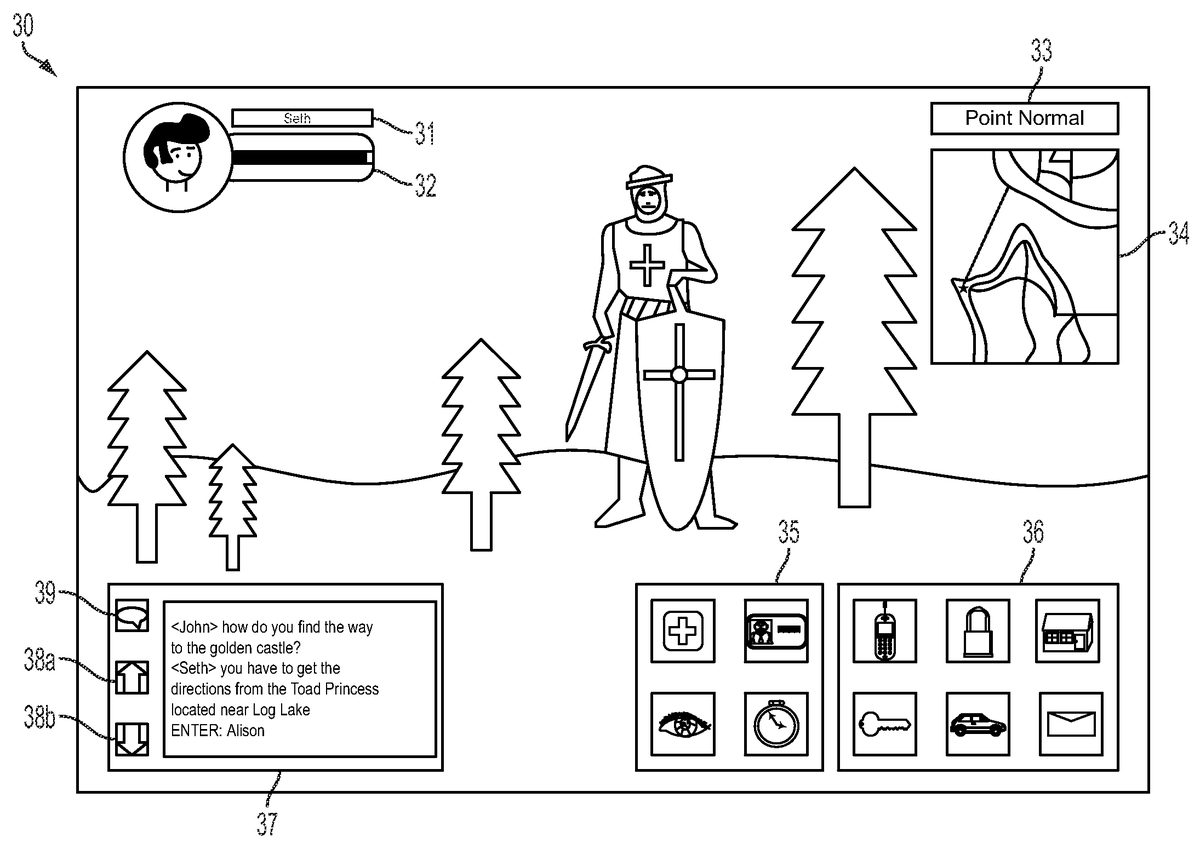
Players of online games follow the game's action and receive information on a screen display, which represents the player's virtual “eyes” and “ears.”FIG. 3is an exemplary screen shot30of an online game. Although the exemplary screen shot30contains graphical elements, other controls and information displays are possible, for example, a display that presents only text.
In a graphical user interface, the game environment is presented through a first person's view or by some other perspective, such as an overhead map. For interactive online games, a character's name31, health32, and location33are often displayed. Other information could also be provided. An overhead map view34can be provided as a guide to the character's location within the game environment. Icon buttons display the character's inventory35of items and possible actions36that the player can take. A chat box37contains scroll up38aand scroll down38bbuttons allowing the player to scroll though a buffer of text messages appearing outside the chat box37. Chat button39toggles the ability of the player to chat “on” or “off.” The buffer may store all messages received since the player logged in, or only a limited number of most recent messages. Due to the large number of messages that a player typically receives, the buffer can quickly fill up and overwhelm the player. Additionally, when only a limited number of messages are stored in the buffer, information of interest to the player can be lost due to the information being replaced by incoming messages.
Additionally, although game environments, such as MMOGs and virtual worlds simulate “conversation” between players, these environments lack real world physics. In the real world, having two ears placed on opposite sides of our heads allow us to hear in stereo and identify the direction and angle of a sound source. We are able to determine whether the source of a sound is near or far, left or right, and up or down compared to our location. In contrast, players only have one “ear” in-game in the form of the chat box. All messages sent within a zone, or “hearing” range, of the MMOG, or virtual world are received at the same “volume,” which leads to a false impression as to the distance and direction of the source of the message to the recipient. Determining the location of a source of communication requires a player to reference some other information as to the nature of the source, which can distract the player and interrupt the continuity of the game play, as further described in commonly-assigned U.S. Patent Application Publication No. 2009-0253512, published Oct. 8, 2009, pending, the disclosure of which is incorporated by reference.
Method
Online games provide a continuous stream of textual information in the form of messages to a player, much of which may be of little help or interest. The stream can be focused through use of the player's profile, which enables the player to control the text stream and to present only important or relevant information while remaining focused on the game.FIG. 4is a flow diagram showing a method40for managing a multiplicity of text messages in an online game in accordance with one embodiment. The method40is performed as a series of process steps by the server13, or any computing device connected to the network14with access to the text messaging stream.
By way of background, online games offer a rich set of meta, characteristic, behavioral, communicative, and other information about each player11a-e. This player information can be mined (step41) to identify information of likely interest to the player11a-e, which can then be stored by the server13(shown inFIG. 1) as a player profile18. Player information can include attributes of the player's character, as further described below with reference toFIG. 6, and details about the player11a-ehimself, as further described below with reference toFIG. 7. Other types of player information are possible.
Messages are continually received into a chat box27as a substantially simultaneous stream of text (steps42-52). Text messages are received close enough in time whereby the player11a-ecan be overwhelmed with the volume of text messages received and have difficulty in mentally processing the messages. A chat box a finite display of text. For example, a chat box can be a framed “box” for displaying text, as shown inFIG. 3, or any other defined limited text display area. Each text message that a player11a-ereceives is temporarily stored or buffered (step43). The buffer may store all messages received since log in, or only a limited number of most recent messages. The buffer is a holding area for the text messages that could be displayed, though not all buffered text messages need be displayed. A main conversation in which the player is participating is identified from the buffered text messages (step44). In a further embodiment, the main conversation is removed, after identification, from the buffer of text messages. The main conversation can be identified directly by the player's11a-eactions, such as by identifying the players11a-eto whom messages are sent, or indirectly, such as described in commonly-assigned U.S. Pat. No. 7,698,141, issued Apr. 13, 2010, the disclosure of which is incorporated by reference. The main conversation can be a text exchange in which the player11a-eis actively engaged or the player11a-ecan activate a selective attention mode (step45). A player11a-eis actively engaged in conversation (step46) when the player11a-eis participating in or focused on a specific conversation. The determination can be automated or player-controlled. The selective attention mode functions when a player11a-eis not involved or actively engaged in a conversation (step47), yet allows information of interest to be displayed, as discussed below. The selective attention mode can be engaged by the player11a-eor automated. In a further embodiment, secondary, or side bar, conversations are identified as a main conversation (not shown). Unlike a primary conversation, where a player11a-eis in a continuous conversation, secondary conversations are conversations where a player11a-ehas a short or temporary exchange with another player, though not fully focused on the secondary conversation. Secondary conversations can be in addition to or in the absence of a primary conversation. Other modes of main conversation processing or selection are possible.
The main conversation is displayed in the chat box27(step48), but the rest of the text stream is omitted. In the background, each remaining text message that is not part of the main conversation is analyzed (step49), based on the player profile18, for information of possible interest to the player11a-eand information of potential interest is extracted. The remaining text messages can come from a variety of sources, as further described below with reference toFIG. 9. In a further embodiment, the main conversation or secondary conversation, if applicable, are also analyzed. In a still further embodiment, the remaining text is analyzed by concurrently parsing the text for keywords defined in the player profile18. After parsing, the keywords are analyzed, as further described below with reference toFIG. 5.
Text of interest is then flashed in-between the lines of the main conversation (step50). Text of interest could also be flashed, for instance, in line with other messages or in a separate chat box. Text of interest is any information contained in a message sent to the player that is of possible significance to the player. The information can be related to the online game or extrinsic to the game. The determination of significance can be automated or player defined. The text of interest is preferably flashed a relatively short time after the originating message was received by the player. Otherwise, the value of the information can become stale. Text of interest may additionally be distinguished from the main conversation by font, font size, color, or other attribute. Additionally, an audio or visual alert can be used. Other distinguishing features are possible. The player11a-ecan then take action (step51) on the flashed text of interest, such as selecting the text of interest to display the original context of the text of interest, as further described below with reference toFIG. 6. Processing continues with each successive message (step52).
Flashed Text
Text of interest is “flashed” by including select portions of the non-main conversation text, that is, the “remaining text messages,” in-between or interspersed within the main conversation.FIG. 5is a data flow diagram showing, by way of example, various types53of flashed text54. The flashed text54can include keywords55, icons56, and code words57. Other58types of flashed text are possible. Keywords55are identified and extracted from the remaining text using an automated process, for example term frequency-inverse document frequency (TF-IDF). Keywords can also be from a set of “stock” keywords from character attributes or player details, as further described respectively below with reference toFIGS. 7 and 8. Similarly, the source or type of a message can trigger certain keywords, as further described, respectively, above with reference toFIG. 2and below with reference toFIG. 9. Additionally, player-defined keywords55are possible. Icons56can be text-based or graphical symbols. Icons56can be defined by the player or generated automatically. Code words57replace the actual text of the message and signal the occurrence of remaining text having particular characteristics or source of origin. Other forms of code words57are possible.
Flashed Text Selection
After text has been flashed, a player can choose to ignore the information presented or investigate the information further.FIG. 6is a process flow diagram showing flashed text selection60for use with the method40ofFIG. 4. Text of interest is flashed61in-between or interspersed within the lines of the main conversation, or at another location. The player can select62the flashed text by clicking the text with a mouse or other pointing device. Upon selection62, the context of the text of interest is displayed63, either within the chat box or separately. The context displayed63may be the full message or sentence from which the text of interest was extracted or a sufficient portion of the full message to enable the player to gain a sense of the manner in which the text of information was used. The context can also be displayed63in the same window as the main conversation or in another window. Other methods of displaying the context63could also be used. After the context is displayed63, the player may choose to ignore the context64or select the context65. If the context is ignored64, the player resumes the main conversation66.
Selection of the context65allows the player to respond to the topic of the context67or join the conversation68from which the text of interest was extracted. Responding to the context67can include sending a text message to the player who sent the message from which the text of interest was extracted. Additionally, if the text of interest was taken from the context63of two other players, the player can join their conversation68. Other post-context actions69are possible.
Character Attributes
Character attributes are a form of player information that can be used to define stock keywords.FIG. 7is a data flow diagram showing, by way of example, categories70of character attributes71for use with the method40ofFIG. 4. The attributes include name72, gender73, race74, class75, level76, clan77, and inventory78of the character. A character can have a real life race74, such as Caucasian, or a fictitious race74, like Elf or Troll. Character class75defines what abilities the character possesses. For example, if a character is a wizard, the character can perform spells, while a character with a class75of warrior cannot perform magic. A character's level76specifies the experience a character has attained. As a character's level76increases, the character can more easily defeat enemies and gains access to higher-level quests and game features. Clans77are groups of characters who maintain an alliance and fight together as a group. Each character has an inventory78of items that is useful in playing the game. Examples of inventory78items include armor, weapons, healing potions, scroll, and keys that open specific doors. Other79types of character attributes71are possible.
For example, a group of characters may be interested in forming a clan. The group would like to have a character of a certain class, such as Paladin, and level, such as Level50, join their clan. As a Paladin character of Level52is wandering through a village on the way to a quest, he passes by as the group is discussing the addition of a Paladin. The keywords “Paladin,” “Level50,” “join,” and “clan” are flashed on the Paladin's screen based on the Paladin character fitting the class and level sought by the group.
Player Details
Player details are a form of player information that can be used to define further stock keywords.FIG. 8is a data flow diagram showing, by way of example, categories80of player details81for use with the method40ofFIG. 4. The player details81include agenda82, strategy83, behavior84, and time85. Agenda82can include goals and interests of the player. Goals can include quests to undertake and groups to join. Interests can include game-related interests and extrinsic interests that a player may have that are unrelated to the game. For example, a player may be interested in a particular ability, such as blacksmithing. The player can add “blacksmithing” as a keyword, or “blacksmithing” can be automatically added by the system. Strategy83entails the player's approach to an obstacle or quest in the game. Behavior84reflects actions the player has taken during the game, such as areas in the game that the player has visited or challenges completed.
For example, a player may have undertaken a quest to find the “Sword of Forever” and failed. Later, as the player is doing other activities the keywords “sword” and “forever” are flashed because nearby, two other players were discussing how to get the Sword of Forever. The flashing of the text is due to the player's previous attempt to find the sword. Time85can include any time constraints or limit the player is under during the game. Other86types of player details are possible.
Text Message Types
Players receive text messages from a variety of sources in online games.FIG. 9is a block diagram showing, by way of example, text message types90for use with the method40ofFIG. 4. Types of text messages90that a player97can receive include private91, clan92, group93, spatial94, and non-chat95. Other96types of text messages are possible. Private messages91are sent directly from a player to one or more other players. Private messages91are received only by the players to which the message was sent. Group messages92are received by all players that are in a particular group. Clan or guild messages93are sent to all members of the clan or guild. Spatial messages94are received by all players in the vicinity of the sending player. The vicinity can be within a “zone” of the game or a certain distance around the player97. Non-chat messages95can relate to the development of a player's character or general game status information.
For example, a player's Elf character may possess a particular amulet, such as the “Amulet of Dragoon.” Another player may desire, but unable to find, the amulet. The other player may send a message to all players within the “zone” where the amulet is supposed to be located asking to trade for the amulet. The keywords “Amulet,” “Dragoon,” and “trade” are flashed on the Elf's screen.
While the invention has been particularly shown and described as referenced to the embodiments thereof, those skilled in the art will understand that the foregoing and other changes in form and detail may be made therein without departing from the spirit and scope of the invention.
Claims
- A system for managing a multiplicity of text messages in an online game, comprising: a database configured to maintain a player profile of a player participating in an online game;a user device, comprising: a communication module configured to continuously receive a multiplicity of text messages substantially simultaneously within a limited text area of a display during an active session of the online game;an identification module to identify a main conversation in which the player is involved from the text messages, the main conversation comprising one or more of the messages;an analysis module to identify one or more keywords of interest by analyzing each text message not in the main conversation against the player profile and by extracting the keywords from the respective text message;a display module to display the messages of the main conversation as one or more lines of text in the display and to intersperse the keywords into at least one of the lines of the text approximately concurrent to receipt of each text message not in the main conversation within which the keywords were comprised;and a context module to display the text message within which the keywords were comprised in the limited text area in response to a selection of the keywords by the player.
- A system according to claim 1 , wherein only those text messages not in the main conversation are analyzed.
- A system according to claim 1 , wherein the main conversation is identified from one of direct means and indirect means.
- A system according to claim 1 , wherein the main conversation is one of a primary conversation, a side bar conversation, and a selective attention mode.
- A system according to claim 1 , wherein the player profile comprises player details selected from the group comprising agenda, strategy, behavior, and time.
- A system according to claim 1 , wherein the player profile comprises character attributes selected from the group comprising name, gender, race, class, level, clan, and inventory.
- A system according to claim 1 , further comprising: a text type module to provide one or more of code words and icons based on the text message not in the main conversation.
- A system according to claim 1 , wherein the text messages are received from the group comprising other players, non-player characters, moderators, automated, private, clan, group, spatial, and non-chat.
- A computer-implemented method for managing a multiplicity of text messages in an online game, comprising configuring a processor to perform the steps of: maintaining a player profile of a player participating in an online game;continuously receiving a multiplicity of text messages substantially simultaneously within a limited text area of a display during an active session of the online game;identifying a main conversation in which the player is involved from the text messages, the main conversation comprising one or more of the messages;identifying one or more keywords of interest by analyzing each text message not in the main conversation against the player profile and extracting the keywords from the respective text message;and displaying the messages of the main conversation as one or more lines of text in the display and interspersing the keywords into at least one of the lines of the text approximately concurrent to receipt of each such text message not in the main conversation within which the keywords were comprised;and displaying the text message within which the keywords were comprised in the limited text area in response to a selection of the keywords by the player, wherein the steps are performed by a suitably programmed computer.
- A computer-implemented method according to claim 9 , wherein only those text messages not in the main conversation are analyzed.
- A computer-implemented method according to claim 9 , wherein the main conversation is identified from one of direct means and indirect means.
- A computer-implemented method according to claim 9 , wherein the main conversation is one of a primary conversation, a side bar conversation, and a selective attention mode.
- A computer-implemented method according to claim 9 , wherein the player profile comprises player details selected from the group comprising agenda, strategy, behavior, and time.
- A computer-implemented method according to claim 9 , wherein the player profile comprises character attributes selected from the group comprising name, gender, race, class, level, clan, and inventory.
- A computer-implemented method according to claim 9 , further comprising: providing one or more of code words and icons based on the text message not in the main conversation.
- A computer-implemented method according to claim 9 , wherein the text messages are received from the group comprising other players, non-player characters, moderators, automated, private, clan, group, spatial, and non-chat.
- A system for providing text of interest to a player from a multiplicity of text messages in an online game, comprising: a database configured to persistently maintain a player profile comprising information of interest to a player participating in an online game;a user device, comprising: a communication module configured to continuously receive a multiplicity of text messages from message sources in the online game substantially simultaneously to each other within a buffer for a limited text area of a display during an active session of the online game;an identification module to identify a main conversation in which the player is involved with one of the sources from the text messages and remove the main conversation from the buffer;an analysis module to analyze the text messages in the buffer not identified as the main conversation for one or more keywords of interest to the player matching the information of interest in the player profile and to extract the keywords from the respective text message;a display module to display the main conversation as one or more lines of text in the limited text area in the display and to intersperse the keywords into at least one of the lines of the text of the main conversation approximately concurrent to receipt of each such text message within which the keywords were comprised.
- A system according to claim 17 , wherein the online game is selected from the group comprising massively multiplayer online games comprising a player-controlled character that advances in level through completion of missions and virtual worlds comprising an avatar socializing within a computer-simulated environment.
- A computer-implemented method for providing text of interest to a player from a multiplicity of text messages in an online game, comprising configuring a processor to perform the steps of: persistently maintaining a player profile comprising information about a player participating in an online game;continuously receiving a multiplicity of text messages from message sources in the online game substantially simultaneously to each other within a buffer for a limited text area of a display during an active session of the online game;identifying a main conversation in which the player is involved with one of the sources from the text messages and removing the main conversation from the buffer;analyzing the text messages in the buffer not identified as the main conversation for keywords of interest to the player matching the information in the player profile and extracting the keywords from the respective text message;and displaying the main conversation as one or more lines of text in the limited text area in the display and interspersing the keywords into at least one of the lines of the text of the main conversation approximately concurrent to receipt of each such text message within which the keywords were comprised, wherein the steps are performed by a suitably programmed computer.
- A computer-implemented method according to claim 19 , wherein the online game is selected from the group comprising massively multiplayer online games comprising a player-controlled character that advances in level through completion of missions and virtual worlds comprising an avatar socializing within a computer-simulated environment.
Disclaimer: Data collected from the USPTO and may be malformed, incomplete, and/or otherwise inaccurate.