U.S. Pat. No. 8,608,535
Systems and methods for providing an interactive game
AssigneeMQ Gaming LLC
Issue DateJuly 18, 2005
Illustrative Figure
Abstract
An interactive treasure hunt game is provided. Game participants receive a card, map and/or identification badge configured with an RFID tag, barcode or a magnetic “swipe” strip or the like. The RFID tag or other identifying device is used to store certain information identifying each play participant and/or describing-certain powers or abilities possessed by an imaginary character that the card may represent. Players advance in the game by finding clues and solving various puzzles presented by the game. Players may also gain (or lose) certain attributes, such as magic skills, magic strength, fighting ability, various spell-casting abilities, etc. All of this information is preferably stored on the RFID tag or card so that the character attributes may be easily and conveniently transported to other similarly-equipped play facilities, computer games, video games, home game consoles, hand-held game units, and the like. In this manner, the game can seamlessly transcend from one play environment and/or entertainment medium to the next.
Description
DETAILED DESCRIPTION OF THE PREFERRED EMBODIMENTS Basic Game Play In one preferred embodiment the invention provides a system and method of multi-media game play carried out using one or more interactive “wands” and/or other tracking/actuation devices which allow play participants to electronically and “magically” interact with their surrounding play environment(s). The play environment may either be real or imaginary (i.e. computer/TV generated), and either local or remote, as desired. Optionally, multiple play participants, each provided with a suitable “wand” and/or tracking device, may play and interact together, either within or outside one or more play environments, to achieve desired goals or produce desired effects within the play environment For example, the invention may be carried out as an electronic treasure hunt game. Game participants receive a card, map and/or identification badge configured with an RFID tag, bar-code or a magnetic “swipe” strip or the like. The RFID tag or other identifying device is used to store certain information identifying each play participant and/or describing certain powers or abilities possessed by of an imaginary role-play character that the card represents. Players advance in the game by finding clues and solving various puzzles presented. Players may also gain (or lose) certain attributes, such as magic skills, magic strength, fighting ability, various spell-casting abilities, etc. All relevant game information is preferably stored (or addressably identified) on the RFID tag or card so that the character attributes may be easily and conveniently transported to other similarly-equipped play facilities, computer games, video games, home game consoles, hand-held game units, and the like. In this manner, the game is able to seamlessly transcend from one play or entertainment medium the next. FIG. 1illustrates one embodiment of an interactive treasure hunt game having features and advantages of the present invention. The particular game illustrated takes on the ...
DETAILED DESCRIPTION OF THE PREFERRED EMBODIMENTS
Basic Game Play
In one preferred embodiment the invention provides a system and method of multi-media game play carried out using one or more interactive “wands” and/or other tracking/actuation devices which allow play participants to electronically and “magically” interact with their surrounding play environment(s). The play environment may either be real or imaginary (i.e. computer/TV generated), and either local or remote, as desired. Optionally, multiple play participants, each provided with a suitable “wand” and/or tracking device, may play and interact together, either within or outside one or more play environments, to achieve desired goals or produce desired effects within the play environment
For example, the invention may be carried out as an electronic treasure hunt game. Game participants receive a card, map and/or identification badge configured with an RFID tag, bar-code or a magnetic “swipe” strip or the like. The RFID tag or other identifying device is used to store certain information identifying each play participant and/or describing certain powers or abilities possessed by of an imaginary role-play character that the card represents. Players advance in the game by finding clues and solving various puzzles presented. Players may also gain (or lose) certain attributes, such as magic skills, magic strength, fighting ability, various spell-casting abilities, etc. All relevant game information is preferably stored (or addressably identified) on the RFID tag or card so that the character attributes may be easily and conveniently transported to other similarly-equipped play facilities, computer games, video games, home game consoles, hand-held game units, and the like. In this manner, the game is able to seamlessly transcend from one play or entertainment medium the next.
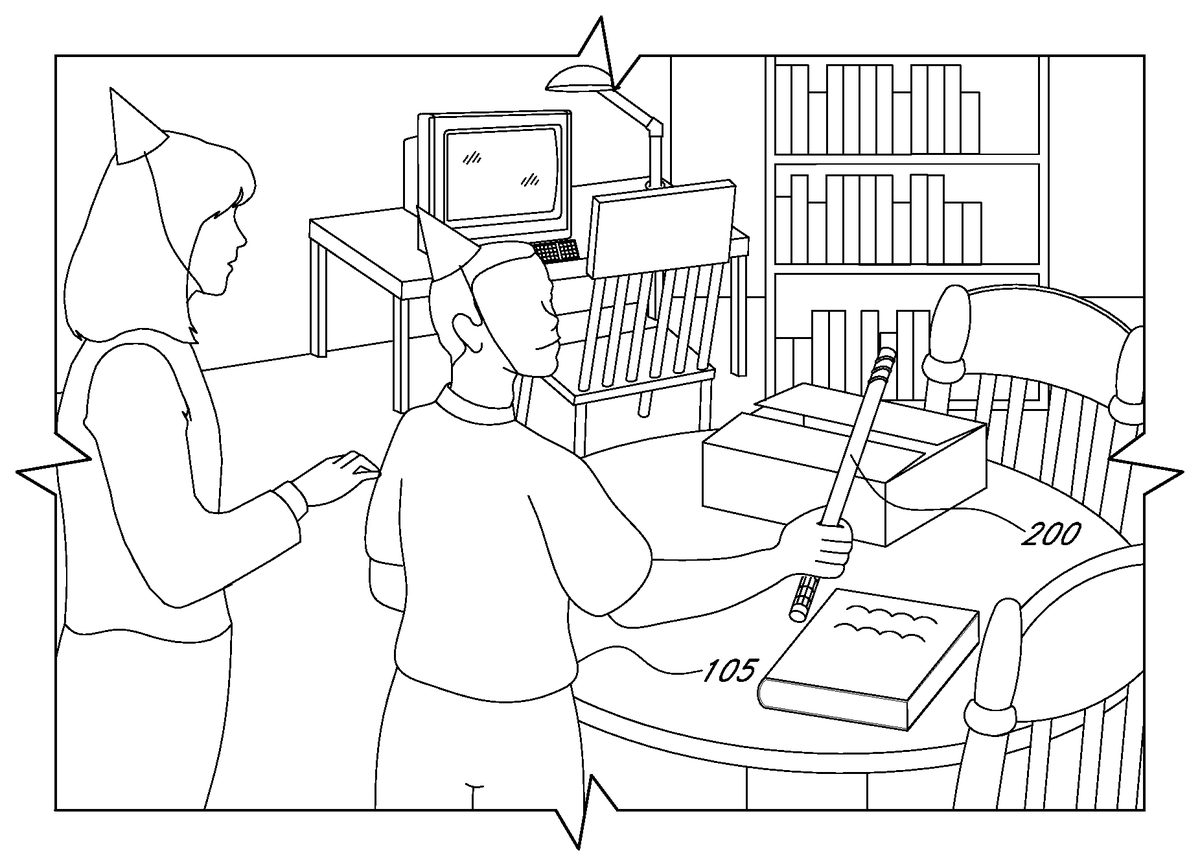
FIG. 1illustrates one embodiment of an interactive treasure hunt game having features and advantages of the present invention. The particular game illustrated takes on the theme of the popular characters and storylines of the children's' book series “Harry Potter” by J. K. Rowling. Within the game, play participants105learn to use a “magic “wand”200and/or other tracking/actuation device. The wand200(described in more detail later) allows play participants to electronically and “magically” interact with their surrounding play environment simply by pointing or using their wands in a particular manner to achieve desired goals or produce desired effects within the play environment.FIG. 1shows a play participant105receiving a wand200and game directions as a gift, for example.
Once the play participant becomes generally familiar with the wand200add the game, he or she can preferably access a web site through the world wide web in order to register the wand and play the first interactive treasure hunt game (see, e.g.,FIG. 2). Preferably this is a relatively simple game intended to provide a basic training session. In this on-line game session, the player learns how to use the wand to cast spells, levitate objects, open and close doors, etc. within an interactive computer-gaming environment provided by an ordinary home computer110. The player also learns how to discover important clues needed to advance in the game and to solve various puzzles or challenges presented by the game.
Once the play participant105has mastered the basic game and successfully completed the various training sessions, he or she is ready to join other players in a world-side multi-media gaming adventure. The adventure may begin with a new movie release. For example,FIG. 3illustrates play participants entering a movie theater to enjoy a newly released HARRY POTTER movie. Preferably, play participants105take their wands200into one or more movie venues125in order to score points, learn clues and advance in the game. For example, a special check-in booth127may be provided within the movie venue for allowing play participants to use their wands200to receive clues, special powers and/or points. While watching the movie (see, e.g.,FIG. 4), the movie storyline itself may reveal additional clues mat will help carefully observant players to advance in the game later. Various clues may also be hidden within otherwise unnoticeable backgrounds, scenery, characters, movie credits, etc. Thus, play participants may need to view a movie multiple times to glean all of the available clues needed to complete the game. Optionally, at certain points in the movie play participants may be able to use their wands200or other similar devices to help direct the story-line progression, change to alternate plots, endings, etc. This may be conveniently achieved using any one or more suitable RFID communications protocols and interactive digital DVD technologies (described in more detail later).
Back at home, play participants105may use their wand200to continue playing the adventure game within one or more available on-line gaming environments (see, e.g.,FIG. 5). Various books130, aids, instructions and other similar materials may be provided to help play participants complete the adventure, while preferably learning valuable knowledge and skills. For example, part of the game play may require play participants to conduct independent research in a particular area or to become proficient in a chosen skill to advance in the game (e.g.,FIG. 7).
The game continues within various participating retail environments. Thus, for example,FIG. 6illustrates a local HARRY POTTER game adventure center created within a local book store, toy store, restaurant, or the like (e.g.,FIG. 8). The game center preferably provides additional clues, assistance and/or opportunities for social interaction, information sharing and/or strategic cooperation among multiple game players. In a particularly preferred embodiment, cooperation among multiple play participants is required to allow cooperating players to advance in the game. The game center also preferably provides a distribution center for related products such as computer games, video games, wands200and the like (e.g.FIG. 9,10). Purchased video games may be played at home (e.g.,FIG. 10) using conventional game controllers and/or a specially configured controller (not shown) adapted to communicate wirelessly with wand200or a similar device.
Advantageously, in this manner the game is able to transcend seamlessly from one entertainment medium to another using the wand200or other similar RFID-capable device as a means to store, transport and communicate character development and game progress between different entertainment mediums and play environments. Thus, game play preferably extends from the home, to television, to internet, to theatre, and/or to one or more local family entertainment centers (“FEC”), games centers, family restaurants, and the like (see, e.g.,FIG. 23). For example,FIGS. 11-15illustrate an entertainment center configured for interactive game play in accordance with the present invention. The particular entertainment center250illustrated takes on the theme of a “magic” training center for would-be wizards in accordance with the popular characters and storylines of the children's' book series “Harry Potter” by J. K. Rowling.
Within this family entertainment center250, play participants105learn to use their magic wands200and/or other tracking/actuation devices. The wand200preferably allows play participants to electronically and “magically” interact with their surrounding play environment simply by pointing or using their wands in a particular manner to achieve desired goals or produce desired effects within the play environment. For example, various wireless receivers or transceivers300may be distributed throughout the play center250to facilitate such interaction via wireless communications. Depending upon the degree of game complexity desired and the amount of information sharing required, the transceivers300may or may not be connected to a master system or central server (not shown). Preferably, most, if not all, of the receivers or transceivers300are stand-alone devices that do not require communications with an external server or network. In one particularly preferred embodiment this may be achieved by storing any information required to be shared on the wand200and/or on an associated radio frequency tracking card or badge worn or carried by the play participant (described later).
If desired, a suitable play media, such as foam or rubber balls or similar objects, may be provided for use throughout the play center to provide convenient objects for clue sources, tools, trading currency and/or tactile interactive play. For example, thousands of soft foam balls may be provided as an interactive play medium (e.g.,FIG. 13). These may be manipulated by play participants using various interactive play elements to create desired effects. Balls may range in size from approximately 1″ to 12″ in diameter or larger, as desired, and are preferable about 2½″ in diameter. Preferably, the objects are not so small as to present a choking hazard for young children. The majority of the objects may be the same size, or a mixture of sizes may be utilized, as desired. Certain play elements within the play center may require the use of certain objects in order to complete a required task. For example, various play objects may identified using one or more embedded or affixed RFID tags which may be electronically read by the various game consoles275within the play center250.
Other suitable play media may include, without limitation, foam, plastic or rubber balls and similarly formed articles such as cubes, plates, discs, tubes, cones, rubber or foam bullets/arrows, the present invention not being limited to any particular preferred play media. These may be used alone or in combination with one another. For instance, flying discs, such as Frisbees™, may be flung from one location within the play center250while other play participants shoot at the discs using foam balls or suction-cup arrows. Wet or semi-wet play mediums, such as slime-like materials, snow, mud, squirt guns and/or water balloons may also used, as desired, to cool and entertain play participants. Durable plastic or rubber play media are preferable in an outdoor play structure where environmental exposure may prematurely destroy or degrade the quality of certain play mediums such as foam balls. The particular play media used is not particularly important for purposes of carrying out the invention and, optionally, may be omitted altogether, if desired.
Various interactive play elements and games275,280are preferably provided within the play center250to allow play participants105to create desired “magical” effects, as illustrated inFIGS. 14 and 15. These may include interactive elements such as video games, coin-operated rides, and the like. These may be actuated manually by play participants or, more desirably, “magically” electronically by appropriately using the wand200in conjunction with one or more transceivers300. Some interactive play elements may have simple immediate effects, while others may have complex and/or delayed effects. Some play elements may produce local effects while others may produce remote effects. Each play participant105, or sometimes a group of play participants working together, preferably must experiment with the various play elements and using their magic wands in order to discover how to create the desired effect(s). Once one play participant figures it out, he or she can use the resulting play effect to surprise and entertain other play participants. Yet other play participants will observe the activity and will attempt to also figure it out in order to turn the tables on the next group. Repeated play on a particular play element can increase the participants' skills in accurately using the wand200to produce desired effects or increasing the size or range of such effects. Optionally, play participants can compete with one another using the various play elements to see which participant or group of participants can create bigger, longer, more accurate or more spectacular effects.
While several particularly preferred play environments have been described, it will be readily apparent to those skilled in the art that a wide variety of other possible play environments and other entertainment mediums may be used to carry out the invention. Alternatively, a suitable play environment may comprise a simple themed play area, or even a multi-purpose area such as a restaurant dining facility, family room, bedroom or the like. Internet (e.g.,FIG. 16), video games, computer games, television, movies and radio can also be used to provide all or part of the overall game experience in accordance with the present invention.
Magic Wand
As indicated above, play participants105learn to use a “magic wand”200and/or other tracking/actuation device. The wand preferably200allows play participants to electronically and “magically” interact with their surrounding play environment simply by pointing or using their wands in a particular manner to achieve desired goals or produce desired effects within the play environment. Use of the wand200may be as simple as touching it to a particular surface or “magical” item within a suitably configured play environment or it maybe as complex as shaking or twisting the wand a predetermined number of times in a particular manner and/or pointing it accurately at a certain target desired to be “magically” transformed or otherwise affected. As play participants play and interact within each play environment they learn more about the “magical” powers possessed by the wand200and become more adept at using the wand to achieve desired goals or desired play effects. Optionally, play participants may collect points or earn additional magic levels or ranks for each play effect or task they successfully achieve. In this manner, play participants105may compete with one another to see who can score more points and/or achieve the highest magic level.
FIG. 17illustrates the basic construction of one preferred embodiment of a “magic” wand200having features and advantages in accordance with one preferred embodiment of the invention. As illustrated inFIG. 17Athe wand200basically comprises an elongated hollow pipe or tube310having a proximal end or handle portion315and a distal end or transmitting portion320. If desired, an internal cavity may be provided to receive one or more batteries to power optional lighting, laser or sound effects and/or to power longer-range transmissions such as via an infrared LED transmitter device or RF transmitter device. An optional button325may also be provided, if desired, to enable particular desired functions, such as sound or lighting effects or longer-range transmissions.
FIG. 17Bis a partially exploded detail view of the proximal end315of the magic wand toy200ofFIG. 17A. As illustrated, the handle portion315is fitted with optional combination wheels having various symbols and/or images thereon. Preferably, certain wand functions may require that these wheels be rotated to produce a predetermined pattern of symbols such as three owls, or an owl, a broom and a moon symbol. Those skilled in the art will readily appreciate that the combination wheels may be configured to actuate electrical contacts and/or other circuitry within the wand200in order to provide the desired functionality. Alternatively, the combination wheels may provide a simple security measure to prevent unauthorized users from actuating the wand. Alternatively, the wheels may provide a simple encoder/decoder mechanism for encoding, decoding, interpreting and/or transforming secret codes or passwords used during game play.
FIG. 17Cis a partial cross-section detail view of the distal end of magic wand toy200ofFIG. 17A. As illustrated, the distal end320is fitted with an RFID (radio frequency identification device) transponder335that is operable to provide relatively short-range RF communications (<60 cm) with one or more of the receivers or transceivers300distributed throughout a play environment (e.g.,FIGS. 11,12). At its most basic level, RFID provides a wireless link to uniquely identify objects or people. It is sometimes called dedicated short range communication (DSRC). RFID systems include electronic devices called transponders or tags, and reader electronics to communicate with the tags. These systems communicate via radio signals that carry data either uni-directionally (read only) or, more preferably, bi-directionally (read/write). One suitable RFID transponder is the 134.2 kHz/123.2 kHz, 23 mm Glass Transponder available from Texas Instruments, Inc. (http://www.tiris.com, Product No. RI-TRP-WRHP). This transponder basically comprises a passive (non-battery-operated) RF transmitter/receiver chip340and an antenna345provided within an hermetically sealed vial350. A protective silicon sheathing355is preferably inserted around the sealed vial350between the vial and the inner wall of the tube310to insulate the transponder from shock and vibration.
FIG. 18is a simplified schematic diagram of one embodiment of an RF transceiver300and optional master control system375for use with the magic wand toy actuator ofFIG. 17A. As illustrated, the transceiver300basically comprises an RF Module380, a Control Module385and an antenna390. When the distal end of wand200comes within a predetermined range of antenna390(˜20-60 cm) the transponder antenna345(FIG. 17C) becomes excited and impresses a voltage upon the RF transmitter/receiver chip340disposed within transponder335at the distal end of the wand200. In response, the RF transmitter/receiver ship340causes transponder antenna345to broadcast certain information stored within the transponder335comprising 80 bits of read/write memory. This information typically includes the user's unique ID number, magic level or rank and/or certain other information pertinent to the user or the user's play experiences.
This information is initially received by RF Module380, which can then transfer the information through standard interfaces to an optional Host Computer375, Control Module385, printer, or programmable logic controller for storage or action. If appropriate, Control Module385provides certain outputs to activate or control one or more associated play effects, such as lighting, sound, various mechanical or pneumatic actuators or the like. Optional Host Computer375processes the information and/or communicates it to other transceivers300, as may be required by the game. If suitably configured, RF Module380may also broadcast or “write” certain information back to the transponder335to change or update one of more of the 80 read/write bits in its memory. This exchange of communications occurs very rapidly (˜70 ms) and so from the user's perspective it appears to be instantaneous. Thus, the wand200may be used in this “short range” or “passive” mode to actuate various “magical” effects throughout the play structure100by simply touching or bringing the tip of the wand200into relatively close proximity with a particular transceiver300. To provide added mystery and fun, certain transceivers300may be provided as hidden clue stations within a play environment so that they must be discovered by discovered by play participants105. The locations of hidden transceivers and/or other clue stations may be changed from time to time to keep the game fresh and exciting.
If desired, the wand200may also be configured for long range communications with one or more of the transceivers300(or other receivers) disposed within a play environment. For example, one or more transceivers300may be located on a roof or ceiling surface, on an inaccessible theming element, or other area out of reach of play participants. Such long-rage wand operation may be readily achieved using an auxiliary battery powered RF transponder, such as available from Axcess, Inc., Dallas, Tex. If line of sight or directional actuation is desired, a battery-operated infrared LED transmitter and receiver of the type employed in television remote control may be used, as those skilled in the art will readily appreciate. Of course, a wide variety of other wireless communications devices, as well as various sound and lighting effects may also be provided, as desired. Any one or more of these may be actuated via button325, as desirable or convenient.
Additional optional circuitry and/or position sensors may be added, if desired, to allow the “magic wand”200to be operated by waving, shaking, stroking and/or tapping it in a particular manner. If provided, these operational aspects would need to be learned by play participants as they train in the various play environments. One goal, for example, may be to become a “grand wizard” or master of the wand. This means that the play participant105has learned and mastered every aspect of operating the wand to produce desired effects within each play environment. Of course, additional effects and operational nuances can (and preferably are) always added over time in order to keep the interactive experience fresh and continually changing. Optionally, the wand200may be configured such that it is able to display 50 or more characters on a LTD or LCD screen. The wand may also be configured to respond to other signals, such as light, sound, or voice commands as will be readily apparent to those skilled in the art. This could be useful, for example for generating, storing and retrieving secret pass words, informational clues and the like.
RFID Tracking Card/Badge
FIGS. 19A and 19Bare front and rear views, respectively, of an optional or alternative RFID tracking badge or card400for use within the interactive game described above. This may be used instead of or in addition to the wand200, described above. The particular badge400illustrated is intended to be affixed or adhered to the front of a shirt or blouse worn by a play participant during their visit to suitably equipped play or entertainment facilities. The badge preferably comprises a paper, cardboard or plastic substrate having a front side404and a back side410. The front405of each card/badge400may be imprinted with graphics, photos, treasure maps or any other information desired. In the particular embodiment illustrated, the front405contains an image of HARRY POTTER in keeping with the overall theme of the game described above. In addition, the front405of the badge400may include any number of other designs or information pertinent to its application. For example, the guest's name430, and group435may be indicated for convenient reference. A unique tag ID Number440may also be displayed for convenient reference and is particularly preferred where the badge400is to be reused by other play participants.
The obverse side410of the badge400contains the badge electronics comprising a radio frequency tag420pre-programmed with a unique person identifier number (“UPIN”). The tag420generally comprises a spiral wound antenna450, a radio frequency transmitter clip460and various electrical leads and terminals470connecting the chip460to the antenna. Advantageously, the UPIN may be used to identify and track individual play participants within the play facility. Optionally, each tag420may also include a unique group identifier number (“UGIN”) which may be used to match a defined group of individuals having a predetermined relationship—either pre-existing or contrived for purposes of game play. If desired, the tag420may be covered with an adhesive paper label (not shown) or, alternatively, may be molded directly into a plastic sheet substrate comprising the card400.
Various readers distributed throughout a park or entertainment facility are able to read the RFID tags420. Thus, the UPIN and UGIN information can be conveniently read and provided to an associated master control system, display system or other tracking, recording or display device for purposes of creating a record of each play participant's experience within the play facility. This information may be used for purposes of calculating individual or team scores, tracking and/or locating lost children, verifying whether or not a child is inside a facility, photo capture & retrieval, and many other useful purposes as will be readily obvious and apparent to those skilled in the art.
Preferably, the tag420is passive (requires no batteries) so that it is inexpensive to purchase and maintain. Such tags and various associated readers and other accessories are commercially available in a wide variety of configurations, sizes and read ranges. RFID tags having a read range of between about 10 cm to about 100 cm are particularly preferred, although shorter or longer read ranges may also be acceptable. The particular tag illustrated is the 13.56 mHz tag sold under the brand name Taggit™ available from Texas Instruments, Inc. (http://www.tiris.com, Product No. RI-103-110A). The tag420has a useful read/write range of about 25 cm and contains 256-bits of on-board memory arranged in 8×32-bit blocks which may be programmed (written) and read by a suitably configured read/write device. Such tag device is useful for storing and retrieving desired user-specific information such as UPIN, UGIN, first and/or last name, age, rank or level, total points accumulated, tasks completed, facilities visited, etc. If a longer read/write range and/or more memory is desired, optional battery-powered tags may be used instead, such as available from ACXESS, Inc. and/or various other vendors known to those skilled in the art.
FIGS. 20 and 21are simplified schematic illustrations of tag and reader operation. The tag420is initially activated by a radio frequency signal broadcast by an antenna510of an adjacent reader or activation device500. The signal impresses a voltage upon the antenna450by inductive coupling which is then used to power the chip460(see, e.g.,FIG. 20A). When activated, the chip460transmits via radio frequency a unique identification number preferably corresponding to the UPIN and/or UGIN described above (see, e.g.,FIG. 20B). The signal may be transmitted either by inductive coupling or, more preferably, by propagation coupling over a distance “d” determined by the range of the tag/reader combination. This signal is then received and processed by the associated reader500as described above. If desired, the RFID card or badge400may also be configured for read/write communications with an associated reader/writer. Thus, the unique tag identifier number (UPIN or UGIN) can be changed or other information may be added.
As indicated above, communication of data between a tag and a reader is by wireless communication. As a result, transmitting such data is always subject to the vagaries and influences of the media or channels through which the data has to pass, including the air interface. Noise, interference and distortion are the primary sources of data corruption that may arise. Thus, those skilled in the art will recognize that a certain degree of care should be taken in the placement and orientation of readers500so as to minimize the probability of such data transmission errors. Preferably, the readers are placed at least 30-60 cm away from any metal objects, power lines or other potential interference sources. Those skilled in the art will also recognize that the write range of the tag/reader combination is typically somewhat less (˜10-15% less) than the read range “d” and, thus, this should also be taken into account in determining optimal placement and positioning of each reader device500.
Typical RFID data communication is asynchronous or unsynchronized in nature and, thus, particular attention should be given in considering the form in which the data is to be communicated. Structuring the bit stream to accommodate these needs, such as via a channel encoding scheme, is preferred in order to provide reliable system performance. Various suitable channel encoding schemes, such as amplitude shift keying (ASK), frequency shift keying (FSK), phase shift keying (PSK) and spread spectrum modulation (SSM), are well know to those skilled in the art and will not be further discussed herein. The choice of carrier wave frequency is also important in determining data transfer rates. Generally speaking the higher the frequency the higher the data transfer or throughput rates that can be achieved. This is intimately linked to bandwidth or range available within the frequency spectrum for the communication process. Preferably, the channel bandwidth is selected to be at least twice the bit rate required for the particular game application.
FIG. 22is a simplified block diagram illustrating the basic organization and function of the electronic circuitry comprising the radio frequency transmitter chip460of the RFID tag device420ofFIG. 19B. The chip460basically comprises a central processor530, Analogue Circuitry535, Digital Circuitry540and on-board memory545. On-board memory545is divided into read-only memory (ROM)550, random access memory (RAM)555and non-volatile programmable memory560, which is available for data storage. The ROM-based memory550is used to accommodate security data and the tag operating system instructions which, in conjunction with the processor530and processing logic deals with the internal “house-keeping” functions such as response delay timing, data flow control and power supply switching. The RAM-based memory555is used to facilitate temporary data storage during transponder interrogation and response. The non-volatile programmable memory560may take various forms, electrically erasable programmable read only memory (EEPROM) being typical. It is used to store the transponder data and is preferably non-volatile to ensure that the data is retained when the device is in its quiescent or power-saving “sleep” state.
Various data buffers or further memory components (not shown), may be provided to temporarily hold incoming data following demodulation and outgoing data for modulation and interface with the transponder antenna450. Analog Circuitry535provides the facility to direct and accommodate the interrogation field energy for powering purposes in passive transponders and triggering of the transponder response. Analog Circuitry also provides the facility to accept the programming or “write” data modulated signal and to perform the necessary demodulation and data transfer processes. Digital Circuitry540provides certain control logic, security logic and internal microprocessor logic required to operate central processor530.
Role Play Character Cards
The RFID card400illustrated and described above is used, in accordance with the afore-mentioned preferred embodiment, to identify and track individual play participants and/or groups of play participants within a play facility. However, in another preferred embodiment, the same card400and/or a similarly configured RFID or a magnetic “swipe” card or the like may be used to store certain powers or abilities of an imaginary role-play character that the card400represents.
For example, card400may represent the HARRY POTTER character. As each play participant uses his or her favorite character card in various HARRY POTTER facilities the HARRY POTTER character represented by the card400gains (or loses) certain attributes, such as magic skill level, magic strength, flight ability, various spell-casting abilities, etc. All of this information is preferably stored on the card400so that the character attributes may be easily and conveniently transported to other similarly-equipped play facilities, computer games, video games, home game consoles, hand-held game units, and the like. In this manner, an imaginary role-play character is created and stored on a card that is able to seamlessly transcend from one play medium to the next.
For example, character attributes developed during a play a participant's visit to a local HARRY POTTER/HOGWART magic facility are stored on the card400. When the play participant then revisits the same or another HARRY POTTER play facility, all of the attributes of his character are “remembered” on the card so that the play participant is able to continue playing with and developing the same role-play character. Similarly, various video games, home game consoles, and/or hand-held game units can be and preferably are configured to communicate with the card400in a similar manner as described above and/or using other well-known information storage and communication techniques. In this manner, a play participant can use the character card400and the role play character he or she has developed with specific associated attributes in a favorite video action game, role-play computer game or the like.
Master Control System
Depending upon the degree of game complexity desired and the amount of information sharing required, the transceivers300may or may not be connected to a master control system or central server375(FIG. 18). If a master system is utilized, preferably each wand200and/or RFID card400,600is configured to electronically send and receive information to and from various receivers or transceivers300distributed throughout a play facility using a send receive radio frequency (“SRRF”) communication protocol. This communications protocol provides the basic foundation for a complex, interactive entertainment system which creates a seemingly magic interactive play experience for play participants who possess and learn to use the magical wand. In its most refined embodiments, a user may electronically send and receive information to and from other wands and/or to and from a master control system located within and/or associated with any of a number of play environments, such as a family entertainment facility, restaurant play structure, television/video/radio programs, computer software program, game console, web site, etc. This newly created network of SRRF-compatible play and entertainment environments provides a complex, interactive play and entertainment system that creates a seamless magical interactive play experience that transcends conventional physical and temporal boundaries.
SRRF may generally be described as an RF-based communications technology and protocol that allows pertinent information and messages to be sent and received to and from two or more SRRF compatible devices or systems. While the specific embodiments described herein are specific to RF-based communication systems, those skilled in the art will readily appreciate that the broader interactive play concepts taught herein may be realized using any number of commercially available 2-way and/or 1-way medium range wireless communication devices and communication protocols such as, without limitation, infrared-, digital-, analog, AM/FM-, laser-, visual-, audio-, and/or ultrasonic-based systems, as desired or expedient.
The SRRF system can preferably send and receive signals (up to 40 feet) between tokens and fixed transceivers. The system is preferably able to associate a token with a particular zone as defined by a token activation area approximately 10-15 feet in diameter. Different transceiver and antenna configurations can be utilized depending on the SRRF requirements for each play station. The SRRF facility tokens and transceivers are networked throughout the facility. These devices can be hidden in or integrated into the facility's infrastructure, such as walls, floors, ceilings and play station equipment. Therefore, the size and packaging of these transceivers is not particularly critical.
In a preferred embodiment, an entire entertainment facility may be configured with SRRF technology to provide a master control system for an interactive entertainment play environment using SRRF-compatible magic wands and/or tracking devices. A typical entertainment facility provided with SRRF technology may allow 300-400 or more users to more-or-less simultaneously send and receive electronic transmissions to and from the master control system using a magic wand or other SRRF-compatible tracking device.
In particular, the SRRF system uses a software program and data-base that can track the locations and activities of up to a hundred more users. This information is then used to adjust the play experience for the user based on “knowing” where the user/player has been, what objectives that player has accomplished and how many points or levels have been reached. The system can then send messages to the user throughout the play experience. For example, the system cal allow or deny access to a user into a new play area based on how many points or levels reached by that user and/or based on what objectives that user has accomplished or helped accomplish. It can also indicate, via sending a message to the user the amount of points or specific play objectives necessary to complete a “mission” or enter the next level of play. The master control system can also send messages to the user from other users.
The system is preferably sophisticated enough that it can allow multiple users to interact with each other adjusting the game instantly. The master system can also preferably interface with digital imaging and/or video capture so that the users' activities can be visually tracked. Any user can locate another user either through the video capturing system or by sending a message to another device. At the end of a visit, users are informed of their activities and the system interfaces with printout capabilities. The SRRF system is preferably capable of sending and receiving signals up to 100 feet. Transmitter devices can also be hidden in walls or other structures in order to provide additional interactivity and excitement for play participants.
Suitable embodiments of the SRRF technology described above may be obtained from a number of suitable sources, such as AXCESS, Inc. and, in particular, the AXCESS active RFID network system for asset and people tacking applications. In another preferred embodiment the system comprises a network of transceivers300installed at specific points throughout a facility. Players are outfitted or provided with a reusable “token”—a standard AXCESS personnel tag clipped to their clothing in the upper chest area. As each player enters a specific interactive play area or “game zone” within the facility, the player's token receives a low frequency activation signal containing a zone identification number (ZID). The token then responds to this signal by transmitting both its unique token identification number (TID) along with the ZID, thus identifying and associating the player with a particular zone.
The token's transmitted signal is received by a transceiver300attached to a data network built into the facility. Using the data network, the transceiver forwards the TID/ZID data to a host computer system. The host system uses the SRRF information to log/track the guest's progress through the facility while interfacing with other interactive systems within the venue. For example, upon receipt of a TID/ZID message received from Zone 1, the host system may trigger a digital camera focused on that area, thus capturing a digital image of the player which can now be associated with both their TID and the ZID at a specific time. In this manner, the SRRF technology allows the master control system to uniquely identity and track people as they interact with various games and activities in a semi-controlled play environment. Optionally, the system may be configured for two-way messaging to enable more complex interactive gaming concepts.
In another embodiment, the SRRF technology can be used in the home. For enabling Magic at the home, a small SRRF module is preferably incorporated into one or more portable toys or objects that may be as small as a beeper. The SRRF module supports two-way communications with a small home transceiver, as well as with other SRRF objects. For example, a Magic wand200can communicate with another Magic wand200.
The toy wand or other object200may also include the ability to produce light, vibration or other sound effects based on signals received through the SRRF module. In a more advanced implementation, the magical object may be configured such that it is able to display preprogrammed messages of up to 50 characters on a LCD screen when triggered by user action (e.g., button) or via signals received through the SRRF module. This device is also preferably capable of displaying short text messages transmitted over the SRRF wireless link from another SRRF-compatible device.
Preferably, the SRRF transceiver300is capable of supporting medium-to-long range (10-40 feet) two-way communications between SRRF objects and a host system, such as a PC running SRRF-compatible software. This transceiver300has an integral antenna and interfaces to the host computer through a dedicated communication port using industry standard RS232 serial communications. It is also desirable that the SRRF transmission method be flexible such that it can be embedded in television or radio signals, videotapes, DVDs, video games and other programs media, stripped out and re-transmitted using low cost components. The exact method for transposing these signals, as well as the explicit interface between the home transceiver and common consumer electronics (i.e., TVs, radios, VCRs, DVD players, A/V receivers, etc.) is not particularly important, so long as the basic functionality as described above is achieved. The various components needed to assemble such an SRRF system suitable for use with the present invention are commercially available and their assembly to achieve the desired functionality described above can be readily determined by persons of ordinary skill in the art. If desired, each SRRF transceiver may also incorporate a global positioning (“GPS”) device to track the exact location of each play participant within one or more play environments.
Most desirably, a SRRF module can be provided in “chip” form to be incorporated with other electronics, or designed as a packaged module suitable for the consumer market. If desired, the antenna can be embedded in the module, or integrated into the toy and attached to the module. Different modules and antennas may be required depending on the function, intelligence and interfaces required for different devices. A consumer grade rechargeable or user replaceable battery may also be used to power both the SRRF module and associated toy electronics.
Interactive Game Play
The present invention may be carried out using a wide variety of suitable game play environments, storylines and characters, as will be readily apparent to those skilled in the art. The following specific game play examples are provided for purposes of illustration and for better understanding of the invention and should not be taken as limiting the invention in any way:
EXAMPLE 1
An overall interactive gaming experience and entertainment system is provided (called the “Magic” experience), which tells a fantastic story that engages children and families in a never-ending adventure based on a mysterious treasure box filled with magical objects. Through a number of entertainment venues such as entertainment facilities, computer games, television, publications, web sites, and the like, children learn about and/or are trained to use these magical objects to become powerful “wizards” within one or more defined “Magic” play environments. The play environments may be physically represented, such as via an actual existing play structure or family entertainment center, and/or it may be visually/aurally represented via computer animation, television radio and/or other entertainment venue or source.
The magical objects use the SRRF communications system allowing for messages and information to be received and sent to and from any other object or system. Optionally, these may be programmed and linked to the master SRRF system. Most preferably, the “magic wand”200is configured to receive messages from any computer software, game console, web site, and entertainment facility, television program that carries the SRRF system. In addition, the magic wand can also preferably send messages to any SRRF compatible system thus allowing for the “wand” to be tracked and used within each play environment where the wand is presented. The toy or wand200also preferably enables the user to interact with either a Master system located within a Magic entertainment facility and/or a home-based system using common consumer electronic devices such as a personal computer, VCR or video game system.
The master control system for a Magic entertainment facility generally comprises: (1) a “token” (gag, toy, wand200or other device) carried by the user105, (2) a plurality of receivers or transceivers300installed throughout the facility, (3) a standard LAN communications system (optional), and (4) a master computer system interfaced to the transceiver network (optional). If a Master computer system is used, preferably the software program running on the Master computer is capable of tracking the total experience for hundreds of users substantially in real time. The information is used to adjust the play for each user based on knowing the age of the user, where the user has played or is playing, points accumulated, levels reached and specific objectives accomplished. Based on real-time information obtained from the network, the system can also send messages to the user as they interact throughout the Magic experience.
The Master system can quickly authorize user access to a new play station area or “zone” based on points or levels reached. It can also preferably indicate, via sending a message to the user, the points needed or play activities necessary to complete a “mission.” The Master system can also send messages to the user from other users. The system is preferably sophisticated enough to allow multiple users to interact with each other while enjoying the game in real-time.
Optionally, the Master system can interface with digital imaging and video capture so that the users' activities can be visually tracked. Users can locate another user either through the video capturing system or by sending a message to another device. At the end of a visit, users are shown photos of their activities related to the Magic experience via display or printout.
For relatively simple interactive games, the Master system may be omitted in order to save costs. In that case, any game-related information required to be shared with other receivers or transceivers may be communicated via an RS-232 hub network, Ethernet, or wireless network, or such information may be stored on the want itself and/or an associated RFID card or badge carried by the play participant (discussed later). For retrofit applications, it is strongly preferred to provide substantially all stand-alone receivers or transceivers that do not communicate to a master system or network. This is to avoid the expense of re-wiring existing infrastructure. For these applications, any information required to be shared by the game system is preferably stored on the wand or other RFID device(s) carried by the play participants. Alternatively, if a more complex game experience is demanded, any number of commercially available wireless networks may be provided without requiring rewiring or existing infrastructure.
EXAMPLE 2
Game participants are immersed in a treasure hunt adventure that combines old fashioned storytelling, live entertainment, hands-on play and interactive gaming together in a seamless experience. The game is carried out in multiple venues and using multiple entertainment mediums so that cross-media promotion and traffic is encouraged and provided by the game (see, e.g.,FIG. 23).
The treasure hunt is brought to life through a live-action story and interactive game using the RFID tag technology. Play participants receive points (optionally redeemable for one or more prizes) for searching and successfully finding clues and other items and for solving various puzzles and the final mystery of the whereabouts of a lost treasure located at Stone Mountain, Ga. Guests are awarded points for finding 18-20 hidden and not-so hidden items such as a framed letter, a painting on the wall, bottle of elixir buried amongst props, etc. These clues and other items are preferably distributed throughout a park facility and in various retail, restaurant and entertainment buildings for which the park desires to generate additional walk-in traffic.
Each item found is worth a certain number of points and/or reveals to the player one or more clue(s) needed to advance in the game. Clues may be the location of other hidden items, tools or clues. Preferably the clues are revealed in an appropriately themed manner, such as a local newspaper account, programmed and staff-led storytelling, signage, performances, and various interactive game consoles. The story is eventually revealed as follows:
Sample Storyline
In 1790 Alexander Mcllivray, son of a Scottish solider and Muskogee Indian Princess, became an important friend of both the Indians and the United States government. He met with several important men at Stone Mountain to put together a peace treaty between the Indians and the government. George Washington invited him to meet with him in New York where they agreed to the Treaty of New York. For his efforts, Alexander was made a “ingather General in the army with a pension. It is believed that he was also given $100,000 gold coins.
This treasure of gold coins was passed down several generations and it is reported to be buried at Stone Mountain. Many in the town believe the story is legend, but two unrelenting men believe that it is true. A famous Historian by the name of Andrew Johnson, and an adventurer by the name of Tom Willingham, are convinced that the treasure exists and have spent the last 10 years searching for the gold. The last living relative to Mcllivray buried the treasure but wanted the search to be difficult and has left important and revealing clues throughout the town of Crossroads. The two men's journey is coming to an exciting conclusion in that they have discovered that the final clue is buried under the fountain/mine/bust of Alexander Mcilivary near the center of town. As they dig in “present” day for their final clue, they tell the story of their hunt for the treasure over the last decade. One and all are invited to retrace their steps in their search for the gold and become a part of the grand adventure when the final clue is revealed to where the treasure is buried.
Game Play
By participating in the game players receive valuable points for each level of accomplishment they make in finding these clues and items which could either give them high point rankings and/or earn them a prize or chance at a large prize in the future (e.g. part of a real treasure). Advantageously, clues and other necessary items are preferably hidden within various retail stores and designated entertainment areas giving kids and adults fun and alluring reasons to go inside buildings and seek out new experiences they might have otherwise overlooked.
Once a player completes the game, her or she will have collected enough points, clues and other information that will give them the knowledge they need to discover and/or solve the final clue of where the treasure is buried. The “reward” for successfully completing the game could be, for example, a small prize, recognition certificate, a sweepstakes entry to win a large prize.
EXAMPLE 3
Game participants are immersed in a worldwide treasure hunt adventure to locate a large, unknown amount or money stashed away in one or more Swiss bank accounts (the money and the accounts can be real or “made-up”).
Sample Storyline
Willy Wonkers, a reclusive/eccentric billionaire, was unsure which of his many would-be heirs was worthy to receive his vast fortunes. So he provided in his will that upon his demise his entire estate was to be liquidated and all of the proceeds placed in a number of anonymous Swiss bank accounts (under secret passwords known only to Willy) to be distributed “to only such heir(s) who prove themselves worthy of inheriting my vast fortunes by successfully completing the Wonkers Worldwide Worthiness Challenge”—a series of intellectual, physical and moral challenges devised by Willy.
To create the ultimate “worthiness” challenge, Willy employed a team of a thousand of the world's top scientists, psychologists, teachers, musicians, engineers, doctors, etc. The goal was to develop a number of probative tests/challenges that would ultimately reveal the worthy recipient(s) of Willy's vast fortunes. Per Willy's instructions the challenges were very carefully and meticulously designed to ensure that only persons of the highest character and pureness of heart/mind could ever succeed in completing all of the necessary challenges and thereby obtain Willy's fortunes. Willy was especially vigilant to thwart the possible feigning efforts of unscrupulous persons who might attempt to gain access to his fortunes by cheating, trickery or other deceptive devices. Above all, he was determined to prevent any part of his vast estate and fortune from ever falling into the hands of persons who were lazy, ignorant or wicked of heart.
While Willy was a prodigiously brilliant and gifted man, he was also surprisingly naive. Willy soon met his demise at the bottom of a boiling vat of chocolate via the hands of his greedy nephew and would-be heir, Ignomeous (“Iggy”) Ignoramus. When Iggy learned of his uncle's plan, he abducted Willy late one night outside his office and forced him at gunpoint to reveal the secret passwords which only Willy knew (it was easy for Willy to remember because the passwords were his favorite candies). While nervously holding the gun to Willy's head, lggy frantically inscribed the secret account numbers and passwords on the back of a chocolate bar (there being no paper hand at the time). He then bound and gagged Willy and threw him into the boiling vat of chocolate whereupon Willy was found dead the next morning.
Iggy's plan (such as it was) was to lay low and wait for Willy's estate to be liquidated and transferred into the various secret Swiss accounts in accordance with Willy's final wishes. But, before any genuinely worthy recipient would have a chance to successfully complete all of the challenges and rightfully claim the Wonkers fortunes, Iggy would secretly divert all of the funds in each of the secret Swiss accounts to his own secret accounts whereupon he would enjoy the good-life forever thereafter.
Unfortunately, Iggy failed to consider the extreme heat radiated by the boiling vat of chocolate. By the time Iggy had gagged, bound, dragged and threw Willy into the boiling vat of chocolate and watched him as he slowly sank deeper and deeper into the molten chocolate to his demise, Iggy realized he was sweating like a pig. It was at that time that he also noticed the chocolate bar—upon which he had inscribed the secret Swiss account numbers and passwords—had all but melted away in his shirt pocket. Frantically, Iggy tried to preserve the rapidly melting chocolate bar, but it was too late. He was only able to salvage a few incomplete numbers and passwords before the candy bar was no more.
Iggy tried mentally to recreate the missing information, but he was not good at remembering much of anything, let alone numbers and obscure passwords. Thus, he could only recreate a few bits and pieces of the critical information. On the brighter side, Iggy did manage to salvage some of the information and he figured, given enough time, he would probably be able to break the secret passwords and ultimately get the loot before anyone else does. His cousin, Malcolm Malcontent, and several other greedy would-be heirs agreed to help him in exchange for a cut of the loot.
Game participants are invited to a reading of the will where they are identified as a potential heir to the Wonkers family fortune. Each participant is challenged to complete the Wonkers Worldwide Worthiness test and to thereby obtain the secret Swiss account number(s)/passwords and the Wonkers fortunes before Iggy does. The first participant who successfully completes the challenge gets all the loot. However, the failure to complete any single challenge results in immediate and permanent disinheritance.
The challenges are arranged so that only those who are smart, diligent and who are pure of heart and mind (etc., etc. . . . ) will be able to successfully complete the worthiness challenge. Thus, participants must faithfully carry out and complete each challenge in the exact manner specified. Any changes or deviations will result in failure. The game is also set up to provide many temptations along the way to cut corners, cheat or trick ones way through the various challenges. Players must not succumb to these temptations, lest they be immediately and permanently disinherited. Players must also be careful not to reveal any helpful information to Iggy or his posse of greedy co-conspirators, lest they get to the loot first.
Game Play
Each game participant receives a card, token, key chain, or other gaming implement (“game token”). This token contains a unique identification number (preferably an RFID tag, mag-strip card, bar-coded card, or the like) which is used to uniquely identify each player throughout the game play. Optionally, a user-selected password is associated with each token so that it can only be used or activated by its proper owner. The token allows players to interact with one or more game enabled readers/stations and/or other compatible devices distributed throughout a selected geographic region (e.g., book stores, theme parks, family entertainment centers, movie theaters, fast-food venues, internet, arcades, etc.).
Preferably, each token represents a specific character in the treasure hunt game. Thus, play participants would preferably select which character he or she would like to play. For example, possible characters may include Eddy the Electrician, Abe the Accountant, Martha the Musician, Doctor Dave, Nurse Betty, Policeman Paul, etc. Each character would come with a unique story about who they are, how they were related to Willy and, most importantly, a touching little vignette about Willy that no one else knows. Hidden within each story is one or more unique clues that are necessary to solve the various challenges the players will soon face. The game is preferably arranged and set up so that clues can only be successfully used by the particular character(s) who legitimately possesses them. If any other character illegitimately obtains these secret clues and tries to use them in the game, he or she will fail the challenge.
Preferably all of the clues (and possibly other, extrinsic clues) are required to complete the quest. Thus, players will preferably need to cooperate with other players in order to receive and exchange clues and/or other specified assistance “legitimately” to enable each player to advance in the game. For example, assume that Policeman Paul knows that Willy detests white chocolate. Nurse Betty knows that Willy can't stand licorice. In the course of game play, Betty and Paul independently determine that one of the secret passwords must be either: (1) Jelly Bean; (2) White Chocolate; or (3) Licorice. Neither Betty or Paul, alone, knows the correct answer (they can try to “trick” the game by guessing, but then they will lose the quest). But, together they can solve the challenge. Betty can share her information with Paul and Paul can share his information with Betty.
Preferably, any sharing of information must be conducted within the rules of the game to be “legitimate” and recognized by the game. Thus, preferably, players cannot advance in the game simply by getting the relevant clue info from the internet or by asking other players. To be legitimate and, therefore, recognized by the game, both players of the Betty and Paul characters must present their tokens together to an enabled token reader (e.g., at a local game center or theme park) and request that the information be shared between the characters. Once the information is legitimately exchanged within the context of the game, it then can be used by each player/character to solve further challenges and to thereby advance in the game. However, if a player guesses the answer (even correctly) or if the clue information is obtained illegitimately, then the player preferably loses the quest and must purchase a new token.
More complex sharing scenarios could also be developed. For example, certain unique clue information could be revealed only during the course of game play and only to certain characters. Other characters would need this clue information to advance in the game and would have to figure out which other character(s) have the information they need. They would then need to find and contact another player (a friend, acquaintance, classmate, etc.) who has the appropriate character token and who has successfully found the clue information they need. Then they would need to meet in order to make the necessary exchange transaction.
For instance, assume in the above example that Paul had information to help Betty, but Betty did not have the information needed to help Paul. Betty had information to help Martha and Martha had the information to help Paul. Now, the players must somehow negotiate a mutual three-way exchange that works for everyone's interest. The resulting transactions could be simple bartering (information in exchange for information/help) and/or there could be some kind of currency involved, such as bonus points or the like, whereby players could negotiate and accumulate points each time they help other players. One goal of the game is to encourage playful interaction among the players by requiring them to work with (and possibly negotiate against) other players to see who can get the information and points they need to advance in the game.
Alternatively, players may need to acquire or learn some special skill or knowledge that is necessary to interpret a clue. For example, one player may get a clue m a strange foreign language and another player happens to be (or chooses to become within the context of the game) an international language expert who can interpret the foreign-language clue. Both players need to somehow find and cooperate with one another in order to advance in the game. Players can (and preferably must) also obtain certain information or clues from other extrinsic sources in order to further advance in the game. These can be simple extrinsic sources like a dictionary, encyclopedia, a local library or museum, or a secret code word printed on a participating retail store purchase receipt.
Preferably, the game is self-policing. That is, it “knows” when an exchange of information and/or other help is legitimately given (i.e. conducted within the rules of the game) and can react accordingly. For example, the game may require both players (or multiple players, if more than two are involved) to simultaneously present their tokens to an enabled reader/device. The reader would then be able to verify the identities of each character/player, extract relevant info, token ID, user password, etc., and write the relevant new info to each player's token. Once the transaction is completed, each player would then legitimately possess and be able to use the information stored on his or her token to advance further in the game using any other gaming device that can read the token.
Alternatively, the same sequence can be followed as described above, except that the token is used only to verify character and player identities (e.g. an RFID read only tag). All other relevant information is stored on in a local and/or central database. The data-base keeps track of each individual player's progress, what information/clues they have learned, who they have interacted with, points accumulated, etc. Thus, game play can proceed on any device that can communicate via the internet, such as a home computer, game console, internet appliance, etc.
Alternatively, an authenticating password may be used in conjunction with each RFID identifying token. When two or more players present their tokens to an enabled reader device as in the examples described above, each player is given an authenticating password, which the player(s) then can enter into any other gaming platform. The password may be an alpha-numeric code that is mathematically derived from the unique ID numbers of each participating player involved in the sharing transaction. Thus, it is unique to the specific players involved in the authorized exchange transaction and cannot be used by other players (even if they copy or seal the password). When the alpha-numeric number is subsequently re-entered into another device (e.g., a home game console or home computer) by the authorized player, the game software can reverse the mathematical algorithm using the players unique ID (previously entered at the beginning of the game) and thereby determine and/or validate the event(s) that generated the authenticating password. Existing public-key/private-key encryption algorithms and/or the like could be used for encoding and decoding the authenticating passwords. Optionally, each authenticating password could have a “shelf life” of any desired length of time such that it must be used within an hour, a day, a week, a month, etc. This might help move the game along by keeping players on their toes. Authenticating passwords could be easily printed and dispensed on special tickets or stickers, which can be collected. Alternatively, and/or in addition, authenticating passwords can be readily printed on any ordinary cash register receipt as part of any purchase transaction (e.g. at a fast food or other retail establishment).
The treasure hunt game may be continual in its progression or it may be orchestrated in “real time” via the internet or any other mass distribution/communication medium, such as TV commercials, mini-gameboy installments, computer-animated MPEG videos. For example, each game might last several days/weeks/months, and may be launched in conjunction with a promotional/advertising campaign for a complementing movie or the like. In that event, players would preferably sign up in advance to receive their tokens to play the game or they can purchase one or more tokens at any participating gaming outlet before or during the game.
Of course, those skilled in the art will readily appreciate that the underlying concept of an RFID trading card900and card game is not limited to cards depicting fantasy characters or objects, but may be implemented in a wide variety of alternative embodiments, including sporting cards, baseball, football and hockey cards, movie character cards, dinosaur cards, educational cards and the like. If desired, any number of other suitable collectible/tradable tokens or trinkets may also be provided with a similar RFID tag device in accordance with the teachings of the present invention as dictated by consumer tastes and market demand.
Although this invention has been disclosed in the context of certain preferred embodiments and examples, it will be understood by those skilled in the art that the present invention extends beyond the specifically disclosed embodiments to other alternative embodiments and/or uses of the invention and obvious modifications and equivalents thereof. Thus, it is intended that the scope of the present invention herein disclosed should not be limited by the particular disclosed embodiments described above, but should be determined only by a fair reading of the claims that follow.
EXAMPLE 4
Game participants are immersed in a “whodunit” murder mystery. For example, this interactive adventure game could be based on the popular board game. “C1ue™.” Players learn that a murder has been committed and they must figure out who did it, in what room, with what weapon, etc. The game is preferably live-action interactive with simulated live-news casts, letters, telephone calls, etc.
Sample Storyline
Major Mayonnaise is found dead in his palatial mansion of an apparent massive coronary. However, clues at the crime scene indicate that this was in fact a carefully planned murder. Based on the indisputable physical evidence, the murder could only have been committed by one of eight possible suspects.
It is common knowledge that each player hated Mayonnaise and, thus, each player has been identified as a suspect in the murder. Thus, the mission is to figure out WHO DUNIT! and how.
Game Play
Game play is essentially as described above in connection with Example 3. Players receive game tokens, cards, bands or the like uniquely identifying each player. Preferably, each token represents one of the eight suspect characters in the Whodunit game. As in Example 3, above, each character would preferably have a unique story about who they are, where they were on the night of the murder, and why they dislike Mayonnaise. Hidden within the collective stories are the unique clues necessary to solve the murder mystery challenge. Players cooperate by exchanging clues and other information needed to solve the mystery. As in Example 3, the game is preferably set up and organized so that relevant clues can only be successfully used by the particular character(s) who legitimately possess them. Any player who tries to cheat will preferably be disqualified or otherwise prevented from advancing in the game.
EXAMPLE 5
Game participants are immersed in a magical computer adventure game. For example, this Interactive adventure game could be based on the popular “Harry Potter™” series of children's books by J. K. Rowling and licensed computer games by Electronic Arts. Players learn basic magic skills as they progress through an adventure game and solve one or more challenges/puzzles.
Sample Storyline
Players are students enrolled at the Hogwart school of witchery where they are learning witchcraft, spell casting, secret messaging and the like. But something terrible and evil has happened and it is up to each player and their fellow classmates to solve the mystery and ferret out the evil-doer and save the school.
Game Play
Game play is essentially as described above in connection with Examples 3 and 4. Players preferably receive game tokens, cards, bands and/or the like uniquely identifying each player. Each token provides a unique identifier for the player and preferably can store his or her progress in the game. Each player begins the adventure with essentially the same magic powers, skills and abilities. Each player may also receive a magic wand or other similar device which the players mush learn to use to accomplish certain goals set out in the game.
Players cooperate by exchanging clues and other information needed to solve the mystery. As in Examples 3 and 4, the game is preferably organized so that relevant clues can only be successfully used by the particular character(s) who legitimately possess them. Any player who tries to cheat will preferably be disqualified or otherwise prevented from advancing in the game.
An authenticating password system is preferably used to verify or authenticate game events and to thereby discourage cheating. These secret codes or pass words may be obtained from any participating game venue (e.g., fast food venues, toy store, theme parks, etc.) or other sources that will become obvious once the game is implemented. Once a secret password is obtained, players can enter it into a specially enabled home computer game, arcade game, portable gaming device, or other device, to get secret powers and/or to find secret parts of the game otherwise unobtainable without the secret code. For example, a player may buy a meal from a fast-food vendor and as part of the meal package would receive a token and/or a secret code. The secret code preferably may be used to access a secret portion or level of a popular computer adventure game.
Most preferably (although not required) authenticating passwords are unique or semi-unique to the player(s) who possess them. For example, each password may be an alpha-numeric code that is mathematically derived from a unique ID number stored on each participating players token or from a password the player selects. Thus, the secret code is more-or-less unique to the specific player(s) involved in an authenticated game event and preferably cannot be used by other players (even if they copy or steal the secret code). When the alpha-numeric number is subsequently re-entered into another device (e.g., a home game console or home computer) by the authorized player, the game software can reverse the mathematical algorithm using the players unique ID or user-selected password (this may or may not be previously entered at the beginning of the game) and thereby determine and/or validate the game event(s) that generated the authenticating password. Existing public-key/private-key encryption algorithms and/or the like could be used for encoding and decoding the authenticating passwords.
Optionally, each authenticating password could have a “shelf life” of any desired length of time such that it must be used within an hour, a day, a week, a month, etc. This might help move the game along by keeping players on their toes. Authenticating passwords could be easily printed and dispensed on special tickets or stickers, which can be collected. Alternatively, and/or in addition, authenticating passwords can be readily printed on any ordinary cash register receipt as part of any purchase transaction (e.g. at a fast food or other retail establishment).
To make the password system more convenient, the token device may optionally include one or more entry buttons and an LCD display. When players insert the token into an enabled reader, the secret code(s) are downloaded automatically to the token device and can be displayed on the LCD screen. The token thus becomes a secret encoder/decoder device that allows players to electronically transport and send/receive secret messages and codes to each other that can only be read by players/devices that possess the correct authenticating code. An optional communication port may allow secret codes to be downloaded directly to a computer game, portable game unit or other devices using, for example, a standard USB communication port.
Claims
- A live-action interactive game system for entertaining or amusing multiple play participants in a live play environment, said interactive game system comprising: multiple game items each representing a character in an interactive game and comprising a machine-readable radio frequency identification (RFID) tag comprising a short-range radio-frequency (RF) transceiver, non-volatile programmable memory and a unique identification number uniquely identifying each said corresponding game item in said interactive game;a plurality of reader devices adapted to communicate with said multiple game items over a limited communication range less than 60 cm, each said reader device configured to wirelessly power and read said machine-readable RFID tag from each of said corresponding game items provided within said limited communication range to thereby obtain each said unique identification number;a game device configured to generate a virtual play environment via one or more virtual play effects comprising a plurality of computer-animated visual, aural or tactile effects, and further configured to generate an authenticating passcode based on successful completion of a game event by one or more play participants and wherein said authenticating passcode is unique to each said play participant and said completed game event;and at least one writer device adapted to communicate with said multiple game items over said limited communication range, said at least one writer device configured to cause said authenticating passcode to be stored in said non-volatile programmable memory of each of said corresponding game items provided within said limited communication range upon the successful completion of the corresponding game event;wherein said interactive game system enables multiple play participants to play and progress in said interactive game and wherein said participation and progress of each play participant in said interactive game can be individually tracked by said game device according to said corresponding unique identification number and said stored authenticating passcode.
- The interactive game system of claim 1 , wherein said interactive game comprises solving a mystery or puzzle and wherein said mystery or puzzle can only be solved using information stored on at least two of said multiple game items.
- The interactive game system of claim 1 , wherein said interactive game comprises a mystery or puzzle and wherein said game event comprises sharing game-relevant information with another play participant.
- The interactive game system of claim 1 , wherein at least one of said multiple game items comprises a paper, cardboard or plastic badge having imprinted thereon one or more graphics or photos relevant to said interactive game.
- The interactive game system of claim 1 , wherein said non-volatile programmable memory is further configured to store tracking information indicating the progress of a play participants in said interactive game.
- The interactive game system of claim 5 , wherein said game device is further configured to execute an encryption algorithm using at least said tracking information to generate said pass-code and wherein said passcode is configured to communicates or authenticates said tracked information to a second game system.
- The interactive game system of claim 1 , wherein at least one of said plurality of reader devices is configured to automatically communicate with each said RFID tag when said at least one reader device and said RFID tag are within said limited communication range of one another and wherein said communication includes communication of said unique identification number.
- The interactive game system of claim 7 , wherein said at least one reader device has a communication range of at least about 10 cm.
- The interactive game system of claim 1 , wherein each said RFID tag comprises a passive, battery-less 13.56 MHz RFID tag comprising a substantially flat wound antenna.
- The interactive game system of claim 9 , wherein said antenna is configured to be wirelessly powered by an externally-generated radio frequency signal for wirelessly powering said RF transceiver and sending and receiving said unique identification number.
- The interactive game system of claim 1 , wherein at least one of said multiple game items is configured to enable a play participant to interact with said game device by pointing, moving or using said at least one game item in a particular manner to achieve a desired goal or produce a desired effect.
- The interactive game system of claim 1 , wherein at least one of said multiple game items comprises a toy wand configured with one or more sensors and associated electronic circuitry and wherein said game device is further configured to enable said play participant to interact with said game device by moving said toy wand in one or more motions.
- The interactive game system of claim 1 , wherein said game device is further configured to selectively reveal or provide to each play participant a game-relevant clue, information or item based at least in part on each corresponding unique identification number of a presented game item.
- The interactive game system of claim 13 , wherein said game device is further configured to selectively reveal or provide to each play participant a game-relevant clue, information or item based at least in part on determining game progress or achievements associated with said corresponding unique identification number.
- An interactive game for entertaining or amusing a plurality of play participants, said interactive game comprising: a plurality of game items configured to be provided to a corresponding plurality of play participants, each said game item comprising a non-volatile programmable memory and machine-readable code that uniquely identifies each said corresponding play participant within an interactive game, and wherein at least one of said game items comprises a selected portion of game-relevant information required to complete said interactive game and wherein said plurality of game items collectively comprise selected portions of game-relevant information sufficient to complete said interactive game;at least one electronic reader device configured to read the machine-readable code from each said game item when said game item is provided within readable proximity to said reader device to thereby uniquely identify a corresponding play participant associated with said game item;and at least one game devices configured to selectively reveal or provide to each said play participant who provides a corresponding game item within readable proximity to said reader device a selected portion of game-relevant information and wherein said selected portion of game-relevant information is revealed or provided based at least in part on each of said play participant's successful completion of one or more selected game challenges, and wherein said at least one game device is further configured to generate an authenticating passcode based on the successful completion of said one or more game challenges and wherein said authenticating passcode is unique to each said play participant and each said one or more completed game challenges;at least one writer device adapted to communicate with said plurality of game items over said readable proximity, said at least one writer device configured to cause said authenticating passcode to be stored in said non-volatile programmable memory of each of said corresponding game items provided within said readable proximity upon the successful completion of the corresponding game challenges;wherein said interactive game enables said plurality of play participants to play and progress in said interactive game and wherein the progress of each said play participant in said interactive game can be individually tracked and authenticated in accordance with said authenticating passcode.
- The interactive game of claim 15 , wherein said at least one reader device comprises a wireless communication device configured to communicate information through radio frequency (RF).
- The interactive game of claim 15 , wherein said at least one game device is further configured to enable a play participant to complete a game challenge by moving said corresponding game item in a particular manner to achieve a desired goal or produce a desired effect.
- The interactive game of claim 15 , wherein said at least one game device is further configured to selectively reveal or provide said game-relevant information by displaying a video or computer animation.
- The interactive game of claim 18 , wherein said at least one game device is further configured to selectively reveal or provide to each said play participant said game-relevant information based at least in part on each corresponding machine-readable code.
- The interactive game of claim 19 , wherein said at least one game device is further configured to selectively reveal or provide to each said play participant said game-relevant information based at least in part on determining the game progress or achievements of said corresponding play participant.
- The interactive game of claim 15 , wherein at least one of said game challenges comprises finding a hidden item, finding another play participant, sharing game-relevant information with another play participant, solving a puzzle, decoding a coded message, obtaining information from an extrinsic information source, or obtaining a secret code or password.
- The interactive game of claim 15 , wherein at least one of said plurality of game items comprises a radio frequency identification (RFID) tag.
- The interactive game of claim 22 , wherein said programmable non-volatile memory is configured and adapted to store said selected portion of game-relevant information.
- The interactive game of claim 23 , wherein said programmable non-volatile memory is further configured to store said tracking information indicating the progress of a corresponding play participant in said interactive game.
- The interactive game of claim 24 wherein said at least one game device is further configured to execute an encryption algorithm using at least said tracking information to generate said pass-code and wherein said passcode is configured to communicate or authenticates said stored tracking information to a second game device.
- The interactive game of claim 22 , wherein said at least one reader device is further configured to wirelessly power said RFID tag.
- The interactive game of claim 26 , wherein said RFID tag comprises a passive, battery-less 13.56 MHz RFID tag comprising a substantially flat wound antenna.
- A method for playing an interactive game carried out within a virtual play environment using one or more physical gaming items and two or more different gaming platforms, said method comprising: configuring a first gaming platform to generate a virtual play environment comprising one or more computer-animated effects in accordance with a game;providing a plurality of physical gaming items each representing a specific character in said game, each said gaming item comprising a passive radio frequency identification (RFID) tag comprising a short-range radio-frequency (RF) transceiver, non-volatile programmable memory and a unique identification number uniquely identifying each said corresponding gaming item;electrically coupling an RFID reader device to said first gaming platform and configuring said RFID reader device to wirelessly power and provide two-way wireless communication with each said RFID tag over a limited communication range less than 60 cm;selecting at least one of said plurality of physical gaming items to be played in said game and bringing said selected gaming item within said limited communication range of said RFID reader device;causing said RFID reader device to ascertain at least said corresponding unique identification number of said selected gaming item;using said selected gaming item to progress in said game by completing one or more game challenges or puzzles presented by said first gaming platform;causing an encryption algorithm to generate an encrypted code that communicates or authenticates said game progress, wherein said encrypted code is unique to each said gaming item and each said one or more completed game challenges or puzzles;and storing said encrypted code in said non-volatile programmable memory of said selected gaming item;and using said encrypted code to communicate or authenticate said game progress to a second gaming platform that is different from said first gaming platform.
- The method of claim 28 wherein said first or second gaming platform comprises one or more of a video game console, home game console, personal computer, handheld game unit, or internet gaming site.
- The method of claim 29 wherein said first gaming platform comprises one or more of a video game console, home game console or handheld game unit and wherein said second gaming platform comprises an internet gaming site.
- The method of claim 30 further comprising printing or displaying said encrypted code and allowing a game participant to use said printed or displayed encrypted code to access and play a game on said internet gaming site.
- The method of claim 28 wherein at least one of said plurality of physical gaming items comprises a physical game token or toy depicting or representing a person or fantasy character relevant to said game.
- The method of claim 32 wherein at least one of said plurality of physical gaming items comprises a collectible or tradable card depicting or representing a person or fantasy character relevant to said game.
- The method of claim 28 further comprising causing said RFID reader device to automatically ascertain selected information stored in said non-volatile programmable member of said corresponding RFID tag when said selected gaming item is provided within said limited communication range of said RFID reader device, and to communicate said selected information to said first gaming platform.
- The method of claim 28 wherein said encryption algorithm uses an encryption key to generate said encrypted code and wherein said encryption key is unique to each said selected gaming item.
- The method of claim 35 wherein said encryption key corresponds to or is based at least in part on said corresponding unique identification number of each said selected gaming item.
- The method of claim 35 further comprising causing said second gaming platform to decrypt said encrypted code using said encryption key.
- The method of claim 28 further comprising providing one or more tickets or stickers comprising a printed passcode configured to enable a game participant to access additional game features otherwise unobtainable without using said passcode.
- The method of claim 38 further comprising collecting said one or more tickets or stickers.
Disclaimer: Data collected from the USPTO and may be malformed, incomplete, and/or otherwise inaccurate.