U.S. Pat. No. 8,602,859
VIDEO GAME DEVICE, VIDEO GAME IMPLEMENTATION METHOD AND PROGRAM
AssigneeKabushiki Kaisha Square Enix
Issue DateSeptember 13, 2007
Illustrative Figure
Abstract
To reflect a player's degree of skill in a battle between a player character and an enemy character, and increase a strategic element. In the event that a player selects magic as an action of a player character in a battle between a player character and an enemy character, a puzzle battle is started. In the puzzle battle, a magic army (a block frame) is displayed on a display device in accordance with a kind of magic selected, the player moves or rotates a block falling from above the display device by operating an input device, stops it in a desired position, and fills the magic army. In the event that all squares of the magic army are filled with the blocks before a time elapsing from a start of the puzzle battle, displayed on an elapsed time gauge, reaches a prescribed time, the magic selected by the player is unleashed, and inflicts damage on the enemy character. An effectiveness of the magic depends on an overlapping, and a protrusion from the magic army, of the blocks.
Description
DESCRIPTION OF THE PREFERRED EMBODIMENT(S) Hereafter, a description will be given of an embodiment of the invention, with reference to the appended drawings. FIG. 1is a block diagram showing a configuration of a portable telephone which forms a platform for executing a game according to the embodiment. As shown in the figure, the portable telephone includes a CPU (Central Processing Unit)11, an ROM (Read Only Memory)12, an RAM (Random Access Memory)13, an input device14, a display device15and a communication device16. In addition to these, the portable telephone also includes components necessary for carrying out a telephone call, but as they have no direct connection with the invention, they are omitted fromFIG. 1. The CPU11, executing a program stored in the ROM12, carries out processes necessary for an implementation of the game. The CPU11, including an internal timer, generates a timer interruption every time the internal timer times a prescribed time (for example, one millisecond). The ROM12stores a process program of the CPU11, which includes a game application program. At least one portion of the ROM12is configured of a flash memory which can electrically write and delete. The game application program (including fixed data used for the relevant application) is downloaded from a server device which exists on a network3, and stored in the flash memory. The RAM13, being backed up by a battery, as well as storing data such as various tables, to be described hereafter, is used as a work area of the CPU11. The input device14, including numeral keys “0” to “1”, a “*” key, a “#” key and direction keys, inputs necessary information into the CPU11by means of a player operation. When implementing the game, a player character is moved, and a command of an action or the like of the player character is selected, by means ...
DESCRIPTION OF THE PREFERRED EMBODIMENT(S)
Hereafter, a description will be given of an embodiment of the invention, with reference to the appended drawings.
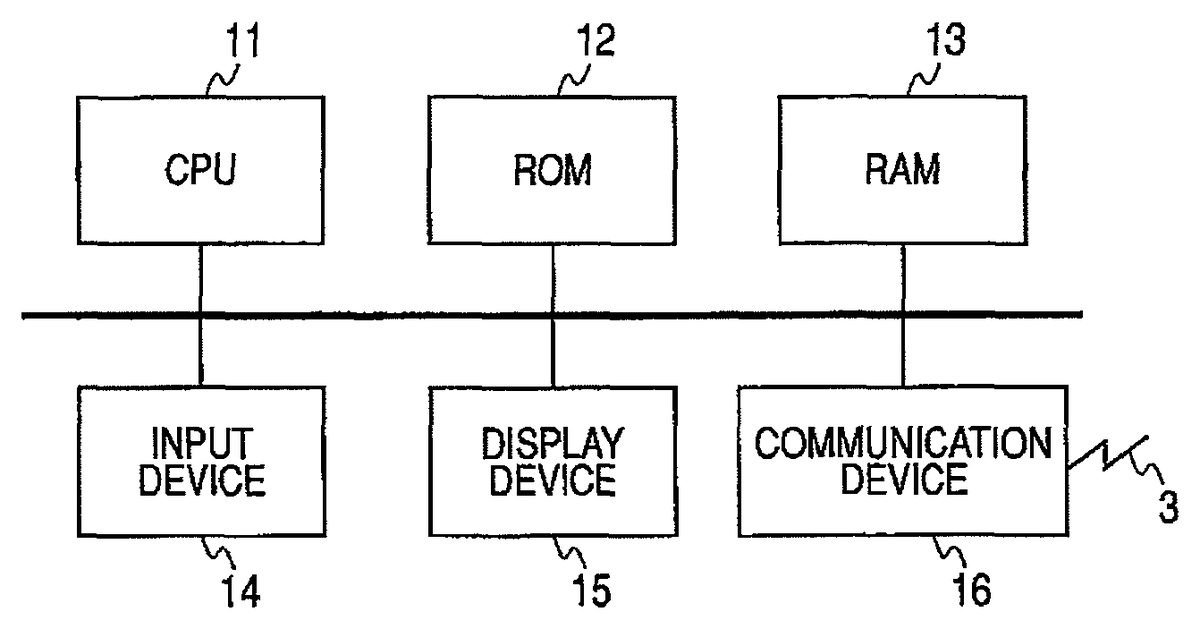
FIG. 1is a block diagram showing a configuration of a portable telephone which forms a platform for executing a game according to the embodiment. As shown in the figure, the portable telephone includes a CPU (Central Processing Unit)11, an ROM (Read Only Memory)12, an RAM (Random Access Memory)13, an input device14, a display device15and a communication device16. In addition to these, the portable telephone also includes components necessary for carrying out a telephone call, but as they have no direct connection with the invention, they are omitted fromFIG. 1.
The CPU11, executing a program stored in the ROM12, carries out processes necessary for an implementation of the game. The CPU11, including an internal timer, generates a timer interruption every time the internal timer times a prescribed time (for example, one millisecond). The ROM12stores a process program of the CPU11, which includes a game application program. At least one portion of the ROM12is configured of a flash memory which can electrically write and delete. The game application program (including fixed data used for the relevant application) is downloaded from a server device which exists on a network3, and stored in the flash memory. The RAM13, being backed up by a battery, as well as storing data such as various tables, to be described hereafter, is used as a work area of the CPU11.
The input device14, including numeral keys “0” to “1”, a “*” key, a “#” key and direction keys, inputs necessary information into the CPU11by means of a player operation. When implementing the game, a player character is moved, and a command of an action or the like of the player character is selected, by means of the direction keys. The direction keys are also used to move a position of, and alter a direction of, a block in a puzzle battle, to be described hereafter. The display device15, being configured of a liquid crystal display device or the like, displays a screen of the game being executed. The communication device16receives the program transmitted from the server device via the network3, and stores it in the ROM12.
In the embodiment, the game executed on the portable telephone ofFIG. 1is an RPG in which the player character is moved, in accordance with an input from the input device14, on a field formed in a hypothetical space, and the player character is developed by fulfillment of a task given to the player during a game implementation process. As the task given to the player, there is a battle with an enemy character which is started when the player character reaches a prescribed position on the field. During the battle between the player character and the enemy character, it is possible, by means of a selection by the player, to carry out the puzzle battle to be described hereafter.
Next, a description will be given of data which change along with the implementation of the game, from among data relating to the player character which acts in accordance with an instruction from the player during the RPG according to the embodiment, and to the enemy character which carries out the battle with the player character. The data relating to the player character and the enemy character which change along with the implementation of the game are stored in the RAM13.
FIG. 2Ashows a player character table in which are registered the data relating to the player character. As shown in the figure, a player character name (PC name)201, HP202aand an HPmax202b, MP203aand an MPmax203b, a level (Lv)204, an experience value (Ev)205, weapons206, protective equipment207, and possessed items208are registered in the player character table200. The player character name201can either be one decided by the player selecting it at a game start time, or one fixed by a default and used without changing.
The HP202ais a value which represents an ability of the player character to survive in the battle. The HP202abeing reduced, when undergoing an attack by the enemy character during the battle, in accordance with an effectiveness of the attack, in the event that the value reaches zero, the player character becomes unable to fight, and the game is over. The HPmax202b, being a maximum value which can be acquired as the HP202avalue, is decided in accordance with the level204of the player character. The MP203ais a value which represents an ability of the player character to try to unleash magic during the battle. The MP203abeing reduced in accordance with magic selected as the player character's attack method, unless the value is equal to or greater than a certain value, it becomes impossible to unleash the magic. The MPmax203b, being a maximum value which can be acquired as the MP203avalue, is decided in accordance with the level204of the player character.
The level204being a current level of the player character, changes occur, in accordance with a difference in the value, in the HPmax202b, the MPmax203b, an attacking strength according to the weapons206, and a defensive strength according to the protective equipment207. The experience value205being a value which is an accumulation of points awarded every time the player character wins the battle with the enemy character, the level204increases every time the value reaches a prescribed value. The weapons206, representing kinds of weapon with which the player character is currently equipped, fixes a regular attacking strength of the player character in accordance with the level204.
The protective equipment207, representing kinds of protective equipment with which the player character is currently equipped, fixes a defensive strength with respect to an attack by the enemy character in accordance with the level204. One kind, or two kinds of attribute which are not mutually opposing attributes, from among attributes fire, earth, water and thunder, being set for each item of protective equipment with which the player character can be equipped, the player character can unleash magic of the attributes set for the protective equipment207with which it is equipped during the battle. Herein, fire and water, and earth and thunder, are opposing attributes, and it is possible to unleash a low-powered magic (fire, comet, blizzard, thunder), and a high-powered magic (firer, cometeo, blizzarer, thunderer) for each attribute.
Also, a defensive strength with respect to a magic attack by the enemy character changes in accordance with the attributes set for the protective equipment207with which the player character is equipped. Even though the enemy character unleashes magic of the same power, in the event that it is of the same attribute as that of the protective equipment207with which the player character is equipped, damage suffered (a reduction amount of the HP202a) is small, while in the event that it is of a different attribute, the damage suffered is large. For example, in the event that the attribute of the protective equipment207with which the player character is equipped is fire, little damage is suffered when being attacked by the enemy character with magic of the attribute fire, but considerable damage is suffered in the event of being attacked with magic of the attribute water.
The possessed items208represent items which the player character currently possesses. As items which the player character can possess, there are those used for carrying out an attack against the enemy character during the battle, those for restoring the HP202aor the MP203a, those for seeing information on the enemy character, and the like. Also, the weapons and protective equipment with which the player character is not currently equipped, from among the weapons and protective equipment with which it can be equipped, are also possessed as the possessed items208. The items can be acquired by picking them up from prescribed positions on the field, or by beating the enemy character in the battle.
FIG. 2Bshows an enemy character table in which are registered data relating to the enemy character. As shown in the figure, an enemy character name (EC1to ECn)211, an appearance place212, HP213aand an HPmax213b, MP214aand an MPmax214b, attributes215, an attacking strength216, a defensive strength217, and an end flag (End)218are registered, for each enemy character appearing in the game, in the enemy character table210. The enemy character names211, being the names of the enemy characters, are also data used as a key for distinguishing between individual enemy characters.
The HP213ais a value which represents an ability of the enemy character to survive in the battle. The HP213abeing reduced, when the enemy character undergoes an attack during the battle, in accordance with an effectiveness of the attack, in the event that the value is reduced to zero before the player character's HP202areach zero, the player character is deemed to have won the battle. The HPmax213b, being both an initial value and a maximum value of the HP213a, is fixed in advance for each enemy character. The MP214ais a value which represents an ability of the enemy character to unleash magic during the battle. The MP214aare reduced in the event that magic is unleashed as the enemy character's attack. The enemy character also becomes unable to unleash magic in accordance with the value of the MP214a. The MPmax214b, being both an initial value and a maximum value of the MP214a, is fixed in advance for each enemy character.
One kind from among the attributes215fire, earth, water and thunder being set for each enemy character, the magic which the enemy character unleashes depends on the attribute215. Also, the fact that damage suffered from magic of an opposing attribute is large, while damage suffered from magic of the same attribute is small, is the same as in the case of the player character. The attacking strength216represents an attacking strength of each enemy character's regular attack. The defensive strength217represents each enemy character's defensive strength with respect to an attack by the player character. The end flag218being a flag which is set in the event that the battle ends with a player character victory, when the player character arrives at an enemy character appearance place212in which the end flag218has not been set, the battle is started.
Next, a detailed description will be given of the battle between the player character and the enemy character, and of the puzzle battle carried out in accordance with a selection by the player during the relevant battle. When the player character arrives at a prescribed position on the field, in the event that a battle has not yet occurred in the relevant position, the battle with the enemy character is started.
FIG. 3Ashows a screen configuration of a battle displayed on the display device15in a situation in which the puzzle battle is not being carried out. As shown in the figure, the player character101and the enemy character102are displayed in the field on which the battle is carried out. Also displayed are an HP gauge103and an MP gauge104, which respectively indicate the player character101's HP202avalue and its ratio of the HPmax202b, and the MP203avalue and its ratio of the MPmax203b.
The player character101and the enemy character102each becoming able to act every time a prescribed time (differing between the player character101and the enemy character102) elapses, when the enemy character102becomes able to act, an attack method of the enemy character102against the player character101is determined, the enemy character102carries out an attack against the player character101by the determined attack method, and reduces the player character101's HP202ain accordance with the effectiveness of the attack.
When the player character101becomes able to act, an action selection window110is displayed. The action selection window110being composed of an action command selection window111and an action category selection window112, the player moves a cursor111cinside the action command selection window111by operating the input device14, and selects one action command from among “fight”, “magic” and “instrument”. “Fight” is an action command which instructs a carrying out of an attack against the enemy character102with the weapons206with which the player character101is currently equipped. In the event that “fight” is selected, the player character101carries out the attack against the enemy character102with the weapons206with which it is equipped, without the player carrying out a further, detailed selection, and reduces the enemy character102's HP213ain accordance with the effectiveness of the attack.
“Instrument” is a command which instructs a use of a desired item from among items (excluding the weapons and the protective equipment) owned by the player character101. When “instrument” is selected from the action command selection window111, an item to be used is selected, in accordance with a further instruction from the player, from inside the action category selection window112. In the event that an item for attacking is selected, the player character101carries out an attack against the enemy character102with the selected item, and reduces the enemy character102's HP213ain accordance with the effectiveness of the attack.
Also, in the event that an HP restoring item is selected, the player character101's HP202aare increased by a prescribed amount, while in the event that an MP restoring item is selected, the player character101's MP203aare increased by a prescribed amount (as far, however, as the HPmax202band the MPmax203brespectively). Alternatively, in the event that an item for acquiring the information on the enemy character102is selected, information on the enemy character102's HP213a, attributes215, attacking strength216, defensive strength217, and the like is displayed on the display device15.
“Magic” is an action command which instructs a carrying out of an attack against the enemy character102, unleashing magic of attributes correlated to the protective equipment207with which the player character1001is currently equipped. When “magic” is selected from the action command selection window111, the attributes correlated to the protective equipment207with which the player character101is equipped, and categories of magic which can be unleashed at a current MP203avalue, are displayed. The player moves a cursor112cinside the action category selection window112by operating the input device14, and instructs an unleashing of a desired category of magic.
Naturally, even in the event that “magic” is selected as the action command, and the magic category is selected, the magic is not unleashed against the enemy character102by this alone. In the RPG according to the embodiment, when “magic” is selected as the action command, and the magic category is selected, the puzzle battle is started, and the selected magic is unleashed only in the event that the puzzle is completed within a time limit during the puzzle battle. MP203aof a certain value or greater remaining to the player character101being a condition for selecting “magic” as the action command, a condition for selecting the higher-powered (firer, cometeo, blizzarer, thunderer) is that a larger quantity of MP203aare remaining. Then, the MP203aare reduced in accordance with the category of the selected magic.
FIG. 3Bshows a screen configuration of the puzzle battle displayed on the display device15when “magic” is selected during the battle. As shown in the figure, during the puzzle battle, a magic army121, which is a puzzle frame composed of a plurality of squares, is displayed, as well as the player character101and the enemy character102. A block122falling in turn from higher on the screen than the magic army121, the player moves or rotates the falling block122by operating the input device14, stops it in a desired position by means of an operation of the input device14, and fills the magic army121. When the block122has been stopped, the next block122comes down.
The falling blocks consisting of ones of various aspects besides the block122shown inFIG. 3B, a next block123awhich is to come down immediately after the currently falling block122, and a one-after-next block123bwhich is to come down immediately after that again, are displayed on the right side of the screen. A time limit being set for the completion (filling all the squares with the blocks) of the magic army121, time remaining until an expiration of the time limit is indicated on a remaining time gauge124.
Also, it being possible that a fireball131comes flying out as an attack by the enemy character102during the puzzle battle, even though one of the squares of the magic army121has been filled with a block, in the event that the fireball131collides with it, the relevant square portion disappears (that is, it becomes no longer filled with the block). Although the fireball131comes flying out at a prescribed time interval, it can happen that it flies to a place with no connection at all with the magic army121, and it can also happen that, even though it flies into the range of the magic army121, squares in its route are not filled in, in which cases the fireball131is a mishit, and the portion filled with the block does not disappear.
In the event that all the squares of the magic army121are filled with the sequentially falling blocks122between the start of the puzzle battle and the time limit elapsing (that is, until the remaining time indicated on the remaining time gauge124is zero), an attack by the player character101against the enemy character102unleashing the selected kind of magic is added, and the puzzle battle finishes. In the event that it is not possible to fill all the squares of the magic army121by the time the time limit elapses, the puzzle battle finishes without the magic being unleashed.
Next, a detailed description will be given of the magic army121and falling blocks122displayed on the display device15during the puzzle battle.FIG. 4Ashows aspects of the magic army121applied in the puzzle battle. The magic army121applied in the puzzle battle includes a magic army121-1, displayed when the low-powered (fire, comet, blizzard, thunder) are selected, and a magic army121-2, displayed when the high-powered (firer, cometeo, blizzarer, thunderer) are selected.
The magic army121-2has a greater number of squares than the magic army121-1, and its overall shape is also complex. As the number of extra squares makes it correspondingly more difficult to fill all the squares of the magic army121-2with the blocks than to fill those of the magic army121-1, the time limit is accordingly longer, but the fact that the shape being complicated makes it more difficult to fill all the squares with the blocks than to fill those of the magic army121-1is not taken into consideration in the difference in the time limit. Also, a possibility of the magic army121-2undergoing the attack by the enemy character102with the fireball131is higher than for the magic army121-1, but this is not taken into consideration in the difference in the time limit either. To summarize, even taking into consideration the fact that the time limit is longer, it is more difficult to fill all the squares of the magic army121-2with the blocks122than to fill those of the magic army121-1.
Also,FIG. 4Bshows examples of the blocks122which fall during the puzzle battle. Among the blocks122which fall during the puzzle battle, there exist seven kinds of block122-1to122-7, having one to four squares which can fill the magic army121. As it is possible, by means of the operation by the player of the input device14, to rotate the blocks122-1to122-7, patterns also exist for the blocks122-2and122-3rotated through 90 degrees, and for the blocks122-4to122-6rotated through 90 degrees, 180 degrees and 270 degrees. Which of the blocks122-1to122-7is caused to fall is decided at random.
As shown inFIGS. 4A and 4B, although the magic armies121-1and121-2are of relatively complex shapes, which of the blocks122-1to122-7is to come down is not decided in accordance with the shape of the magic armies121-1and121-2, but is decided at random. For this reason, in the event that the player judges that the falling block122is not appropriate for filling the magic army121, it is acceptable, without holding its position, to allow it to fall below the magic army121, and disappear. In this case too, as long as it is within the time limit, the next block122comes down.
Also, depending on the shape of the sequentially falling block122, a case can occur in which it is impossible from the outset to fill the magic army121without protrusion or overlapping. Even in a case in which a block122which could actually fill the magic army121without protrusion or overlapping is due to sequentially fall, as the player can see only as far as the one-after-next block123b, it is difficult to predict which squares of the magic army121it is best to fill with the blocks122falling before.
As such, in the puzzle battle in this RPG, it is also possible to stop a block122which is falling in such a way as to protrude from the magic army121, and to stop a block122which is falling overlapped with a previously stopped block. In any case, even though there is the protrusion or overlapping of the blocks, as long as all the squares of the magic army121can be filled with the sequentially falling blocks122within the time limit, it is possible to unleash the magic selected as a trigger for starting the puzzle battle.
Naturally, the protrusion and overlapping of the blocks has an effect on an effectiveness of the magic unleashed. In a case in which there is no protrusion or overlapping of the blocks, as the effectiveness of the attack with the magic by the player character101against the enemy character102, the enemy character102's HP213aare reduced by a value calculated by α×M×Ae×R/De. Herein, α is a prescribed constant number, M is a quantity of squares of the magic army121, Ae is an attribute coefficient (large in the event that the magic is of the opposite attribute to the enemy character's attribute215, and small in the event that the magic is of the same attribute), R is a random value which takes a value of a prescribed range, and De is the enemy character102's defensive strength217.
As opposed to this, in a case in which there is the overlapping of the blocks, an amount by which it is possible to reduce the enemy character102's HP213aby the attack with the magic by the player character101against the enemy character102becomes α×(M−1.5O)×Ae×R/De. Herein, O being a quantity of overlapping squares of different blocks122, squares where three blocks are overlapping are counted as two squares worth of overlap. Even in the event that M−1.5O becomes less than zero, it does not happen that the enemy character102's HP213aare increased.
Also, in a case in which there is the protrusion of the block, the player character101also suffers a loss due to the magic it has unleashed itself, and the HP202aare reduced by a value calculated by β×P×Ap×R/Dp. Herein, β is a prescribed constant number, P is a quantity of squares of the blocks122protruding from the magic army121, Ap is an attribute coefficient (large in the event that the magic is of the opposite attribute to the attribute of the protective equipment207with which the player character101is equipped, and small in the event that it is of the same attribute), and Dp is the defensive strength fixed by the protective equipment207with which the player character101is equipped and the level204. R is the same random value as when calculating the effectiveness against the enemy character102.
In order to time a time for making each of the player character101and the enemy character102capable of action in the battle, a player character attack time timer and an enemy character attack time timer, a value of each of which is updated by a timer interruption generated by the CPU11, are provided in the RAM13. Every time a value of these timers reaches a prescribed value, the player character101or the enemy character102becomes capable of action. When the player character101or the enemy character102commits an action, the value of the player character attack time timer or the enemy character attack time timer is initialized at zero. Also, in order to time a time elapsed in the puzzle battle, a magic army compilation time timer, a value of which is updated by a timer interruption generated by the CPU11, is provided in the RAM13. When the value of the magic army compilation time timer reaches a prescribed value dependent on the kind of magic, the time limit is taken to have elapsed.
In the battle including the above kind of puzzle battle, in the event that the enemy character102's HP213aare reduced to zero before the player character101's HP202areach zero, the player character101is deemed to have won. In the event that the player character101wins the battle, the experience value205is increased, and furthermore, every time the experience value205reaches a prescribed value, the level204is raised. Also, an item is presented to the player character101depending on the kind of enemy character102. Then, the game is restarted, moving the player character101on the field again from the position in which the battle had started.
Contrarily, in the event that the player character101's HP202areach zero before the enemy character102's HP213aare reduced to zero, the player character101is deemed to have lost. In this case, the game finishes immediately.
Hereafter, a description will be given of the processes which the portable telephone ofFIG. 1executes in order to implement the RPG according to the embodiment. In the RPG according to the embodiment too, in the same way as in other RPG's, the game progressing while the player character is being moved on the field, when the player character101reaches the prescribed position on the field, the battle between the player character101and the enemy character102starts. Naturally, as processes before the battle starts have no direct connection with the invention, a detailed description will be omitted.
FIG. 5is a flowchart showing a battle process. When the battle between the player character and the enemy character starts, the CPU11disposes the enemy character102, which has made the relevant position the appearance place212, on the field along with the player character101(step S101). Next, the CPU11, initializing the player character attack time timer and the enemy character attack time timer of the RAM13, starts anew the timing of the player character attack time and the enemy character attack time (step S102).
The CPU11determines whether or not the player character101has become capable of action depending on whether or not the player character attack time timer has reached the prescribed value (step S103). If the player character101has become capable of action, the CPU11determines whether or not “fight” has been selected as the action command instructing the action of the player character101by the operation of the input device14(step S104). If “fight” has been selected, the CPU11inflicts the attack on the enemy character102using the weapons206with which the player character101is equipped, and reduces the enemy character102's HP213ain accordance with the effectiveness of the attack (step S105). Then, the CPU11proceeds to a process of step S110.
If “fight” has not been selected as the action command, the CPU11determines whether or not “instrument” has been selected as the action command instructing the action of the player character101by the operation of the input device14(step S106). If “instrument” has been selected, the CPU11further carries out a process using the kind of item selected by the operation of the input device14from among the items displayed in the action category selection window112(step S107).
For example, if the item for attacking has been selected, the CPU11inflicts the attack by the player character101on the enemy character102, and reduces the enemy character102's HP213ain accordance with the effectiveness thereof. If the HP restoration item or the MP restoration item has been selected, the CPU11increases the player character101's HP202aor MP203a. If the item for acquiring the information on the enemy character102has been selected, the CPU11displays various information on the enemy character102on the display device15. Then, the CPU11proceeds to the process of step S110.
If “instrument” has not been selected as the action command either, the CPU11determines whether or not “magic” has been selected as the action command instructing the action of the player character101by the operation of the input device14(step S108). If “magic” has been selected, the CPU11carries out a puzzle battle process, to be described in detail hereafter (step S109). On returning from the puzzle battle process, the CPU11proceeds to the process of step S110.
If “magic” has not been selected as the action command either, the CPU11proceeds to a process of step S111. If the player character101has not become capable of action in step S103, the CPU11proceeds to the process of step S111. In step S110, the CPU11initializes the player character attack time timer of the RAM13, and starts anew the timing of the player character attack time. Then, the CPU11proceeds to a process of step S115.
In step S111, the CPU11determines whether or not the enemy character102has become capable of action depending on whether or not the enemy character attack time timer has reached the prescribed value. If the enemy character102has not become capable of action either, the CPU11, returning to the process of step S103, further continues determining whether or not the player character101has become capable of action.
If the enemy character102has become capable of action, the CPU11selects an attack method of the enemy character102against the player character101. Herein, in order to select the magic as the attack method, it is necessary that the enemy character102's MP214aare equal to or greater than the prescribed value (step S112). The CPU11, with the attack method selected at this point, inflicts the attack by the enemy character102on the player character101, and reduces the player character101's HP202ain accordance with the effectiveness of the attack (step S113). The CPU11initializes the enemy character attack time timer of the RAM13, and starts anew the timing of the enemy character attack time (step S114). Then, the CPU11proceeds to the process of step S115.
In step S115, the CPU11determines whether or not the player character101's HP202ahave reached zero. If the player character101's HP202ahave not reached zero, as it is still possible for the player character101to continue fighting, the CPU11then determines whether or not the enemy character102's HP213ahave reached zero (step S116). If the enemy character102's HP213ahave not reached zero either, as it is still possible for the enemy character102to continue fighting too, the CPU11, returning to the process of step S103, continues the battle between the player character101and the enemy character102.
If the enemy character102's HP213ahave reached zero, the CPU11, carrying out a battle victory process, increases the player character101's experience value205, raises the HPmax202band the MPmax203bas well as raising the level204as necessary, and furthermore gives the item to the player character101depending on the enemy character102which the player character101has defeated (step S117). Then, finishing the battle process, the CPU11continues the game while again moving the player character101on the field. Contrarily, if the player character101's HP202ahave reached zero, the CPU11carries out a prescribed game completion process (step S118). Then, the CPU11finishes the processes of the RPG according to the embodiment.
FIG. 6is a flowchart showing in detail the puzzle battle process of step S109. In the puzzle battle process, the CPU11further displays the magic army121depending on the kind of magic selected by the operation of the input device14from among the magic displayed in the action category selection window112(the magic army121-1in the case of fire, comet, blizzard or thunder, and the magic army121-2in the case of firer, cometeo, blizzarer or thunderer) on the display device15(step S201). The CPU11reduces the player character101's MP203aby the value corresponding to the magic selected (step S202).
Next, the CPU11initializes the magic army compilation time timer of the RAM13, and starts anew the timing of the magic army compilation time (step S203). Also, the CPU11initializes the enemy character attack time timer of the RAM13, and starts anew the timing of the enemy character attack time. It is acceptable that the enemy character attack time timer used in the puzzle battle process is different from the enemy character attack time timer in the event of not shifting to the puzzle battle process (step S204).
The CPU11determines whether or not the time limit for compiling the magic army121has elapsed, depending on whether or not the value of the magic army compilation time timer has reached the prescribed value corresponding to the kind of magic (fire, comet, blizzard or thunder, or firer, cometeo, blizzarer or thunderer) (step S205).
If the magic army compilation time limit has not elapsed, the CPU11determines whether or not the block122currently falling is being displayed on the display device15(step S206). If the block122currently falling is being displayed, the CPU11proceeds directly to the process of step S208. If the block122currently falling is not being displayed, the CPU11newly displays the kind of block which has been displayed as the next block123aabove the magic army121as the block122. The CPU11also makes the kind of block which has been displayed as the one-after-next block123bthe next block123a, decides a kind of a new one-after-next block123b, and displays it on the display device15(step S207). Then, the CPU11proceeds to the process of step S208.
In step S208, the CPU11causes the block122displayed on the display device15to fall to a lower portion of the display device15. Herein, if the block122is caused to fall below the magic army121, the CPU11causes the block122displayed thus far to cease to be displayed (step S208).
Next, the CPU11determines whether or not an instruction fixing the position of the falling block122as the position currently being displayed has been input by an operation of the input device14(step S209). If the instruction fixing the position of the falling block122as the position currently being displayed has been input, the CPU11stops the block122in that position, and fills the squares of the magic army121(step S210). The CPU11determines whether or not, as a result of the squares of the magic army121being filled at this point, all of the squares in the magic army121have been filled with the blocks122which have sequentially come down, and the magic army121completed (step S211). If the magic army121has not been completed, the CPU11proceeds to a process of step S214.
If the instruction fixing the position of the falling block122as the position currently being displayed has not been input, the CPU11determines whether or not an instruction to move the position of the falling block122, or an instruction to rotate the falling block122, has been input by an operation of the input device14(step S212). If neither the instruction to move nor the instruction to rotate the falling block122has been input, the CPU11proceeds directly to the process of step S214. If the instruction to move or the instruction to rotate the falling block122has been input, the CPU11, in accordance with the instruction input, moves the position of the block122or rotates the block122(step S213). Then, the CPU11proceeds to the process of step S214.
In step S214, the CPU11determines whether or not a time has come for the enemy character102to attack the magic army121, depending on whether or not the enemy character attack time timer has reached a prescribed value (it is acceptable that it is a higher value than the prescribed value in step S111). If the time for the enemy character102to attack the magic army121has not come, the CPU11returns directly to the process of step205.
If the time for the enemy character102to attack the magic army121has come, the CPU11causes the fireball131to appear on the display device15, and moves it in a direction of the magic army121, or in a direction unconnected with the magic army121(step S215). The CPU11determines whether or not the fireball131has collided with a square, among the squares of the magic army121, filled with a block of which the position has already been fixed (step S216).
If the fireball131has collided with the square of the magic army121filled with the block, the CPU11causes the square portion with which the fireball131has collided, among the squares of the magic army121filled with the block, to disappear, returning it again to a condition in which it is not filled with the block (step S217). Then, the CPU11proceeds to a process of step S218. If the fireball131has not collided with the square of the magic army121filled with the block, the CPU11proceeds directly to the process of step S218. In step S218, the CPU11initializes the enemy character attack time timer of the RAM13, and starts anew the timing of the enemy character attack time. Then, the CPU11returns to the process of step S205.
Also, if all the squares in the magic army121are filled, and the magic army121completed, in step S211, the CPU11unleashes the magic selected as the trigger for shifting to the puzzle battle process. By unleashing this magic, the enemy character102's HP213aare reduced by the value calculated by α×(M−1.5O)×Ae×R/De (α is the prescribed constant number, M is the quantity of squares of the magic army121, Ae is the attribute coefficient, R is the random value which takes the value of the prescribed range, De is the enemy character102's defensive strength217, and O is the quantity of overlapping squares of the different blocks122).
Also, in the case in which there is the square of the block which protrudes from the magic army121, the player character101's HP202aare reduced by the value calculated by β×P×Ap×R/Dp (β is the prescribed constant number, P is the quantity of squares of the blocks122protruding from the magic army121, Ap is the attribute coefficient, and Dp is the defensive strength fixed by the protective equipment207with which the player character101is equipped and the level204) (step S219). Then, the CPU11finishes the puzzle battle process, and returns to the flowchart ofFIG. 5.
Also, in the event that the magic army compilation time timer has timed the prescribed time, and reached the time limit for compiling the magic army121, in step S205, the CPU11deletes the magic army121being displayed on the display device15, without unleashing the selected kind of magic (step S220). Then, the CPU11finishes the puzzle battle process, and returns to the flowchart ofFIG. 5.
As heretofore described, in the RPG according to the embodiment, when the player character101reaches the prescribed position on the field, the battle with the enemy character102is started and, in the event that the player selects “magic” as the action of the player character101in the battle, the puzzle battle process is started. In the puzzle battle process, the magic army121is displayed on the display device15, and the squares of the magic army121are filled by moving or rotating the blocks122falling from above in accordance with the operation of the player. Herein, whether or not it is possible to efficiently fill each square of the magic army121is dependent on a degree of skill in the operation of moving and rotating the falling blocks122.
Herein, although the time limit is set for filling the squares of the magic army121with the blocks122, in the event that the player cannot fill all of the squares of the magic army121within the time limit, it does not happen that the selected kind of magic is unleashed. Even though the player selects “magic” as the action of the player character101, in the event that, the magic army121not being completed, the selected kind of magic is not unleashed, it does not happen that the enemy character102's HP213aare reduced. In the event that the magic army121is completed, it is possible to unleash the selected kind of magic, and reduce the enemy character102's HP213a.
In order for the player character101to win the battle between the player character101and the enemy character102, it is necessary to reduce the enemy character102's HP213aas far as possible, but whether or not the enemy character102's HP213acan be reduced depends on a difference in the degree of skill in a puzzle game in which all the squares of the magic army121are filled in this way. For this reason, as the player's degree of skill plays a large part in the battle between the player character101and the enemy character102, a strategic element of the battle is high, and a game variety increases.
Also, although RPG's, including the one according to the embodiment, are generally games with a story element, in battles in heretofore known RPG's, as the player character101has carried out actions as selected by the player, the player's degree of skill has not been largely reflected. To date, the only game, from among games in which the player's degree of skill is clearly reflected, which can be employed in the battle including an element of competition against the enemy character102, has been a racing game. In the RPG according to the embodiment, as it incorporates in the battle the element of the puzzle game, in which the player's degree of skill is clearly reflected, the game variety is extremely high.
Also, although it is necessary to fill all of the squares of the magic army121with the blocks122in order to unleash the kind of magic which the player has selected, in the puzzle battle process according to the embodiment, the protrusion of the block from the magic army121, and also the overlapping of the blocks filling the magic army121, are permitted. Even though there is the protrusion or overlapping of the blocks, just as long as it is possible to fill all the squares of the magic army121within the time limit, it is possible to unleash the kind of magic which the player has selected. For this reason, even a player whose degree of skill at the puzzle game is not particularly high can sufficiently enjoy the battle between the player character101and the enemy character102including the puzzle battle process.
Naturally, in the event that the protrusion of the block from the magic army121occurs, the damage is also inflicted on the player character101in accordance with the quantity of the protruding squares, and the HP202aare reduced. Also, in the event that the overlapping of the blocks filling the magic army121occurs, the damage inflicted on the enemy character102is reduced in accordance with the quantity of squares where the blocks have overlapped, and the amount by which the HP213aare reduced decreases. For this reason, even though the protrusion and overlapping of the blocks are permitted in order that the player whose degree of skill is not particularly high can also have fun, it is still possible to reflect the difference in players' degree of skill in a result of the puzzle battle process.
Also, whether or not the magic is unleashed as the attack by the player character101against the enemy character102during the battle being left entirely to a choice of the player, it is also possible to carry out the battle in such a way that the player character101beats the enemy character102without ever selecting “magic” as the action of the player character101. For this reason, it being unlikely, even in a case of a player who is extremely poor at puzzle games such as the puzzle battle process, to happen that the player character101will be completely unable to beat the enemy character102, it is possible to enjoy the RPG according to the embodiment as a game.
Also, in the case in which the player has selected “magic” as the action of the player character101, as long as the value of the MP203ais sufficient, it is possible to select any of the low-powered magic (fire, comet, blizzard, thunder) or the high-powered magic (firer, cometeo, blizzarer, thunderer), from among the magic of the attribute set for the protective equipment207with which the player character101is currently equipped. Herein, in the event that the player selects the low-powered magic, the magic army121-1with both the small quantity of squares and the comparatively simple shape is displayed on the display device15, but in the event that the player selects the high-powered magic, the magic army121-2with both the large quantity of squares and the comparatively complex shape is displayed on the display device15, and the puzzle battle process is carried out.
As it is possible to carry out both the comparatively simple puzzle game and the comparatively complex puzzle game by means of the player's selection in this way, it is possible to enjoy the puzzle game process in accordance with the player's degree of skill. Naturally, in the case in which the player selects the high-powered magic, which involves going through the complex puzzle game, in the event that it is possible to fill all the squares of the magic army121-2within the time limit, a greater damage is inflicted on the enemy character102than in the case of selecting the low-powered magic. For this reason, as well as a game aspect of the puzzle battle process becoming diverse, it is possible to reflect the difference in the players' degree of skill in the result of the puzzle battle process.
Furthermore, while the puzzle battle process is being carried out too, the enemy character102's attack time arrives at a certain time interval, and it attacks the magic army121with the fireball131. In the event that the fireball131collides with the square, among the squares of the magic army121, which is already filled with the block, the relevant square disappears. As it can happen that the square of the magic army121once filled by the operation of the player is caused to disappear in this way, the strategic element of the game further increases. Naturally, this kind of disappearance of the square, among the squares of the magic army121, once filled with the block is also brought about as the result of the attack by the enemy character102with the fireball131. For this reason, in the puzzle battle process too, it is possible not to eliminate the element of the battle between the player character101and the enemy character102.
The invention not being limited to the heretofore described embodiment, a variety of modifications and applications are possible. Hereafter, a description will be given of modification aspects of the heretofore described embodiment applicable to the invention.
In the heretofore described embodiment, in the event that it is possible to fill all the squares of the magic army121with the blocks within the time limit for compiling the magic army121, as long as the quantity of protruding or overlapping squares and the kind of magic selected are the same, no difference is provided in the calculation method of the effectiveness of the magic unleashed. Naturally, even though it is possible to complete the magic army121within the same time limit, it should be difficult to complete the magic army121in a shorter time. Therefore, it is acceptable to increase the effectiveness of the magic (that is, to increase the reduction amount of the enemy character102's HP213a) in accordance with the time remaining until the time limit when the magic army121is completed.
In the heretofore described embodiment, when selecting the high-powered magic (firer, cometeo, blizzarer or thunderer), the magic army121-2, with a greater quantity of squares and a more complex shape than the magic army121-1displayed when selecting the low-powered magic (fire, comet, blizzard or thunder), is displayed on the display device15. Herein, the magic army121-2is of an aspect which can completely include the magic army121-1.
Therefore, it is possible to arrange in such a way that, when the player has selected the high-powered magic and the magic army121-2has been displayed, even though it is not possible to complete the magic army121-2within the time limit, in the event that it is possible to complete as far as the magic army121-1portion within the time limit, an effectiveness commensurate with the low-powered magic is generated. In this case, it is acceptable that the time limit for completing as far as the magic army121-1portion in order to generate the effectiveness of the low-powered magic is set shorter than the time limit for completing a whole of the magic army121-2.
In the heretofore described embodiment, the timing of the magic army compilation time is started when the puzzle battle is started and, in the event that the magic army121is completed before the time elapsing from that point reaches the prescribed time limit, the magic selected for the relevant puzzle battle is unleashed. Contrarily, in the event that the prescribed time limit is reached while the magic army121is still unfinished, the puzzle battle is finished without unleashing the magic. Naturally, the selection of “magic”, which is a precondition for the puzzle battle, is only possible when there are sufficient player character MP203a, and the MP203aare reduced by selecting “magic”.
That is, in the case in which “magic”, which is the precondition for the puzzle battle, is selected, the consumption amount of the MP203ais the same in the event that the kind of “magic” selected is the same, and in the event that the protrusion and overlapping of the blocks are the same, the difference in the result of the puzzle battle occurs only due to the difference of whether or not the magic army121has been completed within the time limit. As opposed to this, it is also possible to arrange that, without particularly providing the concept of the time limit from the start of the puzzle battle, by employing a method by which the MP203aare reduced in accordance with the elapsing of time during the puzzle battle, the difference in the result of the puzzle battle is generated depending on whether the completion time of the magic army121is fast or slow.
FIG. 7is a flowchart showing a modification example of the puzzle battle process for realizing this kind of puzzle battle. In a case in which the puzzle battle is carried out in accordance with this flowchart, the remaining time gauge124is not displayed on the puzzle battle screen ofFIG. 3B. Naturally, as the reduction of the MP203abecomes an extremely important factor in the puzzle battle carried out in accordance with this flowchart, it is acceptable, rather than displaying the MP gauge104at the same size as the HP gauge103as inFIG. 3B, to display it large in the position of the remaining time gauge124.
In the puzzle battle process ofFIG. 7, the CPU11displays the magic army121depending on the kind of magic selected by the operation of the input device14from among the magic displayed in the action category selection window112on the display device15(step S301). Next, the CPU11initializes an MP reduction time timer of the RAM13, and starts anew timing of MP reduction time (step S302). Also, the CPU11initializes the enemy character attack time timer of the RAM13, and starts anew the timing of the enemy character attack time (step S303).
The CPU11determines whether or not a time to reduce the player character101's MP203ahas come, depending on whether or not a value of the MP reduction time timer has reached a prescribed value (step S304). If the time to reduce the player character101's MP203ahas not come, the CPU11proceeds directly to a process of step S308.
If the time to reduce the player character101's MP203ahas come, the CPU11reduces the player character101's MP203aby a prescribed amount (step S305). The CPU11determines whether or not the player character101's MP203ahave reached zero as a result of reducing the player character101's MP203aby the prescribed amount at this point (step S306). If the player character101's MP203ahave not reached zero, the CPU11initializes the MP reduction time timer of the RAM13, and starts anew the timing of the MP reduction time (step S307). Then, the CPU11proceeds to the process of step S308.
Processes of steps S308to S321are the same as the processes of steps S206to S219shown in the flowchart ofFIG. 6. If the player character101's MP203ahave reached zero in step S306, the CPU11deletes the magic army121being displayed on the display device15, without unleashing the kind of magic selected (step S322). Then, the CPU11finishes the puzzle battle process, and returns to the flowchart ofFIG. 5.
As heretofore described, in the puzzle battle process of the modification example, the player character101's MP203aare reduced in accordance with the elapsing of time until it is possible to fill all the squares of the magic army121with the blocks. The shorter the time until it is possible to fill all the squares of the magic army121, the smaller the reduction volume of the MP203a. Even though it is possible to unleash the magic and reduce the enemy character102's HP213ain the same way, being able to minimize the reduction of the MP203ais more advantageous to the player, but the player's degree of skill has a considerable influence in the minimizing of the reduction of the MP203a, that is, in the filling of all the squares of the magic army121in a short time. For this reason, the strategic element of the puzzle battle process is further increased.
In the case in which, as inFIG. 7, the puzzle battle is implemented while reducing the MP203aat the prescribed interval, and the magic is unleashed in the event that the magic army121is completed before the MP203areach zero, in the event that the player character owns as the instrument the item for restoring the MP, it is also possible, in accordance with the player's instruction from the input device14, to use the item for restoring the MP during the implementation of the puzzle battle, and restore the value of the player character101's MP203abefore the MP203areach zero.
By this means, as long as the player character101possesses the item for restoring the MP, and is using it, as it is possible to fill the squares of the magic army121with the blocks regardless of the time elapsed from the start of the puzzle battle process, a chance of the player filling the squares of the magic army121increases. By this means, it is possible to further increase the variety of the game in the puzzle battle process. Also, by the chance of filling the squares of the magic army121increasing, as it is possible for even the player who does not have a high degree of skill to unleash the magic without being preoccupied with the time, it is possible to enjoy the puzzle battle process.
Although it is also possible to restore the player character's MP during the puzzle battle process shown inFIG. 6by using the item for restoring the MP, as it is possible, even without this, to use the item for restoring the MP during battles other than the puzzle battle, there occurs no particular advantage.
In the heretofore described embodiment, in the event that it is not possible to fill all the squares of the magic army121with the blocks within the time limit for compiling the magic army121(alternatively, in the modification example ofFIG. 7, before the player character101's MP203areach zero), the magic which the player has selected is not unleashed. Naturally, even though it is not possible to fill all the squares of the magic army121, it is acceptable to unleash magic of an effectiveness depending on a quantity of squares filled at a point at which the time limit elapses (in the modification example ofFIG. 7, at a point at which the MP203areach zero).
For example, in a case in which a quantity of squares which have not been filled is taken as N, the enemy character102's HP213aare reduced by a value calculated by α×(M−1.5O−2N)×Ae×R/De (α is the prescribed constant number, M is the quantity of squares of the magic army121, Ae is the attribute coefficient, R is the random value which takes the value of the prescribed range, De is the enemy character102's defensive strength217, and O is the quantity of squares where the different blocks122have overlapped).
Alternatively, it is also acceptable to reduce the player character101's HP202aby a value calculated by β×(P+2N)×Ap×R/Dp (β is the prescribed constant number, P is the quantity of squares of the blocks122protruding from the magic army121, Ap is the attribute coefficient, and Dp is the defensive strength fixed by the protective equipment207with which the player character101is equipped and the level204). It is also acceptable to reduce both the enemy character102's HP213aand the player character101's HP202a.
In this case, even though it is not possible to fill all the squares of the magic army121within the time limit (in the modification example ofFIG. 7, before the MP203areach zero), as it is possible to inflict damage on the enemy character102in accordance with the quantity of squares which it has been possible to fill, the player who does not have a very high degree of skill can also enjoy the puzzle battle process. Naturally, the larger the quantity of the squares, among all the squares of the magic army121, which can be filled within the time limit (in the modification example ofFIG. 7, before the MP203areach zero), the more it is possible to increase the damage which is inflicted on the enemy character102, and to reduce the damage suffered by the player character101, meaning that it is still possible to reflect the difference in the players' degree of skill in the result of the puzzle battle process.
In the heretofore described embodiment, although the protrusion of the block from the magic army121is permitted without limit when filling the squares of the magic army121with the blocks122, the damage is suffered by the player character101in accordance with the quantity of protruding squares. In relation to this, it is also acceptable to reduce the damage inflicted on the enemy character102in accordance with the quantity of block squares protruding from the magic army121. It is also acceptable to use the inflicting of the damage on the player character101and the reduction of the damage inflicted on the enemy character102in tandem. By reducing the damage inflicted on the enemy character102in accordance with the quantity of squares protruding from the magic army121in this way too, it is possible to reflect the difference in the players' degree of skill in the difference in the result of the puzzle battle process.
Contrarily, it is also acceptable, making the protrusion of the block from the magic army121irrelevant, not to inflict the damage on the player character101, or reduce the damage inflicted on the enemy character102, depending on the protrusion, as long as all the squares of the magic army121are filled. Furthermore, it is also acceptable to impose a certain limit on the quantity of squares which can protrude from the magic army121.
In the heretofore described embodiment, although the overlapping of the blocks filling the magic army121is permitted without limit when filling the squares of the magic army121with the blocks122, the damage inflicted on the enemy character102is reduced in accordance with the quantity of squares where the blocks have overlapped. In relation to this, it is also acceptable to inflict the damage on the player character101in accordance with the quantity of squares where the blocks have overlapped. It is also acceptable to use the reduction of the damage inflicted on the enemy character102and the inflicting of the damage on the player character101in tandem. By inflicting the damage on the player character101in accordance with the quantity of squares where the blocks filling the magic army121have overlapped in this way too, it is possible to reflect the difference in the players' degree of skill in the difference in the result of the puzzle battle process.
Contrarily, it is also acceptable, making the overlapping of the blocks filling the magic army121irrelevant, not to reduce the damage inflicted on the enemy character102, or inflict the damage on the player character101, depending on the overlapping of the blocks, as long as all the squares of the magic army121are filled. Furthermore, it is also possible to impose a certain limit on the quantity of squares by which the blocks filling the magic army121can overlap.
In the heretofore described embodiment, the protrusion of the block from the magic army121is permitted, though the damage is inflicted on the player character101too, and the overlapping of the blocks filling the magic army121is permitted, though the damage inflicted on the enemy character102is reduced. Naturally, it is acceptable not to use all the blocks122sequentially falling from above the magic army121displayed on the display device15for filling the squares of the magic army121. Therefore, it is also acceptable not to permit at all the protrusion of the block from the magic army121or the overlapping of the blocks filling the magic army121.
In the heretofore described embodiment, the enemy character102launching the attack with the fireball131at the certain interval during the puzzle battle process, in the event that the fireball131collides with the square, among the squares of the magic army121, already filled with the block, the square returns again to the condition in which it is not filled with the block. However, in the case in which the fireball131collides with the square already filled with the block, it is also acceptable to make a whole of the block which had filled the square disappear. Also, it also being acceptable that, as the attack of the enemy character102, a destruction of the whole of the magic army121occurs at a prescribed rate, in this case, it is possible to return to a condition in which none of the squares of the magic army121is filled with the block.
In the heretofore described embodiment, the square, among the squares of the magic army121, already filled with the block is destroyed by the attack by the enemy character102with the fireball131. Meanwhile, both the protrusion of the block from the magic army121and the overlapping of the blocks filling the magic army121are permitted. Therefore, it is also acceptable that, in a case in which the fireball131which has come flying out during the attack by the enemy character102collides with the block square which is protruding from the magic army121, the protrusion is made to disappear. Also, it is acceptable that, in a case in which the fireball131which has come flying out during the attack by the enemy character102collides with the square where the blocks filling the magic army121are overlapping, the overlap is made to disappear (that is, the relevant square becomes filled with only one block).
In this case, it becoming possible to employ a strategy of daring to allow the enemy character102to attack the block square protruding from the magic army121with the fireball131and make it disappear, or allowing the enemy character102to attack the square where the blocks filling the magic army121are overlapping with the fireball131and eliminate the overlap, the strategic element of the puzzle battle process increases further.
In the heretofore described embodiment, the player having no way of preventing the attack by the enemy character102with the fireball131during the puzzle battle process, in the event that the fireball131comes flying toward the square, among the squares of the magic army121, already filled with the block, the square inevitably disappears. As opposed to this, it is also acceptable to arrange in such a way that it is possible for the player to move or rotate the falling block122by operating the input device14, cause the falling block122to collide with the fireball131, and prevent the disappearance of the square, among the squares of the magic army121, already filled with the block.
In this case, as it is possible to not just simply undergo the attack by the enemy character102with the fireball131, but also to defend by means of the player's operation, the player's degree of skill also plays a part against the attack by the enemy character102, and the strategic element of the puzzle battle process increases further.
In the heretofore described embodiment, the fireball131is caused to fly out as the attack by the enemy character102during the puzzle battle process, and by causing it to collide, the square among the squares of the magic army121already filled with the block is made to disappear. Naturally, the disappearance of the square of the magic army121filled with the block can be due to other than this kind of attack by the enemy character102.
In the heretofore described embodiment, there are four kinds of attribute of the magic which the player character101unleashes against the enemy character102; fire (fire, firer), earth (comet, cometeo), water (blizzard, blizzarer) and thunder (thunder, thunderer), but the attribute of the magic unleashed being selected in advance before the start of the puzzle battle, it does not happen that a change occurs in details of the puzzle battle process in accordance with the attribute of the magic selected. As opposed to this, it is also acceptable to arrange in such a way that the different kinds of magic army are displayed on the display device15in accordance not only with the power of the magic selected, but also the attribute.
Also, it is also acceptable that the attribute of the magic unleashed when the squares of the magic army121are filled with the block122by the puzzle battle process, rather than being decided by the player specifying the magic process before the start of the puzzle battle process, is decided according to the attribute set for the block122which fills the magic army121. For example, it is taken that one of the attributes fire (red), earth (green), water (blue) or thunder (yellow) is set for the block122falling from above the magic army121. It is acceptable that the player, by means of the operation of the input device14, as far as possible fills the magic army121with the block122corresponding to the attribute of the magic he or she wishes to unleash and, even in the event that the block122of the attribute he or she does not wish to unleash comes down, makes it disappear without filling the squares of the magic army121.
In this case, the amount by which the enemy character102's HP213aare reduced by the magic unleashed when all the squares of the magic army121are filled, without the protrusion or overlapping of the blocks occurring, can be calculated by α×(Aa×Ma+Ao×Mo+As×Ms)×R/De. Herein, although the fact that α is the prescribed constant number, R is the random value which takes the value of the prescribed range, and De is the enemy character102's defensive strength217is the same as in the heretofore described embodiment, it can be taken that Aa, Ao and As are, respectively, an attribute coefficient of the opposite attribute to the attribute of the enemy character102, an attribute coefficient of an attribute which is neither the opposite nor the same, and an attribute coefficient of the same attribute (Aa>Ao>As), while Ma, Mo and Ms are, respectively, a quantity of squares filled with the block of the opposite attribute to the attribute of the enemy character102, the block of neither the opposite nor the same attribute, and the block of the same attribute.
In this case, without being limited to just simply filling the squares of the magic army121with the falling blocks122, the player's choice extends as far as deciding the block122endowed with which attribute to fill with. Also, as the difference occurs in the effectiveness of the magic unleashed depending on the selection of the block filling the square of the magic army121, a greater difference occurs in the result of the puzzle battle process due to the difference in the players' degree of skill, and the strategic element becomes even higher.
In the heretofore described embodiment, the puzzle battle process starts in the event that the player has selected “magic” as the action of the player character101in the battle process, but it is also acceptable that it starts automatically, without depending on the player's selection. Also, it is also acceptable that the battles between the player character101and the enemy character102are all carried out based solely on the puzzle battle process. In this case, it is possible that the attack by the enemy character102against the player character101is also carried out by the CPU11compiling the puzzle by executing a prescribed thinking routine.
In the heretofore described embodiment, the magic army121displayed on the display device15during the puzzle battle process is either the magic army121-1or the magic army121-2, depending on the power of the magic selected, but it is acceptable that there are more kinds of magic army than this. It is possible to have one kind of magic army121, but to change the time limit depending on the power of the magic which the player has selected (the higher the power of the magic, the shorter the time limit). In the modification example shown inFIG. 7, it is also possible to change the amount by which the MP203aare reduced in accordance with the power of the magic which the player has selected (the higher the power of the magic, the faster the reduction of the MP203a). Also, the kinds of block122dropped from above the magic army121not being limited to the seven kinds shown inFIG. 4B, it is possible to set their shape and kind as desired.
In the heretofore described embodiment, in the event that the block122falls below the magic army121and disappears, the next block122is dropped from above the magic army121. Naturally, a timing at which the blocks122are caused to sequentially appear on the display device15not being limited to this, it is also acceptable, for example, to cause the blocks122to sequentially appear at a certain time interval fixed in advance. It is also acceptable to cause the timing at which the blocks122are caused to sequentially appear on the display device15to change at random, at irregular intervals. Also, it also being acceptable to arrange in such a way that it is possible, by means of the player's operation, to cancel a block122which is not used to fill the magic army121, in a case in which the player cancels the block122currently being displayed, it is acceptable that the next block122is caused to appear immediately. Naturally, whichever timing the timing at which the blocks122are caused to sequentially appear is fixed at, it is necessary to set the time limit for completing the magic army121longer than a longest among the block122appearance time intervals.
In the heretofore described embodiment, the description is given, as an example, of the case in which the invention is applied to the battle with the enemy character102started when the player character101arrives at the prescribed position on the field in the RPG. However, it is also acceptable that the game to which the invention is applicable is another category of game, such as an ADG, or that it is a game which only carries out the battle between the player character and the enemy character.
In the heretofore described embodiment, the description is given of the case in which the portable telephone shown inFIG. 1is applied as the terminal device for the player to carry out the RPG including the battle between the player character101and the enemy character102. In connection with this, as long as it includes the same components as those of the portable telephone shown inFIG. 1, it is also acceptable to apply another type of terminal device, such as a video game machine, a general-purpose personal computer, a portable game machine, or a PDA (Personal Digital Assistant).
In the heretofore described embodiment, a description is given of a case in which the game program executed in the portable telephone is downloaded from the server device existing on the network3, and stored in the ROM12. In connection with this, it is also possible to provide a portable telephone in which the game program is stored in advance in the ROM12. Also, in a case in which, for example, it is possible to install a memory card, in which the game program is stored, in the portable telephone, it is also acceptable to store in the relevant memory card and distribute. In addition to these too, it is possible to distribute the game program by various methods, in accordance with the type of terminal device applied as the platform.
Claims
- A video game device for executing a game, including a battle between a player character and an enemy character, that progresses in accordance with instructions from a player and displays an image of the game being executed on a display, the video game device comprising: a processor;a memory;a survival capability value storage that stores, in the memory and for each of the player character and the enemy character, a survival capability value which, by being reduced to a prescribed survival impossibility value, entails a defeat in the battle;a game execution progressor that, using the processor, progresses the game in a virtual game space and executes the battle between the player character and the enemy character, the battle being carried out between the player character and the enemy character in the virtual game space, the player character executing an attack on the enemy character in the virtual game space during a first implementation of the battle;a puzzle frame displayer that, using the processor, displays a puzzle frame including a plurality of squares, the puzzle frame being displayed and filled on the display independently of the virtual game space during a second implementation of the battle;a block exposer that, using the processor and while the puzzle frame is being displayed, sequentially displays blocks on the display, each of the blocks including less squares than the puzzle frame;a block mover that, using the processor and in accordance with a first an instruction from the player, moves the blocks sequentially displayed by the block exposer for filling the plurality of squares of the puzzle frame;an elapsed time timer that, using the processor, times an elapsed time elapsed from one of when the puzzle frame is displayed by the puzzle frame displayer and when a first block of the blocks is displayed by the block exposer;and an enemy survival capability value reducer that, using the processor and in accordance with the plurality of squares of the puzzle frame filled with the blocks before the elapsed time is a predetermined time limit, reduces the survival capability value of the enemy character stored in the memory, wherein the survival capability value of the enemy character is reduced both in accordance with the plurality of squares of the puzzle frame filled with the blocks before the elapsed time is the predetermined time limit during the second implementation of the battle and when the player character executes the attack against the enemy character during the first implementation of the battle.
- The video game device according to claim 1 , wherein when all of the plurality of squares of the puzzle frame have not been filled with the blocks before the elapsed time is the predetermined time limit, the enemy survival capability value reducer does not reduce the survival capability value of the enemy character.
- The video game device according to claim 1 , wherein when all of the plurality of squares of the puzzle frame have not been filled with the blocks before the elapsed time is the predetermined time limit, the enemy survival capability value reducer decreases a reduction amount of the survival capability value of the enemy character in accordance with the plurality of squares of the puzzle frame which have not been filled.
- The video game device according to claim 1 , further comprising: a time limit case player survival capability value reducer that, when all of the plurality of squares of the puzzle frame have not been filled with the blocks before the elapsed time is the predetermined time limit, reduces the survival capability value of the player character stored in the survival capability value storage in accordance with the plurality of squares of the puzzle frame which have not been filled.
- A video game device for executing a game, including a battle between a player character and an enemy character, that progresses in accordance with instructions from a player and displays an image of the game being executed on a display, comprising: a processor;a memory;a survival capability value storage that stores, in the memory and for each of the player character and the enemy character, a survival capability value which, by being reduced to a prescribed survival impossibility value, entails a defeat in the battle;an attacking capability value storage that stores, in the memory and for the player character, an attacking capability value which, by being reduced to a prescribed attacking limit value, entails an attack against the enemy character being limited;a puzzle frame displayer that, using the processor, displays a puzzle frame on the display during an implementation of the battle, the puzzle frame including a plurality of squares;a block exposer that, using the processor and while the puzzle frame is being displayed on the display, sequentially displays blocks on the display, each of the blocks including less squares than the puzzle frame;a block mover that, using the processor and in accordance with an instruction from the player, moves the blocks sequentially displayed by the block exposer for filling the plurality of squares of the puzzle frame;an attacking capability value reducer that, using the processor, sequentially reduces the attacking capability value of the player character, in accordance with an elapsed time elapsed from one of when the puzzle frame is displayed by the puzzle frame displayer and when a first block of the blocks is displayed by the block exposer;and an enemy survival capability value reducer that, using the processor and in accordance with the plurality of squares of the puzzle frame filled with the blocks before the attacking capability value is reduced to the prescribed attacking limit value, reduces the survival capability value of the enemy character stored in the memory.
- The video game device according to claim 5 , wherein when all of the plurality of squares of the puzzle frame have not been filled before the attacking capability value is reduced to the prescribed attacking limit value by the attacking capability value reducer, the enemy survival capability value reducer does not reduce the survival capability value of the enemy character.
- The video game device according to claim 5 , wherein when all of the plurality of squares of the puzzle frame have not been filled with the blocks before the attacking capability value is reduced to the prescribed attacking limit value by the attacking capability value reducer, the enemy survival capability value reducer decreases a reduction amount of the survival capability value of the enemy character in accordance with the plurality of squares of the puzzle frame which have not been filled.
- The video game device according to claim 5 , further comprising: a player survival capability value reducer that, when all of the plurality of squares of the puzzle frame have not been filled with the blocks before the attacking capability value is reduced to the prescribed attacking limit value by the attacking capability value reducer, reduces the survival capability value of the player character stored in the memory in accordance with the plurality of squares of the relevant puzzle frame which have not been filled.
- The video game device according to claim 5 , further comprising: an item acquirer that, during an implementation of the game, acquires an item for raising the attacking capability value of the player character;and an attacking capability value raiser that, when the item has been acquired by the item acquirer, implements the item in accordance with a second instruction from the player and raises the attacking capability value of the player character, wherein the attacking capability value raiser, when the puzzle frame is being displayed by the puzzle frame displayer, raises the attacking capability value of the player character in accordance with the second instruction from the player before the attacking capability value is reduced to the prescribed attacking limit value.
- The video game device according to claim 1 , wherein the block mover is configured to move one of the blocks so that some squares of the block fill the plurality of squares of the puzzle frame and other squares of the block protrude from the puzzle frame, and the enemy survival capability value reducer, when the one of the blocks is moved by the block mover so that the other squares protrude from the puzzle frame, reduces the reduction amount of the survival capability value of the enemy character in accordance with the other squares protruding from the puzzle frame.
- The video game device according to claim 1 , wherein the block mover is configured to move one of the blocks so that some squares of the block fill the plurality of squares of the puzzle frame and other squares of the block protrude from the puzzle frame, the video game device further comprising: a protrusion case player survival capability value reducer that, when the one of the blocks is moved by the block mover so that the other squares protrude from the puzzle frame, reduces the survival capability value of the player character stored in the memory in accordance with the other squares protruding from the puzzle frame.
- The video game device according to claim 1 , wherein the block mover moves the blocks sequentially displayed by the block exposer so that the squares included in the blocks overlap and fill the puzzle frame, and the enemy survival capability value reducer, when the plurality of squares of the blocks overlap and fill the puzzle frame, reduces a reduction amount of the survival capability value of the enemy character in accordance with a number of overlapping squares of the blocks.
- The video game device according to claim 1 , wherein the block mover moves the blocks sequentially displayed by the block exposer so that the squares included in the blocks overlap and fill the puzzle frame, the video game device further comprising: an overlapping case player survival capability value reducer that, when the plurality of squares of the blocks overlap and fill the puzzle frame, reduces the survival capability value of the player character stored in the memory in accordance with a number of overlapping squares of the blocks.
- The video game device according to claim 1 , wherein the puzzle frame displayer displays the puzzle frame from among a plurality of puzzle frames, each of the plurality of puzzle frames differing in one of a quantity of the plurality of squares and a combination shape of the plurality of squares, a degree of complexity being fixed by at least one of the quantity of the plurality of squares and the combination shape, and the enemy survival capability value reducer reduces the survival capability value of the enemy character in accordance with the degree of complexity of the puzzle frame displayed by the puzzle frame displayer.
- The video game device according to claim 14 , further comprising: a puzzle frame selector that selects the degree of complexity of the puzzle frame to be displayed on the display device in accordance with a second instruction from the player, wherein the puzzle frame displayer displays the puzzle frame of the degree of complexity selected by the puzzle frame selector on the display.
- The video game device according to claim 1 , further comprising: an attack method selector that, in accordance with a second instruction from the player, selects an attack method of the player character against the enemy character from among a plurality of attack methods, including a method for the display of the puzzle frame and the movement of the blocks, for reducing the survival capability value of the enemy character in during the first implementation of the battle, wherein the puzzle frame displayer, when the method for the display of the puzzle frame and the movement of the blocks has been selected as the attack method against the enemy character by the attack method selector, displays the puzzle frame on the display during the second implementation of the battle.
- The video game device according to claim 1 , further comprising: a block eliminator that, when a prescribed condition is fulfilled when the puzzle frame is being displayed, eliminates at least a part of one of the blocks which has been moved and fills the plurality of squares of the puzzle frame.
- The video game device according to claim 17 , further comprising: an enemy character actor that, each time a prescribed enemy action condition is fulfilled during the battle, determines an action for the enemy character, including an attack against the player character and an elimination of at least a part of one of the blocks, and causes the enemy character to carry out the action, wherein the block eliminator, when the elimination of at least the part of the one of the blocks is determined by the enemy character actor as the action for the enemy character, causes at least the part of the one of the blocks filling the plurality of squares of the puzzle frame to disappear as a result of the action of the enemy character.
- The video game device according to claim 1 , wherein at least one random attribute, from among a plurality of attributes, is appended to each of the blocks sequentially displayed by the block exposer, wherein the enemy survival capability value reducer reduces the survival capability value of the enemy character stored in the memory in accordance with the attribute appended to the one of the blocks filling the plurality of squares of the puzzle frame.
- A video game implementation method, which is executed in a computer, for implementing a game, including a battle between a player character and an enemy character, that progresses in accordance with instructions from a player and displays an image of the game being executed on a display, the method comprising: storing, in a memory and for each of the player character and the enemy character, before the battle starts, a survival capability value which, by being reduced to a prescribed survival impossibility value, entails a defeat in the battle;progressing, with a processor, the game in a virtual game space and executing the battle between the player character and the enemy character, the battle being carried out between the player character and the enemy character in the virtual game space, the player character executing an attack on the enemy character in the virtual game space during a first implementation of the battle;displaying, with the processor, a puzzle frame including a plurality of squares, the puzzle frame being displayed and filled on the display independently of the virtual game space during a second implementation of the battle;sequentially displaying, with the processor and while the puzzle frame is being displayed on the display, blocks on the display, each of the blocks including less squares than the puzzle frame;moving, with the processor, the blocks displayed on the display for filling the plurality of squares of the puzzle frame in accordance with a first an instruction from the player;determining, with the processor, an elapsed time elapsed from one of when the puzzle frame is displayed and when a first block of the blocks is displayed;and reducing, with the processor, the survival capability value of the enemy character stored in the memory in accordance with the plurality of squares of the puzzle frame filled with the blocks before the elapsed time is a predetermined time limit, wherein the survival capability value of the enemy character is reduced both in accordance with the plurality of squares of the puzzle frame filled with the blocks before the elapsed time is the predetermined time limit during the second implementation of the battle and when the player character executes the attack against the enemy character during the first implementation of the battle.
- A video game implementation method, which is executed in a computer, for implementing a game, including a battle between a player character and an enemy character, that progresses in accordance with instructions from a player and displays an image of the game being executed on a display, the method comprising: storing, in a memory and for each of the player character and the enemy character, before the battle starts, a survival capability value which, by being reduced to a prescribed survival impossibility value, entails a defeat in the battle;storing, in the memory and for the player character, before the battle starts, an attacking capability value which, by being reduced to a prescribed attacking limit value, entails an attack against the enemy character being limited;displaying, with the processor, a puzzle frame on the display during an implementation of the battle, the puzzle frame including a plurality of squares;sequentially displaying, with the processor and while the puzzle frame is being displayed, blocks on the display, each of the blocks including less squares than the puzzle frame;moving, with the processor, the blocks displayed on the display for filling the plurality of squares of the puzzle frame in accordance with an instruction from the player;sequentially reducing, with the processor, the attacking capability value of the player character stored in the memory in accordance with an elapsed time elapsed from one of when the puzzle frame is displayed and when a first block of the blocks is displayed;and reducing, with the processor, the survival capability value of the enemy character stored in the memory in accordance with the plurality of squares of the puzzle frame filled with the blocks before the attacking capability value is reduced to the prescribed attacking limit value.
Disclaimer: Data collected from the USPTO and may be malformed, incomplete, and/or otherwise inaccurate.