U.S. Pat. No. 8,591,339
METHOD AND APPARATUS FOR REPRESENTING COMPUTER GAME PLAYER INFORMATION IN A MACHINE-READABLE IMAGE
AssigneeSony Computer Entertainment America LLC
Issue DateJune 29, 2011
Illustrative Figure
Abstract
User information can be encoded into a machine-readable image for use in display on the surface of a tangible and portable apparatus. The machine-readable image may then be optically read by an offline or online processor-based apparatus to decode the information of the machine readable image including the user's identity and/or profile information and any of the user's: (i) preferred setting information (ii) game history information and (iii) previous game performance information. By swiping a personalized machine-readable image pertaining to the individual user, a user (or gamer) may cause the processor based system (i.e. game console system) to perform a number of functions. Updated user information may be re-encoded into an updated machine-readable image that may be easily printed or outputted to the user. The portable machine-readable image may thus be used for the convenient storage of information items to be used in either online or offline gaming environments.
Description
DETAILED DESCRIPTION As mentioned above, before game play begins, a user often views one or more menu screens and makes selections, such as for example the type of character, the difficulty level of the game, etc. More specifically, many computer games and other computer software applications require a user (or player) to sit through a series of studio and game logos when the user first starts the game. That is, a user will typically need to view a title screen, logo screen, studio screen, license splash screen, etc., before the game puts the user in a main menu screen. Once in the main menu screen, the user will then need to make one or more selections, such as for example the type of character, the difficulty level of the game, etc. Many games require that a user make selections from more than one menu screen. After making the required selections, the user can then get into the game and commence with game play. This scenario often applies to both online and offline games. As also mentioned above, many computer games keep track of a user's performance in the game, such as by maintaining a user's performance statistics. It is often a tedious process for a user to enter all of his or her preferred selections into the various menu screens. Furthermore, it can often be difficult for a user to keep track of all his or her performance statistics and provide them to others. Some of the embodiments of the present invention provide a text/font based easily updated “Gamer-QR-card” (Gamer Quick Response card) barcode-like system to capture a player's preferences and/or his or her global statistics, whether playing off-line or on-line games. In some embodiments, it provides a mechanism to track a user and his/her gaming activities and patterns during ...
DETAILED DESCRIPTION
As mentioned above, before game play begins, a user often views one or more menu screens and makes selections, such as for example the type of character, the difficulty level of the game, etc. More specifically, many computer games and other computer software applications require a user (or player) to sit through a series of studio and game logos when the user first starts the game. That is, a user will typically need to view a title screen, logo screen, studio screen, license splash screen, etc., before the game puts the user in a main menu screen.
Once in the main menu screen, the user will then need to make one or more selections, such as for example the type of character, the difficulty level of the game, etc. Many games require that a user make selections from more than one menu screen. After making the required selections, the user can then get into the game and commence with game play. This scenario often applies to both online and offline games.
As also mentioned above, many computer games keep track of a user's performance in the game, such as by maintaining a user's performance statistics.
It is often a tedious process for a user to enter all of his or her preferred selections into the various menu screens. Furthermore, it can often be difficult for a user to keep track of all his or her performance statistics and provide them to others.
Some of the embodiments of the present invention provide a text/font based easily updated “Gamer-QR-card” (Gamer Quick Response card) barcode-like system to capture a player's preferences and/or his or her global statistics, whether playing off-line or on-line games. In some embodiments, it provides a mechanism to track a user and his/her gaming activities and patterns during offline and online game play and console usage. As such, embodiments of the present invention may encourage, promote, and enhance gamer community interaction and engagement with other members who share like interests.
Referring toFIG. 1, there is illustrated an apparatus100in accordance with an embodiment of the present invention. In some embodiments, the apparatus100provides a convenient way for a user to store and manage his or her preferences, global statistics, etc.
Specifically, the apparatus100includes a tangible surface102and a machine-readable image104of information106that is visible on the tangible surface102. In some embodiments, the tangible surface102may comprise paper, cardboard, metal film, and/or plastic. For example, the tangible surface102may comprise a paper or plastic card or the like.
In some embodiments, the information106represented by the a machine-readable image104may comprise the identity of a user and/or at least one of the following items: (i) at least a portion of the user's preferred setting information for one or more computer game applications; (ii) game history information for the user for one or more computer game applications; and (iii) previous game performance information for the user for one or more computer game applications.
User identity information may include user profile information and/or virtually any other information that may be used to identity one or more users. For example, a user's identity information may comprise information pertaining to the user's online identity such as one or more of: account numbers, screen names, email addresses or network IDs.
For example, in one embodiment the user's identity information may include profile information comprising a Network Identification (Network ID), such as for a gaming community or the like. In some embodiments, the user's profile information may also comprise identification information such as a user's real or given name(s), nickname(s), aliase(s), gender, age, geographic location or occupation etc. Additionally, the user's profile information could include information that is chosen by or created by the user; for example, user information could comprise information related to a user's status updates or links to various networked resources, etc.
The user's preferred setting information may comprise any information pertaining to a user's specific preferences in relation to one or more games or game systems. In some embodiments, preferred setting information may comprise information related to a user's preferences pertaining to a specific game or character that may be typically is entered into one or more game menu or option screens. For example, the preferred setting information may comprise a variety of information items related to the user's preferences with respect to a specific simulation or hardware preferences. As further discussed below, in some embodiments, preferred setting information will allow a user to specify his or her online and offline preferences for a particular game, then whenever the game is launched the user's chosen preferences can be automatically applied to the current game simulation.
By way of example, preferred setting information could be used to put the user directly into a game without the need to first navigate some or all of the initial loading screens, such as for example, title screens, logo screens, studio screens, license splash screens or menu screens, etc.
In some embodiments the user's preferred setting information may allow the user to return or jump to a pre-determined location or scenario within a game simulation without the need first navigate (or re-navigate) at least some or all of the initial loading screens and/or portions of the game simulation. For example, the user setting information may enable a user to jump to a specifically saved location, map or scenario within a networked or stand along game.
The game history information may comprise any information related to a user's history of online or offline game play. For example, game history information may comprise information relating to the amount of time the user has spent playing a particular game or games. Game history information may also comprise information regarding, but not limited to: game titles, genres, time and/or duration of play, frequency of play and trophy information etc.
The game performance information may comprise information related to a user's performance statistics and/or other information indicative of a user's performance with respect to a specific game or games. Additionally, game performance information may include information related to a user's offline or online game performance, measured individually or with respect to other players. By way of example, game performance information could include information relating to a user's progress for a specific game title including: progress through levels, score or point accumulations, character upgrades or simulation credits etc. Game performance information may also include relative quantitative or qualitative information measured with respect to one or more other users or players, for example with respect to gaming member of an online community. In some embodiments, game performance information may comprise information pertaining to a user's relative performance as between different games and/or different plays of the same game.
In some embodiments, the information represented in the machine-readable image104may comprise at least two of information items (i), (ii) and (iii) as described above. In some embodiments, the information represented in the machine readable image104may comprise all of items (i), (ii) and (iii). In some embodiments, the information represented in the machine-readable image104may comprise other additional information and/or other various combinations of the above-described information items.
Referring toFIG. 2, in some embodiments, the machine-readable image104of information106may comprise a two-dimensional (2D) code image200, such as what is known as a QR (quick response) code.
In some embodiments, the machine-readable image104of information may comprise a bar code. However, the machine-readable image104of information106may comprise essentially any type of machine-readable image or visual depiction that may be used to encode information.
In some embodiments, the tangible surface102may comprise a display screen. For example,FIG. 3illustrates an apparatus300in accordance with another embodiment of the present invention. The apparatus300may comprise any device or screen capable of displaying the machine-readable image104. By way of example, apparatus300may comprise a mobile phone, smart phone, hand-held, personal digital assistant (PDA), pad-like device, tablet-like device, computer, portable game device, etc. In one preferred embodiment the apparatus300includes a tangible surface in the form of a display screen302and a machine-readable image304of information that is visible on the display screen302.
The apparatus100and the apparatus300provide a convenient way for a user to store and manage his or her game preferences, settings and global statistics, etc.FIG. 4generally illustrates an embodiment of how either such apparatus may be used.
The methods and techniques described herein may be utilized, implemented and/or run on various processor based systems such as computers, workstations, entertainment systems, video game systems, media players, home servers, video game consoles and the like.
In some embodiments a processor based system may comprise an entertainment center or game system such as a game console. By way of example, the processor based system could include a television, computer, PSP, PS3, PDA or a similar device. Referring toFIG. 4, there is illustrated a system400that operates in accordance with an embodiment of the present invention.
Specifically,FIG. 4illustrates an apparatus402in accordance with one embodiment of the present invention. More specifically,FIG. 4depicts the apparatus402containing a machine readable image104(containing information106), together with a display408, optical-input device410, processor based system404and a network412connected to a server416.
As illustrated, the processor based system404is coupled to an optical input device410that may comprise an image or video capturing device, such as a camera. For example, in some embodiments the optical input device410may comprise a PLAYSTATION Eye™ or similar device. However, in other embodiments, the optical input device410may include a variety of optical devices, including but not limited to: web-based cameras, video cameras, CCD sensors, image or barcode scanners etc. Additionally, the optical input device410may either be separate from, or integrated with the processor based system404.
The processor based system404may include, but is not required to include, a CPU, a graphics processing unit (GPU), a random access memory (RAM), and/or a mass storage unit, such as a disk drive. The processor based system404may also be coupled to or integrated with a display408. By way of example, the display408may comprise a television, computer monitor or any other display device capable of displaying images of a computer game or other simulation thereon.
In some embodiments, computer game(s) or other simulation(s) may be stored on a removable memory device. By way of example, removable memory devices may include, but are not limited to: DVDs, CDs, Blu Ray discs, flash memory devices etc. In some embodiments, the computer game(s) or other simulation(s) may be stored on an internal memory of the processor based system404and/or may received from the server416via connection to a network412, such as the internet.
In preferred embodiments, the processor-based system404may be operated in either an on-line or off-line mode. During off-line operation, the processor based system404will refrain from exchanging information with a communications network, for example the network412. However, during online operation, the processor-based system404may communicate with one or more devices over via a communications network, such as network412using, a wired or a wireless connection.
In one preferred embodiment, a user can position apparatus402in the field of view of the optical input device410so that the optical input device410may read at least a portion of the machine readable image104contained thereon. Via the optical input device410, the processor based system404can receive and process user information pertaining to any one (or all) of the user's: (i) preferred setting information; (ii) game history information; or (iii) game performance information, as described above. Information received by the processor based system404may be stored on a memory of the processor based system404and/or may be communicated to another device, such as server416, via a computer network, such as the internet.
In one implementation of the present invention, the processor based system404may receive and process all or a portion of the available user profile information contained in the machine readable image104. The received user profile information may then be displayed on the display408and/or applied to one or more of the computer game or simulation menu/option screens. Additionally, in some embodiments the user may have the ability to add to, edit, save or delete all or a portion of the user profile information. In one potential embodiment, the user profile information may be used to add one or more users to a buddy list, contact list or user profile etc. In another embodiment, one or more users may swap all or part of their individual profile information, for example to trade aliases, email addresses, screen names or Playstation Network IDs (PSN IDs) etc.
When the processor based system404is operated in the online mode, the user profile information may be transmitted to another device such as a server416via the network412or another computer network via a wired or wireless connection. In one embodiment, the user profile information may be uploaded as part of a web page or online user profile that is may be accessible via the internet. For example, the user profile information may be accessible as part of an online profile that is accessible over a network using a URL or other online resource locator.
In yet another embodiment, the processor based system404may receive and process all or a portion of the user's preferred setting information. In exemplary embodiments, the preferred setting information will allow a user to specify his or her online and offline preferences for a computer game or other computer software application. Because the machine readable image104is portable and may easily transported to and read at multiple locations, whenever a game is launched the processor based system404can automatically read the preference information and apply the user's preferred settings to the currently used game system (i.e. processor based device) and/or game simulation.
In some embodiments, the loading of the user's preferred setting information will enable the processor based system404to determine and load the user's preferred settings for particular processor based system, or game whenever the game is launched. In some embodiments, the loading of the user's preferred setting information will enable the user to bypass some or all of the initial game menu and/or option screens.
Additionally, the user's preferred setting information may also allow the user to return to (or jump to) a pre-determined location within a game simulation without the need for first navigating at least some of the loading screens and/or portions of the game simulation. For example, the user setting information may enable a user to jump to a specifically saved game scenario, map or level within a particular simulation.
In some embodiments, the preferred setting information could be used to put the user directly into a specifically desired game without displaying some or all of the initial loading screens, such as the above-mentioned title screens, logo screens, studio screens, license splash screens, menu screens, etc. For example, the next time the game is launched, some or all of the initial loading screens could be skipped and automatically logging the user in, searching for his or her game, and then placing the user into the game. It is believed that many users would have a more satisfying experience by being put directly into the game or other application without having to view some or all of the initial menus/loading screens etc. In some embodiments, application of the preferred setting information may place a user into an online or network-based game.
Additionally, in some embodiments the processor based system404will allow the user to edit, delete and/or store at least a portion of the preferred setting information. When operated in an online mode, the processor based system404may also be capable of communicating with other processor based devices, such as the server416, to exchange data for the storage, update and retrieval of the user's preferred setting information. By way of example the processor based system404may be capable of uploading and downloading information to/from a server (e.g., the server416) on a network (e.g., the network412) such as the internet (i.e., the “cloud”).
In some embodiments, a user's preferred setting information will be remotely stored (i.e., “backed up”) on one or more processor based devices via a network (e.g., the network412or “the cloud”). In some embodiments, the remotely stored preferred setting information could comprise information including a save point or checkpoint for one or more game titles and may enable the user to resume a particular game title (at a desired point) at a later time or on a different device.
By way of example, a user may engage in game play for a particular title on a first device (e.g., the user may play a particular title on a PS3). Upon reaching a stopping point (e.g., an in game-checkpoint) the preferred setting information, including the user's desired save point, will be backed up to the cloud (e.g., saved to the server416via the network412). Subsequently, when the user resumes game play for the same title on a different device (e.g., game play is resumed on a PC or portable device such as a PSP) the game will be re-started at the save point. This cloud-save/cross play feature would be very satisfying to the user as he or she can continue with the game-play experience amongst multiple devices on which the game is offered.
In some embodiments, the processor based system404may receive and process all or a portion of the user's game history information enabling the processor based system404to determine and/or display information regarding the user's previous game play. The received game history information may be used in a number of ways to provide feedback to the user and/or provide comparisons between on or more users. In some embodiments the game history information may be updated with more recent information pertaining to the user's game history statistics.
In another embodiment, the processor based system404may receive and process all or a portion of the game performance information for one or more players to be used for display and/or comparison. For example, when the processor based system404receives game performance information pertaining to multiple players, the processor based system404may display information comparing the two players' performance with respect to one or more games.
In one embodiment, the processor based system404will process the game performance information relating to multiple users and will display all or a portion of the information one or more displays, such as display408, so that one or more users may view and compare performance information. For example, comparison of one or more players' performance information may facilitate in comparing users' trophies, tournament rankings, declaring contest winners and/or in merely comparing various performance statistics such as point or score totals etc.
In one preferred embodiment, the processor based system404will generate image data representing a new or updated machine readable image104. For example, the processor based system404may update the machine readable image104with every use of the machine readable image104. In some embodiments, the image data representing the generated machine readable image104may be comprised of information received by one or more users, retrieved from a local storage or downloaded from another device, such as server416.
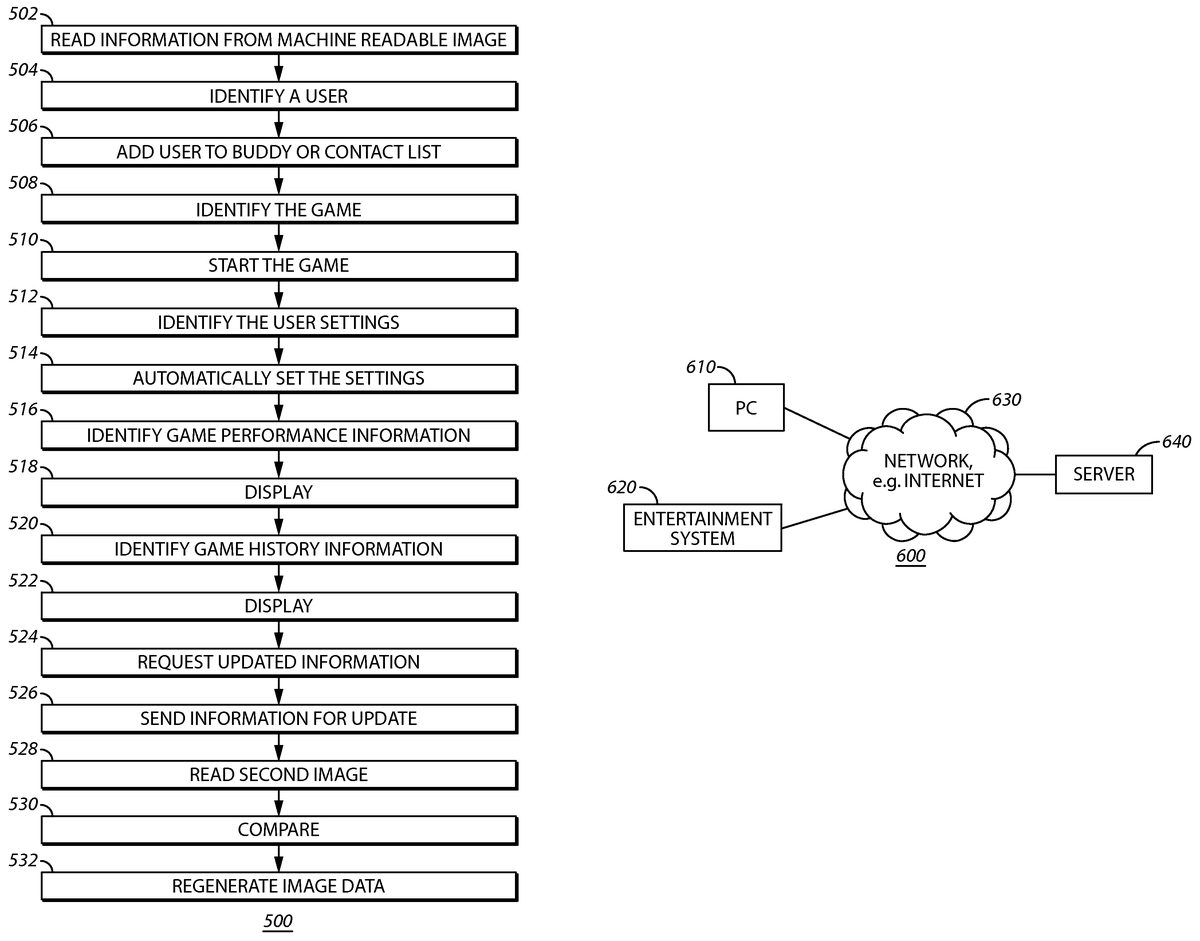
Referring toFIG. 5, there is illustrated a method500that operates in accordance with one embodiment of the present invention. According to some embodiments, the steps in the method500may be optional and may depend on what types of information are included in the machine readable image.
The method begins in step502in which a first machine readable image104is read by an optical input device connected to a processor based system404such as a console game system, as described above with respect toFIG. 4. The machine readable image104may be displayed on virtually any type of apparatus such as those described above with respect toFIGS. 3 and 4. For example, the machine readable image104may be visible on the surface of a paper or plastic card (i.e. a “Gamer Virtual Card” or a Gamer QR Card”). In other embodiments the machine readable image104could be displayed on a display screen, for example on a computer monitor or the screen of a portable device such as a mobile phone, PSP, PDA, tablet device etc.
In some implementations, reading of the machine readable image104by the optical input device will occur when a user positions at least a portion of the machine readable image104into the field of view of the optical input device. In a preferred embodiment, upon reading the machine readable image104, at least a portion of the user information contained thereon will be received by processor based system404. The information received may include any or all of the user's identity and/or profile information and (i) preferred setting information; (ii) game history information; or (iii) game performance information, as described above. In step504, the processor based system404identifies a particular user or player. Identification may occur based at least in part on user profile information retrieved from the machine readable image104in step502.
In step506, the processor based system may add at least a portion of the received user profile information to a contact list such as an address book or buddy list. By way of example, user profile information may include, but is not limited to, information items related to the user's personal identification such as the user's name, alias, email address, screen name, PlayStation ID etc. Furthermore, user profile information could also comprise a user's preferential setting information and/or hardware configuration information such as (but not limited to), controller type for a particular game title, identification information pertaining to the user's TV (e.g., HD or not), monitor resolution and/or display characteristics (e.g., 3D or not), NAT type, geo location information, Console ID for game-play session, top10games played, etc. The user profile information may be added to a contact or buddy list and used to facilitate communication between users. In some implementations, users may use their own respective machine readable images to conveniently swap or trade contact information/user profile information or the like.
Proceeding to step508wherein the processor based system404identifies a game or simulation to be played. In some embodiments, the processor based system404may determine what game or simulation is desired based at least in part on the received user information. In one embodiment, the processor based system may determine the desired game or simulation to be played based upon a selection made by the user on one or more menu or option screens. In step510, the processor based system404loads and executes the game. When operated in an offline mode, the game or simulation may be loaded and/or played from a local storage device such as a removable optical medium or a mass storage device. However, during online operation, the loading and/or execution of the game or simulation may involve communication with one or more processor based devices such as server416, like that discussed above with respect toFIG. 4, via a computer network, such as the internet.
Proceeding to step512, the processor based system identifies the user's preferred setting information. As discussed above, the preferred setting information can include any information pertaining to the user's preferred online or offline settings for one or more game simulations or processor based devices (e.g. consoles, computers, entertainment systems, portable devices etc.).
By way of example, the user's preferred setting information could include information regarding the specific configuration of a character or other aspect of the game. For example, the preferred setting information may contain information related to a user's character selection preferences or visual and/or audio preference e.g., language options, input device options, display options etc.
In yet another example, the preferred setting information may contain information related a saved point or scenario within a game map or level. For example, the preferred setting information may contain data related to a user's most recent progress in a game and may be used to save the user's “spot” in a particular game.
In step514, the processor based system404applies the user's preferences and/or settings based on the user's preferred setting information identified in step512. By way of example, the processor based system404may automatically load a particular game or set of options pertaining to a specific game or character. In one embodiment the application of the user's preferred setting information may load a user's saved screen preferences and/or options so that the user's settings may be restored on the processor based system404. Additionally, application of the user's preferred setting information may cause the processor based system404to jump to a particular location or scenario so the user can quickly join or resume, either online or offline, game play without first navigating some or all of the game's initial loading, menu or option screens etc.
In step516, the processor based system404identifies the user's game performance information. Game performance information may include any type of performance information relating to one or more games played by the user. By way of example, game performance information may include quantitative information pertaining to a user's previous performance or progress in one or more simulations. For example, game performance information may include scores, point totals, time records etc. A user's game performance information may also include qualitative information related to one or more online or offline players or may indicate a user's relative standing with respect to past game play (e.g., online or tournament play etc.). In step518the user's game performance information is displayed to one or more users. In some embodiments only a portion of the user's game performance information may be displayed or, optionally may only be displayed to a select group of one or more players.
In step520the processor based system404identifies the game history information. Game history information may include any information regarding the user's game-play history. For example, game history information could include any information pertaining to previously played titles or genres and/or a frequency of play, duration of play etc. In step522the processor based system displays at least a portion of the user's game history information on one or more displays.
In step524the processor based system404issues a request for updated user information. Updated information can be aggregated automatically or provided manually by the user. Alternatively, updated user information may be retrieved from another processor based device, such as a server via a wired or wireless connection to a network, such as the internet. Updated user information could include user identity and/or profile information in addition any or all of the following information items: (i) preferred setting information for one or more computer game applications, (ii) game history information for the user for one or more computer game applications, or (iii) previous game performance information for the user for one or more computer game applications.
In step526the processor based system communicates with a server to send and/or receive updated user information. By way of example, the processor based system404may cause the updated user information to be sent to and stored on the server. In alternative embodiments, the processor based system404may receive new or updated user information from the server and may store the new or updated user information locally on one or more memory devices in communication with the processor based system.
In an alternative embodiment, when the processor based system404is operated in an offline-mode, updated user information may be stored on one or more local memory devices. By way of example, the local memory devices could include a random access memory (RAM), a mass storage unit, such as a disk drive or a flash based memory device such as USB memory storage etc. In other embodiments, the local memory may be comprised of an optical medium such as a DVD, DVR, Blu-Ray disc etc.; however, the local memory devices may be comprised of essentially any non-transitory storage means.
In step528the processor based system404receives information from a second machine-readable image104. In step530the processor based system404compares at least a portion of the user information of the first machine-readable image to at least a portion of the user information received from the second machine-readable image. In other embodiments, the processor based system404may compare the user information from three or more machine-readable images104. In some embodiments, the processor based system404may compare the user information retrieved from one or more machine-readable images104with user information retrieved from a server, via a computer network such as the internet.
In optional step532, the processor based system404may generate a new machine-readable image104based on new or updated information. In some embodiments, the new (or updated) machine-readable image104will comprise information related to at least a portion of the user's identity or profile information and may further include: (i) preferred setting information; (ii) game history information; or (iii) game performance information. In preferred embodiments, the new or updated machine-readable image104will contain user information pertaining to all of items (i), (ii) and (iii) listed above.
As mentioned above, some of the steps of the method500may be optional. By way of example, steps516-522may be optional in embodiments wherein the machine-readable image104does not contain game history or game performance information.
In preferred implementations, the new or updated machine-readable image104may be easily captured, displayed and/or printed on a tangible apparatus such as a card or the screen of a mobile device that may be easily transported. In some embodiments, the information representing the new/updated machine readable image104may be sent to other processor devices such as for example, mobile phones or servers etc.
Embodiments of the present invention may be used in stand alone games or in network game environments. Referring toFIG. 6, there is illustrated a system600that may be used in implementing a network or online gaming environment in accordance with some embodiments of the present invention. In the system600, users or players are able to interact with each other, such as for example in a network game.
The system600includes a computer (PC)610, an entertainment system620, a network630and a server640. By way of example, the entertainment system620may comprise essentially any type of processor based device capable of engaging in the network gaming features described herein. For example, the entertainment system620could comprise, but is not limited to, a game console such as a PS3 or a handheld device such as a PSP, PDA or mobile phone etc. By way of further example, the network630may comprise virtually any communication network, including but not limited to wired or wireless private or local area networks (LANs), wide area networks (WANs), the PlayStation Network (PSN) or the internet (i.e., the “cloud”). In some embodiments, either one of or both of the PC610and the entertainment system620may be networked devices and may be coupled to the network630. Other devices may also be coupled to the network630, such as for example the server640.
In a preferred embodiment of the present invention the PC610and the entertainment system620will be configured for online operation. When operating in an online mode, the PC610and entertainment system620may communicate with each other and/or other devices coupled to the network630(such as server640) to execute an online game or simulation.
In one preferred embodiment, information106pertaining to one or more users/players may be received by the PC610or entertainment system620via the optical reading of machine readable image104. Alternatively, information106may also be received at the entertainment system620or PC610from the server640via network630. In some preferred embodiments, information106may be retrieved or stored by any type of console system, computer or portable device, configured for engagement with a game or other simulation.
In one implementation of the present invention, receipt of the information106will cause the PC610, entertainment system620and/or the server640to load at least a portion of any number of: (i) the user's preferred setting information, (ii) the user's game history information, and/or (iii) the user's previous game performance information.
In one embodiment, the reading/loading of information106will enable system600to take a player directly to his/her game of choice, independent of the device platform used by the user (e.g. PC610, entertainment system620, or another device).
In some embodiments, the information106may be remotely stored (i.e., “backed up”) on one or more processor based devices (e.g., the server640) via a network (e.g., the network630such as the internet or “the cloud”). In some embodiments, the information106could comprise data pertaining to a save point or checkpoint for one or more game titles and that may enable the user to resume a particular game title (at a desired point) at a later time or on a different device. By way of example, a user may engage in game play for a particular title on a device (e.g., on the PC610). Upon reaching a stop point the information106(including data related to the user's desired save point), will be backed up to the cloud (e.g., saved to the server640via the network630). Subsequently, when the user resumes game play for the previously played title on a different device (e.g., game play is resumed on the entertainment system620) the game will be resumed at the user's chosen save point. This cloud-save/cross play feature would be very satisfying to the user as he or she can continue with the game-play experience amongst multiple devices on which the game is offered.
In one preferred embodiment, as information106is updated or changed by the user (i.e. updated manually or automatically throughout game-play) the information106may be synced with the server640for later retrieval. After syncing with server640, the updated information106may be retrieved and/or downloaded to any device that may communicate with the server640. By way of example, any portion of information106may be displayed to one or more users via a webpage or through one or more game display screens etc.
For example, in one preferred embodiment, a URL can be generated that will point to a webpage containing all or a portion of information106and/or the corresponding machine readable image104. In some embodiments multiple users may compare any of their identity and/or profile information in addition to (i) preferred setting information (ii) game history information, and/or (iii) previous game performance information, via one or more web pages or display screens.
In another embodiment, image data corresponding to an updated machine readable image104may be generated by any of PC610, entertainment system620or server640that represents all or a portion of a user's current information106. For example, PC610or entertainment system620may produce a new machine readable image104that may be displayed or printed locally. In one embodiment, the machine readable image104may be printed as a quick response code (QR code) that represents a particular game in the form of a “Gamer Virtual Card.” Thus, multiple players may easily store and swap and compare information related to a number of games either during online or offline game play.
In another embodiment, a new machine readable image104may be produced by and/or stored on the server640. In some embodiments, the machine readable image104generated by server640can be sent from the sever640to a processor based device connected to network630(e.g., PC610and/or entertainment system620). In other embodiments, the new machine readable image104generated by server640may be displayed as part of a webpage accessible via the network630.
Referring toFIG. 7, there is illustrated a method700performed a server, such as for example server640ofFIG. 6. The method begins in step710in which user information is received by server640. In some embodiments, the user information received in step710will be the first user information pertaining to a specific user that is received by the server. In other embodiments, the user information received in step710will correspond to new or updated user information.
In step720, the server selects at least a portion of the received user information for use in generating a new or updated machine readable image104. In step730, the server generates image data representing a new/updated machine readable image104in which the machine readable image104is representative of at least a portion of the user information selected in step720.
In step740, the server transmits the image data corresponding to the machine readable image104. In one preferred embodiment, the image data corresponding to a machine readable image104is transmitted to a processor based device such as PC610or entertainment system620, via a network630as discussed above with respect toFIG. 6. In some embodiments, the image data is stored at the server or another location accessible via a network such as the internet. In some embodiments, the stored image data may be available in the form of a web page or online user profile.
In step750, the server receives new or updated user information. In some embodiments the new or updated user information may be received by the server automatically; for example, due to changes in the player's game preferences, profile information, game statistics or history information etc., caused as a result of the player's game play. In alternative embodiments, server may receive new and/or updated player information as the result of an explicit update request made by the server or the player. For example, a player may have an online profile that contains (or is linked to) all or a portion of the player's information. The player may add or change his or her user information by making changes to his or her online user profile.
In step760the server re-generates image data corresponding to an updated machine readable image104. In some embodiments, the updated machine readable image104is stored by server. Alternatively, in some embodiments the updated machine readable image104is transmitted to a processor-based device, for example, via a network630such as that depicted inFIG. 6.
The methods and techniques described herein may be utilized, implemented and/or run on many different types of systems. Referring toFIG. 8, there is illustrated a system800that may be used for any such implementations. One or more components of the system800may be used for implementing any system/s or device/s mentioned above, such as for example any of the above-mentioned computers, game consoles, entertainment systems, servers etc. However, the use of the system800or any portion thereof is certainly not required.
By way of example, the system800may include, but is not required to include, a central processing unit (CPU)802, a graphics processing unit (GPU)804, a random access memory (RAM)808, and a mass storage unit810, such as a disk drive. The system800may be coupled to, or integrated with, any of the other components described herein, such as a display812. The system800comprises an example of a processor based system. The CPU802and/or GPU804may be used to execute or assist in executing the steps of the methods and techniques described herein, and various program content, images, title screens, logo screens, studio screens, splash screens, credit screens, menu screens, main menu screens, etc. may be rendered on the display812.
The mass storage unit810may include or comprise any type of computer readable storage or recording medium or media. The computer readable storage or recording medium or media may be fixed in the mass storage unit810, or the mass storage unit810may optionally include removable storage media814, such as a digital video disk (DVD), Blu-ray disc, compact disk (CD), USB storage device, floppy disk, or other media. By way of example, the mass storage unit810may comprise a disk drive, a hard disk drive, flash memory device, USB storage device, Blu-ray disc drive, DVD drive, CD drive, floppy disk drive, etc. The mass storage unit810or removable storage media814may be used for storing code or macros that implement the methods and techniques described herein.
Thus, removable storage media814may optionally be used with the mass storage unit810, which may be used for storing code that implements the methods and techniques described herein, such as code for running the above-described alternative start-up mode and features. However, any of the storage devices, such as the RAM808or mass storage unit810, may be used for storing such code. For example, any of such storage devices may serve as a tangible computer readable storage medium for storing or embodying a computer program for causing a console, system, computer, or other processor based system to execute or perform the steps of any of the methods, code, and/or techniques described herein. Furthermore, any of the storage devices, such as the RAM808or mass storage unit810, may be used for storing any needed database(s).
In some embodiments, one or more of the embodiments, methods, approaches, and/or techniques described above may be implemented in a computer program executable by a processor based system. By way of example, such processor based system may comprise the processor based system800, or a computer, entertainment system, game console, graphics workstation, etc. Such computer program may be used for executing various steps and/or features of the above-described methods and/or techniques. That is, the computer program may be adapted to cause or configure a processor based system to execute and achieve the functions described above. For example, such computer program may be used for implementing any embodiment of the above-described steps or techniques for quick launching a software application or system. As another example, such computer program may be used for implementing any type of tool or similar utility that uses any one or more of the above described embodiments, methods, approaches, and/or techniques. In some embodiments, the computer program may comprise a video game, role-playing game (RPG), other computer simulation, or system software such as an operating system, BIOS, macro, or other utility. In some embodiments, program code macros, modules, loops, subroutines, etc., within the computer program may be used for executing various steps and/or features of the above-described methods and/or techniques. In some embodiments, the computer program may be stored or embodied on a computer readable storage or recording medium or media, such as any of the computer readable storage or recording medium or media described herein.
Therefore, in some embodiments the present invention provides a computer program product comprising a medium for embodying a computer program for input to a computer and a computer program embodied in the medium for causing the computer to perform or execute steps comprising any one or more of the steps involved in any one or more of the embodiments, methods, approaches, and/or techniques described herein. For example, in some embodiments the present invention provides a computer readable storage medium storing one or more computer programs adapted to cause a processor based system to execute steps comprising:
Reading a machine readable image104containing user information and processing at least a portion of the user information; wherein the user information comprises any portion of (or all of) the user's (i) preferred setting information; (ii) game history information; or (iii) game performance information.
Identifying a user based at least in part on the user information read from the machine readable image104. In some embodiments, the processor based system may optionally add a user's name and/or contact information (such as online screen name, email address etc.) to a buddy list or contact list for use in communicating with other users or gamers. For example, a user may scan the machine readable image104of a friend/fellow-gamer by positioning an apparatus (e.g. a gamer virtual card or the screen of a portable device such as a smart phone) containing the machine readable image in front of an optical input device connected to the processor based system. Upon reading the machine readable image104, the processor based system404can add the friend/fellow-gamer's name or contact information to one or more contact or buddy lists. In this way, fellow gamers may easily and conveniently swap contact information in either an online or offline setting.
By way of example, the scanning of a particular player's machine readable image104may offer an easy and convenient way of tracking players at gaming events or tournaments. For example, gamers may easily scan their respective machine readable images at a booth or other live exhibit using, for example, a printable card or the screen of a mobile device displaying the machine readable image104.
In yet another embodiment, after reading the user information from the machine readable image104, the processor based system may identify and automatically load/execute the game or simulation that is desired by the user. For example, based on the received user information, the processor based system404may determine that the gamer wishes to play “Metal Gear Solid4: Guns of the Patriots.” In response, the processor based system can load/execute this game title.
Additionally, in some embodiments, the processor based system can also identify the user's preferred setting information pertaining to a specific title and may automatically set the user's preferred settings. For example, the processor based system404may determine the user's specific system options and/or preferences for a user's character in a particular title; upon game execution, the processor based system can load all or a portion of the user's preferred system and game settings, such as character options, game controller settings and display settings etc.
In some embodiments, the user's preferred setting information may enable the processor based system to return to (or jump to) a specific location or scenario within a particular game or simulation. For example, the processor based system404may cause the player's character to jump to a particular level or point in the game that has been previously chosen or saved by the player.
In some embodiments, the processor based system404can identify the user's game performance information related to the previous play of one or more games. Game performance information may encompass any type of information pertaining to the user's playing performance. The processor based system404may optionally display all, or any portion of, the user's performance information.
In some embodiments, the processor based system may identify one or more information items related to the user's game history information and may display either some or all of this information to one or more users. For example, the processor based system404may display a list of one or more users' most frequently played game titles or preferred genres.
In some embodiments that processor based system404may generate a request to receive updated user information. Updated user information may be received directly from the user or may be received from an external source such as a server via a network.
For example, the processor based system404via one or more menu or pop-up option screens may request updated user information from the user. In one preferred embodiment, a user could provide the requested updated information by scanning a machine readable image (e.g. in the form of a Gamer Virtual Card) into an optical input device (e.g. a camera such as the PlayStation Eye). In alternative embodiments, a user might provide the requested updated user information my manually entering the requested information into one or more menu or option screens. In preferred embodiments, user information will be updated with each use of the machine readable image104.
In some embodiments, the processor based system may store new or updated user information to one or more memory devices. For example, the processor based system404may store updated user information to a local mass storage device such as a flash-based memory, magnetic or optical disk. Alternatively, the processor based system404may transmit updated user information to one or more devices via a wired or wireless connection. For example, the updated user information may be transmitted from the processor based system404to a server via the internet.
In one preferred embodiment, the processor based system will generate new or updated image data pertaining to one or more new/updated machine readable images. For example, the processor based system may generate a new machine readable image104based on the user's most recently known profile information, preferred setting information, game history information, and/or game performance information.
In some embodiments, the processor based system404will read in one or more additional machine readable images and may compare the user information corresponding to one or more of the processed machine readable images.
For example, by reading in multiple machine readable images from different gamers, the processor based system404may conveniently compare any number of game play statistics for multiple players. By way of example, using each gamers' respective user information, the processor based system may easily compare rank or point totals as between multiple players for one or more games.
As another example, in some embodiments the present invention provides a computer readable storage medium storing one or more computer programs adapted to cause a processor based system, such as a server640to execute steps comprising:
Receiving information for one or more users corresponding to user information and/or image data, corresponding to one or more machine readable images104.
In some embodiments the server640will compare the received information and or image data corresponding to one or more machine readable images104that belong to one or more users. For example, the server640may compare the machine readable images104of multiple users to determine contest winners (e.g., as in a raffle) or to compare one or more aspects pertaining to the users' respective profile information, preferred setting information, game history information and/or previous game performance information etc.
In some embodiments, the received user information or image data will be new information pertaining to a specific user. In other embodiments the received information will correspond to updated user information or image data.
In exemplary embodiments, the server640will use the information to generate image data representing a new or updated machine readable image104.
In some embodiments the server may transmit the updated user information or machine readable image104to another device; for example via a network630as described above with respect toFIG. 6. Additionally, in some embodiments the image data pertaining to the machine readable image104may be stored at the server or another location that is accessible via a network630such as the internet. For example, the machine readable image104may be made available in the form of a web page or as part of an online user profile.
While the invention herein disclosed has been described by means of specific embodiments and applications thereof, numerous modifications and variations could be made thereto by those skilled in the art without departing from the scope of the invention set forth in the claims.
Claims
- An apparatus, comprising: a tangible surface;and a machine-readable visible image on the tangible surface, wherein the image comprises information that is encoded into the image and that is optically machine-readable from the image, wherein the image is configured to be image captured by a separate image capturing device when the image is positioned within a field of view of the image capturing device, and wherein the information is decoded by optically reading the image with the image capturing device;wherein the information comprises an identity of a user and the following, (i) at least a portion of the user's preferred setting information for one or more computer game applications, (ii) game history information for the user for one or more computer game applications, and (iii) previous game performance information for the user for one or more computer game applications.
- The apparatus of claim 1 , wherein the tangible surface comprises at least one of paper, cardboard, metal film, or plastic.
- The apparatus of claim 1 , wherein the tangible surface comprises a display screen.
- The apparatus of claim 1 , wherein the machine-readable visible image comprises a two-dimensional (2D) barcode.
- A computer readable storage medium storing one or more computer programs that will cause a processor based system to execute steps comprising: optically machine reading information from a first machine-readable image, wherein the information is encoded into the image and is decoded by optically reading the image with an optical input device;identifying an identity of a user in the read information;identifying the user's preferred setting information for a computer game application in the read information;and automatically setting one or more user settings in the computer game application according to the user setting information.
- The computer readable storage medium of claim 5 , wherein the one or more computer programs will further cause the processor based system to execute steps comprising: identifying profile information for the user in the read information;and automatically selecting the computer game application based on a computer game application identity information in the read information.
- The computer readable storage medium of claim 6 , wherein the one or more computer programs will further cause the processor based system to execute steps comprising: automatically starting the computer game application.
- The computer readable storage medium of claim 5 , wherein the one or more computer programs will further cause the processor based system to execute steps comprising: identifying previous game performance information for the user in the read information;and displaying at least a portion of the previous game performance information.
- The computer readable storage medium of claim 5 , wherein the one or more computer programs will further cause the processor based system to execute steps comprising: identifying game history information for the user in the read information;and displaying at least one item of the game history information.
- The computer readable storage medium of claim 5 , wherein the one or more computer programs will further cause the processor based system to execute steps comprising: sending a request over a network requesting any updated information relating to the user.
- The computer readable storage medium of claim 5 , wherein the one or more computer programs will further cause the processor based system to execute steps comprising: in response to the user playing the computer game, assembling current game performance information relating to the user's performance in the computer game;and sending at least a portion of the assembled current game performance information over a network.
- The computer readable storage medium of claim 5 , wherein the one or more computer programs will further cause the processor based system to execute steps comprising: reading information from a second machine-readable image;and comparing at least a portion of the read information from the second machine-readable image to at least a portion of the read information from the first machine-readable image.
- The computer readable storage medium of claim 5 , wherein the one or more computer programs will further cause the processor based system to execute steps comprising: adding the user to a user list.
- The computer readable storage medium of claim 5 , wherein: the optical input device comprises an image capture device;and the optically machine reading information from the first machine-readable image comprises using the image capture device to read the image.
- The computer readable storage medium of claim 5 , wherein the first machine-readable image comprises a two-dimensional (2D) barcode.
- A computer readable storage medium storing one or more computer programs that will cause a processor based system to execute steps comprising: receiving user information that comprises an identity of a user and the following, (i) at least a portion of the user's preferred setting information for one or more computer game applications, (ii) game history information for the user for one or more computer game applications, and (iii) previous game performance information for the user for one or more computer game applications;selecting at least a portion of the user information;generating image data that represents a visual machine-readable representation;and generating an optically machine-readable image from the image data, wherein the image comprises the selected user information which is encoded into the image and is decoded by optically reading the image with an optical input device.
- The computer readable storage medium of claim 16 , wherein the one or more computer programs will further cause the processor based system to execute steps comprising: sending the generated image data over a network.
- The computer readable storage medium of claim 16 , wherein the one or more computer programs will further cause the processor based system to execute steps comprising: printing the generated image.
- The computer readable storage medium of claim 16 , wherein the one or more computer programs will further cause the processor based system to execute steps comprising: displaying the generated optically machine-readable image on a website.
- The computer readable storage medium of claim 16 , wherein the one or more computer programs will further cause the processor based system to execute steps comprising: updating at least a portion of the user information in response to at least one of, the user providing updated information, and the user playing one of the one or more computer game applications.
- The computer readable storage medium of claim 20 , wherein the one or more computer programs will further cause the processor based system to execute steps comprising: selecting at least a portion of the updated user information;and generating updated image data that represents a visual machine-readable representation comprising the selected updated user information.
- The computer readable storage medium of claim 16 , wherein the one or more computer programs will further cause the processor based system to execute steps comprising: receiving current game performance information for the user from over a network;and updating at least a portion of the user information based on the received current game performance information for the user.
- The computer readable storage medium of claim 16 , wherein the one or more computer programs will further cause the processor based system to execute steps comprising: receiving a request from over a network requesting updated information relating to the user;and sending updated information relating to the user over the network in response to the request.
- The computer readable storage medium of claim 16 , wherein the generated optically machine-readable image comprises a two-dimensional (2D) barcode.
- The computer readable storage medium of claim 16 , wherein the step of receiving the user information comprises reading a two-dimensional barcode.
- The computer readable storage medium of claim 16 , wherein the step of receiving the user information comprises receiving information from over a network.
Disclaimer: Data collected from the USPTO and may be malformed, incomplete, and/or otherwise inaccurate.