U.S. Pat. No. 8,556,729
Video game system and storage medium storing video game program
AssigneeNintendo Co., Ltd.
Issue DateJune 6, 2006
Illustrative Figure
Abstract
In response to a predetermined input operation by a player, item object initial information is produced. The item object initial information is information used for introducing an item object into a virtual game world and controlling the item object in the virtual game world. Then, the item object is introduced into the virtual game world, and controlled in the virtual game world according to a predetermined rule. The item object initial information is transmitted to other video game devices. Each of the other video game devices receives the item object initial information, based on which the video game device introduces the item object into the virtual game world and then controls the item object in the virtual game world according to a predetermined rule.
Description
DESCRIPTION OF THE PREFERRED EMBODIMENTS A video game device capable of executing a video game program according to an embodiment of the present invention will now be described with reference to the drawings. While the video game program of the present invention can be executed under any computer system capable of communicating with other devices, the following description is directed to a video game program being executed by a video game device1(an example of an information processing device) capable of communicating with other devices.FIG. 1shows an external view of the video game device1capable of executing the video game program of the present invention. Although the type of the video game device is not limited to any particular type, the video game device1herein is a portable video game device. Referring toFIG. 1, the video game device1includes a first LCD (Liquid Crystal Display)11and a second LCD12. A housing13includes an upper housing13aaccommodating the first LCD11, and a lower housing13baccommodating the second LCD12. The first LCD11and the second LCD12both have a resolution of 256×192 dots. While LCDs are used in the present embodiment, the display device may be of any other suitable type, e.g., an EL (Electro Luminescence) display device. Moreover, the resolution of the first LCD11and the second LCD12is not limited to the particular resolution used herein. The upper housing13aincludes sound slits18aand18btherein for allowing the sound from a pair of speakers (30aand30binFIG. 2) to be described later to pass therethrough. The lower housing13bincludes a set of input devices, including a cross-shaped switch14a, a start switch14b, a select switch14c, an A button14d, a B button14e, an X button14f, a Y button14g, a power switch14h, an L button14L and an R button14R. Another input device is a touch panel15attached on the screen of the second LCD12. The lower housing13bincludes slots for accommodating a memory card17and ...
DESCRIPTION OF THE PREFERRED EMBODIMENTS
A video game device capable of executing a video game program according to an embodiment of the present invention will now be described with reference to the drawings. While the video game program of the present invention can be executed under any computer system capable of communicating with other devices, the following description is directed to a video game program being executed by a video game device1(an example of an information processing device) capable of communicating with other devices.FIG. 1shows an external view of the video game device1capable of executing the video game program of the present invention. Although the type of the video game device is not limited to any particular type, the video game device1herein is a portable video game device.
Referring toFIG. 1, the video game device1includes a first LCD (Liquid Crystal Display)11and a second LCD12. A housing13includes an upper housing13aaccommodating the first LCD11, and a lower housing13baccommodating the second LCD12. The first LCD11and the second LCD12both have a resolution of 256×192 dots. While LCDs are used in the present embodiment, the display device may be of any other suitable type, e.g., an EL (Electro Luminescence) display device. Moreover, the resolution of the first LCD11and the second LCD12is not limited to the particular resolution used herein.
The upper housing13aincludes sound slits18aand18btherein for allowing the sound from a pair of speakers (30aand30binFIG. 2) to be described later to pass therethrough.
The lower housing13bincludes a set of input devices, including a cross-shaped switch14a, a start switch14b, a select switch14c, an A button14d, a B button14e, an X button14f, a Y button14g, a power switch14h, an L button14L and an R button14R. Another input device is a touch panel15attached on the screen of the second LCD12. The lower housing13bincludes slots for accommodating a memory card17and a stylus16.
The touch panel15may be any of various types of touch-sensitive panels, including a resistive film touch panel, an optical (infrared) touch panel and a capacitance-coupling touch panel. The touch panel15is an example of a pointing device capable of outputting position data corresponding to the contact point on the surface thereof, at which it is being touched with the stylus16. While it is assumed herein that the user uses the stylus16to operate the touch panel15, it is understood that the touch panel15may be operated with a pen (stylus pen) or a fingertip instead of the stylus16. In the present embodiment, the touch panel15has a resolution (detection precision) of 256×192 dots, which is equal to the resolution of the second LCD12. Note however that it is not necessary that the resolution of the touch panel15is equal to that of the second LCD12. As will be apparent from the following description, the present invention can be realized without the provision of the touch panel15and the first LCD11in the video game device1.
The memory card17is a storage medium storing the video game program, etc., and is received by the slot in the lower housing13b.
) Referring now toFIG. 2, an internal configuration of the video game device1will be described.FIG. 2is a block diagram showing the internal configuration of the video game device1.
Referring toFIG. 2, a CPU core21is mounted on an electronic circuit board20accommodated in the housing13. The CPU core21is connected to a connector23, an input/output interface circuit (referred to simply as an “I/F circuit”)25, a first GPU (Graphics Processing Unit)26, a second GPU27, a RAM24and an LCD controller31, via a bus22. The connector23can receive the memory card17. The memory card17includes therein a ROM17astoring a video game program, and a RAM17brewritably storing backup data. The video game program stored in the ROM17aof the memory card17is loaded to the RAM24, and the loaded video game program is executed by the CPU core21. In addition to the video game program, the RAM24also stores temporary data produced while the CPU core21is running a program. The I/F circuit25is connected to the touch panel15, a right speaker30a, a left speaker30b, a control switch section14ofFIG. 1including the cross-shaped switch14aand the A button14d, and a wireless communications section33. The right speaker30aand the left speaker30bare placed behind the sound slits18aand18b, respectively.
A first VRAM (Video RAM)28is connected to the first GPU26, and a second VRAM29is connected to the second GPU27. In response to an instruction from the CPU core21, the first GPU26produces a first display image and renders it on the first VRAM28, based on data stored in the RAM24for producing display images. Similarly, the second GPU27produces a second display image and renders it on the second VRAM29in response to an instruction from the CPU core21. The first VRAM28and the second VRAM29are connected to the LCD controller31.
The LCD controller31includes a register32. The register32stores a value of 0 or 1 in response to an instruction from the CPU core21. When the value stored in the register32is 0, the LCD controller31outputs the first display image rendered on the first VRAM28to the first LCD11and outputs the second display image rendered on the second VRAM29to the second LCD12. When the value stored in the register32is 1, the LCD controller31outputs the first display image rendered on the first VRAM28to the second LCD12and outputs the second display image rendered on the second VRAM29to the first LCD11.
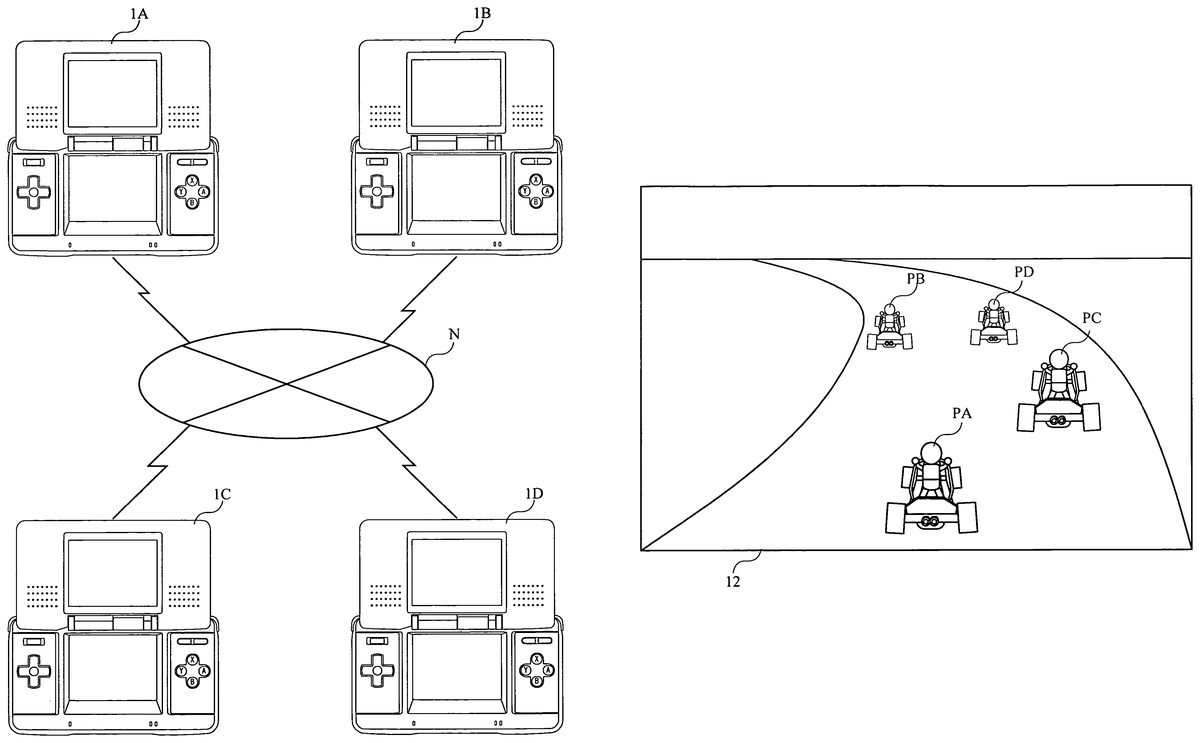
The wireless communications section33exchanges data used in a game process or other data with that of another video game device, and provides a wireless communications function in compliance with the IEEE 802.11 wireless LAN standard, for example. The wireless communications section33outputs received data to the CPU core21. The wireless communications section33transmits data to another video game device, as instructed by the CPU core21. If a communications protocol such as TCP/IP (Transmission Control Protocol/Internet Protocol) and a predetermined browser are provided in the storage section inside the wireless communications section33or the video game device1, the video game device1can be connected to a network such as the Internet via the wireless communications section33. Then, the video game device1can wirelessly communicate with other video game devices via a network. For example, a plurality of video game devices1A to1D are connected together via a network N so that the video game devices1A to1D can communicate with one another to form a video game system, as shown inFIG. 3. Typically, all of the video game devices1A to1D are the same video game device, and will hereinafter be referred to also collectively as “the video game device 1”.
Note that the video game program of the present invention may be supplied to the computer system via a wired or wireless communications line, instead of via an external storage medium such as the memory card17. Alternatively, the video game program may be pre-stored in a non-volatile storage device inside the computer system. The information storage medium for storing the video game program is not limited to a non-volatile semiconductor memory, but may alternatively be a CD-ROM, a DVD or any other suitable type of an optical disk medium.
Referring now toFIGS. 4 to 7, examples of how images are displayed on the second LCD12during the processing operation of the video game program executed by the video game device1will be described, before describing the processing operation in detail. For the purpose of illustration, the following description will be directed to a case where the video game devices1A to1D are each connected to a network such as the Internet via the wireless communications section33and exchange data with one another via the network so as to realize a racing game on the second LCD12.FIG. 4shows an exemplary screen image of a racing game displayed on the second LCD12of the video game device1A.FIG. 5shows an exemplary screen image where an item I is introduced into the racing game displayed on the second LCD12.FIG. 6shows an exemplary screen image of the racing game displayed on the second LCD12, where the item I has entered a target area AB of a player character PB.FIG. 7shows an exemplary screen image of the racing game displayed on the second LCD12, where the item I has hit the player character PB.
Referring toFIG. 4, a racing game is being played between a plurality of video game devices1A to1D, as an example of a multi-player video game to be played in a common game space via a network. Specifically, the players of the video game devices1A to1D control player characters (carts) PA to PD, respectively. In this racing game, there is defined a racetrack in a game space common to all the video game devices1A to1D, and the players compete for fastest time of the player characters PA to PD running around the racetrack.
As the players operate the video game devices1A to1D, a synchronization control operation is performed so that the player characters PA to PD are simultaneously present along the racetrack. Game data necessary for the synchronization control operation are exchanged between the video game devices1A to1D via the network. Through these exchanges of data, a player can know how other player characters are running (e.g., the speed, the direction, etc.) as determined by the operations made by the other players, and how player characters are running is reflected on each of the video game devices1A to1D. On the second LCD12of each of the video game devices1A to1D, the game space is displayed while being centered about the player character controlled by the subject device (the term “subject device” is used herein to refer to one of the participating video game devices that is being the subject of discussion as distinguished from the other participating video game devices, and the term “subject player character” is used herein to refer to a player character that is controlled by the subject device as distinguished from the other player characters).FIGS. 4 to 7show exemplary game images to be displayed on the second LCD12of the video game device1A.
Referring toFIG. 5, the item I can be used in the racing game for obstructing the other player characters. The item I can be used by the player of any of the video game devices1A to1D by performing a predetermined operation input while a predetermined condition is being satisfied. In the illustrated example, in response to the predetermined operation input, the item I is introduced onto the racetrack near the position of the player character being controlled by the player who performed the predetermined operation input. The item I, which has been introduced onto the racetrack, moves along the racetrack with the speed and direction thereof being determined based on a predetermined rule. The driving of any of the player characters PA to PD that is hit by the item I is obstructed.FIG. 5shows an example where the player of the video game device1A uses the item I, wherein the item I appears on the screen near the player character PA. Then, the item I moves along the racetrack in the direction indicated by an open white arrow extending from near the player character PA.
Referring toFIG. 6, target areas AA to AD are defined each centered about the corresponding one of the player characters PA to PD. After the item I enters any of the target areas AA to AD, the item I is controlled so as to home in on the corresponding one of the player characters PA to PD. In the case ofFIG. 6, the item I has entered the target area AB, whereby the player character PB is determined to be the target object on which the item I will be homing in. Then, the item I is controlled so as to chase the player character PB being the target object.
Referring toFIG. 7, when the item I hits any of the player characters PA to PD, the item I obstructs the driving of the player character along the racetrack. In the case ofFIG. 7, the item I hits the player character PB and obstructs the driving of the player character PB along the racetrack. Specifically, the player character PB is caused to spin. After hitting, and obstructing the driving of, any of the player characters PA to PD, the item I is erased from the racetrack.
As described above, the item I is introduced into the game space from any of the player characters PA to PD. Then, after obstructing the driving of a player character that the item I hits, the item I is erased. Thus, the item I is an object that is not controlled by the players of the video game devices1A to1D but is moved across the game space according to a predetermined rule, from the introduction thereof into the game space until the erasure thereof from the game space. Where the movement of such an item I is represented in a racing game played in a common game space between a plurality of video game devices1A to1D via a network, time differences occurring when exchanging data between the video game devices1A to1D may result in different situations being represented on the video game devices1A to1D. For example, the item I may be shown to collide with, and obstruct the driving of, the player character PB on one video game device1, while it is shown to collide with, and obstruct the driving of, a different player character (e.g., PD) on a different video game device1. With such a discrepancy during the game play, the racing game in a common game space will fail. If one video game device1is selected as the reference device, with other video game devices all following the reference device, there may be abrupt changes in the game image displayed on the non-reference devices, which may leave the players with awkwardness. With the game process to be described hereinbelow, it is possible to realize a game image that causes no awkwardness to the players of the video game devices1while avoiding any discrepancies that may possibly occur from when the item I is introduced into the game space until the item I is erased from the game space.
Referring now toFIGS. 8 to 13, specific processing operations of the video game program executed by the video game device1will be described.FIG. 8shows different pieces of data that are stored in the RAM24during the processing operation of the video game program.FIG. 9is a flow chart showing the first half of the game process performed by the video game device1when executing the video game program.FIG. 10is a flow chart showing the latter half of the game process performed by the video game device1when executing the video game program.FIG. 11shows an item rendering process subroutine in step73ofFIG. 10.FIGS. 12 and 13show how the video game devices1A to1D are synchronized together by the process shown inFIGS. 9 to 11. Programs for performing these operations are included in the video game program stored in the ROM17a. When the power supply of the video game device1is turned ON, these programs are loaded from the ROM17ato the RAM24and executed by the CPU core21. For the purpose of illustration, the following description will be directed to a case where the video game devices1A to1D are connected to a network such as the Internet via the wireless communications section33for playing the racing game together via the network, wherein the item I is used during the game. When a racing game is played via the network, the video game devices1A to1D periodically transmit various game data to be received by the video game devices1A to1D. However, the following description will be directed primarily to data to be exchanged that are related to the item I.
Referring toFIG. 8, a data storage area in the RAM24of each video game device1stores data to be exchanged with other video game devices1and data for forming the game space. The data storage area of the video game device1stores a transmit data buffer D1, a receive data buffer D2, a frame number D3, an item data D4, a cart data D5, etc.
The transmit data buffer D1temporarily stores a data frame containing data to be transmitted to other video game devices1. At predetermined transmission timing, a transmit data frame prepared in the transmit data buffer D1is transmitted to other video game devices1via the wireless communications section33. The receive data buffer D2is a buffer area for temporarily storing a data frame received from other video game devices1. The frame number D3is information representing the frame number of the game image being represented on the subject device.
The item data D4is information regarding the item I (seeFIGS. 5 to 7) being present in the game space. Where there are a plurality of items I in the game space, the item data D4is stored for each of the items I. The item data D4includes an item type D4a, an item display position D4b, an item speed D4c, an update count D4d, a delay frame count D4e, a first-time delay process flag D4f, an item-using cart information D4g, target cart information D4h, etc. The item type D4ais information representing the type of the item I for distinguishing different types of items, e.g., an item that homes in on a particular cart, an item that only moves in a straight path, etc. The item display position D4bis information representing the position in the game space at which the item I is displayed. The item speed D4cis information representing the speed and direction of the movement of the item I in the game space, and may be a vector in the game space, for example. The update count D4d, the delay frame count D4eand the first-time delay process flag D4fare information that are used when performing a synchronization control operation for the video game device1that has introduced the item I. The item-using cart information D4gis information representing the player character that is using the item I, and can identify the video game device1that has introduced the item I. The target cart information D4his information representing the player character being the target object of the item I.
The cart data D5is information regarding the player characters (carts) PA to PD (seeFIGS. 4 to 7) being present in the game space. Where there are a plurality of player characters in the game space, the cart data D5is stored for each of the player characters. The cart data D5includes a cart type D5a, a cart display position D5b, a cart speed D5c, target area information D5d, keep-off area information D5e, etc. The cart type D5ais information representing the cart type of the player character. The cart display position D5bis information representing the position in the game space at which the player character is displayed. The cart speed D5cis information representing the speed and direction of the movement of the player character in the game space, and may be a vector in the game space, for example. The target area information D5dis information regarding the target areas AA to AD (seeFIG. 6) defined for the player characters PA to PD, and represents the size, the shape, etc., of the target areas AA to AD. The keep-off area information D5eis information regarding the keep-off area defined for each of the player characters PA to PD, and represents the size, the shape, etc., of the keep-off area.
First, when the power supply (the power switch14h) of the video game device1is turned ON, a boot program (not shown) is executed by the CPU core21, whereby the video game program stored in the memory card17is loaded to the RAM24. The loaded video game program is executed by the CPU core21, thereby performing steps shown inFIG. 9(an abbreviation “S” is used for “step” inFIGS. 9 to 11). Then, the video game devices1participating in the racing game realized by executing the video game program (specifically, the video game devices1A to1D shown inFIG. 3) are connected together via a network so that they can exchange data with one another. In the flow charts discussed below, it is assumed that each video game device1participating in the racing game periodically transmits, by means of its data communications function, the cart data D5(seeFIG. 8) of the player character controlled by the video game device1to other video game devices1and updates the RAM24of the subject device with the cart data D5received from the other video game devices1.
Referring toFIG. 9, the CPU core21controls the player characters PA to PD to update the cart data D5of the player characters PA to PD stored in the RAM24of the subject device, and displays the player characters PA to PD on the second LCD12(step50). Specifically, for a player character controlled by the subject device, the CPU core21of the video game device1controls the player character to update the cart data D5in response to the player's operation on the touch panel15or the control switch section14, and periodically transmits the updated cart data D5to the other video game devices1. For player characters controlled by the other video game devices1, the CPU core21receives the cart data D5periodically transmitted from the other video game devices1to update the cart data D5stored in the RAM24of the subject device. Thus, the player characters PA to PD are controlled while ensuring the synchronization between the video game devices1.
Then, the CPU core21determines whether or not the use_item button is pressed (step51). If so, the process proceeds to step52. If the use_item button is not pressed (including a case where the item-using condition is not satisfied), the process proceeds to step54. For example, the use_item button is the control switch section14and is used for introducing the item I onto the racetrack. Any of the players of the video game devices1A to1D can use the item I by pressing the use_item button while a predetermined condition is being satisfied.
In step52, in response to the use_item button being pressed, the CPU core21stores the item data D4(seeFIG. 8) regarding the item I to be introduced onto the racetrack in the RAM24, and the process proceeds to the next step. The item type D4aand the item speed D4cof the item data D4are set to their predetermined default values. The item display position D4bof the item data D4is set to be a predetermined position with respect to the current position in the game space of the player character controlled by the video game device1(the cart display position D5bof the player character controlled by the subject device), e.g., near the current position of the player character. The item-using cart information D4gof the item data D4is set to be the player character controlled by the video game device1. As the item data D4is stored in the RAM24, the item I is displayed on the second LCD12of the video game device1at the item display position D4bin the game image at the current frame number D3, whereby the item I is introduced onto the racetrack near the position of the player character controlled by the player, who has pressed the use_item button (seeFIG. 5). Then, the CPU core21stores the frame number D3and the item data D4in the transmit data buffer D1, and transmits the frame number D3and the item data D4to the other video game devices1via the wireless communications section33at transmission timing (step53), and the process proceeds to step54.
In step54, the CPU core21determines whether or not the item data D4has been received from another video game device1via the wireless communications section33. If so, the process proceeds to step55. Otherwise, the process proceeds to step58.
In step55, the CPU core21subtracts the frame number D3of the other video game device1included in the received data from the frame number D3of the subject device to obtain the difference as the delay frame count. Then, the CPU core21newly stores the received item data D4in the RAM24(step56). The delay frame count D4eof the item data D4newly stored in the RAM24is the delay frame count as calculated in step55. If another set of the item data D4is already stored in the RAM24, the CPU core21stores the received item data D4in another data storage area. Then, the CPU core21turns ON the first-time delay process flag D4fof the item data D4stored in the RAM24in step56(step57), and the process proceeds to step58.
In step58, the CPU core21refers to the item type D4ato determine whether or not the item I, which has been introduced into the game space, is of a type that homes in on a player character (the “homing” type). If so, the process proceeds to step59. Otherwise, the process proceeds to step71(FIG. 10).
In step59, the CPU core21determines whether or not there is any item data D4of which the item-using cart information D4gspecifies the player character controlled by the subject device. If so (i.e., if the player character is an item-using cart), the process proceeds to step60. Otherwise, the process proceeds to step71(FIG. 10).
In step60, the CPU core21determines whether or not the item I of which the item-using cart information specifies the subject device has entered any of the target areas AA to AD of the player characters PA to PD (seeFIG. 6). Specifically, the CPU core21refers to the item display position D4bof the item data D4, of which the item-using cart information D4gspecifies the subject device, to determine whether or not the item display position D4bis within any of the areas represented by the cart display position D5band the target area information D5cof the cart data D5. If it is determined that the item I has entered any of the target areas AA to AD, the process proceeds to step61. Otherwise, the process proceeds to step71(FIG. 10).
In step61, the CPU core21determines one of the player characters PA to PD associated with one of the target areas AA to AD that the item I has entered as being the target object, and registers the player character being the target object in the target cart information D4hincluded in the item data D4regarding the item I. Then, the CPU core21stores the target cart information D4hregistered in step61in the transmit data buffer D1, and transmits the target cart information D4hto the other video game devices1via the wireless communications section33at transmission timing (step62), and the process proceeds to step71(FIG. 10).
In step71ofFIG. 10, the CPU core21determines whether or not the target cart information D4hhas been received from another video game device1via the wireless communications section33. If so, the CPU core21registers the received target cart information D4hin the corresponding item data D4(step72), and the process proceeds to step73. Otherwise, the process proceeds to step73.
In step73, the CPU core21performs the item rendering process. Referring now toFIG. 11, the item rendering process performed by the CPU core21will be described.
Referring toFIG. 11, the CPU core21determines whether or not any item I is present in the game space (i.e., whether or not any item data D4is stored) (step91). If so, the process proceeds to step92. Otherwise, the process exits the subroutine.
In step92, the CPU core21determines whether or not all the items I present in the game space have been processed. If there is any unprocessed item I, the process proceeds to step93. If all the items I have been processed, the process exits the subroutine.
In step93, the CPU core21selects one of the unprocessed items I, and reads the item data D4of the selected item I. The process of steps94to109to be described below is performed on the item data D4read in step93. Then, the CPU core21determines whether or not the first-time delay process flag D4fof the item data D4is ON (step94). If so, the process proceeds to step95. Otherwise, the process proceeds to step103.
In step95, the position at which the item I is displayed (the item display position D4b) is moved by a distance for a single cycle of the normal game process (for one frame) according to the speed of the item I (the item speed D4c) based on a predetermined rule, thus updating the item display position D4b. Then, the CPU core21refers to the item-using cart information D4gto calculate the distance D between the current position of the player character, which has introduced the item I (the cart display position D5b), and the position of the item I updated in step95(step96). Then, the process proceeds to the next step.
Then, the CPU core21defines a minimum distance Dmin to be equal to the calculated distance D (step97). Then, the CPU core21updates the item display position D4bby moving the position at which the item I is displayed (the item display position D4b) by a distance for a single cycle of the normal game process (for one frame) according to the speed of the item I based on a predetermined rule (step98), and the CPU core21updates the delay frame count D4eby decrementing the delay frame count D4eby1(step99). Then, the CPU core21calculates the distance D between the current player character position (the cart display position D5b) referred to in step96and the position of the item I updated in step98(step100), and determines whether or not the distance D is less than the minimum distance Dmin as defined in step97(step101). If Dmin>D, the process returns to step97to repeat the process. If Dmin<D, the CPU core21turns OFF the first-time delay process flag D4f(step102), and the process proceeds to step109.
By repeating steps97to101as described above, the initial position of the item I is determined to be the position at which the distance between the item I and the item-using cart takes the minimum value. Thus, when an item I is introduced into the game space, the item I will appear near the item-using cart in a natural manner even on a video game device1that is controlling a non-item-using player character. Strictly speaking, however, after repeating the process of steps97to101, the updated position will be a position past the minimum, i.e., the position will be overly updated by the distance corresponding to one iteration of the process. The item rendering process in step109may be performed with such an excessive update count. Alternatively, the item rendering process may be performed using the value of the item display position D4bbefore the last iteration of the update process only when the process passes through the process of steps97to101(the first-time delay process).
If it is determined in step94that the first-time delay process flag D4fis OFF, the CPU core21sets the update count D4dto1, and registers the update count D4din the item data D4in step103. Then, the CPU core21determines whether or not the delay frame count D4eis 0 (step104). If not, the process proceeds to step105. If the delay frame count D4eis 0, the process proceeds to step108.
In step105, the CPU core21updates the update count D4dby adding +1 to the update count D4d. Then, the CPU core21updates the update count D4dby further adding the logarithm of the delay frame count D4ein base4, i.e., Log4(delay frame count), to the update count D4d(rounded down to the nearest whole number) (step106). Then, the CPU core21updates the delay frame count D4eby subtracting the current value of the update count D4dminus 1 from the delay frame count D4e(step107). Then, the process proceeds to step108.
In step108, the CPU core21refers to the value (count) of the update count D4d, and updates the item display position D4bby moving the position at which the item I is displayed (the item display position D4b) by a distance for a single cycle of the normal game process times the update count (i.e., a distance for an equal number of frames to the update count D4d) according to the speed of the item I (the item speed D4c) based on a predetermined rule. Then, the process proceeds to step109.
The speed of the item I used in step108when the item I is homing in on a player character will now be described. As described above, once the target cart is determined, the item I moves along the racetrack following the movement of the target cart. Thus, after the target object is determined, the speed of the item I is influenced by the movement of the target object. For example, the CPU core21calculates the new speed of the item I based on a predetermined function, by using the current speed of the item I (the item speed D4c), the current position thereof (the item display position D4b), the speed of the target cart (the cart speed D5c), and the position thereof (the cart display position D5b). Specifically, the new speed Vin of the item I is calculated as follows:
Vin=Vi+Kp(P−Pi)+Kd(V−Vi) Exp. 1
where P is the position of the target cart, V is the speed of the target cart, Pi is the position of the item I, and Vi is the speed of the item I. Kp is the spring coefficient and Kd a damper coefficient. Thus, Expression 1 above is a function representing a control system having a spring and a damper. Within the area where no vibration occurs in Expression 1 above, increasing/decreasing the spring coefficient Kp shortens/elongates the amount of time over which the item I follows the target object. As will be apparent later, the “target-following time”, i.e., the amount of time from when the target cart of the item I is determined until the item I hits the target cart, varies depending on the transmission/reception time between the video game devices1. Under such a communications environment, it is possible to adjust the item's capability (“target-following capability”) of following the target object by adjusting the spring coefficient Kp according to the expected target-following time.
In step109, the CPU core21renders the item I at a position according to the item display position D4b, and displays the game image on the second LCD12. Then, the CPU core21marks the item data D4as “processed”, and the process proceeds to step92to repeat the process.
Referring back toFIG. 10, after the item rendering process in step73, the CPU core21determines whether or not the player character controlled by the subject device has collided with the item I. Specifically, the CPU core21makes the determination based on the cart display position D5bof the player character controlled by the subject device and the item display position D4b. If the CPU core21determines that the player character has collided with the item I, the process proceeds to step76. Otherwise, the process proceeds to step79.
In step76, the CPU core21performs a crash process for showing a crash between the item I and the player character (that is controlled by the subject device and hit by the item I) on the racetrack. In the crash process, a game image is presented, showing the player character spinning or rolling over on the racetrack. Then, the CPU core21erases the item data D4of the item I from the RAM24(step77). Then, the CPU core21stores, in the transmit data buffer D1, collision information that indicates that the item I and the player character controlled by the subject device have collided with each other, and transmits the collision information to the other video game devices1via the wireless communications section33at transmission timing (step78), and the process proceeds to step79.
In step79, the CPU core21determines whether or not collision information has been received from any other video game device1via the wireless communications section33. If so, the CPU core21performs a crash process for showing a crash between the item I and the player character controlled by the other video game device1(step80) and erases the item data D4of the item I from the RAM24(step81), and the process proceeds to step84. If collision information has not been received from any other video game device1, the process proceeds to step82.
In step82, in a case where the item I is a homing type item, the CPU core21determines whether or not the item I has entered a keep-off area defined for the player character being the target object and controlled by the other video game device1. Then, if the item I has entered the keep-off area of the non-subject, target cart, the CPU core21performs a speed adjustment process for the item I (step83), and the process proceeds to step84. If the item I is not a homing type item or if the item I has not entered the keep-off area of the non-subject, target cart, the process proceeds to step84. Keep-off areas are defined each centered about the corresponding one of the player characters PA to PD. When an item I on the racetrack enters the keep-off area defined for one of the player characters PA to PD being the target object and controlled by one of the other video game devices1, the speed of the item I (the item speed D4c) is adjusted so as not to collide with that player character.
In step84, the CPU core21determines whether or not to end the racing game. For example, the racing game is ended when a game-over condition is met (e.g., when all the player characters have crossed the finish line, or when the controlled player character retires from the race) or when the player manually ends the game. If the game is not to be ended, the CPU core21returns to step50(FIG. 9) to repeat the process. If the game is to be ended, the CPU core21exits the process shown in the flow chart.
Referring now toFIGS. 12 and 13, an example of how the video game devices1A to1D are synchronized together by the process shown inFIGS. 9 to 11will be described.
As shown inFIGS. 12 and 13, the player of the video game device1A presses the use_item button (Yes in S51) at frame #100(i.e., a frame that is assigned a frame number “100”) to transmit the item data D4to the other video game devices1B to1D (S53). After transmitting the item data D4(i.e., at and after frame #101), the video game device1A updates, for each frame, the item display position D4bby moving the display position of the item I by a distance for a single cycle of the normal game process (for one frame) according to the speed of the item I (repeating S108with the update count being 1).
The other video game devices1B to1D receive the item data D4(Yes in S54) from the video game device1A via the network, thereby causing a time delay between the transmission and the reception. For example, the video game device1B receives the item data D4from the video game device1A at frame #116. Then, the video game device1B obtains the delay frame count “16” by subtracting the frame number “100” specified in the received data from the frame number “116” of the frame at which the data is received (S55). The video game device1C receives the item data D4from the video game device1A at frame #130. Then, the video game device1C obtains the delay frame count “30” by subtracting the frame number “100” specified in the received data from the frame number “130” of the frame at which the data is received (S55). The video game device1D receives the item data D4from the video game device1A at frame #120. Then, the video game device1D obtains the delay frame count “20” by subtracting the frame number “100” specified in the received data from the frame number “120” of the frame at which the data is received (S55).
After receiving the item data D4at frame #116, the video game device1B performs the first-time delay process (S95to S102) at frame #117. The process of repeating steps97to101calculates the position at which the item I appears near the player character PA (i.e., the item-using cart) displayed on the second LCD12of the video game device1B, and the item display position D4bis updated by an amount for the number of cycles (e.g., 10 cycles) needed for the calculation, whereby the delay frame count is 16−9=7. Then, the video game device1B performs the process of steps103to108at frame #118. Then, the update count is 3 (1+1+Log47=3.40). Therefore, for the video game device1B, the item display position D4bis updated three times at frame #118, whereby the delay frame count is 7−(3−1)=5. The video game device1B repeats a process as described above for each frame until the delay frame count is 0 (e.g., at frame #122), and updates the item display position D4bby moving the item I with an update count larger than that for a single cycle of the normal game process (for one frame). When the process of steps103to108at frame #122is completed, the update count will be the same between the video game device1A and the video game device1B, thereby realizing a synchronization therebetween for the movement of the item I.
The video game devices1C and1D also update the item display position D4bin a similar manner to that of the video game device1B. Thus, when the process of steps103to108at frame #139is completed, the update count will be the same between the video game device1A and the video game device1C, thereby realizing a synchronization therebetween for the movement of the item I. When the process of steps103to108at frame #127is completed, the update count will be the same between the video game device1A and the video game device1D, thereby realizing a synchronization therebetween for the movement of the item I. Thus, when the item I is introduced into the game space, a video game device1that has instructed the introduction transmits information indicating the item introduction to the other video game devices1. Thereafter, each of the video game devices1updates the position of the item I independently of one another so as to absorb the difference in the transmission/reception delay time, thereby synchronizing the whole video game system.
Next, assume that the item I enters the target area AB of the player character PB, as shown inFIG. 12. As is apparent from the process of steps59to62, the determination of whether or not an item has entered a target area is performed only by the video game device (the video game device1A) controlling the item-using cart (the player character PA). By limiting the video game device that determines the target object of the item I to a single video game device, it is possible to avoid possible discrepancies in the game play.
The video game device1A transmits target cart information, indicating that the item I has entered the target area AB of the player character PB, to the other video game devices1B to1D (S62), and the other video game devices1B to1D will receive the target cart information (Yes in step71). Then, the item I hits the target cart (the player character PB) (Yes in S75). As is apparent from the process of steps74to78, the determination of whether or not the item has hit the target cart is performed only by the video game device (the video game device1B) controlling the target cart (the player character PB). The determination of whether or not the item has hit a particular non-target cart is performed by the video game device (the video game device1A,1C or1D) controlling the particular non-target cart (the player character PA, PC or PD). In other words, the collision detection between an item and a particular player character is performed only by a video game device1controlling the particular player character. By limiting the player characters for which the item collision detection is performed by each video game device1to a single player character (the subject cart) that is controlled by the particular video game device1, it is possible to avoid possible discrepancies in the game play.
The video game device1B transmits collision information, indicating that the player character PB and the item I have collided with each other, to the other video game devices1A,1C and1D (S78), and the other video game devices1A,1C and1D will receive the collision information (Yes in step79). As shown inFIG. 12, the target-following time, i.e., the amount of time from when the target cart of the item I is determined until the item I hits the target cart, varies depending on the transmission/reception time between the video game devices1. Specifically, the target-following times Ta to Td of the video game devices lA to1D, respectively, are in the following relationship: Tb<Tc<Ta and Tb<Td<Ta This is a phenomenon occurring because the video game device that determines the target object is different from the video game device that controls the target object, in a video game system where an amount of time is required for transmitting/receiving data between video game devices. Typically, the target-following time is longer for the video game device that determines the target object and shorter for the video game device that controls the target object. Therefore, while the item I is following the target object, if the video game devices1all move the item I at an equal speed, the item I may possibly hit the target object on a video game device1that is not performing the collision detection. Embodiments of the game systems disclosed herein may avoid such possible discrepancies through the adjustment (S108) of the target-following capability of the item I and the adjustment (S83) of the speed of the item I immediately before the collision.
It is possible to adjust the target-following time, i.e., the amount of time from when the target cart is determined until the item I hits the target cart, by adjusting the target-following capability (the spring coefficient Kp) of the item I by using Expression 1, as described above with respect to step108. Specifically, for the video game device1A determining the target object, whose target-following time Ta is longer than the target-following times of others, the spring coefficient Kp in Expression1is set to a relatively small value so as to decrease the speed at which the item I follows the target object. For the video game device1B controlling the target object, whose target-following time Tb is shorter than the target-following times of others, the spring coefficient Kp in Expression 1 is set to a relatively large value so as to increase the speed at which the item I follows the target object. For the other video game devices1C and1D, whose target-following times Tc and Td are shorter than the target-following time Tb and longer than the target-following time Ta, the spring coefficient Kp in Expression 1 is set to an intermediate value (i.e., a value larger than Kp for the video game device1A and smaller than Kp for the video game device1B) so as to appropriately adjust the speed at which the item I follows the target object.
While the adjustment of the target-following capability of the item I as described above can, to some extent, eliminate possible discrepancies regarding the collision between the item I and the target object, the speed of the item I is also adjusted, when the item I comes close to hitting a player character on a video game device1that is not performing the collision detection, so as to avoid such a collision. Specifically, when the item I comes close to hitting a cart (non-subject cart) that is not controlled by the subject device, the speed of the item I is adjusted so as to avoid such a collision.
Thus, the present embodiment is directed to a video game system for realizing a video game played via a communications network by using information (the introduction time represented by the frame number D3or the item data D4, the position, the speed, etc.) regarding an object (item) that the player can control only when introducing the object into the game space (i.e., after being introduced, the object is controlled based on a predetermined rule), wherein the information of the object introduced by the player of a video game device1is transmitted to other video game devices1only when the object is introduced into the game space and when the status thereof is changed (when the target object is determined, when the object is erased, etc.), based on which each video game device performs a calculation operation and a display control operation. Therefore, it is possible to reduce the amount of data to be transmitted, as compared with a case where such object information is frequently transmitted to the other video game devices1even after the object is introduced into the game space. As the average amount of data per one data transmission is decreased, it is possible to shorten the data transmission time for the same communications environment. In other words, under inferior communications environments, it is possible to prevent the data transmission time from becoming long. With the limitation on the video game device1that introduces an item into the game space and changes the status of the item, it is possible to avoid discrepancies in the game play, which may occur with respect to those changes. The synchronization between the video game devices1after the introduction of the object into the game space or the change of the status thereof is realized by adjusting the update count in the game process or the speed of the item I, whereby it is possible to display a game image on each video game device1that does not give awkwardness to the player.
In the game process described above, information regarding the item I is transmitted to other video game devices1when the item I is introduced into the game space, when the target object of the item I is determined, and when the item I is erased from the game space after hitting the subject cart. However, the information of the item I may be transmitted at other status changing events according to the game rule. For example, in a case where an item I introduced into the game space is an object that can be caught by a player character, information indicating the catch of the item I may be transmitted to other video game devices1when the item I is caught by any of the player characters.
When the item I is introduced into the game space through the process of steps95to101shown inFIG. 11, the item I will appear near the item-using cart in a natural manner even on a video game device1that is controlling a non-item-using player character. In a case where such an effect is not expected, the first-time delay process may be performed in any other suitable manner. An alternative example of the first-time delay process will now be described with reference toFIG. 14.FIG. 14shows an item rendering process subroutine in step73ofFIG. 10.
InFIG. 14, the process of steps121to123is similar to the process of steps91to93ofFIG. 11, and will not be further described below.
In step124, the CPU core21sets the update count D4dto 1 and registers the item data D4. Then, the CPU core21determines whether or not the delay frame count D4eis 0 (step125). If not, the process proceeds to step126. If the delay frame count D4eis 0, the process proceeds to step132.
In step126, the CPU core21updates the update count D4dby adding +1 to the update count D4d. Then, the CPU core21determines whether or not the first-time delay process flag D4fof the item data D4read in step123is ON (step127). If so, the process proceeds to step128. Otherwise, the process proceeds to step130.
Steps128and129correspond to the first-time delay process in the alternative example of the item rendering process. In step128, the CPU core21updates the update count D4dby adding ½ of the delay frame count D4eto the update count D4d. Then, the CPU core21turns OFF the first-time delay process flag D4f(step129), and the process proceeds to step131.
Instep131, the CPU core21updates the delay frame count D4eby subtracting the current value of the update count D4dminus1from the delay frame count D4e. Then, the process proceeds to step132.
In step132, the CPU core21refers to the value (count) of the update count D4d, and updates the item display position D4bby moving the position at which the item I is displayed (the item display position D4b) by a distance for a single cycle of the normal game process times the update count (i.e., a distance for an equal number of frames to the update count D4d) according to the speed of the item I (the item speed D4c). The item display position D4bis updated while the target-following capability is adjusted, which process is similar to step108described above and will not be further described below. Then, the CPU core21renders the item I at the current item display position D4b(step133), and displays the game image on the second LCD12. Then, the CPU core21marks the item data D4as “processed”, and the process proceeds to step122to repeat the process.
Note that a racing game has been described above with specific processes for the purpose of illustration, it is understood that the present invention is not limited to those specific processes or to the racing game.
While a video game device1is connected to a network via a wireless connection in the description above, the video game device1may exchange data with other video game devices1via any other suitable means. For example, the video game device1and the network may be connected via a wired connection to exchange data with other video game devices1. At least some of the plurality of video game devices1may exchange data directly with each other via a wireless or wired connection, without a network therebetween.
As an example of a dual-screen liquid crystal display section, the embodiment described above employs the first LCD11and the second LCD12, which are physically separate from each other and are arranged one above the other (a horizontally-split dual-screen). Alternatively, other display screen arrangements may be employed. For example, the first LCD11and the second LCD12may be provided on the primary surface of the lower housing13bin a left-right arrangement. Alternatively, a vertically-oriented LCD having a horizontal width equal to that of the second LCD12and a vertical length twice that of the second LCD12(i.e., a physically single LCD having a dual-screen display size) may be provided on the primary surface of the lower housing13b, and the first and second display images may be displayed in the upper and lower neighboring display areas of the LCD. Alternatively, a horizontally-oriented LCD having a vertical width equal to that of the second LCD12and a horizontal length twice that of the second LCD12may be provided on the primary surface of the lower housing13b, and the first and second display images may be displayed in the left and right neighboring display areas of the LCD. Thus, the first and second display images may be displayed on a physically single screen divided into two display areas. In a case where a physically single display screen is divided into two display areas in which the first and second display images are displayed, the touch panel15may be provided so as to cover the entire display screen.
While the touch panel15is provided integrally with the video game device1in the embodiment described above, it is understood that the present invention can be carried out even if a video game device and a touch panel are separately provided from each other. Moreover, the touch panel15may alternatively be provided on the upper surface of the first LCD11. The control operation may be done only with the control switch section14, without providing the touch panel15. While two display sections (the first LCD11and the second LCD12) are provided in the embodiment described above, only one display section may be provided in other embodiments. Specifically, the second LCD12as a single display section may be provided with the touch panel15, without providing the first LCD11. Alternatively, the touch panel15may be provided on the upper surface of the first LCD11, without providing the second LCD12.
While the embodiment described above uses portable video game devices1, the present invention may use other types of information processing devices such as common personal computers or home-console video game devices, which are capable of exchanging data with other devices.
The video game system and the storage medium storing a video game program of the present invention can be applied to a multi-player video game, or the like, that is played between a plurality of video game devices via a communications network, wherein it is necessary in the game play that the video game devices are synchronized together.
While the invention has been described in detail, the foregoing description is in all aspects illustrative and not restrictive. It is understood that numerous other modifications and variations can be devised without departing from the scope of the invention.
Claims
- A video game system, comprising a plurality of video game devices connected together so that the video game devices can communicate with one another, wherein the video game devices display the same virtual game world while being synchronized together, the virtual game world including therein player characters each controlled by one of the video game devices;a first video game device being one of the plurality of video game devices includes: a communications which exchanges data with other of the video game devices;a processor executing a first program stored in the first video game device, the first program causing the processor to perform: an object initial information production step to generate object initial information used for introducing an object, different from a first player character, into the virtual game world and control the object in the virtual game world, in response to a predetermined input operation by the player;an object operation controlling step to control the object according to a predetermined rule after introducing the object into the virtual game world based on the object initial information;and an object information transmitting step to transmit the object initial information to other video game devices via the communications device;and a second video game device being another one of the plurality of video game devices different from the first video game device includes: a communications device exchanging data with other of the video game devices;a processor executing a second program stored in the second video game device, the second program causing the processor to perform: an object information receiving step to receive the object initial information from the first video game device via the communications device;and an object operation controlling step to control the object according to a predetermined rule executed by the second video game device after the first video game device introduces the object into the virtual game world, wherein the object is represented and initially positioned in the virtual game world by the second video game device based on the object initial information, wherein the predetermined rule at least determines the movement of the object based on an initial object position included in the object initial information by the first video game device.
- The video game system of claim 1 , wherein: in the object initial information production step performed by the first video game device the object initial information includes introduction time information indicating a time at which the object is introduced into the virtual game world;and in the object operation controlling step of the second video game device includes calculating a delay time of the virtual game world represented by the second video game device with respect to the virtual game world represented by the first video game device based on the introduction time information included in the object initial information, and determines a position at which the object is to be introduced into, and controlled in, the virtual game world represented by the second video game device according to the delay time.
- The video game system of claim 2 , wherein when new object initial information is obtained, the object operation controlling step of the second video game device introduces the object based on a position of the first player character controlled by the first player character synchronization step in the virtual game world represented by the second video game device.
- The video game system of claim 3 , wherein: the object initial information production step produces the object initial information so as to further include position information representing a position at which the object is introduced into the virtual game world;and the object operation controlling step performed by the second video game device repeats updating the position of the object using the object initial information so as to introduce the object at a position closest to the first player character controlled in the first player character synchronization step.
- The video game system of claim 3 , wherein: the object initial information production step performed by the first video game device produces the object initial information so as to further include position information representing a position at which the object is introduced into the virtual game world;and the object operation controlling step performed by the second video game device calculates a travel time required for moving the object from a position in the virtual game world represented by the position information included in the object initial information to the position at which the object is introduced, and updates the delay time by subtracting the travel time from the delay time.
- The video game system of claim 1 , wherein: the second program causes the processor in the second video game device to further perform: a second player character operation controlling step to control a second player character in the virtual game world represented by the second video game device in response to a player's input operation;and a second player character information transmitting step to transmit second player character information regarding an operation of the second player character to the other video game devices via the communications device at regular intervals;the first program causes the processor in the first video game device to further perform: a second player character information receiving step to receive the second player character information from the second video game device via the communications device;and a second player character synchronization step to control the second player character in the virtual game world represented by the first video game device based on the second player character information;when a distance between the second player character controlled by the second player character synchronization step and the object in the virtual game world becomes within a predetermined range, the object operation controlling step of the first video game device determines the second player character to be a target object of the object, and controls the object so as to follow the second player character;in the object information transmitting step target information is transmitted indicating the target object of the object to other video game devices via the communications device;the object information receiving step of the second video game device receives the target information from the first video game device via the communications device;and the object operation controlling step of the second video game device controls the object so as to follow the second player character controlled by the second player character operation controlling step in the virtual game world based on the target information.
- The video game system of claim 6 , wherein: in the object operation controlling step of the second video game device, the object is controlled so as to follow the second player character at a first speed;and the object operation controlling step of the first video game device controls the object so as to follow the second player character at a second speed lower than the first speed.
- The video game system of claim 1 , wherein: the second program stored in the second video game device further causes the processor to perform: a second player character operation controlling step to control a second player character in the virtual game world represented by the second video game device in response to a player's input operation;a second player character information transmitting step to transmit second player character information regarding an operation of the second player character to the other video game devices via the communications device at regular intervals;a collision detection step to detect, only for the second player character, a collision with the object in the virtual game world represented by the second video game device;and a collision information transmitting step to transmit collision information indicating a collision between the second player character and the object to the other video game devices via the communications device;the first program causes the processor in the first video game device to further perform: a second player character information receiving step to receive the second player character information from the second video game device via the communications device;a second player character synchronization step to control the second player character in the virtual game world represented by the first video game device based on the second player character information;and a collision information receiving step to receive the collision information from the second video game device via the communications device;and the second player character synchronization step of the first video game device shows the second player character and the object colliding with each other in the virtual game world represented by the first video game device based on the collision information.
- A non-transitory storage medium storing a video game program to be executed by a computer of each of a plurality of video game devices connected together so that the video game devices can communicate with one another, wherein the video game devices display the same virtual game world while being synchronized together, the virtual game world including therein player characters each controlled by one of the video game devices, the video game program causing the computer to perform: a object initial information production step to produce object initial information used for introducing an object, different from a subject player character, into the virtual game world and for controlling the object in the virtual game world, in response to a predetermined input operation by the player;an object operation controlling step to control the object according to a predetermined rule after introducing the object into the virtual game world based on the object initial information produced by the object initial information production step;an object information transmitting step to transmit the object initial information to the other video game devices;and an object information receiving step to receive the object initial information from one of the other video game devices in response to a predetermined input operation by a player of the one of the other video game devices, wherein when the object initial information is received from the one of the other video game devices, the object operation controlling step introduces an object into the virtual game world and then controls the object in the virtual game world according to a predetermined rule executed by the one of the other video game devices after the first video game device introduces the object into the virtual game world, and wherein the predetermined rule at least determines the movement of the object based on an initial object position included in the object initial information.
- The non-transitory storage medium storing a video game program of claim 9 , wherein: the object initial information transmitted from one of the other video game devices includes introduction time information indicating a time at which the object is introduced into the virtual game world in the one of the other video game devices;and when the object initial information is received from the one of the other video game devices, the object operation controlling step calculates a delay time of the virtual game world represented by the subject device with respect to the virtual game world represented by the one of the other video game devices based on the introduction time information included in the object initial information, and determines a position at which the object is to be introduced into, and controlled in, the virtual game world according to the delay time.
- The non-transitory storage medium storing a video game program of claim 10 , wherein when the object initial information is received from the one of the other video game devices, the object operation controlling step introduces the object based on a position of the non-subject player character controlled by the non-subject player character synchronization step in the virtual game world.
- The non-transitory storage medium storing a video game program of claim 11 , wherein: the object initial information transmitted from the one of the other video game devices further includes position information representing a position at which the object is introduced into the virtual game world;and the object operation controlling step repeats updating the position of the object using the object initial information received from the one of the other video game devices so as to introduce the object at a position closest to the non-subject player character controlled by the non-subject player character synchronization step.
- The non-transitory storage medium storing a video game program of claim 11 , wherein: the object initial information transmitted from the one of the other video game devices further includes position information representing a position at which the object is introduced into the virtual game world;and when the object initial information is received from the one of the other video game devices, the object operation controlling step calculates a travel time required for moving the object from a position in the virtual game world represented by the position information included in the object initial information to the position at which the object is introduced, and updates the delay time by subtracting the travel time from the delay time.
- The non-transitory storage medium storing a video game program of claim 9 , wherein: where the object is introduced into the virtual game world in response to a predetermined input operation by a player on a subject device, when a distance between the non-subject player character and the object becomes within a predetermined range, the object operation controlling step determines the non-subject player character to be a target object of the object, and controls the object so as to follow the non-subject player character;and the object information transmitting step transmits target information indicating the target object of the object to other video game devices;and where the object is introduced into the virtual game world in response to a predetermined input operation by a player on one of the other video game devices, the object information receiving step receives target information indicating that the target object is determined by the one of the other video game devices;and the object operation controlling step controls the object so as to follow a player character that is specified as the target object by the target information in the virtual game world based on the target information received from the one of the other video game devices.
- The non-transitory storage medium storing a video game program of claim 14 , wherein: when the target object specified by the target information transmitted from the one of the other video game devices is the subject player character, the object operation controlling step controls the object so as to follow the subject player character at a first speed;when the target object determined by the subject device is the non-subject player character, the object operation controlling step controls the object to follow the non-subject player character at a second speed being lower than the first speed.
- The non-trasitory storage medium storing a video game program of claim 9 , wherein: the video game program causes the computer to further perform: a collision detection step to detect, only for the subject player character, a collision with the object in the virtual game world;a collision information transmitting step to transmit collision information indicating a collision between the subject player character and the object to the other video game devices;and a collision information receiving step to receive the collision information indicating a collision between the non-subject player character and the object from one of the other video game devices;and the non-subject player character synchronization includes showing the non-subject player character and the object colliding with each other in the virtual game world based on the collision information received from the one of the other video game devices.
- The video game system of claim 1 wherein: the first video game device further performs: a first player character operation controlling step to control the first player character in the virtual game world in response to a player's input operation;a first player character information transmitting step transmitting first player character information regarding an operation of the first player character to the other video game devices via the communications device at regular intervals, and the second video game device further performs: a first player character information receiving step receiving the first player character information from the first video game device via the communications device, and first player character synchronization step to control the first player character in the virtual game world represented by the second video game device based on the first player character information.
- The non-transitory storage medium of claim 9 wherein the video game program causing the computer further perform: a subject player character operation controlling step to control a subject player character in the virtual game world in response to a player's input operation;a subject player character information transmitting step to transmit subject player character information regarding an operation of the subject player character to the other video game devices at regular intervals;a non-subject player character information receiving step to receive non-subject player character information regarding an operation of non-subject player character controlled by one of the other video game devices from the one of the other video game devices at regular intervals, and a non-subject player character synchronization step to control the non-subject player character in the virtual game world based on the non-subject player character information.
- A method performed using at least a first video device and a second video device communicating with the first video device, wherein each video device displays images of a virtual world being displayed through images on the other video device and the virtual world includes player characters each controlled by one of the video devices;the first video device includes: a communications unit that exchanges data with the second video device;a processor executing a first program stored in a non-transitory memory of the first video device, the first program causes the first video device to: generate object initial information to be applied to introduce and initially position an object in the virtual world in response to a predetermined input operation performed by the player on the first video device, wherein the object is different from a first player character;control the object according to a predetermined rule after the object is initially positioned the virtual world based on the object initial information;and transmit the object initial information to the second video device via the communications unit in the first video device;and the second video device includes: a communications unit exchanging data with the first video device;a processor executing a second program stored in a non-transitory memory of the second video device, the second program causing the second video device to: receive the object initial information from the first video device via the communications unit in the second video device;and control the object according to the predetermined rule wherein the object is represented and initially positioned in the virtual world based on the object initial information and the predetermined rule determines the movement of the object.
- A method to play a video game on video devices communicating with each other to display images of a same virtual game world that includes player characters each controlled by one of the video devices, wherein each video device: generates first object initial information to be used to introduce a first virtual object, different from the player character controlled by the video device, into the virtual game world and control the first object in response to a predetermined input operation by the player using the video device;control the first object according to a first predetermined rule after introducing the object into the virtual game world based on the first object initial information;transmit the first object initial information to another one of the video devices;receive a second object initial information generated by another one of the video game devices in response to a predetermined input operation by a player of the another one of the other video devices: in response to the reception of the second object initial information introduce a second an object corresponding to the received second object initial information in the virtual game world, and moving, in the virtual game world, the second object based on a second predetermined rule.
Disclaimer: Data collected from the USPTO and may be malformed, incomplete, and/or otherwise inaccurate.