U.S. Pat. No. 8,556,715
PERSONALIZED CLIENT-SIDE VISUALIZATION IN A MULTIPLAYER NETWORK VIDEO GAME
AssigneeU4iA Games Inc.
Issue DateSeptember 27, 2011
U.S. Patent No. 8,556,715: Personalized client-side visualization in a multiplayer network video game

Summary:
a network interface for connecting the system to the multiple game clients;
a first storage device for storing a library of content that can be selectively delivered to the plurality of game clients during gameplay of the video game;
selecting a first content and a second content from the library to be delivered to the first and second game clients, respectively, based on the received information about the respective players, the first content different from the second content; and
delivering the selected first and second contents representing a same attribute of the video game via the network interface to the first and second game clients during real-time synchronous gameplay between the two game clients.
Illustrative Figure
Abstract
A method for providing customized content in a video game over a computer network to a plurality of game clients operated by different players is disclosed The method includes: storing a library of content that can be selectively delivered to the plurality of game clients during gameplay of the video game; receiving information about each of the players from the respective game client; selecting content from the library to be delivered to each of the game clients based on the received information about the respective player; and synchronously delivering the selected content to the corresponding game client.
Description
DETAILED DESCRIPTION In the following description of preferred embodiments, reference is made to the accompanying drawings which form a part hereof, and in which it is shown by way of illustration specific embodiments in which the disclosure can be practiced. It is to be understood that other embodiments can be used and structural changes can be made without departing from the scope of the embodiments of this disclosure. The present invention relates to systems and methods for providing personalized content in a network video game to multiple players while the players are playing simultaneously in the same game session. The personalized content can be based on one or more factors associated with each individual player. In various embodiments, the factors can include, but are not limited to, the player's age, gender, internet protocol (IP) address, physical location, nationality, experience level, and personal interests. The aspects of the game that can be personalized for individual players can include, but are not limited to, the visualization (i.e., graphics) of the game including, for example, the appearance of the characters and virtual sets in the game, the sound track of the game, and the language used in the game. Other aspects of the game, such as, the overall gameplay design and objective the game, can remain universal to all players. As such, the same game can be made enjoyable for players with different backgrounds playing synchronously over a network. Because the look and feel of the game can be personalized, the appeal of the particular game can increase to a wider range of gamers than the game would normally have. In addition, the present invention can also ensure that the appropriate content is delivered to each individual player based on his/her profile. This, in turn, can help facilitate synchronous online play of the ...
DETAILED DESCRIPTION
In the following description of preferred embodiments, reference is made to the accompanying drawings which form a part hereof, and in which it is shown by way of illustration specific embodiments in which the disclosure can be practiced. It is to be understood that other embodiments can be used and structural changes can be made without departing from the scope of the embodiments of this disclosure.
The present invention relates to systems and methods for providing personalized content in a network video game to multiple players while the players are playing simultaneously in the same game session. The personalized content can be based on one or more factors associated with each individual player. In various embodiments, the factors can include, but are not limited to, the player's age, gender, internet protocol (IP) address, physical location, nationality, experience level, and personal interests. The aspects of the game that can be personalized for individual players can include, but are not limited to, the visualization (i.e., graphics) of the game including, for example, the appearance of the characters and virtual sets in the game, the sound track of the game, and the language used in the game. Other aspects of the game, such as, the overall gameplay design and objective the game, can remain universal to all players. As such, the same game can be made enjoyable for players with different backgrounds playing synchronously over a network.
Because the look and feel of the game can be personalized, the appeal of the particular game can increase to a wider range of gamers than the game would normally have. In addition, the present invention can also ensure that the appropriate content is delivered to each individual player based on his/her profile. This, in turn, can help facilitate synchronous online play of the same game by players of different ages and maturities. The present invention can also allow multiple players to experience different visuals, sound, and other aspects of the game that are tailored to their likings (or that are appropriate for them) while playing the same game in a real-time and synchronous fashion with each other. Exemplary embodiments are discussed in detail in the paragraphs below.
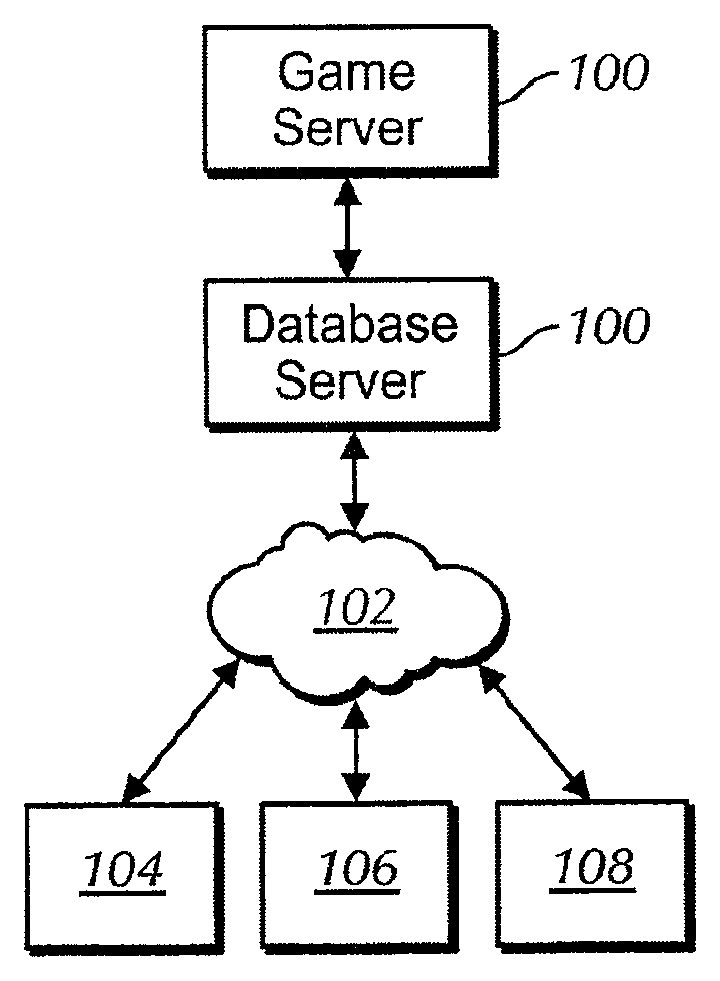
FIG. 1illustrates an exemplary game network102including a central game server100for facilitating multiplayer online video game playing according to an embodiment of this invention. In this embodiment, the game server100can be connected to a database server110. In some embodiments, a single physical server can serve as both the game server110and the database server110. Multiple game clients104,106,108can be connected to the database server110via a computer network102. Although only three game clients104,106,108are shown inFIG. 1, it should be understood that the network112can be configured to support a different number of game clients.
The game clients104,106,108can be PCs, video game consoles, portable electronic devices such as smartphones and tablet PCs, or any other types of devices that support video games. The game clients104,106,108can provide an interface for players to play various video games, at least some of which can have a network mode. Depending on the type of game clients104,106,108(e.g., PC-based or console-based) used for playing a particular game and the configuration and requirements of the game's online mode, at least a portion of the game may have to be installed and/or run on the game clients104,106,108.
The computer network102can be any existing network including, but not limited to, a local area network (LAN), wide area network (WAN), cellular network, WiFi network, and other wireless networks suitable for supporting network video games. In some embodiments, the network102can be a public network such as the internet. In other embodiments, the network102can be a dedicated network (e.g., a virtual private network (VPN)) set up for the sole purpose of supporting network play of one or more video games. The network102can have a far reach that allows players from different parts of the world to access the game server100at the same time to play with or against each other in real time.
The database server110and the game server100can be servers hosted at a central location and connected to the network102. Both the game server100and the game server can include some of the components of a typical computer.FIG. 2illustrates the exemplary components of a computer that can be used as the database server110and/or the game server100. As illustrated, the computer200can include a central processing unit (CPU)202, hard disk drive204, memory206, and network interface208, all of which can be connected to each other via a system bus210. One or more of the functions of the database server110and the game server100in providing personalized content to multiple players of a network game can be performed by the components illustrated inFIG. 2via software programs stored in the memory206(or other types of storage devices such as the hard disk drive204) of the computer200and executed by the processor202.
In some embodiments, one or more programs for running the video game can also be stored and/or transported within any non-transitory computer-readable storage medium for use by or in connection with an instruction execution system, apparatus, or device, such as a computer-based system, processor-containing system, or other system that can fetch the instructions from the instruction execution system, apparatus, or device and execute the instructions. In the context of this document, a “non-transitory computer-readable storage medium” can be any medium that can contain or store the program for use by or in connection with the instruction execution system, apparatus, or device. The non-transitory computer readable storage medium can include, but is not limited to, an electronic, magnetic, optical, electromagnetic, infrared, or semiconductor system, apparatus or device, a portable computer diskette (magnetic), a random access memory (RAM) (magnetic), a read-only memory (ROM) (magnetic), an erasable programmable read-only memory (EPROM) (magnetic), a portable optical disc such a CD, CD-R, CD-RW, DVD, DVD-R, or DVD-RW, or flash memory such as compact flash cards, secured digital cards, USB memory devices, memory sticks, and the like.
In this embodiment, as illustrated inFIG. 2, one or more programs208,210,212required for running the video game can be stored in the memory206of the computer200. If the computer200is the database server, the programs208,210,212can include a database program for tracking player data, a program for profiling players based on the player data, and another program for customizing game settings and content for each individual players based on their profile. If the computer200is the game server, the programs208,210,212can include an authentication program for verifying whether a user has permission to play a particular game hosted on the game server. A part or a complete copy of the game itself may be another program stored on the game server. In some embodiments, the game server can include multiple versions of the art sets, characters, animations, video clips, sound track, and other contents in the game that are tailored to different players or player groups. These different versions of game content can be used to personalize the version of the game each player sees while playing online with other players. In various embodiments of the invention, each of the programs, including those mentioned above, required for running the video game over the network can reside in either the database server or the game server. In the following paragraphs, the interactions among the clients, database server, and game server will be discussed in detail.
FIG. 3illustrates the interactions among the game clients, database server, and game server in an exemplary process of initiating a multiplayer network game in which personalized game contents can be provided to each player's game client based on the player's profile. This can allow the players to be able to playing the same game in a synchronous fashion with each other while enjoying a personalized gaming experience appropriate and/or tailored to their age group, gender, nationality, cultural background, personal preferences and taste, etc.
As illustrated inFIG. 3, player A can log into the game via a login screen displayed on his game client300. The login process can involve inputting his username and password. In this embodiment, Player A can also be asked to submit other personal information, such as his data of birth302and the continent/country in which he is located304during the login process. Other information such as his IP address306can be captured automatically without his input. It should be understood that, in various embodiments, the type of information requested from each player can vary and may include information such as the player's gender, personal interests, favorite fictional character, favorite movie, and any information that can assist in providing a version of the game that is best suited for the player.
The information submitted by Player A or captured from his game client can be transmitted to the database server over a network308. The database server can include a database for storing the collected player information.FIG. 4illustrates an exemplary database table400for storing player data. The table inFIG. 4includes exemplary columns entitled “Player ID”402, “Username”404, “Password”406, “Age”408, “Continent/Country”410, and “IP Address”412. Player information414received from different players of the game can be stored in the corresponding columns of the database table400. It should be understood thatFIG. 4merely illustrates one example of the database table in the database server. In various embodiments, one or more of the columns can be optional. The database can include additional columns to capture other types of player information. The type of database systems used can also vary in different embodiments of the invention.
Referring back toFIG. 3, after the database server collects data on a particular player, the data can be processed based on an algorithm to determine the optimal game settings and/or appropriate content for the player310. For example, Player A, who is a 13-year old American boy accessing the network from an IP address in Chicago, can be matched to game settings and content that are appropriate for a player in the age group of 11-13. The algorithm can further narrow down the content available for him to the content that will most likely appeal to an American teenage boy. For example, the language of the game can be set to English because Player A is American. Player A can be restricted to only be able to create or use a character that is appropriate for his age (e.g., a comic character). Like the player's own character, the other characters in the game can also be personalized based on the player's profile. For example, only certain categories of characters pre-programmed in the game can appear on Player A's screen. These characters can be chosen based on their popularities with the player's demographic characteristics (e.g., age, gender). They can also be chosen based on whether they are appropriate for the player. Similarly, other aspects of the game can also be personalized for Player A based on his profile using the same algorithm. For example, actions or scenes in the game that involve excessive violence can be toned down or replaced by more kid-friendly actions on Player A's screen without departing from the scheme of the game.
As mentioned above, in some embodiments, the game server can store a library of content including multiple versions of the art sets, characters, animations, video clips, sound track, and other contents for the game. Each version can be tailored to different players or player groups. In some embodiments, additional customization by the player within a version can also be allowed. An example of this will be discussed below.
As illustrated inFIG. 3, the database server can communicate to the game server a profile of Player A312. In one embodiment, the database server, using the pre-programmed algorithm, can assign Player A a unique ID corresponding to one of the preset versions of the game (e.g., a version tailored to American players in the age group of 11-13). The unique ID can be passed to the game server. Based on the unique ID, the game server can control the version of the content in various aspects of the game to be delivered to Player A by selecting from the library certain art sets, characters, animations, video clips, sound track, and other contents of the game that are best suited for Player A314. In other embodiments, the database server and the game server can communicate with each other regarding the players of the game and their group assignments by other suitable means known in the art.
In one embodiment where the game allows the players to customize certain aspects of the game, e.g., building his/her own character, the game server can present to each player a virtual market place that offers the various options for building a personalized character for that player316. The options being displayed on the player's screen can only include those that match with the player's profile318. For example, Player A, who is a 13 year old American male, can only be presented with the options of using body parts of comic characters and animals to build his in-game character. From these options, he can build a character, for example with a lizard head, chicken legs, wearing a Hawaiian shirt, and using a water gun as his weapon. Although the game library may include other options for building characters, these other options can be only made available to more mature players, and thus will not be selectable or even shown to Player A.
The same process described above regarding Player A can be similarly undertaken by other players to join the same game and play with or against Player A. As illustrated inFIG. 3, a second player, Player B can initiate the game from his own game client at a different remote location. Player B can also log in to the game network via a login screen displayed on his game client320. He can also submit information such as his date of birth data322, continent/country data324during the login process. Other information such as his IP address326can be captured automatically and transmitted to the database server. The database on the database server can also store Player B's information. In one embodiment, as shown in the database table ofFIG. 4, Player B can be a 20-year old South Korean player accessing the game from an IP address in Seoul, South Korea.
Referring back toFIG. 3, the database server can process the player information associated with Player B using the same pre-programmed algorithm stored in the database server328. AlthoughFIG. 3shows two blocks310,328representing the processes performed by the database server on Player A's and Player B's player data, respectively, it should be understood that the storing and processing of all players' data can be carried out by a single database server. Because Player B is a 20-year old South Korean player, the database server can match Player B to a specific player group (e.g., Asian gamers in the 17+ age group) using the pre-programmed algorithm and assign Player B a unique ID corresponding to another preset version of the game best suited for the 17+ Asian gamer group.
The database server can then pass the unique ID associated with Player B to the game server330. Based on the ID, the game server can select from the library of game content certain art sets, characters, animations, video clips, sound track, and other types of contents of the game that are best suited for Player B314. The selected content can be delivered to Player B's game client at various stages of game as being played by Player B332.
In this embodiment, because Player B is older than Player A, he can have access to the more mature content of the game that may not be available to Player A. For example, content that would have earned the game an “M 17+” rating can be shown on Player B's display332, but not to Player A. Similarly, no restrictions are set with regard to the in-game character(s) Player B can create, select, or encounter during the game. For example, Player B can have the option of creating a camouflaged special force character, which would not have been an option for Player A. Additionally or alternatively, other aspects of the game, such as the other characters and the virtual sets of the game, can also be customized to have an Asian theme to match Player B's profile. For example, on Player B's screen, all the text in the game can be translated into Korean. Similarly, Korean pop music can be used as the sound track of the game to make the game more appealing to Player B. A different sound track comprising songs popular with American teenagers can be played on Player A's game client to enhance Player A's gaming experience.
In the embodiment illustrated inFIG. 3, after both players successfully connected to the game server and joined the same game session, the game can start and the players can play cooperatively or against each other to achieve one or more objectives of the game. According to this embodiment, although the players are in fact playing the same game synchronously, various aspects of the game can appear differently on the screen of each player's game client. In other words, at least some of the content that is being streamed to each player's game client in real time may differ so that the game can be personalized to match each player's profile and taste.
For example, the same character may appear differently to different players as they see it on their screen. Each stage (or virtual set) in the game can also have different looks (e.g., western vs. Asian) to each player, although the different versions should make no difference for each player to navigate. Essentially, different players in the same game can enjoy different visual and/or audio presentations of the game without knowing that what they are experiencing is actually different from what the other players in the same game are experiencing.
In this embodiment, the underlying rules, conditions, and objectives of the game can remain the same to all players to retain the real-time, synchronous nature of online multiplayer games. In other words, the customizable aspects of the game can have little or no effect on the actual gameplay during the game. In one embodiment, the gameplay aspect of the game can be controlled by a program separate from the program for customizing the look and feel of the game for each player.
FIG. 5is a flow chart summarizing the exemplary steps in the process of delivering personalized content to multiple players participating in a multiplayer network game according to an embodiment of this invention. First, each participating player can start the game from his/her game client such as a PC or a game console (step501). They can then attempt to connect to the central game server by, for example, selecting the online mode of the game (step502). The central game server may request the players to authenticate themselves before permitting them to access the game online (step503). In one embodiment, when a play connects to the central game server for the first time, he/she may be required to register for a username and password. When the player log onto the central game server, he/she also can be asked to provide various information about himself/herself (step504). As mentioned in the embodiments discussed above, such information can include the age, gender, geographic location, nationality, IP address, and personal interests of the player. The information is then saved in a database on a data server connected to the central game server (step505). Each player's information can be updated when they are logged onto the game network. The stored player information can be used to customize various aspects of the game for each individual player using a pre-programmed algorithm (step506). The customized content can include, for example, various visual aspects of the game such as the appearances of the characters and sets in the game. After all players successfully joined the game, the customized content can be streamed to each player's game client to provide, for example, unique client-side visualization, sound, and other characteristics of the game (step507).
FIGS. 6aand6billustrate exemplary screen shots from two players' respective game clients as they play against each other in the same game session. The players can be Player A (13-year old American) and Player B (20-year old Korean) from the embodiments discussed above.FIG. 6aillustrates an exemplary game view from Player A's perspective.FIG. 6aillustrates that Player A can be represented by a character600with a lizard head, chicken legs, wearing Hawaiian shirt, and equipped with a water gun as his weapon. As discussed above, this character can be appropriate for a player of Player A's age and background. Similarly, other attributes of the game can also be customized according to Player A's profile. For example, other characters in the games including the ones representing the other players can be restricted to those with kid-friendly appearances. As illustrated inFIG. 6a, Player B's character can be shown as a robot character602with tentacle arms and a unique sphere head with one eye.
FIG. 6billustrates an exemplary game view from Player B's perspective in the same game session. In this view, Player A's character can be seen as a military character wearing body armor604instead of the lizard-head figure shown on Player A's screen as illustrated inFIG. 6a. This is because that the database server has determined from Player B's information (e.g., age) that he may prefer a more matured visualization of the game. A cartoonish character may make the game less appealing to Player B based on his age. Accordingly, even though Player A has created his character as the lizard-head figure, the game server can instead display the military character604on Player B's screen. As previously noted, although Player B's in-game character can have different appearances on Player A and Player B's respective screens, the behavior of Player B's character including its movement and interactions with other characters and how it affects the flow and outcome of the game can be the same to every player in the game in spite of the different personalized client-side visualization of the character.
FIG. 6balso illustrates that Player B's own character in the game can actually be a camouflaged special force character606. This can be the character created by Player B at the beginning of the game. Because the camouflaged special force character606may be determined to be inappropriate or less appealing to Player A, Player B's camouflaged special force character606can be shown instead as the robot character602with tentacle arms and a unique sphere head with one eye on Player A's screen shown inFIG. 6a.
FIGS. 6aand6bonly illustrate one visual aspect of the game that can be personalized for each player during synchronous gameplay. It should be understood that other attributes of the game can also be customized when output to each player's game client. For example, although not illustrated in the screen shots ofFIGS. 6aand6b, the buildings or structures in a particular virtual set of the game may appear differently on Player A and Player B's screens. Western-styled buildings may appear on Player A's screen while Asian-styled buildings can occupy the same virtual space on Player B's screen. As previously discussed, other attributes of the games such as sound and language can also be customized based on the players' individual profiles.
There are numerous advantages from using the systems and methods in the various embodiments of the present invention as disclosed above. For example, by displaying age or globally appropriate content for each player based on a number of factors such as player's age, territory, interest, etc., the embodiments of the invention make it possible to cater the same game to a more diverse audience. In some cases, games with content that may not be appropriate for players of certain age or residing in certain areas of the world can be modified to deliver a more appropriate version of the game that makes the game suitable for players in different areas of the world, as well as creating a version that could be acceptable to younger audiences.
For example, games that would otherwise be rated “M 17+” and not recommended for players younger than 17 can now be made accessible to these younger player without exposing inappropriate content to them. Furthermore, by delivering content tailored to individual player's likings, the various embodiments make the same game attractive to players with different backgrounds. Games that would have been well-received by one group of players can become popular with another group because of the individualized content delivering system disclosed herein.
Although the embodiments above are described in the context of a real-time multiplayer network video game, it should be understood that the same systems and methods can be adopted in other types of virtual environment to achieve similar goals and benefits such as to provide appropriate content to different groups of audiences and make the virtual environment more friendly and appealing to user of different demographics. Examples of such virtual environment can include, for example, interactive forums and virtual markets accessible online to users from different parts of the world.
Although embodiments of this disclosure have been fully described with reference to the accompanying drawings, it is to be noted that various changes and modifications will become apparent to those skilled in the art. Such changes and modifications are to be understood as being included within the scope of embodiments of this disclosure as defined by the appended claims.
Claims
- A system for providing customized content in a video game over a computer network to a plurality of game clients operated by different players, the system comprising: a processor;a network interface for connecting the system to the multiple game clients;a first storage device for storing a library of content that can be selectively delivered to the plurality of game clients during gameplay of the video game;a second storage device storing a program which, when executed by the processor, performs the steps of: receiving information about a first and a second players from their respective game clients;selecting a first content and a second content from the library to be delivered to the first and second game clients, respectively, based on the received information about the respective players, the first content different from the second content;and delivering the selected first and second contents representing a same attribute of the video game via the network interface to the first and second game clients during real-time synchronous gameplay between the two game clients.
- The system of claim 1 , wherein the library comprises different categories of content.
- The system of claim 2 , wherein the different categories of content comprises at least one of art set, character, animation, video clip, and sound track.
- The system of claim 1 , wherein the information about each of the players comprises at least one of the player's age, gender, place of residence, nationality, IP address, and personal interests.
- The system of claim 4 , wherein the information about each of the players comprises the player's age, and wherein content appropriate for players of that age is selected from the library and delivered to the player's game client during gameplay.
- The system of claim 4 , wherein the information about each of the players comprises the player's nationality, and wherein content appealing to players of that nationality is selected from the library and delivered to the player's game client during gameplay.
- The system of claim 1 , further comprising a third storage device for storing the received information about each of the players.
- The system of claim 1 , wherein the first storage device and the second storage device are the same device.
- The system of claim 1 , wherein synchronously delivering the selected content for each game client further comprises providing different visualization of the video game on each game client.
- The system of claim 1 , wherein synchronously delivering the selected content for each game client further comprises providing different soundtracks of the video game to each game client.
- A method for providing customized content in a video game over a computer network to a plurality of game clients operated by different players, the method comprising: storing a library of content that can be selectively delivered over the computer network to the plurality of game clients during gameplay of the video game;receiving information about a first and a second players from their respective game clients over the computer network;selecting a first content and a second content from the library to be delivered to the first and second game clients, respectively, based on the received information about the respective player, the first content different from the second content;and delivering the selected first and second contents representing a same attribute of the video game via the network interface to the first and second game clients during real-time synchronous gameplay between the two game clients.
- The method of claim 11 , wherein the library comprises different categories of content.
- The method of claim 12 , wherein the different categories of content comprises at least one of art set, character, animation, video clip, and sound track.
- The method of claim 11 , wherein the information about each of the players comprises at least one of the player's age, gender, place of residence, nationality, IP address, and personal interests.
- The method of claim 14 , wherein the information about each of the players comprises the player's age, and wherein the method further comprises selecting content appropriate for players of that age from the library to be delivered to the player's game client during gameplay.
- The method of claim 14 , wherein the information about each of the players comprises the player's nationality, and wherein the method further comprises selecting content appealing to players of that nationality from the library to be delivered to the player's game client during gameplay.
- The method of claim 11 , further comprising storing the received information about each of the players.
- The method of claim 17 , wherein the library of content and the information about each of the players are stored on the same storage device.
- The method of claim 11 , wherein synchronously delivering the selected content for each game client further comprises providing different visualization of the video game on each game client.
- The system of claim 11 , wherein synchronously delivering the selected content for each game client further comprises providing different soundtracks of the video game to each game client.
- A non-transitory computer-readable storage medium storing a program which, when executed by a processor, performs the steps of: storing a library of content that can be selectively delivered to a plurality of game clients during gameplay of the video game;receiving information about a first and a second players from their respective game clients;selecting a first content and a second content from the library to be delivered to the first and second game clients, respectively, based on the received information about the respective player, the first content different from the second content;and delivering the selected first and second contents representing a same attribute of the video game via the network interface to the first and second game clients during real-time synchronous gameplay between the two game clients.
- The non-transitory computer-readable storage medium of claim 21 , wherein the stored content comprises content in categories including at least one of art set, character, animation, video clip, and sound track.
- The non-transitory computer-readable storage medium of claim 21 , wherein the information about each of the players comprises at least one of the player's age, gender, place of residence, nationality, IP address, and personal interests.
- The non-transitory computer-readable storage medium of claim 23 , wherein the information about each of the players comprises the player's age, and wherein content appropriate for players of that age is selected from the library and delivered to the player's game client during gameplay.
- The non-transitory computer-readable storage medium of claim 23 , wherein the information about each of the players comprises the player's nationality, and wherein content appealing to players of that nationality is selected from the library and delivered to the player's game client during gameplay.
- The non-transitory computer-readable storage medium of claim 21 , further comprising storing the received information about each of the players.
- The non-transitory computer-readable storage medium of claim 21 , wherein synchronously delivering the selected content for each game client further comprises providing different visualization of the video game on each game client.
- The non-transitory computer-readable storage medium of claim 21 , wherein synchronously delivering the selected content for each game client further comprises providing different soundtracks of the video game to each game client.
Disclaimer: Data collected from the USPTO and may be malformed, incomplete, and/or otherwise inaccurate.