U.S. Pat. No. 8,535,151
Multimedia-Based Video Game Distribution
AssigneeAT&T Intellectual Property I, L.P.
Issue DateAugust 28, 2012
U.S. Patent No. 8,535,151: Multimedia-based video game distribution

Summary:
ending storage of the video game data decoded from the encrypted second channel in response to re-detecting the starting byte.
Illustrative Figure
Abstract
A method includes receiving a multimedia data stream at a device and sending data of a first channel of the multimedia data stream to a display device to generate a presentation of available video games. The method includes receiving user input selecting a first video game of the available video games and sending an identification of the device and a channel indicator corresponding to an encrypted second channel having video game data associated with the first video game to a content provider. The method includes receiving a decryption key for the encrypted second channel in response to verification of the identification of the device. The method also includes decrypting the encrypted second channel, beginning storage of the video game data in response to detecting a starting byte of the video game data, and ending storage of the video game data when the starting byte is redetected.
Description
DETAILED DESCRIPTION In accordance with one aspect of the present disclosure, a method is provided. The method includes providing a multimedia data stream for reception by a display device. The multimedia data stream includes a first channel having video content representing a first list of available video games and corresponding channel identifiers and a second channel having video game data associated with a first video game of the first list. The second channel is associated with a first channel identifier corresponding to the first video game. In accordance with another aspect of the present disclosure, the method includes receiving, at a system including a display device, a multimedia data stream, wherein the multimedia data stream includes a first channel having video content representing a first list of available video games and corresponding channel identifiers and a second channel having video game data associated with a first video game of the first list. The second channel is associated with a first channel identifier corresponding to the first video game. The method further includes providing the video content representing the first list of available video games for display. The method also includes receiving a user input indicating a selection of the first channel identifier associated with the first video game of the first list in response to display of the video content. The method additionally includes obtaining the video game data associated with the first video game from the second channel for storage at the system in response to receiving the user input. In accordance with yet another aspect of the present disclosure, a system is provided. The system includes one or more storage devices to store video game data associated with a plurality of video games and a list generation module to generate video content representing a first list of video ...
DETAILED DESCRIPTION
In accordance with one aspect of the present disclosure, a method is provided. The method includes providing a multimedia data stream for reception by a display device. The multimedia data stream includes a first channel having video content representing a first list of available video games and corresponding channel identifiers and a second channel having video game data associated with a first video game of the first list. The second channel is associated with a first channel identifier corresponding to the first video game.
In accordance with another aspect of the present disclosure, the method includes receiving, at a system including a display device, a multimedia data stream, wherein the multimedia data stream includes a first channel having video content representing a first list of available video games and corresponding channel identifiers and a second channel having video game data associated with a first video game of the first list. The second channel is associated with a first channel identifier corresponding to the first video game. The method further includes providing the video content representing the first list of available video games for display. The method also includes receiving a user input indicating a selection of the first channel identifier associated with the first video game of the first list in response to display of the video content. The method additionally includes obtaining the video game data associated with the first video game from the second channel for storage at the system in response to receiving the user input.
In accordance with yet another aspect of the present disclosure, a system is provided. The system includes one or more storage devices to store video game data associated with a plurality of video games and a list generation module to generate video content representing a first list of video games and corresponding channel identifiers. The system further includes a multimedia stream generator coupled to the one or more storage devices and the list generation module. The multimedia stream generator generates a multimedia data stream for output. The multimedia data stream includes at least a first channel having data representative of the video content representing the first list of video games and a second channel having video game data associated with a first video game of the first list. The second channel is associated with a first channel identifier corresponding to the first video game.
In accordance with an additional aspect of the present disclosure, a television is provided. The television includes a display and a first interface to receive a multimedia data stream. The multimedia data stream includes a first channel having video content representing a first list of available video games and a second channel having video game data associated with a first video game of the first list. The television further includes a decoder to provide the video content to the display. The television also includes a control interface to receive a user input indicating a selection of a channel identifier associated with the first video game of the first list in response to display of the video content. The television further includes a video game storage unit to obtain the video game data associated with the first video game from the second channel in response to the user input, a first modular card receptacle coupled to the first interface. The television additionally includes a game console modular card coupled to the first modular card receptacle. The game console modular card processes the video game data and includes one or more controller inputs to receive user control signals related to game play and an output to provide video data associated with the game play. The television is operable to display video content on the display promptly upon receipt of a request to power up the television.
Referring toFIG. 1, an exemplary networked television100is illustrated in accordance with at least one embodiment of the present disclosure. As depicted, the television100includes a housing101that contains a display102, e.g., a liquid crystal display or a plasma display. Further, the housing101includes a plurality of user interface buttons104, such as a power button, channel change buttons, volume control buttons, and the like. The housing101also includes a remote control interface106, e.g., an infrared interface or a radio frequency (RF) interface, to receive remote control commands from a remote control108. In a particular embodiment, one or more operations of the television100are responsive to the remote control commands. The television100further includes an interface panel110that is accessible via an external surface of the housing101, at a top, back or side surface of the housing101. The interface panel110includes one or more interfaces for receiving or outputting various forms of multimedia data. As shown, the interface panel110includes an IN component112that includes, for example, an S-video receptacle122or audio/visual receptacles124. The interface panel110also includes a digital versatile disk (DVD) IN component114that is configured to receive video data and audio data from an external DVD player or other multimedia source. In particular, the DVD IN component114includes a plurality of receptacles126that can receive component video and audio. The panel110also can include an OUT component116that has receptacles128to provide video data and/or audio data to another television or recording device, such as a personal video recorder (PVR) or an external DVD player/recorder. An RF antenna receptacle120also can be incorporated into the panel110to receive multimedia data via RF transmissions.
In at least one embodiment, the panel110further includes a network interface118that includes a network receptacle130that can be connected to any of a variety of packet-based data networks. The receptacle130can be connected to an Internet Protocol (IP)-based network, e.g., an Ethernet network or an asynchronous transfer mode (ATM)-based network. Further, in a particular embodiment, the network interface118can include an Ethernet interface and as such, the network receptacle130can be an RJ-45 receptacle that is configured to receive an Ethernet cable that is connected to an Ethernet-based network. The television100can utilize the network interface118to receive multimedia data, e.g., video data, audio data, or videogame data, over a packet-based network for processing at the television100. Moreover, the network interface118may be used by the television100to forward information to another networked device, such as another networked television100. The forwarded information may include, for example, processed multimedia data or information associated with the multimedia data, information associated with a video game being played at the television100, and the like.
As illustrated inFIG. 1, the panel110further can include one or more modular card receptacles132(also commonly referred to as “expansion slots”) to interface with one or more modular cards (also commonly referred to as “expansion cards”) to enhance the functionality of the television100. The modular cards can include, for example, a multimedia decoder modular card140, a wireless network interface modular card142, an audio receiver modular card144, a video game console modular card146, and the like. In a particular embodiment, the modular card receptacles132and the corresponding modular cards140,142,144and146may be implemented using a standard architecture, such as a Peripheral Component Interconnect (PCI)-compliant architecture, an Industry Standard Architecture (ISA)-compliant architecture, or a Personal Computer Memory Card International Association (PCMCIA)-compliant architecture. Alternately, the modular card receptacles132and the corresponding modular cards140,142,144and146may be implemented using a proprietary architecture, or a combination of standard and proprietary architectures. The wireless network interface modular card142includes an antenna148to transmit and receive wireless signals.
To customize the functionality of the television100, modular cards may be added to or removed from the television by inserting or removing the modular cards from their corresponding modular card receptacles. For example, the panel110may include an opening in the housing for each modular card receptacle132and each modular card receptacle132may receive a modular card that is inserted through the corresponding opening so that the contacts of the modular card receptacle interface are brought into secure contact with the contacts of the receiving modular card receptacle132. Alternately, part or all of the panel110can be temporarily removed to install the modular card in a modular card receptacle132. In at least one embodiment, some or all of the modular cards may include one or more interface receptacles that are accessible at the panel110to interface with other components.
In a particular embodiment, the incorporation of one or more modular cards into the television100allows for an expansion of the available functionality of the television100. For example, the television100can incorporate the wireless network interface modular card142to provide wireless connectivity for the transmission of information to other networked devices. Moreover, the television100may incorporate the multimedia decoder modular card140to process multimedia data. The processing performed by the multimedia decoder modular card140may include, for example, decoding or transcoding encoded multimedia data, encoding unencoded multimedia data, decrypting encrypted multimedia data, and the like.
In an illustrative embodiment, the multimedia data processed by the decoder modular card140may be obtained from an external multimedia device, such as a DVD player, via the interfaces122-128. Alternatively, the multimedia data may be received as a multimedia data stream via the network interface118or via the wireless interface modular card142. The video content of the resulting processed multimedia data may be displayed on the display102or the resulting processed multimedia data may be provided to one or more networked devices via the network interface118or the wireless network interface modular card142. Various exemplary techniques for processing multimedia data using the multimedia decoder modular card140are discussed in greater detail herein with respect toFIGS. 3-8.
The television100can also incorporate the audio receiver modular card144to process audio data for output to one or more speakers. In one embodiment, the audio receiver modular card144provides many of the features commonly found in separate stereo receivers. The audio data may be received from an external audio device, e.g., a portable music player, via one or more audio inputs150. Alternately, the audio data may be received via the network interface118or the wireless network interface modular card142. The resulting processed audio data may be provided to one or more wired speakers via speaker outputs152or the resulting processed audio data may be provided to one or more wireless speakers via, for example, the wireless network interface modular card142. Various exemplary techniques for processing audio data using the audio receiver modular card144are discussed in greater detail herein with respect toFIGS. 9-12.
The television100further may incorporate the video game console modular card146to process video game data in response to controller input in order to generate game play for display at the display102and output via one or more speakers. The controller input relevant to the game play may be received via one or more controller interfaces156connected to corresponding game controllers, commonly referred to as “game pads” or “joysticks”, via wired or wireless connections. Video game data processed by the video game console modular card146may be obtained from an external device, such as a DVD player that is capable of obtaining video game data from game CDs or DVDs. Additionally, the video game data may be obtained a networked device via the network interface118or the wireless network interface modular card142. Moreover, the network interface118or the wireless network interface modular card142may be used to transmit game play information to other networked devices for use in, for example, a real-time multiple player video game. Various exemplary techniques for obtaining video game data and for video game processing by the video game console modular card146are discussed in greater detail herein with reference toFIGS. 14-18.
Referring toFIG. 2, an exemplary implementation200of the television100is illustrated in accordance with at least one embodiment of the present disclosure. The television100includes one or more processors202, one or more storage devices, such as a random access memory (RAM)204, a read only memory or flash memory206or a hard disk208, a direct memory access (DMA) controller210and a display controller212coupled to the display102(FIG. 1). The television100also can include an overlay graphics generator214, a network communications processor216connected to the network interface118, a conditional access unit218, and an audio output220. The television100further can include modular card receptacles222,224,226and228connected to the multimedia decoder modular card140, the audio receiver modular card144, the video game console modular card146and the wireless network interface modular card142, respectively. As depicted inFIG. 2, the television100can further include the remote control interface106, the RF antenna interface120, the IN component112, the OUT component114and the DVD IN component114of the panel110(FIG. 1). In the illustrated example, some components of the television100can be connected via a first bus232while other components can be connected via a second bus234. Further, the busses232and234can be connected by a bus bridge236.
The processor202can perform multimedia processing routines in accordance with an operating system (OS)230and facilitates the functions performed by the modular cards that are connected to the modular card receptacles222-228of the television100by routing information between the components or by handling various aspects of the functions performed by the modular cards. In a particular embodiment, in order to provide prompt, real-time interaction with a television user, e.g., by displaying video content promptly upon request, the OS230is a real-time OS having specific functionality that is configured to streamline the operations of the processor202and limit the delay between receiving a user request and providing the requested action.
For example, in one embodiment, the OS230is stored in the flash memory206when the television is powered down, and upon a user request to power up the television, e.g., via the user control buttons104or the remote control interface106, at least a portion of the OS230is loaded into a cache of the processor202so that the video content of a video data source selected at power up is provided for display within at least ten seconds of receiving the request, or within five seconds or within two seconds of receiving the user request. Additionally, the streamlined OS230can allow the television100to display video content promptly upon receiving other types of user requests, such as a user request to change television channels or a user request to activate game play associated with video game data processed by the video game console modular card146. As such, the television100can provide the traditional television experience in which changes in the video content displayed and/or the audio content output occur promptly in response to the user's input as one or more requests.
During operation, the various components of the television100communicate information via the busses232and234in order to perform various multimedia-related functions. For example, the communications processor216provides communications protocol-specific processing for data received via the network interface118and for data to be transmitted on a packet-based network via the network interface118. Further, the communications processor216may implement one or more functions associated with, the Open Systems Interconnection (OSI) seven-layer model or the Telecommunications Protocol/Internet Protocol (TCP/IP) stack. During operation, incoming data that is processed by the communications processor216can be routed to one or more of the components of the television100as appropriate. The DMA controller210can control access to the RAM204and/or the ROM206by the components of the television100. Moreover, the overlay graphics generator214can generates overlay graphics that overlay the display graphics that are output to the display102by the display controller212.
In a particular embodiment, the modular cards140-146may communicate information with each other and with other components of the television, e.g., the processor202or the display controller212, using the modular card receptacles222-228and the bus234. For example, the wireless network interface modular card142or the network interface118may be used to receive/transmit multimedia data for the decoder modular card140, receive/transmit audio data for the audio receiver modular card144, or receive/transmit video game data and related information for the video game console modular card146. Alternately, multimedia data or video game data may be received via one or more of the RF antenna interface120, the IN component112, or the DVD IN component114. Further, video data that represents video content may be provided from the decoder modular card140or the video game console modular card146to the display controller212so that the video content is displayed by the display102. Similarly, audio data representing audio content may be provided from the audio receiver modular card144to the audio output220for output of the audio content by one or more speakers of the television100.
Referring toFIG. 3, an exemplary implementation of the multimedia decoder modular card140is illustrated in accordance with at least one embodiment of the present disclosure. In the example depicted, the multimedia decoder modular card140includes a modular card receptacle interface302, an input buffer304, a decryption module305, a parser306, a video decoder308, a video output buffer310, an audio decoder312and an audio output buffer314. In a particular embodiment, the incoming buffer304and the output buffers310and314may be implemented together as a single buffer.
During operation, incoming multimedia data that is to be processed by the decoder modular card140is buffered in the incoming buffer304. In at least one embodiment, the multimedia data is part of an MPEG data stream. Accordingly, the parser306parses the multimedia data to identify the relevant video and/or audio data to be processed. Then, the parser306provides the video data to the video decoder308. The video decoder308decodes, or transcodes, the video data and the resulting decoded/transcoded data can be stored in the outgoing video buffer310before being provided to the bus234(FIG. 2) for transmission to one or more components of the television100. Similarly, the audio decoder312decodes or transcodes the audio data. Audio data is decoded/transcoded by the audio decoder312and the resulting decoded/transcoded audio data is buffered in the outgoing audio buffer314before being provided to the bus234for transmission to one or more other components of the television100.
Alternately, in one embodiment, the received multimedia data includes unencoded multimedia data. In this instance, the video decoder308also may provide a video encoder to encode the video data to generate encoded video data (e.g., MPEG data) and the audio decoder312may include an audio encoder to encode the audio data to generate encoded audio data.
In at least one embodiment, the received multimedia data is encrypted or otherwise protected to prevent unauthorized access to the multimedia content. Accordingly, in at least one embodiment the integrated decoder modular card140further comprises a decryption module305to process the protected multimedia data to generate unprotected multimedia data using a decryption key307supplied by, for example, a provider of the protected multimedia data. In one embodiment, the decryption module305processes the protected multimedia data before it is provided to the parser306. Alternately, the decryption module305could be implemented at the output of the parser306or as part of the decoders308and312.
Referring toFIG. 4, an exemplary method400for processing multimedia data at a networked television is illustrated in accordance with at least one embodiment of the present disclosure. The method400includes receiving a multimedia data stream at the network interface118of the television100at block402. At block404, video data from the multimedia data stream is processed at a multimedia decoder of the television to generate video content. At block406, audio data from the multimedia data stream is processed at the multimedia decoder of the television to generate audio content. The multimedia decoder may include a multimedia decoder that is integrated into a core processing component of the television (e.g., an MPEG decoder chip) or the multimedia decoder may include a multimedia decoder modular card140, as illustrated inFIGS. 1-3. Further, in one embodiment, the audio data and video data are processed by separate components. To illustrate, the audio data can be processed by, for example, the audio receiver modular card144whereas the video data can be processed by an integrated multimedia decoder or the multimedia decoder modular card140. At block408, the video content is provided to the display102of the television100for viewing by a user. At block410, the audio content is provided for output to one or more speakers. The speakers receiving the audio content may be speakers integrated with the television100or they may include, for example, speakers wired to the speaker outputs152(FIG. 1) or speakers wirelessly connected to the television100via the wireless network interface modular card142(FIG. 1).
Referring toFIG. 5, an exemplary method500for providing multimedia data to the television100is illustrated in accordance with at least one embodiment of the present disclosure. The method500includes providing a first data stream including multimedia data from a content provider to the television100via a packet-based network, such as, for example, an IP-compliant network at block502. As noted above, the television100, in one embodiment, includes a network interface118(FIG. 1) to a packet-based network to receive multimedia data and a multimedia decoder to process the multimedia data. As noted above, the content provider may seek to limit distribution of the multimedia content represented by the multimedia data. Accordingly, at block504, the content provider can provide an indicator of a maximum number of televisions authorized to receive the multimedia content represented by the first data stream. In response to this indicator, the television100can provide data representative of the multimedia content to a number of networked devices at block506, where the number of networked devices receiving the multimedia content is limited based on the indicator. Further, in one embodiment, the content provider may bill the user of the television100for services that include providing the first data stream. Moving to508, billing is performed for a service that includes providing the first data stream.
Referring toFIGS. 6-8, an exemplary technique for redistributing multimedia data is illustrated in accordance with at least one embodiment of the present disclosure. As depicted byFIG. 6, a multimedia content provider602(e.g., an operation maintained by a cable television provider or telecommunications company) may be coupled to television606via a packet-based network604, such as, for example, the Internet or a private network. As part of a broadcast, or in response to a user request, the content provider602provides encoded multimedia data612to the television606via the network604. The encoded multimedia data612is received at the television606via a network interface (e.g., network interface118,FIG. 1) connected to the network604. The multimedia data612can be processed by a multimedia decoder of the television606(e.g., multimedia decoder modular card140,FIG. 1) to generate processed multimedia data614. Various operations performed on the multimedia data612by the television606to generate the processed multimedia data614may include decoding or transcoding the multimedia data612, decrypting the multimedia data612, and the like.
The resulting processed multimedia data614can be provided to one or more networked devices for further processing and/or display. In the example illustrated byFIG. 6, the processed multimedia data614is transmitted to another television608via the network604. The television608may further process the multimedia data614for display or for storage. In the example illustrated byFIG. 7, the processed multimedia data614may be communicated wirelessly between the television606and the television608using wireless transceivers702and704, respectively. The wireless transceivers702and704may be implemented as, for example, the wireless network interface modular card142(FIG. 1).
FIG. 8illustrates an exemplary method800for redistributing multimedia content as described with respect toFIGS. 6 and 7. The method800includes receiving a first multimedia data stream at a first network interface of a television at block802, wherein the first network interface is coupled to a packet-based network. The first multimedia data stream may be provided as a scheduled broadcast or may be provided by a content provider in response to a user request for the first multimedia data stream. At block804, the first multimedia data stream is processed at a multimedia decoder of the television to generate a second multimedia data stream. The multimedia decoder can include, for example, an integrated multimedia decoder or the multimedia decoder modular card140(FIG. 1). The processing performed on the first multimedia data stream can include, for example, decoding the first multimedia data stream or transcoding the first multimedia data stream. Moreover, in one embodiment, the first multimedia data stream may include protected multimedia data. Accordingly, the processing performed on the first multimedia data stream further may include decrypting the first multimedia data stream including the protected multimedia data. At block806, the second multimedia data stream is provided to a networked device via a second network interface of the television. The second multimedia data stream may be provided via the same packet-based network used to receive the first multimedia data stream. In this case, the second network interface and the first network interface may be the same network interface. Alternately, the second multimedia data stream may be provided via another packet-based network (e.g., a wireless network) and therefore may be a different network interface than the first network interface.
The exemplary techniques illustrated inFIGS. 6-8allow a single television to act as the distribution point for multimedia content received from a content provider. To illustrate, because the television100, in one embodiment, decodes and/or decrypts the encoded multimedia data612to generate unencoded and/or decrypted multimedia data614, the networked devices receiving the multimedia data614(e.g., television608) do not need to utilize a decoder and/or decryption module to process the multimedia data for display as video and/or audio content. As a result, the decoding/decryption components of the networked devices receiving the multimedia data614may be disabled, thereby reducing the power consumption of the networked devices. Moreover, the networked devices may be supplied without decoding/decryption components, thereby reducing their complexity and cost.
Referring toFIGS. 9 and 10, an exemplary implementation of the audio receiver modular card144is illustrated in accordance with at least one embodiment of the present disclosure. As illustrated, the audio receiver modular card144, in one embodiment, includes a modular card receptacle interface902, a buffer904, one or more digital signal processors (DSPs)906, a digital-to-analog converter (DAC)908, an RF interface910, an analog-to-digital converter (ADC)912, a display control module914, the audio input150and one or more speaker outputs922,924,926,928, and930.
In operation, audio data to be processed can be received from other components of the television via the modular card receptacle interface902or from an external audio source via the audio input150or via an RF transmission received at the RF interface910and converted to digital data by the ADC912. The received audio data can be buffered in the buffer904until accessed by the DSP906for processing. Processing operations performed by the DSP906can include, for example, decoding (e.g., decoding from an MPEG or MP3 format), decryption, filtering, stereo enhancement, equalization and the like. For example, in one embodiment the DSP906performs surround sound processing of the audio data consistent with one or more surround sound standards, such as Dolby Digital 5.1, Dolby Digital Theater System (DTS) Surround, THX Surround EXTM, and the like.
The resulting processed audio data may be provided to one or more other components of the television via the modular card receptacle interface902. For example, the processed audio data may be provided for output to one or more wired speakers via the speaker outputs922,924,926,928, and930after digital-to-analog conversion by the DAC908. In the illustrated example, the speaker output922connects to a right rear (RR) speaker, the speaker output924connects to a right front (RF) speaker, the speaker output926connects to a center speaker, the speaker output928connects to a left front (LF) speaker and the speaker output930connects to a left rear (LR) speaker. Alternately, as illustrated with reference toFIG. 10, the processed audio data (illustrated as audio data1001) can be provided from the audio receiver modular card144to the wireless network interface modular card142for transmission to one or more wireless speakers1002,1004,1006, and1008.
In at least one embodiment, the display control module914provides display content representing information about the audio receiver modular card144for display on the display102(FIG. 1). For example, the display control module914may provide graphical data representing equalization settings, where the graphical content of the graphical data is laid over video content from another source on the display102. Other information for display can include, for example, volume settings, speaker setup, artist and track information, and the like. Moreover, in one embodiment, the operation of the audio receiver card module144is responsive to user commands (e.g., remote control commands). For example, after displaying the current equalization settings on the display102, remote control commands from a user representing a desired change in equalization settings can be received by the display control module914. In response, the display control module914can send a signal to the DSP906to change the equalization settings as well as provide updated equalization settings graphical display information for display by the display102so that the user can visually confirm that the requested changes are made. Other operations affected by user input can include, for example, volume settings, channel selection, track selection, speaker setup, surround sound settings, and the like.
Referring toFIG. 11, an exemplary method1100for providing audio data for processing at a networked television is illustrated in accordance with at least one embodiment of the present disclosure. The method1100includes providing an audio data stream to the television via a packet-based network at block1102. In one embodiment, the television comprises an exterior interface panel including a plurality of interface connections, a network interface to the packet based network to receive the multimedia data, and an audio receiver modular card (e.g., audio receiver modular card144,FIG. 1) to process the audio data stream. In certain instances, a content provider may attempt to protect the audio data stream by encrypting the audio data. In such instances, the audio receiver modular card may have access to a decryption key provided by the content provider, at block1104, or otherwise made available to the audio receiver modular card. The audio receiver modular card thus may use this decryption key to decrypt or otherwise decode the protected audio data. At block1106, a user of the television is billed for services including providing the audio data stream to the television. For example, the user may have subscribed to a service and may receive a monthly bill.
Referring toFIG. 12, an exemplary method1200for processing audio data using the audio receiver modular card144is illustrated in accordance with at least one embodiment of the present disclosure. The method1200includes receiving first audio data at an audio receiver modular card of a television via a first network interface of the television (e.g., network interface118of television100,FIG. 1) at block1202. At block1204, the first audio data is processed at the audio receiver modular card to generate second audio data. Processing operations performed by the audio receiver modular card may include, for example, decoding, filtering, formatting, and the like. At block1206, the second audio data is provided for output to one or more speakers. In one embodiment, the second audio data is provided to one or more speakers via one or more speaker outputs of the audio receiver modular card. In an alternate embodiment, the second audio data is wirelessly transmitted to one or more wireless speakers via a wireless network interface of the television (e.g., wireless network interface modular card142,FIG. 1).
Referring toFIG. 13, an exemplary implementation of the video game console modular card146is illustrated in accordance with one embodiment of the present disclosure. In the depicted example, the game console modular card146includes a modular card receptacle interface1302for connecting to a modular card receptacle of the networked television100(FIG. 2), flash memory1304, one or more processors1306, RAM1308, ROM1310, a hard disk1312, a graphics engine1314, a video game tuner1316, and one or more game controller interfaces156.
In operation, video game data is provided to the television100via a network or by an external video game data source, such as a DVD player. The video game data is forwarded to the game console modular card146via the modular card receptacle interface1302. The video game data may be stored in flash memory1304, RAM1308and/or the hard disk1312. The video game tuner1316manages the storage of video game data supplied to the television via one or more transmission channels.
The processor1306executes instructions represented by the video game data in response to user game controller signals received via the game controller interfaces156. As noted above, the game controller interfaces156may include interfaces to wired game controllers or may include wireless interfaces to wireless game controllers. Data representing the video content of the game play is provided to the graphics engine1314whereupon the data is rendered into display data for output to the display102(FIG. 1) of the television. Data representing the audio content is processed by the processor1306or by an audio decoder (not shown) of the modular card146. Alternately, the audio data is provided to the audio receiver card144or to the multimedia decoder card140for processing. The resulting audio content is output to one or more speakers associated with the television (e.g., integrated speakers or speakers connected via the audio receiver modular card144,FIG. 1). The data representative of the video/audio content can be provided to a core component of the television100(e.g., the processor202or a dedicated television graphics engine) via the modular card receptacle interface1302for rendering into display data and output audio content.
In some instances, the game play represented by the video game data may be multiplayer game play that occurs among multiple players in separate locations. Accordingly, in at least one embodiment, the processor1306provides game play information for transmission by other game consoles involved in the same game play. To illustrate, the game play information is provided to the other components of the television100via the modular card receptacle interface1302, whereby the game play information may be communicated to other networked game consoles via the network interface118(FIG. 1) or wirelessly communicated to other wireless game consoles via the wireless network interface modular card142(FIG. 1).
Referring toFIG. 14, an exemplary method1400for processing video game data at a video game console modular card of a television is illustrated in accordance with at least one embodiment of the present disclosure. The method1400includes receiving video game data at the television via a network interface to a packet-based network at block1402. In one embodiment, the video game data is received as part of a multimedia data stream transmitted by a multimedia content provider via the packet-based network. For example, the video game data could be represented by one or more transmission channels of the multimedia data stream. At block1404, at least a portion of the video game data is provided to the game console modular card (e.g., the game console modular card146) via a first modular card receptacle of the television. At block1406, the video game data is processed to provide game play content for display by the television, wherein the game play content is based on user control signals received via one or more game controller interfaces of the game console modular card. At block1408, video game data associated with the game play is rendered at a graphics engine of the game console modular card to generate rendered display data, and, at block1410, the rendered display data is provided for display via the first modular card receptacle. At block1412, game play information is communicated with one or more networked devices (e.g., other networked televisions having game console modular cards) via the first network interface or via a second network interface, such as a wireless network interface modular card.
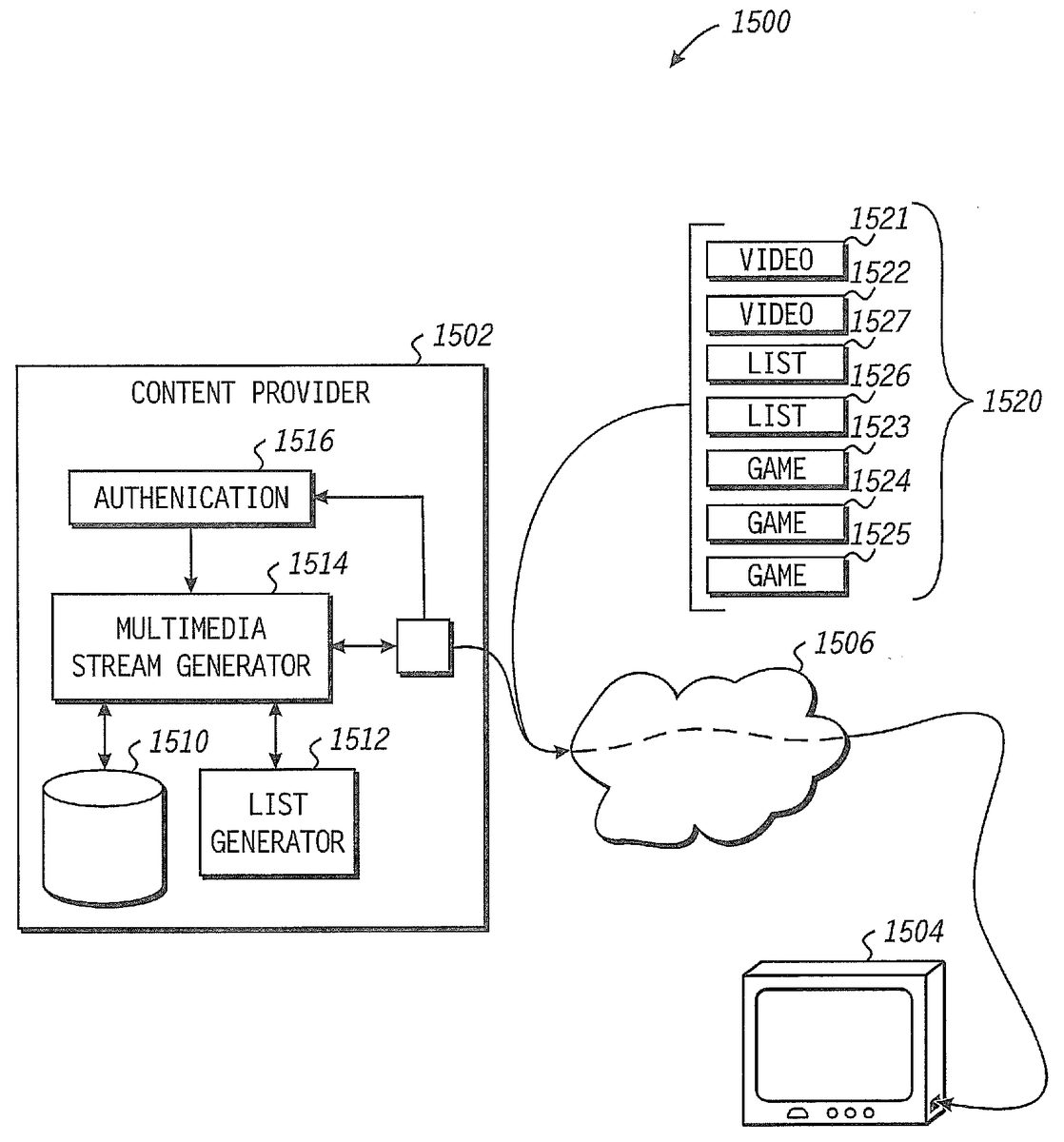
Referring toFIGS. 15-18, exemplary techniques for providing video game data via one or more transmission channels are illustrated in accordance with at least one embodiment of the present disclosure.FIG. 15illustrates an exemplary video game distribution system1500including a video game provider1502and a networked device1504connected via a network1506. The networked device1504may include any of a variety of devices capable of receiving and processing multimedia transmissions comprising a plurality of transmission channels (such as, for example, a digital cable transmission or a satellite television transmission). For ease of illustration, the networked device1504is discussed in the context of a networked television as described in detail above.
In the illustrated embodiment, the video game provider1502includes video game data storage1510for storing video game data associated with one or more video games, a list generator1512, a multimedia stream generator1514, and an authentication module1516.
In operation, the multimedia stream generator1514generates one or more multimedia data streams1520for transmission to the networked device1504. In addition to transmission channels having conventional video and/or audio data representative of television programs or radio programs, such as video channels1521and1522, one or more transmission channels of the multimedia data stream1520can include video game data, such as game channels1523-1525. Accordingly, to download the video game data associated with a particular video game, the networked device1504may select the game channel of the multimedia data stream1520associated with a desired video game and may store video game data transmitted via the selected channel.
To illustrate, a user of the networked device1504may provide a remote control command or other user input that causes the networked device to “tune” to a transmission channel selected by the user. Once “tuned” to this channel, the networked device1504may provide a request for the associated video game data from the video game provider1502. The authentication module1516authenticates an identifier associated with the user request to determine whether the user is authorized to access the video game data. If so authorized, the multimedia stream generator1514obtains the requested video game data from the video game data storage1510and inserts the requested video game data into the appropriate game channel of the multimedia data stream1520. The authentication module1516further may store the request for video game data for billing purposes associated with providing the requested video game data.
Alternately, the video game data associated with one or more video games may be inserted by the multimedia stream generator1514in a repeating manner. In this instance, once the networked device1504is “tuned” to the selected game channel, the networked device1504may delay storing the video game data in the selected game channel until the starting byte of the video game data is retransmitted in the next iteration. Rather than waiting for the starting byte of the video game data, the networked device1504instead can identify an entry point where the networked device1504began storing video game data transmitted in the selected game channel and can cease storing video game data when the identified entry point is encountered again during the next transmit iteration of the video game data. For example, if the networked device1504tunes to the selected channel and starts recording the video game data at byte1000, the networked device1504would continue to record the video game data through the end byte of the present iteration until byte999of the next iteration is encountered. Thus, the networked device1504can store the entire video game data without delaying until the start of the next iteration of the transmission of the video game data in the selected transmission channel.
The association of video games and their corresponding transmission channels may be provided to a user in any of a variety of ways. For example, a printed publication could be provided that indicates which transmission channels are used to carry the video game data of certain video games. However, the use of a printed publication typically results in a static assignment of channels and may cause inconvenience on the part of the user if the printed publication is misplaced or otherwise unavailable. Accordingly, in at least one embodiment, the list generator1512generates one or more lists for display as video content, where the lists, when displayed, provide an indication of available video games and identifiers (e.g., channel numbers) of their corresponding transmission channels. An exemplary display of a list is discussed below with reference toFIG. 16. The lists of available video games may be organized by any of a variety of characteristics, such as rankings, genres, costs, system requirements, and the like. To illustrate, the list generator1512can generate, for example, a list of the top five video game rentals, a list of the top ten bestselling video games, a list of newly introduced video games, a list of action/adventure video games, a list of role-playing video games, a list of video games suitable for children, and other lists.
Multimedia data representative of the one or more generated lists can be provided to the networked device1504as one or more list channels, such as list channels1526and1527, of the multimedia data stream1520. Accordingly, when the networked device1504is “tuned” to a list channel, the network device1504may provide the video content representative of the list associated with the selected list channel for display at the networked device. The user, upon viewing the video content representative of the list, may ascertain the transmission channel carrying data for the video game in which the user is interested. The user then can direct the networked device1504to “tune” to the identified transmission channel (using, for example, remote control commands) so that the video game data can be obtained from the identified transmission channel and stored (e.g., at the hard disk1312of the video game console modular card146,FIG. 13) for subsequent use.
Referring toFIG. 16, an exemplary display of a list of video games at a networked device (e.g., the television100,FIG. 1) is illustrated in accordance with at least one embodiment of the present disclosure. In the depicted example, the displayed list1600provides a listing of five available video games (video games A, B, C, D and E) identified as being the top five in rental frequency. Each video game listed also includes a visual indicator of the transmission channel that carries the video game data representing the video game. For example, the visual indicator may include “select channel” icons1602,1604,1606,1608, and1610corresponding to video games A, B, C, D, and E, respectively, where the icons1602,1604,1606,1608, and1610provide a visual representation of the corresponding transmission channels (e.g., channels101,102,103,104, and105). The displayed list1600further may include screen shots1612,1614,1616,1618, and1620for one or more of the listed video games, as well as written descriptions, critic reviews or ratings of the listed video games (not shown).
Referring toFIG. 17, an exemplary method1700for providing video game data as one or more transmission channels of a multimedia data stream is illustrated in accordance with at least one embodiment of the present disclosure. At block1702, a multimedia data stream is provided for reception by a display device, where the multimedia data stream includes a first channel having video content representing a first list of available video games and their corresponding channel identifiers and a second channel having video game data associated with a first video game of the first list and where the second channel is associated with a first channel identifier corresponding to the first video game. The multimedia data stream also can include other channels associated with other video games. The multimedia data stream can be provided as, for example, a digital cable television transmission or a satellite television transmission, a multimedia data stream transmitted over a packet-switched network. In at least one embodiment, the display device is a networked device, such as a networked television as discussed above.
To discourage unauthorized access, the video game data can be encrypted, such as at the video game content provider, prior to providing the multimedia data stream or prior to inserting the video game data into the multimedia data stream. Accordingly, a decryption key that is used to decrypt the encrypted video game data may be provided by the video game content provider or otherwise made available to the networked device. In one embodiment, the identification of the networked device is verified prior to providing or making the decryption key available. This verification process may include verifying that the particular display device and/or a particular user are authorized to use the video game data.
In one embodiment, the video game data associated with the first video game is provided in a continuous loop as the second transmission channel. Alternately, the video game data associated with the first video game is provided by a video game content provider in response to a user request for the video game data from the networked device. The user request may be initiated by a user remote control command directing the networked device to tune to the transmission channel identified by the first channel identifier.
As noted above, the multimedia data stream may represent the transmission of multimedia content in accordance with a service agreement or arrangement between a user and a content provider. Accordingly, at block1704the user's access of the video game data from the second channel is noted at the content provider and a charge is included in a billing statement sent to the user for the service that includes providing the multimedia data stream.
Referring toFIG. 18, an exemplary method1800for obtaining video game data from one or more channels of a multimedia data stream is illustrated in accordance with at least one embodiment of the present disclosure. The method1800includes receiving a multimedia data stream at a system including a display device at block1802. The multimedia data stream includes a first channel having video content representing a first list of available video games and their corresponding channel identifiers and a second channel having video game data associated with a first video game of the first list. The second channel is associated with a first channel identifier corresponding to the first video game. In one embodiment, the system includes a networked television (e.g., television100,FIG. 1) having a game console modular card (e.g., game console modular card146,FIG. 1) to process the received data. In one embodiment, the storage of video game data at a hard disk1312(FIG. 13) of the game console modular card146is handled by the video game tuner1316.
At block1804, the video content representing the first list of games is provided for display at the display device. In the event that the system includes a networked television as described above, the networked television may include a decoder, such as an integrated decoder or a decoder modular card140(FIG. 1) to generate display data representative of the video content of the first channel for viewing by the user. At block1806, user input indicating a selection of the first channel identifier associated with the first video game of the first list is received in response to display of the video content. The user input may include, for example, a request to “tune” the system to the transmission channel associated with the first channel identifier, where the request may be a remote control command or input received via, for example, a channel change button.
At block1808, the video game data associated with the first video game from the second channel is obtained for storage at the system in response to receiving the user input. As noted above, the video game data may be provided in a single transmission at a predetermined time or in a continuous loop or the video game data can be added to the multimedia data stream in response to a request by the user. In the event that the data is provided in a continuous loop, obtaining the video game data can include identifying a start position within a present loop of the video game data and continuing to store the video game data until a corresponding position to the start position is encountered for the next loop of the video game data. In the event that the video game data is encrypted, at block1810, a decryption key can be received at the system in response to a verification of an identification of the system. At block1812, the video game data can be decrypted using the decryption key. In the event that the system includes the networked television100, the obtained video game data can be stored at the hard disk1312(FIG. 13) of the video game console modular card146of the television100for subsequent processing to provide game play to a user.
The above-disclosed subject matter is to be considered illustrative, and not restrictive, and the appended claims are intended to cover all such modifications, enhancements, and other embodiments, which fall within the scope of the present disclosure. Thus, to the maximum extent allowed by law, the scope of the present disclosure is to be determined by the broadest permissible interpretation of the following claims and their equivalents, and shall not be restricted or limited by the foregoing detailed description.
Claims
- A method comprising: receiving a multimedia data stream from a content provider at processor of a device, wherein the multimedia data stream comprises a first channel having video content representing a first list of available video games and corresponding channel identifiers and an encrypted second channel having video game data associated with a first video game of the first list;sending, via the processor, data of the first channel to a display device coupled to the device to generate a presentation of the available video games;receiving user input selecting the first video game from the presentation at the processor;sending, via the processor, an identification of the device and a channel indicator corresponding to the encrypted second channel to the content provider in response to the user input;receiving, at the processor, a decryption key for the encrypted second channel in response to verification of the identification of the device;decrypting the encrypted second channel with the processor;beginning storage of the video game data decoded from the encrypted second channel to a video game storage unit in response to detecting a starting byte of the video game data;and ending storage of the video game data decoded from the encrypted second channel in response to re-detecting the starting byte.
- The method of claim 1 , further comprising sending the video game data to a game console modular card to process the video game data to generate a first video game display and to send the first video game display to the display device.
- The method of claim 1 , further comprising sending the video game data to one or more second devices coupled to the device by a network.
- The method of claim 3 , further comprising receiving a limitation number of devices from the content provider, wherein a number of devices of the one or more second devices that receive the video game data from the device does not exceed the limitation number.
- The method of claim 1 , wherein the available video games identified in the first list correspond to a particular category of video games.
- The method of claim 1 , wherein the user input is received via a remote control device associated with the device.
- A system comprising: a first interface to receive a multimedia data stream, wherein the multimedia data stream comprises a first channel having video content representing a first list of available video games and an encrypted second channel having video game data associated with a video game included in the first list;a decoder to send a presentation of the first channel to a display device;a control interface to receive user input that indicates a selection of a channel identifier associated with the video game from the presentation;a video game storage unit to: send an identification of the system and an identifier of the second channel to a content provider;and receive a decryption key to decrypt the video game data of the encrypted second channel in response to verification of the identification of the system by the content provider;and obtain video game data associated with the video game by decoding the encrypted second channel using the decryption key, wherein the video game storage unit is configured to initiate storage of the video game data in response to detecting a starting byte of the video game data is detected and to cease storage of the video game data in response to detecting the starting byte again;and a first modular card receptacle coupled to the first interface, the first modular card receptacle configured to receive a game console modular card to process the video game data.
- The system of claim 7 , further comprising the game console modular card coupled to the first modular card receptacle.
- The system of claim 8 , wherein the video game storage unit is a component of the game console modular card.
- The system of claim 8 , wherein the game console modular card sends a display of the video game to the display device.
- The system of claim 7 , wherein the decoder is configured to decode the encrypted second channel to generate unencrypted second channel data.
- The system of claim 11 , wherein the decoder is configured to distribute the unencrypted second channel data to one or more networked devices.
- The system of claim 7 , wherein the first interface comprises at least one of a network interface to a packet-based network and a cable interface to receive a digital cable television transmission including the multimedia data stream.
- The system of claim 7 , wherein the user input is received at the control interface from a remote control device.
- A computer-readable storage device comprising instructions executable by a processor to perform operations comprising: receiving a multimedia data stream from a content provider, wherein the multimedia data stream comprises a first channel having video content representing a first list of available video games for a particular game category and corresponding channel identifiers, and an encrypted second channel having video game data associated with a first video game of the first list;sending the first channel to a display device to display a presentation of the available video games;receiving user input selecting the first video game from the presentation;send an identification of a system and a channel indicator corresponding to the encrypted second channel to the content provider in response to the user input;receiving a decryption key for the encrypted second channel in response to verification of the identification of the system by the content provider;decrypting the encrypted second channel to generate a decoded second channel;beginning storage of the video game data from the decoded second channel to a video game storage unit in response to detecting a starting byte of the video game data;ending storage of the video game data when the starting byte is redetected;and sending the video game data to a game console card to process the video game data.
- The computer-readable storage device of claim 15 , wherein the operations further comprise sending information corresponding to the selection of the first video game to the content provider for billing purposes.
- The computer-readable storage device of claim 15 , wherein the operations further comprise distributing the video game data to one or more networked devices.
- The computer-readable storage device of claim 15 , wherein the video game storage unit is a component of the game console card.
- The computer-readable storage device of claim 15 , wherein the user input is received via a remote control interface that receives remote control commands from a remote control device.
- The computer-readable storage device of claim 15 , wherein the presentation includes a screen shot of the first video game.
Disclaimer: Data collected from the USPTO and may be malformed, incomplete, and/or otherwise inaccurate.