DETAILED DESCRIPTION OF THE PREFERRED EMBODIMENT For a better understanding of the present invention, together with other and further objects, advantages and capabilities thereof, reference is made to the following disclosure and appended claims in connection with the above-described drawings. It is understood that like numerals will be used to indicate like elements from drawing figure to drawing figure. In accordance with the present invention there is provided a vocally interactive video gaming mechanism. A microphone is connected to a video game system for allowing a player in a room to communicate by voice within the game. A video recording device is also provided for scanning and recording the physical characteristics of the player to be projected into the gaming world. A holographic projector projects the recorded physical characteristics of the player into the room in which the player is engaged in the game. The system uses optional controllers with handheld devices, sensors and cameras to track the player's entire body. Separately available controllers may utilize accelerometers and/or gyroscopes for better precision and to detect motion. Infrared emitters and image sensors create detailed images that may be stored with computer programs, transmitted to various electronic devices for player action/viewing, and projected into detailed 3-D images via infrared projectors disposed in front of the player. The projectors can be adjusted for color, contrast, and/or size. The cameras can detect X-Y-Z positions while the emitters can provide X-Y positions. Referring now toFIG. 1, there is shown an image of an avatar and a living person being scanned by the hardware of the present invention, generally identified as reference numeral10. The avatar12is selected by a player14and is the subject of a projection into the room, not shown, in which the player14resides. The actual player14is scanned by an appropriate camera residing in or connected ...
DETAILED DESCRIPTION OF THE PREFERRED EMBODIMENT
For a better understanding of the present invention, together with other and further objects, advantages and capabilities thereof, reference is made to the following disclosure and appended claims in connection with the above-described drawings. It is understood that like numerals will be used to indicate like elements from drawing figure to drawing figure.
In accordance with the present invention there is provided a vocally interactive video gaming mechanism. A microphone is connected to a video game system for allowing a player in a room to communicate by voice within the game. A video recording device is also provided for scanning and recording the physical characteristics of the player to be projected into the gaming world. A holographic projector projects the recorded physical characteristics of the player into the room in which the player is engaged in the game.
The system uses optional controllers with handheld devices, sensors and cameras to track the player's entire body. Separately available controllers may utilize accelerometers and/or gyroscopes for better precision and to detect motion. Infrared emitters and image sensors create detailed images that may be stored with computer programs, transmitted to various electronic devices for player action/viewing, and projected into detailed 3-D images via infrared projectors disposed in front of the player. The projectors can be adjusted for color, contrast, and/or size. The cameras can detect X-Y-Z positions while the emitters can provide X-Y positions.
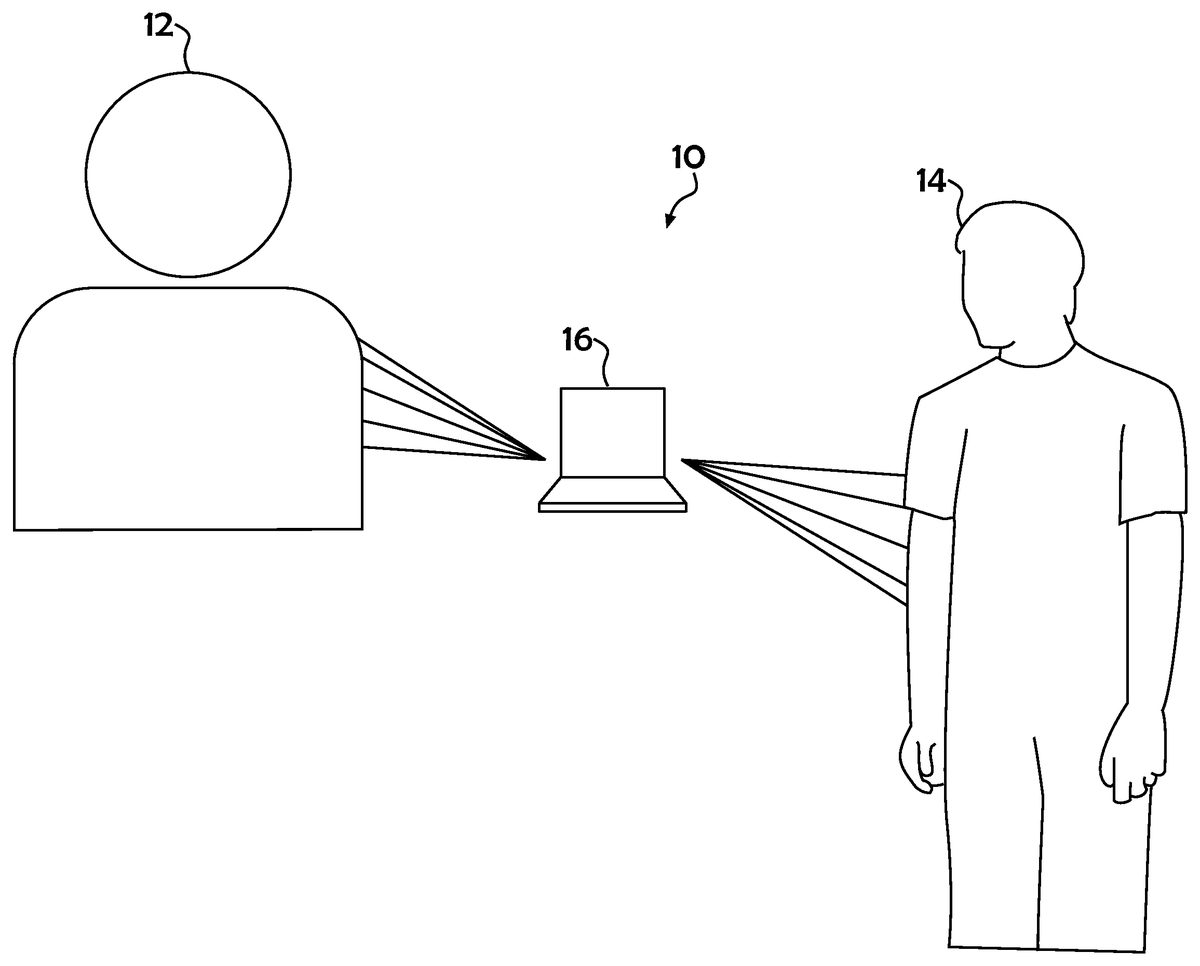
Referring now toFIG. 1, there is shown an image of an avatar and a living person being scanned by the hardware of the present invention, generally identified as reference numeral10. The avatar12is selected by a player14and is the subject of a projection into the room, not shown, in which the player14resides. The actual player14is scanned by an appropriate camera residing in or connected to a processor16. Processor16includes a video camera, microphone, speaker, and scanner/projector, some or all of which may be disposed within processor16or electronically operatively connected thereto by hardwire or wirelessly. Processor16may also reside in a handheld device, as described hereinbelow.
The camera is a video camera, as is known in the art, capable of capturing moving images, so that movements of player14are projected in three dimensions in real time. Alongside this projected image is an image of avatar12. Player14can adjust color, contrast, and size of the 3-D projection. In this way, the movements of avatar12mirror the movements of player14. Multiple players can use the system of the invention10to control the movements of respective avatars. Moreover, multiple players can play each other via their respective avatars via the Internet. A language translator residing in processor16can also be used to translate languages of the various players, if necessary.
Referring now toFIG. 2, there is shown a handheld implementation of the present invention. A handheld device20, such as a cell phone, can be used to interact with the images of one or more players22. The computer-generated character can be another living person scanned into the game and playing over the Internet, a wireless communications telephone network, or, as shown, can reside in the same room as the handheld device20. Handheld device20has pre-recording abilities, as well as freeze/pause action and save/store functions. Again, single and/or multi-player support and language translation, all in real time, can be provided. Living person22is scanned or has been scanned. His or her image is transmitted into handheld device20to play in the video game. The image has already been fully scanned and software allow the living player22to control his actions on the screen-scanned image via the keypad of handheld device20. Moreover, living player22can speak into a microphone operatively connected to processor16(FIG. 1), so that the words and sound appear to emanate from device20with mouth, facial, and body movements that coincide with the image of avatar12(FIG. 1) displayed on device20.
Referring now toFIG. 3, there is shown the inventive system30used with a plurality of live players32a,32b, . . . ,32nand their respective avatar images34a,34b, . . . ,34n. The plurality of players can play with or against each other via the Internet or with the use of a telecommunications network, as required by devices such as cell phones, not shown. Each player can interact with other players from their respective homes or from one common location. Moreover, each player can represent himself or herself as a 3-D projection or as his or her avatar character.
Since other modifications and changes varied to fit particular operating requirements and environments will be apparent to those skilled in the art, the invention is not considered limited to the example chosen for purposes of this disclosure, and covers all changes and modifications which do not constitute departures from the true spirit and scope of this invention.
Having thus described the invention, what is desired to be protected by Letters Patent is presented in the subsequently appended claims.