U.S. Pat. No. 8,517,838
ONLINE GAME SYSTEM AND METHOD OF DATA RESOURCE HANDLING FOR AN ONLINE GAME
AssigneeXpec Entertainment Inc.
Issue DateSeptember 21, 2011
Illustrative Figure
Abstract
An online game system is capable of connection with a client through a communication network to provide an online game to the client. The online game system includes a gaming logic server cluster and a network resource server cluster. The gaming logic server cluster is configured for providing at least one of client login service, client account service, game logic operation service, game database service and data backup service related to the online game. The network resource server cluster is configured for providing data resources associated with gaming images of the online game to the client.
Description
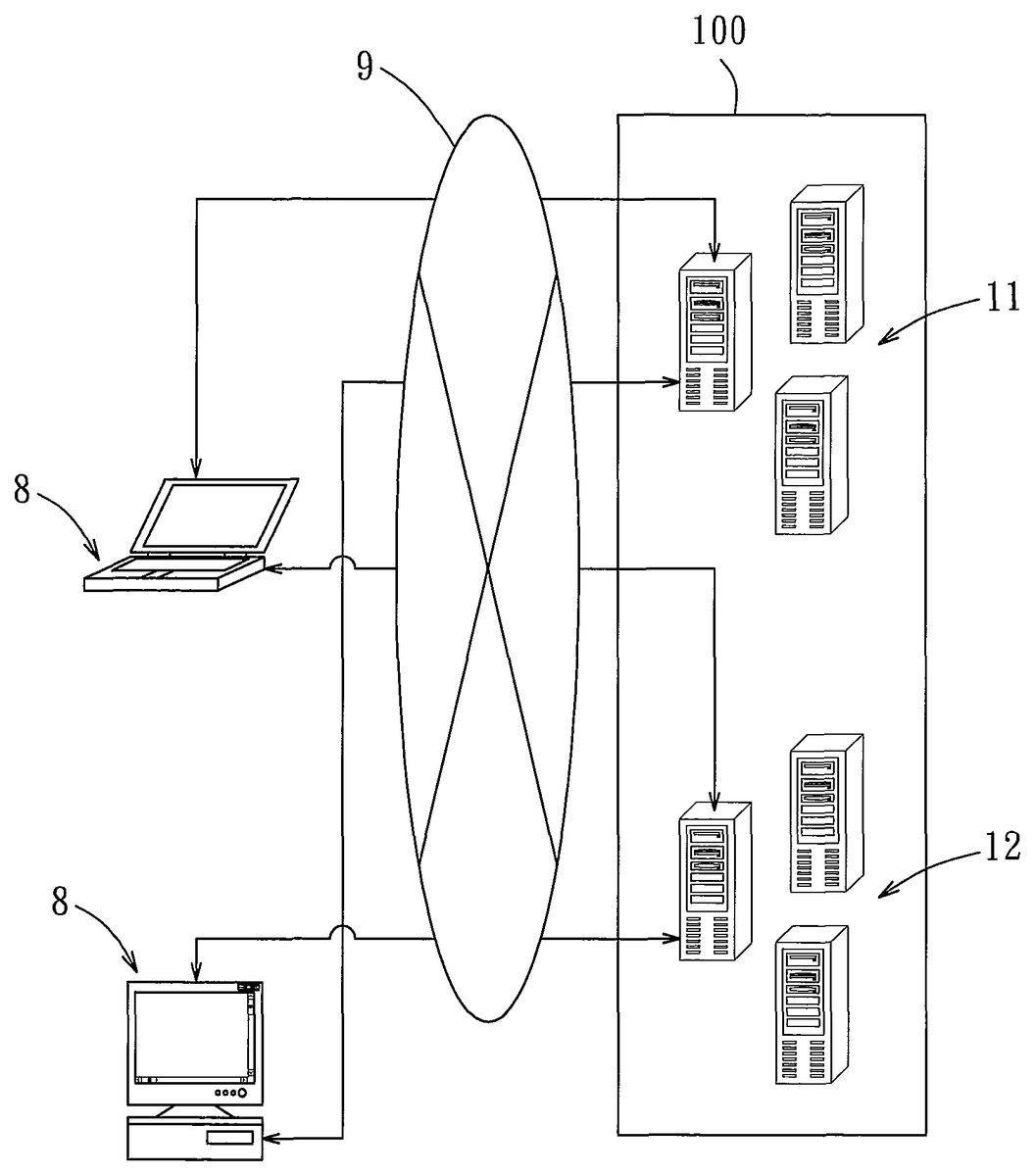
DETAILED DESCRIPTION OF THE PREFERRED EMBODIMENT Referring toFIG. 1, a preferred embodiment of an online game system100according to this invention includes a gaming logic server cluster11and a network resource server cluster12. The online game system100is capable of connection with a plurality of clients8through a communication network9to provide an online game or a web game that has a virtual world with a plurality of virtual zones to the clients8, such a massive multiplayer online role-playing game (abbreviated as MMORPG). In practice, the communication network9may be a wired network, or a wireless network such as the general packet radio service (GPRS), the 3RDgeneration mobile telecommunication (3G), and the worldwide interoperability for microwave access (WiMAX). In this embodiment, connection between the gaming logic server cluster11and the clients8is a full-duplex connection based upon a transmission control protocol (TCP) socket for communication related to logic operation of the online/web game. On the other hand, connection between the network resource server cluster12and the clients8is based on the hyper text transfer protocol (HTTP) for data transmission through the HTTP. In particular, the network resource server cluster12is configured to transmit data resources to the clients8in response to requests from the clients8. It should be noted that the gaming logic server cluster11is not directly connected to the network resource server cluster12, and the clients8connected to the gaming logic server cluster11can download the data resources from the network resource server cluster12so that the load of the online game system100can be shared. Referring toFIG. 2, the gaming logic server cluster11is configured to provide client login service, client account service, game logic operation service, game database service and data backup service related to the online/web game. In this embodiment, the gaming logic server cluster11includes a login server111, an account server112, a global game server113, a plurality of game zone servers114, a database ...
DETAILED DESCRIPTION OF THE PREFERRED EMBODIMENT
Referring toFIG. 1, a preferred embodiment of an online game system100according to this invention includes a gaming logic server cluster11and a network resource server cluster12. The online game system100is capable of connection with a plurality of clients8through a communication network9to provide an online game or a web game that has a virtual world with a plurality of virtual zones to the clients8, such a massive multiplayer online role-playing game (abbreviated as MMORPG). In practice, the communication network9may be a wired network, or a wireless network such as the general packet radio service (GPRS), the 3RDgeneration mobile telecommunication (3G), and the worldwide interoperability for microwave access (WiMAX).
In this embodiment, connection between the gaming logic server cluster11and the clients8is a full-duplex connection based upon a transmission control protocol (TCP) socket for communication related to logic operation of the online/web game. On the other hand, connection between the network resource server cluster12and the clients8is based on the hyper text transfer protocol (HTTP) for data transmission through the HTTP. In particular, the network resource server cluster12is configured to transmit data resources to the clients8in response to requests from the clients8. It should be noted that the gaming logic server cluster11is not directly connected to the network resource server cluster12, and the clients8connected to the gaming logic server cluster11can download the data resources from the network resource server cluster12so that the load of the online game system100can be shared.
Referring toFIG. 2, the gaming logic server cluster11is configured to provide client login service, client account service, game logic operation service, game database service and data backup service related to the online/web game. In this embodiment, the gaming logic server cluster11includes a login server111, an account server112, a global game server113, a plurality of game zone servers114, a database server115, and a backup server116. Each of the game zone servers114is associated with a respective one of the virtual zones of the virtual world of the online/web game, and with a respective Internet protocol (IP) address. The database server115and the backup server116are configured to provide the game database service (e.g., storage of account information of players of the online/web game) and the data backup service, respectively.
The login server111and the account server112are configured for a short-term connection with the client8. In particular, the login server111is operable to actively disable the connection with the client8after verification of identity of the client8is successful. Then, the account server112is operable to allow the client8to manage characters of an account associated therewith, and is configured to be connected to the client8until the player associated with the client8inputs a start command to play the online/web game. The management of the characters of the account includes, for example, creation of a new character, deletion of an existing character, etc.
Different from the short-term connection, the global game server113and the game zone servers114are configured for a long-term connection with the client8. The global game server113is configured for the logic operation related to the entire virtual world of the online/web game, for example, chatting among the players around the virtual world and data synchronization of the account information of the players. After a player associated with the client8inputs the start command to play the online/web game, the global game server113is connected to the client8until the player inputs a logout command to finish the online/web game or directly closes a browser that is running the online/web game. During the online/web game, the client8is only connected to one of the game zone servers114that is associated with one of the virtual zones where a virtual character of the account of the player associated with the client8is currently located. When the virtual character moves to another one of the virtual zones, the client8is disconnected from said one of the game zone servers114and is connected to another one of the game zone servers114that is associated with said another one of the virtual zones.
Regarding hardware construction of the gaming logic server cluster11, the global game server113and the game zone servers114are not built in the same physical server, and the database server115and the backup server116are separately built as respective physical servers. For the logic operation, the login server111, the account server112, the global game server113and the game zone servers114are connected with each other and are further connected to the database server115.
Referring toFIG. 3, the network resource server cluster12is configured to provide various data resources related to the gaming images (such as the data resources related to scenes, animation, video effects, etc.) to the client8connected thereto. The network resource server cluster12includes a load balancer121, and a plurality of data servers122(only one is shown inFIG. 3for convenience of illustration) connected to the load balancer121and to a preprocessing unit3. In this embodiment, the data servers122are Apache Web servers supporting the HTTP service. The connection between the network resource server cluster12and the client8is a short-term connection, and the network resource server cluster12will not store any information of the client8.
The data servers122of the network resource server cluster12store respective files (seeFIG. 6) corresponding respective sets of the data resources. Each of the files has a content data block62that includes a plurality of content data sets of a corresponding one of the sets of the data resources, and a file header61that describes a number of the content data sets, and a size and a name length of each of the content data sets. The load balancer121of the network resource server cluster12is configured to receive a resource request from the client8, and is operable to provide one of the sets of the data resources according to a corresponding one of the files that is associated with the resource request received from the client8.
Referring toFIGS. 4A and 4B, the online game system100is configured to implement a method of data resource handling for the online/web game. The method includes the following steps.
In step S301, the client8is operable to send a stowage resource request to the network resource server cluster12. Then, in step S41, the network resource server cluster12is operable to provide a resource stowage to the client8in response to the stowage resource request. The resource stowage is used for obtaining from designated positions the data resources to be used by a main program of the online/web game.
In step S302, the client8is operable to send a program resource request to the network resource server cluster12. Then, in step S42, the network resource server cluster12is operable to provide the main program to the client8in response to the program resource request. The main program is a portal program of the online/web game, and bundles a set of data resources and is downloaded by the client8with the resource stowage obtained in step S41.
In step S303, the client8is operable to send a login request with an account number and a password to the login server111. In response to the login request from the client8, the login server111is operable, in step S43, to verify identity of the client8in response to the login request and to send a verification code to the client when verification of the identity of the client8is successful. The verification code enables the client8to issue a character request.
In step S304, the client8is configured to send the character request to the account server112. Then, in response to the character request from the client8, the account server112is operable, in step S44, to send character information of a virtual character associated with the client8(i.e., associated with the account number provided by the client8in step S303). The character information includes, for example, unique identification, name, level, character profession, sex and equipments of the virtual character, and a payment state of the account associated with the virtual character. The character information enables the client8to issue a game request.
In step S305, the client8is configured to send an avatar resource request to the network resource server cluster12. In response to the avatar resource request from the client8, the network resource server cluster12is operable to provide the data resources related to an avatar of the virtual character to the client8in step S45.
In step S306, the client8is configured to send the game request with the account number and the verification code received in step S43to the global game server113for accessing the global game server113. In response to the game request from the client8, the global game server113is operable to implement data initialization in step S461, and to send the IP address of one of the game zone servers114associated with the respective virtual zone where the virtual character associated with the client8is currently located in step S462. In particular, the global game server113is operable to read detailed information of the virtual character (e.g., a friend list, a guild to which the virtual character belongs, etc.), and to dispose the virtual character into the virtual world of the online/web game. Thus, after the client8accesses the global game server113, the player associated with the client8can communicate with other players through the virtual character, and the global game server113is operable to determine which one of the virtual zones in the virtual world where the virtual character is currently located and to send the IP address of a corresponding one of the game zone servers114that is associated with said one of the virtual zones to the client8.
Then, the client8is configured to send a static resource request to the network resource server cluster12in step S307, and the network resource server cluster12is operable, in response to the static resource request, to provide static data resources to the client8in step S47. In should be noted that the static data resources are necessary for starting the online/web game, and include, for example, visual data resources related to the gaming images (such as information and picture resources for displaying the virtual zone where the virtual character is currently located) and static information of the online/web game (such as information of various equipments, items, character profession, skills, etc.).
In step S308, the client8is configured to send an access request with the account number and the verification code received in step S43to the corresponding one of the game zone servers114that is associated with the IP address received in step S462. Then, in response to the access request, the corresponding one of the game zone servers114is operable to allow connection with the client8and to implement zone data initialization in step S48. In the zone data initialization, the corresponding one of the game zone servers114is operable to handle and process the data including the virtual zone where the virtual character is currently located, a position of the virtual character in the virtual zone and other virtual characters nearby, and to send a notification to these nearby virtual characters.
The client8is configured to send an active resource request to the network resource server cluster12in step S309, and the network resource server cluster12is operable, in response to the active resource request, to provide active data resources to the client8in step S49. Compared with the static data resources, the active data resources are not involved with the logic operation and are actively and frequently used in the online/web game. Therefore, it is not required to load the active data resources before the online/web game starts. The active data resources include, for example, a module of appearance of the virtual character, appearance of non-player characters and monsters, etc.
Referring toFIGS. 3,5and6, the preprocessing unit3connected to the network resource server cluster12includes a converter31and a bundler32. As described above, the data servers122of the network resource server cluster12store the plural files corresponding to the respective sets of the data resources, and each of these files is generated using the preprocessing unit3to implement a bundling procedure with the following steps.
The converter31is operable, in step S501, to convert format of the data resources of the online/web game (e.g., the XML format) into a self-defined format that is accessible to the main program and that is easier to be used and occupies less resource in the online/web game. In step S502, the bundler32is operable to classify the sets of the data resources according to types of the data resources, such as the static data resources and the active data resources. In step S503, the bundler32is operable to make statistics and to obtain information of the data resources. In step S504, the bundler32is operable to segment the data resources according to a predetermined file length, and to arrange the content data sets of the data resources in a specific order.
Then, for each set of the data resources, the bundler32is operable to generate the file header61of the file corresponding to the set of the data resources in step S505, and to allocate the content data sets into the content data block62of the file according to the specific order in step S506. In step S507, the bundler32is operable to determine whether all of the content data sets of the set of the data resources have been allocated into the file. The bundler32is operable to further determine whether the content data block reaches a predetermined length limit in step S508when there are still some of the content data sets that have not yet been allocated into the file, and to implement step S510to store the file to a corresponding one of the data servers122so as to complete the bundling procedure when otherwise. When it is determined that the predetermined length limit is reached in step S508, the bundler32is operable to complete the allocation of the content data sets in step S509and the flow goes back to step S505. When it is determined that the predetermined length limit has not yet been reached in step S508, the flow goes back to step S506.
As shown inFIG. 3, the client8includes a resource pool81, a management unit82, a stowage unit83, and a merging unit84.
The resource pool81is configured to store the data resources received from the network resource server cluster12, and to pack related data resources. For example, the visual data resources related to the gaming images are packed and compressed into a SWF file. The resource pool81is further configured to manage service lives of the data resources. Namely, how long the data resources are used, and when and how the data resources are deleted are managed by the resource pool81according to a preset rule.
The management unit82is configured to integrate access of the data resources, and to automatically monitor the data resources for releasing the data resources that are not used anymore from memory of the client8according to a predefined strategy. In this way, utilization of the data resources and efficiency of the memory of the client8are balanced. Further, the management unit82is operable to dispatch various functional modules of the client8(i.e., the resource pool81, the stowage unit83, the merging unit84, etc.), and to create the functional modules using an object-oriented design pattern (e.g., the factory method pattern).
Before starting the online/web game, the stowage unit83is operable to read parts of the data resources that are frequently used and to arrange these data resources in various batches. Thus, the client8may smoothly execute the online/web game by reading relatively less data resources, and display relatively smoother and finer gaming images to the player.
The merging unit84is configured to merge the data resources stored in the resource pool81, and to unpack and decompress the data resources so as to obtain a completed set of the data resources. In this way, it is ensured that the stowage unit83can obtain the completed set of the data resources from the resource pool81through the merging unit84.
In summary, the online game system100according to this invention includes the gaming logic server cluster11and the network resource server cluster12so that the load of the online game system100can be shared. Further, the data servers122of the network resource server cluster12store the respective files, and the content data sets of the data resources are segmented and are arranged in the specific order. Thus, it is relatively easier and faster to provide the data resources to the client8according to a corresponding one of the files that is associated with the resource request received from the client8.
While the present invention has been described in connection with what is considered the most practical and preferred embodiment, it is understood that this invention is not limited to the disclosed embodiment but is intended to cover various arrangements included within the spirit and scope of the broadest interpretation so as to encompass all such modifications and equivalent arrangements.
Claims
- An online game system capable of connection with a client through a communication network to provide an online game to the client, said online game system comprising: a gaming logic server cluster for providing at least one of client login service, client account service, game logic operation service, game database service and data backup service related to the online game;and a network resource server cluster for providing data resources associated with gaming images of the online game to the client, wherein said network resource server cluster stores a plurality of files corresponding respectively to sets of the data resources, each of the files having a content data block that includes a plurality of content data sets of a corresponding one of the sets of the data resources and a file header that describes a number of the content data sets, and a size and a name length of each of the content data sets, said network resource server cluster being configured to receive a resource request from the client and being operable to provide one of the sets of the data resources according to a corresponding one of the files that is associated with the resource request received from the client.
- The online game system as claimed in claim 1 , wherein said gaming logic server cluster includes: a login server configured to receive a login request from the client and operable to verify identity of the client in response to the login request and to send a verification code to the client when verification of the identity of the client is successful, the verification code enabling the client to issue a character request;an account server configured to receive the character request from the client and operable to send character information of a virtual character associated with the client in response to the character request, the character information enabling the client to issue a game request;a plurality of game zone servers each associated with a respective virtual zone of the online game and with a respective Internet protocol address;and a global game server configured to receive the game request from the client and operable to send the Internet protocol address of one of said game zone servers associated with the respective virtual zone where the virtual character associated with the client is currently located, wherein said one of said game zone servers associated with the respective virtual zone where the virtual character associated with the client is currently located is operable to provide game progress services to the client upon connection with the client.
- The online game system as claimed in claim 1 , wherein connection between said gaming logic server cluster and the client is a full-duplex connection based upon a transmission control protocol socket.
- The online game system as claimed in claim 1 , wherein connection between said network resource server cluster and the client is based on the hyper text transfer protocol.
- The online game system as claimed in claim 1 , wherein the data resources provided by said network resource server cluster are selected from static data resources and active data resources.
- A method of data resource handling for an online game, comprising: a) providing a gaming logic server cluster configured to provide at least one of client login service, client account service, game logic operation service, game database service and data backup service related to the online game;and b) providing a network resource server cluster configured to provide data resources associated with gaming images of the online game to a client, wherein the network resource server cluster stores a plurality of files corresponding respectively to sets of the data resources, each of the files having a content data block that includes a plurality of content data sets of a corresponding one of the sets of the data resources and a file header that describes a number of the content data sets, and a size and a name length of each of the content data sets, the network resource server cluster being configured to receive a resource request from the client and being operable to provide one of the sets of the data resources according to a corresponding one of the files that is associated with the resource request received from the client.
- The method as claimed in claim 6 , wherein the gaming logic server cluster includes: a login server configured to receive a login request from the client and operable to verify identity of the client in response to the login request and to send a verification code to the client when verification of the identity of the client is successful, the verification code enabling the client to issue a character request;an account server configured to receive the character request from the client and operable to send character information of a virtual character associated with the client in response to the character request, the character information enabling the client to issue a game request;a plurality of game zone servers each associated with a respective virtual zone of the online game and with a respective Internet protocol address;and a global game server configured to receive the game request from the client and operable to send the Internet protocol address of one of the game zone servers associated with the respective virtual zone where the virtual character associated with the client is currently located, wherein said one of the game zone servers associated with the respective virtual zone where the virtual character associated with the client is currently located is operable to provide game progress services to the client upon connection with the client.
- The method as claimed in claim 6 , wherein the data resources provided by the network resource server cluster are selected from static data resources and active data resources.
- A method of data resource handling for an online game, said method to be implemented using an online game system that includes a plurality of data servers and comprising: i) configuring the online game system for classifying a plurality of sets of data resources of the online game according to types of the data resources;ii) configuring the online game system for generating a plurality of files corresponding to respective sets of the data resources of the online game, each of the files having a content data block that includes a plurality of content data sets of a corresponding one of the sets of the data resources and a file header that describes a number of the content data sets, and a size and a name length of each of the content data sets;iii) configuring the online game system for storing the files in respective ones of the data servers according to the classification made in step i);and iv) configuring the online game system for receiving a resource request from a client and for providing the data resources stored in one of the data servers according to a corresponding one of the files that is associated with the resource request received from the client.
- The method as claimed in claim 9 , wherein, in step i), the data resources are classified into static data resources and active data resources.
Disclaimer: Data collected from the USPTO and may be malformed, incomplete, and/or otherwise inaccurate.