U.S. Pat. No. 8,506,396
ONLINE GAME TO PROMOTE PHYSICAL ACTIVITY
AssigneeHumana Inc.
Issue DateApril 8, 2010
Illustrative Figure
Abstract
An online game that promotes physical activity by visually representing the comparative biometric data of a group of people. The biometric data may be collected using a variety of biometric devices. Each individual in the group selects an avatar for use in representing the biometric data. The biometric data is transmitted to a server and displayed collectively on a computer screen. Each individual's avatar is displayed on the screen and animated according the biometric data. In an example embodiment in which avatars are fish that are displayed on a fish tank background and the biometric data is steps counted by a pedometer, avatars associated with individuals having a higher step count are positioned above avatars for individuals having a lower step count. Biometric data may be collected from biometric devices at various time intervals and the display updated to reflect the changes in biometric data.
Description
DETAILED DESCRIPTION In one exemplary embodiment an on-line game provides visual representations of the number of steps game users have taken as reported by pedometers that the users are wearing. Referring toFIG. 1, a sample main tank page according to an example embodiment is shown. The main tank page elements include a fish tank100that has a background image102, and multiple fish avatars104that are comprised of different types of fish and are located throughout the tank100. Each avatar104represents a different user of the game. The fish avatars104inFIG. 1are animated and move around the tank100in such as way as to simulate swimming. In some embodiments someone observing the fish tank on a touch screen can tap an avatar104to find out more about the person it represents. In these embodiments, when an avatar104is tapped, an on-screen tag106appears near the avatar104that shows information about the avatar104and the person that the avatar104represents. As shown inFIG. 1, an avatar104in the form of a catfish108has been tapped and the tag106shows a profile picture110of the user and the user's name112, which inFIG. 1is “Martin R.” The tag106also shows activity level information114, which in this example is that Martin R. has taken 120,579 steps. In other embodiments, user information different from that shown inFIG. 1may be shown on the tags106. For example, in embodiments played by users in a work office environment, the tags106may show the professional title of a user or the department they work in. In other embodiments different information may appear on the tags106. When a user is viewing the tank100on a screen that is not a touch screen, an avatar tag106may be viewed by clicking a mouse over the avatar104or otherwise selecting the avatar104. Referring toFIG. 2, a sample user log-in page according to an example embodiment is shown. The log-in page elements include a ...
DETAILED DESCRIPTION
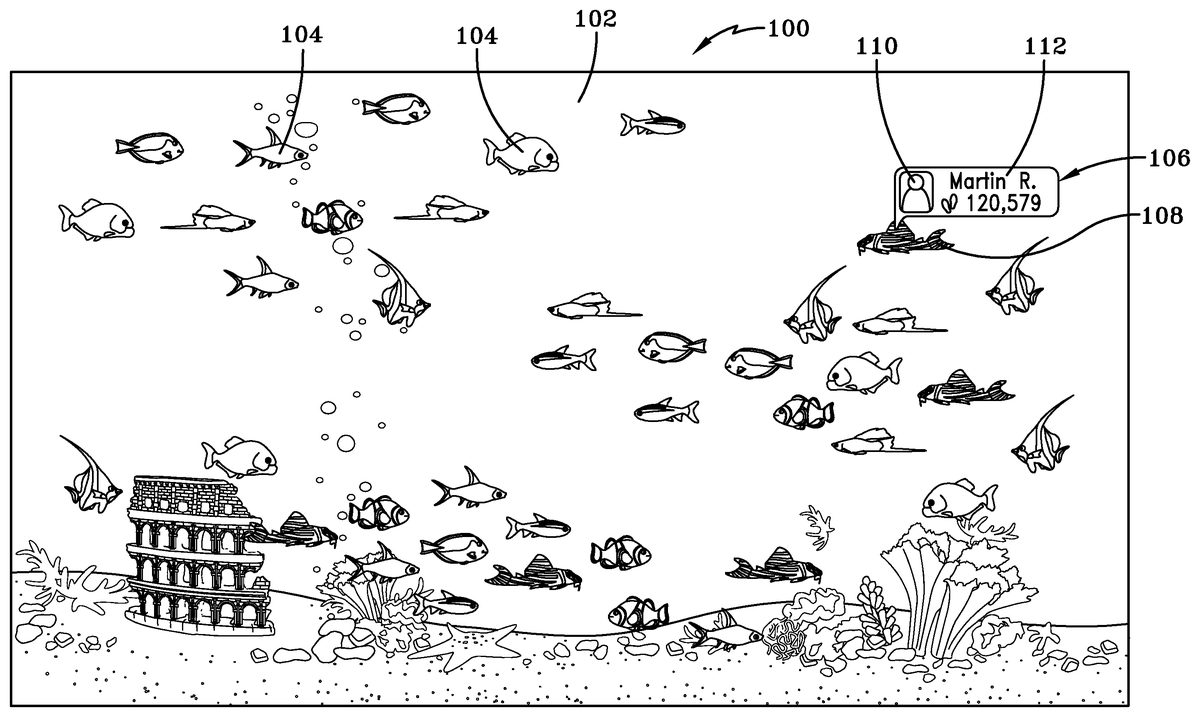
In one exemplary embodiment an on-line game provides visual representations of the number of steps game users have taken as reported by pedometers that the users are wearing. Referring toFIG. 1, a sample main tank page according to an example embodiment is shown. The main tank page elements include a fish tank100that has a background image102, and multiple fish avatars104that are comprised of different types of fish and are located throughout the tank100. Each avatar104represents a different user of the game. The fish avatars104inFIG. 1are animated and move around the tank100in such as way as to simulate swimming.
In some embodiments someone observing the fish tank on a touch screen can tap an avatar104to find out more about the person it represents. In these embodiments, when an avatar104is tapped, an on-screen tag106appears near the avatar104that shows information about the avatar104and the person that the avatar104represents. As shown inFIG. 1, an avatar104in the form of a catfish108has been tapped and the tag106shows a profile picture110of the user and the user's name112, which inFIG. 1is “Martin R.” The tag106also shows activity level information114, which in this example is that Martin R. has taken 120,579 steps. In other embodiments, user information different from that shown inFIG. 1may be shown on the tags106. For example, in embodiments played by users in a work office environment, the tags106may show the professional title of a user or the department they work in. In other embodiments different information may appear on the tags106. When a user is viewing the tank100on a screen that is not a touch screen, an avatar tag106may be viewed by clicking a mouse over the avatar104or otherwise selecting the avatar104.
Referring toFIG. 2, a sample user log-in page according to an example embodiment is shown. The log-in page elements include a background image102that is the same as that inFIG. 1, and a log-in section114. The log-in section114contains two text boxes116for entering a user's log-in name and password. The log-in section114also includes a button a user may select to log in once a user has entered their log-in information118and a button that routes the user to the main tank page120.
Referring toFIG. 3, a sample fitness profile page according to an example embodiment is shown. The fitness profile page elements include a background image102that is the same asFIGS. 1 and 2, and a fitness profile section122. The fitness profile section122contains the profile picture110of the user and an image of the user's avatar104. The fitness profile section122also contains visual representations of the user's daily activity levels124. InFIG. 3the current daily activity level and the past seven daily activity levels are shown, but in other embodiments different time frames of daily activity levels124may be shown. Also, in some embodiments the user may be able to access past daily activity level data that is no longer shown. InFIG. 3the daily activity levels124are represented as vertical bars126with heights that correspond to the number of steps the user took on a particular day. The number of steps taken each day is printed on each bar126. The daily activity levels124include the activity level of the current day, which in this example is April 9th, and the number of steps taken on April 9this 120,579. In other embodiments the daily activity levels124may be visually represented in different ways. The fitness profile section122contains an explore tank button120for routing the user to a main tank page, and also contains a customize button128that routes the user to a page where they can select their avatar104. The fitness profile section may also contain additional information about the user, including their name and job information.
Referring toFIG. 4, a sample avatar selection page according to an example embodiment is shown. The avatar selection page elements include a background image102that is the same asFIGS. 1,2, and3, and an avatar selection section130. The avatar selection section130contains the profile picture110of the user, as well as a picture of their current avatar104, which inFIG. 3is a catfish108. Toggle buttons132allow the user to select which fish they want, and a sliding button134allows the user to select how thick they want their avatar to be. Beneath the picture of the avatar104, different color options for the avatar are also presented. Buttons allow the user to save their current avatar selection or cancel it. An explore tank button120is also included in the avatar selection section130, as well as a button for routing the user to the fitness profile page140and an activity level bar126showing the current day's activity level124. The avatar selection section also includes a link for editing the user's profile142.
Referring toFIG. 5, a sample avatar profile page according to an example embodiment is shown. This page allows the user to view the different types of avatars104available in the game and determine the avatar104and color by which they wish to be represented in the fish tank100. In this embodiment, the different avatar types are as follows: regal tang; swordtail; shark; angel fish; clown fish; catfish; tetra; and piranha. Each type of avatar104is available in three different types of colors. In other embodiments different avatars may be available for user selection, whether they be different kinds of fish, or different types of animals or people. The options to change an avatar's visual characteristics such as color and size may vary as well.
Referring toFIG. 6, a sample game page layout diagram according to an example embodiment is shown. In this layout, when a user first enters the game they come to a main screen142where they can view the fish tank100and log into the game. Once the system has authenticated the user, they can view a welcome user screen144that offers them the options of customizing their avatar104, tracking their fitness, or viewing the fish tank100. If they wish to review their activity levels they can go to a “Track Your Fitness” screen146where they can view the steps they have taken in the last hour, the steps they took the day before, or the number of steps they have taken in the past month. If they wish to customize their fish, then they are taken to a customization screen148where they are able to choose their fish shape, choose the colors for their fish, or add biographical information and upload a picture to be part of their profile. Different embodiments may have different game layouts than that presented inFIG. 6, and may have more or fewer game pages. For example, in some embodiments a user may be routed directly to the fish tank from any web page. Also, in different embodiments different page layouts may be used in order to provide additional options for customizing the user's experience, recording activity data, viewing the fish tank, or reporting activity data.
In an exemplary embodiment the on-line game is played by users who share a common characteristic, such as working at the same office or in the same building. In such an embodiment the users can view the pages of the game on-line through a web application, so that the game can be accessed from any computer that has internet. If the game is only played by users who have computers that are all on a shared network, then the internet may not be necessary for facilitating the game. In some embodiments a touch screen may also be dedicated to showing the fish tank and allowing users to interact with the game via its touch screen. In other embodiments, a live display of the fish tank on a computer or TV screen may otherwise be available for viewing and interaction by users of the game. Also, while the game may be played by multiple persons in the same office or building, due to the web application it may also be played among persons who are at a distance from each other.
In some embodiments the game may be played by family members in order to encourage physical activity and a healthy lifestyle at home. Referring toFIG. 7, a sample pedometer kit according to an example embodiment is shown. This kit150contains four pedometers152that can be used by a family or four other individuals. The kit150may also include software necessary for uploading data from the pedometers to the vendor's databases, USB cords or wireless routers for uploading data from the pedometer to a computer, and instructions on how to use the pedometers and participate in the on-line game. The kit may also include any other type of software, activity measurement device, or information necessary or helpful to playing the on-line game. While the kit shown inFIG. 7is aimed to be used by four individuals, other kit embodiments may have more or fewer pedometers152and be targeted towards use with more or fewer than four people.
Referring toFIG. 8, a sample log-in page according to an example embodiment targeted towards family use is shown. This log-in page contains text boxes116for a user to provide their log in username and password in order to obtain entry into the game. Also, the log-in page contains various links to other pages that discuss different topics that may be of interest to someone playing the game.
Referring toFIG. 9, a sample fitness profile page according to the example embodiment ofFIG. 8is shown. In this embodiment four avatars are associated with four different individuals. The avatars104are not all fish as in the embodiment shown inFIG. 1, but instead include a turtle, an octopus, and a person. This page includes a section for reporting step totals for each individual154, and a section for reporting the level of the game156, the group step total158, and the days the group has been participating in the challenge160. As shown inFIG. 9, it is day0of the game challenge, and all values for these items are 0.
Referring toFIG. 10, a sample fitness profile page according to an example embodiment targeted towards family use is shown. This embodiment is the same as that shown inFIG. 9, except this page shows data received regarding the individuals. The individual step totals for the four individuals are set forth, as well as the game level, the total steps taken by the group, and the days into the challenge. As shown on this page, on the second day of this challenge the avatar104associated with the individual identified as Brad has taken the most steps. In this embodiment as individuals take more steps, they move farther down in the tank. Accordingly, Brad is positioned the lowest in the tank. Margie is the individual in this embodiment with the fewest steps taken, and her avatar104is positioned highest in the tank.
In an exemplary embodiment a user's activity levels are determined by pedometers that measure the number of steps the user takes throughout the day. Pedometers are commonly available in the market, and are made by many manufacturers including Sportline® Gaiam®, SportBrain® and FitLinxx®. Pedometers are typically carried by a person on their belt, waistband, or shoe for optimum accuracy. Vendors such as SportBrain® and FitLinxx® offer pedometers whose data can be uploaded to a computer and stored by the vendor in a data file corresponding to the user and available to the user online. Data from a pedometer may ether be directly uploaded to a computer via a USB connection, or may be uploaded automatically through a wireless connection made between the pedometer and a remote access point that is connected to the computer via a USB port.
Referring toFIG. 11, a block diagram of hardware components to support user interaction with the system of an example embodiment is shown. A user200is associated with a pedometer152. The pedometer provides data about the user's activity level to a user computer162. Data provided to the user computer162may include the number of steps the user200has taken, the distance travelled by the user, or other biometric information such as calories burned. The pedometer152may provide this data for a particular predetermined time period, or may send all data the pedometer152has acquired since its first use. Once the user computer has received this data, it sends the data to a remote data store156. A remote data store164is a computer or group of computers separate from the user computer162that records and stores activity data for one or more users. Data sent from a user computer162to a remote data store164may be sent via the internet. Remote data stores164may include those data stores associated with Fitlinxx® and SportBrain® that record information sent by their brand of pedometers. The remote data store164stores data for different users in separate files, so that when queried it can send data pertaining to a particular user or users. A game application server166is a computer that runs the game application, including the creation of the game pages described above, and the web application associate with the game. Activity data used by the game application server166to run the game application is received from the remote data store164via the internet or a local network, as long as the remote data store164is accessible on the network. Software on the game application server166further supports the registration of users into the game, the selection of user profiles, and the calculations necessary to determine the relative positioning of avatars of different users in the game. For a game such as that shown inFIGS. 1-5, the game application server166performs the algorithms necessary to interpret the activity records of different users as the visual display of the fish tank.
In some embodiments the game application server166periodically queries one or more remote data stores164to update the activity level of a pre-defined set of users for the recent past. For example, the game application server166may query the remote data stores164every 24 hours in order to get daily updates on the activity level of its users. Similarly, the game application server166also periodically checks whether any user has updated his or her profile or changed the characteristics of the corresponding avatar. This information is received by the game application server166from the user computer162at which the change has been made. The game application server166stores changes as they are received so that when it performs its periodic updates such information is readily available. In some embodiments, when the game application server166updates user information the visualization automatically updates with the change, and it is not necessary to restart the game. For example, if a user changes the color of their fish avatar, the fish automatically changes color on all screens being viewed by different users at that time, without the need for the users to restart the game. In this way, a user can modify their avatar's appearance on one computer, such as a home computer, and their fish is automatically updated for everyone else watching the visualization of the fish tank on different screens. Depending on the network connection between the different user computers162and the game application server166, there may be a short time delay between when an update is made on one computer until it is visible on other computer screens or touch screens.
In an embodiment as shown inFIGS. 1-5, the game application server166determines correlation and similarity in the activity level and activity timing of multiple users and provides a visual representation of the information by determining placement of the animated fish avatars104in the fish tank100. The correlation and similarity is calculated by an algorithm which may consider the activity of each user over a particular time period, such as the past 24 hours, as an n-dimensional vector. The components of the vector may reflect the activity levels during pre-determined intervals throughout the day, such as 20 minute intervals. A unit vector for each user is computed, and a comparison matrix is calculated that contains the dot-product of every pair of users' unit vectors. These comparisons are then thresholded to decide on whether to group the pairs of users, and averaged n-dimensional unit vectors are then computed for each group made. Then the groups are then grouped, and the process continues recursively until a target group count is reached. The resultant groups of this algorithm are used to create “schools” of fish. Each school represents people with similar activity levels and timing. It may also be that the position of the individual fish, and by extension, of their schools in the tank is also a result of the similar activity level and timing of the users represented by the school. For example, in some embodiments those schools of fish swimming near the top of the tank may represent users who have higher activity levels than those in schools swimming near the bottom of the tank. In other embodiments the opposite may be true.
The diagram ofFIG. 11is only one embodiment of how the game system may be constructed. In some embodiments there may not be a remote data store, and once the user computer162receives data from the pedometer152it may upload the data directly to the game application server166. In other embodiments the game application server166may be directly linked to remote access points that allow the game application server166to wirelessly upload data from a user's pedometer152. For example, if the game is played among employees in a particular office there could be a single remote access point that wirelessly uploads information from different users' pedometers as they walk by.
In some embodiments data acquired from remote data stores164could be shared by two game application servers166, which may be responsible for hosting different games. Referring toFIG. 12, a diagram of hardware components to support user interaction with the system of an example embodiment is shown, where a central computer168acts as an intermediary between the remote data stores164and the game application servers166. In this way, activity data sent from multiple remote data stores can be collected by the central computer168and disseminated to multiple game application servers166. This configuration may make it easier to integrate new data stores since it can reduce the need to alter game applications each time a new data store is added. Similarly, it may make it easier to make new devices work with older game applications. The central computer168may be a single computer, or multiple computers operating together via a common network.
Referring toFIGS. 13, and14, a diagram of hardware components to support user interaction with the system of two different example embodiments are shown. In the embodiment shown inFIG. 14, the system includes a profile management system170. The profile management system170stores the profiles of different users and related data. Different game applications run in the game application servers166, which can attach arbitrary metadata to user profiles. Through the use of a profile management system, different game application servers166can read metadata from one another. With a profile management system170it may become possible to share avatars, biographies, and user preferences between different games, as well as for other types of cross-game interaction.
In an example embodiment, user biometric devices (e.g., pedometer) have firmware that communicates via a specified protocol over a USB to a synchronization software application executing on the user's computer. The synchronization software application then communicates via a specified protocol to a data store maintained by the device distributor. The protocols and related applications may be developed, documented, and published using Open Source products so that the data store is open to a variety of device manufacturers. As a result, the number of supported devices may be increased to facilitate participation of individuals using many different types of devices from many different manufacturers.
While the embodiments discussed inFIGS. 1-10include an underwater theme with fish and other animals, other embodiments may have different themes. One possible theme is environmental, meaning that the more engaged a user is the more the environment changes. In some embodiments the ability to perform tasks in a visual environment may be dictated by the activity level of a user. One embodiment could take the form of building a beach resort and maintaining it for a period of time. In other embodiments different pieces of the environment may become unlocked or more defined to a user depending on their activity level, such as allowing the user to complete a puzzle or a painting.
In some embodiments the user's reward for activity is the evolution of their avatar. The avatar could either evolve in size, shape, or color, or the avatar may evolve into a completely different type of avatar depending on the activity of the user. For example, in some embodiments a player may start with a mouse avatar and depending on activity levels could evolve up to an elephant avatar.
In other embodiments the user's reward for activity would be some type of adventure for their avatar. The decisions regarding the adventure could be dictated by the user's activity levels.
Also, in some embodiments the activity that the game is based on may be different than just walking or something that is measured by a pedometer. Activities could include any type of action that can be measured and transmitted to the game. Also, the means for inputting a user's activity levels into the game could be accomplished through the use of biometric or other activity measurement devices, self-reported data, or a combination of both. Biometric devices may include pedometers, glucometers, weight scales, fitness equipment, or any other device capable of reporting biometric information about a user. Self-reported data may be necessary when the activity meant to be promoted by the game is not something that is easily measured by devices, such as behavioral goals. Examples of behavioral goals include caloric intake goals, and smoking cessation.
In some embodiments users may receive rewards for achieving a particular activity level. Rewards could be either actual rewards such as gifts, gift cards, store credit, discounts at participating stores, special offers, or experience packages. Rewards may also be virtual rewards that are simply fun to receive and show to other users, similar to those found in social networking games like Farmville, Restaurant City, or Mafia Wars that are often associated with Facebook™.
While certain embodiments of the present invention are described in detail above, the scope of the invention is not to be considered limited by such disclosure, and modifications are possible without departing from the spirit of the invention as evidenced by the claims. For example, other physical activities and related devices for measuring activity may be used and fall within the scope of the claimed invention. In addition, a variety of avatars may be used and fall within the scope of the claimed invention. One skilled in the art would recognize that such modifications are possible without departing from the scope of the claimed invention.
Claims
- A computerized method for promoting physical activity comprising: (a) receiving at a server user profile data for a plurality of computer users;(b) receiving at said server from each of said plurality of computer users a selection of an avatar;(c) receiving at said server from each of said plurality of computer users biometric data from a biometric device used by said computer user;(d) defining at said server an activity time period;(e) defining at said server a target group count;(f) calculating for each of said plurality of computer users an activity value corresponding to said user's activity level as measured by said biometric data at a plurality of intervals within said activity time period;(g) defining at said server a plurality of activity groups by: (1) comparing said computer users' activity values to identify users with correlated activity values;and (2) adding computer users with correlated activity values to one of said plurality of activity groups until said target group count for said group is reached;(h) transmitting from said server for display at a user computer said avatar for each of said plurality of users;and (i) transmitting from said server to said user computer animation data for said avatars wherein said avatars are: (1) visually grouped according to said activity groups;and (2) animated in said activity groups according to said correlated activity values for said activity groups.
- The computerized method of claim 1 wherein transmitting from said server to said user computer animation data comprises transmitting animation data to simulate swimming.
- The computerized method of claim 2 wherein receiving at said server from each of said plurality of computer users a selection of an avatar comprises receiving selections of fish avatars.
- The computerized method claim 1 further comprising: (j) receiving at said server a user's selection of an avatar appearing on said display;(k) in response to receiving said user's selection of an avatar, displaying said biometric data for said computer user associated with said avatar.
- The computerized method of claim 1 wherein said biometric device is selected from the group consisting of: pedometers, glucometers, and weight scales.
- The computerized method of claim 1 wherein receiving at a server user profile data for a plurality of computer users comprises receiving profile data for a plurality of co-workers in an office.
- The computerized method of claim 1 wherein receiving at a server user profile data for a plurality of computer users comprises receiving profile data for a plurality of members of a family.
- The computerized method of claim 1 further comprising receiving from one of said plurality of computer users a selection of a different avatar.
- The computerized method of claim 1 further comprising receiving from one of said plurality of computer users a request to view said computer user's biometric data over a period of time.
- The computerized method of claim 1 further comprising: (j) receiving from said plurality of computer users updated biometric data;(k) regrouping said avatars according to new activity values calculated from said updated biometric data;and (l) transmitting to said user computer animation data for said avatars wherein said avatars are: (1) visually regrouped;and (2) animated in said activity groups according to said new activity values for said activity groups.
- The computerized method of claim 1 wherein said display is a touch screen.
- A computerized system for promoting physical activity comprising: (a) a computer database for storing: (1) profile data for a plurality of computer users;(2) avatar data for an avatar selected by each of said plurality of computer users;and (3) a plurality of biometric device measurements within an activity time period from each of said plurality of computer users;(b) a server in communication with said computer database for: (1) calculating for each of said plurality of computer users an activity value corresponding to said user's biometric device measurements;(2) defining a plurality of activity groups by comparing said computer users' activity values to identify users with correlated activity values;(3) adding computer users with correlated activity values to one of a plurality of activity groups until a target group count is reached;(4) transmitting to a display at a user computer: (A) said avatar for each of said plurality of users;and (B) animation data for said avatars on said display wherein said avatars are: (i) visually group according to said activity groups;and (ii) animated in said activity groups according to said correlated activity values for said activity groups.
- The computerized system of claim 12 wherein said animation data comprises animation data to simulate swimming.
- The computerized system of claim 12 wherein avatar data comprises data for fish avatars.
- The computerized system of claim 12 further comprising: (3) selection data for a user's selection of an avatar appearing on said display;and (4) biometric data values for said selected avatar displayed on said display in response to receiving said user's selection of an avatar.
- The computerized system of claim 12 wherein said biometric device is selected from the group consisting of: pedometers, glucometers, and weight scales.
- The computerized system of claim 12 wherein said display is a touch screen.
- A computerized method for promoting physical activity comprising: (a) receiving at a server from each of a plurality of computer users biometric data from a biometric device used by said computer user;(b) defining at said server an activity time period;(c) defining at said server a target group count;(d) determining for each of said plurality of computer users an activity value corresponding to said user's activity level as measured by said biometric data during a plurality of intervals within said activity time period;(e) defining at said server a plurality of activity groups by: (1) comparing said computer users' activity values to identify users with correlated activity values;and (2) adding computer users with correlated activity values to one of said plurality of activity groups until said target group count for said group is reached;(f) transmitting from said server for display at a user computer an avatar for each of said plurality of users;(g) transmitting from said server to said user computer animation data for said avatars wherein said avatars are: (1) visually organized according to said activity groups;and (2) animated in said activity groups according to said activity values for said activity groups;and (h) in response to receiving from a computer user a selection of an avatar, displaying said biometric data for said avatar.
- The computerized method of claim 18 wherein avatars appear on said display in positions within said activity groups relative to said activity values.
- The computerized method of claim 19 wherein avatars with higher activity values appear on said display in a position above said avatars with lower activity values.
Disclaimer: Data collected from the USPTO and may be malformed, incomplete, and/or otherwise inaccurate.