U.S. Pat. No. 8,500,553
System And Method For Providing A Progress Indicator Of An Amount Of Time Left In A Users Turn In A Virtual Game Environment
AssigneeKamagames Entertainment Group Ltd
Issue DateSeptember 2, 2011
Illustrative Figure
Abstract
A system and method provide a virtual game environment to users. The virtual game environment may enable the users to participate in a game within the virtual game environment. The game may be a turn-based game. A progress indicator may be included in views of the virtual game environment provided to the users that indicates an amount of time left in a present turn of a user in an enhanced manner. For example, the progress indicator may unobtrusively indicate an amount of time left in the present turn in a clear, distinctive manner.
Description
DETAILED DESCRIPTION FIG. 1illustrates a system10configured to provide a virtual game environment to users. The system10may be configured such that the users participate in a game within the virtual game environment that is a turn-based game. An enhanced visual indicator of turn length may be provided to users in views of the virtual game environment. Providing the virtual game environment may include hosting the virtual game environment over a network. In some implementations, system10may include a server12. The server12may be configured to communicate with one or more client computing platforms14according to a client/server architecture. The users may access system10and/or the virtual game environment via client computing platforms14. The server12may be configured to execute one or more computer program modules. The computer program modules may include one or more of an environment module16, a game module18, a timing module20, and/or other modules. The environment module16may be configured to provide one or more virtual game environments to users via client computing platforms14. As used herein, a “virtual environment” may include a virtual space, one or more interactive, electronic social media, and/or other virtual environments. A virtual game environment may refer to a virtual environment in which a game is being played that involves a plurality of users. Providing a virtual environment to users may include executing one or more instances of a virtual environment, determining view information representing the virtual environment (e.g., from the instance(s)) for the users (e.g., individually and/or collectively), transmitting the view information to the client computing platforms14associated with the users to facilitate views of the virtual environment being presented to the users, and/or other activities. A virtual space may comprise a simulated space that is accessible by users via clients (e.g., client computing platforms14) that present the views of the virtual space to a user. The simulated space ...
DETAILED DESCRIPTION
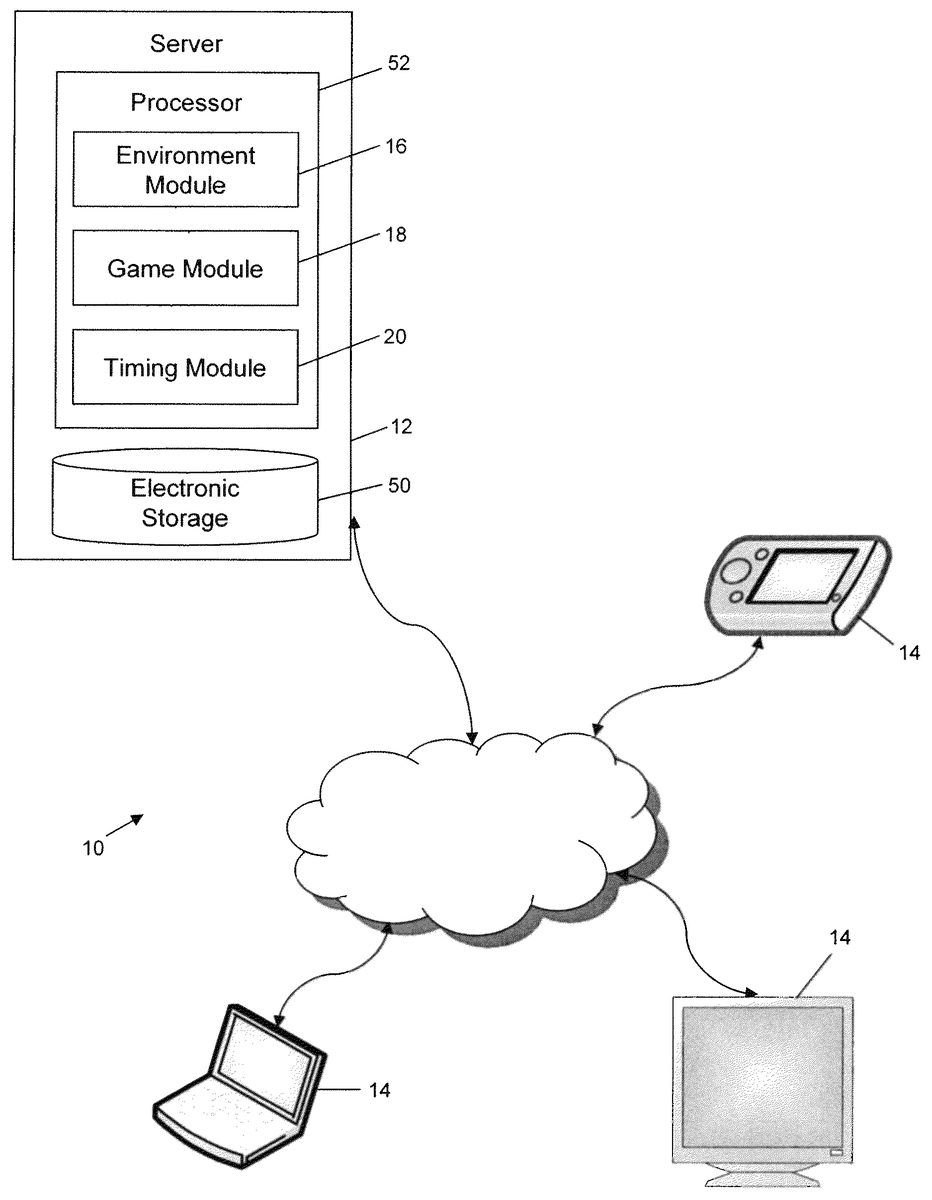
FIG. 1illustrates a system10configured to provide a virtual game environment to users. The system10may be configured such that the users participate in a game within the virtual game environment that is a turn-based game. An enhanced visual indicator of turn length may be provided to users in views of the virtual game environment. Providing the virtual game environment may include hosting the virtual game environment over a network.
In some implementations, system10may include a server12. The server12may be configured to communicate with one or more client computing platforms14according to a client/server architecture. The users may access system10and/or the virtual game environment via client computing platforms14.
The server12may be configured to execute one or more computer program modules. The computer program modules may include one or more of an environment module16, a game module18, a timing module20, and/or other modules.
The environment module16may be configured to provide one or more virtual game environments to users via client computing platforms14. As used herein, a “virtual environment” may include a virtual space, one or more interactive, electronic social media, and/or other virtual environments. A virtual game environment may refer to a virtual environment in which a game is being played that involves a plurality of users. Providing a virtual environment to users may include executing one or more instances of a virtual environment, determining view information representing the virtual environment (e.g., from the instance(s)) for the users (e.g., individually and/or collectively), transmitting the view information to the client computing platforms14associated with the users to facilitate views of the virtual environment being presented to the users, and/or other activities.
A virtual space may comprise a simulated space that is accessible by users via clients (e.g., client computing platforms14) that present the views of the virtual space to a user. The simulated space may have a simulated physical layout, express ongoing real-time interaction by one or more users, and/or be constrained by simulated physics that governs interactions between virtual objects in the simulated space. In some instances, the simulated physical layout may be a 2-dimensional layout. In other instances, the simulated physical layout may be a 3-dimensional layout.
The above description of virtual spaces is not intended to be limiting. The environment module16may be configured to express the virtual space in a more limited, or more rich, manner. For example, views of the virtual space presented to the users may be selected from a limited set of graphics depicting an event in a given place within the virtual space. The views may include additional content (e.g., text, audio, pre-stored video content, movable icons, avatars, and/or other content) that describes particulars of the current state of the space, beyond the relatively generic graphics. For example, a view of the virtual space may depict a card table and/or a non-player character that are static (or change relatively little) visually in views of virtual space. Icons representing game components (e.g., game pieces, playing cards, dice, and/or other game components) may change and/or move within the views of the virtual space to depict a game being played within the virtual space. Other expressions of individual places within the virtual space are contemplated.
Within the instance(s) of the virtual space (or other virtual environment) executed by environment module16, users may control avatars to interact with the virtual space and/or each other. As used herein, the term “user character” may refer to an object (or group of objects) present in the virtual space that represents an individual user. The avatar may be controlled by the user with which it is associated. The avatars may move through and interact with the virtual space (e.g., non-user characters in the virtual space, other objects in the virtual space), or the avatars may be relatively static visually within views of virtual space. The avatar representing a given user may be created and/or customized by the given user. The user may have an “inventory” of virtual goods and/or currency that the user can use (e.g., by manipulation of an avatar or other user controlled element, and/or other items), display, gift, and/or otherwise interact with in the virtual space.
The users may participate in the virtual space by controlling one or more of the available user controlled elements in the virtual space (e.g., game elements, avatars, and/or other elements). Control may be exercised through control inputs and/or commands input by the users through client computing platforms14.
Interactive, electronic social media may include one or more of a social network, a virtual space, a micro-blogging service, a blog service (or host), a browser-based game, a multi-player mobile game, a file (e.g., image file, video file, and/or other files) sharing service, a messaging service, a message board, a forum, and/or other electronically distributed media that are scalable and enable interaction between the users. As was the case with virtual spaces, in some implementations, users may be represented within interactive, electronic social media by avatars. An avatar representing a given user may be presented in views of the interactive, electronic social media as being associated with content that may be provided by the given user, directed the given user, related to the given user, and/or associated with the given user in other ways. Some non-limiting specific examples of interactive, electronic social media may include the micro-blogging service provided by Twitter™, the social network provided by Facebook™, the social network provided by MySpace™, the social network provided by Foursquare®, the virtual world provided by SecondLife®, the massively multi-player online game provided by World of Warcraft®, the file sharing service provided by Flickr®, Blogger, YouTube, PlayStation® Home, Xbox® Live, and/or other interactive electronic social media.
The game module18may be configured to manage the game being played by the users within the virtual game environment. Managing the game may include one or more of determining score, assessing success and/or failure (e.g., of individual actions, sets, of actions, matches, game events within an individual match, and/or other episodes), determining random or pseudo-random game parameters (e.g., card value during ordering and/or distribution, dice values, battle multipliers, and/or other parameters), and/or other game management functions. Managing the game may include accepting input in the form of user selections and/or actions (e.g., input at client computing platforms14), output from one or more random (or pseudo-random) number generators, rules and/or settings governing one or more game mechanics of the game, and/or other inputs. Managing the game may include determining outputs in the form scores (e.g., of individual actions, sets, of actions, matches, game events within an individual match, and/or other episodes), winners and/or losers, required actions to be performed by the users, and/or other outputs.
By way of non-limiting example, in some implementations, game module18may be configured to manage a game of poker being played within the virtual game environment. Such management may require one or more of determining blind size and/or assignment, determining card value and/or distribution, managing the pot (e.g., receiving bets, distributing winnings, and/or other management), determining hand winners, maintaining user chip stacks, maintaining user bank rolls, and/or other management tasks. As another non-limiting example, game module18may be configured to manage a game of backgammon. Such management may require one or more of managing checker position, determining dice value, determining doubling cube value, determining score, determining a winner, and/or other management tasks. Implementations in which game module18manages other turn-based games are contemplated. Such games may be based on real world board and/or card games, and/or games that have not previously been implemented as real world games.
It will be appreciated that the description herein of environment module16providing a virtual game environment to a set of users in which a game is being played by the set of users is not intended to be limiting. For example, environment module16may be configured to provide a plurality of different virtual game environments to a plurality of different sets of users. The individual sets of users may be participating in different instances of the game within the individual virtual game environments. The concepts described herein with respect to the individual virtual game environment and game should be extendible to implementations in which a plurality of different virtual game environments are being used to conduct a plurality of different instances of the game (e.g., between different sets of users).
The timing module20may be configured to determine transitions of user turns. These transitions may include turn beginnings, turn endings, and/or other transitions. The transitions may be determined such that individual turns have a turn length. The turn length may be a fixed length for all user turns, may be first length that can be extended by timing module20, may be variable, and/or other may have other lengths. The turns may be adjacent to each other in time, such that responsive to the turn of a given user ending, the turn of the next user may begin. The turns may be separated by some time buffer in time. This may delay the beginning of a next turn after the previous turn by the time buffer. The time buffer may be have a fixed length and/or may have a variable length. The length of the time buffer may vary, for example, based on lag between client computing platforms14and server12, a strength of a network connection between one or more of client computing platforms14and server12, and/or other parameters.
In some implementations, at a turn beginning, server12may be configured to transmit communication to the client computing platform14corresponding to the user whose turn is beginning. The communication may signal to the client computing platform14that the user's turn is beginning/has begun. The communication may include an update to the virtual game environment that indicates one or more results from a previous turn. The timing module20may be configured to listen for a response from the client computing platform14to this communication. Responsive to not receiving a response from the client computing platform14, timing module20may extend the turn length. This may include adding a predetermined amount of time to the turn length, extending the term length by a dynamically determined amount of time, and/or other extending the turn length in other ways. The extension of the turn length may be indicated within the virtual game environment (e.g., as described below).
The environment module16may further be configured such that the views of virtual game environment may depict a progress indicator. The progress indicator may indicate an amount of time left in a current turn of one of the users. The progress indicator may progress around individual avatars during the turns of the corresponding users such that during a turn of a given user, the progress indicator may progress around the avatar of the given user from a starting point to an ending point. The starting point and the ending point may be the same point (e.g., the progress indicator makes a complete lap around the avatar). The starting point may correspond to the beginning the given user's turn. The ending point may correspond to the end of the given user's turn.
By way of illustration,FIG. 2illustrates a view30of a virtual game environment. View30may be presented to a first user via a client computing platform similar to or the same as client computing platform14(shown inFIG. 1and described herein). The view30may be generated by the client computing platform based on view information received by the client computing platform from a server similar to or the same as server12(shown inFIG. 1and described herein). Within the virtual game environment, a set of users may be participating in a game with the first user.
The view30may depict a set of avatars including a first avatar32, a second avatar34, a third avatar36, and/or other avatars. The avatars32,34, and/or36may correspond to the users participating in the game. For example, first avatar32may correspond to the first user, second avatar34may correspond to a second user, and/or third avatar36may correspond to a third user.
Within view30, responsive to it being the first user's turn in the game, a progress indicator38may indicate an amount of time left in the first user's turn. Responsive to it being the second user's turn or the third user's turn, progress indicator38may indicate an amount of time left in these turns. During the turn of the first user, progress indicator38may progress around first avatar32from a starting point40to an ending point42. The starting point40may correspond to the beginning of the first user's turn such that at the beginning of the first user's turn progress indicator38may be located at starting point40. The ending point42may correspond to the end of the first user's turn such that at the end of a period of time for the first user's turn progress indicator38may be located at ending point42. The speed of progress indicator38during the first user's turn may be constant. The speed of progress indicator38may accelerate and/or decelerate during the first user's turn. Acceleration and/or deceleration may take place at specific points in time during the turn, responsive to user performance (e.g., positive or negative performance), and/or for other reasons.
In some implementations, the speed of progress indicator38may be constant during the turn, but may be adjusted on a per turn basis to ensure that the user's turn is for the same amount of time. For example, if the view presented to the first user does not indicate it is the first user's turn until after some delay (e.g., due to network latency and/or other phenomena), the speed for progress indicator38may be determined as the speed at which progress indicator38must travel to travel the distance from starting point40to ending point42during the time remaining in the first user's turn (after the delay).
In progressing around first avatar32, progress indicator38may follow a path44that bends to at least partially surround first avatar32on at least two sides, on at least three sides, or on at least four sides. This may include surrounding first avatar32without surrounding any other avatar in view30, and/or may include surrounding first avatar32without surrounding any other object in view30. The path44may be translucent (e.g., not visible in view30), may have a color different than that of progress indicator38, and/or may be depicted in other ways. The progress indicator38may proceed along the path in the direction indicated by arrow46(and/or the opposite direction, or any other trajectory). As was mentioned above, starting point40and ending point42may be the same point or different points. In implementation in which starting point40and ending point42are different points, path44may be open or closed (e.g., with part of path44overlapping). The path44may be circular, oval, polygonal, and/or have other shapes. In implementations in which path44forms a shape having corners (e.g., as shown inFIG. 2), the corners may be chamfered.
If progress indicator38progresses during the first user's turn from starting point40to ending point42, this may indicate that the first user did not take timely enough action. This may result in the first user losing his turn, being removed from the game, being removed from the virtual game environment, and/or have other consequences. In some games, the user may be attempting to perform some action for the duration of his turn. Iterations of the action may have additional value to the first user in the game, so that the first user may continue to perform the action (or actions) until progress indicator38reaches ending point42, indicating that the first user's turn is over and that the first user will not be able to iterate the action (or actions) any more during this turn.
As progress indicator38progresses along path44, progress indicator38may change size. This may include increasing in length, decreasing in length, and/or changing size in other ways. For example, as progress indicator38progresses along path44, progress indicator38may decrease in length by a distance equal to the distance along path44that progress indicator38has travelled. This is illustrated inFIG. 2, which shows the progress of progress indicator38being depicted by a decrease in length that correspond to the distance along path44that progress indicator38has travelled. As another example, as progress indicator38progresses along path44, progress indicator38may increase in length by a distance equal to the distance along path44that progress indicator38has travelled. This may result in progress indicator38“growing” during its progress until it runs along the entirety of path44.
During the turns of the users, the progress indicator38may change colors. The change in color may be correlated to an amount of time left in a present turn. For example, at the beginning of the first user's turn (e.g., when progress indicator38is at or near starting point40), progress indicator38may have a first color. At the end of the first user's turn (e.g., when progress indicator38is at or near ending point42), progress indicator38may have a second color. At a point along path44between starting point40and ending point42(e.g., at a time between the beginning and end of the turn), progress indicator38may have third color. By way of non-limiting example, the first color may be green, the second color may be red, and the third color may be yellow. Other color combinations and/or numbers of colors (e.g., 2, 4, 5, 6, etc.) are contemplated within the scope of this disclosure.
As progress indicator38progresses from starting point40to ending point42, the progress indicator may have one or more other visual characteristics that change in views of the game environment to indicate the progression of time during the turn. For example, the contrast and/or brightness may be adjusted as a function of time (e.g., brighter and/or more contrast toward the end of the turn), a height of progress indicator38out of the plane of the display (e.g., represented isometrically, in perspective, and/or with 3D technology) may be adjusted as a function of time (e.g., taller or shorter toward the end of the turn), a thickness of progress indicator38(e.g., wider or narrower toward the end of the turn), and/or other visual characteristics may be adjusted over time during the turn.
As progress indicator38proceeds along the path, one or more other sensory cues about the amount of time left in the turn may be provided to the user(s). These cues may include, for example, audible cues, tactile cues (e.g., through vibration and/or tactical feedback), and/or other sensory cues.
It will be appreciated that the description of progress indicator38proceeding along a single path44is not intended to be limiting. In some implementations, progress indicator38may move along a plurality of spatially separate paths during the turn of a user. This may include implementations in which a single progress indicator moves along the different paths in succession, implementations in which a plurality of progress indicators that move along the separate paths simultaneously (at least for a portion of the turn), and/or other implementations.
At the end of the first user's turn (e.g., because the first user's makes his move and/or because his time runs out), it may become the second user's turn. During the second user's turn, progress indicator38may begin to follow path44around second avatar34to indicate an amount of time left in the second user's turn, as shown for illustrative purposes inFIG. 3. Similarly, after the end of second user's turn, it may become the third user's turn and progress indicator38may begin to progress around third avatar36to indicate an amount of time left in the third user's turn (not shown).
During the game, the users may receive views of the virtual game environment that are the same or different. However, some or all of the features represented in view30ofFIGS. 2 and 3(e.g., elements32,34,36,38and/or other features) may be present in the views provided to each of the individual users participating in the game (e.g., the first user, the second user, the third user, and/or other users).
InFIG. 4, view30of the virtual game environment is shown at the end of a game. At the end of the game, path44may be implemented to visually indicate success within the game (e.g., a winner of the game and/or other success). By way of non-limiting example,FIG. 4may depict implementation of path44to indicate that the third user may have had some success in the game (e.g., has won the game and/or has had some other success). The indication may be provided in the form of a color change, a flashing of path44, a change in a size of path44, and/or through other visual mechanisms.
In the examples of view30illustrated inFIGS. 2-4, avatars32,34, and/or36may be located at fixed positions within the views. It will be appreciated that this is not intended to be limiting. In some implementations one or more of avatars32,34, and/or36may be mobile within view30. In such implementations, progress indicator38may move through view30with the avatar for which it is providing an indication.
Turning back toFIG. 1, in some implementations,12server and client computing platforms may be operatively linked via one or more electronic communication links. For example, such electronic communication links may be established, at least in part, via a network such as the Internet and/or other networks. It will be appreciated that this is not intended to be limiting, and that the scope of this disclosure includes implementations in which server12and/or client computing platforms14.
A given client computing platform14may include one or more processors, and electronic display, a control interface, and/or other components. The one or more processors may be configured to execute computer program modules. The computer program modules may be configured to enable or user associated with the given client computing platform14to interface with system10, and/or provide other functionality attributed herein to client computing platforms14. For example, the computer program modules may include a view module configured to receive view information from server12(e.g., generated by environment module16), and to present a view of the virtual game environment (e.g., as described above) based on the received view information. This may facilitate participation by the user of the given client computing platform14in the game taking place in the virtual game environment. By way of non-limiting example, the given client computing platform14may include one or more of a desktop computer, a laptop computer, a handheld computer, a tablet computing platform, a NetBook, a Smartphone, a gaming console, and/or other computing platforms.
The server12may include electronic storage50, one or more processors52, and/or other components. The server12may include communication lines, or ports to enable the exchange of information with a network and/or other computing platforms. Illustration of server12inFIG. 1is not intended to be limiting. The server12may include a plurality of hardware, software, and/or firmware components operating together to provide the functionality attributed herein to server12. For example, server12may be implemented “in the cloud” by a plurality of computing platforms operating together as server12.
Electronic storage50may comprise electronic storage media that electronically stores information. The electronic storage media of electronic storage50may include one or both of system storage that is provided integrally (i.e., substantially non-removable) with server50and/or removable storage that is removably connectable to server50via, for example, a port (e.g., a USB port, a firewire port, etc.) or a drive (e.g., a disk drive, etc.). Electronic storage50may include one or more of optically readable storage media (e.g., optical disks, etc.), magnetically readable storage media (e.g., magnetic tape, magnetic hard drive, floppy drive, etc.), electrical charge-based storage media (e.g., EEPROM, RAM, etc.), solid-state storage media (e.g., flash drive, etc.), and/or other electronically readable storage media. The electronic storage50may include one or more virtual storage resources (e.g., cloud storage, a virtual private network, and/or other virtual storage resources). Electronic storage50may store software algorithms, information determined by processor52, information received from server12, information received from client computing platforms14, and/or other information that enables server12to function as described herein.
Processor(s)52is configured to provide information processing capabilities in server12. As such, processor52may include one or more of a digital processor, an analog processor, a digital circuit designed to process information, an analog circuit designed to process information, a state machine, and/or other mechanisms for electronically processing information. Although processor52is shown inFIG. 1as a single entity, this is for illustrative purposes only. In some implementations, processor52may include a plurality of processing units. These processing units may be physically located within the same device, or processor52may represent processing functionality of a plurality of devices operating in coordination. The processor52may be configured to execute modules16,18, and/or20. Processor52may be configured to execute modules16,18, and/or20by software; hardware; firmware; some combination of software, hardware, and/or firmware; and/or other mechanisms for configuring processing capabilities on processor52.
It should be appreciated that although modules16,18, and/or20are illustrated inFIG. 1as being co-located within a single processing unit, in implementations in which processor52includes multiple processing units, one or more of modules16,18, and/or20may be located remotely from the other modules. As a non-limiting example, some or all of the functionality attributed to modules16,18,20, and/or22may be provided “in the cloud” by a plurality of processors connected through a network. The description of the functionality provided by the different modules16,18, and/or20herein is for illustrative purposes, and is not intended to be limiting, as any of modules16,18, and/or20may provide more or less functionality than is described. For example, one or more of modules16,18, and/or20may be eliminated, and some or all of its functionality may be provided by other ones of modules16,18, and/or20. As another example, processor52may be configured to execute one or more additional modules that may perform some or all of the functionality attributed below to one of modules16,18, and/or20.
FIG. 5illustrates a method60of providing a virtual game environment to client computing devices for interaction by users. The operations of method60presented below are intended to be illustrative. In some embodiments, method60may be accomplished with one or more additional operations not described, and/or without one or more of the operations discussed. Additionally, the order in which the operations of method60are illustrated inFIG. 5and described below is not intended to be limiting.
In some embodiments, method60may be implemented in one or more processing devices (e.g., a digital processor, an analog processor, a digital circuit designed to process information, an analog circuit designed to process information, a state machine, and/or other mechanisms for electronically processing information). The one or more processing devices may include one or more devices executing some or all of the operations of method60in response to instructions stored electronically on an electronic storage medium. The one or more processing devices may include one or more devices configured through hardware, firmware, and/or software to be specifically designed for execution of one or more of the operations of method60.
At an operation62, a beginning of a turn in a game being played in the virtual game environment may be identified. The turn may be the turn of one of the users participating in the game. In some implementations, operation62may be performed by a timing module similar to or the same as timing module20(shown inFIG. 1and described herein).
At an operation64, views of the virtual game environment may be provided to the users that include a progress indicator that indicates an amount of time left in the turn of the user. The progress indicator may be similar to or the same as progress indicator38(shown inFIGS. 2 and 3, and described herein). Providing the views to the users may include generating view information that facilitates presentation of the views, generating the views based on view information describing the views, and/or other functions. In some implementations, operation64may be performed by an environment module executed by a server similar to or the same as environment module16(shown inFIG. 1and described herein), and/or a view module executed by a client computing platform (e.g., as described herein).
At an operation66, an end of the turn may be detected. The turn may be ended based on the passage of time, based on a user taking an action that ends the turn, and/or based on other events. In some implementations, operation66may be performed by a timing module similar to or the same as timing module20(shown inFIG. 1and described herein).
At an operation68, a determination may be made as to whether another turn should begin. Responsive to a determination that another turn should begin, method60may return to operation62. Responsive to a determination another turn should not begin, method60may proceed to an operation70.
At operation70, a winner of the game may be determined, and the winner may be indicated one or more of the view of the virtual game environment by adjusting a visual appearance of a path followed by the progress indicator. This may include, for example, adjusting the visual appearance of the path followed by the progress indicator around an avatar of a user that has won the game and/or had some other success in the game. The adjustment in the visual appearance may include a change in color, size, a flashing, and/or other adjustments. In some implementations, operation70may be performed by an environment module executed by a server similar to or the same as environment module16(shown inFIG. 1and described herein), and/or a view module executed by a client computing platform (e.g., as described herein).
Although the present technology has been described in detail for the purpose of illustration based on what is currently considered to be the most practical and preferred implementations, it is to be understood that such detail is solely for that purpose and that the technology is not limited to the disclosed implementations, but, on the contrary, is intended to cover modifications and equivalent arrangements that are within the spirit and scope of the appended claims. For example, it is to be understood that the present technology contemplates that, to the extent possible, one or more features of any implementation can be combined with one or more features of any other implementation.
Claims
- A system configured to provide a virtual game environment to users, the system comprising: one or more processors configured to execute computer program modules comprising: an environment module configured to determine view information for transmissions to client computing platforms associated with users that facilitate presentation of views of a game environment to the users on the client computing platforms, wherein the game environment is common among the users, wherein the individual users are represented in the game environment by avatars, and wherein the users comprise a first user represented by a first avatar;a game module configured to manage a game being played by the users within the game environment, wherein the game is a turn-based game, and wherein user turns during the game are timed;and a timing module configured to determine transitions of user turns including turn beginnings and turn endings, and wherein the environment module is further configured such that views of the game environment depict a progress indicator that progresses around individual avatars during the turns of the corresponding users such that during a turn of the first user the progress indicator progresses around the first avatar in the views of the game environment from a starting point that corresponds to the beginning of the turn of the first user to an ending point that corresponds to the end of the turn of the first user, whereby the progress of the progress indicator from the starting point to the ending point graphically indicates an amount of time left in the turn of the first user.
- The system of claim 1 , wherein the game environment module is configured such that during the turn of the first user the progress indicator follows a path from the starting point to the ending point that surrounds the first avatar in the views of the game environment.
- The system of claim 2 , wherein the game environment module is configured such that during the turn of the first user as the progress indicator progresses from the starting point to the ending point of the path in the views of the game environment the progress indicator increases in length.
- The system of claim 3 , wherein the game environment module is configured such that during the turn of the first user as the progress indicator progresses from the starting point to the ending point of the path, the increase in the length of the progress indicator in the views of the game environment is equal to the distance the progress indicator has moved along the path.
- The system of claim 2 , wherein the game environment module is configured such that during the turn of the first user as the progress indicator progresses from the starting point to the ending point of the path in the views of the game environment the progress indicator decreases in length.
- The system of claim 5 , wherein the game environment module is configured such that during the turn of the first user as the progress indicator progresses from the starting point to the ending point of the path, the decrease in the length of the progress indicator in the views of the game environment is equal to the distance the progress indicator has moved along the path.
- The system of claim 2 , wherein the game environment module is configured such that during the turn of the first user the one or more portions of the path that are not occupied by the progress indicator are depicted in the views of the game environment as having a different color than the progress indicator.
- The system of claim 1 , wherein the game environment module is configured such that during the turn of the first user the progress indicator changes colors in the views of the game environment such that at the beginning of the turn of the first user the progress indicator has a first color and at the end of the turn of the first user the progress indicator has a second color.
- The system of claim 1 , wherein the game environment module is configured such that during the turn of the first user the progress indicator has a third color in the views of the game environment at a point in time between the beginning of the turn and the end of the turn.
- The system of claim 1 , wherein the game environment module is configured such that responsive to a success of the first user in the game, the path changes color in the views of the game environment to indicate the success of the first user.
- A client computing platform configured to present a view of a virtual game environment to a first user, the client computing platform comprising: an electronic display;a control interface;one or more processors configured to execute computer program modules comprising: a view module configured to receive view information from a server, and generate a view of a game environment for presentation to a user via the electronic display, wherein the game environment is common among the user and a set of other users to facilitate playing of a group game by the user and the set of other users within the game environment, wherein the individual users are represented in view of the game environment by avatars, wherein the set of other users comprise a first user represented by a first avatar, wherein the game is a turn-based game, wherein user turns during the game are timed;and wherein the view module is further configured such that the view of the game environment depicts a progress indicator that progresses around individual avatars during the turns of the corresponding users such that during a turn of the first user the progress indicator progresses around the first avatar in the view of the game environment from a starting point that corresponds to the beginning of the turn of the first user to an ending point that corresponds to the end of the turn of the first user, whereby the progress of the progress indicator from the starting point to the ending point graphically indicates an amount of time left in the turn of the first user.
- The client computing platform of claim 11 , wherein the view is configured such that during the turn of the first user the progress indicator follows a path from the starting point to the ending point that surrounds the first avatar in the view of the game environment.
- The client computing platform of claim 12 , wherein the view module is configured such that during the turn of the first user as the progress indicator progresses from the starting point to the ending point of the path in the view of the game environment the progress indicator increases in length.
- The client computing platform of claim 13 , wherein the view module is configured such that during the turn of the first user as the progress indicator progresses from the starting point to the ending point of the path, the increase in the length of the progress indicator in the view of the game environment is equal to the distance the progress indicator has moved along the path.
- The client computing platform of claim 12 , wherein the view module is configured such that during the turn of the first user as the progress indicator progresses from the starting point to the ending point of the path in the view of the game environment the progress indicator decreases in length.
- The client computing platform of claim 15 , wherein the view module is configured such that during the turn of the first user as the progress indicator progresses from the starting point to the ending point of the path, the decrease in the length of the progress indicator in the view of the game environment is equal to the distance the progress indicator has moved along the path.
- The client computing platform of claim 12 , wherein the view module is configured such that during the turn of the first user the one or more portions of the path that are not occupied by the progress indicator are depicted in the view of the game environment as having a different color than the progress indicator.
- The client computing platform of claim 11 , wherein the view module is configured such that during the turn of the first user the progress indicator changes colors in the view of the game environment such that at the beginning of the turn of the first user the progress indicator has a first color and at the end of the turn of the first user the progress indicator has a second color.
- The client computing platform of claim 11 , wherein the view module is configured such that during the turn of the first user the progress indicator has a third color in the view of the game environment at a point in time between the beginning of the turn and the end of the turn.
- The client computing platform of claim 11 , wherein the view module is configured such that responsive to a success of the first user in the game, the path changes color in the view of the game environment to indicate the success of the first user.
Disclaimer: Data collected from the USPTO and may be malformed, incomplete, and/or otherwise inaccurate.