U.S. Pat. No. 8,469,819
GAME APPARATUS AND GAME CONTROL METHOD FOR CONTROLLING AND REPRESENTING MAGICAL ABILITY AND POWER OF A PLAYER CHARACTER IN AN ACTION POWER CONTROL PROGRAM
Issue DateJune 2, 2010
Illustrative Figure
Abstract
A game apparatus and game control method for controlling and representing magical ability and power of a player character, in an action power control program is provided. The game apparatus and game control method permits the accessing of an unlimited level of magical power available to the player character by affecting a control button on the input device, which then allows for a determination to be made on a proper amount of the unlimited level of magical power based upon the player character's known abilities and vitality to be used, which then in turn permits utilization of said proper amount of the unlimited level of magical power against at least one other character within the video game to obtain a desired result against said at least one other character before a detrimental effect causes a penalty to the player character.
Description
DETAILED DESCRIPTION OF THE PREFERRED EMBODIMENT Referring toFIGS. 1 and 2, it can be seen that the prior art uses a method to represent various attributes, such as Health, Fatigue and Magical Abilities/Power, of a player character in a video game with horizontal bars that move in along a linear scale based upon the events occurring in such game. By way of example,FIGS. 1 and 2show how a typical avatar in a prior art game having a full Health, Fatigue and Magical Abilities/Power losses some amount of these attributes as he fights an enemy. Each strike of the sword of the enemy against the unprotected body of the avatar will affect his Health and each swing of the sword by the avatar or other movement of his body will affect his Fatigue. Finally, the use of any Magical Abilities/Powers that the avatar has will deplete his finite reserve of such until it is empty. The present invention differs significantly from the aforementioned prior art in a multitude of various ways. First, in the game apparatus and game control method for controlling and representing magical ability and power of a player character, in an action power control program, of the present invention, there is no finite level of magic, which must be replenished and found by scourging through the scenes of the game. Instead, and referring toFIG. 3, an infinite quantity of magic is always present and available for channeling to any given player character, represented along the “x” axis. In the present invention of a game apparatus and game control method for controlling and representing magical ability and power of a player character, in an action power control program, it is possible for the player character to change bodies from the lowest of creatures (i.e., a rodent), to the highest ...
DETAILED DESCRIPTION OF THE PREFERRED EMBODIMENT
Referring toFIGS. 1 and 2, it can be seen that the prior art uses a method to represent various attributes, such as Health, Fatigue and Magical Abilities/Power, of a player character in a video game with horizontal bars that move in along a linear scale based upon the events occurring in such game. By way of example,FIGS. 1 and 2show how a typical avatar in a prior art game having a full Health, Fatigue and Magical Abilities/Power losses some amount of these attributes as he fights an enemy. Each strike of the sword of the enemy against the unprotected body of the avatar will affect his Health and each swing of the sword by the avatar or other movement of his body will affect his Fatigue. Finally, the use of any Magical Abilities/Powers that the avatar has will deplete his finite reserve of such until it is empty.
The present invention differs significantly from the aforementioned prior art in a multitude of various ways. First, in the game apparatus and game control method for controlling and representing magical ability and power of a player character, in an action power control program, of the present invention, there is no finite level of magic, which must be replenished and found by scourging through the scenes of the game. Instead, and referring toFIG. 3, an infinite quantity of magic is always present and available for channeling to any given player character, represented along the “x” axis. In the present invention of a game apparatus and game control method for controlling and representing magical ability and power of a player character, in an action power control program, it is possible for the player character to change bodies from the lowest of creatures (i.e., a rodent), to the highest of magical persons, such as an “Archmage” (a type of extremely powerful wizard, used within the context of a fantasy video game that utilizes the method of the present invention).
Therefore, with continuing reference toFIG. 3, it can be seen that four types of player characters are represented (solely by way of example, as a multitude of other characters are employed) along the “y” axis; they include: a Wino, a Soldier, an Apprentice Mage and an Archmage. Each of these characters in the method of the present invention can utilize larger quantities of the unlimited quantity of magic that can be channeled, as compared to the “lesser character” below them. So, since some characters are not as strong as others, they do not have the same amount of Vitality, and therefore the quantity of channeled magic used can have a detrimental effect on those with lesser Vitality. By way of example, a Wino has less Vitality than a Soldier, who in turn has less Vitality than an Apprentice Mage, who in turn has less Vitality than an Archmage.
Again, with continuing reference toFIG. 3, a representation of how magic can be shown on a display screen that interfaces with either a computer or game console wherein the method for controlling and representing magical ability and power of a player character, in an action power control program, is shown. In particular, it is shown how a quantity of unlimited magic can be channeled at anytime during said action power control program (represented by the smaller of the two “flame-like” shapes) to said character, in combination with representation of how much effect that quantity of channeled magic has on the character type (i.e., how much “burn-off” or damage to the avatar's body, represented by the larger of the two “flame-like” shapes) in relation to the avatar's attribute of Vitality. This can also be shown, as used in an alternate embodiment, to be part of the avatar's body, wherein a spigot of unlimited magical can be tapped into. What is most important to understand fromFIG. 3is that the use of just a little bit of magic, say for example in a Wino, has a large and detrimental effect on his Vitality, which could lead to a quick death for the Wino. In contrast though, the use of a large amount of magic by an Archmage, even for long periods of time, can have very little, and in some cases almost non-existent, effect on his Vitality, permitting him to continuingly tap into the spigot and cast magic at will.
Referring now toFIGS. 4A-4C, it is shown how the method of controlling the magical power is carried out in a video game of the game apparatus and game control method for controlling and representing magical ability and power of a player character, in an action power control program, of the present invention. In particular, a character encounter occurs between an avatar and another character, wherein the game player's avatar's attributes of Magical Power, Health and Vitality are represented in a virtual environment on a display screen in defined quantities against the other character (NPC1) having a defined quantity of Health and an obtainable quantity of Magical Power and Vitality that cannot be used by NPC1, but which can be taken by the avatar if he chooses to take-over (inhabit) the body of NPC1under certain conditions precedent. In this scenario, the avatar has a Magical Power ability of 25, a Health of 40 and a Vitality of 1,500. However, a Magical Power ability of 25 does not allow the avatar to channel large quantities of magic and in fact any magical spell that he uses by opening the spigot will more than likely deplete his Vitality quite quickly. In the preferred embodiment, utilizing the maximum amount of Magical Power (i.e., 25), will only provide the avatar with 30 seconds of life span to accomplish his task of killing or disabling his opponent NPC1before he dies and suffers whatever penalty that might entail. However, inFIGS. 4B and 4C, it can be seen that tapping into the spigot at about ⅘thsof his capability (i.e., 20 of 25), he is able to defeat NPC1by making him think that NPC1is going to die, which causes his soul and spirit to depart, whereby the avatar can then jump into (i.e., inhabit) his body and take on the new levels of Magical Power abilities and Vitality of 100/2000, respectively. However, as shown inFIG. 5A, the avatar, now inhabiting NPC1also takes the current state of health of only 15 of a maximum of 30 while experiencing the next and new character encounter.
With reference now toFIG. 5B, the avatar has tapped into the unlimited source of Magical Power (the spigot) to a certain higher level than before (60 of 100), which does not exceed the avatar's new higher Magical Power abilities for casting a Magical Spell against NPC2and for making NPC2believe that he is about to die, which causes the NPC2Soul and Spirit to depart from his body. The effects on his body though can be seen as his Vitality drops from 2000 to 1,500. Notwithstanding, the avatar again jumps to a new body, that of NPC2and gains yet even a higher amount of Magical Power abilities and Vitality (250/5000, respectively). Again however, the avatar is forced to except the current state of health, which in this example, is 40 of 50.
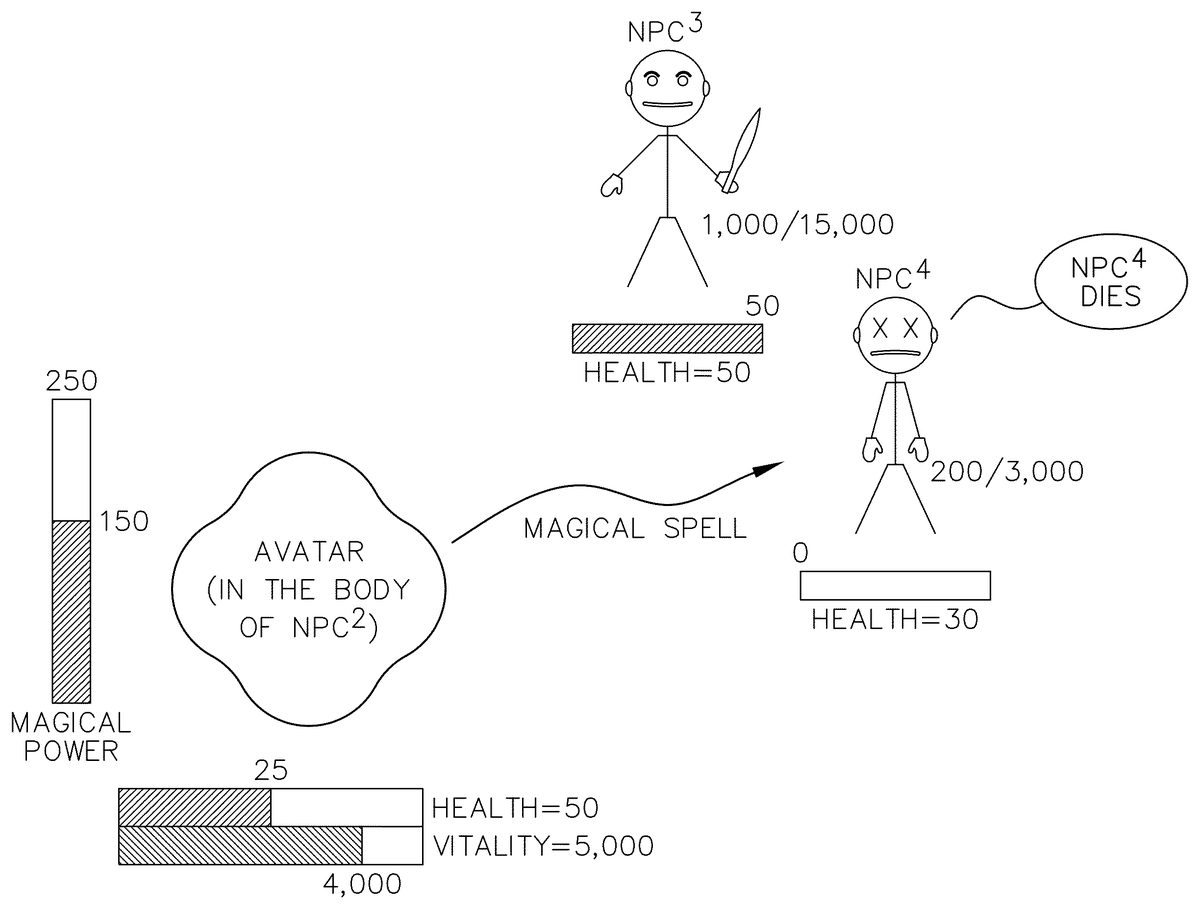
Referring now toFIGS. 6A-6C, a new encounter occurs wherein the avatar, having taken-over the body of NPC2from the previous encounter, now possesses the new Magical Power abilities and Vitality (250/500, respectively) along with the NPC2health level at 40 of 50. The avatar encounters two opposing characters (NPC3) and (NPC4), each having their own defined quantities of Health and their own set of obtainable quantities of Magical Power abilities and Vitality that cannot be used by either character, but which can be taken by the avatar if he chooses to take-over the body of one or the other of the two characters NPC3and NPC4. InFIG. 6Bit shows that the avatar has opened the spigot of Magical Power to a certain new higher level than before (150 of 250), but which does not exceed the avatar's new higher Magical Power abilities, for casting a Magical Spell against NPC4that kills him. The depletion of his Vitality is also shown as dropping from 5000 to 4000. InFIG. 6C, it shows the same character encounter as that ofFIGS. 6A-6B, with NPC4dead, and wherein the avatar has tapped into the spigot of Magical Power to a certain even new higher level than before (225 of 250), which still does not exceed the avatar's newest level of Magical Power abilities, for casting a Magical Spell against NPC3, which makes NPC3believe that he is about to die, even though his Health has not been depleted (no damage to NPC3body) from its original level. This causes the NPC3Soul and Spirit to depart from his body, but the Vitality of the avatar is depleted further down to 2000 from 5000.
Referring toFIGS. 7A-7D, yet another new encounter occurs for the avatar, having taken-over the body of NPC3from the previous encounter, he now possesses the new Magical Power abilities and Vitality (1,000/15,000, respectively) along with the NPC3health level at 50 of 50, since no damage to the NPC3body had occurred. The avatar encounters three opposing characters (NPC5), (NPC6) and (NPC7) each having their own defined quantities of Health and their own set of obtainable quantities of Magical Power and Vitality that cannot be used by any of the non-player characters, but which can be taken by the avatar if he chooses to take-over the body of any one or the three encountered characters. InFIG. 7Bit shows that the avatar has opened the spigot of Magical Power to a certain new higher level than before (600 of 1,000), but which does not exceed the avatar's new higher Magical Power abilities, for casting a Magical Spell against NPC5that kills him and in the process rips his skeleton from his body for use as Bone Armor to protect the avatar against the other two encountered characters. However, there has been some significant level of depletion to the avatar's Vitality because of the opening of the spigot to such a large level or relative percentage.
Thereafter though, as shown inFIG. 7C, the avatar, with his Bone Armor in place, taps into the spigot of Magical Power to a fairly low level (75 of 1,000), which is more than adequate for casting a Magical Spell against NPC3, which kills him, but which depletes the avatar's Vitality by very little (only down to 10,900 from the previous level of 11,000). Then, as shown inFIG. 7D, the avatar directs his attention to NPC7and again taps into the spigot of Magical Power to a fairly low level (100 of 1,000) to quickly kill NPC7, which also has very little effect on the avatar's Vitality (down to 10,750 from the previous amount of 10,900).
Referring now toFIG. 8, this diagram illustrates that in the method of the present invention that an avatar possessing extremely high levels of Vitality (100,000) and Magical Power abilities (10,000), can continually cast relatively effective (albeit a trickle as compared to the levels he could cast) magic over long periods of time while barely affecting his Vitality (a negligible level, at best) over one week (depleted only by 100 when casting Magical Power at a level of 200), one month (depleted only by 400 when casting the same Magical Power) or even one year (depleted only by 4,800 when again casting the same Magical Power).
Referring toFIGS. 9 and 10, an alternate embodiment of the representation of the avatar's magical powers and how they affect his body is shown (i.e., how it is displayed to the game player by a third party perspective view). In particular, a visual representation (like a glow), emanates from the back of the neck of the player character. The glow is almost completely invisible when the spigot is at a minimal setting. It then transitions to a large bright flare when completely open. The glow radiates outward like white glowing veins through the body. This method is used as a combination of factors through the player character and any follow cameras. On the game controller, or on any other computing input device, as the spigot opens the camera is affected by the use of shake (along with player controller rumble), motion blur and depth of field. All these elements combine to give the sense of power utilized when opening up the spigot for the third party perspective alternate embodiment.
The Spell Spigot is what the player uses in the video game utilizing the method of the present invention to determine the size and power rating of the spell that they can cast. The spigot is opened and closed by affecting pressure on any one of a number of different buttons on a typical game console controller or other computing input device. The Spell Spigot itself is limited by the body type that the player inhabits—either from a very lowly drunk (extremely limited) up to a highly powerful Archmage (full power). The Spell Spigot is also directly tied to the lifespan of the body as it drains the life force when a player casts a spell. The more that the spigot is open, the more powerful the spell becomes but also the faster the drain on the current body life force (leading to a shorter lifespan). Examples of such where illustrated inFIGS. 4A through 7D. It should be noted that in the preferred embodiment, visually the Spell Spigot will be accomplished with the use of 2D HUD (“head-up display”) elements for the player to decipher. Only in the alternate embodiment of the third person perspective will all the elements be imbedded in the playable character on the video display screen, as discussed above and as shown by way of example inFIGS. 9 and 10.
Further to the Spell Spigot, it essentially has two functions: (1) the Size of the Effect (the visual effects); and (2) the Absolute Power Rating (the damage inflicted). The Spell Spigot has a Spigot Cap that limits how much the player may open the spigot which is determined by what type of body the player has chosen to inhabit. By way of example, a street dwelling drunk has a very low Spigot Cap while a Mage has a very high Spigot Cap.
Referring now toFIG. 11, an example of Absolute Power Rating is shown, wherein regardless of the actual numerical value that will be implemented of true damage inflicted, the power rating is deterministic. Once a game player recognizes each type of body, they will then understand that a Drunk Type isn't as good as a Thief Type. In a preferred embodiment there are nine power rating levels. However, alternate embodiments permit a greater or lesser number of power rating levels if so needed to accommodate a greater or lesser number of game character body types. In the preferred embodiment ofFIG. 11, there are Drunks, Prostitutes, Thieves, General Population, Armed Guards, Warriors, Brutes, Mages and Master Mages.
The Size of the Effect used visually in the alternate embodiment of the third person perspective changes as the game player opens the spigot to higher levels. The actual look of the effect, or the effect itself, does not necessarily matter, as there will be many magical spells that work in the same manner and display the same size and type of effect.
Referring now toFIG. 12, a Relative Power Value is established between each character type, which is the actual numbers that are used to calculate damage inflicted upon an opponent and damage received to the avatar. These numbers can include a multitude of varying ranges and are not visible to the game player in a video game utilizing the method of the present invention.FIG. 12(400 to 490 points) is merely illustrative of one of a plurality of numerical ranges.
Referring toFIG. 13, the Body Life Span (also known as Vitality) and the Body Health are both illustrated. The Relative Power Value used by the game player is directly connected to draining the magic power from the inhabited body's total amount of magic power. This type of magic power is referred to as the Lifespan and losing this Lifespan is referred to as the Body Drain. The body's actual health (from taking physical damage through physical attacks) is a separate piece of functionality. Neither of these two items can be refilled; once it is used up, it's gone. The player must find another body to inhabit to regain Body Life Span and Body Health. In the alternate embodiment third person perspective, as the Lifespan is drained from the body, it is represented to the game player by the game player's character's body deteriorating. The body starts by looking “normal” and upon draining, the body slowly morphs down to a mummified skeleton. When the body gets close to being destroyed, it begins to smoke and then eventually catches on fire. If the player empties out the Body Lifespan, the body is destroyed and the player suffers whatever penalty the game designers create, such as reverting to a lowering being with less power.
The deterioration effect, as described above, is also used in the first person perspective preferred embodiment. However, only those body parts that can be seen from such first person perspective show the effect.
Further, equivalent steps can be substituted for ones set forth herein to achieve the same results in the same way and in the same manner.
Claims
- A method of controlling action power of a player character in a video game wherein control of a computing input device interfacing with said method causes a representation of magical power to be displayed on a display screen on a virtual basis, the steps of the method comprising: a) accessing an unlimited level of magical power available to the player character by affecting a first control button on the computing input device;b) determining a proper amount of the unlimited level of magical power based upon the player character's known abilities and vitality by affecting a second control button on the computing input device;and c) utilizing said proper amount of the unlimited level of magical power against at least one other character within the video game to obtain a desired result against said at least one other character before a detrimental effect causes a penalty to the player character.
- The method of controlling action power of a player character in a video game according to claim 1 , wherein said video game is operated on a device chosen from the group consisting of a personal computer, a gaming console and a standalone arcade-type computerized apparatus.
- The method of controlling action power of a player character in a video game according to claim 2 , wherein the video game is played on computer network with at least two game players and at least two player characters.
- The method of controlling action power of a player character in a video game according to claim 1 , wherein the detrimental effect to the player character occurs within 30 seconds.
- The method of controlling action power of a player character in a video game according to claim 1 , wherein the effects to the vitality of the player character through the use of the magical power is represented on the display screen in the virtual basis separate from the player character.
- The method of controlling action power of a player character in a video game according to claim 1 , wherein the effects to the vitality of the player character through the use of the magical power is represented on the display screen in the virtual basis on the player character.
- The method of controlling action power of a player character in a video game according to claim 6 , wherein the effects to the vitality of the player character through the use of the magical power represented on the display screen in the virtual basis on the player character is displayed upon a body back side of the player character.
- A computer-readable storage medium including computer program code for storing an action power control program wherein control of a computing input device interfacing with said computer-readable storage medium causes a representation of magical power to be displayed on a display screen on a virtual basis, said computer-readable storage medium comprising: a) a first interfacing control input on said computing input device for accessing an unlimited level of magical power available to the player character;b) a displayable representation of an amount of the accessible unlimited level of magical power based upon the player character's known abilities and vitality displayed in response to affecting the first interfacing control input;and c) a second interfacing control input on said computing input device for utilizing said amount of the accessible unlimited level of magical power against at least one other character within the action power control program to obtain a desired result against said at least one other character before a detrimental effect causes a penalty to the player character.
- A game apparatus including computer program code located on a computer-readable storage medium for storing an action power control program having at least one player character wherein control of a computing input device interfacing with said game apparatus causes a representation of magical power to be displayed on a display screen on a virtual basis, said game apparatus comprising: a) the computing input device, the computer-readable storage medium and the display screen all communicating with one another to activate the action power control program for visual display and control thereof by a game player;b) means for accessing an unlimited level of magical power available to the at least player character by affecting a first control button on the computing input device by the game player;c) means for determining a proper amount of the unlimited level of magical power to use based upon known abilities and vitality of the at least one player character by affecting a second control button on the computing input device by the game player;and d) means for utilizing said proper amount of the unlimited level of magical power against at least one other character within the action power control program to obtain a desired result against said at least one other character before a detrimental effect causes a penalty to the at least one player character.
- A computer program product for controlling action power of a player character in a video game, the video game being arranged for representing an unlimited amount of magical power to be displayed on a display screen on a virtual basis, said computer program product comprising: a) means for accessing the unlimited amount of magical power available to the player character by affecting a first control button on a computing input device interfacing with said computer program product;b) means for determining a proper amount of the unlimited amount of magical power based upon known abilities and vitality of the player character by affecting a second control button on the computing input device interfacing with said computer program product;and c) means for utilizing said proper amount of the unlimited amount of magical power against at least one other character within the video game to obtain a desired result against said at least one other character before a detrimental effect causes a penalty to the player character.
- The computer program product according to claim 10 , operated on a device chosen from the group consisting of a personal computer, a gaming console and a standalone arcade-type computerized apparatus.
- The computer program product according to claim 10 , wherein the detrimental effect to the player character occurs within 30 seconds.
- The computer program product according to claim 12 , wherein the effects to the vitality of the player character through the use of the magical power is represented on the display screen in the virtual basis separate from the player character.
- The computer program product according to claim 12 , wherein the effects to the vitality of the player character through the use of the magical power is represented on the display screen in the virtual basis on the player character.
- The computer program product according to claim 14 , wherein the effects to the vitality of the player character through the use of the magical power represented on the display screen in the virtual basis on the player character is displayed upon a body back side of the player character.
Disclaimer: Data collected from the USPTO and may be malformed, incomplete, and/or otherwise inaccurate.