U.S. Pat. No. 8,458,028
SYSTEM AND METHOD FOR INTEGRATING BUSINESS-RELATED CONTENT INTO AN ELECTRONIC GAME
AssigneeQuantum Imaging LLC
Issue DateOctober 16, 2002
Illustrative Figure
Abstract
A method of integrating business-related content into the execution of a game application is disclosed. A player of the game application is exposed to the business-related content within the context of the game. User actions within the game cause the game application to transparently re-direct the user to a customized corporate web site containing selected information from a business sponsor. Game-related user actions performed while the player is at the customized corporate web site cause the player to be exposed to additional business-related content from the business sponsor. The player may earn benefits while at the customized corporate web site. Some of the player benefits are real-life benefits external to the game application which may be utilized by the player after finishing the game. A record of external benefits is kept by the business sponsor. Other benefits may be immediately available to the player by pausing the game, thereby allowing the player to access the sponsor's reward program. Following the occurrence of a pre-determined event, the game application transparently re-directs the player back to the original game site.
Description
DETAILED DESCRIPTION The illustrative embodiment of the present invention provides a method of integrating business-related content into the execution of a game application. A player of the game application is exposed to the business-related content within the context of the game. User actions within the game cause the game application to automatically re-direct the user to a customized corporate web site containing selected information from a business sponsor. Game-related user actions performed while the player is at the customized corporate web site cause the player to be exposed to additional business-related content from the business sponsor. The additional content is displayed to the player within the context of the game. The player may earn benefits while at the customized corporate web site. Some of the player benefits are real-life benefits external to the game application and may be utilized by the player after finishing the game. A record of external benefits is kept by the business sponsor. Other benefits may be immediately available to the player by pausing the game, thereby allowing the player to access the sponsor's reward program. Additional benefits are used by the player within the context of the game. Following the occurrence of a pre-determined event, the game application re-directs the player back to the original game site. For the sake of clarity in explaining the invention, the description herein focuses on the integration of business-related content into the game application. However, those skilled in the art will appreciate that the content being integrated into the game application may be business-related content and/or non business-related content. Examples of non-business related content include, but is not limited to, art content, historical data, geographical content, literature content, etc. FIG. 1depicts an environment suitable for practicing the illustrative embodiment of the present invention. A primary electronic device2holds a game ...
DETAILED DESCRIPTION
The illustrative embodiment of the present invention provides a method of integrating business-related content into the execution of a game application. A player of the game application is exposed to the business-related content within the context of the game. User actions within the game cause the game application to automatically re-direct the user to a customized corporate web site containing selected information from a business sponsor. Game-related user actions performed while the player is at the customized corporate web site cause the player to be exposed to additional business-related content from the business sponsor. The additional content is displayed to the player within the context of the game. The player may earn benefits while at the customized corporate web site. Some of the player benefits are real-life benefits external to the game application and may be utilized by the player after finishing the game. A record of external benefits is kept by the business sponsor. Other benefits may be immediately available to the player by pausing the game, thereby allowing the player to access the sponsor's reward program. Additional benefits are used by the player within the context of the game. Following the occurrence of a pre-determined event, the game application re-directs the player back to the original game site.
For the sake of clarity in explaining the invention, the description herein focuses on the integration of business-related content into the game application. However, those skilled in the art will appreciate that the content being integrated into the game application may be business-related content and/or non business-related content. Examples of non-business related content include, but is not limited to, art content, historical data, geographical content, literature content, etc.
FIG. 1depicts an environment suitable for practicing the illustrative embodiment of the present invention. A primary electronic device2holds a game application4, character profiles6, and is interfaced with the network10. Character profiles6are records which track the game choices a player makes while playing the game application4. The use of character profiles6is discussed further below. The network10may be the Internet, an Intranet, a local area network, a wide area network, a wireless network, or some other type of network. A user12accesses the network10through an electronic device14holding a web browser16. Also interfaced with the network10are a number of secondary electronic devices20,26and32, such as web servers. Each secondary electronic device hosts a customized web site,22,28and34. Each customized web site includes business-related content24,30and36. The user12requests the initiation of the game application4, and the game starts.
A game event re-directs the user12to one of the customized web sites22,28and34. While the user is at one of the customized web sites22,28and34, the user is exposed to the business-related content24,30and36. Game actions undertaken by the user12while at the customized web sites or at the primary electronic device2may cause the generation of player benefits. Some of the benefits are real-life benefits external to the game which may be accessed by the player after the conclusion of the game or by pausing the game. The real-life benefits are stored in a network-accessible database39. The external real-life benefits may be things such as hotel guest reward points or frequent flyer miles for airlines. Those skilled in the art will recognize that additional business-related content40may be at other sites accessible over the network10. Game benefit records8of benefits meant to be used within the context of the game are stored on the primary electronic device2executing the game application4.
FIG. 2depicts an alternative environment suitable for practicing the illustrative embodiment of the present invention. A user60accesses the game application64on a local electronic device62. The local electronic device62may be a desktop computer, laptop computer, PDA, cellular phone or other device able to access the network70. The local electronic device62is interfaced with a network70. Also interfaced with the network70are a number of remote secondary electronic devices72,78and84. The secondary electronic devices72,78and84each include a customized web page74,80and86. The customized web pages74,80and86each hold business-related content76,82and88. Following initiation of the game application64, the occurrence of a pre-determined event in the game causes a transparent re-direction to one of the customized web pages74,80and86. The web pages expose the user60to additional business-related content in the context of the ongoing game. Game actions undertaken by the user60may result in the generation of benefits for the user60which are to be used outside the game environment. Records of the external benefits may be stored in an external benefits database90accessible through one of the secondary electronic devices and over the network70.
The game the user is playing may take many forms. The game may be a role playing game involving a geographic theme in which, for example, the player is exposed to data relating to the travel industry for a certain geographical area. Examples of this would be the player being exposed to data involving hotels, planes and restaurant information for a particular city. The player may be presented with a display of their virtual location as a 3-D virtual rendition, by a web-cam picture, by a map display (which may be provided by a sponsor) or some other visual rendering which indicates to the player the player's current location within a geography zone. Alternatively, the game may take the form of a scavenger hunt where a player is required to go to various places within the game environment and “retrieve” various items. The game may also involve an educational sequence of events such that the player's game actions also serve a dual purpose of educating the player in the use of technology for a particular company's infrastructure. The players may be required while at the external web sites holding the business-related content to answer questions or retrieve objects. The external company web sites are custom designed by business sponsors so that the data to which the user is exposed is relevant to the game-playing environment. The custom designed web sites may allow the user to pause the game and transfer to a non-game web site of a business sponsor. The games may be directly developed by the business sponsors thereby customizing the entire game playing experience in order to emphasize a particular subject for the player. Those skilled in the art will recognize that the game may take additional forms other than those listed herein without departing from the scope of the present invention.
FIG. 3is a flowchart of the sequence of steps followed by the illustrative embodiment of the present invention to expose a game player to business-related content through the execution of the game application. The sequence begins when the game is initiated (step100). The player is exposed to company branding through player action during game play (step102). Eventually, a game event re-directs the source of the content being displayed to the user to an external company web site (step104). While at the external web site, the player may earn game or real life reward benefits (step106). The events triggering the benefits are related to the business-related content to which the player is exposed. The content is displayed within the context of the game play. While at the external company web site the player may have the opportunity to purchase items at the external company web site either in the course of the game play or by pausing the game play and temporarily departing from the game site (step108). Eventually, a predetermined event causes the player to be re-directed from the external web site back to the original game site (step110). Back at the original game site the player continues to be exposed to selected data through game play. Eventually, if a player executes a game ending event (step113) the game ends (step114). At that point, the player must decide whether or not to restart the game (step115). If the player elects to continue a new game is initiated (step100). If the player elects not to restart the game, the game application is exited (step116). Alternatively, if the action is not a game ending event (step113), the player continues to be exposed to company branding through game play (step102) and the overall sequence of events reiterates. Those skilled in the art will recognize that the sequence of events is not limited to a linear sequence described above, but can involve multiple re-directions back and forth to company web sites as part of the sequence of game events with the player being exposed to business-related content at multiple points in the process.
The business-related content to which the user is exposed may take a number of different forms. The content may be in the form of static web pages. Alternatively, the content may be in the form of web pages including dynamic content, which is constantly being updated through the use of, scripts, Java applets, ActiveX objects, or other similar mechanisms. An example of this is the display of a news crawl from a sponsoring news channel. Alternatively, the dynamic content may include real-life weather data for the geographic area the player is virtually experiencing in the game. Network-accessible databases of current weather reports, currency valuations, current events, airline schedules and similar subjects may be used to provide this information. The content to which the game player is exposed may include video and audio data. The exposure of the player to this data occurs in the context of the game. The player may also play the game in conjunction with one or more people in a multiplayer game and access a database of the other players progress in real-time. The game may be a long-term competition spanning days, weeks, months or longer periods. The user actions within the context of the game are evaluated either through a static decision tree or the use of an artificial intelligence engine to generate the next game event for the user. Events occurring at the external company web sites to which the player is re-directed are captured and sent back to the original game site so that long term records may be kept of the players progress and history. Those skilled in the art will recognize that additional forms of business-related data may be integrated into the game application without departing from the scope of the present invention.
In one aspect of the present invention, character profiles are developed which track the game decisions made by each player. Players log-in at the outset of game play using a player ID and password. The player is cross-indexed to a character profile which tracks the player's decisions during the course of the game. The character profiles may include non-identifying demographic data and may be exchanged with the business sponsors so that they can tailor content or product offerings in a manner appealing to the game participants. The profiles are tied to a character representing the player, not the actual individual playing the game.
The game application4allows the player to access more than task-oriented games. The application may present the user with a platform to access music sites (run by a sponsor), chat areas, reading area, educational areas, areas specific to sponsor reward programs, shopping areas and other areas in addition to the game area. The player may be allowed to view video clips or answer quiz questions. The choices made by the player are tracked, collected in the character profiles, and exchanged with business sponsors. The sites relating to the non-game selections are unique to the game application so that player choices may be tracked and added to the character profiles.
FIG. 4depicts a block diagram of the game application using a virtual reality platform during the execution of the game. A user132goes to a franchised game location130. The franchised game location130includes a virtual reality platform134allowing the user132to experience three-dimensional effects in an immersive environment. The virtual reality platform134is interfaced with the primary electronic device136holding the game application138. The game location has access to a network140through which the user may be re-directed to a secondary electronic device142holding a customized web page144. The customized web pate144holds business-related content to which the user132will be exposed during the course of game play.
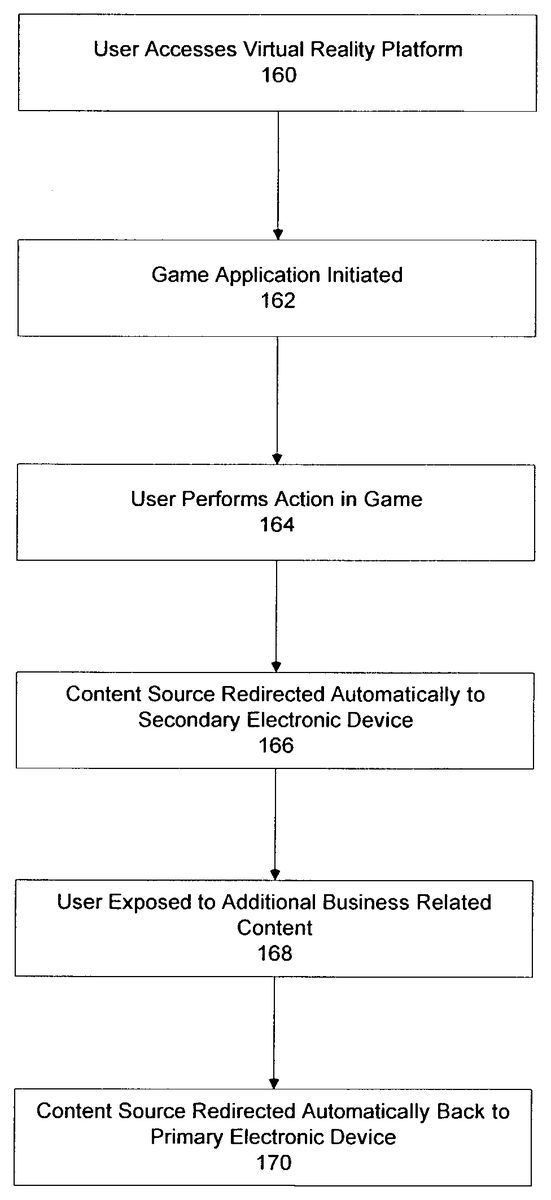
FIG. 5depicts the sequence of events by which the illustrative embodiment of the present invention utilizes a virtual reality platform to increase the user experience. The sequence begins when the user accesses the virtual reality platform (step160). The game application is initiated (step162). The user performs actions in the game (step164). One of the events in the game causes the source of the content being displayed to the user through the virtual reality platform to be automatically re-directed to a secondary electronic device (step166). At the secondary electronic device, the user is exposed to additional business-related content (step168). Following the conclusion of a pre-determined task or event at the secondary electronic device, the content source is re-directed automatically back to the original game site (step170). During this time the user is experiencing the displayed data through the three dimensional effects of the virtual reality platform134.
The illustrated embodiment of the present invention anticipates the generation of both two-dimensional and three dimensional image data for the user by the game application. In the network environment where the user is accessing the game application through a local web browser with the game application being stored on a remote site on the network, the user may receive two-dimensional data through the web browser. In such a case, the web page is retrieved to the local web browser and the graphics are rendered locally prior to displaying the page to the user. It is also anticipated within the scope of the present invention that for users with broadband connections that are able to handle the greater data broadcast requirements, three dimensional data may be received from the remote site holding the game application. In such a case, the external site renders the three dimensional graphics and forwards the three-dimensional data to the local device being used by the user over a high capacity connection such as a cable modem line, DSL line, T1 line, or optical line. Three-dimensional images will then be displayed to the user. In one aspect of the invention the three-dimensional images which are rendered at the external site may be compressed prior to being sent over the network.
It will thus be seen that the invention attains the objectives stated in the previous description. Since certain changes may be made without departing from the scope of the present invention, it is intended that all matter contained in the above description or shown in the accompanying drawings be interpreted as illustrative and not in a literal sense. For example, although web sites have been listed herein as the repository of the business-related content on the secondary electronic devices, those skilled in the art will recognize that other locations may be used to hold business-related data without departing from the scope of the present invention. Practitioners of the art will realize that the sequence of steps and architectures depicted in the figures may be altered without departing from the scope of the present invention and that the illustrations contained herein are singular examples of a multitude of possible depictions of the present invention.
Claims
- A method of integrating business-related content over a computerized network, into a primary electronic device that accesses a game application, from at least one secondary electronic device that accesses business-related content on a plurality of web pages, the method comprising: receiving a request at said primary electronic device to initiate a locally executed game application that is accessible at said primary electronic device, from a user interfaced with said network;initiating said game application at said primary electronic device;automatically integrating business-related content from at least one of said web pages of said secondary electronic device into said locally executed game application during execution of said game application;automatically re-directing said user to one of said web pages of said secondary electronic device from said primary electronic device, said re-direction being integrated into said game application and said re-direction occurring as part of the user executing said game application;and executing a user action on said business-related content from said secondary electronic device.
- The method of claim 1 wherein said user purchases an item from a vendor associated with said business-related content on said at least one customized web page.
- The method of claim 1 wherein said game application displays branded business-related content to said user.
- The method of claim 3 wherein said branded business-related content is dynamically updated.
- The method of claim 1 , comprising the further steps of: executing game-related user actions in said game application as a result of user choices;and generating a player profile based on said user choices made during said game application;wherein the player profile is specific to said user.
- The method of claim 5 wherein said player profile is disseminated to providers of business-related content used in said game application.
- A method of automatically integrating content into an electronic device over a computerized network, comprising: receiving a request from a user at a primary electronic device to initiate at least one of a plurality of locally executed applications that are accessible to said primary electronic device interfaced with said network;initiating said at least one of said plurality of applications at said primary electronic device;providing at least one customized web page at a secondary electronic device, accessed over said computerized network by said primary electronic device, said web page being customized with content for use with said one of said plurality of applications;automatically integrating said content from said secondary electronic device into said at least one of said plurality of locally executed applications during execution of said at least one of said plurality of applications;automatically re-directing said user to one of said customized web pages at said secondary electronic device, from said primary electronic device, said re-direction being integrated into said one of said plurality of applications and said re-direction occurring as part of the user executing said one of said plurality of applications;and executing a user action on said content from said secondary electronic device, said user action generating a benefit for said user relating to said content.
- The method of claim 7 , wherein said content includes dynamic content.
- The method of claim 7 , further comprising: providing a virtual reality platform interfaced with said primary electronic device, said virtual reality platform providing a three-dimensional visualization in which the user interacts.
Disclaimer: Data collected from the USPTO and may be malformed, incomplete, and/or otherwise inaccurate.