U.S. Pat. No. 8,444,488
DEVICE AND METHOD FOR CONTROLLING THE MOVEMENT OF A GAME CHARACTER
AssigneeNCSOFT Corporation
Issue DateFebruary 20, 2012
Illustrative Figure
Abstract
The present invention relates to a device and method for controlling the movement of a games character, which enable character movement of a type in which a character in the game jumps down and falls freely from an elevated height following an action by the games player, or progresses forwards in the direction of movement if another action is performed. The present invention has the advantageous effect that the appeal of a game is maximized as the movement time and the movement distance differ depending on the terrain and updrafts in the game even though the degree of freedom for actions is small.
Description
DETAILED DESCRIPTION OF THE INVENTION Hereinafter, the configuration of the apparatus of controlling game character's movement according to the present invention will be described with reference to the accompanying drawings. FIG. 1shows the apparatus of controlling game character's movement according to the present invention, andFIG. 2illustrates function block diagram of the apparatus of controlling game character's movement according to the present invention. The apparatus of controlling game character's movement according to the present invention100receives input from input means110and shows result of the input on monitor200, and can be implemented on a computer as illustrated inFIG. 1. Computer means an apparatus that processes inputted instruction words in digital way and outputs the result on output means in a broad sense. It also means a platform for game software. Therefore, the word “computer” includes personal computer illustrated inFIG. 1and much more devices such as PDA or Laptop, etc. The input means110is illustrated as a keyboard inFIG. 1, however the input means110can be various device such as joystick that are commonly used in game play. The apparatus of controlling game character's movement according to the present invention100comprises an input means110for receiving input from user, a coordinate calculation means120for calculating character's coordinate and a display control means130for display game character with calculated coordinate on monitor200as illustrated inFIG. 2. Usually, user can play game by moving his character in 2-dimensional or 3-dimensional coordinate system regardless of game genre from classic arcade games with vertical or horizontal scroll system to popular MMORPGs (Massive Multiplayer Online Role Playing Game). Coordinate calculation means120calculates coordinate of game character in coordinate system of the game. It repeatedly calculates coordinate of the game character that changes when user inputs with input means110in order to move his game character in game. For example, coordinate calculation means120calculates coordinate of game character according to ...
DETAILED DESCRIPTION OF THE INVENTION
Hereinafter, the configuration of the apparatus of controlling game character's movement according to the present invention will be described with reference to the accompanying drawings.
FIG. 1shows the apparatus of controlling game character's movement according to the present invention, andFIG. 2illustrates function block diagram of the apparatus of controlling game character's movement according to the present invention.
The apparatus of controlling game character's movement according to the present invention100receives input from input means110and shows result of the input on monitor200, and can be implemented on a computer as illustrated inFIG. 1.
Computer means an apparatus that processes inputted instruction words in digital way and outputs the result on output means in a broad sense. It also means a platform for game software. Therefore, the word “computer” includes personal computer illustrated inFIG. 1and much more devices such as PDA or Laptop, etc.
The input means110is illustrated as a keyboard inFIG. 1, however the input means110can be various device such as joystick that are commonly used in game play.
The apparatus of controlling game character's movement according to the present invention100comprises an input means110for receiving input from user, a coordinate calculation means120for calculating character's coordinate and a display control means130for display game character with calculated coordinate on monitor200as illustrated inFIG. 2.
Usually, user can play game by moving his character in 2-dimensional or 3-dimensional coordinate system regardless of game genre from classic arcade games with vertical or horizontal scroll system to popular MMORPGs (Massive Multiplayer Online Role Playing Game).
Coordinate calculation means120calculates coordinate of game character in coordinate system of the game. It repeatedly calculates coordinate of the game character that changes when user inputs with input means110in order to move his game character in game.
For example, coordinate calculation means120calculates coordinate of game character according to inputted “→” key when user inputs “→” key with keyboard so the character can move to the direction corresponds to “→” key.
Display control means130shows the character on monitor200with the calculated coordinate values when the character's coordinate is calculated. Coordinate calculation means120renew the character's coordinate in the event of key input or game process. Display control means130animates the character on monitor200with renewed coordinate.
Coordinate system provides scheme for representing relative location of objects including character in game. X coordinate and Y coordinate can be used to represent location of objects. Also, Z coordinate can be used in games with 3-dimensional graphic or 3 dimensional coordinate system.
A character may have X coordinate and Y coordinate in a game illustrated inFIG. 1. Y coordinate may increase while the character moves to upper direction of monitor200and X coordinate may increase while the character moves to right. If the character stand on the ground as illustrated inFIG. 1it means that Y coordinate of the ground equals to that of the character.
Now, way of calculating movement velocity and coordinate when the character jumps from an elevated height (that is, Y coordinate value is high) to lower place will be introduced.
Coordinate calculation means120renews the character's coordinate by calculating falling speed of the character based on predetermined algorithm when user input command via input mean110to let the character jump to lower place while the character lies in an elevated height such as top of building or hill. Then coordinate calculation means120calculates amended falling speed and the character's forward direction moving speed when the user controls the character to move forward by input predetermined command with input means110while the character falls freely and does not reaches the ground yet. So, coordinate calculation means120can renew the character's coordinate again. The character's motion of opening glider and flying over air current during free fall in game can be shown on monitor200as an animated motion picture.
Detailed procedure in order to implement the motion is as follow:
Coordinate calculation means120calculates the character's coordinate of the game's coordinate system based on Formula 1 shown below when command to force the character to fall freely from an elevated height (hereinafter referred as “fall command”.) at the moment of that the character lies on an elevated height of the game's coordinate system.
vf=vf0+(g*t) [Formula 1]
(vf: movement velocity in Y axis, vf0: initial movement velocity in Y axis, g: acceleration of gravity, t: time increment)
Formula 1 is for calculating free fall speed. vf means free fall speed and changing speed of Y coordinate of the character at the same time. vf0 means initial speed in Y axis at the moment the character starts to fall. g means acceleration of gravity. vf0 is a constant and g also is, and they can have proper value.
t means time increment after “fall command” inputted.
By this, varying Y coordinate of the character can be calculated. Display means130shows animated motion picture of the character's free fall on monitor200using the calculated Y coordinate.
What is explained above is the procedure in case of “fall command” inputted while the character's Y coordinate is bigger than a certain value. So, the procedure may not the same if the character's Y coordinate is not bigger than a certain value. For example, if “fall command” is inputted while the character lies on the ground as illustrated inFIG. 1, there is nowhere to fall so the character will do nothing or do another motion but fall.
In the mean time, if a command to force the character move forward (hereinafter referred as “gliding command”.) is inputted during the character's free fall (that is, before the character reaches the ground), coordinate calculation means120calculates the character's coordinate based on Formula 2 shown below.
v=v0+(ks*[kd*vf]*t) [Formula 2]
(v: movement velocity in X axis, initial movement velocity in X axis, kd: damping factor, ks: conversion coefficient, vf: movement velocity in Y axis, t: time increment)
In case of “gliding command”, the character stops free fall then moves forward in game. Formula 2 is for calculating movement velocity of X axis of the character.
v0 means initial speed in X axis at the moment the character starts to fall. kd is damping factor for calculating upward resistance added when the glider opened. ks is a conversion coefficient from upward (Y axis) resistance into horizontal (X axis) resistance. These constants can be set up in programming process. t is time increment after “gliding command” inputted. Therefore it is not the same as Formula 1.
In the mean time, the character will stop to fall in case “gliding command” inputted during free fall before the character reaches the ground. That is, the absolute value of movement velocity in Y axis decreases as “gliding command” inputted. Preferably, decreasing movement velocity in Y axis coincide with increasing movement velocity in X axis by letting the absolute value of movement velocity in Y axis be in inverse proportion to the absolute value of movement velocity in X axis.
But, in such certain assumption that the character falls in a constant velocity, value of vf after “gliding command” cab be substituted by a constant value in spite of Formula 1.
Free fall velocity increase as time goes after the character starts to fall according to Formula 1, and forward movement speed v will be higher as free fall velocity vf increases according to Formula 2.
On the contrary, vf may not be such a high value at the moment of free fall started, and forward movement speed v will be lower as lower free fall velocity. But, altitude (Y coordinate of the character) will be lower as time progresses after free fall started.
So, it is not clear which forward movement distance is longer. It depends on diverse variables of every single case. At this moment, forward movement distance means movement distance in X axis the character moves in coordinate system of the game.
A free-falling character is shown in left side ofFIG. 3while forward moving character with glider opened is shown in right side. Dotted line means movement direction of the character.
A character's movement of free fall and flying forward with opened glider can be implemented in game according to the explanation stated above.
In the meantime, the character flying forward with glider opened after “gliding command” inputted may be affected by ascending air current. It is preferable because this helps garners feel interesting and the character's motion not be too simple.
In order to implement this feature, coordinate calculation means130raise Y coordinate of the character as the character changes moving direction in Y axis and then moves to some degree in Y axis. Coordinate calculation means130then recalculate movement velocity in both X and Y axis in view of Formula 1 and 2.
The character's upward movement by ascending air current may occur in a second, the character's movement velocity in X axis can be calculated with Formula 3.
v=v0−(ks*[kd*vf]*t) [Formula 2]
(v: movement velocity in X axis, v0: initial movement velocity in X axis, kd: damping factor, ks: conversion coefficient, vf: movement velocity in Y axis, t: time increment)
Plus sign “+” after v0 is substituted by minus sign “−” in comparison to Formula 2.
Therefore, movement velocity in X axis of the character becomes low but altitude becomes high. Thus, overall movement distance becomes longer.
This kind of ascending air current may occur randomly during the character's flying forward or may occur just before the character's landing.
In the meantime, during the character's flying forward by “gliding command”, user can input another predetermined command (hereinafter referred as “fast advance command”.) in order for the character to avoid ascending air current and to fly fast.
If user input “fast advance command” during the character's flying forward by “gliding command” in order for the character to avoid ascending air current and to fly fast, coordinate calculation means120calculates the character's movement velocity with Formulas 1 and 2. In this calculation process Y coordinate of the character never become higher. By this, the character can avoid ascending air current and land swiftly.
In the meantime, it is possible to increase falling speed in Y axis or movement velocity of X axis by adding a certain constant or multiplying by a certain constant.
By controlling the character's movement as stated above, the character's movement after during the character's free fall and degree of freedom of the character's movement control may be quite restricted. User may feel interesting while trying to make overall fly distance longer. In order to restrict degree of freedom of movement control, some commands inputted after “fall command” and “gliding command” can be omitted.
For example, even if user inputs “↑” or “↓” key from keyboard during the character's flying forward by “gliding command”, process according to the inputted key—to move the character upward or downward etc.—will not be executed.
In the meantime, users may have fun with controlling his character and may be familiar with the game easily if key input scheme be simplified. In order to provide simple input scheme “space bar” inputted when the character's altitude is higher than a predetermined value can be regarded as “fall command”, the same “space bar” inputted during the character's free fall can be regarded as “gliding command”.
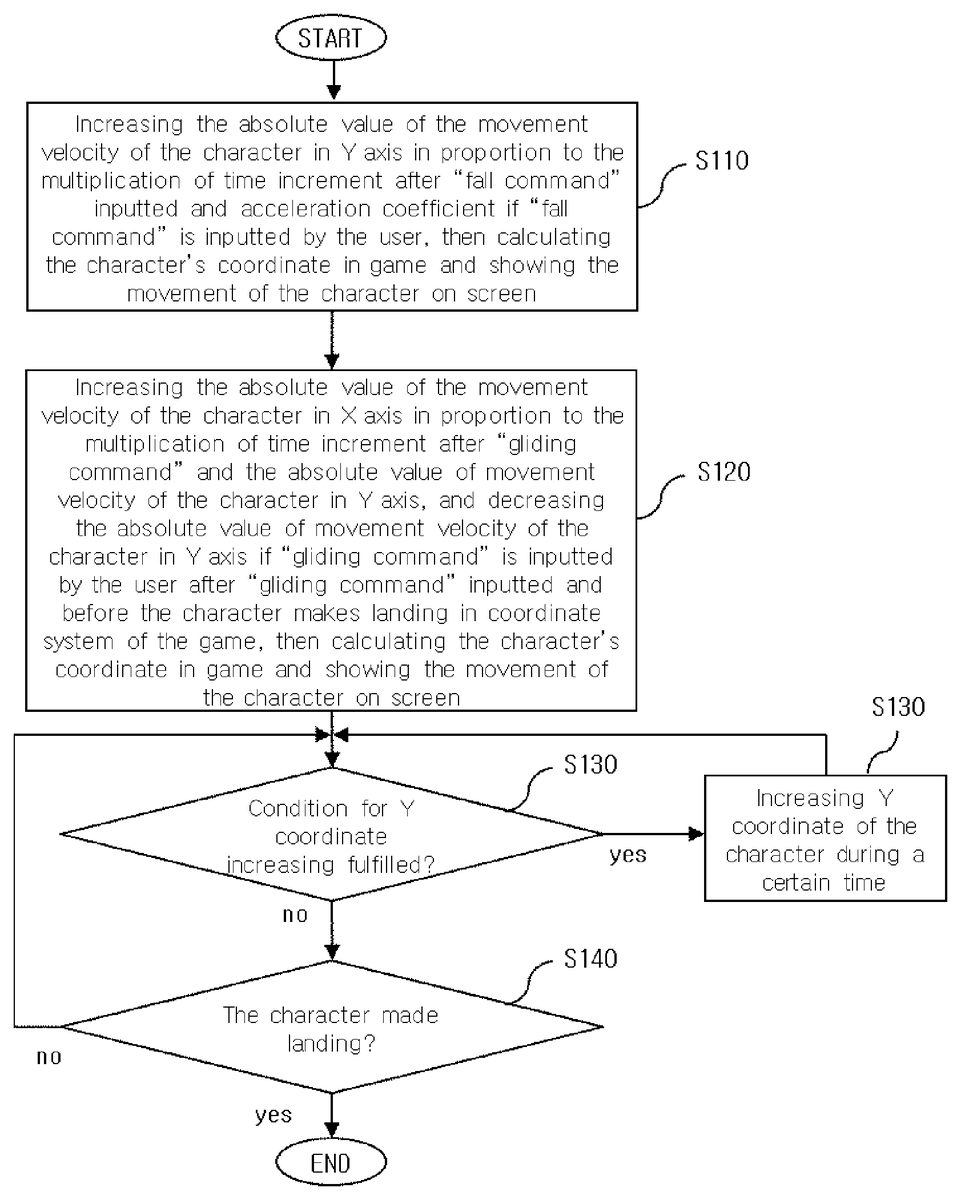
Hereinafter, the method of calculating the character's coordinate and processing animation on screen by the apparatus of controlling game character's movement according to the present invention will be described with reference toFIG. 4.
The same explanation with the above stated explanation will be skipped.
At first, if user inputs from keyboard110the apparatus of controlling game character's movement recognize the value of the input. If input value equals “fall command” to let the character fall in game, the apparatus increases the absolute value of the character's movement velocity in Y axis in proportion to the time increment after “fall command” inputted multiplied by acceleration coefficient. Then, the apparatus calculates the character's coordinate in game and processes animation of the character's movement in screen. (step110).
By this, animation process of the character's free fall from an elevated height (a position with high Y coordinate in coordinate system of the game) such as hill can be implemented.
If user inputs “gliding command” after that, the apparatus increases the absolute value of movement velocity in X axis in proportion to the time increment after “gliding command” multiplied by the absolute value of movement velocity of Y axis, and the apparatus decreases the absolute value of movement velocity in Y axis. Thus, the apparatus calculates the character's coordinate and then shows the motion of the character in screen. (step120).
Display control means130may process the character's motion as an animation that the character opens glider just as what is illustrated inFIG. 3. InFIG. 3, a character opens glider and flies forward during free fall.
In the meantime, movement velocity in Y axis is no longer free fall when the character flies forward with glider opened and becomes uniform motion. That is, movement velocity in Y axis equals to a certain constant. Or, movement velocity in Y axis becomes in inverse proportion to movement velocity in X axis.
After that, the apparatus can increase Y coordinate of the character in coordinate system randomly before the character make landing. It can be executed when the ascending air current occurs. Ascending air current can occur randomly or occur just before the character's landing. By the ascending air current falling speed of the character decreases and the character may ascend in a certain distance. Movement velocity in X axis of the character may decrease in this moment. This makes the game more realistic.
When the ascending air current disappears, that is, when the rise of Y coordinate ends, the apparatus calculates movement velocity in X axis and Y axis again, and coordinate of the character again. (step130)
The apparatus repeats from S110top S130before the character make landing in game, and ends the process after the character's landing. (step140)
Although several exemplary embodiments of the present invention have been described for illustrative purposes, the present invention is not limited to these embodiments. Those skilled in the art will appreciate that various modifications, additions and substitutions are possible, without departing from the scope and spirit of the invention as disclosed in the accompanying claims.
Claims
- A method of controlling and displaying a movement of a game character on a screen of a computer, comprising: (a) causing a processor to increase an absolute value of a movement velocity of a character in Y axis in proportion to a value obtained by multiplying a first time increment after a fall command is inputted by an acceleration coefficient when a fall command is inputted by a user, then causing the processor to calculate the coordinate of the character in a game and showing the movement of the character on a screen;and (b) increasing an absolute value of a movement velocity of the character in X axis in proportion to a value obtained by multiplying a second time increment after a gliding command is inputted by the absolute value of movement velocity of the character in Y axis, and decreasing the absolute value of movement velocity of the character in Y axis after the gliding command is inputted and before the character's landing in the coordinate system of the game, then calculating the coordinate of the character in the game and showing the movement of the character on the screen.
- The method of claim 1 , wherein the step of decreasing the absolute value of the movement velocity in Y axis in step (b) includes setting the absolute value of the movement velocity in Y axis in inverse proportion to the absolute value of the movement velocity in X axis.
- The method of claim 1 , further comprising, after step (b): (c) randomly increasing a Y coordinate value of the character during a certain time period before the character makes landing in the game, and then re-calculating the movement velocities of the character in X and Y axes.
- The method of claim 1 , further comprising, after step (b): (d) increasing a Y coordinate value of the character during a certain time period, and then re-calculating the movement velocities of the character in X and Y axes when a distance between the character and a ground in the game is shorter than a preset value.
- The method of claim 1 , wherein step (b) includes setting X coordinate and Y coordinate values of the character in the game while keeping the Y coordinate values of the character from being raised before the character's landing when the fall command and the gliding command are inputted in a consecutive order and then a fast forward command is inputted by the user.
- The method of claim 1 , further comprising: (e) ending a process if a Y coordinate value of the character is equal to a Y coordinate value of a ground in the coordinate system of the game, otherwise jumping to step (a).
- A non-transitory computer readable recording medium carrying one or more sequences of pattern data for controlling a movement of a game character in a computer, wherein execution of one or more sequences of pattern data by one or more processors causes the one or more processors to perform the steps of: increasing an absolute value of a movement velocity of a character in Y axis in proportion to a value obtained by multiplying a first time increment after a fall command is inputted by an acceleration coefficient when a fall command is inputted by a user, then calculating the coordinate of the character in a game and showing the movement of the character on a screen;and increasing an absolute value of a movement velocity of the character in X axis in proportion to a value obtained by multiplying a second time increment after a gliding command is inputted by the absolute value of movement velocity of the character in Y axis, and decreasing the absolute value of movement velocity of the character in Y axis after the gliding command is inputted and before the character's landing in the coordinate system of the game, then calculating the coordinate of the character in the game and showing the movement of the character on the screen.
- The non-transitory readable medium of claim 7 , wherein the execution of one or more sequence of pattern data by one or more processors causes the one or more processors to perform the additional step of: randomly increasing a Y coordinate value of the character during a certain time period before the character makes landing in the game, and then re-calculating the movement velocities of the character in X and Y axes.
- The non-transitory readable medium of claim 7 , wherein the execution of one or more sequence of pattern data by one or more processors causes the one or more processors to perform the additional step of: increasing a Y coordinate value of the character during a certain time period, and then re-calculating the movement velocities of the character in X and Y axes when a distance between the character and a ground in the game is shorter than a preset value.
- An apparatus for controlling a game character's movement, comprising: an input means for receiving an input from a user, the input including a fall command and a gliding command;a coordinate calculation means for calculating a coordinate of a character in a coordinate system of a game during a play of the game, increasing an absolute value of a movement velocity of the character in Y axis in proportion to a value obtained by multiplying a first time increment after the fall command is inputted by an acceleration coefficient, increasing an absolute value of a movement velocity of the character in X axis in proportion to a value obtained by multiplying a second time increment after a gliding command is inputted by the absolute value of the movement velocity of the character in Y axis, and decreasing the absolute value of the movement velocity of the character in Y axis after the gliding command is inputted and before the character's landing in the coordinate system;and a display control means for showing the character on a screen by using the calculated coordinate of the character in the game.
- The apparatus of claim 10 , wherein the coordinate calculation means is for calculating the movement velocity of the character in Y axis in the coordinate system of the game and then calculating the coordinate of the character, when the fall command is inputted by the user, according to an equation: vf=vf 0+( g*t ), where vf is the movement velocity of the character in Y axis, vf0 is an initial movement velocity in Y axis, g is an acceleration of a free falling, and t is a time increment.
- The apparatus of claim 10 , wherein the coordinate calculation means is for calculating the movement velocity of the character in X axis in the coordinate system of the game and then calculating the coordinate of the character, when the fall command and the gliding command are inputted by the user in a consecutive order, according to an equation: v=v 0+( ks*[kd*vf]*t ), where v is the movement velocity of the character in X axis, v0 is an initial movement velocity in X axis, kd is a damping coefficient, vf is a movement velocity in Y axis, and t is a time increment.
- The apparatus of claim 12 , wherein the coordinate calculation means is for setting the movement velocity of the character in Y axis in the coordinate system of the game in proportion to the movement velocity of the character in X axis, then calculating the coordinate of the character in the game.
- The apparatus of claim 10 , wherein the coordinate calculation means is for randomly increasing a Y coordinate value of the character during a certain time period before the character makes landing in the game, and then re-calculating the movement velocities of the character in X axis and Y axis.
- The apparatus of claim 14 , wherein the coordinate calculation means is for calculating the movement velocity of the character in X axis during the certain time period, and then calculating the coordinate of the character in the game according to an equation: v=v 0−( ks*[kd*vf]*t ), where v is the movement velocity of the character in X axis, v0 is an initial movement velocity in X axis, kd is a damping coefficient, ks is a conversion coefficient, vf is the movement velocity in Y axis, and t is a time increment.
- The apparatus of claim 10 , wherein the coordinate calculation means is for increasing a Y coordinate value of the character during a certain time period, and then recalculating the movement velocities of the character in X axis and Y axis when a distance between the character and a ground in the game is shorter than a preset value.
- The apparatus of claim 16 , wherein the coordinate calculation means is for calculating the movement velocity of the character in X axis during the certain time period, and then calculating the coordinate of the character in the game according to an equation: v=v 0−( ks*[kd*vf]*t ), where v is the movement velocity of the character in X axis, v0 is an initial movement velocity in X axis, kd is a damping coefficient, ks is a conversion coefficient, vf is the movement velocity of the character in Y axis, and t is a time increment.
- The apparatus of claim 10 , wherein the coordinate calculation means is for setting X and Y coordinate values of the character in the game by keeping the Y coordinate value of the character from being raised before the character's landing when the fall command and the gliding command are inputted in a consecutive order and then a fast forward command is inputted by the user.
- The apparatus of claim 10 , wherein the input means further comprises a keyboard, and the fall command is inputted by pressing a space bar of the keyboard, and the gliding command is inputted by pressing the space bar of the keyboard again after the fall command is inputted and before the character makes landing in the coordinate system of the game.
- The apparatus of claim 10 , wherein the coordinate calculation means is for ignoring a command for controlling the character's movement inputted through the input means after the fall command and the gliding command are inputted in a consecutive order and before the character makes landing in the coordinate system of the game.
Disclaimer: Data collected from the USPTO and may be malformed, incomplete, and/or otherwise inaccurate.