U.S. Pat. No. 8,425,295
SYSTEM AND METHOD FOR RATING INTENSITY OF VIDEO GAMES
Issue DateAugust 17, 2011
Illustrative Figure
Abstract
A method of rating the intensity of game play of a video game based on energy expenditure of a user playing the video game including the steps of selecting the video game, determining whether the video game requires the user to expend energy in excess of resting energy rate, testing the video game by having a plurality of users play the video game, measuring energy expenditure of the plurality of users, calculating energy expenditure of each of the plurality of users, calculating an average energy expenditure of the plurality of users and categorizing the video game based on the average energy expenditure as low intensity, moderate intensity or high intensity.
Description
DETAILED DESCRIPTION OF THE INVENTION Certain terminology is used in the following description for convenience only and is not limiting. The words “right,” “left,” “lower,” and “upper” designate directions in the drawings to which reference is made. The words “inwardly” or “distally” and “outwardly” or “proximally” refer to directions toward and away from, respectively, the geometric center or orientation of the system and related parts thereof. The terminology includes the above-listed words, derivatives thereof and words of similar import. Referring toFIGS. 1-4, in the preferred embodiment, the present application is directed to a system and method for rating the intensity of video games12. The preferred intensity rating system10involves selecting the game12for rating, testing the game12and providing a relatively easy to understand, preferably easy for a consumer to understand, rating for the game12based upon the conducted testing or evaluation. The preferred intensity rating system10of the present application results in an intensity rating14,15that may be associated with the evaluated game12. The intensity rating12is preferably a four-tiered or four-category intensity rating14including a sedentary/passive rating14a, a low intensity rating14b, a moderate intensity rating14cand a high intensity rating14d. These intensity ratings14are preferably selected due to their ability to simply and easily convey the intensity or activity generally required to play the game12. The intensity rating14is not limited to the preferred four-tiered or four category intensity rating14and may include more or less tiers or categories, depending upon preferences and/or particular games12or categories of games12. In a preferred embodiment, games12that are rated in the sedentary/passive rating14aare typically played by pushing buttons or manipulating a controller while seated. These games12typically result in limited or no increase in heart rate, limited or no increase in metabolic rate and are similar in activity level to sitting, reading or watching television. The games12that fall into the sedentary/passive rating14aare typical of traditional ...
DETAILED DESCRIPTION OF THE INVENTION
Certain terminology is used in the following description for convenience only and is not limiting. The words “right,” “left,” “lower,” and “upper” designate directions in the drawings to which reference is made. The words “inwardly” or “distally” and “outwardly” or “proximally” refer to directions toward and away from, respectively, the geometric center or orientation of the system and related parts thereof. The terminology includes the above-listed words, derivatives thereof and words of similar import.
Referring toFIGS. 1-4, in the preferred embodiment, the present application is directed to a system and method for rating the intensity of video games12. The preferred intensity rating system10involves selecting the game12for rating, testing the game12and providing a relatively easy to understand, preferably easy for a consumer to understand, rating for the game12based upon the conducted testing or evaluation.
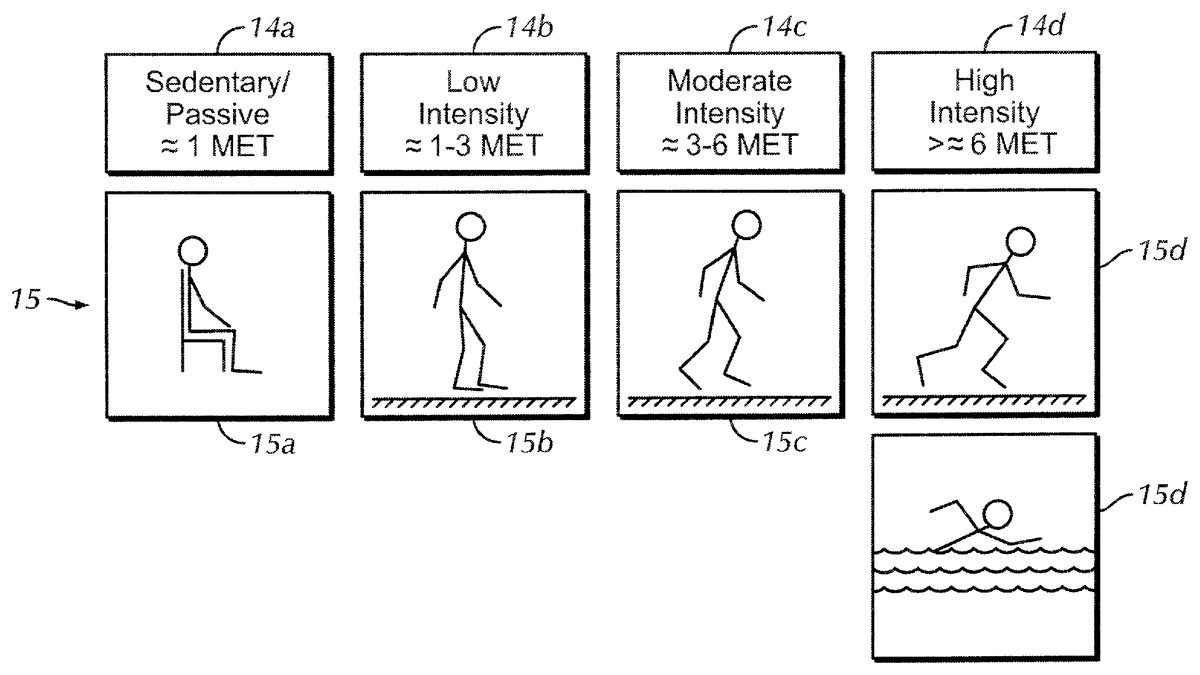
The preferred intensity rating system10of the present application results in an intensity rating14,15that may be associated with the evaluated game12. The intensity rating12is preferably a four-tiered or four-category intensity rating14including a sedentary/passive rating14a, a low intensity rating14b, a moderate intensity rating14cand a high intensity rating14d. These intensity ratings14are preferably selected due to their ability to simply and easily convey the intensity or activity generally required to play the game12. The intensity rating14is not limited to the preferred four-tiered or four category intensity rating14and may include more or less tiers or categories, depending upon preferences and/or particular games12or categories of games12.
In a preferred embodiment, games12that are rated in the sedentary/passive rating14aare typically played by pushing buttons or manipulating a controller while seated. These games12typically result in limited or no increase in heart rate, limited or no increase in metabolic rate and are similar in activity level to sitting, reading or watching television. The games12that fall into the sedentary/passive rating14aare typical of traditional video games12that have been played for numerous years by garners. The sedentary/passive rating14ais typically provided to games12that result in an energy expenditure of approximately one metabolic equivalent task (1 MET) or approximately the energy expended by a user at their resting metabolic rate (“RMR”). METs is an expression of energy expended during physical activities as multiples of a typical RMR.
The low intensity rating14bis usually or typically the result of a game12where energy expenditure is two to three (2-3) times the user's RMR. The low intensity rating14bis preferably equivalent to the energy expended by the user while walking. This low intensity rating14bis preferably given to games12that result in the user expending approximately two to three (2-3) METs. Expending two to three (2-3) METs is often associated with activities such as walking at a rate of approximately two miles per hour (2 MPH).
A third category of the preferred intensity rating14is the moderate intensity rating14c. The moderate intensity rating is typically provided to games12that result in an energy expenditure of three to six (3-6) times the user's RMR or three to six (3-6) METs. The moderate intensity rating14cis generally equivalent to a user taking a brisk walk at a rate of approximately three and one-half to four miles per hour (3.5-4 MPH) or leisurely riding a bicycle. The fourth rating of the preferred intensity rating14of the present application is the high intensity rating14dthat is typically provided to games12that result in an energy expenditure of six to eight (6-8) or more times the user's RMR. The high intensity rating14dis preferably equivalent to a user jogging, swimming, jumping rope or performing a relatively high intensity workout.
The intensity rating14is not limited to the above-described four-level or four-category intensity rating14and may have various additional or fewer levels, preferably characterized in a manner that is understandable by a consumer. In addition, the above-described average energy expenditures, expressed, for example as METs, for determining the intensity rating14are not limiting and various categories and strategies for placing different games12into the categories may be designed and developed by an evaluator16or governing body of the intensity rating system10.
In combination with the preferred intensity rating system10of the present application, the very real artistry of video games12may become important for public health. As video game developers, game manufactures and gaming system manufactures strive to come up with enjoyable games12, garners/users18and preferably child garners/users18may see a decrease in obesity because of hours spent playing enjoyable video games12that require a certain level of physical activity from the garners/users18. This additional time spent playing more active video games12results in significant calorie burn. Innovative controllers, interfaces and consoles coupled with competitive pressure to develop fun, active video games12could revolutionize the fight against obesity and, particularly, childhood obesity.
The preferred intensity rating system10of the present invention may help foster a new era in gaming that provides relatively simple to determine and understand intensity ratings14. The preferred intensity ratings14preferably provide a general idea of calorie burn, for example, average calories burned per hour. The intensity ratings14provide an indication to the consumer of calories burned when playing the game12, which can assist the consumer in making informed buying decisions. This intensity rating14would provide a relatively simple method for consumers to understand which games12include content appropriate for their children users18and provide information about whether the games12may be beneficial for their children users18. The preferred intensity ratings14may be utilized in conjunction with existing rating systems, for example, violent or non-violent rating systems, when a consumer is making a decision regarding which game to purchase.
The intensity ratings14are preferably incorporated into information provided to consumes when purchasing the games12. The intensity ratings14preferably provide estimates of calories burned by the average person or user18in a predetermined time, potentially an hour. For example, the game12rated with the sedentary/passive rating14indicates to the consumer that the game12typically does not result in significant energy or calorie burn during play, at least little more than RMR or one MET. These games12that are rated with the sedentary/passing ratting14are typically lean-back, button-intensive shooting games or the like. In contrast, active games12with a calorie-expenditure rate comparable to walking, brisk walking, running/swimming, jumping rope and/or playing basketball would be provided with the appropriate low intensity, moderate intensity or high intensity rating14b,14c,14dto provide relatively quick, simple to understand purchasing information to the consumer. An independent organization could estimate the minimum calories required to play a particular video game12over a predetermined period of time and that rating could be placed onto a label for the game12or otherwise communicated to the consumer.
The preferred intensity rating system10would go a long way toward helping families make informed decisions about game play. The preferred intensity rating system10has the potential to become part of a solution when it comes to obesity, in particularly childhood obesity.
The preferred intensity rating system10of the present invention provides the preferred intensity rating14for rating video games12based generally on the energy expended playing the game12over a typical hour of game play by selected users18. The intensity rating14is preferably established by measuring and/or calculating energy expenditures of test users18using physiological sensors20. The intensity ratings14for the preferred rating system10are generally based on the intensity and energy expenditure from the sedentary/passive rating14a(similar energy expenditure to sitting) to the high intensity rating14dindicating high activity (similar energy expenditure to jogging or swimming). The preferred intensity rating system10offers consumers simple and objective ratings for comparing video games12by the physical intensity or average physical intensity of game play.
The intensity rating system10may be applied to any number or all video games12, past and present, including games12that are designed for the most technologically advanced gaming consoles, traditional gaming consoles and gaming consoles that are developed in the future. The preferred intensity rating system10may also be utilized for games12and devices that are not typically considered video games12and/or video game consoles. For example, the intensity rating system10may be utilized for games that are played on a user's smart phone, personal organizer device or similar devices. A majority of these games12would typically fall into the sedentary/passive rating14a, but efforts are being made to develop games12for such devices that would fall into higher categories of the intensity rating14. For example, augmented reality games12that ask the user18to cross certain distances in a certain amount of time using a pedometer and/or GPS technology or other varieties of sensors or positioning systems could result in games12that have a categorical intensity rating14greater than the sedentary/passive rating14afor games played on smart phones, personal organizers or similar devices. Games12could be ranked for nearly any type of device including a home computer, smart phones, gaming console or nearly any device that urges a user to play a game.
Testing of a selected game12for incorporation into the intensity rating system10typically relies on criteria based on thermodynamics and clinical/human testing, particularly games that have intensity ratings greater than the sedentary/passive rating14a. Evaluation of the game12by the evaluator16is preferably the initial screening step for the game12. The most passive games12do not necessarily require testing using the physiological sensors20and a plurality of users18under controlled conditions and may be categorized in the sedentary/passive rating14awithout such clinical/human testing.
Games12that the evaluator16expects or determines require clinical/human testing to incorporate into the intensity rating system10are typically games that require at least some physical activity from the user18. These games12are preferably categorized in the preferred intensity rating system14by determining an average energy expenditure of a typical user18in an hour of game play. This average energy expenditure may be determined by a submitted summary of the game12by game developers, the manufacturer, users18or other like, interested individuals or organizations. Alternatively, this average energy expenditure may be determined by a testing protocol of game play involving independent tester users18that is developed by the evaluator16. The evaluator16preferably develops the test to evaluate the energy expenditure for a typical hour of game play, which may be tailored to the specific technology utilized to play the game12and the kind of game12being played. For example, if the game12is primarily a rhythm dance game12, the average intensity of the game12could generally be determined by a single user18playing the game for an hour as there is typically little physical intensity variation in certain rhythm dance games12. In contrast, an adventure game12that has a period of relative inactivity with short bursts of intense physical activity would typically require a different testing protocol. The evaluator16preferably devises a testing strategy for such variable intensity games12where the average physicality or energy expenditure would be assessed over several hours of game play to determine the average expenditure of energy for playing the game12during an average hour of game time. Certain adventure games12may also requires even longer intervals of inactivity interspersed with spurts of intense activity. Such adventure games12may result in the evaluator16devising testing protocols that require users18to play the game12for sixty hours (60 hrs) or more to determine average energy expenditure for a typical one hour (1 hr) period of game play. Numerous periods of testing times for the users18may be required to determine the typical energy expenditure for any specific game12to enter into the intensity rating system10and the above are non-limiting examples.
Recommended exercises or exercise for individuals is generally based on how long a user18participates in a particular intensity of exercise over the course of a day or a week. Various organizations provide recommendations for individuals, such as one hundred fifty minutes (150 min.) per week of moderate intensity exercise or seventy-five minutes (75 min.) of high intensity exercise. For the purposes of the preferred rating system10, the game12is preferably provided with an intensity rating14based on a per hour duration of typical game play. The per hour energy expenditure is preferably determined by calculation, screening, field testing and/or other appropriate methods or techniques that are developed by the evaluator16. Such a strategy is preferred for the intensity rating system10because video games12, unlike many other forms of physical exertion such as playing basketball, swimming, jogging, walking or other activities, may not have a consistent rate of exertion through the course of the activity. Certain games12may have only fifteen minutes (15 min.) per hour during which significant physical exertion is prompted while other games12may have continuous physicality over the entire period of game play. Until screening, field testing and/or other evaluations are conducted by the evaluator16, it cannot be presumed that the physical exertion observed during a single point in or short interval of time of game play of the game12is the same level of physical intensity maintained throughout game play.
The intensity rating system10of the preferred embodiment is also able to rate games12that have various intensity settings. The intensity rating system10may be utilized to test or analyze such games12and determine a min/max expenditure for categorization in the intensity rating14. Therefore, several intensity ratings14a,14b,14c,14dmay be appropriate for games that have these variable intensity settings. The consumer can be informed by the manufacturer, developer or organization communicating the intensity rating14to the consumer regarding which rating14a,14b,14c,14dis appropriate for each setting. The communication may also include information related to the minimum caloric expenditure for the game12and what settings result in maximum caloric expenditure for the game12. Details of how to achieve these settings and results may be communicated in a report of the intensity rating14for the specific game12.
In preferred embodiment of the intensity rating system10of the present invention the rankings of the games12may be based on objective metrics of energy expenditure that are consistent across many different users18of various ages, basal metabolic indices (height/weight ratio), states of cardiovascular health and related parameters. The uniformity of the intensity rating14across games12preferably allows consumers and users18to directly and quickly compare games12based on the energy expenditure when playing the game12, which is preferably analogous to the intensity rating14. The preferred intensity rating system10provides valuable information to consumers for comparison of active or exercise-based games12. The intensity rating14provides consumers with the ability to directly compare such games for comparing energy expended during game play. In combination with the obesity epidemic and the popularity of video games12, the preferred intensity rating system10provides relevant information to consumers and users18to make direct comparison buying decisions of such games12. It is conceivable that users18will make decisions for their children's media diet, specifically the purchase of video games12, based on the expected expenditure of energy or activity level required for these games12.
Games12may be rated in an initial screening process without the requirement for field or clinical testing, as is described above, based on a submitted description of the game12. If the game12is designed to be played on a computer or console where limited physical activity will be requested from the user18, the evaluator16may rank such a game12in the sedentary/passive ranking14without the need for field testing. Generally, games12that are not immediately ranked as sedentary/passive14aare field tested for qualification in the intensity rating system10of the present invention.
The evaluator16may also add categories to the preferred intensity rating14or remove categories from the intensity rating14based on the field testing of a particular game12. Specific notations may be included in the intensity rating14that provide indications to consumers that are unrelated to the energy expenditure required to play the game. For example, notations may be provided indicating that game12is appropriate for or targeted to users18with disabilities. Such games12may include those that entirely rely on use of a player's arms while playing the game12. Alternatively, a notation may be provided indicating a particular motion game12is appropriate for a visually impaired user18.
The energy expenditure calculated to facilitate the intensity rating14of the preferred embodiment of the intensity rating system10is not limited to being defined by METs and may be defined by nearly any measure that provides a meaningful value to the average energy expended during play of a particular game12. Physiological parameters that may be utilized to determine energy expenditure during testing of particular games12may include, but are not limited to, aerobic capacity, heart rate, breathing rate, heart rate reserve, temperature, breathing, movement and related parameters.
In the preferred embodiment of the intensity rating system10, the evaluator16typically tests or determines RMR for the selected testers or users18prior to conducting field testing. One (1) MET or the RMR of the particular user18is typically considered to be three and a half millimeters of oxygen per kilogram per minute (3½ ml O2/kg/min) and this standard can be utilized for all testers or users18in the field test. The evaluator16may alternatively establish a base line MET or RMR for each individual user or tester18prior to conducting any tests with the particular users or testers18. The energy expenditure of the user18over a predetermined time is then compared to the standard or measured 1 MET or RMR of the user or tester18to determine the energy expenditure during game play. Typically, a skilled evaluator16understands various methods and strategies for determining the energy expenditure during game play in a particular testing situation, for example, by utilizing calorimetry or like techniques.
Various physiological sensors20may be utilized during field testing for the preferred intensity rating system10of the present invention. The physiological sensors20may include a thermometer, a heart rate sensor, a carbon dioxide sensor, an oxygen sensor, a heart rate sensor, an aerometer, a breathing rate sensor, a movement sensor, a global positioning system, a respiration sensor, a skin conductance sensor, an electromyogram, an optical sensor, a scale or other like sensors that are able to measure physiological characteristics of testers or users18during game play. This list of physiological sensors20is not all inclusive and alternative sensors20and techniques may be utilized by the evaluator16.
GPS sensing may be particularly appropriate when evaluating energy expenditure of augmented reality games12for smart phones. The GPS technology could record distance, velocity, acceleration and changes in altitude of the user or tester18while playing the augmented reality games12.
In the preferred embodiment of the intensity rating system10, the testing results in a value of energy expended during typical play of the game12. The preferred method of energy evaluation is the comparison of RMR and the METs value from game play. This comparison is preferably characterized during an average hour of game play.
To evaluate the selected game12, the evaluator16may elect to utilize specially trained video game testers or users18and indirect calorimetry or other devices to measure average energy expenditure in a typical hour of play of the game12in METs. The testers or users18would preferably vary in age, gender and body mass index (“BMI”) and at least two testers18would test each game being ranked for at least one hour. Testing sessions are preferably video taped or otherwise audio and visually recorded digitally and testers or users18preferably complete questionnaires in which they note prominent physicality descriptors during play of the game12. The physiologic data, audio, video and tester questionnaires may all be reviewed by the evaluator16who makes an informed decision regarding whether the specific game12requires additional testing to provide a better evaluation of where the game12should be listed in the intensity rating14. In addition, additional testing may be appropriate when the game12falls close to a level between ratings of the intensity rating14. Additional tests may then be conducted of the game12or the testers or users18may be directed to play the game12for longer periods of time. In addition, results may indicate that sporadic, infrequent, inconsistent or diverse forms of physicality in the game12require additional testing or longer test periods.
Once the testing under the preferred intensity rating system10is completed, the evaluator16is able to assign a rank or intensity rating14to the game12. The intensity rating14preferably provides consumers with information about the physicality or level of activity and intensity required for the particular game12. The intensity rating14may be communicated utilizing the above-described phrases including sedentary/passive14a, low intensity14b, moderate intensity14cand high intensity14d. Alternatively, the intensity rating14may be communicated utilizing symbols15to generally convey the intensity rating14to the users. Specifically referring toFIG. 2, the symbols15utilized to indicate the four-tier intensity rating system14permit a relatively simple format for conveying the ratings to the consumers in a universal manner, via rating symbols15a,15b,15c,15d. The rating symbols15a,15b,15c,15dare preferably able to convey the intensity rating14without requiring translation into various languages. Accordingly, the symbols15for the intensity rating system14are able to universally convey the ratings to consumers. The particular rating symbols15a,15b,15c,15dutilized to indicate the intensity rating14shown inFIG. 2are not meant to be limiting and may be comprised of nearly any symbol that is able to convey the intensity of the game12to the consumer in a relatively simple manner.
The preferred rating symbols15a,15b,15c,15dto characterize the intensity rating14include the seated individual symbol15ato indicate the sedentary/passive rating14a, the walking individual symbol15bto communicate the low intensity rating14b, the brisk walking symbol15cto indicate the moderate intensity rating14cand the running/jogging or swimming symbols15dto indicate the high intensity rating14d. The preferred rating symbols15a,15b,15c,15dshown inFIGS. 2 and 4are not limiting and may be comprised of nearly any symbol or indication selected by the evaluator16or any governing body to communicate to the consumer the expected amount of energy expended for the selected game12. The symbols15may take on any form that is able to convey such information to the consumer. The rating symbols15a,15b,15c,15dare generally selected to indicate the amount of activity expected while playing the game12that a consumer may expect in the activity.
Referring toFIGS. 1-4, the intensity rating14may include only three (3) categories including the sedentary/passive rating14a, the low intensity rating14band the high intensity rating14d. In this alternative configuration, the sedentary/passive rating14apreferably indicates the game12results in activity of approximately one MET or RMR, the low intensity rating14bmeans average game play results in expenditure in the range of one to five and nine tenths METs (1-5.9) and the high intensity rating indicates average game play results in six or more METs average energy expenditure. The three-category intensity rating14is a further simplification for communication with the consumer. The three-category intensity rating14also makes quantification into the intensity rating14slightly easier for the evaluator16. Screening and testing of selected games12is preferably not different than that of the four-category intensity rating14as energy expenditure is still utilized for the rankings. The intensity rating14may alternatively be broken into less than three or more than four categories, as long as the intensity rating14provides a meaningful, relatively easy to understand indication to a consumer of the expected amount of physical exertion expected during game play.
Referring toFIG. 4, the intensity rating14may be communicated in various manners to the consumer. For example, the intensity rating14may be printed in word or symbol format on the labeling or box of the game12or may be displayed at the point of sale of the game12, either in store or onscreen. Each of the various levels of ratings14a,14b,14c,14dmay be displayed with a mark indicating the appropriate individual rating14a,14b,14c,14dor identifying using the appropriate rating symbol15, A,15b,15c,15d. Further, reports related to the testing conducted on the specific game12by the evaluator16may be provided for consumers desiring further details regarding the intensity rating14. Unique aspects or characteristics, such as handicapped game indications, which were described above, may be displayed on or with the game12. The intensity rating14or symbol15may also be indicated or associated with a bar code or quick response (“QR”) code that, when viewed with a reader such as a smart phone, would prompt the reader to provide additional information to the consumer. For example, the reader may take the consumer to or display to the consumer a website with additional information related to the intensity rating14or symbol15. The additional information could include more detailed information about the physicality of game play of the game12, comparative analysis to other similar games12, supporting information related to the intensity rating14, supporting information related to the symbols15, videos of users18playing the game12, promotional information related to similar games12or nearly any other information that may be useful for the consumer in making a purchasing decision. The additional information may also include similarly situated games12that the consumer may be interested in investigating. Such information of related games12may be utilized by designers, manufacturers or developers to market or promote games12that would be of interest or benefit to the particular consumer.
Additional sub-categories or information may also be provided with the intensity rating14or symbols15to provide additional description for the consumer. For example, qualifiers may be utilized in the intensity rating14such as a continuous designation indicating movement is continuous throughout the game12, an episodic indicator showing that movement occurs at regular intervals in the game12, a sporadic indicator describing that movement occurs sporadically during the game12, handicapped indicators showing that the game12is appropriate for handicapped users or numerous other indicators that provide specialized information about the game12. Additional descriptors may also include genre descriptors such as sports, simulation, dance, fighting, action, adventure, strategy, role playing, racing, trivia or like indicators, mode indicators such as open world which impacts the frequency of physicality and consistency of active game play, closed world, which indicates physicality at certain times during game play, likely making active game play more consistent, in-room play, indicating games designed to be played primarily in a single room near a television, out-of-room play indicating the game12is primarily played by a portable, virtual reality or augmented reality device and designed to have the play move across distances and other like descriptors. Further descriptors that may be utilized in the intensity rating14to provide further information to the consumer may include categories such as rhythm, marital arts, boxing, fighting, sports fitness simulation, jumping, punching, kicking, augmented reality, motion, swinging, variable intensity, positive reward and related descriptors.
Extended descriptions may also be utilized for the intensity rating14of the preferred intensity rating system10. The extended descriptions preferably appear on the packaging of the game12or on a website and provide extended descriptions of the physicality of game play. The extended descriptions preferably include a summary of the content of the game, a description of movements made during the majority of the game play, how the movements apply to the context of the game12, extended explanations of the game's subtitle qualifiers (jumping, rhythm, etc.), explanations of the impact of game settings on the intensity of game play, special notes about the game12, or other like descriptions. Explanations regarding the various settings of the game12may be described, for example, any game settings that may alter the particular game12between the levels in the intensity rating14, such as from a sedentary/passive rating14ato a high intensity rating14dare preferably provided.
Communication of the intensity rating14is not limited to being printed or posted on the game12itself or its packaging and may be communicated through a website, either public or subscription only, communicated through a newsletter or communicated in nearly any manner that is able to identify the relevant intensity rating14to the appropriate purchaser. The intensity rating system10of the preferred embodiment also contemplates follow-ups to the games12that are already rated to confirm that the particular intensity rating14that was assigned to the game12is not erroneous or should change based changed circumstances. For example, games12are often changed and updated following initial release or may simply be updated by providing patches to the game12weeks or months after initial release. The evaluator16preferably provides surveillance or follow-up on the games12following upgrades or patches to determine if modifications to the intensity rating14are appropriate. If the evaluator16determines that updates to the intensity rating14are necessary, the game12may be retested or re-ranked based on changed circumstances.
In use, the intensity rating system10of the present application rates the intensity of game play of the video game12based on energy expenditure of the user18playing the game12. The video game12to be evaluated is initially selected or provided. The preferred intensity rating system10may be utilized such that only video games12including motion/location technology, accelerometers, gyroscopes and/or augmented reality technology are selected for categorization with an intensity rating14. Alternatively, the games12selected may be limited to exercise-based video games12in a preferred employment of the intensity rating system10. Once the game12is selected, a determination is made whether the game12requires the user18to expend energy in excess of an approximate RMR. If the game12is not expected to require energy to be extended in excess of RMR, the game12is categorized with the sedentary/passive rating14aand may be labeled with the sedentary/passive symbol15a. Otherwise, the game12is preferably tested by having a plurality of the users or testers18play the video game12for at least one hour intervals. During the one hour interval of game play, energy expenditure of the plurality of users18is measured with the physiological sensors20. The interval or predetermined interval of game play for testing is not limited to one hour intervals and may be between one and six hours (1-6 hrs), less than one hour (6 hrs) or nearly any interval that provides meaningful energy expenditure during game play. The testing interval is preferably determined by the evaluator16such that an informed intensity rating14may be provided to the game12based on the characteristics of the game12that is being evaluated. Energy expenditure of each of the plurality of users or testers18is calculated for the period during game play. An average energy expenditure is subsequently calculated for the plurality of users or testers18. The video game12is preferably categorized in the intensity rating14based on the calculated average energy expenditure. In the preferred embodiment, the game12is preferably categorized into one of the four categories of the intensity rating14, including the sedentary/passive rating14a, low intensity rating14b, moderate intensity rating14cor high intensity rating14d.
In the preferred embodiment of the intensity rating system10, the average energy extended by the plurality of users or testers18is converted into the MET for ranking in the intensity rating14. Specifically, in the preferred embodiment, average energy expenditure greater than one to approximately three (1-3) METs is rated as low intensity14b, average energy expenditures greater than three to approximately six (>3-6) METs is rated as moderate intensity14cand average energy expenditures greater than approximately six (>6) METs is rated as high intensity14d. The testing and intensity ratings14are preferably memorialized in a report of the specific video game12for reference by the evaluator16, to provide information to the consumer or for reference when conducting follow-up on the particular game12.
The testing and evaluation of a plurality of video games12may be conducted utilizing the methodology of the preferred intensity rating system10and a database of intensity ratings14for the plurality of video games12may be created. The video games12that are evaluated may be grouped into sub-categories, globally grouped together or alternatively arranged for communication to consumers. Subscription consumers may also be solicited or gathered who are provided access to this database by an intensity rating service. The intensity rating service would provide the updated database information to the subscription consumers for the consumer's purposes, such as for making informed video game12purchasing decisions.
It will be appreciated by those skilled in the art that changes could be made to the embodiment described above without departing from the broad inventive concept thereof. It is understood, therefore, that this invention is not limited to the particular embodiment disclosed, but it is intended to cover modifications within the spirit and scope of the present invention as defined by the appended claims.
Claims
- A method of rating the intensity of game play of video games, including a first video game and a second video game, based on energy expenditure of a user playing the video games, the method comprising the steps of: a) selecting the first and second video games to rate;b) determining whether the first video game and the second video game require the user to expend energy in excess of an approximate resting energy rate;c) testing the first video game and the second video game by having a plurality of users play the first and second video games for at least one hour intervals;d) measuring energy expenditure of the plurality of users in step (c) with physiological sensors;e) calculating the energy expenditure of each of the plurality of users during a predetermined time period of game play;f) calculating an average energy expenditure of the plurality of users for each of the first and second video games;and g) categorizing the first and second video games based on the average energy expenditure as one of at least low intensity, moderate intensity, and high intensity for comparing the intensity of game play of the first video game to the second video game.
- The method of claim 1 , wherein the first and second video games are categorized as generally passive and sedentary following step (b) when expected energy expended during game play is approximately the resting energy rate of the user.
- The method of claim 1 comprising the further step of: h) converting the average energy expended into a metabolic equivalent of task (MET), wherein the first and second video games are categorized as low intensity if the average energy expenditure is greater than one (1) to approximately three (3) METs, moderate intensity if the average energy expenditure is greater than three (3) to approximately six (6) METs and high intensity if the average energy expenditure is greater than six (6) METs.
- The method of claim 1 wherein the testing interval of step (c) is between one (1) hour and six (6) hours.
- The method of claim 1 comprising the further step of: h) preparing a report of the categorization of the first and second video games.
- The method of claim 1 wherein the physiological sensors of step (d) include at least one of a thermometer, a heart rate sensor, a carbon dioxide sensor, an oxygen sensor, a heart rate sensor, an accelerometer, a breathing rate sensor, a movement sensor, a global positioning system sensor, a respiration sensor, a skin conductance sensor, an electromyogram, an optical sensor, and a scale.
- The method of claim 6 wherein the energy expenditure of step (e) is calculated utilizing data from the physiological sensors and the predetermined time period during which the user played the first and second video games.
- The method of claim 1 comprising the further step of: h) labeling the packaging of the first and second video games with at least one of the low intensity, moderate intensity and high intensity.
- The method of claim 1 comprising the further step of: h) repeating steps (a)-(g) with a plurality of additional video games;and i) providing a database of the plurality of additional video games, the first video game and the second video game grouped into their appropriate categories determined in step (g) to subscribers of an intensity rating service.
- The method of claim 1 wherein each of the first and second video games selected in step (a) include at least one of motion/location technology, accelerometers, gyroscopes, and augmented reality technology.
- The method of claim 1 wherein each of the first and second video games selected in step (a) is an exercise-based video game.
- A method of rating the intensity of game play of a plurality of video games including a first video game and a second video game that require a user to expend energy in excess of an approximate resting energy rate, the method comprising the steps of: a) testing the first video game and the second video game by having a plurality of users play the first and second video games for at least one hour intervals;b) measuring energy expenditure of the plurality of users in step (a) with physiological sensors;c) calculating the energy expenditure of each of the plurality of users during a predetermined time period of game play;d) calculating an average energy expenditure of the plurality of users for each of the first and second video games;and e) categorizing the first and second video games based on the average energy expenditure as one of at least low intensity, moderate intensity, and high intensity for comparing the intensity of game play of the first video game to the second video game.
- The method of claim 12 comprising the further step of: f) converting the average energy expended into a metabolic equivalent of task (MET), wherein the first and second video games are categorized as low intensity if the average energy expenditure is greater than one (1) to approximately three (3) METs, moderate intensity if the average energy expenditure is greater than three (3) to approximately six (6) METs and high intensity if the average energy expenditure is greater than six (6) METs.
- The method of claim 12 comprising the further step of: f) repeating steps (a)-(g) with a plurality of additional video games of the plurality of video games;and i) providing a database of the plurality of additional video games, the first video game and the second video game grouped into their appropriate categories determined in step (e) to subscribers of an intensity rating service.
- The method of claim 12 wherein the physiological sensors of step (b) include at least one of a thermometer, a heart rate sensor, a carbon dioxide sensor, an oxygen sensor, a heart rate sensor, an accelerometer, a breathing rate sensor, a movement sensor, a global positioning system sensor, a respiration sensor, a skin conductance sensor, an electromyogram, an optical sensor, and a scale.
- The method of claim 15 wherein the energy expenditure of step (c) is calculated utilizing data from the physiological sensors and the predetermined time period during which the user played the first and second video games.
- The method of claim 12 comprising the further step of: f) labeling the packaging of the first and second video games with at least one of the low intensity, moderate intensity and high intensity based on the categorizing in step (e).
- The method of claim 12 wherein each of the first and second video games include at least one of motion/location technology, accelerometers, gyroscopes, and augmented reality technology.
- The method of claim 12 wherein the first and second video games are exercise-based video games.
Disclaimer: Data collected from the USPTO and may be malformed, incomplete, and/or otherwise inaccurate.