U.S. Pat. No. 8,409,008
GAME SERVER, BYSTANDER EVALUATING METHOD, INFORMATION RECORDING MEDIUM, AND PROGRAM
AssigneeKonami Digital Entertainment Co Ltd
Issue DateAugust 3, 2010
Illustrative Figure
Abstract
A game management unit (20) manages a match-up game which progresses based on a move transmitted from a terminal of a player. At this time, moves are successively added as game record information in a history storing unit (206). When an expected move is transmitted from a terminal of a spectator before a move by the player is received, an expected move management unit (207) stores the expected move in an expected move storing unit (208). The expected move is stored in association with an actual move stored in the history storing unit (206). A spectator evaluation unit (209) compares each expected move stored in the expected move storing unit (208) with a corresponding move stored in the history storing unit (206) at a predetermined timing (e.g., at the time of resignation), and comprehensively evaluates the expected move of each spectator.
Description
DESCRIPTION OF REFERENCE NUMERALS 11game server12,22terminal100game device101CPU102ROM103RAM104interface105controller106external memory107DVD-ROM drive108image processor109sound processor110NIC201terminal-information storing unit202information reception unit203process control unit204game management unit205game-information storing unit206history storing unit207expected move management unit208expected move storing unit209spectator evaluation unit210information transmission unit301board-information storing unit302rule storing unit303operation unit304control unit305communication unit306display unit501game record storing unit502expected move processor503expected move storing unit BEST MODE FOR CARRYING OUT THE INVENTION An explanation of embodiments of the invention will be given below. While the following describes embodiments in which the present invention is adopted to a game device for the ease of understanding, the invention can be likewise adopted to various information processing devices, such as a computer, a PDA, and a cellular phone device. That is, the embodiments to be described below are intended for explanation only, and not to limit the scope of the invention. Therefore, those skilled in the art can employ embodiments in which the individual elements or all elements are replaced with equivalent ones, and which are also included in the scope of the invention. First Embodiment FIG. 1is a schematic diagram showing the general structure of a game system including a game server or the like according to an embodiment of the invention. In this game system10, a game server11which provides (manages) match-up games is disposed over the Internet13. Each terminal12(player terminal or spectator terminal to be discussed below) of the game system10is connected to the game server11via the Internet13in a communicationable manner. Note that terminals12can directly and mutually communicate with each other by, a so-called peer-to-peer communication technology. For the ease of understanding, an explanation will be given of an example where the terminal12is a game device connectable to the Internet. FIG. 2is a schematic diagram showing the general structure of a game device100serving as the terminal12of the embodiment. Hereinafter, an explanation will be given with reference to ...
DESCRIPTION OF REFERENCE NUMERALS
11game server12,22terminal100game device101CPU102ROM103RAM104interface105controller106external memory107DVD-ROM drive108image processor109sound processor110NIC201terminal-information storing unit202information reception unit203process control unit204game management unit205game-information storing unit206history storing unit207expected move management unit208expected move storing unit209spectator evaluation unit210information transmission unit301board-information storing unit302rule storing unit303operation unit304control unit305communication unit306display unit501game record storing unit502expected move processor503expected move storing unit
BEST MODE FOR CARRYING OUT THE INVENTION
An explanation of embodiments of the invention will be given below. While the following describes embodiments in which the present invention is adopted to a game device for the ease of understanding, the invention can be likewise adopted to various information processing devices, such as a computer, a PDA, and a cellular phone device. That is, the embodiments to be described below are intended for explanation only, and not to limit the scope of the invention. Therefore, those skilled in the art can employ embodiments in which the individual elements or all elements are replaced with equivalent ones, and which are also included in the scope of the invention.
First Embodiment
FIG. 1is a schematic diagram showing the general structure of a game system including a game server or the like according to an embodiment of the invention.
In this game system10, a game server11which provides (manages) match-up games is disposed over the Internet13. Each terminal12(player terminal or spectator terminal to be discussed below) of the game system10is connected to the game server11via the Internet13in a communicationable manner.
Note that terminals12can directly and mutually communicate with each other by, a so-called peer-to-peer communication technology. For the ease of understanding, an explanation will be given of an example where the terminal12is a game device connectable to the Internet.
FIG. 2is a schematic diagram showing the general structure of a game device100serving as the terminal12of the embodiment. Hereinafter, an explanation will be given with reference to this drawing.
The game device100has a CPU (Central Processing Unit)101, a ROM (Read Only Memory)102, a RAM (Random Access Memory)103, an interface104, a controller105, an external memory106, a DVD (Digital Versatile Disk)-ROM drive107, an image processor108, a sound processor109, and an NIC (Network Interface Card)110.
As a DVD-ROM storing a program and data for a game is loaded into the DVD-ROM drive107and the game device100is powered on, the program is executed to realize the terminal12of the embodiment.
The CPU101controls the general operation of the game device100, and is connected to individual components to exchange a control signal and data therewith.
An IPL (Initial Program Loader) which is executed immediately after power-on is recorded in the ROM102. As the IPL is executed, the program recorded in the DVD-ROM is read into the RAM103and is executed by the CPU101. Further, the RAM102stores a program and various data for an operating system necessary for controlling the overall operation of the game device100.
The RAM103is for temporarily storing data and programs, and retains the program and data read from the DVD-ROM, and other data needed for progressing a game and chat communication.
The controller105connected via the interface104receives an operation input which is made when a user plays a game. For example, the controller105receives an input of character string (message) or the like in accordance with the operation input.
The external memory106detachably connected via the interface104rewritably stores data indicating the progress status of the game, data of chat communication logs (records), etc. As the user makes an instruction input via the controller105, these data can adequately be recorded in the external memory106.
The program for realizing the game and the image data and sound data accompanying the game are recorded in the DVD-ROM to be loaded into the DVD-ROM drive107. Under the control of the CPU101, the DVD-ROM drive107performs a process of reading from the DVD-ROM loaded therein to read a necessary program and data, and these are temporarily stored in the RAM103or the like.
The image processor108processes data read from the DVD-ROM by means of the CPU101and an image operation processor (not shown) that the image processor108has, and then records the data in a frame memory (not shown) in the image processor108. The image information recorded in the frame memory is converted to a video signal at a predetermined synchronous timing, which is in turn output to a monitor (not shown) connected to the image processor108. Thereby, image displays of various types are available.
Note that the image operation processor can enable fast execution of an overlay operation of a two-dimensional image, a transparent operation like a blending, and various kinds of saturate operations.
It is also possible to enable fast execution of an operation of rendering polygon information which is arranged in virtual three-dimensional space and to which various kinds of texture information are added, by a Z buffer scheme to acquire a rendered image with a downward view of a polygon, arranged in the virtual three-dimensional space, from the predetermined view point position.
Further, the CPU101and the image operation processor cooperate to be able to write a string of characters as a two-dimensional image in the frame memory or on each polygon surface according to font information which defines the shapes of characters. The font information is recorded in the ROM102, but exclusive font information recorded in the DVD-ROM can be used.
The sound processor109converts sound data read from the DVD-ROM to an analog sound signal, and outputs the sound signal from a speaker (not shown) connected thereto. Under the control of the CPU101, the sound processor109generates sound effects and music data to be generated during progress of the game, and outputs sounds corresponding thereto from the speaker.
The NIC110serves to connect the game device100to a computer communication network (not shown), such as the Internet. The NIC109includes one compatible to the 10 BASE-T/100 BASE-T standard used in constituting a LAN (Local Area Network), an analog modem for connecting to the Internet using a telephone circuit, an ISDN (Integrated Services Digital Network) modem, an ADSL (Asymmetric Digital Subscriber Line) modem, a cable model for connecting to the Internet using a cable television circuit, or the like, and an interface (not shown) which intervenes between these modems and the CPU101.
In addition, the game device100may be configured to achieve the same functions as the ROM102, the RAM103, the external memory106, and the DVD-ROM or the like which is to be loaded into the DVD-ROM drive107by using a large-capacity external storage device, such as a hard disk.
Moreover, a configuration that a keyboard for receiving an edition input of character strings from the user, a mouse for receiving a designation of various positions and a selection input, and the like are connected can be employed.
A general computer (general-purpose personal computer or the like) can be used as the terminal12instead of the game device100of the embodiment. For example, like the game device100, the general computer has a CPU, a RAM, a ROM, a DVD-ROM drive, an NIC, an image processor with a simpler function than that of the game device100, and a hard disk as an external storage device, and can use a flexible disk, a magnet-optical disk, an electromagnetic tape, and the like. Moreover, a keyboard and a mouse are used as input devices instead of the controller. As a game program is installed and executed, the general computer functions as the terminal12.
According to normal game system, such a general computer is often used instead of a game exclusive machine, but in the embodiment, an explanation will be given of the terminal12which is the game device100shown inFIG. 2without any annotation. Note that a component of the game device100can be replaced with a component of a general computer appropriately in accordance with necessity, and such embodiments should be included in the scope of the invention.
The game server11is realized by a general computer, but it is possible to use a predetermined game device100in plural game devices100(terminals12) as the game server11. The game device100and a general computer do not have a large difference in the structure and the function. That is, the game server11can be realized by the game device100.
(General Structure of Game Server)
FIG. 3is a schematic diagram showing the general structure of the game server11according to the embodiment. As an example, the game server11provides a match-up game of Japanese chess (Japanese chess game). Hereinafter, an explanation will be given with reference to this drawing.
The game server11has a terminal-information storing unit201, an information reception unit202, a process control unit203, a game management unit204, a game-information storing unit205, a history storing unit206, an expected move management unit207, an expected move storing unit208, a spectator evaluation unit209, and an information transmission unit210.
First, the terminal-information storing unit201stores information on a terminal12(player terminal) of a player who actually plays a match-up game (Japanese chess), and information on a terminal12(spectator terminal) of a spectator who watches the match-up.
For example, the terminal-information storing unit201stores terminal information exemplified inFIGS. 4A and 4B.FIG. 4Ashows an example of information on the terminal12used by a player, andFIG. 4Bshows an example of information on the terminal12used by a spectator.
Those pieces of terminal information include information necessary to communicate with each terminal12, such as an address (global IP address), and a port.
Such terminal information is acquired from a non-illustrated lobby server or the like. For example, when a user enters as a player in the lobby server, the terminal12thereof is registered as a player terminal, and when the user enters as a spectator, the terminal12thereof is registered as a spectator terminal.
Returning toFIG. 3, the information reception unit202receives operation information or the like transmitted from each terminal12(player terminal and spectator terminal). For example, the terminal12of a player transmits operation information indicating a move (next move), and the terminal12of a spectator transmits operation information indicating a move (expected move) thought out by a spectator, and the information reception unit202receives those pieces of operation information.
In addition, after a match-up game is started, the terminal12of a participating spectator or the like transmits information for requesting the latest game status (board information to be discussed later or the like), and information for requesting the progression so far (game record information to be discussed later) during the progress of the game, and the information reception unit202receives such pieces of information.
Note that information received by the information reception unit202is added with a header, and the header includes information, such as an address, and a port of a terminal which has sent information to the information reception unit202.
The process control unit203controls the game server11entirely.
For example, as the information reception unit202receives operation information or the like, the process control unit203acquires that information from the information reception unit202, compares the address and port in the header added thereof with information (address, port, and the like) stored in the terminal-information storing unit201, and determines whether the information is one transmitted from the terminal12of a player or one transmitted from the terminal12of a spectator. When it is determined that the information indicates a move transmitted from the terminal12of the player, the process control unit203provides that information to the game management unit204.
As the information on a move is provided to the game management unit204and game information (board information or the like) in the game information storing unit205is updated, the process control unit203acquires the updated information from the game management unit204, and transmits the acquired information to each terminal12through the information transmission unit210. That is, the process control unit refers to the terminal information in the terminal-information storing unit201, and transmits the updated information to individual terminals12of the player and the spectator.
When it is determined that information received by the information reception unit202indicates an expected move transmitted from the terminal12of the spectator, the process control unit203provides that information to the expected move management unit207.
As the spectator evaluation unit209evaluates the expected move by the spectator and a skill (stage, class) is certified based on the evaluation result, the process control unit203acquires the certification information, and transmits that information to the terminal12of the spectator through the information transmission unit210.
The game management unit204manages a match-up game played by the players. That is, the game management unit204manages a Japanese chess game progressed in accordance with information on a move (operation information or the like) alternately transmitted from the individual terminals12of the players.
For example, as information on a move is provided from the process control unit203, the game management unit204appropriately updates game information (board information or the like) stored in the game-information storing unit205in accordance with the move. Moreover, the game management unit204adds information on the move to the game record information stored in the history storing unit206.
The game management unit204provides the updated game information (update information) to the process control unit203.
The game-information storing unit205stores game information shown inFIG. 5AandFIG. 5B.FIG. 5Ashows an example of the board information (information on the position of a piece, information on pieces in hand), andFIG. 5Bshows an example of management information on black/white.
Note thatFIG. 5Avisualizes and represents the board information for the ease of understanding, but in the reality, for example, the board information is stored as information that numeric data is disposed on a two-dimensional array (table) or the like.
Such game information is appropriately updated by the game management unit204corresponding to the progress of the game in accordance with a move by the player.
The history storing unit206stores the game record information shown inFIG. 6. The game record information indicates examples of the procedure of each player (history of move) at a match-up, and is successively added and stored by the game management unit204.
Returning toFIG. 3, the expected move management unit207manages an expected move (next move) thought out by the spectator. That is, the expected move management unit207stores an expected move arbitrarily transmitted from the terminal12of the spectator to the expected move storing unit208and manages the expected move.
For example, as information on an expected move is provided from the process control unit203, the expected move management unit207stores the expected move together with a user ID in the expected move storing unit208. Thereafter, as an actual move by the player is added in the history storing unit206, the expected move management unit207manages the move in the history storing unit206in association with the expected move in the expected move storing unit208.
The expected move management unit207sets an expected move acquired from the terminal12of the spectator before a move by the player (move corresponding to expected move) is acquired as effective, and sets an expected move acquired after an actual move is acquired as no effect. That is, only effective expected moves which are not last-out are stored in the expected move storing unit208.
The expected move storing unit208stores expected move information shown inFIG. 7. The expected move information is an example of information on an expected move arbitrarily transmitted from each terminal12of a spectator, and is successively stored by the expected move management unit207.
Such expected move information is associated with a move in the history storing unit206(actual move by player) with a value of the number of moves, for example.
Returning toFIG. 3, the spectator evaluation unit209evaluates each expected move by a spectator at a predetermined timing.
For example, the spectator evaluation unit209compares each expected move stored in the expected move storing unit208with a corresponding move (game record) stored in the history storing unit206after the game is finished (after resignation), and comprehensively evaluates the expected move by the spectator. As an example, the spectator evaluation unit counts a rate that an expected move matches an actual move for each spectator, and evaluates the spectator in accordance with that rate. The evaluation of the spectator may be appropriately corrected by setting a predetermined weight to an expected move matching an actual move which had an impact on the game situation, or by setting a predetermined weight to an expected move matching an actual move of the winner.
The spectator evaluation unit209certifies a stage or a class representing the game skill based on an evaluation result, and provides certification information together with a user ID to the process control unit203.
The information transmission unit210is controlled by the process control unit203, transmits the foregoing update information to each terminal12, and appropriately transmits the foregoing certification information to each terminal12of a spectator.
That is, the information transmission unit210transmits the content of a match-up game in real time to each terminal12, and transmits the evaluation result of an expected move by a spectator (certification information) to a corresponding terminal12at a predetermined timing (e.g., at a time of resignation).
(General Structure of Terminal)
FIG. 8is an explanatory diagram showing the general structure of the terminal12(foregoing game device100) according to the embodiment. Hereinafter, an explanation will be given with reference to this drawing.
The terminal12has a board-information storing unit301, a rule storing unit302, an operation unit303, a control unit304, a communication unit305, and a display unit306. The terminal12access a lobby server or the like, and enters as a player or a spectator, thereby becoming communicationable with the game server11.
The board-information storing unit301stores the board information (information on the position of a piece, information on pieces in hand). That is, the board-information storing unit stores the same information as the board information stored in the game server11(game-information storing unit205) and shown inFIG. 5A.
More specifically, as update information or the like is transmitted from the game server11, the control unit304appropriately updates the board information, thereby establishing a synchronization with the board information in the game server11.
The RAM103, the external memory106, and the like may function as such a board-information storing unit301.
The rule storing unit302stores information defining the rule or the like of the Japanese chess game. For example, the rule storing unit302stores information on, for example, how to arrange pieces, a movement condition of a piece, an irregularity like NIFU, and a condition of NARI/FUNARI.
Those pieces of information are used whether or not a move by the user (player or spectator) is acceptable based on the rule when the user moves a piece (or adding a piece in hand) as a next move (actual move or expected move).
The RAM103, the external memory106, and the like may function as such a rule storing unit302.
The operation unit303receives various operation instructions input by the user (player or spectator).
For example, the operation unit303receives an instruction of, for example, moving an arbitrarily piece on the board to a specific arbitrary position, or of adding a piece in hand to an arbitrary position. The operation unit303provides the content of the received instruction to the control unit304.
Note that the controller105may function as such an operation unit303.
The control unit304controls the terminal12entirely. The control unit304appropriately performs a different control in accordance with whether the terminal12is used by a player (whether a user is entered as a player) or the terminal is used by a spectator (a user is entered as a spectator).
For example, as receiving update information or the like from the game server11through the communication unit305, the control unit304updates the board information stored in the board-information storing unit301. In accordance with the updated board information, the control unit304displays a game screen including an image of the Japanese chess board, etc. on the display unit306.
Moreover, as the content of an instruction (movement of a piece or the like) is provided from the operation unit303, the control unit304refers to the information stored in the rule storing unit302, and checks whether or not the operation instruction follows the rule. In a case where it follows the rule, the control unit304transmits the operation instruction as operation information (move or expected move) to the game server11through the communication unit305. On the other hand, in a case where it does not follow the rule, an error message or the like is merely displayed on the display unit306, and the operation instruction is not transmitted to the game server11.
The CPU101may function as such a control unit304.
The communication unit305is controlled by the control unit304, and performs communication with the game server11or the like.
For example, the communication unit305transmits the foregoing operation information (move or expected move) to the game server11, and receives update information or the like transmitted from the game server11.
Further, in a case where the terminal12is a spectator terminal, the communication unit305receives the evaluation result of an expected move (certification information) transmitted from the game server11.
The NIC110may function as such a communication unit305.
The display unit306generates a game screen of the Japanese chess game or the like, and displays the game screen.
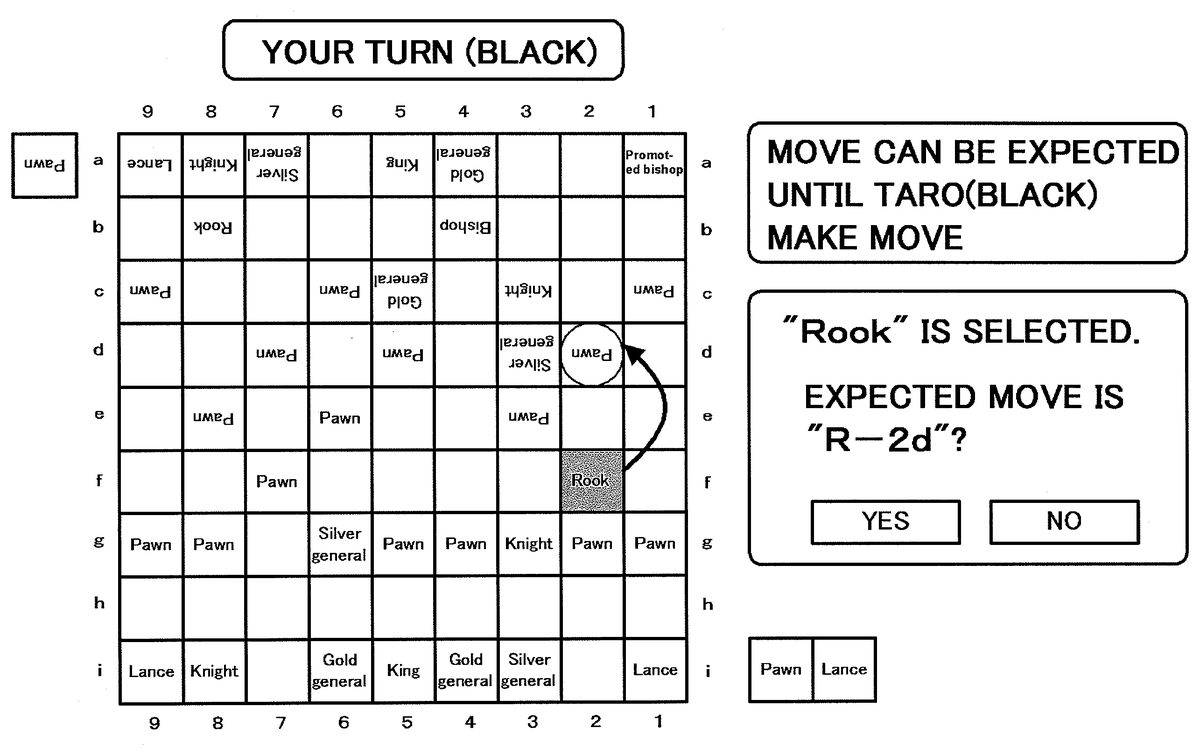
For example, the display unit306displays game screens shown inFIGS. 9A, and9B.FIG. 9Ashows an example of a game screen displayed when the terminal12is the player terminal, andFIG. 9Bshows an example of a game screen displayed when the terminal12is the spectator terminal.
That is, when the player thinks moves while viewing the game screen shown inFIG. 9A, the spectator can view the game screen shown inFIG. 9B, and transmit a move (expected move) thought out by himself/herself to the game server11by operating the operation unit303.
The image processor108and a monitor or the like connected thereto may function as such a display unit306.
(Operation of Game Server)
FIG. 10is a flowchart showing the flow of a game control process executed by the game server11. Hereinafter, an explanation will be given with reference to this drawing. The game control process is executed together with the start of the Japanese chess game. It is supposed that the terminal-information storing unit201of the game server11registers (stores) information on the entered player and the terminal12of a spectator beforehand.
First, the game server11transmits the game information or the like to each terminal12with the start of the game (step S401). That is, the game server11refers to the information stored in the terminal-information storing unit201, and transmits initial board information or the like to the terminal12of the player and that of the spectator.
The game server11stands by until receiving information transmitted from any terminal12(step S402).
That is, the game server11waits for information on a move transmitted from the terminal12of the player or information on an expected move transmitted from the terminal12of the spectator, etc.
As receiving information transmitted from any terminal12(step S402: YES), the game server11determines whether or not that information is an expected move (step S403). That is, it is determined whether or not received information is an expected move transmitted from the terminal12of the spectator or a move transmitted from the terminal12of the player.
When the received information is not either an expected move or a move (e.g., when receiving information transmitted from the terminal12of a spectator who participate in the middle of the game and for requesting board information), the game server11appropriately executes a process in accordance with the received information.
When determining that the received information is an expected move (step S403: YES), the game server11stores the expected move (step S404). That is, the expected move is stored in association with a user ID in the expected move storing unit208.
Thereafter, the game server11returns the process to the step S402.
On the other hand, when determining that the received information is a move (step S403: NO), the game server11updates the game information, and transmits update information to each terminal12(step S405).
That is, the game server11appropriately updates the game information (board information, etc.) stored in the game-information storing unit205in accordance with the move transmitted from the terminal12of the player. Thereafter, the game server11transmits the updated game information (update information) to each terminal12in real time.
The game server11stores the move, and associates the expected move with the move (step S406).
That is, the game server11adds the move to the game record information stored in the history storing unit206. Thereafter, the game server11associates the expected move stored in the expected move storing unit208at the step S404with the move stored in the history storing unit206at this time by, for example, the value of the number of moves.
The game server11determines whether or not the Japanese chess game has ended (step S407). That is, it is determined whether or not either player won the Japanese chess game played through the terminals12of the individual players.
When determining that the Japanese chess game has not ended (step S407: NO), the game server11returns the process to the step S402, and repeats the process from the step S402to the step S407.
On the other hand, when determining that the Japanese chess game has ended (step S407: YES), the game server11evaluates the expected move, and certifies the stage and the class (step S408).
For example, the game server11compares each expected move stored in the expected move storing unit208with a corresponding move stored in the history storing unit206, and counts the rate that expected moves match actual moves for each spectator, and evaluates the expected moves of each spectator. Based on the evaluation result, the stage and class representing a Japanese chess skill is certified.
The game server11transmits the certification information to an object terminal12(step S409). That is, the certification information is transmitted to the terminal12of each spectator whose stage and class are certified.
According to such a game control process, the Japanese chess game can progress in accordance with a move transmitted from the terminal12of the player, an expected move transmitted from the terminal12of the spectator is managed and is evaluated.
That is, a spectator is not just viewing a screen when watching the Japanese chess game, but thinks a next move, and transmits the thought-out move as an expected move to the game server11. The expected move is evaluated at a predetermined timing, so that the spectator makes an effort to try to think a better expected move while watching the Japanese chess game more seriously.
In other words, unlike a case where a match-up is broadcasted through a TV program, a spectator can enjoy watching the match-up more while taking the advantage of the characteristic of the network-compatible match-up game.
This results in an improvement of the amusingness of the spectator in a match-up game.
Other Embodiments
In the foregoing embodiment, the explanation has been given of the case where the certification information of a stage and class is transmitted as an evaluation result to the terminal12of a spectator. Information transmitted to the terminal12of a spectator is, however, not limited to such certification information, and is arbitrarily.
For example, the spectator evaluation unit209may collect evaluation results of all spectators, acquire a ranking (order or the like) for each spectator, and transmit ranking information to the terminal12of a spectator.
In the foregoing case, a spectator can figure out his/her skill (stage, class) of the Japanese chess and the rank (order), but cannot know what move other spectators expect. Therefore, a spectator can be made to know the expected move of another spectator.
For example, the expected move management unit207stores the skill (stage, class) of a spectator when storing an expected move in the expected move storing unit208. It is supposed that the skill is acquired from information stored in the terminal-information storing unit201and shown inFIG. 4B. The spectator evaluation unit209collects expected move stored in the expected move storing unit208for each skill at a predetermined timing or in response to a request by the terminal12. Such a collection result is transmitted to the terminal12from the information transmission unit210.
In the foregoing embodiment, the explanation has been given of the case where an expected move transmitted from the terminal12of a spectator is evaluated in the game server11. However, the expected move by the spectator may be evaluated on the terminal12side.
Hereinafter, an explanation will be given of a terminal22which can evaluate the expected move of a spectator with reference toFIG. 11.FIG. 11is a schematic diagram showing the general structure of the terminal22according to another embodiment of the invention. Note that the terminal22can be used by both player and spectator, but in the figure, a structure is shown for a case where the terminal22is used by a spectator (a case where a user is entered as a spectator) to facilitate the explanation.
The terminal22has a board-information storing unit301, a rule storing unit302, an operation unit303, a control unit304, a communication unit305, a display unit306, a game record storage unit501, an expected move processor502, and an expected move storing unit503.
In comparison with the structure of the terminal12shown inFIG. 8, the terminal22differs that the game record storage unit501, the expected move processor502, and the expected move storing unit503are added.
The game record storage unit501is controlled by the control unit304, and stores a move of a player as game record information. That is, the control unit304specifies a move from update information transmitted from the game server11through the communication unit305, and the move is addingly stored as game record information in the game record storage unit501.
The game record information stored in the game record storage unit501is information equal to the game record information stored in the game server11(history storing unit206) and shown inFIG. 6.
The expected move processor502manages an expected move thought out by a spectator, and evaluates the expected move at a predetermined timing.
For example, as an expected move is input through the operation unit303, the expected move processor502stores the expected move in the expected move storing unit503. Thereafter, when an actual move by a player is added in the game record storage unit501, the expected move processor502manages the move in the game record storage unit501in association with an expected move in the expected move storing unit503.
The expected move processor502compares the expected move stored in the expected move storing unit503with the corresponding move stored in the game record storage unit501at a time of, for example, resignation of the game, and comprehensively evaluates each expected move. For example, a rate that expected moves match actual moves is counted, and an expected move is evaluated based on that rate. At this time, a predetermined weight may be added to a move which had an impact on the game situation, or a predetermined weight may be added to the move of the winner, thereby appropriately correcting the evaluation of an expected move.
The expected move storing unit503stores an expected move of a spectator. That is, the expected move storing unit503is controlled by the expected move processor502, and stores an expected move input through the operation unit303.
An expected move stored in the expected move storing unit503is associated with a move in the game record storage unit501(actual move by a player) by, for example, the value of the number of moves.
Hereinafter, the operation of the terminal22having such a structure will be explained with reference toFIG. 12.FIG. 12is a flowchart showing the flow of an expected move evaluation process executed by the terminal22of a spectator. The expected move evaluation process is executed with the start of a Japanese chess game after the terminal22entered as a spectator accesses the game server11.
First, the terminal22receives the game information or the like transmitted from the game server11with the start of the game, and creates an initial game screen (step S601).
The terminal22determines whether or not update information transmitted to the game server11is received (step S602).
When determining that the update information is not received (step S602; No), the terminal22determines whether or not an expected move is input (step S603).
When determining that an expected move is input (step S603; Yes), the terminal22stores the expected move in the expected move storing unit503(step S604). Thereafter, the terminal22returns the process to the step S602. On the other hand, when determining that an expected move is not input (step S603; No), the terminal22returns the process to the step S602.
When determining that update information transmitted from the game server11is received (step S602: YES), the terminal22updates the board information stored in the board-information storing unit301in accordance with the received update information (step S605).
The terminal22specifies a move from the update information, and stores the specified move in the game record storage unit501(step S606).
The terminal22creates a game screen from the updated board information (step S607). That is, the terminal22updates the game screen.
The terminal22determines whether or not the viewed Japanese chess game has ended (step S608).
When determining that the Japanese chess game has not ended (step S608; No), the terminal22returns the process to the step S602, and repeats the process from the step S602to the step S608.
On the other hand, when determining that the Japanese chess game has ended (step S608; Yes), the terminal22evaluates an expected move, and certifies a stage and a class (step S609).
For example, the terminal22compares each expected move stored in the expected move storing unit503with a corresponding move stored in the game record storage unit501, counts a rate that expected moves match actual moves, and evaluates the expected move of a spectator. Based on the evaluation result, a stage and class representing the skill of the Japanese chess are certified.
The terminal22creates a message indicating the certified stage and class, and displays the message. The terminal22may transmit certification information to the game server11, and the game server11may manage the certification result.
According to such an expected move evaluation process, the expected move of a spectator can be evaluated on the terminal22side.
In this case, a spectator also thinks a next move, and input the thought out move as an expected move when watching the Japanese chess game. The expected move is evaluated at a predetermined timing, so that the spectator watches the Japanese chess game more seriously, and makes an effort to think out a better expected move.
That is, unlike the case where a match-up is broadcasted through a TV program, the spectator enjoys the watching itself while taking the advantage of the characteristic of the network-compatible match-up game.
This results in an improvement of the amusingness of the spectator in a match-up game.
In the foregoing embodiment, the explanation has been given of the case where a spectator is evaluated at the time of the end (resignation) of the match-up game, the timing at which the spectator is evaluated is not limited to at the time of the end of the match-up game, and for example, evaluation may be made for each expected move.
Specifically, an explanation will be given of an example case where players A and B play a match-up game, and a spectator thinks en expected move of the player A.
First, when the expected move by the spectator matches the move by the player A, the expected move by the spectator is evaluated based on the response of the player B. For example, in a case where greater than or equal to a certain time is required until the player B does a next move, the expected move by the spectator is highly evaluated. In addition, in a case where the player B requests “changing of a move” (changing of a move by player B before the previous move), and in a case where the player B takes an extreme defensive formation (specifically, for example, the player B moves the “Rook” or “Bishop” positioned in the opponent field into his/her own field, or the player B puts a piece in hand better than or equal to “Silver General”), the expected move by the spectator may be highly evaluated.
A move by a player is not always a good move, in a case where an expected move by the spectator does not match the move by the player A, when it is possible to determined that the move by the player A is bad, the expected move by the spectator may be evaluated with a certain measure. For example, in a case where the player A requests “changing of a move” after a successive move by the player B, the expected move by the spectator is evaluated as a good move. In addition, in a case where it requires a certain time until the player A makes a move after the move by the player B, or in a case where the player A takes an extreme defensive formation by a next move, the expected move by the spectator may be evaluated as a better move.
Further, the expected move by a spectator may be compared with the expected move by another spectator to do comparative evaluation. For example, expected moves by all spectators or spectators having a skill greater than or equal to a certain level are collected, and what rate the expected move of a spectator matches other expected moves is determined, thereby comparatively evaluating the expected move by that spectator.
In those cases, an evaluation is quickly acquired for an expected move by a spectator, so that the spectator can enjoy the watching itself more while taking the advantage of the characteristic of the network-compatible match-up game. This results in an improvement of the amusingness of the spectator in a match-up game.
Regarding the terminal22shown inFIG. 11, the explanation has been given of the case where the spectator watches the Japanese chess game in real time, but the invention can be adopted to a case where the spectator watches a Japanese chess game played in the past. For example, the game server11may read past game record information stored in the history storing unit206, create update information for each predetermined timing, and transmit the update information to the terminal22or the like of a spectator.
Moreover, the invention can be adopted to a post mortem after a Japanese chess game has ended.
In this case, because the terminal22stores the game record information in the game record storage unit501, it is possible for a spectator, etc. to review the game from an arbitrary situation, and to put another move, thereby doing a post mortem.
For example, the terminal22creates a game screen for a post mortem shown inFIG. 13and displays that screen. The spectator operates move buttons MB on the screen, and progresses or reverses the move in accordance with the game record. Note that it is possible to verify a move (expected move or the like) by himself/herself while selecting a piece and freely moving the selected piece at an arbitrarily situation.
After the verification, a return button RB is operated, and the game screen is returned in accordance with the game record right before a piece is moved by the spectator.
Specifically, in a case where a piece is arbitrarily moved and the situation becomes different from the game record, the terminal22stores the position of the piece (number of moves, or the like), and returns the situation to the original game record in response to an instruction of returning the game record (operation of the return button RB).
In the foregoing embodiment, Japanese chess game has been explained as an example of a match-up game, but a match-up game is not limited to the foregoing case, and can be selected arbitrarily. For example, the invention can be adopted to a match-up game, such as game of go, chess, Othello, and mah-jongg.
The present application claims the benefit of the priority based on Japanese Patent Application No. 2006-037429, and the content of which is incorporated by reference in the present application.
INDUSTRIAL APPLICABILITY
As explained above, according to the invention, there is provided a game server, a spectator evaluation method, an information recording medium and a program which is suitable for improving the amusingness of a spectator who watches a match-up game.
Claims
- A game server which manages a player terminal which executes a predetermined match-up game, and a spectator terminal for watching the match-up game, the player terminal and the spectator terminal being connected to the game server via a network, and the game server comprising: a providing unit which provides a current status of the match-up game, which progresses based on moves successively acquired from the player terminal, to the spectator terminal;an acquisition unit which acquires an expected move of a first player thought out by a spectator from the spectator terminal before a next move of the first player of the match-up game is acquired from the player terminal;and an evaluation unit which compares the acquired expected move by the spectator with an actual move acquired from the player terminal, and evaluates the expected move by the spectator as a function of the actual move of the first player and a subsequent move by a second player, wherein the evaluation unit evaluates the acquired expected move by the spectator as high if the acquired expected move does not match the actual move and at least one of the following: a time period elapsed until the first player takes a further subsequent move is greater or equal to a predetermined time period;the first player changes the further subsequent move;or, the further subsequent move is a defensive move.
- A game server which manages a player terminal which executes a predetermined match-up game, and a spectator terminal for watching the match-up game, the player terminal and the spectator terminal being connected to the game server via a network, and the game server comprising: a providing unit which provides a current status of the match-up game, which progresses based on moves successively acquired from the player terminal, to the spectator terminal in real time;an acquisition unit which acquires an expected move of a first player thought out by a spectator from the spectator terminal only before a next move of the first player of the match-up game is acquired from the player terminal;and an evaluation unit which compares the acquired expected move by the spectator with an actual move acquired from the player terminal, and evaluates the acquired expected move by the spectator as a function of the actual move of the first player and a subsequent move by a second player, wherein the evaluation unit evaluates the acquired expected move by the spectator as high if the acquired expected move does not match the actual move and at least one of the following: a time period elapsed until the first player takes a further subsequent move is greater or equal to a predetermined time period;the first player changes the further subsequent move;or, the further subsequent move is a defensive move.
- A spectator evaluation method for a server which manages a player terminal which executes a predetermined match-up game, and a spectator terminal for watching the match-up game, the player terminal and the spectator terminal being connected to the server via a network, and the method comprising: a providing step of providing a current status of the match-up game, which progresses based on moves successively acquired from the player terminal, to the spectator terminal;an acquisition step of acquiring an expected move of a first player thought out by a spectator from the spectator terminal before a next move of the first player of the match-up game is acquired from the player terminal;and an evaluation step of comparing the acquired expected move by the spectator with an actual move acquired from the player terminal, and of evaluating the expected move by the spectator as a function of the actual move of the first player and a subsequent move by a second player, wherein the evaluation step evaluates the acquired expected move by the spectator as high if the acquired expected move does not match the actual move and at least one of the following: a time period elapsed until the first player takes a further subsequent move is greater or equal to a predetermined time period;the first player changes the further subsequent move;or, the further subsequent move is a defensive move.
- A non-transitory information recording medium recording a program, the program controlling a computer which manages a player terminal which executes a predetermined match-up game, and a spectator terminal for watching the match-up game, the player terminal and the spectator terminal being connected via a network, to function as: a providing unit which provides a current status of the match-up game, which progresses based on moves successively acquired from the player terminal, to the spectator terminal;an acquisition unit which acquires an expected move of a first player thought out by a spectator from the spectator terminal before a next move of the first player of the match-up game is acquired from the player terminal;and an evaluation unit which compares the acquired expected move by the spectator with an actual move acquired from the player terminal, and evaluates the acquired expected move by the spectator as a function of the actual move of the first player and a subsequent move by a second player, wherein the evaluation unit evaluates the acquired expected move by the spectator as high if the acquired expected move does not match the actual move and at least one of the following: a time period elapsed until the first player takes a further subsequent move is greater or equal to a predetermined time period;the first player changes the further subsequent move;or, the further subsequent move is a defensive move.
Disclaimer: Data collected from the USPTO and may be malformed, incomplete, and/or otherwise inaccurate.