U.S. Pat. No. 8,408,999
Game Apparatus, Game Processing Method, and Information Recording Medium
AssigneeKonami Digital Entertainment Co Ltd
Issue DateMarch 18, 2011
Illustrative Figure
Abstract
A game apparatus displaying on a screen moves to be made by the player in time with reproduction of a piece of music is provided. In the game apparatus, a reproduction part reproduces music stored in a storage. The music to be reproduced is divided into multiple segments of the same length of time and an image is associated with each of the multiple segments, presenting moves to be made by the player while that segment is reproduced. Multiple regions are provided on the screen. The display part displays an image stored in the storage and associated with a segment i+j−1 among the multiple segments in a region j among the multiple regions on the screen while a segment i among the multiple segments is reproduced by the reproduction part.
Description
DETAILED DESCRIPTION Embodiments of the present invention will be described. For easier understanding, embodiments realizing the present invention in a game information processing apparatus will be described below. The following embodiments are given for the purpose of explanation and do not confine the scope of the invention of the present application. A person of ordinary skill in the field may be able to employ an embodiment in which individual elements or all elements are replaced with something equivalent. Such an embodiment will fall under the scope of the present invention. Embodiment 1 FIG. 1is a schematic chart showing the general configuration of a typical information processing apparatus functioning as the game apparatus of the present invention. An information processing apparatus100according to Embodiment 1 will be described hereafter with reference to this figure. The information processing apparatus100comprises a CPU (central processing unit)101, a ROM (read only memory)102, a RAM (random access memory)103, an interface104, a mat type controller105, an external memory106, a DVD-ROM (digital versatile disk-read only memory) drive107, an image processing part108, a sound processing part109, and an NIC (network interface card)110. A DVD-ROM in which game programs and data are recorded is mounted on the DVD-ROM drive107and the information processing apparatus100is powered on to execute the programs, thereby realizing the game apparatus of this embodiment. The CPU101controls the entire operation of the information processing apparatus100. The CPU100is connected to the components to exchange control signals and data. An IPL (initial program leader) that is executed immediately after the power-on is recorded in the ROM102. With the IPL being executed, the programs recorded in the DVD-ROM are read onto the RAM103and the CPU101starts executing them. Furthermore, operation system programs and various data necessary for operation control of the entire information processing apparatus100are recorded in the ROM102. The RAM103is used to ...
DETAILED DESCRIPTION
Embodiments of the present invention will be described. For easier understanding, embodiments realizing the present invention in a game information processing apparatus will be described below. The following embodiments are given for the purpose of explanation and do not confine the scope of the invention of the present application. A person of ordinary skill in the field may be able to employ an embodiment in which individual elements or all elements are replaced with something equivalent. Such an embodiment will fall under the scope of the present invention.
Embodiment 1
FIG. 1is a schematic chart showing the general configuration of a typical information processing apparatus functioning as the game apparatus of the present invention. An information processing apparatus100according to Embodiment 1 will be described hereafter with reference to this figure.
The information processing apparatus100comprises a CPU (central processing unit)101, a ROM (read only memory)102, a RAM (random access memory)103, an interface104, a mat type controller105, an external memory106, a DVD-ROM (digital versatile disk-read only memory) drive107, an image processing part108, a sound processing part109, and an NIC (network interface card)110.
A DVD-ROM in which game programs and data are recorded is mounted on the DVD-ROM drive107and the information processing apparatus100is powered on to execute the programs, thereby realizing the game apparatus of this embodiment.
The CPU101controls the entire operation of the information processing apparatus100. The CPU100is connected to the components to exchange control signals and data.
An IPL (initial program leader) that is executed immediately after the power-on is recorded in the ROM102. With the IPL being executed, the programs recorded in the DVD-ROM are read onto the RAM103and the CPU101starts executing them. Furthermore, operation system programs and various data necessary for operation control of the entire information processing apparatus100are recorded in the ROM102.
The RAM103is used to temporarily store data and programs, retaining programs and data read from a DVD-ROM and other data necessary for game progress and chat communication.
The mat type controller105connected via the interface104receives input of operations by the user in executing a game.
FIG. 2is an illustration showing the mat type controller105. Multiple buttons that are pressed by the player and accordingly change between the pressed state and non-pressed state are provided in given regions on the surface. For example, as shown in this figure, a left button201a, a bottom button201b, a top button201c, and a right button201dare provided. The mat type controller105receives input of operations generally made by the user with a foot. When the user presses these buttons, the input of operation corresponding to the pressed button is received.
In this embodiment, the mat type controller105comprises four buttons201ato201d. The number of buttons is not restricted to four. Three or less buttons or five or more buttons can be provided. The object used for input of operations is not necessarily laid on the floor and can be a so-called touch pad, which is held in hand for operation, or can be something gripped by hand.
In place of the mat type controller105, an infrared camera can be used to catch the motion of the entire body of the player as input of operations in executing a game.
InFIG. 1, the external memory106detachably connected via the interface104stores data presenting the game play states (past scores), data presenting the game progress, and chat communication log(record) data of network games in a rewritable manner. The user can record these data in the external memory106as necessary through input of instructions via the mat type controller105.
Programs for realizing a game and image data and sound data accompanying the game are recorded in a DVD-ROM mounted on the DVD-ROM drive107. The CPU101controls the DVD-ROM drive107to read the mounted DVD-ROM, and read out necessary programs and data and temporarily stores them in the RAM103.
The image processing part108processes the data read from the DVD-ROM by means of the CPU101and an image arithmetic processor (not shown) provided in the image processing part108, and records them in a frame memory (not shown) provided in the image processing part108. The image information recorded in the frame memory is converted to video signals in a given synchronized timely manner and output to a monitor (not shown) connected to the image processing part108. In this way, various images can be displayed.
The image arithmetic processor can execute two-dimensional image superimposing calculation, transmission calculation such as a blending, and a variety of saturate calculation at a high speed.
The image arithmetic processor can also execute high speed calculation for rendering virtual three-dimensional polygon information including a variety of additional texture information by the Z buffer method so as to obtain a rendering image in which a polygon placed in a virtual three-dimensional space is looked down from a given viewpoint in a given viewing direction.
Cooperation between the CPU101and image arithmetic processor makes it possible to depict a character string as a two-dimensional image in a frame memory or on a polygon surface according to font information defining the shape of characters. The font information is recorded in the ROM102. However, specific font information recorded in a DVD-ROM can be used.
The sound processing part109converts sound data read from the DVD-ROM to analog sound signals and outputs them from a speaker (not shown) connected thereto. Furthermore, under the control of the CPU101, the sound processing part109creates sound effects or music data to be generated in the course of a game and outputs the corresponding sound from the speaker.
The NIC110is used to connect the information processing apparatus100to a computer communication network (not shown) such as the Internet. The NIC110is composed of a member complying with 10BASE-T/100BASE-T standards used for LANs (local area networks), an analog modem for connecting to the Internet using telephone lines, an ISDN (integrated services digital network) modem, an ADSL (asymmetric digital subscriber line) modem, or a cable modem for connecting to the Internet using cable television lines, and an interface (not shown) mediating between them and the CPU101.
Furthermore, the information processing apparatus100can utilize a large capacity external storage such as a hard disc to function as the ROM102, RAM103, and external memory106, and a DVD-ROM mounted on the DVD-ROM drive107.
The functional configuration of the game apparatus of this embodiment will be described hereafter.
A typical game executed by the game apparatus of the present invention is a game in which the player dances to music in a real space. This embodiment will be described hereafter using a dancing game by way of example.
FIG. 3is an illustration for explaining the general configuration of the game apparatus. As shown in this figure, a game apparatus300comprises a reproduction part301, a display part302, and a storage303.
The storage303consists of a RAM103and the like. For example, necessary programs and data such as music, music information, animated images, and still images recorded in a DVD-ROM mounted on the DVD-ROM drive107are read and stored in the storage303.
The reproduction part301reads necessary programs and data such as music and music information stored in the storage303and reproduces the music. For example, the reproduction part301reproduces music sound based on the music information while the music game is played, supplies sound signals accompanying the reproduction, and outputs the music sound from the speaker. Here, the sound processing part109functions as such a reproduction part301.
The display part302reads necessary programs and data such as animated images and still images stored in the storage303as necessary and reproduces game images. Here, the image display part108functions as such a display part302.
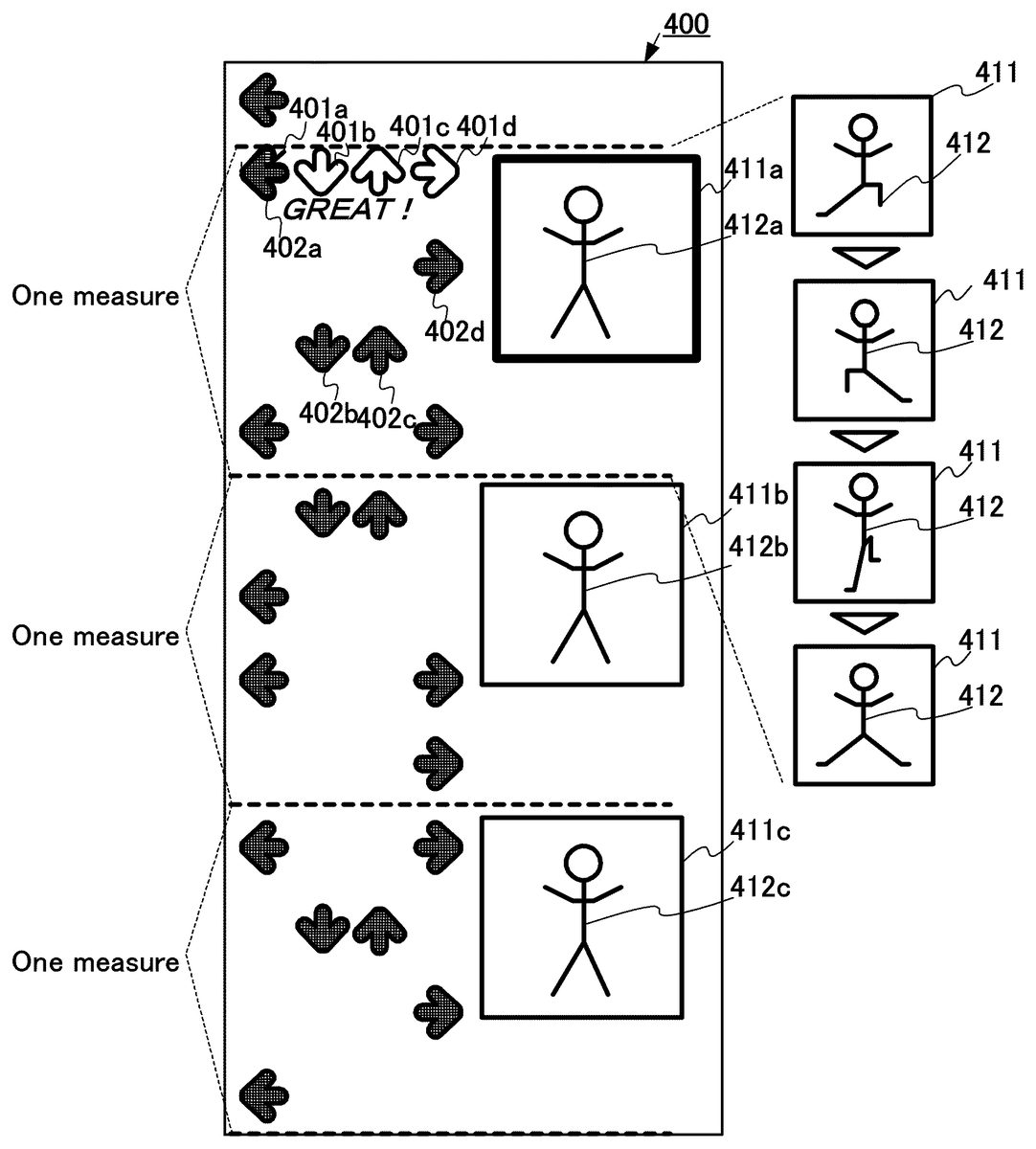
FIG. 4shows exemplary game images according to Embodiment 1. The display part302generates game images as shown in this figure. In other words, multiple display regions411(411a,411b,411c) are provided on a screen400. Model animated images412(412a,412b,412c), which present the moves to be made by the player while a corresponding segment of a piece of music divided into multiple segments of the same length of time is reproduced, are displayed in the display regions411. Here, the multiple segments of the same length of time correspond to the measures composing a piece of music by way of example. As shown in the figure, reference indicators401(401a,401b,401c,401d) depicted at fixed given positions on the screen400, instruction indicators402(402a,402b,402c,402din the figure) depicted at positions moving with time, and other background images (not shown) are displayed on the screen400.
The instruction indicators402correspond to the buttons provided on the mat type controller105. Up-arrow, down-arrow, right-arrow, and left-arrow images are depicted on the mat type controller105. More specifically, a left-arrow image (402a) is depicted on the left button (201a) of the mat type controller105; a down-arrow image (402b), on the bottom button (201b); an up-arrow image (402c), on the top button (201c); and a right-arrow image (402d), on the right button (201d).
As for the reference indicators401, the reference indicators401ato401dcorrespond to the controller buttons201ato201d, respectively, in the same manner as the instruction indicators402. The up-arrow, down-arrow, left-arrow, and right-arrow images of the reference indicators401are depicted at given positions on the screen400.
The instruction indicators402are scrolled from the bottom to top in time with the music being reproduced. When the instruction indicators402are scrolled up to the same positions as the reference indicators401, the player presses with a foot the button corresponding to the arrowed direction depicted by the reference indicators401. In doing so, the player can do model (standard) dance steps to the music being reproduced.
In this embodiment, the display regions411are provided on the screen400. Three display regions411a,411b, and411care lined up on the screen400from the top. The display regions411ato411care each associated with a segment corresponding to one measure of the music being reproduced. Assuming that a measure corresponding to a segment i is currently reproduced, the display region411ais associated with the measure corresponding to the segment i, the display region411bis associated with the measure corresponding to the segment i+1, and the display region411cis associated with the measure corresponding to the segment i+2.
Here, three display regions411are provided on the screen400for the purpose of explanation. Two display regions411or more display regions411can be provided.
Model animated images412are displayed in the display regions411. The model animated images412are also each associated with a segment corresponding to one measure of the music being reproduced. Assuming that a measure corresponding to a segment i is currently reproduced, a model animated image412aassociated with the segment i is displayed in the display region411a, a model animated image412bassociated with the segment i+1 is displayed in the display region411b, and a model animated image412cassociated with the segment i+2 is displayed in the display region411c.
The model animated images412ato412cpresent moves to be made by the player in the corresponding measures in animated images. In other words, the model animated images display moves of the player pressing with a foot in accordance with the instruction indicators402during the corresponding measure, whereby the player can do model (standard) dance steps to the music being reproduced. In this regard, details will be described below.
FIG. 5shows the correspondence between the instruction indicators402and the moves in the model animated images412. InFIG. 5A, the instruction indicator402indicates the left (402a) and the model animated image412presents a move of the player stepping on the left button201aof the mat type controller105with the left foot. InFIG. 5B, the instruction indicator402indicates the right (402d) and the model animated image412presents a move of the player stepping on the right button201dof the mat type controller105with the right foot. InFIG. 5C, the instruction indicator402indicates the up and down simultaneously (402b,402c) and the model animated image412presents a move of the player stepping on the top button201cand bottom button201bof the mat type controller105with both feet simultaneously. InFIG. 5D, the instruction indicator402indicates the left and right simultaneously (402a,402d) and the model animated image412presents a move of the player stepping on the left button201aand right button201dof the mat type controller105with both feet simultaneously.
In this embodiment, the moves are not restricted to the above four patterns. The moves can include, for example, stepping on two, left and top, buttons simultaneously, stepping on three, left, right, and top, buttons simultaneously, and stepping on four, left, right, top, and bottom, buttons simultaneously.
Based on the above-described correspondence, the model animated images412show model moves to the player. For example, inFIG. 4, for music having four beats per measure, the model animated images412show four moves corresponding to four different instruction indicators402in a measure. In the model animated image412a, the instruction indicators402indicate the left on the first beat, the right on the second beat, the up and down on the third beat, and the right and left on the fourth beat. Then, as shown inFIGS. 5A to 5D, the images shown inFIG. 5A,FIG. 5B,FIG. 5C, andFIG. 5Dare reproduced in this order. Similarly in the model animated images412band412c, the model animated images412corresponding to the instruction indicators402for the associated measures are reproduced.
In this embodiment, as shown inFIG. 4, the display region411ais intensified. More specifically, the display region411ahas thicker frame borders. The display region411acan be intensified in various manners such as colored differently, brightened, blinked, or enlarged in comparison with the other display regions411band411c.
The model animated image412aassociated with the music segment being reproduced at the time is reproduced in the display region411a, presenting the move to be made by the player at the time. With the display region411abeing intensified, the player can easily distinguish it from the other display regions (411band411c) and learn the move he/she should currently make.
FIGS. 6A to 6Eare illustrations showing chronologically changed game images according to Embodiment 1.FIGS. 6A to 6Eshow the screen400changed on each beat of music having four beats per measure. More specifically,FIG. 6Acorresponds to the first beat of a measure (a measure i) of music being reproduced,FIG. 6Bcorresponds to the second beat of the same measure,FIG. 6Ccorresponds to the third beat of the same measure,FIG. 6Dcorresponds to the fourth beat of the same measure, and theFIG. 6Ecorresponds to the first beat of the next measure (a measure i+1).
In this embodiment, the model animated images412each associated with a measure of music are smoothly scrolled up on the screen400in time with reproduction of the music. Therefore, the three display regions411ato411clined up from the top to bottom on the screen400(other display regions411also appear on the screen400depending on the positions of the display regions411) are properly moved so that it seems to the player that the model animated images412displayed in the display regions411ato411care scrolled. In other words, the display regions411ato411care moved as shown inFIGS. 6A to 6Edescribed below.
InFIG. 6A, the first beat of a measure i of a piece of music is reproduced. The instruction indicator402indicates the left. Then, the model animated image412adisplayed in the display region411adisplays a model animated image412apresenting a move of the player stepping on the left of the mat type controller105with the left foot. Similarly, the model animated image412bdisplayed in the display region411bdisplays a model animated image412bcorresponding to the instruction indicator402(the up and down) for the first beat of the measure i+1. The model animated image412cdisplayed in the display region411cdisplays a model animated image412ccorresponding to the instruction indicator402(the left and the right) for the first beat of the measure i+2.
Subsequently, inFIG. 6B, the second beat of the measure i of the music is reproduced. The display regions411ato411care scrolled up the same distance as the instruction indicators402in comparison withFIG. 6A. The model animated images412ato412cdisplayed in the display regions411ato411care scrolled as well. Here, the instruction indicator402for the second beat of the measure i indicates the right. Then, the model animated image412adisplayed in the display region411adisplays a model animated image412apresenting a move of the player stepping on the right of the mat type controller105with the right foot. Similarly, the model animated image412bdisplayed in the display region411bdisplays a model animated image412bcorresponding to the instruction indicator402(the left) for the second beat of the measure i+1. The model animated image412cdisplayed in the display region411cdisplays a model animated image412ccorresponding to the instruction indicator402(the up and down) for the second beat of the measure i+2.
InFIG. 6C, the third beat of the measure i of the music is reproduced. The display regions411ato411care scrolled up the same distance as the instruction indicators402in comparison withFIG. 6B. The model animated images412ato412cdisplayed in the display regions411ato411cdisplay the model animated images412corresponding to the instruction indicators402for the third beat of the measures i, i+1, and, i+2, respectively.
InFIG. 6D, the fourth beat of the measure i of the music is reproduced. The display regions411ato411care scrolled up the same distance as the instruction indicators402in comparison withFIG. 6C. The model animated images412ato412cdisplayed in the display regions411ato411cdisplay the model animated images412corresponding to the instruction indicators402for the fourth beat of the measures i, i+1, and, i+2, respectively.
InFIG. 6E, the first beat of the measure i+1 of the music is reproduced. The display regions411ato411care moved to the same positions as the display regions411ato411cin FIG.6A. Namely, they are returned. On the other hand, the model animated images412ato412care displayed in the display regions411one level higher in comparison withFIG. 6A. More specifically, the model animated image412bis displayed in the display region411a, the model animated image412cis displayed in the display region411b, and the model animated image412ais displayed in a region one level higher than the display region411a.
In this way, the three display regions411ato411clined up on the screen400are moved up/down in a cycle of a measure of music. It seems to the player that the model animated images412keep moving along the line at a given speed. Consequently, the player can easily learn the subsequent choreographed moves or body movements to make.
FIG. 7is a flowchart showing the process executed in the game apparatus300according to Embodiment 1. The following explanation will be made with reference to this figure.
First, the CPU101of the game apparatus300executes a variety of initialization (Step S901). The initialization includes selection of a piece of music to which the player will dance, and reading of various data such as the music, reference indicators401, instruction indicators402, display regions411, model animated images412, and other various objects provided on the screen400. The initialization further includes reading of the length of time of a measure (S), the number of measures (N), and the number of beats per measure (H) of the music, the width of the entire screen400(D) (pixels), the number of frames per second of N model animated images (F) (frames/second), S×F pieces of image information per model animated image412, time of appearance of the instruction indicators402on the screen400(T), and scroll speed (V) (pixels/second).
Then, the CPU101of the game apparatus300instructs the sound processing part109to start playing the music selected in the initialization (Step S902). The sound processing part109functions as the reproduction part301under the control of the CPU101.
The music data can be prepared as various sound data such as MIDI (musical instrument digital interface) data, PCM (pulse coded modulation) data, MP3 (MPEG audio layer-3) data, and Ogg Vorbis data. The data are stored in a DVD-ROM mounted on the DVD-ROM drive107.
Then, the CPU100acquires the elapsed time t up to the current time since the start of playing the music (Step S903). As described later, this process has a loop structure and one loop is equal to the vertical synchronization period. Therefore, the elapsed time t can be obtained by counting the loops using a counter variable prepared in a given region of the RAM103.
Furthermore, the elapsed time t can also be obtained by acquiring the quantity of sound data expanded, reproduced, and output up to the current time since the start of playing the music data. The sound data are eventually output at 44 kHz, 48 kHz, or 96 kHz. It is easy to obtain the elapsed time t from the quantity of sound data eventually output to the speaker.
The CPU101divides the current time t by the length of time of a measure S to yield a quotient i and a remainder A (seconds). The CPU101will know that the measure i of the music is currently reproduced from the quotient i and that the beat H×A/S in the measure is played from the remainder A (Step S904).
Then, the following procedure is repeated for each of the multiple display regions411on the screen400(Steps S905to S909). When the repetition starts, in other words when there are any unfinished display regions among the multiple display regions411on the screen400(Step S905; NO), the CPU101acquires one of the unfinished display regions411(Step S906) and places that display region411on the screen400at a position moved up by V×A (pixels) from the position where it was when the measure started (Step S907).
Then, a corresponding model animated image412is acquired in the placed display region411(Step S908). Here, if the display region411is a display region j, a model animated image associated with the measure i+j−1 is acquired.
Furthermore, the image in the frame F×A of the selected model animated image412is displayed in the display region411(Step S909), returning to Step S905.
After the repetition is over (Step S905; YES), the CPU101compares the time T at which the instruction indicators402obtained in the initialization appear at the start positions or the time T+D/V at which they disappear at the end positions with the current time, and selects all instruction indicators402satisfying T≦t≦T+D/V (Step S910).
The following procedure is repeated for each of the selected instruction indicators402(Steps S911to S914). When the repetition starts, in other words, when there are any unfinished instruction indicators402among the selected instruction indicators402(Step S911; NO), one of the unfinished instruction indicators402is acquired (Step S912) and the position of the instruction indicator402is calculated from the elapsed time t (Step S913).
The object of the instruction indicator402is placed at the position calculated as the position of the instruction indicator402(Step S914), returning to Step S911. The orientation of the object is determined as described above.
After the repetition is over (Step S911; YES), the CPU101generates images by means of the image processing part108and transfers them to the frame memory (Step S915).
The CPU101waits until the next vertical synchronous interrupt occurs (Step S916). Then, in sync with the vertical synchronous interrupt, the image data stored in the frame memory are displayed on the monitor. The CPU101functions as the display part302in cooperation with the image processing part108and others.
Immediately after the vertical synchronous interrupt occurs, the CPU101examines the operation states of the mat type controller105and determines the operation states of the buttons201a,201b,201c, and201d(Step S917).
The player's score parameters are updated according to whether the buttons201a,201b,201c, and201dare pressed in a given timely manner (Step S918).
Then, it is determined whether the game play is over (Step S919) and, if not (Step S919; NO), returning to Step S903. On the other hand, if it is over (Step S919; YES), the score of the play of this time is properly displayed (Step S920) and the process ends.
With the above process, this embodiment properly displays the moves to be made by the player on the screen400using the instruction indicators402and the model animated images412displayed in the display regions411, which are scrolled in time with the music being reproduced.
With the above configuration, the moves to be made by the player are properly displayed on the screen400in time with reproduction of the music and furthermore the layer can learn the subsequent choreographed moves or body movements to make.
Embodiment 2
Embodiment 2 of the present invention will be described hereafter. In Embodiment 1, the display regions411are scrolled as the music is reproduced. Consequently, the model animated images412displayed in the display regions seem to be scrolled at the same speed as the instruction indicators402. In this embodiment, the instruction indicators402are scrolled as the music is reproduced. However, the display regions411are fixed at given positions on the screen400, not scrolled. In this regard, details will be described below.
FIGS. 8A to 8Eare illustrations showing chronologically changed game images according to Embodiment 2. As inFIGS. 6A to 6E,FIGS. 8A to 8Eshow the screen400changed on each beat of music having four beats per measure. More specifically,FIG. 8Acorresponds to the first beat of a measure (a measure i) of music being reproduced,FIG. 8Bcorresponds to the second beat of the same measure,FIG. 8Ccorresponds to the third beat of the same measure,FIG. 8Dcorresponds to the fourth beat of the same measure, and theFIG. 8Ecorresponds to the first beat of the next measure (a measure i+1).
InFIG. 8A, the first beat of a measure i of a piece of music is reproduced. The instruction indicator402indicates the left. Then, the model animated image412adisplayed in the display region411adisplays an animated image presenting a move of the player stepping on the left of the mat type controller105with the left foot. The model animated image412bdisplayed in the display region411bdisplays a model animated image412corresponding to the instruction indicator402(the up and down) for the first beat of the measure i+1. The model animated image412cdisplayed in the display region411cdisplays a model animated image412corresponding to the instruction indicator402(the left and right) for the first beat of the measure i+2.
InFIG. 8B, the second beat of the measure i of the music is reproduced. The display regions411ato411cstay at the same positions as inFIG. 8Aand only the instruction indicators402are scrolled. The model animated images412ato412cdisplayed in the display regions411ato411calso stay at the same positions as inFIG. 8A. Here, the instruction indicator402for the second beat of the measure i indicates the right. Then, the model animated image412adisplayed in the display region411adisplays a model animated image412apresenting a move of the player stepping on the right of the mat type controller105with the right foot. Similarly, the model animated image412bdisplayed in the display region411bdisplays a model animated image412bcorresponding to the instruction indicator402(the left) for the second beat of the measure i+1. The model animated image412cdisplayed in the display region411cdisplays a model animated image412ccorresponding to the instruction indicator402(the up and down) for the second beat of the measure i+2.
InFIG. 8C, the third beat of the measure i of the music is reproduced. The display regions411ato411cstay at the same positions as inFIGS. 8A and 8Band only the instruction indicators402are scrolled. The model animated images412ato412cdisplayed in the display regions411ato411calso stay at the same positions as inFIG. 8Band display the model animated images412corresponding to the instruction indicators402for the third beat of the measures i, i+1, and, i+2, respectively.
InFIG. 8D, the fourth beat of the measure i of the music is reproduced. The display regions411ato411cstay at the same positions as inFIGS. 8A to 8Cand only the instruction indicators402are scrolled. The model animated images412ato412cdisplayed in the display regions411ato411calso stay at the same positions as inFIG. 8Cand display the model animated images412corresponding to the instruction indicators402for the fourth beat of the measures i, i+1, and, i+2, respectively.
InFIG. 8E, the first beat of the measure i+1 of the music is reproduced. The display regions411ato411cstay at the same positions as inFIGS. 8A to 8D. On the other hand, the model animated images412ato412care moved up to the display regions411one level higher in comparison withFIGS. 8A to 8D. More specifically, the model animated image412bis moved to the display region411a, the model animated image412cis moved to the display region411b, and the model animated image412ais moved to a display region411one level higher than the display region411a.
Consequently, the model animated image412associated with the measure currently being reproduced is displayed in the display region411aalways fixed on the screen400.
As described above, in this embodiment, the instruction indicators402are scrolled as the music is reproduced while the display regions411are fixed at given positions on the screen400, not scrolled. Therefore, the player can learn the moves to make from the model animated images412without moving his/her line of sight.
Embodiment 3
Embodiment 3 of the present invention will be described. In Embodiment 1, the instruction indicators402and display regions411are both displayed on the screen400. In this embodiment, the instruction indicators402are not displayed on the screen400. Only the display regions411and model animated images412displayed therein are displayed on the screen400. In this regard, details will be described below.
FIGS. 9A to 9Eare illustrations showing chronologically changed game images according to Embodiment 3. As inFIGS. 6A to 6Eand8A to8E,FIGS. 9A to 9Eshow the screen400changed on each beat of music having four beats per measure. More specifically,FIG. 9Acorresponds to the first beat of a measure (a measure i) of a piece of music being reproduced,FIG. 9Bcorresponds to the second beat of the same measure,FIG. 9Ccorresponds to the third beat of the same measure,FIG. 9Dcorresponds to the fourth beat of the same measure, and theFIG. 9Ecorresponds to the first beat of the next measure (a measure i+1).
InFIG. 9A, the first beat of a measure i of a piece of music is reproduced. The model animated image412adisplayed in the display region411adisplays a model animated image412afor the first beat of the measure i, namely a model animated image412apresenting a move of the player stepping on the left of the mat type controller105with the left foot. Similarly, the model animated image412bdisplayed in the display region411bdisplays a model animated image412bfor the first beat of the measure i+1. The model animated image412cdisplayed in the display region411cdisplays a model animated image412cfor the first beat of the measure i+2.
InFIG. 9B, the second beat of the measure i of the music is reproduced. The display regions411ato411care scrolled as the music is reproduced in comparison with the positions inFIG. 9A. The model animated images412ato412cdisplayed in the display regions411ato411care also similarly scrolled. Here, the model animated image412adisplayed in the display region411adisplays a model animated image412afor the second beat of the measure i, namely a model animated image412apresenting a move of the player stepping on the right of the mat type controller105with the right foot. Similarly, the model animated image412bdisplayed in the display region411bdisplays a model animated image412bfor the second beat of the measure i+1. The model animated image412cdisplayed in the display region411cdisplays a model animated image412cfor the second beat of the measure i+2.
InFIG. 9C, the third beat of the measure i of the music is reproduced. The display regions411ato411care scrolled as the music is reproduced in comparison with the positions inFIG. 9B. The model animated images412ato412cdisplayed in the display regions411ato411cdisplay the model animated images412for the third beat of the measures i, i+1, and, i+2, respectively.
InFIG. 9D, the fourth beat of the measure i of the music is reproduced. The display regions411ato411care scrolled as the music is reproduced in comparison with the positions inFIG. 9C. The model animated images412ato412cdisplayed in the display regions411ato411cdisplay the model animated images412for the fourth beat of the measures i, i+1, and, i+2, respectively.
InFIG. 9E, the first beat of the measure i+1 of the music is reproduced. The display regions411ato411care moved to the same positions of those inFIG. 9A, namely they are returned. On the other hand, the model animated images412ato412care displayed in the display regions411one level higher in comparison withFIG. 9A. More specifically, the model animated image412bis displayed in the display region411a, the model animated image412cis displayed in the display region411b, and the model animated image412ais displayed in a display region411one level higher than the display region411a.
In this way, it seems to the player that the model animated images412keep moving along the line at a given speed. Consequently, the player can easily learn the subsequent choreographed moves or body movements to make.
As described above, in this embodiment, the instruction indicators402are not displayed on the screen400. Only the display regions411and model animated images412displayed therein are displayed on the screen400. Therefore, this embodiment is suitable for the case in which the entire move of the player is caught by an infrared camera for input of operations in executing the game instead of using the mat type controller105.
Embodiment 4
Embodiment 4 of the present invention will be described. In Embodiment 3, the display regions411are scrolled as the music is reproduced. Consequently, the model animated images412displayed in the display regions411seem to be scrolled as well. In this embodiment, the display regions411are fixed at given positions on the screen400, not scrolled. In this regard, details will be described below.
FIGS. 10A to 10Eare illustrations showing chronologically changed game images according to Embodiment 4. As inFIGS. 6A to 6E,8A to8E, and9A to9E,FIGS. 10A to 10Eshow the screen400changed on each beat of music having four beats per measure. More specifically,FIG. 10Acorresponds to the first beat of a measure (a measure i) of a piece of music being reproduced,FIG. 10Bcorresponds to the second beat of the same measure,FIG. 10Ccorresponds to the third beat of the same measure,FIG. 10Dcorresponds to the fourth beat of the same measure, and theFIG. 10Ecorresponds to the first beat of the next measure (a measure i+1).
InFIG. 10A, the first beat of a measure i of a piece of music is reproduced. The model animated image412adisplayed in the display region411adisplays a model animated image412afor the first beat of the measure i, namely a model animated image412apresenting a move of the player stepping on the left of the mat type controller105with the left foot. Similarly, the model animated image412bdisplayed in the display region411bdisplays a model animated image412bfor the first beat of the measure i+1. The model animated image412cdisplayed in the display region411cdisplays a model animated image412cfor the first beat of the measure i+2.
InFIG. 10B, the second beat of the measure i of the music is reproduced. Here, the display regions411ato411cstay at the same positions as inFIG. 10A. The model animated images412ato412cdisplayed in the display regions411ato411calso stay in the same positions as inFIG. 10A. The model animated image412adisplayed in the display region411adisplays a model animated image412afor the second beat of the measure i, namely a model animated image412apresenting a move of the player stepping on the right of the mat type controller105with the right foot. Similarly, the model animated image412bdisplayed in the display region411bdisplays a model animated image412bfor the second beat of the measure i+1. The model animated image412cdisplayed in the display region411cdisplays a model animated image412cfor the second beat of the measure i+2.
InFIG. 10C, the third beat of the measure i of the music is reproduced. The display regions411ato411cstay in the same positions as inFIGS. 10A and 10B. The model animated images412ato412cdisplayed in the display regions411ato411calso stay in the same positions as inFIG. 10Band display the model animated images412for the third beat of the measures i, i+1, and, i+2, respectively.
InFIG. 10D, the fourth beat of the measure i of the music is reproduced. The display regions411ato411cstay in the same positions as inFIGS. 10A to 10C. The model animated images412ato412cdisplayed in the display regions411ato411calso stay in the same positions as inFIG. 10Cand display the model animated images412for the fourth beat of the measures i, i+1, and, i+2, respectively.
InFIG. 10E, the first beat of the measure i+1 of the music is reproduced. The display regions411ato411cstay in the same positions as inFIGS. 10A to 10D. On the other hand, the model animated images412ato412care moved up to the display regions one level higher in comparison withFIGS. 10A to 10D. More specifically, the model animated image412bis moved to the display region411a, the model animated image412cis moved to the display region411b, and the model animated image412ais moved to a display region411one level higher than the display region411a.
Consequently, the model animated image412associated with the measure currently being reproduced is displayed in the display region411aalways fixed on the screen400.
As described above, in this embodiment, the instruction indicators402are not displayed on the screen400. Only the display regions411and model animated images412displayed therein are displayed on the screen400. Furthermore, the display regions411are fixed at given positions on the screen400, not scrolled. Therefore, this embodiment is suitable, for example, for the case in which the entire move of the player is caught by an infrared camera for input of operations in executing the game instead of using the mat type controller105. The player can properly learn the moves to make from the model animated images412without moving his/her line of sight.
Embodiment 5
Embodiment 5 of the present invention will be described. In the above Embodiments 1 to 4, multiple display regions411are vertically lined up from the top to bottom on the screen400. In this embodiment, they are horizontally lined up from the left to right. In this regard, details will be described below.
FIGS. 11A to 11Eare illustrations showing exemplary game images according to Embodiment 5. As inFIGS. 6A to 6E,8A to8E,9A to9E, and10A to10E,FIGS. 11A to 11Eshow the screen400changed on each beat of music having four beats per measure. As for the model animated images412displayed in the display regions411a,411b, and411c, the display region411bdisplays a model animated image412associated with the music one measure ahead of the display region411aand the display region411cdisplays a model animated image412associated with the music one measure ahead of the display region411b.
In these figures, multiple display regions411are lined up from the left to right on the screen400. The display region411ais larger and intensified in comparison with the other display regions411band411c. The other characteristics are the same as those inFIGS. 10A to 10Eand their detailed explanation is omitted here.
The display regions411of this embodiment may be scrolled as the music is reproduced in the same manner as the display regions411of Embodiment 3, or may not be scrolled as the music is reproduced in the same manner as the display regions411of Embodiment 4. Furthermore, the instruction indicators402may be displayed on the screen400as in Embodiment 1 or 2.
With the above configuration, in this embodiment, multiple display regions411are lined up from the left to right on the screen400, properly displaying on the screen400the moves to be made by the player in time with reproduction of the music, whereby the player can learn the subsequent choreographed moves or body movements to make.
Embodiment 6
Embodiment 6 of the present invention will be described. In Embodiments 1 to 5, the model animated images412presenting the moves to be made by the player are displayed in the display regions411on the screen400. In this embodiment, animated images of the mat type controller105, not the model animated images412, are displayed. In this regard, details will be described hereafter.
FIG. 12is an illustration showing exemplary game images according to Embodiment 6. As inFIG. 4, the reference indicators401depicted at fixed given positions on the screen400and the instruction indicators402depicted at positions moving with time are displayed on the screen400. InFIG. 4, the model animated images412presenting the moves to be made by the player in time with reproduction of music are displayed in the display regions411. InFIG. 12, animated images of the mat type controller105are displayed in the display regions411.
As inFIG. 4, the animated images of the mat type controller105are associated with the segments each corresponding to a measure of a piece of music. The animated images each suggest the moves to be made by the player during the corresponding measure by highlighting the buttons on the mat type controller105. More specifically, for the top measure inFIG. 12, the instruction indicators402indicate the left, the right, and the up and down, and the left and right for the first, second, third, and fourth beats, respectively. Therefore, the button201aof the mat type controller105that corresponds to the left is highlighted on the first beat, the button201dof the mat type controller105that corresponds to the right is highlighted on the second beat, the buttons201cand201bof the mat type controller105that correspond to the up and down are simultaneously highlighted on the third beat, and the buttons201aand201dof the mat type controller105that correspond to the left and right are simultaneously highlighted on the fourth beat.
The animated images of the mat type controller105in this embodiment may be scrolled as the music is reproduced in the same manner as the display regions411in Embodiment 1 or 3. Alternatively, they may not be scrolled as the music is reproduced in the same manner as the display regions411in Embodiment 2 or 4. Alternatively, the instruction indicators402may be displayed on the screen400as in Embodiment 1 or 2 or may not be displayed on the screen400as in Embodiment 3 or 4. Alternatively, the display regions411may be horizontally lined up on the screen400as in Embodiment 5.
In this embodiment, the model animated images412are not displayed on the screen400but the animated images of the mat type controller105are displayed. Therefore, the player can learn the moves of stepping on the mat type controller105in a more direct manner in the case of the mat type controller105being used.
Embodiment 7
Embodiment 7 of the present invention will be described. In Embodiments 1 to 6, the model animated images412displayed in multiple display regions411on the screen400are all reproduced at the same speed as reproduction of music. In this embodiment, the model animated images412may be reproduced at different speeds depending on the display regions in which they are displayed.
For example, the model animated image412displayed in the first display region411is reproduced at the same speed as reproduction of a piece of music; the model animated image412displayed in the second display region411is reproduced at a speed 1.5 times faster than the reproduction speed of the music; and the model animated image412displayed in the third display region411is reproduced at a speed two times faster than the reproduction speed of the music.
The reproduction speed of the model animated images412is not restricted to the speeds 1.5 or two times faster than the reproduction speed of music as described above. The reproduction speed can be increased to any extent. It can be 3 and 5 times faster in the second and third display regions411, respectively, or two times faster in all of the second and subsequent display regions411.
In this embodiment, the player can learn the subsequent choreographed moves or body movements to make at faster reproduction speeds many times.
Embodiment 8
Embodiment 8 of the present invention will be described. In Embodiments 1 to 7, the model animated images412are displayed in multiple display regions411on the screen400. In this embodiment, still images, not animated images, are displayed in multiple display regions411. In this regard, details will be described hereafter.
FIG. 13is an illustration showing exemplary game images according to Embodiment 8. As inFIGS. 4 and 12, the reference indicators401depicted at fixed given positions on the screen400and the instruction indicators402depicted at positions moving with time are displayed on the screen400. InFIG. 4, the model animated images412presenting the moves to be made by the player in time with reproduction of music are displayed in the display regions411. Here, mode still images413are displayed in the display regions411.
The model still images413are still images presenting moves to be made by the player. In other words, this embodiment utilizes still images that do not change with time to present the moves of the player while Embodiments 1 to 7 utilize animated images to present the moves of the player.
The model still images413are associated with measures composing a piece of music as the model animated images412in Embodiments 1 to 7. More specifically, inFIG. 13, associated with the top measure, next measure, and bottom measure, respectively, model still images413a,413b, and413care displayed in the displayed regions411ato411con the screen400.
In order to present the moves to be made by the player during the corresponding measure, the model still images413ato413cshow in what order the player should press the buttons201ato201dof the mat type controller105. The model still images413ato413cinFIG. 13show the arrows presenting the steps and the numbers given to the arrows so as to present the steps to be made by the player. The shown numbers correspond, for example, to the beats in that measure. The arrow having a number (1) presents the move on the first beat; the arrow having a number (2), the move on the second beat; the arrow having a number (3), the move on the third beat; and the arrow having a number (4), the move on the fourth beat.
More specifically, the model still image413apresents:
(1) a move of the player stepping on the left of the mat type controller105with the left foot on the first beat;
(2) a move of the player stepping on the right of the mat type controller105with the right foot on the second beat;
(3) a move of the player stepping on the bottom of the mat type controller105with the left foot on the third beat; and
(4) a move of the player stepping on the top of the mat type controller105with the right foot on the fourth beat.
The model still image413bpresents:
(1) a move of the player stepping on the top of the mat type controller105with the right foot on the first beat;
(2) a move of the player stepping on the right of the mat type controller105with the right foot on the second beat;
(3) a move of the player stepping on the bottom of the mat type controller105with the left foot on the third beat; and
(4) a move of the player stepping on the left of the mat type controller105with the left foot on the fourth beat.
The model still image413cpresents:
(1) a move of the player stepping on the bottom of the mat type controller105with the left foot on the first beat;
(2) a move of the player stepping on the right of the mat type controller105with the right foot on the second beat;
(3) a move of the player stepping on the left of the mat type controller105with the left foot on the third beat; and
(4) a move of the player stepping on the bottom of the mat type controller105with the left foot on the fourth beat.
Furthermore, the model still images413ato413cinFIG. 13are given choreography names414ato414c(“AAA,” “BBB,” and “CCC”). The choreography names414ato414care the names of foot moves (dance steps) in the model still images413ato413c. For example, assuming that the move shown in the model still image413ais a dance step called “AAA,” the move shown in the model still image413bis a dance step called “BBB,” and the move shown in the model still image413cis a dance step called “CCC,” they are displayed in the corners of the model still images413ato413c(the display regions411ato411c), respectively.
In this way, the model still images413ato413cand choreography names414ato414care displayed during each measure composing a piece of music to be reproduced, whereby the player can learn what body movement or choreographed move to make during that measure.
The display regions411in which the model still images413are displayed in this embodiment may be scrolled as the music is reproduced in the same manner as the display regions411of Embodiment 1 or 3. Alternatively, they may not be scrolled as the music is reproduced in the same manner as the display regions411of Embodiment 2 or 4. Alternatively, the instruction indicators402may be displayed on the screen400as in Embodiment 1 or 2 or may not be displayed on the screen400as in Embodiment 3 or 4. Alternatively, the display regions411may be horizontally lined up on the screen400as in Embodiment 5.
As described above, in this embodiment, the model animated images412are not displayed in the display regions411on the screen400; instead, the model still images413are displayed. In this way, compared with use of animated images, it is easier to teach the moves to the player where one does not want to take so much time to reproduce animated images, there is no need of specific presentation by animated images, or it is desired to reduce the game processing load.
In the above Embodiments 1 to 8, three display regions411are mainly provided on the screen400. In the present invention, the number of display regions is not restricted thereto and two, five, or more display regions411can be provided on the screen400.
As described above, the present invention can provide a game apparatus, game processing method, and information recording medium suitable for properly displaying on a screen moves to be made by the player in time with reproduction of a piece of music.
Having described and illustrated the principles of this application by reference to one (or more) embodiment(s), it should be apparent that the embodiments described herein may be modified in arrangement and detail without departing from the principles disclosed herein and that it is intended that the application be construed as including all such modifications and variations insofar as they come within the spirit and scope of the subject matter disclosed herein.
Claims
- A game apparatus displaying on a screen moves to be made by a player in time with reproduction of a piece of music, wherein said piece of music is divided into multiple segments of the same length of time, each segment corresponding to a measure of said piece of music, each measure having a plurality of beats, said game apparatus comprising: a reproduction part reproducing said music by sequentially reproducing each segment in turn, each segment has an associated set of game images, each set of game images including at least one instruction indicator and an animated image;and a display part displaying multiple sets of the game images on the screen at the same time, wherein each of the sets of displayed game images is deemed active when its associated segment is being played, wherein each instruction indicator is associated with one of the beats, wherein the animated image of each set of game images includes a plurality of still images, each still image being associated with one of the beats of the associated segment, and wherein the animated image is animated by displaying each still image, in turn and in time with the beats of the associated segment to present moves to be made by said player while the respective set of game images is active.
- The game apparatus according to claim 1 , wherein each set of game images includes a plurality of instruction indicators.
- The game apparatus according to claim 1 , wherein each set of game images is associated with a corresponding region on the screen, said multiple regions are lined up on said screen in order.
- The game apparatus according to claim 3 , wherein said multiple regions move at a given speed along said line while said active segment is reproduced by said reproduction part and, when said reproduction of said segment is over, move to positions where they were when said reproduction of said segment started.
- The game apparatus according to claim 1 , wherein said display part displays a first region among said multiple regions in an intensified manner.
- The game apparatus according to claim 1 wherein the animated image corresponding to the active set of game images is played at a normal speed, the normal speed being synchronized with the corresponding segment of music and wherein other animated images displayed on the screen are animated at a speed different from the normal speed.
- The game apparatus according to claim 6 wherein the speed different from the normal speed is faster than the normal speed.
- A game processing method executed in a game apparatus displaying on a screen moves to be made by a player in time with reproduction of a piece of music, wherein said piece of music is divided into multiple segments of the same length of time, each segment corresponding to a measure of said piece of music, each measure having a plurality of beats, said game apparatus has a reproduction part and a display part the method including the steps of: a reproduction step performed by said reproduction part, of reproducing said music by sequentially reproducing each segment in turn, each segment has an associated set of game images, each set of game images including at least one instruction indicator and an animated image;and a display step, performed by said display part, of displaying multiple sets of the game images on the screen at the same time, wherein each of the sets of displayed game images is deemed active when its associated segment is being played, wherein each instruction indicator is associated with one of the beats, wherein the animated image of each set of game images includes a plurality of still images, each still image being associated with one of the beats of the associated segment, and wherein the animated image is animated by displaying each still image, in turn and in time with the beats of the associated segment, to present moves to be made by said player while the respective set of game images is active.
- The game processing method according to claim 8 wherein the animated image corresponding to the active set of game images is played at a normal speed, the normal speed being synchronized with the corresponding segment of music, the display step including the step of displaying other animated images at a speed different from the normal speed.
- The game processing according to claim 9 wherein the speed different from the normal speed is faster than the normal speed.
- A non-transitory computer-readable information recording medium in which recorded are programs that allow a computer to function as a game apparatus displaying on a screen moves to be made by a player in time with reproduction of a piece of music, wherein said piece of music is divided into multiple segments of the same length of time, each segment corresponding to a measure of said piece of music, each measure having a plurality of beats, said programs allow said computer to function as: a reproduction part reproducing said music by sequentially reproducing each segment in turn, each segment has an associated set of game images, each set of game images including at least one instruction indicator and an animated image;and a display part displaying multiple sets of the game images on the screen at the same time, wherein each of the sets of displayed game images is deemed active when its associated segment is being played, wherein each instruction indicator is associated with one of the beats, wherein the animated image of each set of game images includes a plurality of still images, each still image being associated with one of the beats of the associated segment, and wherein the animated image is animated by displaying each still image, in turn and in time with the beats of the associated segment, to present moves to be made by said player while the respective set of game images is active.
- The non-transitory computer-readable information recording medium according to claim 11 wherein the animated image corresponding to the active set of game images is played at a normal speed, the normal speed being synchronized with the corresponding segment of music and wherein other animated images displayed on the screen are animated at a speed different from the normal speed.
- The non-transitory computer-readable information recording medium according to claim 12 wherein the speed different from the normal speed is faster than the normal speed.
Disclaimer: Data collected from the USPTO and may be malformed, incomplete, and/or otherwise inaccurate.