U.S. Pat. No. 8,360,836
GAMING DEVICE, GAME PROCESSING METHOD AND INFORMATION MEMORY MEDIUM
AssigneeKonami Digital Entertainment Co Ltd
Issue DateJuly 6, 2010
Illustrative Figure
Abstract
In a gaming device, an input receiving unit receives an instruction input to specify a position where a moving object is to be arranged. The moving object is movable in a predetermined pathway. A memory unit stores, for each of a plurality of timings, a timing and a position where the moving object is to be placed at that timing in association with each other. For each of the plurality of timings, a sound outputting unit determines whether a position stored in the memory unit in association with a timing matches a position specified by a latest instruction input received by the input receiving unit. When the positions match, the sound outputting unit outputs a sound associated with the matching position.
Description
DETAILED DESCRIPTION First Embodiment Embodiments of the present application will be explained. For ease of understanding, embodiments that use an information processing device for games to realize the objectives of the present application will be explained. However, the embodiments described below are provided to give explanations, not to limit the scope of the present application. Therefore, those skilled in the art can adopt embodiments in which some or all of the structural elements are replaced with respective equivalents, and it should be understood that such embodiments are also to be included within the scope of the present application. FIG. 1is an exemplary diagram showing a general configuration of a typical information processing device100that functions as a gaming device of the present application by running a program. The explanation will be given with reference to this diagram. The information processing device100includes a CPU (Central Processing Unit)101, a ROM (Read Only Memory)102, a RAM (Random Access Memory)103, an interface104, a controller105, an external memory106, a DVD-ROM (Digital Versatile Disc-Read Only Memory) drive107, an image processing unit108, a sound processing unit109, and an NIC (Network Interface Card)110. First, a player may load a DVD-ROM that stores a game program and data in the DVD-ROM drive107. As the information processing device100is turned on, the program is preferably run and a gaming device of the present embodiment is realized. The CPU101controls the entire operation of the information processing device100, and is connected to each structural element to exchange control signals and data therewith. The CPU101includes a register (not shown). The register is a memory area which allows a high-speed access thereto. The CPU101can perform various arithmetic operations to the register using an ALU (Arithmetic Logic Unit) (not shown). Such various arithmetic operations may be numerical operations, such as addition, subtraction, multiplication, and division, logical operations, ...
DETAILED DESCRIPTION
First Embodiment
Embodiments of the present application will be explained. For ease of understanding, embodiments that use an information processing device for games to realize the objectives of the present application will be explained. However, the embodiments described below are provided to give explanations, not to limit the scope of the present application. Therefore, those skilled in the art can adopt embodiments in which some or all of the structural elements are replaced with respective equivalents, and it should be understood that such embodiments are also to be included within the scope of the present application.
FIG. 1is an exemplary diagram showing a general configuration of a typical information processing device100that functions as a gaming device of the present application by running a program. The explanation will be given with reference to this diagram.
The information processing device100includes a CPU (Central Processing Unit)101, a ROM (Read Only Memory)102, a RAM (Random Access Memory)103, an interface104, a controller105, an external memory106, a DVD-ROM (Digital Versatile Disc-Read Only Memory) drive107, an image processing unit108, a sound processing unit109, and an NIC (Network Interface Card)110.
First, a player may load a DVD-ROM that stores a game program and data in the DVD-ROM drive107. As the information processing device100is turned on, the program is preferably run and a gaming device of the present embodiment is realized.
The CPU101controls the entire operation of the information processing device100, and is connected to each structural element to exchange control signals and data therewith. The CPU101includes a register (not shown). The register is a memory area which allows a high-speed access thereto. The CPU101can perform various arithmetic operations to the register using an ALU (Arithmetic Logic Unit) (not shown). Such various arithmetic operations may be numerical operations, such as addition, subtraction, multiplication, and division, logical operations, such as logical addition, logical multiplication, and logical negation, and bit operations, such as bitwise OR, bitwise AND, bit inversion, bit shift, and bit rotation. Furthermore, the CPU101may by itself be configured to be able to perform saturate calculations, such as addition, subtraction, multiplication, and division, vector operations, trigonometric functions and the like, to execute multimedia processing. The CPU101may realize these high-speed operations with a coprocessor.
The ROM102preferably stores an IPL (Initial Program Loader) which is executed immediately after the power is turned on. As the IPL is executed, a program stored in the DVD-ROM is preferably read into the RAM103. Next, the CPU101starts running the program. Further, the ROM102preferably stores an operating system program and various data that are necessary for controlling the operation of the whole information processing device100.
The RAM103is a temporary memory for storing data and programs. The RAM103preferably retains the programs and the data read out from the DVD-ROM. Additionally, the RAM103preferably retains the data necessary for game advancement and chat communications. The CPU101may have a variable area in the RAM103. The CPU101may perform operations by directly working the ALU on the value stored as the variable. The CPU101may once store the value stored in the RAM103in the register to perform calculations thereon, and may write back the calculation result in the RAM103.
The controller105connected via the interface104in an operable manner preferably receives an operation input given by the player for playing a game, such as a dancing game or a soccer game. Plural controllers105may be connected to the interface104.
The external memory106is detachably connected via the interface104. The external memory106preferably stores data representing a play status of a game (e.g., past scores), data representing a progress status of a game, log (record) data of chat communication in the case of a game over a network. The external memory106is preferably rewritable. As needed, the player can record such data in the external memory106by giving an instruction input via the controller105.
A DVD-ROM to be preferably loaded in the DVD-ROM drive107preferably records a program for attaining a game and image data and sound data accompanying the game. Under the control of the CPU101, the DVD-ROM drive107preferably performs a read-out process on the DVD-ROM loaded therein. The CPU101reads out a necessary program and data from the DVD-ROM. The read-out program and data are preferably temporarily stored on the RAM103or the like.
The image processing unit108preferably processes data read out from the DVD-ROM by means of the CPU101and an image computation processor (not illustrated) possessed by the image processing unit. Next, the image processing unit108preferably records the processed data in a frame memory (not illustrated). The image processing unit108preferably converts image information recorded in the frame memory into video signals at predetermined synchronization timings. Thereafter, the image processing unit108preferably outputs the video signals to a monitor (not illustrated) connected thereto. This enables various types of image display.
The image computation processor can perform, at a high speed, overlay calculation of two-dimensional images, transparency calculation like α blending, and various saturation calculations.
A polygon can be arranged in a virtual three-dimensional space. Texture information is affixed to the information of the polygon. The polygon information is subjected to rendering by Z buffering, and therefore executing a calculation of obtaining a rendered image at a high-speed is enabled. Note that a rendered image can be acquired by looking down a polygon arranged in a virtual three-dimensional space from a predetermined view position.
The image computation processor can further depict a letter string together with the CPU101in accordance with font information. The font information preferably defines the shape of a letter. The letter string may be depicted in the frame memory as a two-dimensional image, or may be depicted on each polygon surface.
Furthermore, information on images of a game may be recorded in the DVD-ROM. As such information is extracted in the frame memory, the atmosphere or the like of the game can be displayed on a screen.
The sound processing unit109first preferably converts sound data read out from the DVD-ROM into an analog signal. Next, the sound processing unit109preferably causes a speaker connected thereto to output a sound. Under the control of the CPU101, the sound processing unit109may create data on sound effects or music to be output during the progress of the game. The sound processing unit109causes the speaker to output sound associated with created data on the sound effects or music.
When sound data recorded in the DVD-ROM is MIDI data, the sound processing unit109preferably reads out sound source data to convert the MIDI data into PCM data. When the sound data is compressed sound data in an ADPCM (Adaptive Differential Pulse Code Modulation) form, an Ogg Vorbis form, or the like, the sound processing unit109preferably extracts the compressed sound data and converts it into PCM data. The sound processing unit109preferably performs D/A (Digital/Analog) conversion on the PCM data at timings in accordance with the sampling frequency of that compressed sound data and preferably outputs it to the speaker. Accordingly, a sound is output.
The NIC110preferably connects the information processing device100to a computer communication network (not illustrated) like the Internet. The NIC110is preferably an interface that intermediates an Internet-connecting device (not illustrated) and the CPU101. Such Internet-connection device may be a 10 BASE-T/100 BASE-T compatible product used for establishing a LAN (Local Area Network), an analog modem, an ISDN (Integrated Services Digital Network) modem, or an ADSL (Asymmetric Digital Subscriber Line) modem for connecting to the Internet via a telephone line, or a cable modem or the like for connecting to the Internet via a cable television line.
Furthermore, the information processing device100may have a large-capacity external memory device which functions as the ROM102, the RAM103, a DVD-ROM loaded in the DVD-ROM drive107, and the like. Such large-capacity external memory device may be a hard disk drive or the like.
Next, an explanation will be given of a functional configuration of a gaming device200of the embodiment attained by the information processing device100having the foregoing configuration.
FIG. 2is a diagram showing a functional configuration of a gaming device200of the embodiment. The gaming device200may include an input receiving unit201, a memory unit202, a sound outputting unit203, and a display unit210.
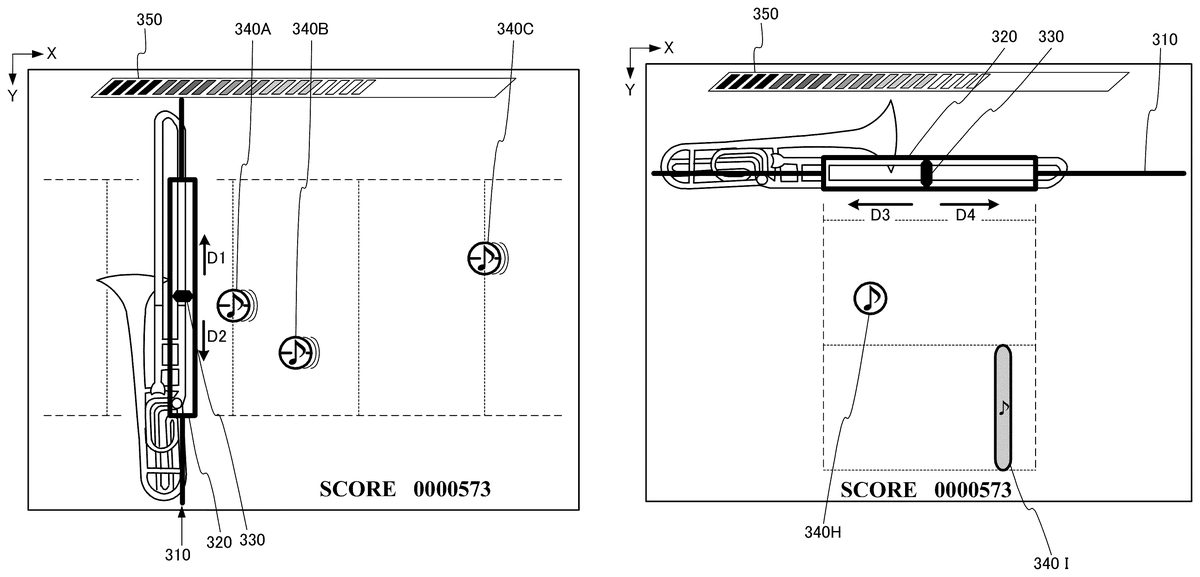
FIG. 3is a diagram showing an illustrative configuration of a game screen by the gaming device200. In the game screen, a determination line310, a moving box320, a moving object320, musical performance instruction marks340(340A to340C inFIG. 3), a gauge350, and the like are displayed.
FIG. 4is an enlarged diagram showing the proximity of the determination line310in order to facilitate understanding with the background and the like of the game screen shown inFIG. 3being eliminated.
What follows is a brief explanation of a game executed by the gaming device200. The player plays a particular musical instrument in a simulated manner in this game. Then, a music task is reproduced completely. As the game starts, a background sound (or a background music) excluding a particular music instrument (e.g., a trombone) is output from the speaker. The player plays the musical instrument excluded from the background sound in a simulated manner. As a result, the music is played by all musical instruments.
The moving box320is preferably fixed at a predetermined position in the game screen. In the present embodiment, there is preferably only one moving object330in the game screen. The moving object330can move in the moving box320along the determination line310. The moving object330preferably moves in a direction of an arrow D1or an arrow D2over a pathway430in accordance with an instruction from the player. The pathway430is preferably a line interconnecting a first end point410and a second end point420both on the determination line310. When moving the moving object330, the CPU101may move an image of slide of a trombone drawn over the background together with the moving object330.
The game screen is preferably displayed on the surface of the display device. A touch panel may be provided on the display device. The touch panel preferably has a sensor that can detect a position where a pen or a finger touches. Such a display device is a so-called “touch screen”. The player can move the moving object330while contacting a touch pen thereto. In general, this operation is called a “drag”. The moving object330preferably smoothly moves from a moving start position to a moving end position in response to an instruction from the player.
Sounds with predetermined pitches (musical scales or frequencies) are preferably associated with respective positions on the pathway430.FIGS. 5A and 5Bare diagrams showing an illustrative association between a position on the pathway430and a pitch (musical scale or frequency).
InFIG. 5A, the horizontal axis represents a coordinate of the position of the moving object330. The vertical axis represents a pitch. The moving object330can move within a range from PMINto PMAX. Moreover, the pitch associated with respective positions preferably successively change from VMINto VMAX. The longer a distance from the first end point410to the moving object330, the higher the associated pitch becomes.
A preferred correspondence relation between a position of the moving object330and a pitch inFIG. 5Bis as follow.
Higher than or equal to PMINand lower than P1:VMIN(e.g., a pitch of “do”)Higher than or equal to P1and lower than P2:V1(e.g., a pitch of “re”)Higher than or equal to P2and lower than P3:V2(e.g., a pitch of “mi”)Higher than or equal to P3and lower than P4:V3(e.g., a pitch of “fa”)Higher than or equal to P4and lower than P5:V4(e.g., a pitch of “so”)Higher than or equal to P5and lower than P6:V5(e.g., a pitch of “la”)Higher than or equal to P6and lower than P7:V6(e.g., a pitch of “si”)Higher than or equal to P7and lower than PMAX:VMAX(e.g., a pitch of “do”one octave higher)
In the present embodiment, the first end point410is preferably associated with the lowest sound of a trombone. The second end point420is preferably associated with the highest sound of the trombone. In other words, inFIG. 3, as the player moves the moving object330to the upper part of the game screen (a direction in which a Y-coordinate becomes small), a low sound is preferably emanated. Conversely, as the player moves the moving object330to the lower part of the game screen (a direction in which the Y-coordinate becomes large), a high sound is preferably emanated.
However, the correspondence relation between each position on the pathway430and a sound is optional, and is not limited to the embodiment of the present application. For example, inFIG. 5A, the change rate of a high sound is constant. However, the change rate of a high sound may be not constant. That is, the change amount of a pitch may be non-proportional to the change amount of a position.
The CPU101preferably moves a musical performance instruction mark340along with playing of music. The musical performance instruction mark340preferably moves toward the determination line310. InFIG. 4, the musical performance instruction mark340preferably moves from right to left over an orbit440. The musical performance instruction mark340is also called a “musical note”. When passing through the determination line310, the musical performance instruction mark340preferably moves further to the left of the screen. Thereafter, a distance between the musical performance instruction mark340and the determination line310preferably becomes large, and the musical performance instruction mark340preferably disappears from the screen.
The player may input an instruction in order to play a trombone in a simulated manner using the controller105. This instruction is preferably given by moving the moving object330in a direction of the arrow D1or the arrow D2. The player can move the moving object330at an arbitrary position on the pathway430.
When the musical performance instruction mark340moves to a position450overlapping the determination line310, it is necessary for the player to move the moving object330to the position450. In this timing, as the moving object330moves to the position450, a sound associated with the position450is preferably emanated. That is, a sound of a trombone that the player plays in a simulated manner is preferably emanated. Then, a sound of the trombone is superimposed on the background sound, so that a musical performance by all musical instruments is preferably emanated.
The musical performance instruction mark340preferably notifies the player the timing at which the moving object330must be moved and a position where the moving object330must be moved at that timing (hereinafter, a “game task”). The player may visually check the musical performance instruction mark340, thereby determining a position and a time that the moving object330must be moved. At least one game task is defined for each music piece. However, it is desirable that plural game tasks should be defined.
A timing that the moving object330must be moved is typically indicated as a bar number currently played and a beat in that bar. Alternatively, the timing may be indicated as information indicating how many seconds have elapsed from the beginning of the music played.
The position where the moving object330must be moved is preferably specified by a coordinate. A coordinate system used for indicating a coordinate may be a predetermined coordinate system (e.g., an X-Y coordinate) defined in the game screen. How to define the coordinate system is optional.
A condition that the position of the musical performance instruction mark340matches the position of the moving object330is called that “a game task completes”. When one game task completes, the player acquires a predetermined point. The acquired point is added to a score. Moreover, a value of the gauge350which indicates the heat of the game increases by a predetermined level.
Next, an explanation will be given of individual units of the gaming device200.
The input receiving unit201preferably receives an instruction input specifying a position where the moving object330is arranged. The instruction input is given as, for example, the player depresses an operation button of the controller105of the gaming device200. The CPU101and the controller105preferably work together to function as the input receiving unit201.
The memory unit202preferably stores a timing associated with a position where the moving object330must be moved at that timing as a game task. When there are multiple game tasks, the memory unit202preferably stores each timing and each position where the moving object330must be moved in association with each other specified by each game task. The CPU101and the external memory106work together to function as the memory unit202.
The display unit210preferably displays the musical performance instruction mark340indicating a timing and a position at which the moving object330must be moved, both stored in the memory unit202. The display unit210may move the musical performance instruction mark340on the orbit440as time elapses.
The CPU101, the image processing unit108and the like preferably work together to function as the display unit210.
Note that the display unit210may be omitted accordingly.
FIG. 6is a diagram showing an illustrative configuration of a game task stored in the external memory106. By way of example, assume a total of N (N is an integer greater than or equal to 1) number of game tasks are defined. As shown inFIG. 6, the first illustrative game task (item number=1) is “to move the moving object330to a position having coordinates of (X1, Y1) at the first beat of the first bar”. The second illustrative game task (item number=2) is “to move the moving object330to a position having coordinates of (X2, Y2) at the third beat of the second bar”. The N-th illustrative game task (item number=N) is “to move the moving object330to a position having coordinates of (XN, YN) at an m-th beat of an n-th bar”.
When there are a total of N number (N is an integer greater than or equal to 1) of game tasks, an i-th game task P(i) can be expressed as an [equation 1].
P(i)=(T(i),(X(i),Y(i))) [Equation 1]
where:
T(i) is a timing (time) that the moving object330must be moved;
X(i) is an X-coordinate of a position where the moving object330must be moved; and
Y(i) is a Y-coordinate of the position where the moving object330must be moved.
A position may be expressed only by an X-coordinate as expressed in [equation 2]. Alternatively, the position may be expressed only by a Y-coordinate as expressed in [equation 3].
P(i)=(T(i),X(i)) [Equation 2]
P(i)=(T(i),Y(i)) [Equation 3]
Note that the specific content of a game task is not limited to the embodiment of the present application. That is, a position and a timing specified by a game task can be set arbitrarily. Moreover, the number of game tasks can be set arbitrarily.
The sound outputting unit203preferably determines whether, at a timing specified by a game task, a position specified by an instruction input matches a position stored in association with that timing. The instruction input is preferably received from the input receiving unit201. Typically, the sound outputting unit203preferably determines whether a position specified by a latest instruction input matches a position stored in association with a timing specified by a next game task. The latest instruction input means the last instruction input received. When determining that a position specified by the instruction input matches a position stored in association with a timing specified by a game task, the sound outputting unit203preferably emanates a sound associated with the position specified by the instruction input. The CPU101and the sound processing unit109preferably work together to function as the sound outputting unit203.
FIG. 7is a diagram showing an example how the position (Y-coordinate) of the moving object330shown inFIG. 3changes as time elapses. As explained above, in the present embodiment, the moving object330preferably moves in the vertical direction along the determination line310fixed in the screen. An explanation will now be given of a process executed by the sound outputting unit203with reference toFIG. 7.
At a time T1, the moving object330is arranged at a position YA. As shown inFIG. 7, two game tasks P(i), and P(i+1) can be expressed as [equation 4] and [equation 5], respectively. Note that P(i+1) is a game task following P(i).
P(i)=(T(i),YB) [Equation 4]
P(i+1)=(T(i+1),YC) [Equation 5]
From the time T1to a time T2, the player may input an instruction to move the moving object330. The player inputs an instruction by, for example, dragging an image representing the moving object330using a touch pen or a finger. The CPU101preferably moves the moving object330from the position YA to a position YB. During this operation, the CPU101outputs only a background sound. That is, the CPU101does not output any sound of a musical instrument (trombone) played by the player.
From the time T2to a time T(i), the player inputs no instruction to move the moving object330. The CPU101preferably causes the moving object330to stand still at the position YB. During this operation, the CPU101preferably outputs only a background sound. That is, the CPU101does not output any sound of the trombone.
At a time T(i), the CPU101preferably determines whether a position specified by a latest instruction input matches the position YB specified by the game task P(i). The position specified by the latest instruction input is the position YB at the time T2. In the case ofFIG. 6, the position YB specified by the latest instruction input matches the position YB specified by the game task P(i). Accordingly, the CPU101emanates a sound of the trombone associated with the position YB at the time T(i) for a predetermined period TP1.
When a position specified by the latest instruction input does not match the position YB specified by the game task P(i), the CPU101preferably outputs only a background sound. That is, the CPU101does not output a sound of the trombone.
That is, as shown inFIG. 7, when a position specified by the latest instruction input is YD (≠YB), the CPU101preferably does not output a sound of the trombone associated with the position YD.
A predetermined period may be common to all game tasks. Alternatively, the predetermined period may differ for each game task. The CPU101may change the predetermined period in accordance with a position or a timing specified by a game task.
From the time T(i) to a time T3, the player inputs no instruction to move the moving object330. The CPU101preferably causes the moving object330to stand still at the position YB. During this operation, the CPU101outputs only a background sound. That is, the CPU101does not output any sound of the trombone.
Note that the predetermined period TP1is preferably shorter than a time from the time T(i) to the time T3, or is the same time length.
From the time T3to a time T4, the player inputs an instruction to move the moving object330. The player inputs an instruction by, for example, dragging the image representing the moving object330using a touch pen or a finger. The CPU101preferably moves the moving object330from the position YB to a position YC. During this operation, the CPU101outputs only a background sound. That is, the CPU101does not output any sound of the trombone.
From the time T4to a time T(i+1), the player inputs no instruction to move the moving object330. The CPU101preferably causes the moving object330to stand still at the position YC. During this operation, the CPU101outputs only a background sound. That is, the CPU101does not output any sound of the trombone.
At a time T(i+1), the CPU101determines whether a position specified by the latest instruction input matches the position YC specified by the game task P(i+1). The position specified by the latest instruction input is preferably the position YC at the time T4. In the case ofFIG. 7, the position YC specified by the latest instruction input matches the position YC specified by the game task P(i+1). Accordingly, at the time T(i+1), the CPU101preferably outputs a sound of the trombone associated with the position YC for a predetermined period TP2.
Next, an explanation will be given of a preferred game process executed by the above-explained individual units of the present embodiment with reference to the flowchart ofFIG. 8. A game process shown inFIG. 8is preferably a process executed per game task. When there are multiple game tasks, a process of each step explained below is repeated by the number of game tasks. The CPU101preferably counts an elapsed time from the start of the game (start of playing a background sound).
First, the CPU101preferably receives an instruction input of specifying a position (e.g., an destination point of dragging) where the moving object330is to be moved (step S801). For example, the player drags the image representing the moving object330using a touch pen or a finger, thereby inputting an instruction to specify a position where the moving object330is to be moved. The CPU101preferably receives an instruction input from the player.
Based on the instruction input received in the step S801, the CPU101preferably moves a position of the moving object330in the game screen (step S802).
The CPU101preferably determines whether a current time matches the timing specified by a game task (step S803). For example, this determination process is repeated at a predetermined periodical time interval by vertical synchronization (VSYNC).
When the current time is not a timing specified by the game task (step S803: NO), the CPU101preferably repeats the processes from the step S801to the step S802again.
When the current time is the timing specified by the game task (step S803: YES), the CPU101preferably determines whether a position specified by a latest instruction input matches a position specified by a game task (step S804).
The CPU101may determine whether a position specified by a latest instruction input matches a position specified by a game task within a predetermined error range.
When the position specified by the latest instruction input matches the position specified by the game task (step S804: YES), the CPU101preferably outputs a sound associated with the position specified by the instruction input (step S805). The CPU101may output a sound associated with the position specified by the game task for a predetermined period.
When the position specified by the latest instruction input does not match the position specified by the game task (step S804: NO), the CPU101preferably terminates the game process. Note that the CPU101returns the process to the step S801and preferably repeats the processes from the step S801to the step S805if the following two conditions are satisfied:
(a) there are multiple game tasks; and
(b) there is a game task following a game task determined in the step S803.
According to the present embodiment, the player can enjoy a game of playing a musical instrument in a simulated manner through a simple operation. In the foregoing explanation, an explanation of a music game of playing a trombone was given as an example. However, the present application can be applied to games of playing other musical instruments, such as a sliding whistle, a musical saw, and a violin.
The gaming device200may have an input interface which allows a player to change a virtual position of his left hand when playing a string instrument. That is, the operation of the gaming device200is not limited to an operation of changing a pitch of a wind instrument. The gaming device200can provide an input interface common to various musical instruments without needing an exclusive controller for playing a certain musical instrument.
In the present embodiment, the moving object330is moved based on an instruction input as the player touches a touch screen. However, the moving object330may be moved based on an instruction input through other schemes. For example, the CPU101may move the moving object330based on a depressing operation of a predetermined button of the controller105or a keyboard. Moreover, the CPU101may move the moving object330based on an instruction input through a clicking operation of a mouse or a moving operation of a mouse pointer.
Second Embodiment
Next, another embodiment of the present application will be explained. In the foregoing embodiment, a timing and a position in which the moving object330must be moved are associated with each other in one game task. In the present embodiment, in addition to a timing and a position, a time length for maintaining the moving object330at that position is also associated.
FIG. 9is a diagram showing an illustrative configuration of a game screen. The horizontal length of the musical performance instruction marks340of the present embodiment (inFIG. 9, two of340D and340E) preferably adjusts in accordance with the time length that the moving object330is meant to be maintained. In a word, the musical performance instruction mark340indicates not only a position of a musical note but also the time length of the musical note.
FIG. 10is a diagram showing an illustrative configuration of a game task stored in the memory unit202according to the present embodiment. In a pair of game tasks, the timing at which the moving object330must be moved, the position where the moving object330must be moved at that timing, and the time length of maintaining the moving object330at that position are associated with each other. In the present embodiment, the time length for maintaining the current position of the moving object330corresponds to the time length of the emanating sound of, for example, a trombone with a constant pitch.
An i-th game task P(i) can be expressed as [equation 6].
P(i)=(T(i),(X(i),Y(i)),L(i)) [Equation 6]
L(i) is the time length for maintaining the moving object330at a position (X(i), Y(i)). In other words, L(i) is the time length of the emanating sound. The time length set for each game task (i.e., for each musical note) may differ.
Like the timing, a time length may be expressed using a bar number and a beat such that “from an M1-th beat of a bar with a bar number of N1to an M2-th beat of a bar with a bar number of N2in a music to be played”. Moreover, a time length may be expressed with reference to an actual time like “for X seconds”, “by X times of VSYNC”.
When a position specified by a latest instruction input matches a position specified by a game task, the sound outputting unit203of the present embodiment emanates a sound associated with that position for the time length specified by the game task.
FIG. 11is an illustrative diagram demonstrating how a position (Y-coordinate) of the moving object330shown inFIG. 9may change. The moving object330preferably moves in the vertical direction along the determination line310fixed in the screen. An explanation will now be given of a process executed by the sound outputting unit203of the present embodiment.
As shown inFIG. 11, at a time T5, the moving object330is arranged at a position YE, and a game task P(i) is expressed as [equation 7].
P(i)=(T(i),YF,L(i)) [Equation 7]
From the time T5to a time T6, a player inputs an instruction to move the moving object330. The player inputs an instruction by dragging an image representing the moving object330using, for example, a touch pen. The CPU101preferably moves the moving object330from the position YE to a position YF. During this operation, the CPU101preferably outputs only a background sound. That is, the CPU101does not output any sound of a musical instrument (trombone) played by the player.
From the time T6to a time T(i), the player inputs no instruction to move the moving object330. The CPU101preferably halts the moving object330at the position YF. During this operation, the CPU101preferably outputs only a background sound. That is, the CPU101does not output any sound of the trombone.
At the time T(i), the CPU101preferably determines whether a position specified by a latest instruction input matches the position YF specified by the game task P(i). The position specified by the latest instruction input is preferably the position YF at the time T6. In the case ofFIG. 11, the position YF specified by the latest instruction input matches the position YF specified by the game task P(i). Accordingly, at the time T(i), the CPU101preferably starts outputting a sound of the trombone associated with the position YF.
When the position specified by the latest instruction input does not match the position YF specified by the game task P(i), the CPU101preferably outputs only a background sound. That is, the CPU101does not output any sound of the trombone.
From the time T(i) to a time T(i)+L(i), when the moving object330rests at the position YF, the CPU101preferably keeps outputting a sound of the trombone associated with the position YF.
Conversely, during an arbitrary time T7from the time T(i) to the time T(i)+L(i), when the moving object330moves to a position YG (≠YF) which is not the position YF, the CPU101preferably terminates outputting a sound of the trombone. In this case, a sound of the trombone discontinues after being output for a period shorter than the output time length L(i) specified by the game task P(i).
At the time T(i)+L(i), when a sound of the trombone associated with the position YF is being output, the CPU101preferably terminates the sound of the trombone which is being output. That is, in this case, the sound of the trombone is being output for the output time length L(i).
Note that at a time T(i)+L(i), when the sound of the trombone associated with the position YF is not output, the CPU101preferably refrains from outputting any sound of the trombone.
Next, an explanation will be given of a game process of the embodiment with reference to a flowchart ofFIG. 12.
First, the CPU101preferably receives an instruction input to specify a position (e.g., an destination point of dragging) where the moving object330is to be moved (step S1201).
The CPU101preferably updates a position of the moving object330based on an instruction input received in the step S1201(step S1202).
The CPU101preferably determines whether a current time is the time specified by a game task (step S1203). For example, this determination process is repeated at a predetermined periodical time interval like vertical synchronization (VSYNC).
When the current time is not the time specified by the game task (step S1203: NO), the CPU101preferably executes the processes from the step S1201to the step S1202again.
When the current time is the time specified by the game task (step S1203: YES), the CPU101preferably determines whether a position specified by a latest instruction input matches a position specified by the game task (step S1204).
When the position specified by the latest instruction input does not match the position specified by the game task (step S1204: NO), the CPU101preferably terminates the game process. Note that if following two conditions are satisfied, the CPU101preferably returns to the process of the step S1201, and repeats the game process for a following game task:
(a′) there are multiple game tasks; and
(b′) there is a game task following a game task determined in the step S1203.
Conversely, when the position specified by the latest instruction input matches the position specified by the game task (step S1204: YES), the CPU101preferably starts outputting a sound associated with the position specified by the game task (step S1205). For example, the CPU101starts outputting a sound of a trombone. The pitch of the sound of the trombone may correspond to the position specified by the game task.
The CPU101preferably successively receives an instruction input to specify a position where the moving object330is to be moved (step S1206). Next, the CPU101preferably updates a position of the moving object330in the game screen based on the received instruction input (step S1207).
The CPU101determines whether an output time length specified by the game task has elapsed (step S1208). In other words, the CPU101determines whether a sound is being continuously output until the time length specified by the game task has elapsed after emanation of the sound is started at the step S1205. For example, the CPU101determines whether a sound of the trombone with a specified pitch kept emanating.
When the output time length has elapsed (step S1208: YES), the CPU101preferably progresses the process to a step S1210to be discussed later.
When the output time length has not elapsed yet (step S1208: NO), the CPU101determines whether a position specified by a latest instruction input matches a position specified by a game task (step S1209).
When the position specified by the latest instruction input matches the position specified by the game task (step S1209: YES), the CPU101preferably returns to the process of the step S1206. Subsequently, the CPU101preferably receives an instruction input to specify a moving destination of the moving object330. The CPU101keeps outputting a sound associated with the position specified by the instruction input. That is, while the moving object330is being placed at the position specified by the instruction input, a sound of the trombone is continuously emanating. Note that outputting of the sound has been started at the step S1205.
When the position specified by the latest instruction input does not match the position specified by the game task (step S1209: NO), the CPU101preferably terminates outputting a sound associated with the position specified by the game task (step S1210). That is, as the moving object330separates from the position specified by the game task, the sound of the trombone is preferably terminated. Thereafter, the CPU101preferably terminates the game process. Note that outputting of the sound has been preferably started in the step S1205.
When the moving object330is preferably moved again to the position specified by the game task within the time length specified by the game task after terminating emanation of the sound at the step S1210, the CPU101may start outputting a sound associated with a position specified by the latest instruction input again. In this case, the sound of a trombone is temporarily discontinued, but resumes emanating again.
According to the present embodiment, the player can enjoy the game that allows the player to obtain the feeling of playing a musical instrument through a simple operation. The gaming device200may provide an input interface which facilitates an operation of maintaining a pitch of a wind instrument or an operation of maintaining a position of a left hand for a string instrument. The gaming device200does not need an exclusive controller for playing a specific musical instrument. Hence, the gaming device200can provide an input interface common to various musical instruments.
The present application is not limited to the foregoing embodiments, and can be changed and modified in various forms. Moreover, individual elements of the foregoing embodiments may be mixed and combined together.
In each of the foregoing embodiments, an instruction input of moving the moving object330is preferably given through a dragging operation by the player on a touch screen. However, an instruction input may be given through other schemes.
For example,FIG. 13is a diagram showing an external appearance of an illustrative trombone-like controller. The player may grab a supporting body1300, and slide it over a pathway1350. The CPU101preferably measures a displacement width of the supporting body1300. The displacement width may be, for example, a distance from a preset position. The CPU101moves the moving object330in the game screen shown inFIG. 4along the pathway430based on a measured displacement width. In other words, the supporting body1300and the moving object330preferably move in unison. Note that the shapes of the parts other than the supporting body1300of the trombone-like controller may be changed. This makes it possible to provide an input device for various purposes which enables an operation of not only a trombone but also various musical instruments in a simulated manner.
In each of the foregoing embodiments, there is only one moving object330. However, the number of moving objects330may be larger than or equal to two.FIG. 14shows an illustrative configuration of a game screen where two moving objects330A,330B are arranged. For example, assume the game of the embodiments allows two players to play simultaneously. The moving object330A at the upper part of the screen is a moving object that one (1P side) player must operate. The moving object330B at the lower part of the screen is a moving object that another (2P side) player must operate.
A musical performance instruction mark340F is preferably positioned on a lane1410for the 1P side. The player of the 1P side inputs an instruction to move the moving object330A so as to accomplish a game task indicated by the musical performance instruction mark340F. Conversely, a musical performance instruction mark340G is preferably positioned on a lane1420for the 2P side. The player of the 2P side preferably inputs an instruction to move the moving object330B so as to accomplish a game task indicated by the musical performance instruction mark340G.
The game of the embodiments may be a game for playing different musical instruments simultaneously in a simulated manner. For example, the player at the 1P side may input an instruction of playing a trombone. At the same time, the player at the 2P side may input an instruction of playing a violin. Moreover, the game of the embodiments may be a game that allows multiple moving objects330to be operated by a single player.
There may be multiple moving objects330along the determination line310.FIG. 15shows an illustrative configuration of a game screen having two moving objects330C,330D arranged in one moving box320. For example, in a single player game allowing the single player to play two musical instruments simultaneously, one moving object330C may be a moving object that the player must operate in order to play a first trombone. Another moving object330D may be a moving object that the player must operate in order to play a second trombone.
A game task is preferably indicated by a musical performance instruction mark340J associated with the first trombone and a musical performance instruction mark340K associated with the second trombone. The player preferably inputs instructions to move the moving objects340J,340K in order to accomplish the game task.
Note that when multiple moving objects330are arranged on the same determination line310, it is desirable that individual moving objects330have different sizes, shapes, designs, and the like.
For example, as shown inFIG. 15, one moving object330C is shown as being larger than another moving object330D. Accordingly, it can be seen that the moving object330D is always overlapping with the moving object330C. Therefore, it is not possible for the moving object330D to be hidden by the moving object330C and become invisible.
The direction in which the moving object330is to be moved and the direction in which the musical performance instruction mark340scrolls are not limited to the foregoing embodiments of the present application. For example, as shown inFIG. 16, the moving object330may be moved in a rightward and leftward direction (directions of arrows D3, D4). In the example shown inFIG. 16, the musical performance instruction marks340H,340I scroll in the upward and downward direction.
In each of the foregoing embodiments, the CPU101preferably outputs a sound associated with a position correlating with an instruction input, when the position specified by the instruction input matches a position specified by a game task. However, the CPU101may output a sound associated with a game task. In this case, an i-th game task P(i) can be expressed as, for example, [equation 8].
P(i)=(T(i),(X(i),Y(i)),S(i)) [Equation 8]
Note that S(i) is a parameter specifying a sound to be output. For example, S(i) specifies a musical scale, such as “do”, “re”, or “mi”, and a file name of music data to be played.
A program which allows a computer to function as a part of or a whole gaming device200may be stored in a computer-readable recording medium, such as a memory card, a CD-ROM, a DVD, or an MO (Magneto Optical disk) and distributed, and, installed in another computer to function in such a computer using the foregoing means or to execute the foregoing processes.
The program may be stored in a disk device of a server device over the Internet, and for example, superimposed on a carrier wave, and downloaded by a computer.
As explained above, according to the present application, there are provided a gaming device which realizes a game that allows a player to obtain the feeling of playing various musical instruments through a simple operation, a game processing method, and an information memory medium.
Having described and illustrated the principles of this application by reference to one or more preferred embodiments, it should be apparent that the preferred embodiments may be modified in arrangement and detail without departing from the principles disclosed herein and that it is intended that the application be construed as including all such modifications and variations insofar as they come within the spirit and scope of the subject matter disclosed herein.
Claims
- A gaming device for allowing a player to play a musical instrument in a music game, comprising: an input receiving unit that receives an instruction input that specifies an input position where a moving object movable in a predetermined pathway is to be placed;a memory unit which stores a plurality of timings and a plurality of stored positions where the moving object is to be placed, each of the plurality of timings and each of the plurality of stored positions being associated with each other;and a sound outputting unit which outputs a background sound during play of the music game, wherein at each one of the plurality of timings, when the received input position matches the stored position associated with the respective one of the plurality of timings, the sound outputting unit outputs a second sound associated with the position associated with the one of the plurality of timings, the second sound being initiated by the sound outputting unit at the position associated with the respective one of the plurality of timings even if the stored position associated with the respective one of the plurality of timings is achieved by the instruction input prior to the respective one of the plurality of timings, the sound outputting unit combining the background sound and the second sound, the second sound corresponding to a sound that should be played by the musical instrument being played by the player.
- The gaming device according to claim 1 , wherein the moving object is a predetermined image displayed on a touch screen, and the input receiving unit receives a dragging operation of the predetermined image on the touch screen as the instruction input of specifying a destination point reached by the dragging operation.
- The gaming device according to claim 2 , wherein the input receiving unit accepts the instruction input of specifying, as the destination point reached by the dragging operation, a point where the dragging operation of the predetermined image is terminated, or a point nearby the predetermined image, at which an amount of move from a point at which the predetermined image is originally located becomes less than a predetermined value.
- The gaming device according to claim 1 , further comprising a supporting body provided with a predetermined pathway, wherein when the player grabs and moves the supporting body, the input receiving unit receives the instruction input of specifying a position where the moving object is to be moved.
- The gaming device according to claim 1 , wherein the memory unit further stores an output time length in association with each of the plurality of timings, and wherein the sound outputting unit outputs the sound associated with the matching stored position for the output time length at each of the plurality of timings.
- The gaming device according to claim 1 , further comprising a display unit which displays an instruction mark indicating one of the plurality of timings and one of the plurality of stored positions stored in the memory unit, wherein the display unit displays the instruction mark while moving the instruction mark toward the pathway as time elapses.
- The gaming device according to claim 1 , wherein the sound outputting unit outputs a sound having a pitch, a musical scale, or a frequency associated with the matching position.
- The gaming device according to claim 1 , wherein a first moving object and a second moving object exist as the moving object, the input receiving unit receiving a first instruction input of specifying a first moving object position of the first moving object, and a second instruction input of specifying a second moving object position of the second moving object, the memory unit stores, for each of the plurality of timings, the timing and a moving object position where the first moving object and/or the second moving object is to be moved in association with each other, and when at each of the plurality of timings, the first moving object position specified by the first instruction input and/or the second moving object position specified by the second instruction input received at the timing matches the moving object position stored in association with the timing, the sound outputting unit outputs the sound associated with the matching position.
- A game processing method, for allowing a player to play a musical instrument in a music game, executed by a gaming device including an input receiving unit, a memory unit, and a sound outputting unit, the memory unit storing a plurality of timings and a plurality of stored positions where a moving object movable in a predetermined pathway is to be placed, each of the plurality of timings and each of the plurality of positions being associated with each other, and the method comprising: an input receiving step in which the input receiving unit receives an instruction input of specifying an input position where the moving object is to be arranged;and a sound outputting step that the sound outputting unit outputs a background sound during play of the music game, wherein at each one of the plurality of timings, when the received input position matches the stored position associated with the respective one of the plurality of timings, the sound outputting unit outputs a second sound associated with the position associated with the one of the plurality of timings, the second sound being initiated by the sound outputting unit at the position associated with the respective one of the plurality of timings even if the stored position associated with the respective one of the plurality of timings is achieved by the instruction input prior to the respective one of the plurality of timings, the sound outputting unit combining the background sound and the second sound, the second sound corresponding to a sound that should be played by the musical instrument being played by the player.
- A non-transitory computer-readable information memory medium storing a program, for allowing a player to play a musical instrument in a music game, which allows a computer to function as: an input receiving unit which receives an instruction input that specifies an input position where a moving object movable in a predetermined pathway is to be placed;a memory unit which stores a plurality of timings and a plurality of stored positions where the moving object is to be placed, each of the plurality of timings and each of the plurality of positions being associated with each other;and a sound outputting unit which outputs a background sound during play of the music game, wherein at each one of the plurality of timings, when the received input position matches the stored position associated with the respective one of the plurality of timings, the sound outputting unit outputs a second sound associated with the position associated with the one of the plurality of timings, the second sound being initiated by the sound outputting unit at the position associated with the respective one of the plurality of timings even if the stored position associated with the respective one of the plurality of timings is achieved by the instruction input prior to the respective one of the plurality of timings, the sound outputting unit combining the background sound and the second sound, the second sound corresponding to a sound that should be played by the musical instrument being played by the player.
Disclaimer: Data collected from the USPTO and may be malformed, incomplete, and/or otherwise inaccurate.