U.S. Pat. No. 8,353,758
AMUSEMENT DEVICE HAVING ELECTRONIC GAME AND JUKEBOX FUNCTIONALITIES
AssigneeAMI Entertainment Network LLC
Issue DateSeptember 17, 2008
Illustrative Figure
Abstract
An amusement device has a display, an audio output, and an input component. The display includes a touchscreen. The input component receives at least one of currency, coins, and credit cards/debit cards. The amusement device also includes a common controller. The common controller is configured to select and play at least one electronic game and to select and retrieve for playing a music data set from a plurality of music data sets. The electronic game and the music data set may optionally be played simultaneously. In certain embodiments, a reward based on one of either the electronic game or selection of the music data set is applied to the respective other of the electronic game and the selection of the music data. In further embodiments, a content of the electronic game is based on the music data set.
Description
DETAILED DESCRIPTION OF THE INVENTION Certain terminology is used in the following description for convenience only and is not limiting. The words “right”, “left”, “lower”, and “upper” designate directions in the drawings to which reference is made. The words “inwardly” and “outwardly” refer to directions toward and away from, respectively, the geometric center of the portable amusement device and designated parts thereof. The terminology includes the above-listed words, derivatives thereof, and words of similar import. Additionally, the words “a” and “an”, as used in the claims and in the corresponding portions of the specification, mean “at least one.” Further, the terms “coin” or “currency” should not be construed as limiting and can be used herein to mean all forms of coin and paper currency from any country as well as proprietary tokens, game cards, credit cards, debit cards, chits, or other representative forms of credit and/or payment. Referring to the drawings in detail, wherein like reference numerals indicate like elements throughout, there is shown inFIG. 1Aa first preferred embodiment of an amusement device10A. The amusement device10A includes a common controller U1and a memory U2. As used herein, controller U1is referred to as “common” because it performs tasks for both game play and jukebox functionalities, as will be described in greater detail below. The memory U2can be any known or suitable memory device such as random access memory (RAM), read only memory (ROM), flash RAM, hard disk, optical disk, or the like. The amusement device10A further includes a video display12A that is operatively connected to the common controller U1.FIG. 1Bshows another or second amusement device10B in accordance with a second preferred embodiment of the present invention. The second amusement device10B also includes a common controller U1, a memory U2, and a display12B.FIG. 1Cshows another or third amusement device10C in accordance with ...
DETAILED DESCRIPTION OF THE INVENTION
Certain terminology is used in the following description for convenience only and is not limiting. The words “right”, “left”, “lower”, and “upper” designate directions in the drawings to which reference is made. The words “inwardly” and “outwardly” refer to directions toward and away from, respectively, the geometric center of the portable amusement device and designated parts thereof. The terminology includes the above-listed words, derivatives thereof, and words of similar import. Additionally, the words “a” and “an”, as used in the claims and in the corresponding portions of the specification, mean “at least one.” Further, the terms “coin” or “currency” should not be construed as limiting and can be used herein to mean all forms of coin and paper currency from any country as well as proprietary tokens, game cards, credit cards, debit cards, chits, or other representative forms of credit and/or payment.
Referring to the drawings in detail, wherein like reference numerals indicate like elements throughout, there is shown inFIG. 1Aa first preferred embodiment of an amusement device10A. The amusement device10A includes a common controller U1and a memory U2. As used herein, controller U1is referred to as “common” because it performs tasks for both game play and jukebox functionalities, as will be described in greater detail below. The memory U2can be any known or suitable memory device such as random access memory (RAM), read only memory (ROM), flash RAM, hard disk, optical disk, or the like. The amusement device10A further includes a video display12A that is operatively connected to the common controller U1.FIG. 1Bshows another or second amusement device10B in accordance with a second preferred embodiment of the present invention. The second amusement device10B also includes a common controller U1, a memory U2, and a display12B.FIG. 1Cshows another or third amusement device10C in accordance with a third preferred embodiment of the present invention. The third amusement device10C also includes a common controller U1, a memory U2, and a flat display12C. Preferably, the video displays12A,12B,12C are touchscreen video displays configured to accept touch input. The first amusement device10A is a free-standing or floor-standing apparatus, whereas the second and third amusement devices10B,10C are table-top or counter-top apparatus. However, the amusement devices10A,10B,10C may be arranged in any configuration including table mount, wall mount, pole mount, and the like without departing from the invention.
For convenience, the amusement devices10A,10B will be referred to hereinafter simply as “amusement device10.”
Referring toFIG. 2, the amusement device10is shown with the display12, preferably touchscreen, being coupled to the common controller U1. Also coupled to the common controller U1is an input component14. Input component14may accept at least one of coins (or tokens), currency (e.g. paper money or the like), credit cards/debit cards, and the like. Although only one input component14is shown, the amusement device10may include more than one input component14to give a user an option for payment, for permitting multiple players, or the like. Preferably, the amusement device10is made operable upon actuation of the input component14, for example, the user may only select and play an electronic game or select and retrieve for play a music data set once payment has been made via the input component14and/or one or more credits are issued to the user. However, free selections may be offered at the discretion of an operator of the amusement device10.
The amusement device10also includes an audio output16coupled to the common controller U1. The audio output16may comprise one or more speakers internally housed by the amusement device10. The audio output16may also comprise one or more sockets for connection to one or more speakers, headphones, or the like, that may be attached externally to the amusement device10. Additionally, the audio output16may comprise one or more sockets for connection to an external audio system (not shown), such as a stereo, wall-mounted speakers, surround sound system, or the like. Volume may be controlled by an external control or an on-screen volume control manipulated via the touchscreen display12.
The amusement device10also includes a communications component18, such as an Ethernet port, a wireless transceiver, or the like. Using the communications component18, the amusement device10may communicate with other devices or file servers, access the Internet, communicate over wide area networks (WANs) or local area networks (LANs), or the like. For example, the communications component18may couple the common controller U1of the amusement device10to a remote music data server20. Similarly, the amusement device10may connect with a second amusement device22using the communications component18. The second amusement device22optionally includes the same components and features as amusement device10. The amusement device10might also utilize an external audio output device24for outputting music data over the communications component18.
Turning now to the operation of the amusement device10, the memory U2stores one or more electronic games and a system control program. However, the one or more electronic games may also be stored remotely. The common controller U1controls the touchscreen display12based upon the system control program retrieved from the memory U2and based upon inputs from the touchscreen display12. As used herein, the system control program refers to all of the software functions outside of the electronic game files or music data including an operating system, display control, input control, sound drivers, and the like. Other input devices which may be connected to the amusement device10include a pushbutton(s), a track-ball or touchpad, a mouse, a joy-stick, a foot-pedal, a voice recognition system, a keypad or keyboard, and the like. But, preferably, the input device is the touchscreen display12.
The amusement device10includes an operating mode and a setup mode. When the operating mode is selected, a player or user is selectively permitted to play electronic games and to select music data sets for play. When the setup mode is selected, the owner/operator is permitted to make system setup adjustments. To switch from the operating mode to the setup mode, a mode selector pushbutton (hardware not shown) is provided that is typically concealed from the users. The mode selector pushbutton may be implemented as a hidden software feature, but preferably the mode selector pushbutton is a simple pushbutton that is disposed inside a housing of the amusement device10. In the setup mode, the owner/operator may also make adjustments to the game and music features as will be described in greater detail hereinafter.
In the preferred embodiments of the present invention, the common controller U1controls the display12based upon the system control program retrieved from the memory U2and based upon inputs of the user. The common controller U1is configured to (i) select and play at least one electronic game and (ii) select and retrieve for playing a music data set from a plurality of music data sets. The common controller U1also preferably plays the music data set. However, this function may also be performed by a separate controller (not shown) dedicated to decoding and playing of music data. The common controller U1is preferably a single processing unit, but may comprise multiple processing units. For example, common controller U1may include a main processing unit for controlling basic functionality of the amusement device10and a dedicated communication processing unit for handling transactions of the communications component18.
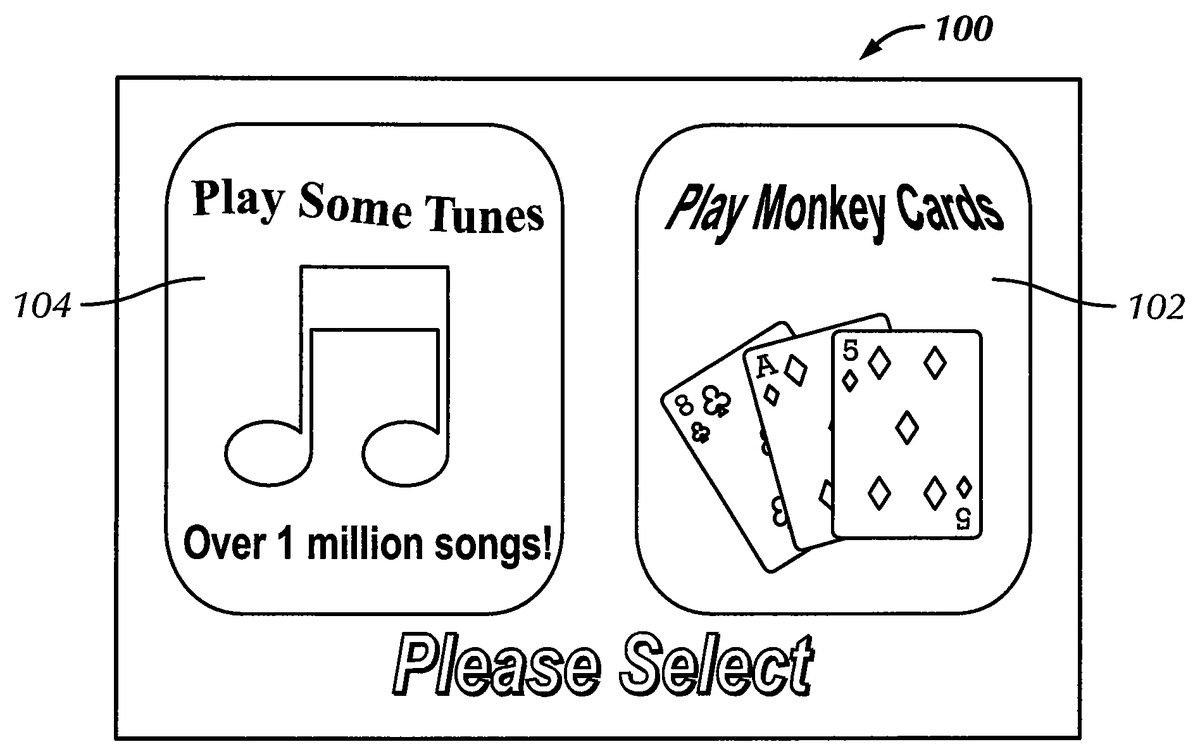
FIG. 3shows a screenshot100of a menu with an input102allowing a user to select and play a game, and an input104allowing a user to select a song from a collection of songs. By selecting the song input104, a user is taken to a menu of playable songs and may select as many as desired, depending of course on how many credits the user has been granted and the number of credits required per song. Each song is stored as a “music data set.” A music data set includes at least the audio data required for playing the song, but may also include metadata, i.e., information about the song such as artist, title, album, run time, or the like. The music data set is preferably stored remotely, for example, on a music data server20or a second amusement device22(FIG. 2) and can be retrieved over a broadband connection to a WAN, LAN, or the like. Optionally, the music data or a subset of the most commonly played music data can be stored locally and updated from time to time based upon play metrics or the like.
The music data set may be streamed to the common controller U1. The music data is provided serially to a temporary memory of common controller U1and the music data is played as packets of music data are being received. The data does not necessarily remain in memory once it has been played. The data is preferably buffered such that a minor interruption in the data download does not cause an interruption in the song performance.
In preferred embodiments of the present invention, the music data set is not played until some specified portion of the music data set has been downloaded to the temporary memory, depending on the bandwidth of the communication path available for download, processor and/or memory speed, and the like. For example, the song may not begin until 10% of the music data set has been received at the common controller U1. The specified portion of the music data set may be set by an operator of the amusement device10as a standard. The figure may also be adjusted dynamically by the common controller U1based on current perceived network download rates and/or prior download times, or the like. A combination of both methods can similarly be utilized.
The common controller U1may additionally dynamically adjust the total download amount based on current conditions. For example, if a song fails, it may be required that 15% more of the music data be downloaded to common controller U1before the song continues. Alternatively, if the total download is greatly exceeding the play rate, the download speed may be reduced. Preferably, the percentage of the music data set left to play should exceed the percentage of the music data left to download by about 10%. If a user selects a plurality of music data sets to be played, it is preferable to begin playing the first song and continue downloading the others. Downloading of the music data sets may occur sequentially or in parallel.
Conversely, it may be desirable to allow the entire music data set or total selected data sets to download to the temporary memory of the common controller U1before the music data set is played. This at least ensures that a song will not be interrupted by intermittent lapses in connectivity or other network disruptions. In either case, should a music data set suffer a severe enough interruption, one or more unplayed song credits may be returned to the user as a courtesy.
It is preferable that the electronic game and the selected music data set be capable of simultaneous play. A user should not have to choose between playing a game and listening to music. However, it is contemplated that the amusement device10may be configured to prevent games and music from being played concurrently.FIG. 4shows a screenshot200of a game in progress while simultaneously a music data set is playing. The display12may optionally provide the user with song information, which may be encoded as metadata in the music data set, as discussed above. For example, status bar202shows the current song, the artist, and time remaining. Other information may be provided to the user, but should be done in a manner that is least intrusive to the user's enjoyment of the game. It is also contemplated that a user may cancel unplayed music selections and the amusement device10converts at least a portion of the unused credits to gameplay credits, the user may cancel unplayed game credits that the amusement device converts to music selection credits, or alternatively returns money to the user.
In addition, a user may be permitted to temporarily pause a game in order to access the music feature of the amusement device10. For example, a user may be in the middle of a game when the song selections have finished playing on the amusement device10. Rather than waiting for the game to end, or prematurely terminating a game, the user may put the game on hold in order to make further music data set selections. Following the music selection, the user may resume the game.
An operator of the amusement device10may wish to encourage more business by offering rewards for achieving threshold levels of use. For example, a user selecting a certain number of songs to play on the amusement device may be awarded an additional free song selection. Similarly, a user achieving a certain level in a game or playing a game a certain number of times may be awarded an additional free play.
Preferably, the amusement device10promotes cross-use of music and game play features through rewards. For example,FIG. 5shows a screenshot300including a pop-up window302with a reward message for the user. In this instance, a user has selected nine music data sets or songs for play on the amusement device10. The pop-up window302informs the user that if a tenth song is selected for play, the user will be entitled to a free game. Alternatively, a user achieving a high score in the game may be entitled to a free music data set selection. It will be appreciated that these examples are in no way limiting and that there a number of different methods of offering cross-promotional rewards between the music data set selection and electronic game play that may be encompassed by embodiments of the present invention.
In addition, it is contemplated that the music feature and game play feature on the amusement device10may share content. For example,FIG. 6shows a screenshot400of a trivia game question posited to the user. The question is based on the music data set (by way of the metadata) currently being played, specifically, the name of the artist of the current song. In this instance, a prior user may have selected this song for play and the common controller U1recognizes the song as a candidate for a trivia question, or the song may be triggered to play as a part of the game. It will be appreciated that these examples are in no way limiting and that there a number of different methods of sharing content between the music data set feature and electronic game play feature that may be encompassed by embodiments of the present invention.
Game play sounds are typically played through an internal speaker or the like of a game amusement device while jukeboxes often are wired to broadcast music throughout the entire location, such as a restaurant. The amusement device10according to embodiments of the present invention may play the game sounds and music data selections through audio output16such that all audio emanates locally from the cabinet of the amusement device10. However, as described above, the audio output16may be a socket (digital or analog) for outputting the audio to externally placed speakers or a sound system. Additionally, the amusement device10may be in communication with other remote audio output devices24or other amusement devices22for outputting the audio. Preferably, only music data is output remotely for a broadcast, as game audio does not typically provide a desired atmosphere for other patrons. Likewise, the amusement device10may include one set of speakers for game sounds and a second, more powerful set of speakers for music play. The amusement device10may also be configured to receive an additional amplifier and speaker set to increase the wattage of audio output and provide better sound.
Embodiments of the present invention also include methods of playing an amusement device10as described above.
The amusement device10may also include other functionality and features such as video jukebox, multimedia player, Internet browsing, broadcast media viewing, time based rental mode, non-prize tournaments, prize-based tournaments, head-to-head competitions, prize-based lotteries, ticket dispensing, prize dispensing, debit/credit card charging, phone card dispensing, e-mail, photography, placing customer orders, communicating with other amusement devices, and the like.
The amusement device10may also provide for remote or local access for accounting and/or bookkeeping purposes. The amusement device10may include a local connector for uploading to a hand-held or portable computer or removable memory for receiving accounting or other data. The amusement device10may include accounting and bookkeeping screens accessible by an operator through set up screens and/or through password protection.
From the foregoing, it can be seen that embodiments of the present invention comprise an amusement device having a controller configured for selecting and playing an electronic game and selecting and playing a music data set. It will be appreciated by those skilled in the art that changes could be made to the embodiments described above without departing from the broad inventive concept thereof. It is understood, therefore, that this invention is not limited to the particular embodiments disclosed, but it is intended to cover modifications within the spirit and scope of the present invention as defined by the appended claims.
Claims
- An amusement device comprising: (a) a display having a touchscreen;(b) an input component for receiving at least one of currency, coins, and credit cards/debit cards;(c) an audio output;and (d) a common controller communicatively coupled to the display and the audio output and being configured to: (i) select and play at least one electronic game using the display, (ii) select, retrieve, and play via the audio output a music data set from a plurality of music data sets, the music data set being streamed to the common controller, the music data set not being played until a specified portion of the music data set is downloaded to the common controller, the specified portion of the music data set being one of: (A) set by an operator, (B) dynamically adjusted based on a current download rate and prior downloads, and (C) a combination of (A) and (B), and (iii) prevent concurrent play of the at least one electronic game, via the controller and the display, with play of the music data set, via the controller and the audio output.
- An amusement device comprising: (a) a display having a touchscreen;(b) an input component for receiving at least one of currency, coins, and credit cards/debit cards;(c) an audio output;and (d) a common controller communicatively coupled to the display and the audio output and being configured to: (i) select and play at least one electronic game using the display, (ii) select and retrieve for playing via the audio output a music data set from a plurality of music data sets, the music data set being streamed to the common controller, the music data set not being played until a specified portion of the music data set is downloaded to the common controller, the specified portion of the music data set being one of: (A) set by an operator, (B) dynamically adjusted based on a current download rate and prior downloads, and (C) a combination of (A) and (B), and (iii) prevent concurrent play of the at least one electronic game, via the controller and the display, with play of the music data set, via the controller and the audio output.
- The amusement device of claim 1 , wherein interruption of the stream of the music data set causes one or more unplayed song credits to be returned to a user of the amusement device.
- The amusement device of claim 1 , wherein a reward based on the at least one electronic game is applied toward selection of one or more music data sets.
- The amusement device of claim 1 , wherein a reward based on selection of one or more music data sets is applied toward the at least one electronic game.
- The amusement device of claim 1 , wherein the music data set is entirely downloaded to the controller.
- The amusement device of claim 6 , wherein interruption of the music data set download causes one or more unplayed song credits to be returned to a user of the amusement device.
- The amusement device of claim 6 , wherein a reward based on the at least one electronic game is applied toward selection of one or more music data sets.
- The amusement device of claim 6 , wherein a reward based on selection of one or more music data sets is applied toward the at least one electronic game.
- The amusement device of claim 1 , wherein at least one of the at least one electronic game and the music data set is stored remotely and is retrieved by the controller over one of a wide area network and a local area network.
- The amusement device of claim 10 , wherein the music data set is stored on one of a central server and a second amusement device.
- The amusement device of claim 1 , wherein the audio output is housed by the amusement device.
- The amusement device of claim 12 , wherein the audio output includes an amplifier and at least one speaker.
- The amusement device of claim 1 , wherein a content of the at least one electronic game is based on the music data set.
- The amusement device of claim 1 , wherein the audio output is configured to connect to one of an amplified sound system, headphones, and at least one speaker.
- The amusement device of claim 1 , wherein the controller is further configured to perform at least one of selecting and playing a video file, browsing the Internet, sending electronic mail, placing orders, and communicating with other amusement devices.
- A method of playing an amusement device, the amusement device having a display, an audio output, an input component for receiving at least one of currency, coins, and credit cards/debit cards, and a common controller communicatively coupled to the display and the audio output, the method comprising: (a) selecting and playing, by the common controller of the amusement device, at least one electronic game using the display;(b) selecting and retrieving for playing via the audio output, by the common controller of the amusement device, a music data set from a plurality of music data sets, the music data set being streamed to the common controller, the music data set not being played until a specified portion of the music data set is downloaded to the common controller, the specified portion of the music data set being one of: (i) set by an operator, (ii) dynamically adjusted based on a current download rate and prior downloads, and (iii) a combination of (i) and (ii);and (c) preventing, by the common controller, concurrent play of the at least one electronic game, via the controller and the display, with play of the music data set, via the controller and the audio output.
- The method of claim 17 , wherein selecting and retrieving a music data set from a plurality of music data sets includes retrieving the music data set from a remote location over one of a wide area network and a local area network.
Disclaimer: Data collected from the USPTO and may be malformed, incomplete, and/or otherwise inaccurate.