U.S. Pat. No. 8,337,312
METHODS AND APPARATUS FOR INCREASING ENJOYMENT AND/OR REALISM IN VIDEO GAMES BY INTRODUCING ONE OR MORE REALITY TV SHOW FEATURES
Issue DateJune 20, 2011
Illustrative Figure
Abstract
Embodiments disclosed herein related to video games, methods, and apparatus for providing a video game including a reality television show feature. The video game can include video game characters who represent real-life athletes in the video game. The real-life athletes can also be part of a real-life reality television show upon which the reality television show feature of the video game is based.
Description
DESCRIPTION OF EMBODIMENTS The present invention relates to providing video game features and updates in connection with a reality TV show. The reality TV show can include a sport tournament in connection with athlete interaction outside of the sport tournament. The interaction outside of the sport tournament can include a house where the athletes live and interact in preparation for the sports tournament. The sports tournament can be a MMA tournament with matchups of the athletes and such MMA tournament and matchups can be updated over the internet in the video game to provide an up-to-date video game experience, interactive experience, and video game tournament for users of the video game. In addition, features related to the reality TV show can be provided that are separate, or in addition to, the sports tournament. For example, a “house” feature can be provided where a navigatable virtual environment is provided for users to control a virtual athlete and navigate the virtual environment. For example, the navigatable environment can be a virtual Ultimate Fighter house where the MMA fighters live and the user can control a fighter and interact with other users controlling other fighters in the house. In one embodiment, multiple users can each control the different fighters in a virtual representation of the current Ultimate Fighter reality show and compete in a video game tournament which tracks the real-life Ultimate Fighter reality show. The video game can be updated visually and with video game character performance parameters so that the video game, and reality show feature, more closely simulate the real-life athletes and real-life show format, events, and real-life environment. Examples of apparatus and methods for updating sports video games, providing video game navigatable environments, and advertising as well as other features are disclosed in U.S. patent application Ser. Nos. 11/956,288 ...
DESCRIPTION OF EMBODIMENTS
The present invention relates to providing video game features and updates in connection with a reality TV show. The reality TV show can include a sport tournament in connection with athlete interaction outside of the sport tournament. The interaction outside of the sport tournament can include a house where the athletes live and interact in preparation for the sports tournament. The sports tournament can be a MMA tournament with matchups of the athletes and such MMA tournament and matchups can be updated over the internet in the video game to provide an up-to-date video game experience, interactive experience, and video game tournament for users of the video game.
In addition, features related to the reality TV show can be provided that are separate, or in addition to, the sports tournament. For example, a “house” feature can be provided where a navigatable virtual environment is provided for users to control a virtual athlete and navigate the virtual environment. For example, the navigatable environment can be a virtual Ultimate Fighter house where the MMA fighters live and the user can control a fighter and interact with other users controlling other fighters in the house. In one embodiment, multiple users can each control the different fighters in a virtual representation of the current Ultimate Fighter reality show and compete in a video game tournament which tracks the real-life Ultimate Fighter reality show. The video game can be updated visually and with video game character performance parameters so that the video game, and reality show feature, more closely simulate the real-life athletes and real-life show format, events, and real-life environment. Examples of apparatus and methods for updating sports video games, providing video game navigatable environments, and advertising as well as other features are disclosed in U.S. patent application Ser. Nos. 11/956,288 and 10/266,795 the contents of which are hereby incorporated by reference herein in their entirety.
Reality television is a genre of television programming that presents purportedly unscripted dramatic or humorous situations, documents actual events, and usually features ordinary people instead of professional actors. The genre has existed in some form or another since the early years of television (primarily with game shows), but has expanded significantly since the series Big Brother first aired in 1999. Programs in the reality television genre are commonly called “reality shows” and often are produced in series. Documentaries and nonfictional programming such as news and sports shows are usually not classified as reality shows.
The genre covers a wide range of programming formats, from game or quiz shows which resemble the frantic, often demeaning shows produced in Japan in the 1980s and 1990s (such as Gaki no tsukai), to surveillance- or voyeurism-focused productions such as Big Brother.
Reality television frequently portrays a modified and highly influenced form of reality, utilizing sensationalism to attract viewers and so to generate advertising profits. Participants are often placed in exotic locations or abnormal situations, such as fighters living together, and are sometimes coached to act in certain scripted ways by off-screen “story editors” or “segment producers,” with the portrayal of events and speech manipulated and contrived to create an illusion of reality through editing and other post-production techniques.
MMA, and in particular the UFC, exist and find success in a large part due to the popularity of the reality TV show, The Ultimate Fighter. For example, it was not until the public was allowed to view into the personalities, lives, and interactions of the MMA fighters that the sport was able to gain legitimacy in many ways. Prior to the reality show, The Ultimate Fighter, many people considered the sport human cock fighting and not a legitimate sport. Subsequently, and with its rise to predominance MMA has become the fastest growing sport. But, to this day the reality show, The Ultimate Fighter, remains an integral part of the draw and interest in MMA and the UFC, in particular. Taken one step further, it begs the question as to whether a rival MMA organization could compete with the UFC without a corresponding reality show.
Just in the past year or two both the UFC and EA Sports have released MMA video games in a somewhat heated battle. In particular, both companies have battled to secure athletes and create the most animatedly accurate video game. However, neither company has realized the integral link that the Ultimate Fighter reality show plays in the grand scheme of the MMA sport attraction as disclosed herein. Therefore, what would be advantageous are methods and apparatus for providing reality show based features in a video game.
According to one embodiment, means for providing an Ultimate Fighter feature is provided in conjunction with an MMA video game. Examples of MMA video games include the UFC UNDISPUTED 2010 video game or EA SPORTS' MMA video game. The Ultimate Fighter feature can include an accurate, up to date, and updatable over the internet roster of ULTIMATE FIGHTER reality show video game characters that represent the real-life athletes in the video game. The ULTIMATE FIGHTER, or other associated reality show, feature can include a tournament that tracks the real-life Ultimate Fighter reality show. The user of the video game can control a particular MMA fighter from the Ultimate Fighter or the user can create a new fighter to participate in the simulated Ultimate Fighter video game tournament using a control of a game console, such as a PSIII or other game machine.
The results of the video game tournament can be separate from the real life results of the Ultimate Fighter tournament or the results can at least partially track the results of the real-life Ultimate Fighter tournament. For example, each week the user can be offered to control one or more fighters participating the matchups from that week in the Ultimate Fighter tournament. The user can compete against other users online or over a local network or single gaming console or other game device.
The Ultimate Fighter feature include means for updating the Ultimate Fighter feature with results and performance attributes from the real-life Ultimate Fighter reality show. For example, where a fighter has a particularly hard or easy fight such fights might take a toll or lack of toll on that fighter. Therefore, such attributes can be updated in the Ultimate Fighter feature as well as injuries to fighters and changes in appearance to fighters by downloading executable instructions, data structures representing new real-life attributes of fighters or other aspects of the show, as well as new imagery associated thereto over an Internet connection, WAN, LAN, and from a remote server.
The clothing worn by the fighters can also be updated over the Internet to more closely represent the fighters as they appear in real life. Moreover, paid in-game advertising can be updated on the fighters, such as their virtual clothing, so as to provide paid advertising to the users of the Ultimate Fighter video game.
Activity within the MMA video game can have consequences in the real-life Ultimate Fighter reality show as well. For example, actions of users of the MMA video game, and/or Ultimate Fighter feature can affect selection of fighters, matchups, or disqualifications of fighters in the real life Ultimate Fighter reality show. Actions of user of the MMA video game can also affect events outside of the Ultimate Fighter reality show including matchups at UFC main events, other real-life events, and other real-life fight cards.
Feedback and interaction with the real-life fighters in the Ultimate Fighter can also be facilitated by the MMA video game where users are able to contribute to correspondence with the Ultimate Fighter contestants using pools, chats, or other text, video, email interaction. For example, the user can receive feedback regarding training, products, or other information provided by the MMA athlete which can be provided over the Internet via a server-client arrangement. And, real-life MMA athletes can appear in the virtual environment or video game as virtual characters controlled by the real-life athlete to promote produces or entertain and interact with video game users.
The Ultimate Fighter feature can also be associated with a navigatable environment. For example, the virtual athletes can live in a virtual house and interact in the house as the virtual Ultimate Fighter feature video game reality and real life reality show progress. In one embodiment different users can control each athlete of the Ultimate Fighter reality show video game feature, for example online, and they can pair up for a virtual tournament and navigate a virtual environment similar to that in the show. For example, in the show the athletes live in a house together and complete tasks in addition to the MMA reality show real-life fights in some instances. In such an embodiment the users can complete similar video game tasks and fight each other in the video game so as to see how the virtual tournament progresses in comparison with the real-life tournament. In each instance, the performance attributes of the athletes can be updated on an at least weekly basis or at least daily basis, for example, so that the attributes of the video game athletes more closely resemble those of the real-life athletes in the real-life Ultimate Fighter reality show.
And, where a user selects a video game character fighter from the Ultimate Fighter and that video game character fighter subsequently wins the real-life tournament or the video game tournament and joins the UFC with a real-life contract or simulated video game contract and continues into the other matches that user can be recognized as having selected a successful Ultimate Fighter athlete or progressed a successful video game character athlete and the MMA video game can be modified to assimilate that video game fighter into the mainstream queue of fighters in the video game.
Examples of Systems and Apparatus for Carrying out the Inventions Disclosed herein
FIG. 1illustrates a system for providing a sports video game that incorporates a reality show feature. According to this embodiment, a user300plays a video game hosted by a server305and also plays a reality show feature using a video game machine310, such as a video game console, general purpose or special purpose computer, cell phone, personal digital assistant (PDA), other handheld device, or other electronic device. Most preferably and advantageously, however, the video game machine310is a video game console, such as the SONY PLAYSTATION, NINTENDO Wii, or the MICROSOFT XBOX, which are examples of well-known game consoles.
The user300receives updates from the server305(e.g. via the Internet using a computer. The server305(or multiple server(s)) also receives information315describing real-life attributes, such as current performance attributes of real-life athletes, real-life MMA camp attributes, real-life environmental attributes, real life appearance attributes, real-life reality show events, real-life reality show tournament results, athlete physical and mental attributes etc. The video game machine310downloads information describing at least one setting and/or a video game parameter associated with at least one real-life reality show athlete, environment attribute, or other attribute disclosed herein from the server305. The video game machine310records the information describing the video game parameter and/or the reality show setting for video game play or a navigatable environment; and/or adds, modifies or deletes a video game parameter based on the video game parameter associated with the real-life attribute. The user300then competes with the sports video game that uses the parameter associated with the at least one real-life attribute as parameters affecting the sports video game play, reality show feature, and/or otherwise interacts with other users via the navigatable environment.
The server305can also make a virtual world and/or advertising available to the user300via the video game machine310or via a computer as discussed above and in the applications incorporated by reference above.
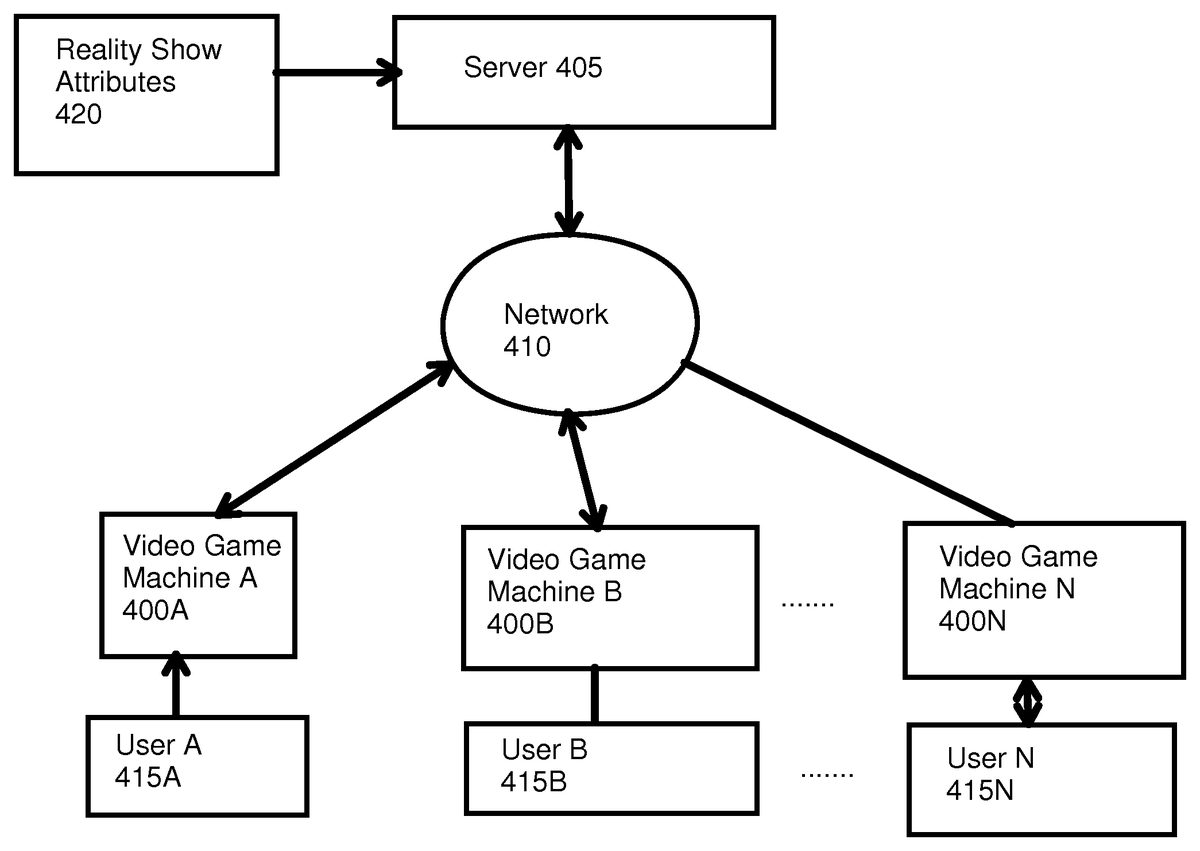
FIG. 2illustrates a system for providing a sports video game that incorporates real-life attributes, virtual identity/virtual world aspects, advertisement, reality TV show features and/or open video game aspects such as feedback or control, supplement, or modify, to the real-life reality TV show based on user input or video game play. The system ofFIG. 4can also enable access to a virtual world and/or advertising to users of video game machines400A-N. Executable instructions that include initial video game parameters can be stored on a storage medium, such as a video game cd, dvd, cartridge, or can be downloaded via a data transmission link to a tangible non-transitory memory device. The instructions provide the game for play by video game machines400-A-N. The video game machines400-A-N can include memory for video game parameter storage. The memory can also store parameters associated with real-life attributes and fantasy settings420for affecting the sports video game. The parameters associated with real-life attributes and fantasy settings420can be downloaded from a server405via a network410, which may include the Internet. The parameters stored on the memory at the video game machines400A-N associated with the real-life attributes and fantasy settings420can be continuously updated and current real-life attributes and fantasy settings420can be updated each time that the video game machines400A-N log onto the server405or according to any other schedule which may be periodic or user defined, for example. The parameters may also be downloaded (e.g. renewed) each time a storage medium containing the sports video game is coupled to the video game machines. Users415A-N then compete using the video game incorporating the settings and attributes over the network.
FIG. 3is a block diagram of an example of a video game machine520. The video game machine520can incorporate a central processing unit (CPU)532and coprocessor (CP)534. The CP534can includes a bus control circuit538for controlling buses, a signal processing unit (SPU)540for performing polygon coordinate transformation, shading treatment, etc., a display processing unit (DPU)545for rastorizing polygon data into an image to be displayed and converting the data into a data from (dot data) stored on a memory. The CP534is coupled to a cartridge connector550for detachably mounting with a ROM cartridge552, a disc drive connector554for detachably mounting with a disc drive556, and a RAM558. Also, the CP534is connected with an audio signal generating circuit561for outputting a sound signal to an audio output device562, processed by the CPU532, and an image signal generating circuit564for outputting an image signal to a display565. Further, the CP534is coupled with a controller control circuit567for serially transferring operational data for one or a plurality of controllers570A-570D and data for a RAM cartridge573for extension.
A modem572is coupled to the bus control circuit538. The modem572is also preferably coupled to the internet (not shown) wirelessly or wired. As discussed with reference toFIG. 4, a server coupled to the internet stores real-life attributes and reality show settings, imagery, and parameters. The modem572couples to the server and downloads a real-life attribute and a reality show setting for affecting a parameter of play in the video game.
According to an embodiment, the CPU511can send a signal through the bus control circuit to initialize the modem572and control the modem572to download the attribute and setting information from the server. The information can be stored in RAM558for affecting a parameter of play of the video game. It will be understood by those of skill in the art that other configurations of video game machines are possible. For example, the CPU532and the CP534, or portions of the CP534, may be incorporated as one component. Also, for example, RAM558, may be divided into more than one memory element, or other types of memory elements may be included. The video game machine can also be represented as currently available computers and game consoles. For example, the game machine520can be represented by a PLAYSTATION, such as a PLAYSTATION II or III, or a future version of the PLAYSTATION units made by SONY CORPORATION. Other embodiments of the game machine include the XBOX and NINTENDO, such as the NINTENDO Wii. For example, a PLAYSTATION III type console includes a Cell Broadband Engine CPU, a RSX GPU, 256 MB XDR Main RAM 256 MB GDDR3 VRAM, a 2.5″ Serial ATA 60 GB IIDD, USB connections, an Ethernet connection, IEEE 802.11b/g WiFi connection, a BLUETOOTH connection, and a wireless BLUETOOTH controller connection supporting up to 7 controllers. Examples of video game machines are further discussed in U.S. Pat. Nos. 6,908,386, 7,019,205, and Publication 2007/0060384, the contents of these two patents and one publication are hereby incorporated by reference herein.
FIGS. 4A-4Eare block diagrams of a video game medium700. The video game medium700can include video game instructions705, video game parameters710, and image data715for the video game. The video game medium can further include video game modification instructions720for enabling a video game machine to update the video game with parameters associated with real-life attributes, reality show settings, modifications to the video game via open video game aspects, to provide access to a virtual world hosted by a server connected to the video game machine, and/or to provide access to advertising media.
Parameters stored on the storage medium700can include video game character performance parameters705for each character of the video game. The video game character performance parameters705can be modified based on the reality show and/or real-life parameters downloaded as shown inFIGS. 1 and 2.
Image data and video game instructions can also be modified as illustrated inFIGS. 4C and 4D. For example, a shown inFIG. 4Cweather imagery for location A715A can be modified, video game character A appearance imagery715B can be modified, and any imagery related to the appearance of Location A715C can also be modified. Video game instructions can also be modified such that the manner in which the video game functions, or the manner in which the video game is played, can be modified as disclosed herein.
FIG. 4Eillustrates an example of the types of video game modification instructions720that may be included in a video game product. For example, the video game modification instructions can include instructions for accessing reality show settings720A, instructions for accessing parameters associated with real-life attributes720B, and instructions for modifying the video game based on the assessed parameters and reality show settings720C. The video game modification instructions can also include instructions for accessing advertising media and the virtual world or any of the other actions disclosed herein.
Embodiments within the scope of embodiments illustrated herein can also include computer-readable media for carrying or having computer-executable instructions or data structures stored thereon. Such computer-readable media can be any available media that can be accessed by a general purpose or special purpose computer. By way of example, and not limitation, such computer-readable media can comprise RAM, ROM, EEPROM, CD-ROM or other optical disk storage, magnetic disk storage or other magnetic storage devices, or any other medium which can be used to carry or store desired program code means in the form of computer-executable instructions or data structures and which can be accessed by a general purpose or special purpose computer. When information is transferred or provided over a network or another communications connection (either hardwired, wireless, or a combination of hardwired or wireless) to a computer, the computer properly views the connection as a computer-readable medium. Thus, any such connection is properly termed a computer-readable medium. Combinations of the above should also be included within the scope of computer-readable media. Computer-executable instructions comprise, for example, instructions and data which cause a general purpose computer, special purpose computer, or special purpose processing device to perform a certain function or group of functions.
Although not required, several embodiments will be described in the general context of instructions, such as program modules, being executed by computer consoles, computers in network environments. Generally, program modules include routines, programs, objects, components, data structures, etc. that perform particular tasks or implement particular abstract data types. Instructions, associated data structures, and program modules represent examples of the program code means for executing steps of the methods disclosed herein. The particular sequence of such executable instructions or associated data structures represents examples of corresponding acts for implementing the functions described in such steps.
The embodiments illustrated herein may be practiced in network gaming and computing environments with many types of system configurations, including video game machines, such as consoles, personal computers, hand-held devices, multi-processor systems, microprocessor-based or programmable consumer electronics, network PCs, minicomputers, mainframe computers, and the like. Several embodiments may also be practiced in distributed gaming and computing environments where tasks are performed by local and remote processing devices that are linked (either by hardwired links, wireless links, or by a combination of hardwired or wireless links) through a communications network. In a distributed computing environment, program modules may be located in both local and remote memory storage devices, for example in reference to a video game machine.
The present invention may be embodied in other specific forms without departing from its spirit or essential characteristics. The described embodiments are to be considered in all respects only as illustrative and not restrictive. The scope of the invention is, therefore, indicated by the appended claims rather than by the foregoing description. All changes which come within the meaning and range of equivalency of the claims are to be embraced within their scope.
Claims
- A non-transitory computer-readable game medium configured to provide a sports video game in conjunction with a video game machine, the sports video game having associated video game data comprising at least video game rules, one or more video game character parameters, and one or more video game stadium or field parameters, the computer-readable game medium having instructions stored thereon, which when executed by one or more processors of the video game machine, cause the video game machine to perform the steps of: loading said video game data stored by the computer-readable game medium into video game machine memory for playing the sports video game, wherein the one or more video game character parameters define respective one or more video game characters, and wherein each of the one or more video game characters are associated with corresponding real-life sports athletes;loading data associated with a reality television show into the video game machine memory, the real-life athletes being participants in the reality television show;and enabling a user to control the one or more video game characters during playing of the sports video game using a video game controller connected to the video game machine;wherein, the reality television show is a martial arts reality television show where the real-life sports athletes live together in a house during a real-life competition, the real-life competition progressing as the reality television show progresses;and wherein, said data is periodically updated over the Internet as the martial arts reality show progresses through the real-life competition, thereby affecting at least one of said one or more character parameters and/or said one or more video game stadium or field parameters.
- A method comprising: loading video game data stored by a computer-readable game medium into video game machine memory of a video game machine for playing a sports video game, the video game data comprising at least video game rules, one or more video game character parameters, and one or more video game stadium or field parameters, wherein the one or more video game character parameters define one or more video game characters that are each associated with corresponding real-life sports athletes;loading data associated with a reality television show into the video game machine memory, the real-life athletes being participants in the reality television show;and enabling a user to control the one or more video game characters during playing of the sports video game using a video game controller connected to the video game machine;wherein, the reality television show is a martial arts reality television show where the real-life sports athletes live together in a house during a real-life competition, the real-life competition progressing as the reality television show progresses;and wherein, said data is periodically updated over the Internet as the martial arts reality show progresses through the real-life competition, thereby affecting at least one of said one or more character parameters and/or said one or more video game stadium or field parameters.
- A method according to claim 2 , wherein the sports video game is a mixed martial arts (MMA) related video game and the martial arts reality television show includes MMA bouts.
- A method according to claim 2 , wherein the sports video game includes a corresponding house feature.
- A method according to claim 4 , wherein the house feature includes a navigable virtual environment provided for a user to control one of the one or more video game characters and navigate the virtual environment.
- A method according to claim 5 , wherein the user uses said one of the one or more video game characters to interact with additional video game characters controlled by other users in the navigable virtual environment.
- A method according to claim 2 , wherein the video game machine includes a video game console.
- A method according to claim 2 , further comprising downloading over the internet and updating imagery of the sports video game related to an appearance of a video game character.
- A method according to claim 2 , further comprising downloading over the internet and updating in-game advertising.
- A method according to claim 9 , wherein the in-game advertising includes in-game advertising updated on virtual clothing.
- A method according to claim 2 , wherein the reality television show does not including professional actors.
- A video game machine comprising: one or more processors;video game machine memory;a video game controller;and a computer-readable game medium configured to provide a sports video game in conjunction with a video game machine, the sports video game having associated video game data comprising at least video game rules and one or more video game character parameters, the computer-readable game medium having instructions stored thereon, which when executed by said one or more processors, causes the video game machine to perform the steps of: loading said video game data stored by the computer-readable game medium into video game machine memory for playing the sports video game, wherein the one or more video game character parameters define respective one or more video game characters, and wherein each of the one or more video game characters are associated with corresponding real-life reality television show participants;loading data associated with a reality television show into the video game machine memory, the real-life reality show participants being participants in the reality television show;and enabling a user to control the one or more video game characters during playing of the sports video game using the video game controller;wherein, the reality television show is a martial arts reality television show where the real-life reality television show participants live together in a house during a real-life competition, the real-life competition progressing as the reality television show progresses;and wherein, said data is periodically updated over the Internet as the martial arts reality show progresses through the real-life competition, thereby affecting at least the one or more character parameters.
- A video game machine according to claim 12 , wherein the reality television show is in a genre of television programming that presents purportedly unscripted dramatic or humorous situations, documents actual events, and does not include professional actors.
- A method according to claim 12 , wherein the video game machine includes a video game console.
Disclaimer: Data collected from the USPTO and may be malformed, incomplete, and/or otherwise inaccurate.