U.S. Pat. No. 8,337,310
MARGIN-BASED ONLINE GAME
Issue DateDecember 20, 2006
Illustrative Figure
Abstract
The invention utilizes the predicted margin of victory in an event as a metric on which to base an online game in which users attempt to predict the outcome of an upcoming event or set of events. The game also utilizes the aggregate of all the margins set by users participating in the game as a measure of how users participating in the game, as a whole, are predicting the outcome of a pending event. This is achieved by means of a method for enabling users to identify upcoming events within the context of the game and enter values to record their predicted winners and margins for one or more of these upcoming events.
Description
DETAILED DESCRIPTION The principal and secondary objects of the invention are to utilize the margin of victory as a metric on which to base a game in which users attempt to predict the outcome of an upcoming event or set of events, and to utilize the aggregate of the margins set by users participating in the game as a measure of how users participating in the game, as a whole, are predicting the outcome of the pending event. FIG. 1is a flow chart outlining the stages involved in a method100consistent with an embodiment of the present invention. Method100begins at stage105in which the competitive event information (e.g. type of event, teams or players competing in the event, time of event, descriptive text about the event, and organizational structure of multiple events into weeks or seasons) is entered. This event information may be used to generate a home page at stage110, which is also further discussed with regard toFIG. 2, and individual matchup pages at stage115, which is also further discussed with regard toFIG. 3. The method proceeds to stage120, wherein users may interact with the home page or matchup pages to enter their predicted winner and margin for one or more of the events displayed on the home page or matchup pages. Once entered by a user, this information is stored via stage125, where the user may see and access this value and edit it if so desired. The method proceeds to stage130, wherein the aggregate margins of all users who have chosen to set a value for an event are calculated. In accordance with one embodiment, this calculation may be taken as an average of all margins entered for a specific event, with margins set for opposing teams considered offsetting. For example: if two users enter identical margin values for ...
DETAILED DESCRIPTION
The principal and secondary objects of the invention are to utilize the margin of victory as a metric on which to base a game in which users attempt to predict the outcome of an upcoming event or set of events, and to utilize the aggregate of the margins set by users participating in the game as a measure of how users participating in the game, as a whole, are predicting the outcome of the pending event.
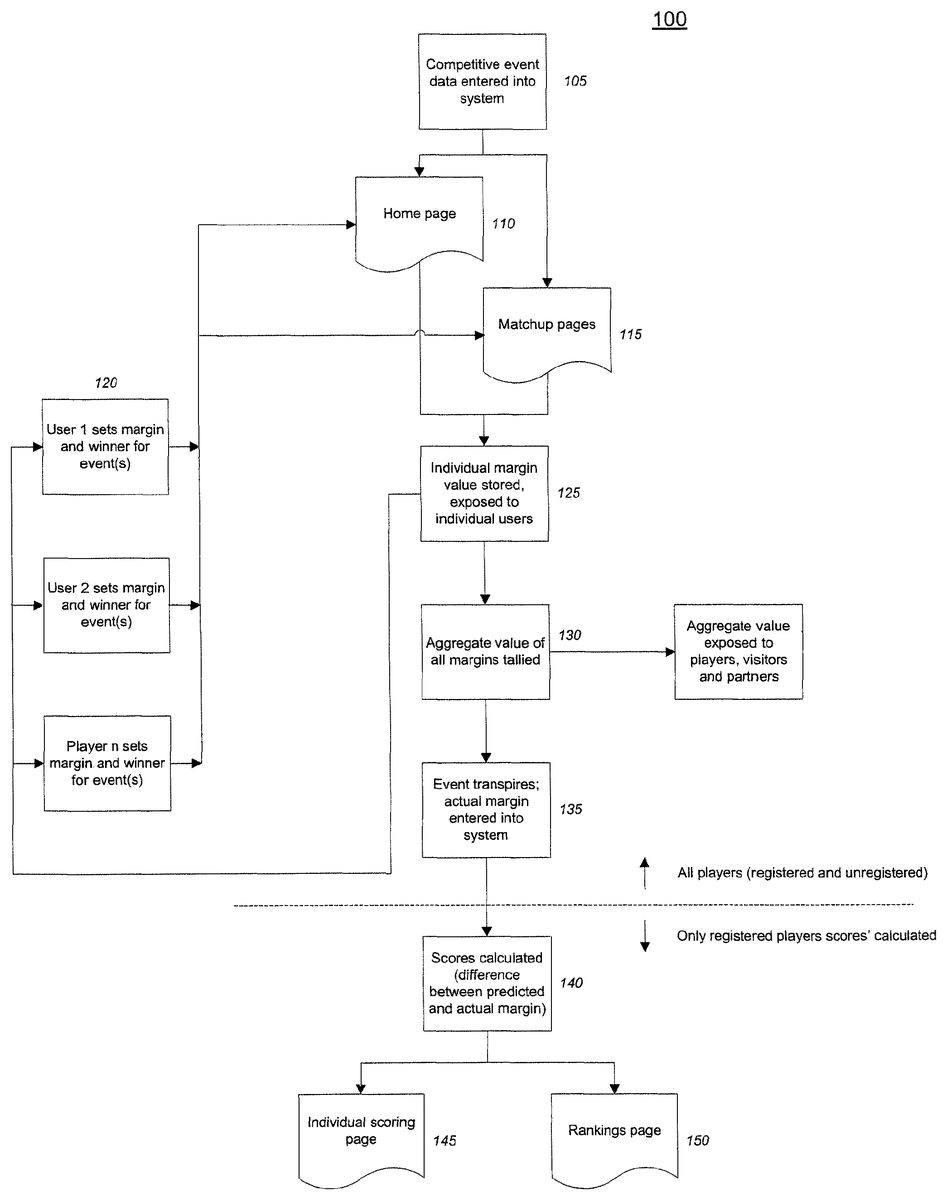
FIG. 1is a flow chart outlining the stages involved in a method100consistent with an embodiment of the present invention. Method100begins at stage105in which the competitive event information (e.g. type of event, teams or players competing in the event, time of event, descriptive text about the event, and organizational structure of multiple events into weeks or seasons) is entered. This event information may be used to generate a home page at stage110, which is also further discussed with regard toFIG. 2, and individual matchup pages at stage115, which is also further discussed with regard toFIG. 3.
The method proceeds to stage120, wherein users may interact with the home page or matchup pages to enter their predicted winner and margin for one or more of the events displayed on the home page or matchup pages. Once entered by a user, this information is stored via stage125, where the user may see and access this value and edit it if so desired.
The method proceeds to stage130, wherein the aggregate margins of all users who have chosen to set a value for an event are calculated. In accordance with one embodiment, this calculation may be taken as an average of all margins entered for a specific event, with margins set for opposing teams considered offsetting. For example: if two users enter identical margin values for a matchup, but pick opposing teams, i.e. User A sets the margin as “Team A wins by 3 points” and User B sets the margin for the same event as “Team B wins by 3 points,” the average margin calculated and displayed would be “0” or “Tie.” If User A sets the margin as “Team A wins by 3 points” and User B sets the margin for the same event as “Team B wins by 1 point,” the average margin calculated and displayed would be “Team. A by 1 point.” If User A sets the margin as “Team A wins by 3 points” and User B sets the margin for the same event as “Team A wins by 6 points,” the average margin calculated and displayed would be “Team A by 4.5 points.”
The method proceeds to stage135, wherein the actual result of the event is entered, and this value is used to calculate the users' scores. In accordance with one embodiment, the score may be determined by calculating the difference between the winner and margin set by the user and the winner and margin of the actual event, treating margins for opposing teams as opposing values. For example: if User A sets the margin for an event as “Team A wins by 3 points” and Team A wins by 6 points, the user User A would be assigned a score of 3. If User A sets the margin as “Team A wins by 3 points” and Team B wins by 3 points, the user User A would be assigned a score of 6. If User A sets the margin as “Team A wins by 3” points and Team A wins by 3 points, the user User A would be assigned a score of 0. To determine the user's total score for a set of events across a week or a season of events, the user's scores may be added together. In embodiments where users compete with each other, a lower score would be considered the winning score. A user must be registered to have his or her scores calculated, stored and displayed.
The method proceeds to stage140, wherein registered users' scores may be tallied and listed on an individual scoring page at stage145, which is also further discussed inFIG. 4. Users' scores are compared and ranked in a rankings page at stage150, which is also further discussed inFIG. 5.
FIG. 2illustrates an exemplary home page interface200according to one embodiment. The home page may provide users with a view of the current week205of the featured season of events. Utilizing this interface, the user may select the winner210and margin215of each featured event, and then submit the selected winner and margin of each featured event using a submit link or button220.
By aggregating the input of all users who have chosen to enter a winner and margin for a specific event, an “average margin” or “average line” for the event225may be calculated and displayed. In accordance with one embodiment, this calculation may be taken as an average of all margins entered for a specific event, with margins set for opposing teams considered offsetting. For example: if two users enter identical margin values for a matchup, but pick opposing teams, i.e. User A sets the margin as “Team A wins by 3 points” and User B sets the margin for the same event as “Team B wins by 3 points,” the average margin calculated and displayed would be “0” or “Tie.” If User A sets the margin as “Team A wins by 3 points” and User B sets the margin for the same event as “Team B wins by 1 point,” the average margin calculated and displayed would be “Team A by 1 point.” If User A sets the margin as “Team A wins by 3 points” and User B sets the margin for the same event as “Team A wins by 6 points,” the average margin calculated and displayed would be “Team A by 4.5 points.”
The home page may also provide a rankings “snapshot”230of the top, for example, five currently ranked players. Additional elements on the rankings page may include a means to navigate between different sets of competitive events235, a means for registered users to login and unregistered users to begin the registration process240, the most recent, for example, five posts from the Web site's forums245, links to specific forums250, and a list of users who were winners from previous weeks or seasons255.
FIG. 3illustrates an exemplary matchup page interface300according to one embodiment of the present invention. The matchup page is focused on a single, specific event and may provide users with an interface to set the winner305and margin310for the event and then submit the chosen winner and margin using a submit link or button315. By aggregating the input of all users who have chosen to enter a winner and margin for a specific event, an “average margin” or “average line” for the competitive event320may be calculated and displayed. In accordance with one embodiment, this calculation may be taken as an average of all margins entered for a specific event, with margins set for opposing teams considered offsetting. For example: if two users enter identical margin values for a matchup, but pick opposing teams, i.e. User A sets the margin as “Team A wins by 3 points” and User B sets the margin for the same event as “Team B wins by 3 points,” the average margin calculated and displayed would be “0” or “Tie.” If User A sets the margin as “Team A wins by 3 points” and User B sets the margin for the same event as “Team B wins by 1 point,” the average margin calculated and displayed would be “Team A by 1 point.” If User A sets the margin as “Team A wins by 3 points” and User B sets the margin for the same event as “Team A wins by 6 points,” the average margin calculated and displayed would be “Team A by 4.5 points.”
The matchup page also provides users with detailed game commentary325and a view into relevant discussion forums330that may be organized by event, team, week or season. Additional elements on the rankings page may include a means to navigate between different sets of events335, a means for registered users to login and unregistered users to begin the registration process340, the most recent, for example, five posts from the Web site's forums345, links to specific forums350, and a list of users who were winners from previous weeks or seasons355.
FIG. 4illustrates an exemplary scoring page interface400according to one embodiment of the present invention. Scoring pages may show an individuals user's score in a game for the current week of the game, listing for each event tracked, the predicted winner and margin405, the actual winner and margin410and the calculated score based on the difference between the predicted margin and the actual margin415. In accordance with one embodiment, the score is calculated by calculating the difference between the predicted margin set by the user and the margin of the actual event once it has transpired, treating margins that predict opposing winning teams as opposing values. For example: if User A sets the margin for an event as “Team A wins by 3 points” and Team A wins by 6 points, the user would be assigned a score of 3. If User A sets the margin as “Team A wins by 3 points” and Team B wins by 3 points, the user would be assigned a score of 6. If User A sets the margin as “Team A wins by 3 points” and Team A wins by 3 points, the user would be assigned a score of 0. To determine the user's total score for a set of events across a week or a season of events, the user's scores may be added together. In embodiments where users compete with each other, a lower score would be considered the winning score. A user must be registered to have his or her scores calculated, stored and displayed. The scoring page may also display the user's total score for the week420and average score per game for that week425. Also displayed is the user's rank in the current grouping or “season” of competitive events430and an average score per game for those events435. This page also includes a link to a page featuring profile information440about the user, for example, “Hans,” and a means to navigate to scores for other weeks in the current grouping or season445.
Additional features on the individual scoring page may include a means to navigate between different sets of competitive events450, the most recent, for example, five posts from the Web site's forums460, links to specific forums465, and a list of users who were winners from previous weeks or seasons470.
FIG. 5illustrates an exemplary rankings page interface500according to one embodiment of the present invention. The rankings page may provide users with a view including all registered users' scores calculated505and ranked510. These rankings may be filtered by such criteria as specific week in the season or rankings for the overall grouping or “season”515of events being featured and scored against. These rankings may also be filtered to show the rankings of all users520, only those users525whose rankings are calculated to be closest to those of the registered user viewing the list, or only a specific set of users530that the registered user viewing the list enters. Only users who have registered can have their scores calculated, ranked, and stored in this manner. Additional features on the rankings page may include a means navigate between different sets of competitive events535, the most recent, for example, five posts from the Web site's forums545, links to specific forums550, and a list of users who were winners from previous weeks or seasons555.
FIG. 6illustrates an exemplary registration page interface600according to one embodiment of the present invention. The registration system utilizes and extends current registration and profile online systems. To register, users may enter basic information605and then e-mail validation610may be used to verify their accounts. By registering, the system is able to recognize the user, and store, track and display the user's score and ranking in such contexts as the scoring page and ranking page discussed inFIGS. 4 and 5. Additionally, registered users may enter profile information (city of residence, favorite teams, etc.) that other users may view. For unregistered users, a cookie may be set, for example, so that their entered values for individual competitive events can be persisted, but unregistered users will not have their scores calculated. Additional features on the registration page may include a means to navigate between different sets of competitive events615, a means for registered users to login and unregistered users to begin the registration process620, the most recent, for example, five posts from the Web site's forums625, links to specific forums630, and a list of users who were winners from previous weeks or seasons635.
FIG. 7illustrates an exemplary administration page interface700according to one embodiment of the present invention. The administrative interface allows the game's publishers to establish the parameters of the events being used as the basis for the game: the teams705, the time of the event710, the commentary715, and the organizational structure of multiple events (such as how they might be grouped into weeks720, and weeks grouped into seasons725). The administrative interface may also allow the game administrators to enter the results of the actual events730and calculate the scores and rankings of players playing the game735. The administrative interface may also allow the game administrators to navigate to any set of games740in a particular grouping or “season”. Events may be organized into groups or “seasons” and events within those groups may be further subcategorized into subgroups or “weeks.” Multiple seasons (such as an NFL season, an NBA season and an “election winners” season) may appear on the site concurrently.
Additional features on the administration page may include a means to navigate between different sets of competitive events745, the most recent, for example, five posts from the Web site's forums755, links to specific forums760, and a list of users who were winners from previous weeks or seasons765.
Claims
- A computer-executed method for aggregating predictions from a plurality of users and for a plurality of upcoming sporting events, the computer-executed method comprising: displaying identifiers for a plurality of sporting events that are upcoming;registering a number of registered users from a plurality of users;receiving from any of the plurality of users a predicted margin of victory for each sporting event;for each sporting event, aggregating the received predicted margins of victory to generate an average predicted margin of victory for the sporting event and displaying the average predicted margin of victory on a web page;after each of the plurality of sporting events occurs, recording an actual margin of victory for the sporting event;for each registered user, for each sporting event for which the registered user provided a predicted margin of victory, calculating a score using the actual margin of victory and the predicted margin of victory received from the registered user and displaying the calculated score on an individual scoring web page;and for at least some of the registered users, displaying a user score and an identifier for the registered user on a rankings web page.
- The computer-executed method of claim 1 , further comprising: for each sporting event, generating a match up web page displaying information pertaining to the sporting event.
- The computer-executed method of claim 1 , wherein aggregating the received predicted margins of victory comprises calculating an average of the received predicted margins of victory.
- The computer-executed method of claim 1 , further comprising for each registered user, displaying on the individual scoring web page a list of the sporting events, the registered user's predicted margin of victory and the actual margin of victory for each of the sporting events, and the difference between the user's predicted margin of victory and the actual margin of victory.
- A computer-readable medium having instructions stored thereon that direct a computing system to aggregate predictions from a plurality of users and for a plurality of sporting events, the instructions: display identifiers for a plurality of sporting events that are upcoming;register a number of registered users from a plurality of users;receive from any of the plurality of users a predicted margin of victory for each sporting event;for each sporting event, aggregate the received predicted margins of victory to generate an average predicted margin of victory for the sporting event and display the average predicted margin of victory on a first electronic document;after each of the plurality of sporting events occurs, record an actual margin of victory for the sporting event;for each registered user, for each sporting event for which the registered user provided a predicted margin of victory, calculate a score using the actual margin of victory and the predicted margin of victory received from the registered user and display the calculated score on a second electronic document;and for at least some of the registered users, display a user score and an identifier for the registered user on a third electronic document.
- A computing system for aggregating predictions from a plurality of users and for a plurality of upcoming sporting events, the computing system comprising: a component adapted to display identifiers for a plurality of sporting events that are upcoming, and to register a number of registered users from a plurality of user;a component adapted to receive and store from any of the plurality of users a predicted margin of victory for each sporting event;a component adapted to, for each sporting event, aggregate the received predicted margins of victory to generate an average predicted margin of victory for the sporting event and to display the average predicted margin of victory on a first Internet document;a component adapted to record an actual margin of victory for each of the plurality of sporting events;for each registered user, for each sporting event for which the registered user provided a predicted margin of victory, a component adapted to calculate a score using the actual margin of victory and the predicted margin of victory received from the registered user, and to display the calculated score on a second Internet document;and for at least some of the registered users, a component adapted to display a user score and an identifier for the registered user on a third Internet document.
Disclaimer: Data collected from the USPTO and may be malformed, incomplete, and/or otherwise inaccurate.