U.S. Pat. No. 8,332,499
VIRTUAL SPACE MANAGEMENT SYSTEM
AssigneeSony Interactive Entertainment Inc; Sony Network Entertainment Platform Inc
Issue DateDecember 1, 2009
Illustrative Figure
Abstract
A virtual space management system includes: a plurality of space management servers for respectively managing a plurality of partial spaces obtained by dividing a virtual space; and a communication control server for relaying communication between at least one of the plurality of space management servers and a user terminal. Each space management server executes a process relating to a transition in which a position in the virtual space associated with the user terminal transitions from inside a partial space managed by another space management server to inside a partial space managed by the local space management server. The communication control server maintains communication connection with the user terminal during execution of the process relating to the transition, and changes a transmission destination of data received from the user terminal to the local space management server managing the partial space to which the transition has been made according to the transition.
Description
DETAILED DESCRIPTION OF THE INVENTION An embodiment of the present invention is described in detail below with reference to the accompanying drawings. A virtual space management system1according to this embodiment manages one virtual space or a plurality of virtual spaces. The virtual space is a space where, for example, a multi-participant type on-line game is realized, and may be a two-dimensional or three-dimensional space. Each user of the virtual space management system operates their own user terminal to access the virtual space management system according to this embodiment over a communication network such as the Internet, and participate in one virtual space. Specifically, when a user participates in a virtual space, a position associated with the user terminal used by the user (hereinafter referred to as “user position”) is set in the virtual space. For example, the user position may be the position where an object corresponding to the user (user object) is arranged, or the position of a view point set in the virtual space for displaying an image indicating a state in the virtual space on the user terminal. The virtual space management system according to this embodiment moves the user position in the virtual space according to the user's instructional operation on the user terminal and presents a user with sounds or an image indicating a state in the virtual space by transmitting information on various events which occur in the virtual space to the user terminal. This allows the user to play a game which is realized in the virtual space, or experience various events which occur in the virtual space. FIG. 1is an outline diagram illustrating a general outline of the virtual space management system1according to this embodiment. As illustrated in the diagram, the virtual space management system1includes a system log-in management server2, a space ...
DETAILED DESCRIPTION OF THE INVENTION
An embodiment of the present invention is described in detail below with reference to the accompanying drawings.
A virtual space management system1according to this embodiment manages one virtual space or a plurality of virtual spaces. The virtual space is a space where, for example, a multi-participant type on-line game is realized, and may be a two-dimensional or three-dimensional space. Each user of the virtual space management system operates their own user terminal to access the virtual space management system according to this embodiment over a communication network such as the Internet, and participate in one virtual space. Specifically, when a user participates in a virtual space, a position associated with the user terminal used by the user (hereinafter referred to as “user position”) is set in the virtual space. For example, the user position may be the position where an object corresponding to the user (user object) is arranged, or the position of a view point set in the virtual space for displaying an image indicating a state in the virtual space on the user terminal. The virtual space management system according to this embodiment moves the user position in the virtual space according to the user's instructional operation on the user terminal and presents a user with sounds or an image indicating a state in the virtual space by transmitting information on various events which occur in the virtual space to the user terminal. This allows the user to play a game which is realized in the virtual space, or experience various events which occur in the virtual space.
FIG. 1is an outline diagram illustrating a general outline of the virtual space management system1according to this embodiment. As illustrated in the diagram, the virtual space management system1includes a system log-in management server2, a space log-in management server3, a plurality of communication control servers4, and a plurality of space management servers5. Those servers each include an information processing apparatus like a server computer, and are connected to one another over a communication network. A plurality of user terminals6which are used by respective users of the virtual space management system1are connected to the virtual space management system1over a communication network such as the Internet. The user terminal6is an information processing apparatus, such as a consumer game machine or a personal computer. It is assumed in this embodiment that the communication control servers4are connected to the space management servers5over a communication network, such as a LAN in a center, having a larger communication band than the communication band of the communication network which connects the user terminals6to the communication control servers4.
The system log-in management server2performs the general log-in management of the virtual space management system1. When a user starts using the virtual space management system1, the user first operates the user terminal6to access the system log-in management server2for user authentication by the system log-in management server2.
The space log-in management server3is provided for each virtual space which is managed by the virtual space management system1, and manages the participation (log-in) of the user in the corresponding virtual space. InFIG. 1, there is one virtual space to be managed by the virtual space management system1, and there is one space log-in management server3. However, the virtual space management system1may be configured to be able to manage a plurality of virtual spaces. In this case, a single space log-in management server3, one or a plurality of communication control servers4, and one or a plurality of space management servers5are provided for each virtual space.
The user who is authenticated by the system log-in management server2selects a virtual space in which the user is to participate from one or a plurality of virtual spaces which are managed by the virtual space management system1. According to the selection, the user terminal6used by the user transmits a request to participate in the virtual space to the space log-in management server3corresponding to the selected virtual space. The space log-in management server3authenticates the user who has made the participation request, determines whether or not to permit the participation, and notifies the user terminal6of the determination result.
The communication control server4is associated with any one of the virtual spaces which are managed by the virtual space management system1, and controls communication with the user terminals6used by users who are participating in the associated virtual space. Specifically, the communication control server4establishes communication connection with a user terminal6participating in the corresponding virtual space, and relays communication between the user terminal6and the space management server5that manages the virtual space in which the user terminal6participates. A plurality of user terminals6which participate in the same virtual space can communicate and connect with the communication control server4. The communication control server4is communicably connected to one space management server5or each of a plurality of space management servers5which manage the corresponding virtual space.
In the case of permitting a participation request from a user terminal6, the above-mentioned space log-in management server3notifies the user terminal6of information specifying one of the communication control servers4corresponding to the participation-requested virtual space. When there are a plurality of communication control servers4corresponding to the virtual space, the space log-in management server3manages the number of user terminals6assigned to each communication control server4, and notifies the user terminal6which has newly made a participation request of information specifying a communication control server4having fewer user terminals6currently assigned thereto (i.e., communication control server4having a lighter processing load than the other communication control servers4).
In response to the notification, the user terminal6issues a connection request to the communication control server4which is specified by the notified information to establish communication connection with the communication control server4. That is, both of the user terminal6and the communication control server4specify each other as the communication party or destination, and execute an initialization process (session initiation process) to always maintain the data transmittable/receivable state therebetween. After the communication connection is established, the communication connection between the user terminal6and the communication control server4is maintained while the user terminal6is participating in the virtual space, and hence the user terminal6performs communication with the space management server5which manages the virtual space in which the user terminal6is participating, via the communication control server4.
The space management server5is associated with any one of the virtual spaces managed by the virtual space management system1, and manages the associated virtual space. When there are a plurality of space management servers5corresponding to one virtual space, each space management server5manages any associated one of a plurality of partial spaces obtained by dividing one virtual space. Specifically, according to this embodiment, one virtual space to be managed by the virtual space management system1is divided into a plurality of partial spaces, to each of which the space management server5that manages objects arranged in the associated partial space and events which occur therein is assigned. The space management server5manages the behavior of each object in the associated partial space, and executes processes relating to various events which occur in that partial space (various events which occur in the virtual space as a result of interactions between objects or instructions or the like from participating users).
FIG. 2is a conceptual diagram of a virtual space V which is managed by the virtual space management system1. In the illustrated example, the virtual space V is divided into four partial spaces Vpa, Vpb, Vpc and Vpd, and each of user objects corresponding to the respective users participating in the virtual space V is located in any one of the four partial spaces Vp. The space management servers5which respectively manage the partial spaces Vpa, Vpb, Vpc and Vpd are denoted as space management servers5a,5b,5cand5dhereinafter. Users who are participating in the virtual space V are denoted by users Ua, Ub, Uc, Ud and Ue, and the user terminals6which are used by those users U are denoted by user terminals6a,6b,6c,6dand6e. Further, user objects respectively corresponding to the users are denoted by user objects Oa, Ob, Oc, Od and Oe. In this embodiment, the locations of those user objects O in the virtual space V correspond to user positions associated with the respective user terminals6. The user terminals6a,6band6care communicably connected to a communication control server4awhile the user terminals6dand6eare communicably connected to a communication control server4b.
The following describes a specific example of the functions which are realized by the virtual space management system1according to this embodiment while a user U is participating in the virtual space V.
To begin with, a general outline of the process that is executed by the virtual space management system1will be described. When the user U operates the user terminal6to give an instruction while participating in the virtual space V, the user terminal6transmits information according to the contents of the instruction operation (hereinafter referred to as “user message”) to the communication control server4communicably connected. For example, a user message may be information instructing the current coordinate values, the moving direction, the moving speed or the like of the user object O, or may be information instructing the user object O to make various motions. Each communication control server4transmits a user message, transmitted from the user terminal6, to the space management server5which manages the partial space Vp to which the user object O corresponding to the user terminal6belongs. The space management server5outputs event information to be notified to each associated user terminal6based on the user message transmitted from the user terminal6associated with each user object O present in the partial space Vp which is managed by the local space management server5, information acquired by calculating the behavior of each object located in the partial space Vp managed by the local space management server5, or the like. The event information output from the space management server5is transmitted to each user terminal6via the associated communication control server4. The user terminal6which has received the event information updates an image to be displayed on the monitor, or reproduces sounds from a loudspeaker according to the contents of the event information. When such processing is executed continuously, each user U can manipulate a user object O in the virtual space V and experience various events which occur in the virtual space V.
FIG. 3is a functional block diagram specifically exemplifying functions which are achieved by the virtual space management system1according to this embodiment. As illustrated in the diagram, the space management server5functionally includes an application execution unit11, an event information management unit12, a user transition control unit13and a communication processing unit14. The communication control server4functionally includes a connection destination management unit21, a data relay processing unit22and a communication status management unit23. The user terminal6functionally includes a user message transmission unit31and a space information presentation unit32. All of the functions are achieved when the control unit (program control device such as a microprocessor) equipped in each of the space management server5, the communication control server4and the user terminal6executes a program stored in a storage unit (e.g., a memory device such as RAM). Those programs may be supplied to the individual apparatuses over a communication network such as the Internet, or may be supplied as programs stored on various kinds of computer readable information storage media such as an optical disc.
The application execution unit11of the space management server5is realized when the control unit executes a game application program or the like which realizes the virtual space V. The contents of the process which is executed by the application execution unit11define what kind of object is located in the partial space Vp managed by the space management server5and what event occurs in the partial space Vp.
Specifically, the application execution unit11receives a user message sent from each user terminal6by the user message transmission unit31to be described later. Then, the application execution unit11determines a change in status of each object located in the partial space Vp (position and direction, moving speed and moving direction of each object in the partial space, and other parameters) based on the received user message, the various predetermined event conditions and so on. As the status of each object changes per unit time, each object demonstrates various behaviors in the partial space Vp with time. Objects to be targets whose status changes are to be determined may include not only a user object O but also other character objects or the like. At the time of determining a change in status of each object, predetermined decision conditions may be used, or the result of executing a physical simulation or the like may be used.
Further, the application execution unit11outputs event information indicating the above-mentioned change in status of each object and various events which occur in the partial space Vp to the event information management unit12. The event information is various kinds of information about the partial space Vp which are to be transmitted to the user terminal6by the space management server5. The application execution unit11may designate a specific user terminal6, or the location of occurrence of the event information (position of an object whose status has changed, or the like) and a predetermined range including its periphery (hereinafter referred to as “peripheral range”) as the notification destination of the event information.
The event information management unit12of the space management server5manages event information output from the application execution unit11. According to this embodiment, the event information management unit12functionally includes an event information storing unit12a, an event information output unit12band a buffer information change unit12c, as illustrated inFIG. 4.
The event information storing unit12astores a plurality of items of event information output from the application execution unit11in a predetermined buffer area (hereinafter referred to as “temporary buffer”) in the storage unit in a manner that specifies the transmission order of the individual event information items. The transmission order of the individual items of event information is defined by the application execution unit11. As a specific example, event information may be stored in the temporary buffer in order of transmission from the application execution unit11, and the transmission order of the individual event information items may be specified in the order in which they are stored. Alternatively, the application execution unit11may output the event information with information specifying the transmission order in such a way that the transmission order of the event information differs from the order of outputting the event information to the event information storing unit12a. A specific example of this case will be described later. The temporary buffer is secured for each user terminal6which is the transmission destination of event information, and the event information management unit12stores each item of event information in the temporary buffer associated with the transmission destination user terminal6.FIG. 5illustrates an example of such a temporary buffer, and represents each item of event information, stored in the temporary buffer of each user terminal6, with a circle.
When the application execution unit11designates the peripheral range of an event-occurred location as the notification destination of event information, the event information management unit12specifies the notification destination of the event information as follows. That is, the partial space Vp which is managed by each space management server5is further divided into predetermined unit regions (hereinafter referred to as “grids”), and the event information management unit12manages to which grid each user object O present in the partial space Vp belongs. When receiving event information to be transmitted to the peripheral range, the event information management unit12determines whether or not the user object O is present inside a grid to which the location of occurrence of the event information belongs and adjoining grids around the grid. If the user object O is present in such a grid, the user terminal6associated with the user object O is determined as the transmission destination of the event information.
FIG. 6is an explanatory diagram illustrating a peripheral range to which event information is to be transmitted. In the illustrated example, broken lines represent the boundaries of individual grids, and the partial space Vpa is divided into a total of twenty-five grids in a 5×5 matrix. Suppose that the application execution unit11generates event information indicating a change in status of the user object Oa, designating the peripheral range as the notification destination. At this time, the peripheral range to be the notification destination of the event information contains a total of nine grids in a 3×3 matrix which are indicated by hatches in the diagram. In addition to the user object Oa, the user object Ob and the user object Oc are present in the peripheral range. Therefore, the event information management unit12determines the user terminals6a,6band6cas the notification destinations of the event information, and stores the event information in the temporary buffers associated with the respective user terminals6. The user object Od is not included in the peripheral range, and hence it is not the notification destination of event information. When the event information management unit12specifies the user object O which belongs to the peripheral range as the notification destination of event information, the application execution unit11can notify only those user terminals6which are likely to be affected by the event information of event information by merely instructing notification of event information to the peripheral range and without individually designating each notification destination of the event information.
When the location of occurrence of event information is a grid positioned at an end of the partial space Vp, the peripheral range of the grid includes a grid belonging to another adjoining partial space Vp. In such a case, the event information management unit12notifies the space management server5which manages another adjoining partial space Vp of event information. The event information management unit12of another space management server5which has received the event information determines whether or not the user object O is present in a grid adjoining the location of occurrence of the notified event information. When the user object O is present there, the event information management unit12stores the notified event information in the temporary buffer of the user terminal6associated with the user object O.
The event information output unit12breads out a plurality of event information items, stored in the temporary buffer by the event information storing unit12a, in the specified transmission order, and writes the event information in a predetermined transmission queue. The event information written in the transmission queue is deleted from the temporary buffer. The transmission queue, unlike the temporary buffer, is secured in the storage unit for each communication control server4which is the actual transmission destination of event information. Therefore, the event information output unit12bspecifies which communication control server4is connected to each user terminal6by referring to a table indicating the correlation between the user terminals6and the communication control servers4and stored in the storage unit. Then, the event information output unit12bstores event information associated with each user terminal6in the transmission queue associated with the communication control server4connected to the user terminal6.FIG. 7illustrates an example of such a transmission queue, and represents each item of event information, stored in the transmission queue, with a circle as inFIG. 5.
The buffer information change unit12cchanges information stored in the temporary buffer in response to a request from the application execution unit11. This allows event information prior to storage thereof in the transmission queue to be deleted or updated as needed, or allows the transmission order of individual event information items to be reviewed.
The user transition control unit13of the space management server5executes a process relating to a transition in which the position of the user object O in the virtual space V transitions from inside one partial space Vp to inside another partial space Vp. Specifically, when the user object O is moved from the partial space Vp which is managed by the local space management server5to the partial space Vp which is managed by another space management server5in response to a user's instruction or the like, the user transition control unit13executes a process of transferring information on the user object O to the other space management server5. When the user object O enters the partial space Vp which is managed by the local space management server5from the partial space Vp which is managed by another space management server5, the user transition control unit13executes a user object receiving process for receiving information on the newly entered user object O from the other space management server5.
The communication processing unit14of the space management server5executes transmission and reception of data to and from the communication control server4. Specifically, the communication processing unit14outputs a user message, transmitted from each communication control server4, to the application execution unit11. The communication processing unit14manages the transmission queue, and sequentially transmits event information, written in the transmission queue by the event information output unit12b, to the communication control server4. The transmission queue is a memory area for storing data which has already been in a communication queue state, and hence data is stored in the first-in-first-out (FIFO) mode. The communication processing unit14does not update data stored in the transmission queue or change the order of the data.
The connection destination management unit21of the communication control server4manages to which partial space Vp managed by which space management server5the user object O associated with each user terminal6communicably connected to the local communication control server4belongs. Specifically, the connection destination management unit21generates a connection destination management table associating each user terminal6connected to the local communication control server4with the space management servers (connection destination space management server5) which manages the partial space Vp to which the user object O associated with this user terminal6belongs, and updates information in the table according to the notification from the user transition control unit13.
The data relay processing unit22of the communication control server4relays transmission and reception of data between the user terminal6and the space management server5which manages the partial space Vp to which the user object O associated with this user terminal6belongs. Specifically, when receiving a user message from the user terminal6communicably connected to the local communication control server4, the data relay processing unit22specifies the space management server5corresponding to this user terminal6by referring to information managed by the connection destination management unit21, and stores the received user message in that of server-oriented transmission queues prepared for the respective space management servers5, which corresponds to the specified space management server5. Then, the data relay processing unit22sequentially transmits user messages, stored in the server-oriented transmission queues, to the communication processing unit14of the corresponding space management server5.
When receiving event information specifying the notification destination user terminal6from the communication processing unit14of each space management server5, the data relay processing unit22stores the received event information in user-terminal-oriented transmission queues prepared for the respective user terminals6at the transmission destination. Then, the data relay processing unit22sequentially transmits the event information, stored in the user-terminal-oriented transmission queues, to the space information presentation unit32of the corresponding user terminal6.
The communication status management unit23of the communication control server4monitors the statuses of transmission and reception of data to and from each user terminal6by the data relay processing unit22, and notifies the event information management unit12of the space management server5of acquired information. The notified information on the statuses of transmission and reception of data is used at the time when the event information output unit12bin the event information management unit12carries out the process of outputting event information.
The user message transmission unit31of the user terminal6accepts an instruction operation of an operation device or the like of the user terminal6, which is performed by the user, and outputs information relating to the instruction operation to the data relay processing unit22of the communication control server4as a user message. The space information presentation unit32of the user terminal6receives event information transmitted from the data relay processing unit22of the communication control server4, and updates an image representing the state in the virtual space V or reproduces sounds from the loudspeaker according to the received event information.
Next, some specific examples of the processes to be executed by the above-mentioned individual units will be described.
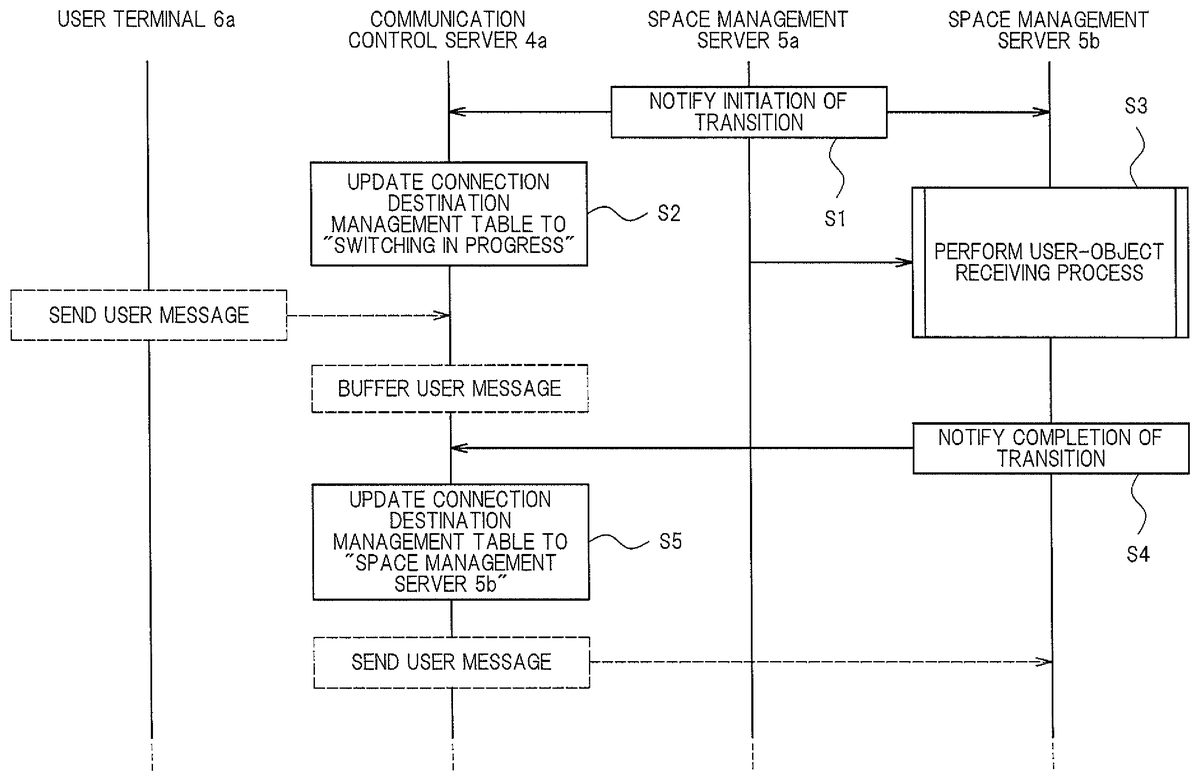
First, a description will be given of processing when the position of the user object O transitions from one partial space Vp to another partial space Vp, referring to a flow chart ofFIG. 8. The following describes, as an example, a case where the user object Oa present in the partial space Vpa is moved into the partial space Vpb in response to a user's instruction.
When being notified of the motion of the user object Oa from the partial space Vpa to the partial space Vpb from the application execution unit11, the user transition control unit13of the space management server5awhich manages the partial space Vpa specifies the space management server5bwhich manages the partial space Vpb, and notifies the space management server5band the communication control server4aconnected with the user terminal6aof the initiation of the transition of the user object Oa (S1).
The connection destination management unit21of the communication control server4awhich has received the notification of the initiation of the transition in S1updates information indicating the space management server5to which the user terminal6ais connected to information indicating “switching in progress” in the connection destination management table (S2).FIG. 9is a diagram illustrating an example of the connection destination management table which has undergone such an update.
Meanwhile, the user transition control unit13of the space management server5bwhich has received the notification of the initiation of the transition in S1executes a user-object receiving process as a process relating to the transition (S3). The user-object receiving process includes a process to receive information on the user object Oa from the user transition control unit13of the space management server5a, to place the user object Oa in the partial space Vpb, and to enable transmission of event information and reception of user messages to and from the user terminal6a. The information on the user object O which is the reception target in the user-object receiving process includes user specifying information (user ID or the like) which specifies a user associated with the user object O, and information indicating the position of the transitioned user object O in the virtual space V. The user specifying information specifies the user terminal6which the user uses and the communication control server4at the connection destination of that user terminal6. In addition, the information on the user object O of the reception target may include information on the moving direction, the moving speed and so forth of the user object O. Further, the user transition control unit13of the space management server5before transition may acquire various kinds of information relating to the type and state of the user object O by inquiring the application execution unit11about the information, and may give the acquired information to the space management server5after the transition as part of the information on the user object O.
During execution of the user-object receiving process, when an event to be notified to the user terminal6ahas occurred (e.g., when an event has occurred around the grid to which the user object Oa belongs last), the event information management unit12of the space management server5atransfers the event information to the event information management unit12of the space management server5b, not to the communication control server4a. The event information storing unit12aof the space management server5bstores the transferred event information in the temporary buffer as in the case of the event information output from the application execution unit11of the space management server5b. It is to be noted that the event information output unit12bdoes not output event information stored in the temporary buffer corresponding to the user terminal6ato the transmission queue, but keeps the event information stored in the temporary buffer until the user-object receiving process in S3is completed.
When receiving a user message from the user message transmission unit31of the user terminal6aduring execution of the user-object receiving process in S3, the data relay processing unit22of the communication control server4asecures a received-event buffer in association with the user terminal6a, buffers the received user message in the received-event buffer, and withholds data transmission because the information associated with the user terminal6ais “switching in progress” in the connection destination management table. Process flows indicated by broken lines ofFIG. 8represent a case where such a process has occurred.
When the user-object receiving process in S3is completed, the user transition control unit13of the space management server5bnotifies the connection destination management unit21of the communication control server4aof the completion of the process (i.e., completion of the transition of the user position) (S4).
The connection destination management unit21of the communication control server4awhich has received the notification of the completion of the transition in S4updates information indicating the space management server5to which the user terminal6ais connected to information indicating the space management server5bwhich has transmitted the notification in the connection destination management table (S5). Accordingly, the transition of the user object Oa from the partial space Vpa to the partial space Vpb is completed, after which transmission and reception of a user message and event information are carried out between the user terminal6aand the space management server5bvia the communication control server4a.
When the transition is completed, first, the data relay processing unit22of the communication control server4atransfers the user messages, received from the user terminal6aand stored in the received-event buffer during execution of the user-object receiving process, to the server-oriented transmission queue corresponding to the space management server5b, and sequentially transmits the user messages to the space management server5b. The event information output unit12bof the space management server5boutputs event information, stored in the temporary buffer by the event information storing unit12aduring execution of the user-object receiving process and to be transmitted to the user terminal6a, to the transmission queue as the transmission target to the communication control server4a.
The above-mentioned process relating to the transition of the user object Oa is carried out with every communication connection being kept between the user terminal6aand communication control server4a, between the communication control server4aand space management server5a, and between the communication control server4aand space management server5b. This method achieves the transition of the user object O without disconnecting or reconnecting the communication connection between any apparatuses, thereby making it possible to shorten the period of time needed for the transition of the user object O. If each user terminal6always establishes communication connection with a single communication control server4alone while participating in the virtual space V, the user terminal6, no matter which partial space Vp it moves to, can exchange a user message and event information with the space management server5which manages the partial space Vp at the moving destination due to the relay of the communication control server4.
The communication control server4abuffers the user message during execution of the transition of the user object Oa, and hence the user terminal6acan have the process executed by the user message transmission unit31and keep sending the user message even during execution of the transition, as was done before the transition. Event information which has occurred near the user object Oa in both the space management servers5aand5bis also stored in the temporary buffer of the space management server5bduring execution of the transition, and is transmitted to the user terminal6aafter the transition is completed. Accordingly, a user message about the user operation executed during execution of the transition, and event information which has occurred in the virtual space V during execution of transition are transmitted to the space management server5band the user terminal6awithout disappearing. According to this embodiment, as described above, the communication band of the communication network between the communication control server4aand the space management server5bis wider than the communication band of the communication network between the user terminal6aand the communication control server4a. Therefore, when the execution of transmission of a user message to the communication control server4afrom the user terminal6ais enabled, even during execution of the transition process, communication which takes a relatively long period of time can be prevented from being interrupted by the transition process. That is, according to this embodiment, if the user message has reached the communication control server4a, the user message can be transmitted to the space management server5afrom the communication control server4ain a relatively short period of time after the transition process is completed, thus making it possible to shorten the time lag from a user's instruction operation to the arrival of the user message originated from the instruction operation at the space management server5a, compared with the case where the user terminal6astarts transmitting the user message only after the transition process is completed.
The description above has been given of the example case where movement of the user object Oa itself in the virtual space V causes the transition from the partial space Vpa to the partial space Vpb, but a process similar to the above-mentioned process may be executed even when the transition of the user object O takes place due to other causes. For example, the range of the partial space Vp which is managed by the space management server5may be dynamically changed according to this embodiment. That is, when user objects O are concentrated on one partial space Vp, for example, the user transition control unit13transfers part of the partial space Vp grid by grid, along with objects positioned in the grid, to the space management server5which manages the adjoining partial space Vp. This allows the space management servers5to adjust the loads so that the loads are not concentrated on a specific space management server5.
In this case, it is assumed that each space management server5regularly exchanges information on the load status with other space management servers5. When the processing load becomes higher as the number of user objects O belonging to the partial space Vp which is managed by the local space management server5exceeds a predetermined number or so, part of the partial space Vp is transferred grid by grid to the space management server5with a relatively low processing load, among those space management servers5which manage adjoining other partial spaces Vp. At this time, the space management server5first transmits information on the transfer target grid to the space management server5at the transfer destination, and then executes the above described transition processes for user objects O present in the grid, in order. This also allows the grid transfer process to be executed without interrupting the processing of the user terminal6.
Next, a specific example of event information management by the event information management unit12will be described.
According to this embodiment, the event information output unit12badjusts the amount of data of event information per unit time to be transmitted to the communication control server4by outputting the event information to the transmission queue according to the communication environment between the communication control server4and the user terminal6. Specifically, the event information output unit12bvaries the amount of data to be output per unit time to the transmission queue from the temporary buffer corresponding to each user terminal6according to the amount of data which the communication control server4can transmit per unit time to that user terminal6. The amount of data transmittable per unit time to the user terminal6by the communication control server4may be specified by, for example, information about the network environment, such as the communication band of each user terminal6, obtained by the communication control server4from each user terminal6. In addition, the amount of data may be estimated according to the amount of data which the communication control server4has transmitted to the user terminal6per unit time in the past. A specific example in this case is described below.
Specifically, the communication status management unit23of the communication control server4regularly measures the available maximum communication band (maximum transmittable and receivable amount of data per unit time) for each user terminal6and space management server5connected to the local communication control server4. Further, the communication status management unit23regularly measures the actual use communication band (amount of data actually transmitted and received per unit time) in a predetermined period of time in the most recent past. Those information items are measured every several seconds to every several minutes, for example, and are notified to the event information output unit12bof the space management server5. Note that the maximum communication band or use communication band for the user terminal6is to be notified to the space management server5recorded as the connection destination of the user terminal6in the connection destination management table. Accordingly, the event information output unit12bof each space management server5regularly acquires and records information to be stored in a communication band management table as exemplified inFIG. 10.
The event information output unit12bdetermines the amount of data to be read out from the temporary buffer and output to the transmission queue per unit time by referring to the information stored in the communication band management table. That is, the user terminal6whose use communication band has a large value can transmit a large amount of data, and hence the amount of data to be transferred to the transmission queue per unit time is increased according to the value. It is to be noted that data whose amount exceeds the value of the maximum communication band cannot be transmitted even in the case of increasing the amount of data, and hence the amount of data is increased with the value of the maximum communication band being the upper limit. For the user terminal6whose use communication band has a small value, on the other hand, the amount of transmittable data is limited, and hence the amount of data to be transferred to the transmission queue per unit time is decreased according to the value.
Further, the event information output unit12bmay correct the amount of data of event information to be transferred to the transmission queue from the temporary buffer according to the amount of data remaining in the user-terminal-oriented transmission queue of the communication control server4. In this case, the communication status management unit23of the communication control server4measures the amount of data of event information which cannot be transmitted to the user terminal6and remains in the user-terminal-oriented transmission queue every time the data relay processing unit22executes the process of a single transmission cycle (process of transmitting a transmittable amount of event information in the event information stored in the user-terminal-oriented transmission queue to all the user terminals6connected). When the user-terminal-oriented transmission queue is empty, a request for increasing the amount of transmission data to the user terminal6is output to the event information output unit12b. In response to the request, the event information output unit12bperforms correction to increase the value of the use communication band in the communication band management table, and transfers event information to the transmission queue from the temporary buffer based on the corrected value. In this case, the corrected value is limited so as not to exceed the value of the maximum communication band. When a predetermined amount or a larger amount of data remains in the user-terminal-oriented transmission queue, the communication status management unit23sends a request for decreasing the amount of transmission data to the user terminal6to the event information output unit12b. In response to the request, the event information output unit12bperforms correction to decrease the value of the use communication band in the communication band management table, and transfers event information to the transmission queue from the temporary buffer based on the corrected value.
When the above-mentioned control is carried out, the amount of data of event information to be transmitted to the communication control server4from the space management server5is adjusted according to the amount of data which has been transmitted to each user terminal6from the communication control server4in the past. Accordingly, the state of the user-terminal-oriented transmission queue can be controlled in such a way that the user-terminal-oriented transmission queue of the communication control server4does not become empty and a large amount of data, unable to be transmitted to the user terminal6, does not remain in this user-terminal-oriented transmission queue. According to this embodiment, as described above, data in the temporary buffer can be updated by the buffer information change unit12c. Specifically, the buffer information change unit12c, for example, deletes event information which need not be transmitted to the user terminal6with the progress of the process executed by the application execution unit11from the temporary buffer. Therefore, event information which, even when being transmitted to the communication control server4, cannot be transmitted to the user terminal6and is predicted to remain queued in the communication control server4for a certain period of time, may not be transmitted to the communication control server4and instead be kept stored in the temporary buffer until it becomes transmittable to the user terminal6. This makes it possible to increase the chances of discarding the event information which has become unnecessary without being transmitted.
Note that each event information may be associated with information designating a valid period and stored in the temporary buffer, and event information which remains in the temporary buffer, even after a period of time equal to or longer than the associated valid period has elapses since generation of the event information by the application execution unit11, may be a deletion target. Accordingly, event information which stays untransmitted for a long period of time since generation of the event and becomes insignificant can be removed from the transmission target. The deletion of event information whose valid period has expired from the temporary buffer may be carried out when the event information output unit12btransfers event information stored in the temporary buffer to the transmission queue.
Further, according to this embodiment, the buffer information change unit12cmay not only delete event information stored in the temporary buffer but also change the transmission order of event information or update the contents of event information as requested by the application execution unit11.
As a specific example, priority information designated by the application execution unit11may be associated with each event information to be stored in the temporary buffer as information defining the transmission order of each event information. The application execution unit11rewrites the priority information of individual event information items stored in the temporary buffer according to an event which occurs in the virtual space. In response to the rewriting, the buffer information change unit12csorts a plurality of event information items stored in the temporary buffer for the respective user terminals6according to the priority every predetermined period of time. Accordingly, event information which has a particularly high significance (e.g., event information or the like which has been generated with regard to the user object O corresponding to the transmission target user terminal6) can be transmitted with priority to the user terminal6to which a large amount of data cannot be transmitted because of the limited communication band, while event information which has a low significance (e.g., event information or the like which has been generated at a position far from the user object O corresponding to that user terminal6) can be left in the temporary buffer. When the virtual space V serves to realize a game, for example, the above-mentioned control allows minimum event information required for the progress of the game to be transmitted with priority to the user terminal6with a limited communication band while information or the like which is not directly related to the progress of the game but serves to indicate a more detailed state in the virtual space V can be transmitted to the user terminal6with a large communication band. This makes it possible to transmit data whose amount corresponds to the communication capability of each user terminal6without spoiling the fairness of the game. With the valid period associated with event information which has a low priority and thus stays untransmitted in the temporary buffer as described above, this event information can be removed from the transmission target and deleted when a period equal to or longer than the valid period elapses.
In this case, the event information storing unit12amay not store event information which has a particularly high priority and should always be transmitted to the user terminal6in the temporary buffer, but may store the event information in the transmission queue directly. This allows event information which fulfills a predetermined condition to be controlled so that it is always transmitted to the user terminal6regardless of the data communication status of the user terminal6.
Event information may be stored in the temporary buffer in association with information specifying the type of an event. In this case, when event information of the same type as that of event information which is to be newly stored in the temporary buffer has already been stored in the temporary buffer in association with the same user terminal6, the event information storing unit12aoverwrites the stored event information with the new event information. This makes it possible to avoid transmitting event information of the same type, such as event information designating the current position of a specific object, to the user terminal6over and over again, and transmit only event information representing the latest state to the user terminal6, thus reducing wasteful data transmission.
The following describes an example where a chat system is realized by the virtual space management system1as an application example of the virtual space management system1according to this embodiment. In this example, each user object O can move in the virtual space V and enjoy having a conversation with another nearby user object O. In this example, each user inputs characters for desired speech using an operation device such as a keypad. The user message transmission unit31of the user terminal6transmits the input text information, together with information relating to the predetermined voice quality of the user, to the communication control server4as a user message. Referring to the connection destination management table, the data relay processing unit22of the communication control server4transmits the user message to the space management server5which manages the partial space Vp to which the user object O associated with the user terminal6belongs. This user message is output to the application execution unit11of the space management server5via the communication processing unit14.
The application execution unit11sends the event information management unit12text information and information about the voice quality, which are included in the received user message, as spoken event information indicating the speech of the user, with the position of the user object O (speaker) corresponding to the user terminal6from which the user message is transmitted being the location of occurrence of an event, and the peripheral range of the location of occurrence of the event being the notification destination. The event information storing unit12aof the event information management unit12stores the spoken event information in the temporary buffer of the user terminal6corresponding to each user object O (listener) present in the peripheral range of the location of occurrence of the event. The application execution unit11may change the order of priority of the spoken event information stored in the temporary buffer according to the positional relationship between the speaker and listener in the virtual space V. That is, when the distance between the speaker and listener is long, or when the direction of the listener is opposite to the direction of the speaker, for example, the order of priority of the spoken event information for the listener is lowered. This makes it possible to lower the order of priority of the spoken event information which is estimated to be hard for the listener to hear, and transmit other spoken event information which is estimated to be easy for the listener to hear, to the user terminal6with priority.
The event information output unit12boutputs spoken event information in the temporary buffer to the communication processing unit14, which transmits the spoken event information to the communication control server4. The data relay processing unit22of the communication control server4transmits the spoken event information to the user terminal6. The space information presentation unit32of the user terminal6performs voice synthesis on the contents of the text information included in the received spoken event information with the voice quality according to the information on the voice quality of the speaker, and reproduces the contents of the speech from a loudspeaker. Accordingly, the content of speech input using text by a user is heard with the voice quality of the user by another nearby user in the virtual space V. In this case, the space information presentation unit32may execute control to effect the surround playback using multi-channel loudspeakers so that the content of the speech of the speaker are heard from the direction in which the user object O of the speaker is present in the virtual space V with respect to the direction of the user object O of the listener. This allows the user to chat with the feeling of actually having a conversation with another user in the virtual space V.
While the virtual space management system1according to the embodiment described above divides one virtual space V into a plurality of partial spaces Vp, and allows the independent space management servers5to manage the respective partial spaces Vp, it is unnecessary to change over the communication connection at the time of transition of a user object O from inside one partial space Vp to inside another partial space Vp, and it is possible to achieve the transition quickly without interrupting the processing of the user terminal6.
The virtual space management system1according to this embodiment adjusts the amount of data to be transmitted per unit time to the communication control server4from the space management server5according to the amount of data transmitted per unit time to the user terminal6from the communication control server4in the past. Hence, event information which cannot be transmitted to the user terminal6can be kept stored in the temporary buffer and the contents of the temporary buffer can be updated as needed to reduce the transmission of unnecessary data.
The embodiment of the present invention is not limited to the above-mentioned type. For example, a plurality of communication control servers4and a plurality of space management servers5are present for a single virtual space V in the description above. Even when there is a single communication control server4, however, the process of transition of a partial space Vp can be realized without interrupting the processing of the user terminal6when the communication control server4relays communication between the user terminal6and any one of a plurality of space management servers5. Even when there is a single space management server5, the amount of transmission data from the space management server5to the communication control server4can be adjusted according to the amount of transmission data from the communication control server4to the user terminal6to update the contents of the temporary buffer of the space management server5, thus reducing unnecessary data transmission.
While there have been described what are at present considered to be certain embodiments of the invention, it is understood that various modifications may be made thereto, and it is intended that the appended claims cover all such modifications as fall within the true spirit and scope of the invention.
Claims
- A virtual space management system, comprising: a plurality of space management servers for respectively managing a plurality of partial spaces obtained by dividing a virtual space;and a communication control server for relaying communication between at least one of the plurality of space management servers and a user terminal, wherein: a first of the plurality of space management servers comprises user transition control means operating to: (i) execute a process relating to a transition in which a position in the virtual space associated with the user terminal transitions from inside a first partial space which is managed by the first space management server to inside a second partial space which is managed by a second of the plurality of space management servers, (ii) notify the communication control server and the second space management server of an initiation of the transition from the first partial space to the second partial space;the communication control server comprises connection destination management means operating, in response to the notification of the initiation of the transition from the first partial space to the second partial space: (i) to maintain communication connection with the user terminal during execution of the process relating to the transition even after receiving the notification of the initiation of the transition, and (ii) to buffer information received from the user terminal and not forward such information to the first or second space management servers;the second space management server comprises a user transition control means operating to notify the communication control server of completion of the process relating to the transition;and the connection destination management means operates, in response to the notification of the completion of the process relating to the transition: (i) to transmit the buffered information from the user terminal to the second space management server, and (ii) to change the transmission destination of the data received from the user terminal to the second space management server.
- The virtual space management system according to claim 1 , wherein during the execution of the process relating to the transition, the communication control server maintains the communication connection with the first space management server which manages the first partial space and the second space management server which manages the second partial space.
- The virtual space management system according to claim 1 , wherein: the connection destination management means holds, as connection destination information, information specifying a space management server that manages a partial space to which the position in the virtual space associated with the user terminal belongs, and, when receiving a notification of completion of the transition, updates the connection destination information to information specifying a space management server that has made the notification;and the communication control server determines the transmission destination of the data received from the user terminal by referring to the connection destination information.
- A communication control server for relaying communication between at least one of a plurality of space management servers for respectively managing a plurality of partial spaces obtained by dividing a virtual space, and a user terminal, the communication control server comprising: connection destination management means for: (i) receiving a notification from a first of the plurality of space management servers of an initiation of a transition in which a position in the virtual space associated with the user terminal transitions from inside a first partial space which is managed by the first space management server to inside a second partial space which is managed by a second of the plurality of space management servers, (ii) in response to the notification of initiation of the transition, maintaining communication connection with the user terminal while the second space management server is executing a process relating to the transition, even after receiving the notification of the initiation of the transition, (iii) in response to the notification of initiation of the transition, buffering information received from the user terminal and not forwarding such information to the first or second space management servers (iv) receiving a notification from the second of the plurality of space management servers of completion of the process relating to the transition, (v) in response to receiving the notification of completion of the transition, transmitting the buffered information from the user terminal to the second space management server, and (vi) changing a transmission destination of data received from the user terminal to the second space management server according to the transition.
- A control method for a communication control server for relaying communication between at least one of a plurality of space management servers for respectively managing a plurality of partial spaces obtained by dividing a virtual space, and a user terminal, the control method comprising: receiving a notification from a first of the plurality of space management servers of an initiation of a transition in which a position in the virtual space associated with the user terminal transitions from inside a first partial space which is managed by the first space management server to inside a second partial space which is managed by a second of the plurality of space management servers;in response to the notification of initiation of the transition, maintaining communication connection with the user terminal while the second space management server is executing a process relating to the transition, even after receiving the notification of the initiation of the transition;in response to the notification of initiation of the transition, buffering information received from the user terminal and not forwarding such information to the first or second space management servers;receiving a notification from the second of the plurality of space management servers of completion of the process relating to the transition;in response to receiving the notification of completion of the transition, transmitting the buffered information from the user terminal to the second space management server;and in response to receiving the notification of completion of the transition, changing a transmission destination of data received from the user terminal to the second space management server according to the transition.
- A non-transitory, computer readable information recording medium, storing a program for causing a communication control server for relaying communication between at least one of a plurality of space management servers for respectively managing a plurality of partial spaces obtained by dividing a virtual space, and a user terminal, to function as: connection destination management means for: (i) receiving a notification from a first of the plurality of space management servers of an initiation of a transition in which a position in the virtual space associated with the user terminal transitions from inside a first partial space which is managed by the first space management server to inside a second partial space which is managed by a second of the plurality of space management servers, (ii) in response to the notification of initiation of the transition, maintaining communication connection with the user terminal while the second space management server is executing a process relating to the transition, even after receiving the notification of the initiation of the transition, (iii) in response to the notification of initiation of the transition, buffering information received from the user terminal and not forwarding such information to the first or second space management servers (iv) receiving a notification from the second of the plurality of space management servers of completion of the process relating to the transition, (v) in response to receiving the notification of completion of the transition, transmitting the buffered information from the user terminal to the second space management server, and (vi) changing a transmission destination of data received from the user terminal to the second space management server according to the transition.
Disclaimer: Data collected from the USPTO and may be malformed, incomplete, and/or otherwise inaccurate.