U.S. Pat. No. 8,317,624
SYSTEM AND METHOD FOR CREATING AND/OR SERVING ONLINE GAMES EMBEDDED IN WEBSITES
AssigneeTwoChop Inc.
Issue DateNovember 7, 2011
Illustrative Figure
Abstract
Online games embedded in webpages of websites may be created and/or served through a system and/or method. The games may be embedded in websites that are hosted separately from the games. The games may be designed by the website operators and/or other entities associated with the websites, and may include content from the websites to drive engagement with the websites and their content. An interface may be provided to the website operators to facilitate efficient and intuitive configuration of games that use website content. Such games may be served separately from the websites. As such, the games may provide a convenient, efficient, and/or effective mechanism for enhancing engagement of users with the website and/or its content.
Description
DETAILED DESCRIPTION FIG. 1illustrates a system10configured to host online games. The games may be embedded in websites that are hosted separately from the games. The games may be designed by the website operators and/or other entities associated with the websites, and may include content from the websites to drive engagement with the websites and their content. System10may provide an interface to the website operators to facilitate efficient and intuitive configuration of games that use website content, and may host such games separately from the websites. As such, the games may provide a convenient, efficient, and/or effective mechanism for enhancing engagement of users with the website and/or its content. In some implementations, system10may include one or more game servers12. Game server12may be configured to communicate with client computing platforms14in a client/server configuration. Client computing platforms14may be configured to operate in a client/server configuration with one or more web servers16. Web server16may be configured to serve or host webpages. The webpages may be organized into websites. The webpages may be associated with different network locations (e.g., URLs and/or other network locations). The network location associated with a given webpage may be the network location at which web server16serves the given webpage. Game server12and web server16may be configured to communicate with each other. The communication between game server12, web server16, and/or client computing platforms14may take place via wired and/or wireless communication media, and/or may take place through a network. Game server12may be separate and discrete from web server16. This may refer to hardware devices that are physically separate from each other, and/or computing resource that are divided virtually between game server12and web server16. Game server12may be configured to serve games through webpages that are served by web server16. In some implementations, game server12may be configured to execute one or more of a game ...
DETAILED DESCRIPTION
FIG. 1illustrates a system10configured to host online games. The games may be embedded in websites that are hosted separately from the games. The games may be designed by the website operators and/or other entities associated with the websites, and may include content from the websites to drive engagement with the websites and their content. System10may provide an interface to the website operators to facilitate efficient and intuitive configuration of games that use website content, and may host such games separately from the websites. As such, the games may provide a convenient, efficient, and/or effective mechanism for enhancing engagement of users with the website and/or its content. In some implementations, system10may include one or more game servers12.
Game server12may be configured to communicate with client computing platforms14in a client/server configuration. Client computing platforms14may be configured to operate in a client/server configuration with one or more web servers16. Web server16may be configured to serve or host webpages. The webpages may be organized into websites. The webpages may be associated with different network locations (e.g., URLs and/or other network locations). The network location associated with a given webpage may be the network location at which web server16serves the given webpage. Game server12and web server16may be configured to communicate with each other. The communication between game server12, web server16, and/or client computing platforms14may take place via wired and/or wireless communication media, and/or may take place through a network.
Game server12may be separate and discrete from web server16. This may refer to hardware devices that are physically separate from each other, and/or computing resource that are divided virtually between game server12and web server16. Game server12may be configured to serve games through webpages that are served by web server16. In some implementations, game server12may be configured to execute one or more of a game selection module18, a content selection module20, a game information module22, a game indicator module24, a game module26, a reward module28, and/or other modules.
Game selection module18may be configured to receive a selection of a game template for a game being created. The game may be created by an operator of a website, and/or other parties or entities associated with the website. Game selection module18may be configured to generate a user interface for presentation to the creating user on a client computing platform14associated with the creating user. The user interface may include one or more fields configured to receive entry and/or selection of a game template for the game being created. The different game templates may correspond to games having different game mechanics. By way of non-limiting example, potential game templates may include one or more of a trivia game template, a word game template, an image analysis game template, an image puzzle game template, list game template, music game template, and/or other game templates.
By way of illustration,FIG. 2depicts a user interface30that may be presented to a creating user to facilitate selection and/or entry of a game template for a game. User interface30may include one or more of a title field32, a website field34, a game template field36, and/or other fields. Title field32may be configured to display a title of the game. Website field34may be configured to display a website and/or webpage with which the game will be associated (e.g., where it will be embedded, from which content for the game will be obtained, and/or associated with the game in other ways). Game template field36may be configured to receive entry and/or selection of a game template for the game being created. Entry may include manual entry of a game template, and/or other mechanisms for input entry. To facilitate selection of a game template, game template field36may be configured to present a set of potential game templates for selection by the creating user. The set of potential game templates may be presented in a list, a pop-up menu, a drop-down menu, and/or via other mechanisms for displaying selectable options.
Returning toFIG. 1, content selection module20may be configured to receive selections from creating users of content to be included in games. The content selected for a given game may be selected from a webpage in a website associated with the given game. Selected content may be received by content selection module20in the form of electronic files with the actual content, and/or may include network locations at which the content can be obtained from web server16. To facilitate receipt of such content, content selection module20may be configured to generate a user interface for presentation to creating users through which content can be entered and/or selected for content selection module20. The content may include one or more of images, video, audio, text, and/or other content. The selections of content received through content selection module20enable a creating user to efficiently and effectively create a game for users of a website that includes content from the website. The use of content from the website in the game being created may enhance user engagement with the website and/or the subject matter thereof. The content selected may depend on the game template previously selected, as different game mechanics may call for different types of content.
By way of illustration,FIG. 3depicts a user interface40that may be presented to a creating user to facilitate selection and/or entry of a game template for a game. User interface40may include one or more of a title field42, a website field44, a game template field46, a content selection field48, a prompt field50, and/or other fields. Title field42may be configured to display a title of the game. Website field44may be configured to display a website and/or webpage with which the game will be associated (e.g., where it will be embedded, from which content for the game will be obtained, and/or associated with the game in other ways). Game template field46may present a game template for the game being created (e.g., as previously selected by the creating user). Content selection field48may be configured to receive selection and/or entry of content for inclusion in the game being created. The content may be content available on and/or included in the website where the game may be embedded. Entry may include manual entry of content and/or a network or file system location at which the content may be available, and/or other mechanisms for input entry. To facilitate selection of online content, content selection field48may be configured to facilitate browsing for the content. The browsing may be of a file system the website, and/or other content repositories. Content selection field48may include one or more of a list, a pop-up menu, a drop-down menu, and/or via other mechanisms for displaying selectable options.
Prompt field50may be configured to present information to the creating user about the content that should be selected. This information may suggest one or more of a content type (e.g., image, video, text, and/or other types), a subject (e.g., logo, person or people, and/or other subjects), and/or other content parameters. The information presented to the creating user may be determined based on, for example, a game template selected for the game being created, metadata about content previously received from the creating user, previously configured game parameters, and/or other information previously obtained and/or determined about the game being created. The prompting information may be determined to facilitate creation of an engaging and/or integrated game.
Returning toFIG. 1, game information module22may be configured to receive information from creating users that define one or more aspects of the games being created. For example, game information module22may be configured to receive art assets to customize the visual of the game, music tracks and other sound effects to customize the audio of the game, one or more of questions to be posed to users as part of a game, a performance threshold for a game by which user performance in the game may be measured, an amount of time allotted to one or more tasks in a game, a number of tasks to be included in a game, metadata related to content received by content selection module20for a game, a game parameter, and/or other information.
Game indicator module24may be configured to provide game indication objects. The game indication object of a given game may be embedded in a webpage of a website associated with the given game. The game indication object may indicate the availability of the given game to users of the website, the game that is associated with the game indication object, times the game has been played, top scoring players of the game, and other game related information. The game indication object may be selectable by users of the website to initiate participation in the given game. To facilitate this functionality, the game indication object may include a network location associated with game server12at which game server12can be contacted to request participation in the given game. The network location may be the location at which game server12serves the given game. Responsive to selection of the game indication object by a user viewing the webpage (e.g., on a client computing platform14), a request for the given game may be transmitted to game server12at the network location included in the game indication object. Game indicator module24may be configured such that providing the game indication objects may include serving a game indication object, transmitting a game indication object to web server16so that web server16serves the game indication object in a webpage directly, and/or providing game indication objects in other ways. A game indication object may include one or more of an image, an applet, a hyperlink, a flash object, and/or other objects.
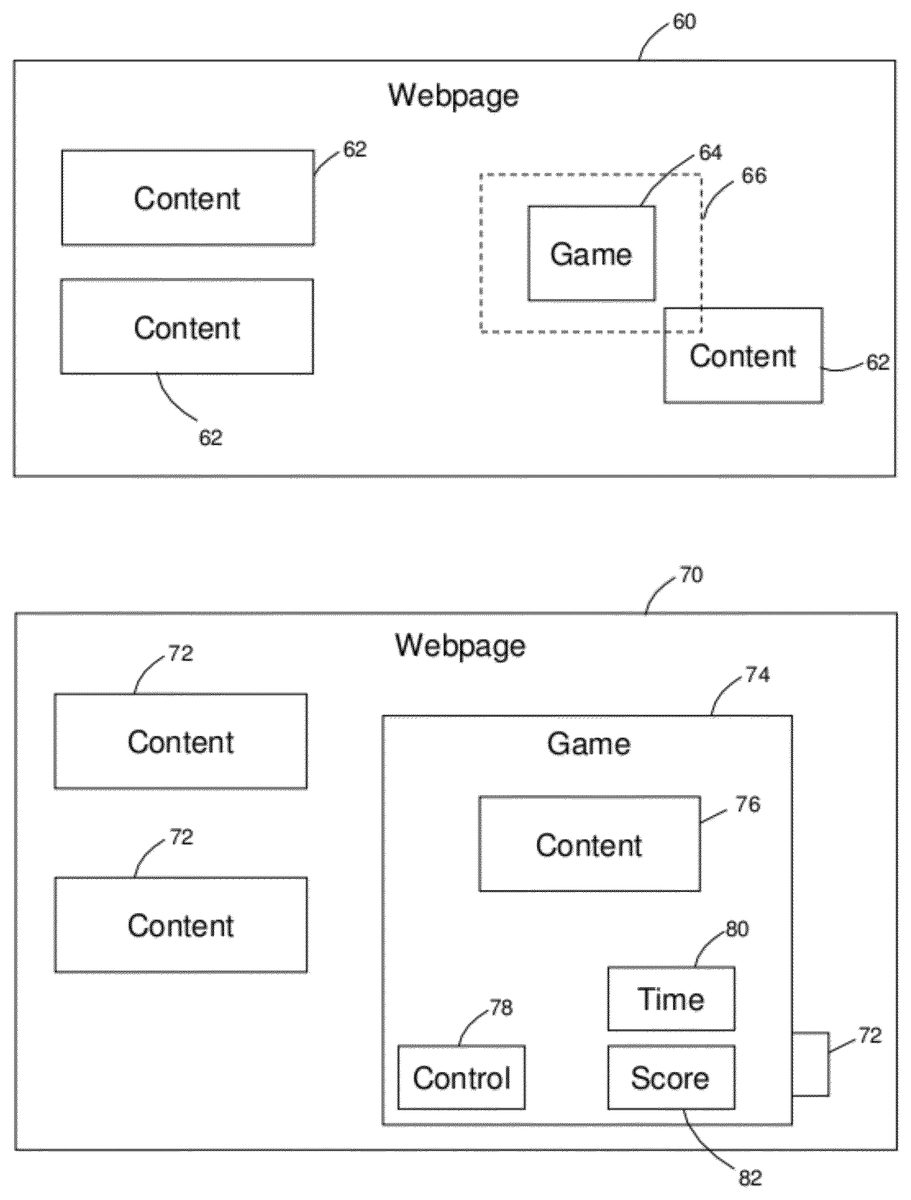
By way of illustration,FIG. 4shows a view of a webpage60with a game embedded therein. Webpage60may include one or more of at least one content field62, a game indication object64, and/or other fields. Content fields62contain content presented to users of webpage60. The organization of content into the discrete fields62illustrated inFIG. 4is not intended to be limiting. In some implementations, content of webpage60may be spread throughout webpage60as, effectively, a single field. Game indication object64may be displayed in webpage60to indicate the availability of the game associated with game indication object64. Game indication object64may appear outside of content fields62, and/or may appear within (at least partially) one or more of content fields62. Game indication object64may be visually static and/or dynamic within webpage60. For example, responsive to a user wanding over game indication object64, the appearance of game indication object64may be changed. In some implementations, while a cursor under control of the user is located over game indication object64, game indication object64may expand to fill a field66illustrated inFIG. 4. The expanded game indication object may provide additional information like (not limited to) the game that is associated with the game indication object, times the game has been played, top scoring players of the game, and other game related information. This expansion may temporarily obscure content of webpage60, and/or the expanded portion of game indication object64may facilitate view of webpage content through the expanded portion.
Referring back toFIG. 1, game module26may be configured to serve games to the users of the websites through webpages of the websites. Game module26may be configured to receive selections of the game indication objects, and to serve instances of the games to users responsive to the received selections. For example, responsive to a user selecting a game indication object in a webpage via a client computing platform14, game module26may receive the selection, and may serve an instance of the game corresponding to the game indication object to the user via the client computing platform14. This may include determining view information that describes a view of the instance of the game for presentation to the user via the client computing platform14. The view of the instance of the game may include the content selected for the game by a creating user. Such content may include content from the website of the webpage. The use of such information may encourage the user to more fully explore the website, may inform the user about the subject(s) of the website, may engage the user with the content of the website, and/or may have other impacts on the user participating in the game.
Serving an instance of a game may include receiving control inputs from a user provided to game module26via a client computing platform14on which the user is viewing a view of the instance of the game. Game module26may be configured to implement these control inputs by performing corresponding actions in and/or with respect to the instance of the game. By submitting the control inputs, the user may be able to control one or more aspects of the game. Through this control, the user may participate in the game to complete a task or objective. The actions performed by game indicator module24in response to received control inputs may be reflected in the view of the instance of the game defined by the view information determined by game indicator module24, thereby providing feedback to the user for the control being exerted.
By way of illustration,FIG. 5depicts a view of a webpage70with a game embedded therein. The view illustrated inFIG. 5may correspond to the view presented to a user via a browser window on a client computing platform. Webpage70may include one or more content field72. Content fields72contain content presented to users of webpage72. The organization of content into the discrete fields72illustrated inFIG. 5is not intended to be limiting. In some implementations, content of webpage70may be spread throughout webpage70as, effectively, a single field.
A game interface74may presented inside of and/or along with webpage70. Game interface74may be presented to the user within the same browser window as webpage70, and/or game interface74may be presented within a separate interface window. Game interface74may be configured to present an instance of a game embedded within webpage70to the user. Game interface74may include one or more of a content field76, a control field78, a time field80, a score field82, and/or other fields. The view of the instance of the game may be presented within the browser window of the webpage in which the game indication object was located, and/or the view of the instance of the game may be presented within a separate interface window arranged inside of the browser window.
Content field76may be configured to present game content to the user. The game content may include content previously selected by a creating user from the website of webpage70. The presentation of the game content to the user may be accompanied by one or more game elements associated with a game mechanic of game. The one or more game elements may, for example, explain how the user should interact with the content, be manipulated by the user with respect to the game content to participate in the game, present a question or challenge to be answered by the user as part of the game, and/or facilitate game play by the user in other ways.
Control field78may be configured to receive entry and/or selection of control inputs from the user. Although control field78is illustrated inFIG. 5as being separate from content field76, it will be appreciated that this is merely intended to be exemplary. In some implementations, control field78may overlap, at least in part, with content field76. In some implementations, control field78and content field76may be the same field. Control field78may include one or more of a text entry box, selectable icons, a menu, a directional pad, and/or other control interface elements. By entering and/or selecting control inputs, the user may participate in the game presented through game interface74.
Time field80may be configured to convey a measure of time related to the game. The measure of time may include one or more of an amount of time left in a turn or attempt, an amount of time that has expired in a turn or attempt, and/or other measures of time.
Score field82may present to the user a measure of success in the game. The measure of success may include one or more of a turn score, a game score, a prize earned, a number of successful attempts, and/or other measures of success.
Returning toFIG. 1, reward module28may be configured reward users based on the performance of the users in the games. For example, responsive to a user achieving a threshold level of success in a game, reward module28may provide a reward to the user. The threshold level may include one or more of a turn score, a game score, a cumulative game score, a maximum amount of time, a minimum amount of time, and/or other thresholds. The reward may include, for example, a virtual good, a virtual currency, and/or other rewards.
Reward module28may be configured to maintain leaderboards for the game. A given leaderboard may indicate relative success of individual users in a group of users on one or more games associated with the leaderboard. For example, the given leaderboard may indicate relative success for an individual game, the games for an individual website, and/or other sets of games. The given leaderboard may be available on the website of the associated game(s), at a website associated with game server12(separate from any website hosted by web server16), and/or at other locations.
In some implementations, game server12, client computing platforms14, and/or web server16may be operatively linked via one or more electronic communication links. For example, such electronic communication links may be established, at least in part, via a network such as the Internet and/or other networks. It will be appreciated that this is not intended to be limiting, and that the scope of this disclosure includes implementations in which servers12,16, and/or client computing platforms14may be connected and/or interface via some other configuration and/or mechanism.
A given client computing platform14may include one or more processors, and electronic display, a control interface, and/or other components. The one or more processors may be configured to execute computer program modules. The computer program modules may be configured to enable a user associated with the given client computing platform14to interface with system10and/or web server16, and/or provide other functionality attributed herein to client computing platforms14. For example, the computer program modules may include a view module configured to receive view information from server12(e.g., generated by game module26), and to present a view of the virtual game environment (e.g., as described above) based on the received view information. This may facilitate participation by the user of the given client computing platform14in the game taking place in the virtual game environment. By way of non-limiting example, the given client computing platform14may include one or more of a desktop computer, a laptop computer, a handheld computer, a tablet computing platform, a NetBook, a Smartphone, a gaming console, and/or other computing platforms.
Game server12may include electronic storage90, one or more processors92, and/or other components. Game server12may include communication lines, or ports to enable the exchange of information with a network and/or other computing platforms. Illustration of game server12inFIG. 1is not intended to be limiting. Game server12may include a plurality of hardware, software, and/or firmware components operating together to provide the functionality attributed herein to game server12. For example, game server12may be implemented “in the cloud” by a plurality of computing platforms operating together as game server12.
Electronic storage90may comprise electronic storage media that electronically stores information. The electronic storage media of electronic storage90may include one or both of system storage that is provided integrally (i.e., substantially non-removable) with game server12and/or removable storage that is removably connectable to game server12via, for example, a port (e.g., a USB port, a firewire port, etc.) or a drive (e.g., a disk drive, etc.). Electronic storage90may include one or more of optically readable storage media (e.g., optical disks, etc.), magnetically readable storage media (e.g., magnetic tape, magnetic hard drive, floppy drive, etc.), electrical charge-based storage media (e.g., EEPROM, RAM, etc.), solid-state storage media (e.g., flash drive, etc.), and/or other electronically readable storage media. The electronic storage90may include one or more virtual storage resources (e.g., cloud storage, a virtual private network, and/or other virtual storage resources). Electronic storage90may store software algorithms, information determined by processor92, information received from game server12, information received from client computing platforms14, and/or other information that enables game server12to function as described herein.
Processor(s)92is configured to provide information processing capabilities in game server12. As such, processor92may include one or more of a digital processor, an analog processor, a digital circuit designed to process information, an analog circuit designed to process information, a state machine, and/or other mechanisms for electronically processing information. Although processor92is shown inFIG. 1as a single entity, this is for illustrative purposes only. In some implementations, processor92may include a plurality of processing units. These processing units may be physically located within the same device, or processor92may represent processing functionality of a plurality of devices operating in coordination. The processor92may be configured to execute modules18,20,22,24,26, and/or28. Processor92may be configured to execute modules18,20,22,24,26, and/or28by software; hardware; firmware; some combination of software, hardware, and/or firmware; and/or other mechanisms for configuring processing capabilities on processor92.
It should be appreciated that although modules18,20,22,24,26, and/or28are illustrated inFIG. 1as being co-located within a single processing unit, in implementations in which processor92includes multiple processing units, one or more of modules18,20,22,24,26, and/or28may be located remotely from the other modules. As a non-limiting example, some or all of the functionality attributed to modules18,20,22,24,26, and/or28may be provided “in the cloud” by a plurality of processors connected through a network. The description of the functionality provided by the different modules18,20,22,24,26, and/or28herein is for illustrative purposes, and is not intended to be limiting, as any of modules18,20,22,24,26, and/or28may provide more or less functionality than is described. For example, one or more of modules18,20,22,24,26, and/or28may be eliminated, and some or all of its functionality may be provided by other ones of modules18,20,22,24,26, and/or28. As another example, processor92may be configured to execute one or more additional modules that may perform some or all of the functionality attributed below to one of modules18,20,22,24,26, and/or28.
FIG. 6illustrates a method100of hosting a game embedded in a website. The operations of method100presented below are intended to be illustrative. In some embodiments, method100may be accomplished with one or more additional operations not described, and/or without one or more of the operations discussed. Additionally, the order in which the operations of method100are illustrated inFIG. 6and described below is not intended to be limiting.
In some embodiments, method100may be implemented in one or more processing devices (e.g., a digital processor, an analog processor, a digital circuit designed to process information, an analog circuit designed to process information, a state machine, and/or other mechanisms for electronically processing information). The one or more processing devices may include one or more devices executing some or all of the operations of method100in response to instructions stored electronically on an electronic storage medium. The one or more processing devices may include one or more devices configured through hardware, firmware, and/or software to be specifically designed for execution of one or more of the operations of method100.
At an operation102, a selection of a game template may be received from a creating user creating a game to be embedded in a webpage of a website. In some implementations, operation102may be performed by a game selection module similar to or the same as game selection module18(shown inFIG. 1and described herein).
At an operation104, selection of content from the website may be received. The content may include content to be used in the game being created. In some implementations, operation104may be performed by a content selection module similar to or the same as content selection module20(shown inFIG. 1and described herein).
At an operation106, information defining one or more aspects of the game may be received from the creating user. In some implementations, operation106may be performed by a game information module similar to or the same as game information module22(shown inFIG. 1and described herein).
At an operation108, a game indication object may be provided. The game indication provided at operation108may be embedded in a webpage of the website. The game indication object may indicate to users viewing the webpage that the game is available, the game that is associated with the game indication object, times the game has been played, top scoring players of the game, and other game related information. The game indication object may be selectable by users to initiate game play. In some implementations, operation108may be performed by a game indicator module similar to or the same as game indicator module24(shown inFIG. 1and described herein).
At an operation110, a selection of the game indication object by a user of the website may be received. In some implementations, operation110may be performed by a game module similar to or the same as game module26(shown inFIG. 1and described herein).
At an operation112, responsive to the received selection, an instance of the game may be served to the requesting user. This may include generating view information for transmission to a client computing device associated with the user. The view information may define a view of the instance of the game for presentation on the client computing device. The game includes content from the website selected at operation104. In some implementations, operation112may be performed by a game module similar to or the same as game module26(shown inFIG. 1and described herein).
At an operation114, participation and/or performance in the game by the user may be rewarded. In some implementations, operation114may be performed by a reward module similar to or the same as reward module28(shown inFIG. 1and described herein).
Although the system(s) and/or method(s) of this disclosure have been described in detail for the purpose of illustration based on what is currently considered to be the most practical and preferred implementations, it is to be understood that such detail is solely for that purpose and that the disclosure is not limited to the disclosed implementations, but, on the contrary, is intended to cover modifications and equivalent arrangements that are within the spirit and scope of the appended claims. For example, it is to be understood that the present disclosure contemplates that, to the extent possible, one or more features of any implementation can be combined with one or more features of any other implementation.
Claims
- A system configured to host a game embedded in a website, the game being configured based on input from a first user associated with the website, the system comprising: one or more game servers that are separate and discrete from the one or more web servers that host the website, the one or more game servers comprising one or more processors configured to execute computer program modules, the computer program modules comprising: a content selection module configured to receive selections made by the first user of content from the website;a game information module configured to receive information from the first user that defines one or more aspects of the game;a game indicator module configured to provide a game indication object that is embedded in a webpage of the website, wherein the game indication object indicates to users viewing the webpage that the game is available, the game indication object being selectable by users of the webpage to initiate game play;and a game module configured receive selections of the game indication object by users through the webpage, and to serve the game to the users responsive to such selections, wherein the game module is configured such that responsive to selection of the game indication object by a second user viewing the webpage, the game module serves an instance of the game to the second user by generating view information for transmission to a client computing device associated with the second user that defines a view of the instance of the game for presentation on the client computing device, and wherein the game includes the content from the website selected by the first user.
- The system of claim 1 , wherein the computer program modules further comprise a game selection module configured to receive a selection by the first user of a game template for the game, wherein the game template specifies a game mechanic for the game.
- The system of claim 2 , wherein the game selection module is configured to present potential game templates to the first user for selection, and wherein the potential game templates are categorized by the content that they could turn into games.
- The system of claim 1 , wherein the game indicator module is configured such that the indicator object comprises one or more of an image, an applet, or a hyperlink.
- The system of claim 1 , wherein the game indicator object includes a network address associated with the one or more game servers, and wherein the game indicator object is configured such that responsive to selection of the game indicator object by the user, a game request is transmitted to the one or more game servers at the network address.
- The system of claim 1 , wherein the game indicator is configured such that responsive to user selection, the game indicator transmits back to the one or more game servers the webpage's URL and metadata from where the user selection was made.
- The system of claim 1 , wherein the game information module is configured to receive game information from the first user that includes questions about the content to be posed to users through instances of the game.
- The system of claim 1 , wherein the game information module is configured to receive game information from the first user that includes a performance threshold for the game by which user performance in the game will be measured.
- The system of claim 1 , wherein the computer program modules further comprise a reward module configured to reward the second user based on the performance of the second user in the game.
- The system of claim 8 , wherein the reward module is configured such that responsive to the second user achieving a threshold level of success in the game, the reward module provides the second user with a virtual good or currency.
- The system of claim 8 , wherein the reward module is configured to maintain a leaderboard that indicates relative success of a group of users in the game.
- A computer-implemented method of hosting a game embedded in a website, the game being configured based on input from a first user associated with the website, the method being implemented in one or more game servers configured to execute computer program modules, the one or more game servers being separate and discrete from one or more web servers that host the website, the method comprising: receiving selections made by the first user of content from the website;receiving information from the first user that defines one or more aspects of the game;providing a game indication object that is embedded in a webpage of the website, wherein the game indication object indicates to users viewing the webpage that the game is available, the game indication object being selectable by users of the webpage to initiate game play;and receiving a selection of the game indication object by a second user through the webpage;and responsive to selection of the game indication object by the second user viewing the webpage, serving an instance of the game to the second user by generating view information for transmission to a client computing device associated with the second user that defines a view of the instance of the game for presentation on the client computing device, wherein the game includes the content from the website selected by the first user.
- The method of claim 12 , further comprising receiving a selection by the first user of a game template for the game, wherein the game template specifies a game mechanic for the game.
- The method of claim 13 , further comprising presenting potential game templates to the first user for selection, wherein the potential game templates include one or more of a trivia game template, a word game template, an image analysis game template, or an image puzzle game template.
- The method of claim 12 , wherein the indicator object comprises one or more of an image, an applet, or a hyperlink.
- The method of claim 12 , wherein the game indicator object includes a network address associated with the one or more game servers, and wherein the game indicator object is configured such that responsive to selection of the game indicator object by the user, a game request is transmitted to the one or more game servers at the network address.
- The method of claim 12 , wherein the game information received from the first user includes questions about the content to be posed to users through instances of the game.
- The method of claim 12 , wherein the game information includes a performance threshold for the game by which user performance in the game will be measured.
- The method of claim 12 , further comprising rewarding the second user based on the performance of the second user in the game.
- The method of claim 19 , wherein rewarding the second user comprises, responsive to the second user achieving a threshold level of success in the game, the providing the second user with a virtual good or currency.
- The method of claim 12 , further comprising maintaining a leaderboard that indicates relative success of a group of users in the game or a group of games based on the same game template.
Disclaimer: Data collected from the USPTO and may be malformed, incomplete, and/or otherwise inaccurate.