U.S. Pat. No. 8,313,370
VIDEO GAME SYSTEMS AND METHODS FOR PROVIDING SOFTWARE-BASED SKILL ADJUSTMENT MECHANISMS FOR VIDEO GAME SYSTEMS
AssigneeTetris Holding LLC
Issue DateAugust 31, 2009
Illustrative Figure
Abstract
Video game systems and methods provide one or more software-based skill adjustment mechanisms for video game systems to adjust a difficulty level of the video games based on an existing skill level or game play of a player. The difficulty level of the video games is adjustable to correspond to an existing skill level of the player for removing digital blocks from a digital matrix, clearing digital complete horizontal lines from the digital matrix and/or avoiding game ending conditions. The difficulty level of the video game may be adjusted to facilitate skill-building game play for the player. The difficulty level of the video games is adjustable during game play that is approaching or leading to a game ending condition via software for one or more primary and/or secondary skill adjustment mechanisms. The one or more primary and/or secondary skill adjustment mechanisms include matrix dimension adjustments, line clear adjustments, level and fall speed adjustments, piece adjustments and/or a top-out, lock-out and/or block-out meter.
Description
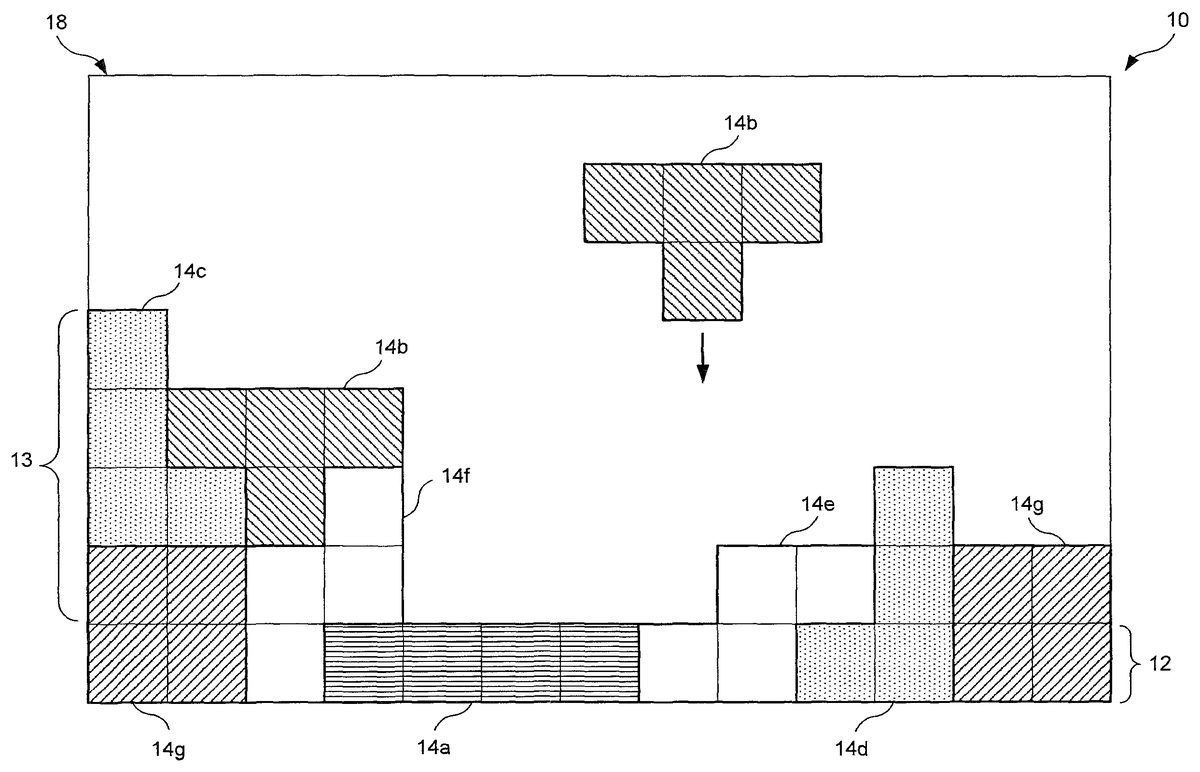
EMBODIMENTS The present disclose is related to video game systems and methods for providing software-based skill adjustment mechanisms to video game systems for adjusting a difficulty level of a puzzle video game based on a current, existing skill level or game play of a player. During game play, tetrimino digital blocks14a-14g(hereinafter “blocks14a-14g”), comprised of four minos16, may be introduced into a digital matrix10displayed via a digital display of by the gaming device for the video game system as shown inFIGS. 1 and 2. The player may manipulate and organize the falling blocks14a-14gwithin the matrix10, via an input device of the video game system, to form complete horizontal lines12which are cleared from the matrix10. An initial difficulty level of the video game may have a goal which may be obtainable by the player prior to the player advancing to the next difficulty level. Failure by the player to remove the blocks14a-14gfrom the matrix10in a timely fashion may result an increased possibility of an occurrence of a game ending condition. During game play, the player may be unable to form and clear complete digital horizontal lines with the blocks14a-14gwithin the matrix10as quickly as new blocks14a-14gare introduced and descend downward from the skyline18towards a bottom20of the matrix10via the buffer zone. If the player does not possess the necessary or sufficient skill level to form and clear the complete horizontal lines12with the blocks14a-14gwithin the matrix10at a speed that is equal to or greater than a fall speed of newly generated blocks14a-14gintroduced into the matrix10, the matrix10may begin to fill up and/or be blocked with blocks14a-14gand/or incomplete horizontal lines13. If the player is incapable of achieving timely line clears after the blocks14a-14gbegin to fill the matrix10, one or more blocks14a-14gbeing introduced and/or locked down within the matrix10may begin approaching the skyline18of the matrix10or extend above ...
EMBODIMENTS
The present disclose is related to video game systems and methods for providing software-based skill adjustment mechanisms to video game systems for adjusting a difficulty level of a puzzle video game based on a current, existing skill level or game play of a player. During game play, tetrimino digital blocks14a-14g(hereinafter “blocks14a-14g”), comprised of four minos16, may be introduced into a digital matrix10displayed via a digital display of by the gaming device for the video game system as shown inFIGS. 1 and 2. The player may manipulate and organize the falling blocks14a-14gwithin the matrix10, via an input device of the video game system, to form complete horizontal lines12which are cleared from the matrix10. An initial difficulty level of the video game may have a goal which may be obtainable by the player prior to the player advancing to the next difficulty level. Failure by the player to remove the blocks14a-14gfrom the matrix10in a timely fashion may result an increased possibility of an occurrence of a game ending condition.
During game play, the player may be unable to form and clear complete digital horizontal lines with the blocks14a-14gwithin the matrix10as quickly as new blocks14a-14gare introduced and descend downward from the skyline18towards a bottom20of the matrix10via the buffer zone. If the player does not possess the necessary or sufficient skill level to form and clear the complete horizontal lines12with the blocks14a-14gwithin the matrix10at a speed that is equal to or greater than a fall speed of newly generated blocks14a-14gintroduced into the matrix10, the matrix10may begin to fill up and/or be blocked with blocks14a-14gand/or incomplete horizontal lines13. If the player is incapable of achieving timely line clears after the blocks14a-14gbegin to fill the matrix10, one or more blocks14a-14gbeing introduced and/or locked down within the matrix10may begin approaching the skyline18of the matrix10or extend above the skyline18and into the buffer zone of the digital matrix. As a result of one or more blocks14a-14gbeing located within the buffer zone of the digital matrix, the player may commit a game ending condition or may increase possibilities of committing or approaching a game ending condition.
After an occurrence of a game ending condition or as the game play by the player approaches a game ending condition, the video game system may execute software for one or more activated software-based skill adjustment mechanisms. Execution of the software for a software-based skill adjustment mechanism by the video game system may reduce the difficulty level of the video game to an adjusted difficulty level of the video game which may correspond to the current, existing skill level or game play of the player. The adjusted difficulty level of the video games may be based on the current, existing skill level or game play of the player to clear lines from the matrix10, to avoid a game ending condition and/or to avoid game play that may approach a game ending condition. As a result, the game play by the player at the adjusted difficulty level may continue uninterrupted within single game play without restarting or terminating the game play. Single game play may refer to game play of the video game that is continuous and interrupted with delay or stoppage of game play by the player.
The video game system may include software and/or one or more algorithms for executing one or more primary and/or secondary software-based skill adjustment mechanisms for the video game systems during a single game play by the player. The primary and/or secondary software-based skill adjustment mechanisms may include, for example, a matrix dimensions adjustments, line adjustments, level and fall speed adjustments, piece adjustments and/or a top-out, lock-out or block-out meter (hereinafter “the meter”). After the video game system executes the software for a software-based skill adjustment mechanism, game play by the player may continue uninterrupted and continuous or may be restarted at the adjusted difficulty level. The adjusted difficulty level may have a goal which may be less difficult for the player to achieve than the goal of the initial difficulty level which was previously and/or potentially unobtainable by the player.
In embodiments, the primary skill adjustment mechanisms may include line adjustments and level and fall speed adjustments, and the secondary skill adjustment mechanisms may include matrix dimensions adjustments and piece adjustments. The achieve the adjusted difficulty level, the video game system may execute software for two primary skill adjustment mechanisms, a primary and a secondary skill adjustment mechanism, two primary and a secondary skill adjustment mechanism, or two primary and two secondary skill adjustment mechanisms. Moreover, the video game system may execute the software for one or more skill adjustment mechanisms without adjusting or changing the current blocks14a-14gwithin the matrix10and/or without delay or interrupting game play by the player. As a result, the game play of the player after the video game system executes software for one or more skill adjustment mechanisms may be single uninterrupted and/or continuous game play.
If the player achieves the goal of the adjusted difficulty level or approaches the goal of the adjusted difficulty level, the video game system may increase the difficulty level of the video game to a higher difficulty level. In embodiments, the higher difficulty level of the video game that may be playable by the player may correspond to the initial difficulty level or an intermediate difficulty level that is between the initial difficulty level and the adjusted difficulty level. If the goal of the adjusted difficulty level is not achieved by the player and the player commits or approaches a subsequent game ending condition, game play of the video game by the player may be terminated.
Alternatively, the video game system may execute software for one or more subsequent primary and/or secondary software-based skill adjustment mechanisms to further adjust the difficulty level of the video game to a second adjusted difficulty level during the single game play by the player. If the difficulty level is adjusted to a second adjusted difficulty level via one or more primary and/or secondary software-based skill adjustment mechanisms, game play by the player may continue or be restarted by the video game. One or more subsequent occurrences or approaching occurrences of a game ending condition may terminate game play of the video game by the player. As a result, the single game play by the player may be terminated and the player may have to restart the video game for subsequent game play.
With respect to the matrix dimensions adjustment, the video game may adjust the dimensions of the matrix10to adjust the difficulty level of the video game. Software for a matrix dimensions adjustment may be executed by the video game system after the player commits or approaches a game ending condition. As a result, the video game may decrease the number of columns and/or rows within the matrix10to change the difficulty level of the video game to an adjusted difficulty level which may be based on and/or may correspond to the current, existing skill level and/or of the player. The game play by the player may be continuous and uninterrupted by the execution of the software for the matrix dimensions adjustment. Additionally, the current blocks14a-14gwithin the matrix10may not be cleared, adjusted or moved by execution of the software for the matrix dimensions adjustment.
For example, the player may have initially selected a difficult level for the video game having a matrix10of twenty (20) rows by ten (10) columns. In embodiments, the matrix10may be a square matrix having dimensions, such as, for example, ten (10) rows by ten (10) columns, fourteen (14) rows by fourteen (14) columns and/or the like. It should be understood that the matrix10may be a square matrix having any square dimensions as known to one of ordinary skill in the art.
Alternatively, the matrix10may be initially preset or programmed to have a specific number of rows and/or columns. The game play by the player may result in the player committing or approaching a game ending condition, and the video game system may execute the software for the matrix10dimensions adjustment to change the difficulty level of the video game to an adjusted difficulty level. As a result, the software-based skill adjustment mechanisms of the video game may decrease the dimensions of the matrix10to adjusted dimensions, such as, for example, ten (10) rows by eight (8) columns. The adjusted dimensions of the matrix10and/or the corresponding adjusted difficulty level of the video game may allow the player to more easily form and clear complete horizontal lines12. As a result, the player may be capable of accomplishing the goal associated with the adjusted difficulty level without committing or approaching a subsequent game ending condition.
With respect to the line adjustment, the video game system may eliminate one or more incomplete horizontal lines13and/or blocks14a-14gwithin the existing and/or current matrix10to provide the player with open area within the matrix10to manipulate, move, rotate and/or drop one or more falling blocks14a-14gfor forming and clearing complete horizontal lines12. The game play by the player may be continuous and uninterrupted by the execution of the software for the line adjustment. Additionally, one or more current blocks14a-14gand/or incomplete horizontal lines within the matrix10may not be cleared by execution of the software for the line adjustment.
Software for a line adjustment may be executed by the video game system after the player commits or approaches a game ending condition. As a result, the video game system may automatically clear a specific and/or configurable number of incomplete horizontal lines13from the bottom20of the matrix10after committing or approaching a game ending condition to adjust the difficulty level of the video game to correspond to the current, existing skill level and game play of the player.
For example, the player may commit or approach a game ending condition and the video game system may execute software for a line adjustment to change the difficulty level of the video game. As a result, the software-based skill adjustment mechanisms of the video game may automatically remove one or more lines from the bottom20of the matrix10, such as, for example, five (5) or less lines, ten (10) or less lines or fifteen (15) or less lines. By eliminating one or more incomplete horizontal lines13from the bottom20of the matrix10, the matrix10provides open area for the player to manipulate one or more falling blocks14a-14gto form and clear complete horizontal lines12more easily. As a result, the player may be capable of accomplishing the goal associated with the difficulty level of the video game without committing or approaching a subsequent game ending condition.
With respect to the level and fall speed adjustment, the video game may adjust the level and fall speed of one or more blocks14a-14gfalling within the matrix10to change the difficulty level of the video game to an adjusted difficulty level. Software for the difficulty level and fall speed adjustment may be executed by the video game system after the player commits or approaches a game ending condition. As a result, the video game may decrease the difficulty level of game play by a configurable number of levels to achieve an adjusted difficulty level. The game play by the player may be continuous and uninterrupted by the execution of the software for the level and fall speed adjustment. Additionally, the current blocks14a-14gwithin the matrix10may not be cleared, adjusted or moved by execution of the software for the level and fall speed adjustment.
The video game system may not decrease the difficulty level below a preset or predetermined level, such as, for example, Level 1. As a result, the fall speed of one or more blocks14a-14gmay be decreased to an adjusted fall speed corresponding to a fall speed of the corresponding adjusted difficulty level. The adjusted level and fall speed of one or more blocks14a-14gand the adjusted difficulty level may be based on and/or correspond to the current, existing skill level and game play of the player.
For example, the player may be playing the video game at an initial difficulty level, such as, for example, Level 3 wherein the fall speed of the blocks14a-14gmay be less than one (1) second per line. The player may commit or approach a game ending condition, and the video game system may execute level and fall speed adjustment software to change the difficulty level of the video game to an adjusted difficulty level. The software-based skill adjustment mechanisms software of the video game may decrease the level of the game play by one or more difficulty levels, such as, for example, two (2) difficulty levels to Level 1 wherein the fall speed of the blocks14a-14gmay be greater than one (1) second per line. The adjusted difficulty level having the adjusted fall speed of the video game may allow the player to more easily form and clear complete horizontal lines12. As a result, the player may be capable of accomplishing the goal associated with the adjusted difficulty level without committing or approaching a subsequent game ending condition.
In embodiments, the adjusted difficulty level may provide one or more blocks14a-14gfalling at a first fall speed and one or more blocks14a-14gfalling at a second fall speed which may be less than the first fall speed. The software-based skill adjustment mechanisms of the video game system may determine that organizing or locking down one or more first type of blocks14a-14gwith the existing blocks of the matrix10is easier than with one or more second type of blocks14a-14g. As a result, the video game system may drop the one or more first type of blocks at the first fall speed and the one or more second type of blocks at the second fall speed. The video game system may base the determination on size, shape and/or configuration of the first and second blocks14a-14g, the matrix10and/or the current blocks14a-14gwithin the matrix10.
With respect to the piece adjustment, the video game may adjust a size and/or configuration of one or more adjusted blocks24a-24cfalling within the matrix10to change the difficulty level of the video game to an adjusted difficulty level. Initially, the falling blocks of the video game may be tetrimino blocks14a-14gcomprised of four minos16. Software for the piece adjustment may be executed by the video game system after the player commits or approaches a game ending condition. As a result, one or more adjusted blocks24a-24cmay be trimino blocks24a,24bcomprised of three minos16, dimino blocks24ccomprised of two minos16or single minos16as shown inFIG. 2. The game play by the player may be continuous and uninterrupted by the execution of the software for the piece adjustment. Additionally, the current blocks14a-14gwithin the matrix10may not be cleared, adjusted or moved by execution of the software for the piece adjustment.
The video game may decrease the difficulty level of game play by replacing new tetrimino blocks14a-14gwith one or more adjusted blocks24a-24ccomprised of less than four minos16to achieve the adjusted difficulty level for the video game. In embodiments, the video game system may introduce both tetrimino blocks14a-14gand adjusted blocks24a-24ccomprised of less than four minos16into the matrix10during single game play. The one or more adjusted blocks24a-24cmay change the difficulty level of the video game to the adjusted difficulty level which may be based on and/or may correspond to the current, existing skill level and game play of the player.
With respect to the meter, the video game system may have software for providing the player with more than one opportunity to accomplish a goal associated with one or more difficulty levels before game play by the player is terminated. The video game may allow the player to commit or approach one or more game ending conditions before the video game terminates the single game play of the player. The meter may be provided by the video game system and may be displayed to the player via digital display of the gaming device. During a single game play, the meter software may track and record (a) one or more occurrences or approaching occurrences of game ending conditions (b) one or more changes made to the difficulty level of the video game, and/or (c) one or more executions of the software for the skill adjustment mechanisms. When the meter may be completely filled, the video game may terminate game play of the player immediately or after the player commits a subsequent game ending condition.
For example, the meter may permit the player to commit or approach committing more than one game ending condition, such as, for example, three (3) game ending conditions before the video game terminates the single game play by the player. Initially, the meter may be empty or may indicate that no game ending conditions have been committed or approached by the single game play of the player. After the player commits or approaches a game ending condition, the video game system may record the first occurrence of a game ending condition, the first execution of the software for the skill adjustment mechanisms with the meter software or the first changing to the adjusted difficulty for the video game. The video game system may add a mark, an indicator or a symbol to represent the occurrence or approaching of the first game ending condition or the execution of the software to the meter. Additional subsequent occurrences or approaches of game ending conditions and/or subsequent executions of the software are also recorded by the video game system with the meter software. The meter may become completely full after one or more subsequent occurrences of game ending conditions, such as, for example, after a third occurrence of a game ending condition. As a result, the video game system may identify that the meter is full and may terminate the single game play by the player. By providing the player with multiple opportunities to continue the single game play after committing or approaching a game ending condition without terminating the single game play, the player may be afforded more than one opportunity to form and clear complete horizontal lines12and/or accomplish a goal associated with the current or adjusted difficulty level of the video game. As a result, the player may not become frustrated by frequent game ending conditions and subsequent game restarting procedures after each and every game ending condition.
FIG. 3illustrates a flow chart of a method100for providing software-based skill adjustment mechanisms for video game systems. After powering on the gaming device, the player may initiate the video game as shown at Step112. The player may configure one or more parameters of the video game before beginning game play via the input device, the digital display and the software of the gaming device. For example, the player may select an initial difficulty level for game play as shown at Step114. The video game may have multiple difficulty levels such that the player may select the initial difficulty level for game play from lower, intermediate or higher difficulty levels.
Further, the player may select initial dimensions for the matrix10of the video game as shown at Step116. The initial dimensions may be selected from a range of widths from about four (4) columns to about twenty (20) columns and a range of heights from about ten (10) rows to about thirty (30) rows. The present disclosure should not be deemed as limited to a specific embodiment of the width and/or height dimensions of the matrix10.
Moreover, the player may activate one or more primary and/or secondary software-based skill adjustment mechanisms for the video game as shown at Step118. Subsequent to configuring one or more parameters of the video game, the player may start game play of the video game as shown at Step120. Alternatively, the game may be pre-configured and the player may directly start game play without configuring the one or more parameters of the video game.
During game play of the video game, the player may commit or approach a first game ending condition as shown at Step122. The first game ending condition may be an occurrence of a top-out, block-out or lock-out condition. The video game system may determine that the player may have committed a game ending condition or may be approaching a game ending condition. The video game system may, optionally, analyze the game play of the player to determine which of one or more primary and/or secondary software-based skill adjustment mechanisms may be executed to increase the skill level of the player and to avoid committing or approaching of subsequent game ending condition. The video game system may select one or more primary and/or secondary software-based skill adjustment mechanisms for execution based on the skill level and/or game play of the player as shown at Step123. Alternatively, the video game system may be preset or preconfigured to select one or more primary and/or secondary software-based skill adjustment mechanisms to execute in a predetermined or programmable order. For example, the video game system may be programmed to select one or more primary and/or secondary software-based skill adjustment mechanisms in the following order: line adjustment; level and fall speed adjustment; matrix dimensions adjustment; and block adjustment.
After the video game system determines and selects one or more primary and/or secondary software-based skill adjustment mechanisms, the video game system may execute software for at least one activated primary and/or secondary software-based skill adjustment mechanisms as shown at Step124. The one or more primary and/or secondary software-based skill adjustment mechanisms may include one or more matrix dimensions, line, level and fall speed and/or block adjustments. After execution of the one or more software-based skill adjustment mechanisms, game play of the video game by the player may continue uninterrupted or be restarted as shown at Step126.
Optionally, if the meter software is activated, the video game system may increase the meter by an increment, such as, one (1) unit, as shown at Step128. Subsequent to increasing the meter, the video game may determine if the meter is partially filled or completely filled as shown at Step130. If the meter is partially full and not maximized, the game play of the video game by the player may continue or be restarted as shown at Step126. If the meter is completely filled, the video game system may terminate single game play of the player as shown at Step132. The player may have to initiate the video game again to proceed with subsequent game play after the termination as shown at Step132.
During single game play subsequent to the execution of the first software-based skill adjustment mechanism, the player may commit or approach a second game ending condition as shown at Step134. After the second game ending condition is committed or approached by the single game play of the player, the video game system may additionally select and/or execute software for one or more primary and/or secondary activated software-based skill adjustment mechanisms as shown at Step124. Alternatively, game play by the player may be terminated by the video game after an occurrence of a second game ending condition as shown at Step132. It should be understood that the video game system may allow the player to commit any number of game ending conditions and/or may execute software for any number of primary and/or secondary software-based skill adjustment mechanisms prior to terminating single game play of the video game by the player.
After the occurrence of the second game ending condition and execution of the software for the one or more software-based skill adjustment mechanisms, the video game system may optionally increase the meter by an increment as shown at Step128. The video game may reexamine the meter to determine if the meter is partially full or completely full as shown at Step130. If the meter is completely full the game play is terminated as shown at Step132, and if the meter is partially full game play may continue or may be restarted as shown at Step126. It should be understood that the video game system may continue single game play by the player until a number of game ending conditions committed or approached by the player completely fills or exceeds the number of game ending conditions permitted by the meter.
A method for providing one or more software-based skill adjustment mechanisms for video game systems with an initial difficulty level is shown inFIG. 4. During game play of the video game by the player, the video game system may determine whether a game ending condition has been committed or approached by the game play of the player as shown at Step210. The player may timely form and clear complete horizontal lines12from the matrix10and may prevent committing or approaching an occurrence of a game ending condition. As a result, single game play by the player may continue until a game ending condition occurs or is approached as shown at Step212. Alternatively, the player may fail to timely form and clear complete horizontal lines12with the falling blocks within the matrix10. As a result, the player's skill level and/or game play may cause a game ending condition to be committed or approached.
After a game ending condition is committed or approached, the video game system may determine whether one or more primary and/or secondary software-based skill adjustment mechanisms are activated as shown at Step214. Without one or more software-based skill adjustment mechanisms activated, committing or approaching an occurrence of a game ending condition may result in termination of single game play of the video game by the player as shown at Step216. If one or more primary and/or secondary software-based skill adjustment mechanisms are activated, the video game system may determine which of the one or more software-based skill adjustment mechanisms are activated and may execute software for one or more activated software-based skill adjustment mechanisms for changing the initial difficulty level of the video game to an adjusted difficulty level of the video game. The video game system may select and execute one or more software-based skill adjustment mechanisms based on the skill level and/or game play of the player as shown at Step215.
The video game system may determine whether the matrix dimensions adjustment is activated as shown at Step216. If the matrix dimensions adjustment is not activated, the video game system may determine whether one or more other software-based skill adjustment mechanisms are activated. When the matrix dimensions adjustment is activated, the video game system may execute software for the matrix dimensions adjustment after a game ending condition is committed or approached. As a result, the initial dimensions of the matrix10may be changed to adjusted dimensions of the matrix10such that an adjusted difficulty level of the video game may correspond to the skill level and/or game play of the player as shown at Step218.
The video game system may determine whether the line adjustment is activated as shown at Step220. Without the line adjustment activated, and the video game system may determine whether other software-based skill adjustment mechanisms are activated. With the line adjustment being activated, the video game system may execute the line adjustment software. As a result, one or more incomplete horizontal lines13from the bottom20of the matrix10may be cleared without emptying or clearing the entirety of the matrix10as shown at Step222. Subsequent to clearing the one or more incomplete horizontal lines13from the matrix10, the remaining incomplete horizontal lines13and/or blocks may move downward towards the bottom20of the matrix10as shown at Step224.
The video game system may determine whether the level and fall speed adjustment may or may not be activated as shown at Step226. With the level and fall speed adjustment deactivated, the video game system may determine whether other software-based skill adjustment mechanisms are activated. With the level and fall speed adjustment software activated, the video game system may execute software for the level and fall speed adjustment after a game ending condition is committed or approached. The difficulty level of the video game may be decreased by one or more difficulty levels to achieve the adjusted difficulty level for the video game as shown at Step228. As a result, the fall speed of the blocks14a-14g, adjusted blocks24a-24cand/or minos16may be reduced to correspond to the adjusted difficulty level
The video game system may determine whether the piece adjustment is activated or not activated as shown at Step232. With the piece adjustment deactivated, the video game system may determine whether one or more other software-based skill adjustment mechanisms are activated. Alternatively, the video game system may execute piece adjustment software so that the blocks14a-14g, the adjusted blocks24a-24cand/or the minos16are generated to achieve an adjusted difficulty level of the video game which may correspond to the skill level and/or game play of the player. As a result the player may more easily form and clear complete horizontal lines12as shown at Step234.
Changing the difficulty level of the video game to the adjusted difficulty level via one or more primary and/or secondary software-based skill adjustment mechanisms may match the skill level and game play of the player to a difficulty level associated with the video game. As a result, the player may exhibit or achieve the necessary skill level and game play to form and clear complete horizontal lines12and accomplish the goal associated with the adjusted difficulty level without committing or approaching subsequent game ending conditions. After the difficulty level of the video game is changed to one or more adjusted difficulty levels, the game play by the player may continue or may be restarted by the video game as shown at Step236.
The single game play of the player at the adjusted difficulty level of the video game may continue and the video game system may determine whether the player has achieved the goal associated with the adjusted difficulty level as shown at Step238. If the video game system determines that the goal of an adjusted difficulty level has not been achieved by the player, then the video game system may return to the Step210for determining whether a game ending condition has been committed or approached by the single game play of the player.
Alternatively, the video game system may determine that the player has achieved the goal of the adjusted difficulty level. As a result, the video game system may increase the difficulty level of the video game to the initial difficulty level prior to the game ending condition being committed or approached or may change the difficulty level to an intermediate difficulty level between the adjusted difficulty level and the initial difficulty level as shown at Step240.
It will be appreciated that various of the above-disclosed and other features and functions, or alternatives thereof, may be desirably combined into many other different systems or applications. Also, various presently unforeseen or unanticipated alternatives, modifications, variations or improvements therein may be subsequently made by those skilled in the art, and are also intended to be encompassed by the following claims.
Claims
- A method for providing software-based skill adjustments to a video game, wherein game-play of the video game is conducted via a gaming device having a digital display and a non-transitory computer-readable storage medium on which software, for one or more skill adjustment mechanisms, is stored which enables the gaming device, after the software is loaded into the gaming device, to adjust a difficulty level of the video game based on game-play of the video game, wherein the game-play of the video game is being conducted at a current difficulty level, wherein, during the game-play, digital blocks move downwardly from a skyline of a digital matrix to a bottom of the digital matrix that is located opposite to the skyline, wherein digital blocks are removed from the digital matrix by forming complete horizontal digital lines with the digital blocks within the digital matrix, wherein the digital blocks and digital matrix are displayed via the digital display of the gaming device, the method comprising: causing the gaming device to identify an approaching occurrence of a game ending condition based on the current game play of the video game;causing the gaming device to execute at least one of the one or more skill adjustment mechanisms based on the approaching occurrence of the game ending condition, wherein the one or more skill adjustment mechanisms comprises at least one of a line adjustment and a piece adjustment, wherein the line adjustment, when executed by the gaming device, removes at least one incomplete horizontal line from the bottom of the digital matrix, wherein the piece adjustment, when executed by the gaming device, changes a size of one or more digital blocks;and causing the gaming device to change the video game, during the game play, from the current difficulty level to an adjusted difficulty level, wherein the adjusted difficulty level is less difficult than the current difficulty level.
- The method according to claim 1 , wherein the game-play of the video game is continuous and uninterrupted by the execution of at least one of the one or more skill adjustment mechanisms.
- The method according to claim 1 , further comprising: causing the gaming device to increase a count of a counter after at least one of the one or more skill adjustment mechanisms is executed by the gaming device.
- The method according to claim 3 , further comprising: causing the gaming device to terminate the game-play of the video game when the count of the counter is equal to a selected or preset number.
- The method according to claim 1 , further comprising: causing the gaming device to terminate game-play of the video game after an occurrence of a subsequent game ending condition.
- The method according to claim 1 , further comprising: causing the gaming device to identify an approaching occurrence of a subsequent game ending condition based on subsequent game-play of the video game at the adjusted difficulty level;and causing the gaming device to execute at least one of the one or more skill adjustment mechanisms.
- The method according to claim 1 , further comprising: causing the gaming device to adjust the video game from the adjusted difficulty level to an intermediate difficulty level, wherein the intermediate difficulty level is more difficult than the adjusted difficulty level.
- The method according to claim 1 , wherein executing at least one of the one or more skill adjustment mechanisms does not clear all existing digital blocks, located within the digital matrix, from the digital matrix.
- The method according to claim 1 , wherein the one or more skill adjustment mechanisms further comprises a level and fall speed adjustment, wherein the level and fall speed adjustment, when executed by the gaming device, changes a fall speed of one or more digital blocks within the digital matrix.
- The method according to claim 9 , wherein the adjusted difficulty level is achieved by causing the gaming device to execute at least two of the one or more skill adjustment mechanisms.
- A video game system for providing software-based skill adjustments to game-play, wherein game-play is conducted with digital blocks that move downward from a skyline of a digital matrix to a bottom of the digital matrix that is located opposite to the skyline of the digital matrix, wherein complete horizontal digital lines are formed with one or more digital blocks during game-play and are removed from the digital matrix, the system comprising: a gaming device having a digital display that displays the digital blocks and the digital matrix during game-play, wherein game-play is conducted at a current difficulty level via the gaming device, and a non-transitory computer-readable storage medium on which software, for one or more skill adjustment mechanisms, is stored which enables the gaming device, after the software is loaded into the gaming device, to adjust a difficulty level of the video game based on the game-play of the video game, wherein the gaming device is configured to identify an approaching game ending condition based on current game play and execute at least one of the one or more skill adjustment mechanisms based on the approaching game ending condition, wherein the one or more skill adjustment mechanisms, when executed, changes the current difficulty level, during the game play, to an adjusted difficulty level that is less difficult than the current difficulty level, wherein the one or more skill adjustment mechanisms comprises a line adjustment and a piece adjustment, wherein the line adjustment, when executed by the gaming device, removes at least one incomplete horizontal line from the bottom of the digital matrix, and further wherein the piece adjustment, when executed by the gaming device, changes a size of one or more digital blocks.
- The video game system according to claim 11 , further comprising: a meter displayed by the gaming device via the digital display, wherein a counter for the meter is increased after at least one of the one or more skill adjustment mechanisms is executed by the gaming device.
- The system according to claim 11 , wherein the game play is continuous and uninterrupted by the execution of at least one of the one or more skill adjustment mechanisms.
- The system according to claim 11 , further comprising: means for changing the adjusted difficulty level to an intermediate difficulty level, wherein the intermediate difficulty level is more difficult than the adjusted difficulty level.
- The video game system according to claim 11 , wherein the one or more skill adjustment mechanisms further comprises a level and fall speed adjustment, wherein the level and fall speed adjustment, when executed by the gaming device, changes a fall speed of one or more digital blocks within the digital matrix.
- A method for providing software-based skill adjustments to a video game, wherein game-play of the video game is conducted via a gaming device having a digital display and a non-transitory computer-readable storage medium on which software, for one or more skill adjustment mechanisms, is stored which enables the gaming device, after the software is loaded into the gaming device, to adjust a difficulty level of the video game based on the game-play of the video game, wherein the game-play of the video game is being conducted at a current difficulty level, wherein, during the game-play, digital blocks move downwardly from a skyline of a digital matrix to a bottom of the digital matrix that is located opposite to the skyline, wherein digital blocks are removed from the digital matrix by forming complete horizontal digital lines with the digital blocks within the digital matrix, wherein the digital blocks and digital matrix are displayed via the digital display of the gaming device, the method comprising: causing the gaming device to identify an approaching occurrence of a game ending condition based on the current game play of the video game;causing the gaming device to automatically execute, when the game ending condition occurs, at least one of the one or more skill adjustment mechanisms, wherein the one or more skill adjustment mechanisms comprises at least one of a line adjustment, a piece adjustment and a level and fall speed adjustment, wherein the line adjustment, when executed by the gaming device, removes at least one incomplete horizontal line from the bottom of the digital matrix, wherein the piece adjustment, when executed by the gaming device, changes a size of one or more digital blocks, and further wherein the level and fall speed adjustment, when executed by the gaming device, changes a fall speed of one or more digital blocks;and causing the gaming device to change the video game, during the game play, from the current difficulty level to an adjusted difficulty level, wherein the adjusted difficulty level is less difficult than the current difficulty level.
- The method according to claim 16 , wherein the game-play of the video game is continuous and uninterrupted by the execution of the at least one of the one or more skill adjustment mechanisms.
- The method according to claim 16 , further comprising: causing the gaming device to increase a count of a counter after the at least one of the one or more the skill adjustment mechanisms is executed by the gaming device.
- The method according to claim 18 , further comprising: causing the gaming device to terminate game-play of the video game when the count of the counter is equal to a selected or preset number.
- The method according to claim 16 , further comprising: causing the gaming device to adjust the video game from the adjusted difficulty level to an intermediate difficulty level, wherein the intermediate difficulty level is more difficult than the adjusted difficulty level.
- The method according to claim 16 , wherein executing the at least one of the one or more skill adjustment mechanisms does not clear all existing digital blocks, located within the digital matrix, from the digital matrix.
- The method according to claim 16 , wherein the adjusted difficulty level is achieved by causing the gaming device to execute at least two of the one or more skill adjustment mechanisms.
Disclaimer: Data collected from the USPTO and may be malformed, incomplete, and/or otherwise inaccurate.