U.S. Pat. No. 8,298,084
MULTI-PLAYER GAME CONTROLLER SYSTEM WITH COMBINABLE HAND-HELD GAME CONTROLLERS
Issue DateFebruary 3, 2011
Illustrative Figure
Abstract
There is provided a multi-player game controller system first and second hand-held game controllers and engagement circuitry. The first hand-held game controller includes a first input control configured to generate a first input control signal in response to interaction with a first user. The second input controller includes a second input control configured to generate a second input control signal in response to interaction with a second user. The first and second hand-held game controllers have engagement states of an engaged state and an unengaged state. The engagement circuitry is configured to generate an engagement signal when the first and second hand-held game controllers are in an engagement state. There is also provided methods of operating the multi-player game controller system.
Description
Common reference numerals are used throughout the drawings and the detailed description to indicate the same elements. DETAILED DESCRIPTION The detailed description set forth below in connection with the appended drawings is intended as a description of certain embodiments of the present disclosure, and is not intended to represent the only forms that may be developed or utilized. The description sets forth the various functions in connection with the illustrated embodiments, but it is to be understood, however, that the same or equivalent functions may be accomplished by different embodiments that are also intended to be encompassed within the scope of the present disclosure. It is further understood that the use of relational terms such as top and bottom, first and second, and the like are used solely to distinguish one entity from another without necessarily requiring or implying any actual such relationship or order between such entities. Referring now toFIG. 1, there is depicted a symbolic exemplary environment including first and second users10,12as interacting with a multi-player game controller system14. The multi-player game controller system14includes a first hand-held game controller16as being used by the first user10and a second hand-held game controller18as being used by a second user12. As will be further described below the first and second hand-held game controllers16,18are in an unengaged state. There is also illustrated a game platform20and a display device22. Referring additionally toFIG. 2, there is depicted the symbolic exemplary environment ofFIG. 1with the first and second, hand-held game controllers16,18in an engaged state. In accordance with one embodiment of the present disclosure, the multi-player game controller system14includes the first and second hand-held game controllers16,18. The multi-player game controller system14further includes engagement circuitry46(as symbolically depicted inFIG. 7as discussed further below). The first hand-held game controller16includes a first game controller housing24, and a first input control, such ...
Common reference numerals are used throughout the drawings and the detailed description to indicate the same elements.
DETAILED DESCRIPTION
The detailed description set forth below in connection with the appended drawings is intended as a description of certain embodiments of the present disclosure, and is not intended to represent the only forms that may be developed or utilized. The description sets forth the various functions in connection with the illustrated embodiments, but it is to be understood, however, that the same or equivalent functions may be accomplished by different embodiments that are also intended to be encompassed within the scope of the present disclosure. It is further understood that the use of relational terms such as top and bottom, first and second, and the like are used solely to distinguish one entity from another without necessarily requiring or implying any actual such relationship or order between such entities.
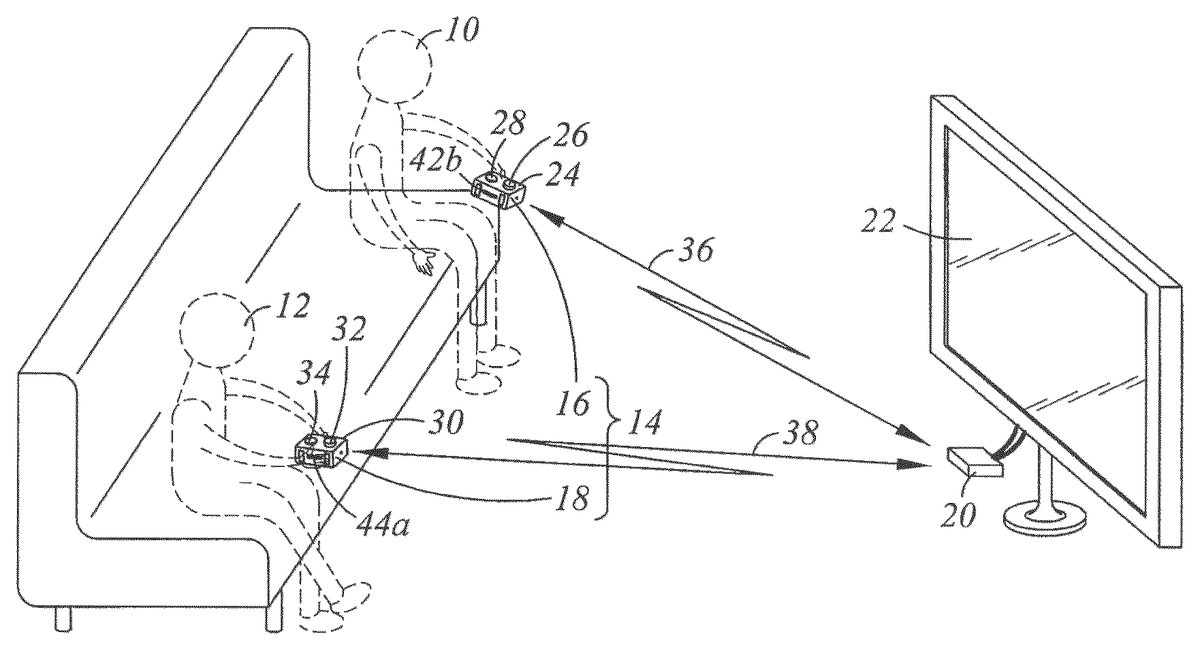
Referring now toFIG. 1, there is depicted a symbolic exemplary environment including first and second users10,12as interacting with a multi-player game controller system14. The multi-player game controller system14includes a first hand-held game controller16as being used by the first user10and a second hand-held game controller18as being used by a second user12. As will be further described below the first and second hand-held game controllers16,18are in an unengaged state. There is also illustrated a game platform20and a display device22. Referring additionally toFIG. 2, there is depicted the symbolic exemplary environment ofFIG. 1with the first and second, hand-held game controllers16,18in an engaged state.
In accordance with one embodiment of the present disclosure, the multi-player game controller system14includes the first and second hand-held game controllers16,18. The multi-player game controller system14further includes engagement circuitry46(as symbolically depicted inFIG. 7as discussed further below). The first hand-held game controller16includes a first game controller housing24, and a first input control, such as a knob26or a button28, attached to the first game controller housing24. The first input control is configured to generate a first input control signal36in response to interaction with the first user10. The first and second hand-held game controllers16,18have engagement states of an engaged state and an unengaged state. The first and second game controllers16,18are in fixed physical relation to each other with respect to at least one degree of freedom when in the engaged state. The first and second hand-held game controllers16,18are independently movable in relation to each other when in the unengaged state. The second hand-held game controller18includes a second game controller housing30, and a second input control, such as a knob32or a button34, attached to the second game controller housing30. The second input control18is configured to generate a second input control signal38in response to interaction with a second user12. The engagement circuitry46is configured to generate an engagement signal40in response to the first and second hand-held game controllers16,18being in the engagement state.
As mentioned above, the multi-player game controller system14requires that the hand-held game controllers have the capability to be in an engaged state and an unengaged state with each other. In this regard, the users who use the multi-player game controller system14are required to physically and cooperatively move the game controllers16,18into and out of engagement with each other. This engagement is contemplated to greatly enhance and change how game players personally interact with one another in a dimension not previously explored.
As used herein the engagement circuitry46refers to any combination of electrical components and connecting electrical conduits that are used to generate the engagement signal40in response to the first and second hand-held game controllers16,18being in an engagement state. The engagement circuitry46may include any combination of analog and/or digital components.
In an embodiment, the engagement signal40may be generated when the first and second hand-held game controllers16,18are in the engaged state. This engagement signal40may then be transmitted to the game platform20for use to affect game play. The generation and transmission process may be initiated by the engagement circuitry46upon receipt of inputs indicative of the first and second game controllers being in an engagement state. However, it is contemplated that the game platform20may periodically poll the engagement circuitry46and in response the engagement signal42may be generated. The frequency in which the engagement circuitry46transmits the engagement signal40and whether such engagement signal40is representative of the game controllers16,18being in the engaged or unengaged state may vary in accordance to those design principles of one of ordinary skill in the art.
The engagement circuitry46may be disposed within either or both of the first and second game controllers16,18. In this regard, each of the first and second game controllers16,18may include electrical components capable of generating an engagement signal40. In practice, such engagement signal40may be transmitted from just one of the first or second game controllers16,18. Alternatively, each of the game controllers16,18may transmit an engagement signal40. As one of ordinary skill in the art will appreciate, computer programming of the game platform20would dictate logic to determine how such incoming engagement signals40are used to represent whether the first and second game controllers16,18are in either of the engaged or unengaged states. It is contemplated that where just two game controllers are used (such as game controllers16,18), generation and transmission of engagement signals40from both of the game controllers16,18would be redundant in nature. However, where more than two game controllers are being used, each such game controller may likely include engagement circuitry capable of generating engagement signals.
While in the embodiment ofFIGS. 1 and 2, the engagement signal40is contemplated to be wirelessly transmitted from the hand game controllers16,18, such engagement signal40may be transmitted to the game platform20via a wired connection.
In an embodiment, the first hand-held game controller16includes magnets42a-b, and the second hand-held game controller16includes magnets44. The magnets42a-b,44a-bare configured to magnetically interact with each other with the first and second hand-held game controllers16,18being in the engaged state. The magnetic interaction may be attractive in nature to facilitate an ease of establishing the first and second hand-held game controllers16,18in the engaged state. However, it is also contemplated that the magnetic interaction may be repulsive in nature so as to increase the difficulty of establishing the first and second hand-held game controllers16,18in the engaged state for more advanced game play. While the first hand-held game controller16includes two magnets42a-b, more or less than two magnets may be used. Similarly, while the second hand-held game controller18includes two magnets44a-b, more or less than two may be used.
In addition, a respective one of the magnets42a-bmay be configured to physically contact a respective one of the magnets44a-bwith the first and second hand-held game controllers16,18being in the engaged state. It is contemplated that inFIG. 2, the magnet42ais in contact with the magnet44b(not depicted in this view). Such physical contact may not only provide a strong magnetic engagement, such contact may facilitate electrical communication. In this regard, the magnets44,46may be in electrical communication with the engagement circuitry46. The magnets42a-band44a-bmay be electrically conductive and may be rare earth magnets. The contact between the magnets42,44may be configured to complete an electrical path in which an electrical signal passing there through may be indicative of such contact and therefore the engaged nature of the first and second hand-held game controllers16,18. It is contemplated that depending upon which magnets42aorbis in contact with magnets44aorb, this information may be used by the game platform20to effect game play as may be ultimately reflected on the display device22(in other words, the game platform20may be configured to reflect through game play that the first hand-held game controller16is engaged to the left of the second hand-held game controller18). Thus, not only may the game platform20may recognize that the first and second game controllers16,18are in an engaged state, it may recognize in what manner or orientation the first and second game controllers16,18are engaged. The particular material selection, magnetic strength, polarity configuration, number of magnetic components, electrical conductivity and other design characteristics of the magnets42a-band44a-bmay be chosen from those which are well known to one of ordinary skill in the art.
As mentioned above, the first and second game controllers16,18are in fixed physical relation to each other with respect to at least one degree of freedom when in the engaged state. In the embodiment ofFIGS. 1-6, the first and second game controllers16,18are in fixed physical relation to each other with respect to all degrees of freedom. However, it is contemplated that other arrangements may be implemented. For example, the first and second game controllers16,18may be at a fixed distance from each other by configured to rotate about one or more axis of rotation. In this regard, though not depicted, a socket and ball joint may be considered. Moreover, while the first and second game controller housings24,30are in direct physical contact when the first and second game controllers16,18are in the engaged state, intermediary components or couplers may be used to effect the first and second game controllers16,18being in fixed physical relation to each other with respect to at least one degree of freedom when in the engaged state.
In the embodiment illustrated, the first and second game controller housings24,30respectively include molded features48a-dand50a-dto facilitate alignment and engagement of the first and second controllers16,18. The molded features48a-bare respectively sized and configured to engage with the molded features50d-cwith the first and second game controllers16,18in the engaged state. Likewise, the molded features48d-care respectively sized and configured to engage with the molded features50a-bwith the first and second game controllers16,18in the engaged state.
The particular embodiment illustrated for the first and second hand-held game controllers16,18are exemplary in nature for purposes of discussing aspects of the inventions disclosed herein. It is contemplated that the first and second game controller housings24,30may be formed to be of a variety of shapes and sizes that may take into design consideration the feature set of the input controls, the number and manner of engagement configurations with other controllers, ergonomics and aesthetics.
Referring now toFIG. 7, there is depicted a symbolic schematic diagram of electrical components that may be disposed within the first hand-held game controller16. A similar arrangement is contemplated for the second hand-held game controller18. Electrical circuitry52is provided, which may take the form of a microprocessor and/or one or more integrated circuits. It is contemplated the various electrical components and connectivity there between may be selected from those which are well known to one of ordinary skill in the art. The engagement circuitry46may be included in the electrical circuitry52.
The first hand-held game controller16may further include a first acceleration sensor. It is contemplated that the methods and means for implementing the acceleration sensor may be chosen from those which are well known to one of ordinary skill in the art. In an embodiment, the first acceleration sensor may be configured to generate an acceleration signal in response to changes in acceleration of the first hand-held game controller16with respect to an axis of motion. The first acceleration sensor may take the form of the accelerometers54,56,58. It is contemplated that the accelerometers54,56,58may be configured to detect changes in acceleration with respect to an axis of motion and that such axes of motion may be configured to be orthogonal to each other. In this regard, the first acceleration sensor may be used to detect changes in acceleration with regard to all axes of motion and with regard to translation and rotation. The outputs from the acceleration sensor may be used as a game input to be included in the first input control signal36.
Movement of the first and second hand-held game controllers16,18may be integral components of the user input or interactivity with the game platform20. As such, during game play the users10,12would be required to physically and cooperatively move the game controllers16,18while in an engaged state. This interaction is contemplated to greatly enhance and change how game players personally interact with one another in a dimension not previously explored.
The first hand-held game controller16may further include a wireless transmitter60. The wireless transmitter60may be integrated with the electrical circuitry52. The wireless transmitter60may be configured to transmit the engagement signal40. In addition, the wireless transmitter60may also be configured to transmit the first input control signal36. In this regard the game platform20may be configured to wirelessly receive the first input control signal36, the second input control signal38, and the engagement signal40. The transmitter60may be constructed from those techniques which may be chosen from those which are well known to one of ordinary skill in the art, and may include use of well established RF technology.
While the embodiment illustrated inFIGS. 1-7contemplate a wireless transmission of the engagement signal40and the first and second input control signals36,38, it is contemplated that any of such signals40,36,38may be sent via a wired connection.
The game platform20is configured to interact in response to particular computer programming defining a multi-player video game. A particular game may be programmed to allow different interactivity in certain stages or time periods of game play. Visual and/or audio queues reflective of various degrees of game play options may be output from the game platform20to the display device22. In addition, similar queues may be output by the first and second hand-held game controllers16,18. For example, the first and second hand-held game controllers16,18may each be provided with a light source, such as the LED components62,64. The LED components62,64may be configured with different colors, intensity, and be able to flash or pulsate depending upon the state of game play and particularly with regard to the engagement state of the first and second hand-held game controllers16,18. Similarly, the first and second hand-held game controllers16,18may each be provided with a vibration motor66for similar purposes.
According to another embodiment there is provided a method of operating the multi-player game controller system14. The method includes providing to the first user10the first hand-held game controller16including the first game controller housing24and the first input control attached to the first game controller housing24. The first input control is configured to generate the first input control signal36in response to interaction with the first user10. The method further includes providing to the second user12a second hand-held game controller18. The first and second hand-held game controllers16,18have engagement states of an engaged state and an unengaged state. The first and second game controllers16,18are in fixed physical relation to each other with respect to at least one degree of freedom when in the engaged state. The first and second hand-held game controllers16,18are independently movable in relation to each other when in the unengaged state. The second hand-held game controller18includes the second game controller housing30and the second input control attached to the second game controller housing30, and the second input control is configured to generate a second input control signal38in response to interaction with the second user12. The method further includes moving the first and second hand-held game controllers16,18into the engaged state. The method further includes generating the engagement signal40when the first and second hand-held game controllers16,18are in an engagement state.
According to various embodiments, the method may include moving the first and second hand-held game controllers16,18into contact with each other. The method may include wirelessly transmitting the engagement signal40. The method may include generating a first input control signal36in response to interaction with the first user10and the first hand-held game controller16with the first and second hand-held game controllers16,18in the engaged state. Similarly, the method may include generating a second input control signal38in response to interaction with the second user12and the second hand-held game controller18with the first and second hand-held game controllers16,18in the engaged state.
Referring now toFIG. 8, there is depicted a symbolic schematic view representative of first and second hand-held game controllers68,70according to another embodiment. The first and second hand-held game controllers68,70are similar to the first and second hand-held game controllers16,18, however, with different elements for sensing the engagement state. Like reference numerals indicate like structures. This embodiment the first hand-held game controller68includes a mechanical pin72and a switch74. The second hand-held game controller70includes a mechanical pin76and a switch78. The mechanical pin76is cooperatively sized and configured to physically contact the switch74when the first and second hand-held game controllers68,70are positioned adjacent each other with the mechanical pin76and the mechanical switch74facing each other. Continued physical force exerted by the mechanical pin76against the switch74is contemplated to activate the mechanical switch76. The mechanical switch76may be configured to generate an electrical signal to the engagement circuitry46upon the switch being activated. The mechanical switch76may be a simple spring-loaded switch. Likewise, the mechanical pin72is cooperatively sized and configured to physically contact the switch78when the first and second hand-held game controllers68,70are positioned adjacent to each other with the mechanical pin72and the switch78facing each other. The mechanical pins72,76and the switch74,78may be constructed from those techniques which may be chosen from those which are well known to one of ordinary skill in the art.
Referring now toFIG. 9, there is depicted a symbolic schematic view representative of first and second hand-held game controllers80,82according to another embodiment. The first and second hand-held game controllers80,82are similar to the first and second hand-held game controllers16,18, however, with different elements for sensing the engagement state. Like reference numerals indicate like structures. This embodiment the first hand-held game controller80includes a light source84and a light detector86. The second hand-held game controller82includes a light source88and a light detector90. The light sources84,88, may be infrared light sources, such as LED lights. The light detectors86,90may be photodiodes. The light detector86is cooperatively sized and configured to detect light from the light source88upon the first and second hand-held game controllers80,82being positioned adjacent each other with light detector86is and the light source88facing each other. The light source88and the light detector86may be cooperatively sized, configured and calibrated to trigger a signal representative of the light source88and the light detector86being a predetermined distanced from each other. Such pre-determined distance may be established such that the first and second hand-held game controllers80,82are in physical contact with each other. Upon such signal being sent to the engagement circuitry46, the engagement circuitry46may generate the engagement signal40. Upon such physical contact being established, it is contemplated that the first and second game controllers80,82are in fixed physical relation to each other with respect to at least one degree of freedom when in the engaged state. Likewise, the light detector90is cooperatively sized and configured to detect light from the light source84upon the first and second hand-held game controllers80,82being positioned adjacent each other with light detector90is and the light source84facing each other. The light detectors86,90and the light sources84,88may be constructed from those techniques which may be chosen from those which are well known to one of ordinary skill in the art.
As mentioned above, the light source88and the light detector86may be cooperatively sized, configured and calibrated to trigger a signal representative of the light source88and the light detector86being a predetermined distanced from each other. Such pre-determined distance may be established such that the first and second hand-held game controllers80,82are not in physical contact with each other. Upon such signal being sent to the engagement circuitry46, the engagement circuitry46may generate the engagement signal40. In this regard the first and second game controllers80,82are contemplated to be in close physical proximity to each other when in the engaged state. As used herein being in close physical proximity refers to the multi-player game controller system having the capability to detect or sense the relative distance or positioning of the first and second game controllers80,82with respect to each other.
Moreover, the intensity of the detected light may be translated to an electrical signal as well. This electrical information may be processed by the engagement circuitry46and included in the engagement signal40. In this regard, the game platform20may be configured to use such signal as representative of a distance between the first and second game controller80,82to impact game play. For example, the smaller the distance between the first and second game controller80,82during an engaged state may result in enhanced features set values in the particular game being played.
While the embodiments depicted above contemplated a side-by-side hand-held game controller engagement, other orientations or options for other orientation may be contemplated. For example one controller may be upside down relative to another hand-held game controller while in the engaged state. The method and means of detecting whether the hand-held game controllers are in a specific orientation relative to each other may be accomplished via any of those methods which are well known to one of ordinary skill in the art. For example where conductive magnets are utilized to detect an engaged state, more than on pairing of magnets may be used with each side of a given hand-held game controller having at least two magnets that magnetically and electrically interact with corresponding magnets of the other engaging hand-held game controller. The engagement circuitry may be configured to recognize or at least include information unique to each engagement configuration so as facilitate the game platform to use such information so as to impact game play. Thus users may be “rewarded” with enhanced gaming features during game play to being in an engaged state which is perceived as being more difficult to operate the hand-held game controllers.
It is contemplated that the hand-held game controllers may take the form of a mobile communications device, such as a mobile phone, smart phone or PDA. Engagement circuitry could be integrated with on-board communications circuitry. It is contemplated that such devices would need to be modified to facilitate a means for detecting engagement with one another. For example an add-on aftermarket component may be added to facilitate such functionality. Moreover, it is contemplated that such devices may include output display screens which may be used by the users for game play. The game platform may be located locally and interacted with wirelessly, such a via an RF connection, or via a wired connection. In addition, the game platform may be remote and access wirelessly such as via a WiFi connection to the Internet.
Referring now toFIG. 10, there is depicted a symbolic schematic view representative of first, second, third and forth hand-held game controllers92,94,96,98according to another embodiment. The first, second, third and forth hand-held game controllers92,94,96,98are similar to the first hand-held game controller16as discussed above, however, with the differences noted. The first hand-held game controller92includes electrical circuitry100that includes engagement circuitry102. The first hand-held game controller92further includes magnets104,106that are each respectively in electrical communication with the engagement circuitry102. The electrical circuitry100, the engagement circuitry102, and the magnets104,106are similar in respect to electrical circuitry52, the engagement circuitry46, and the magnets42a-b. Likewise, the second hand-held game controller94includes electrical circuitry108, engagement circuitry110, and magnets112,114, the third hand-held game controller96includes electrical circuitry116, engagement circuitry118, and magnets120,122, and the forth hand-held game controller98includes electrical circuitry124, engagement circuitry126, and magnets128,130.
In this embodiment, it is contemplated that each of the first, second, third and forth hand-held game controllers92,94,96,98may be in an engaged state with one or two of the other first, second, third and/or forth hand-held game controllers92,94,96,98. As such, each engagement circuitry102,110,118,126is configured to respectively receive electrical signals from the magnets104,106,112,114,120,122,128,130which are correlated to electrical paths being established between and/or among the first, second, third and forth hand-held game controllers92,94,96,98. Such electrical signals representing the establishment of the engaged states being established between and/or among the first, second, third and forth hand-held game controllers92,94,96,98. It is contemplated that the engagement circuitry102is programmed to identify which specific one or ones of the second, third and/or forth hand-held game controllers94,96,98is engaged with the first hand-held game controller92. Each of the engagement circuitry110,118,126is likewise so programmed. Such information is contemplated to be included in the transmitted engagement signals.
In this regard, this embodiment is exemplary of more than two hand-held game controllers being implemented in a multi-player game controller system. This embodiment contemplates four such hand-held game controllers being implemented, more than four are contemplated. In addition, this embodiment is exemplary of a given hand-held game controller being capable to be simultaneously engaged the more that one hand-held game controller. This embodiment contemplates that each hand-held game controller may be simultaneously engaged with two other hand-held game controllers. It is contemplated that more than two hand-held game controllers may be simultaneously engaged. It is further contemplated that each of the hand-held game controllers need not have the same input controls. Thus, various combinations of hand-held game controllers may result in different functionality being programmed to the particular game.
Referring now toFIG. 11, there is depicted a symbolic exemplary environment including users as interacting with a multi-player game controller system with first and second hand-held game controllers132,134in an unengaged state. The first and second hand-held game controllers132,134are similar to the first and second hand-held game controllers16,18, however, with different elements for sensing the engagement state. Like reference numerals indicate like structures. This embodiment the multi-player game controller system includes a sensor device136. The sensor device136is contemplated to be electrically connected to the game platform20. This may be a wired or wireless connection. The sensor device136may include sensor components138a-c. The sensor components138a-cmay be RF based elements configured to generate RF signals. In this regards, the sensor components138a-cmay be configured to generate sensing signals140a-cand142a-cto respectively detect the angular position and distance of the first and second game controllers132,134. Using such sensing signals140a-cand142a-cas inputs a microprocessor may be configured to determine a relative location of each of the first and second hand-held game controllers132,134, such as by using triangulation techniques. The sensor device136may be constructed from those techniques which may be chosen from those which are well known to one of ordinary skill in the art, which may additionally require components included within the first and second hand-held game controllers132,134. Like the embodiment ofFIG. 9discussed above, the engagement circuitry may be configured to generate engagement signals based upon the first and second hand-held game controllers132,134being in physical contact with each other or based upon some predetermined distance or distances (for varying degrees of game responsiveness). In this regard the first and second hand-held game controllers132,134may be close proximity to each other when in the engaged state. Such close proximity may be calibrated to be some pre-determined distance or actual contact.
In this embodiment the engagement circuitry is not located on-board either of the controllers132,134. Rather, the engagement circuitry may be disposed within sensor device136. Alternatively, the engagement circuitry may be disposed within the game platform20. In addition, while the sensor device136is depicted as a separate unit from the game platform20, the sensor device136may be integrated in a single device housing with the game platform20.
It is contemplated that any number of arrangements may be implemented to facilitate detecting or sensing of the hand-held game controllers being in an engaged state. As discussed above, such engaged state may or may not include being in physical contact. Further, the methods and apparatus for sensing of the engaged state may be chosen from those which are well known to one of ordinary skill in the art and may included use of electrical contacts, electro-mechanical switches and contacts, mechanical switches, magnetic switches, cameras coupled with image recognition software, radio waves and other forms of electromagnetic waves, flex or pressure switches, and even gps technology.
According to an embodiment, the underlying software programming for use with the multi-player game controller system14may include the following modules or sections: 1) controller specific logic, 2) aggregator of all the various controller engagement states, 3) generic mapping class that allows loose coupling of the software to the hardware, and 4) custom event that developers may use to determine controller status. The controller specific logic is software programming that communicates with the hardware. The controller specific logic maps all of the input and output signals of each of the hand-held game controllers the software programming. This software programming may be specific to the electrical hardware components. The aggregator of all the various hand-held game controller states is configured to store the various combined engagement states of all the hand-held game controllers. The generic mapping class is configured to allow a loose coupling of software to the hardware. The generic mapping class takes all input events and maps them to a custom event. Input events are user inputs such as keyboard, mouse, and hand-held game controllers. These input events are all mapped to one type of custom output event. Thus, a developer's code does not need to change if the underlying software programming of the controller specific logic and the controller aggregator is changed. The custom event that developers may use to determine controller status has many generic variables with values such as up/down/left/right, in addition to custom values such as an indication of the engagement states. These values give the events flexibility and structure, so software developers may embed logic and needs of the particular game into the event as well as use the existing values.
The particulars shown herein are by way of example only for purposes of illustrative discussion, and are presented in the cause of providing what is believed to be the most useful and readily understood description of the principles and conceptual aspects of the various embodiments set forth in the present disclosure. In this regard, no attempt is made to show any more detail than is necessary for a fundamental understanding of the different features of the various embodiments, the description taken with the drawings making apparent to those skilled in the art how these may be implemented in practice.
Claims
- A multi-player game controller system comprising: a first hand-held game controller including;a first game controller housing;and a first input control attached to the first game controller housing, the first input control being configured to generate a first input control signal in response to, interaction with a first user;a second hand-held game controller, the first and second hand-held game controllers having engagement states of an engaged state and an unengaged state, the first and second hand-held game controllers being in fixed physical relation to each other with respect to at least one degree of freedom when in the engaged state, the first and second hand-held game controllers being independently movable in relation to each other when in the unengaged state, the second hand-held game controller including;a second game controller housing;and a second input control attached to the second game controller housing, the second input control being configured to generate a second input control signal in response to interaction with a second user;a third hand-held game controller, the second and third hand-held game controllers having engagement states of an engaged state and an unengaged state, the second and third hand-held game controllers being in fixed physical relation to each other with respect to at least one degree of freedom when in the engaged state, the second and third hand-held game controllers being independently movable in relation to each other when in the unengaged state, the third hand-held game controller including: a third game controller housing;and a third input control attached to the third controller housing, the third input control being configured to generate a third input control signal in response to interaction with a third user;and engagement circuitry configured to generate an engagement signal in response to the first and second hand-held game controllers being in an engagement state, and configured to generate an engagement signal in response to the second and third hand-held game controllers are in an engagement state.
- The game controller system of claim 1 wherein the first hand-field game controller further includes a first magnet, the second hand-held game controller further includes a second magnet, the first and second magnets are configured to magnetically interact with each other with the first and second hand-held game controllers being in the engaged state.
- The game controller system of claim 2 wherein the first and second magnets are configured to physically contact each other with the first and second hand-held game controllers being in the engaged state.
- The game controller system of claim 2 wherein the first and second magnets are in electrical communication with the engagement circuitry.
- The game controller system of claim 1 wherein the first hand-held game controller further includes an infrared light source, the second hand-held game controller further includes an infrared light detector sized and, configured to detect infrared light from the infrared light source with the first and second hand-held game controllers being in the engaged state.
- The controller system of claim 1 wherein the first and second hand-held game controllers are in physical contact with each other when in the engaged state.
- The game controller system of claim 1 wherein the first hand-held game controller includes a first acceleration sensor, the first acceleration sensor is configured to generate an acceleration signal in response to changes in acceleration of the first hand-held game controller with respect to an axis of motion.
- The game controller system of claim 7 wherein the first acceleration sensor is an accelerometer.
- The game controller system of claim 7 wherein the first acceleration sensor is configured to generate the acceleration signal in response to changes in acceleration of the first hand-held game controller with respect to an axis of motion.
- The game controller system of claim 7 wherein the first acceleration sensor is configured to generate the acceleration signal in response to changes in rotational acceleration of the first hand-held game controller with respect to an axis of motion.
- The game controller system of claim 1 wherein the first hand-held game controller further includes a wireless transmitter configured to transmit the engagement signal.
- The game controller system of claim 1 wherein the first hand-held game controller further includes a first magnet, the second hand-held game controller further includes a second magnet, the first and second magnets are configured to magnetically interact with each other with the first and second hand-held game controllers being in the engaged state, the second hand-held game controller further includes a third magnet, the third hand-held game controller includes a fourth magnet, the third and fourth magnets are configured to magnetically interact with each other with the second and third hand-held controllers being in the engaged state.
- The game controller system of claim 1 further includes a game platform, the game platform is configured to receive the first input control signal, the second input control signal, and the engagement signal.
- The game controller system of claim 13 wherein the game platform configured to wirelessly receive the first input control signal, the second input control signal, and the engagement signal.
- The game controller system of claim 1 wherein the first and second hand-held game controllers are in fixed physical relation to each other with respect to all of degrees of freedom when in the engaged state.
- A multi-player game controller system comprising: a first hand-held game controller including;a first game controller housing;a first input control attached to the first game controller housing, the first input control being configured to generate and wirelessly transmit a first input control signal in response to interaction with a first user;and an infrared light source;a second hand-held game controller, the first and second hand-held game controllers having engagement states of an engaged state and an unengaged state, the first and second hand-held game controllers being in close physical proximity to each other when in the engaged state, the first and second hand-held game controllers being independently movable in relation to each other when in the unengaged state, the second hand-held game controller including;a second game controller housing;and a second input control attached to the second game controller housing, the second input control being configured to generate a second input control signal in response to interaction with a second user;and an infrared light detector sized and configured to detect infrared light from the infrared light source with the first and second hand-held game controllers being in the engaged state;a transmitter in electrical communication with the infrared light detector and engagement circuitry configured to generate an engagement signal when the first and second hand-held game controllers are in an engagement state, the engagement circuitry including the transmitter, the transmitter being configured to wirelessly transmit the engagement signal upon detection of infrared light from the infrared light source by the infrared light detector.
- The game controller system of claim 16 further includes an infrared light source and an infrared light detector cooperative configured to determine a distance between the first and second hand-held game controllers.
- The game controller system of claim 16 wherein the engagement circuitry is configured to generate an engagement signal when the first and second hand-held game controllers are within a pre-determined distance of each other.
- A method of operating a multi-player game controller system, the method comprising: a) providing to a first user a first hand-held game controller including a first game controller housing and a first input control attached to the first game controller housing, the first input control being, configured to generate a first input control signal in response to interaction with the first user;b) providing to a second user a second hand-held game controller, the first and secondhand-held game controllers having engagement states of an engaged state and an unengaged state, the first and second game controllers being in fixed physical relation to each other with respect to at least one degree of freedom when in the engaged state, the first and second hand-held game controllers being independently movable in relation to each other when in the unengaged state, the second hand-held game controller including a second game controller housing and a second input control attached to the second game controller housing, the second input control being configured to generate a second input control signal in response to interaction with the second user;and c) moving the first and second hand-held game controllers into the engaged state;d) generating an engagement signal when the first and second hand-held game controllers are in an engagement state;and f) generating a first input control signal in response to interaction with the first user and the first hand-held game controller with the first and second hand-held game controllers in the engaged state and generating a second input control signal in response to interaction with the second user and the second hand-held game controller with the first and second hand-held game controllers in the engaged state while the first user physically interacts with the first hand-held game controller and the second user physically interacts with the second hand-held game controller.
- The method of claim 19 wherein c) includes moving the first and second hand-held game controllers into contact with each other.
- The method of claim 19 further includes: e) wirelessly transmitting the engagement signal.
- A method of operating a multi-player game controller system, the method comprising: a) providing to a first user a first hand-held game controller including a first game controller housing and a first input control attached to the first game controller housing, the first input control being configured to generate a first input control signal in response to interaction with the first user;b) providing to a second user a second hand-held game controller, the first and second hand-held game controllers having engagement states of an engaged state and an unengaged state, the first and second hand-held game controllers being in close proximity to each other when in the engaged state, the first and second hand-held game controllers being independently movable in relation to each other when in the unengaged state, the second hand-held game controller including a second game controller housing and a second input control attached to the second game controller housing, the second input control being configured to generate a second input control signal in response to interaction with the second user;and c) moving the first and second hand-held game controllers into the engaged state;d) generating an engagement signal when the first and second hand-held game controllers are in an engagement state;and f) generating a first input control signal in response to interaction with the first user and the first hand-held game controller with the first and second hand-held game controllers in the engaged state and generating a second input control signal in response to interaction with the second user and the second hand-held game controller with the first and second hand-held game controllers in the engaged state while the first user physically interacts with the first hand-held game controller and the second user physically interacts with the second hand-held game controller.
- The method of claim 22 further includes: e) wirelessly transmitting the engagement signal.
- A multi-player game controller system comprising: a first hand-held game controller including;a first game controller housing;a first input control attached to the first game controller housing, the first input control being configured to generate a first input control signal in response to interaction with a first user;and a first magnet;a second hand-held game controller, the first and second hand-held game controllers having engagement states of an engaged state and an unengaged state, the first and second hand-held game controllers being in fixed physical relation to each other with respect to at least one degree of freedom when in the engaged state, the first and second hand-held game controllers being independently movable in relation to each other when in the unengaged state, the second hand-held game controller including;a second game controller housing;a second input control attached to the second game controller housing, the second input control being configured to generate a second input control signal in response to interaction with a second user;and a second magnet the first and second magnets are configured to magnetically repulse each other with the first and second hand-held game controllers being in the engaged state;and engagement circuitry configured to generate an engagement signal in response to the first and second hand-held game controllers being in an engagement state.
Disclaimer: Data collected from the USPTO and may be malformed, incomplete, and/or otherwise inaccurate.