U.S. Pat. No. 8,267,790
INTERACTIVE GAMES ON A TELEVISION VIA INTERNET PROTOCOL
AssigneeAT&T Intellectual Property I LP
Issue DateSeptember 29, 2006
Illustrative Figure
Abstract
Particular embodiments of the disclosed subject matter provide methods and systems to support interactive games on a television via internet protocol. An example embodiment includes receiving a game selection from a remote user through a set-top box via a network, activating the selected game on a games server, and communicating game rendering information to the set-top box via the network thereby enabling remotely playing the selected game via a television monitor and a remote control device.
Description
DETAILED DESCRIPTION In the following detailed description, reference is made to the accompanying drawings that form a part hereof, and in which are shown by way of illustration, specific embodiments in which the disclosed subject matter can be practiced. It is understood that other embodiments may be utilized and structural changes may be made without departing from the scope of the disclosed subject matter. As described further below, according to various example embodiments of the disclosed subject matter described herein, there is provided a system and method supporting interactive games on a television via internet protocol. The system can include a set-top box device comprising a processor and a memory accessible to the processor. The system can also include a computer program embedded within the memory and executable by the processor, the computer program comprising instructions to receive a user interface at the set-top box device via a private network within an Internet Protocol Television (IPTV) system, where the user interface includes at least one type of game playable via a public network. The set-top box device can be associated with a public network user account at a server within the IPTV system, and the at least one type of game can be associated with a user preference received at the public network user account. Referring toFIG. 1, an example embodiment of an IPTV system is shown and is generally designated100. As shown, the system100can include a client facing tier102, an application tier104, an acquisition tier106, and an operations and management tier108. Each tier102,104,106,108is coupled to a private network110, a public network112, or both the private network110and the public network112. For example, the client-facing tier102can be coupled to the private network110. Further, the application tier104can be coupled to the private network110and to the public network112, such as the Internet. The ...
DETAILED DESCRIPTION
In the following detailed description, reference is made to the accompanying drawings that form a part hereof, and in which are shown by way of illustration, specific embodiments in which the disclosed subject matter can be practiced. It is understood that other embodiments may be utilized and structural changes may be made without departing from the scope of the disclosed subject matter.
As described further below, according to various example embodiments of the disclosed subject matter described herein, there is provided a system and method supporting interactive games on a television via internet protocol. The system can include a set-top box device comprising a processor and a memory accessible to the processor. The system can also include a computer program embedded within the memory and executable by the processor, the computer program comprising instructions to receive a user interface at the set-top box device via a private network within an Internet Protocol Television (IPTV) system, where the user interface includes at least one type of game playable via a public network. The set-top box device can be associated with a public network user account at a server within the IPTV system, and the at least one type of game can be associated with a user preference received at the public network user account.
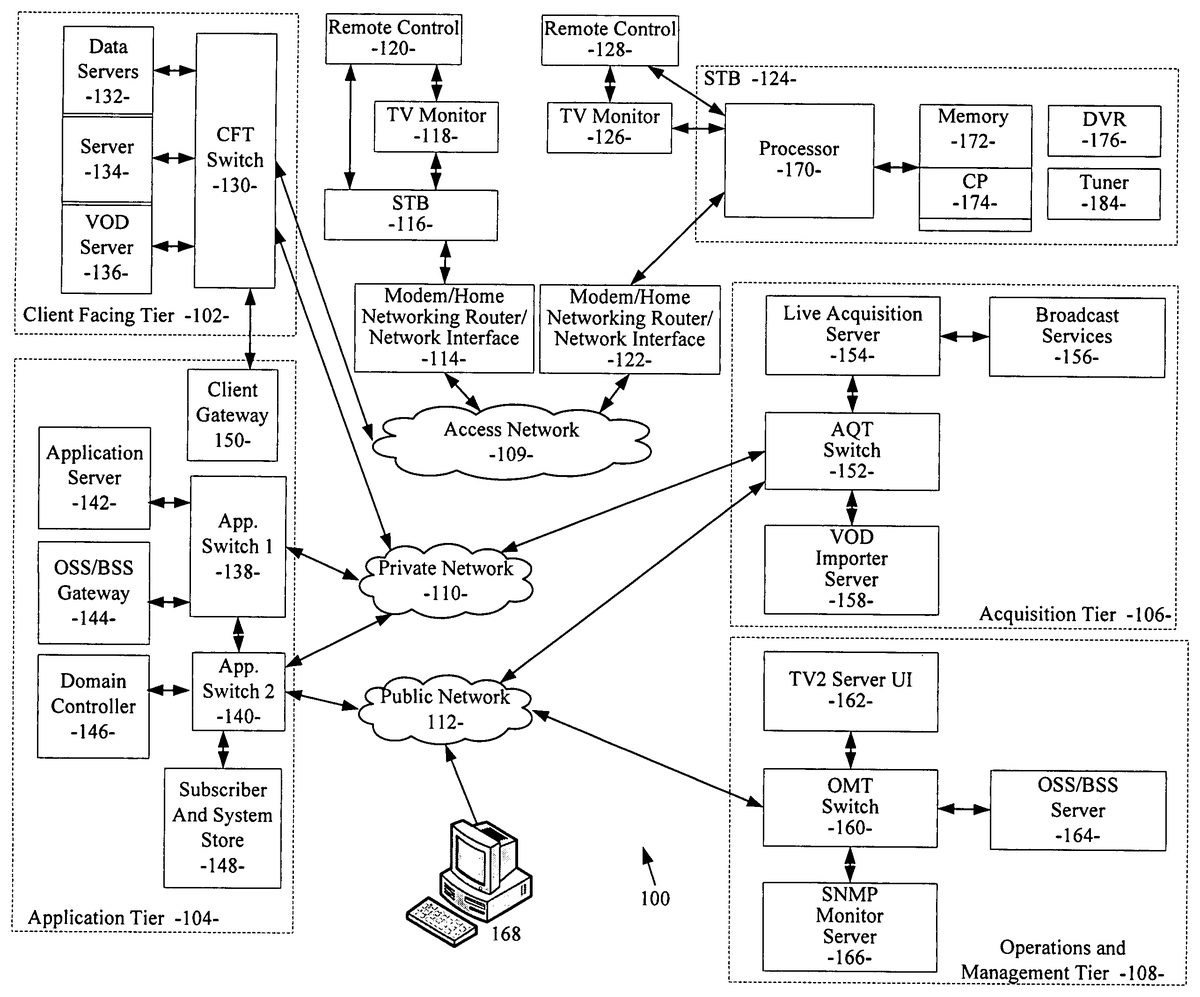
Referring toFIG. 1, an example embodiment of an IPTV system is shown and is generally designated100. As shown, the system100can include a client facing tier102, an application tier104, an acquisition tier106, and an operations and management tier108. Each tier102,104,106,108is coupled to a private network110, a public network112, or both the private network110and the public network112. For example, the client-facing tier102can be coupled to the private network110. Further, the application tier104can be coupled to the private network110and to the public network112, such as the Internet. The acquisition tier106can also be coupled to the private network110and to the public network112. Moreover, the operations and management tier108can be coupled to the public network112.
As shown inFIG. 1, the various tiers102,104,106,108communicate with each other via the private network110and the public network112. For instance, the client-facing tier102can communicate with the application tier104and the acquisition tier106via the private network110. The application tier104can also communicate with the acquisition tier106via the private network110. Further, the application tier104can communicate with the acquisition tier106and the operations and management tier108via the public network112. Moreover, the acquisition tier106can communicate with the operations and management tier108via the public network112. In a particular embodiment, elements of the application tier104can communicate directly with the client-facing tier102.
As illustrated inFIG. 1, the client-facing tier102can communicate with user equipment via a private access network109, such as an Internet Protocol Television (IPTV) network. In an illustrative embodiment, conventional network interface devices including modems, home networking routers, and network interface hardware can be used to connect a user to the private access network109. As shown inFIG. 1, modem/home networking router/network interface devices (denoted herein as network interfaces)114and122can be coupled to the private access network109. The client-facing tier102can communicate with a first representative set-top box device116via the first network interface114and with a second representative set-top box device124via the second network interface122. The client-facing tier102can similarly communicate with a large number of set-top boxes, such as the representative set-top boxes116,124, over a wide geographic area, such as a regional area, a metropolitan area, a viewing area, or any other suitable geographic area that can be supported by networking the client-facing tier102to numerous set-top box devices.
In one embodiment, the client-facing tier102can be coupled to the network interfaces114,122via fiber optic cables. Alternatively, the network interfaces114and122can include digital subscriber line (DSL) modems that are coupled to one or more network nodes via twisted pairs, and the client-facing tier102can be coupled to the network nodes via fiber-optic cables. Each set-top box device116,124can process data received via the private access network109, via an IPTV software platform, such as Microsoft® TV IPTV Edition.
Additionally, the first set-top box device116can be coupled to a first display device118, such as a first television monitor, and the second set-top box device124can be coupled to a second display device126, such as a second television monitor. Moreover, the first set-top box device116can communicate with a first remote control120, and the second set-top box device124can communicate with a second remote control128.
In an exemplary, non-limiting embodiment, each set-top box device116,124can receive data or video from the client-facing tier102via the private access network109and render or display the data or video at the display device118,126to which it is coupled. In an illustrative embodiment, the set-top box devices116,124can include tuners, such as the tuner184shown inFIG. 1, that receive and decode television programming information for transmission to the display devices118,126. Further, the set-top box devices116,124can include a STB processor170and a STB memory device172that is accessible to the STB processor170. In a particular embodiment, the set-top box devices116,124can also communicate commands received from the remote control devices120,128back to the client-facing tier102via the private access network109.
In an illustrative embodiment, the client-facing tier102can include a client-facing tier (CFT) switch130that manages communication between the client-facing tier102and the private access network109and between the client-facing tier102and the private network110. As shown, the CFT switch130is coupled to one or more data servers132that store data transmitted in response to user requests, such as video-on-demand content. The CFT switch130can also be coupled to a server134that provides support for terminal devices, such as a game application server168and other devices with a common connection point to the private network110. In a particular embodiment, the CFT switch130can also be coupled to a video-on-demand (VOD) server136.
As shown inFIG. 1, the application tier104can communicate with both the private network110and the public network112. In this embodiment, the application tier104can include a first application tier (APP) switch138and a second APP switch140. In a particular embodiment, the first APP switch138can be coupled to the second APP switch140. The first APP switch138can be coupled to an application server142and to an OSS/BSS gateway144. The application server142provides applications to the set-top box devices116,124via the private access network109, so the set-top box devices116,124can provide functions, such as display, messaging, processing of IPTV data and VOD material, etc. In a particular embodiment, the OSS/BSS gateway144includes operation systems and support (OSS) data, as well as billing systems and support (BSS) data.
Further, the second APP switch140can be coupled to a domain controller146that provides web access, for example, to users via the public network112. The second APP switch140can be coupled to a subscriber and system store148that includes account information, such as account information that is associated with users who access the system100via the private network110or the public network112. In a particular embodiment, the application tier104can also include a client gateway150that communicates data directly to the client-facing tier102. In this embodiment, the client gateway150can be coupled directly to the CFT switch130. The client gateway150can provide user access to the private network110and the tiers coupled thereto.
In a particular embodiment, the set-top box devices116,124can access the system100via the private access network109, using information received from the client gateway150. The private access network109provides security for the private network110. User devices can access the client gateway150via the private access network109, and the client gateway150can allow such devices to access the private network110once the devices are authenticated or verified. Similarly, the client gateway150can prevent unauthorized devices, such as hacker computers or stolen set-top box devices from accessing the private network110, by denying access to these devices beyond the private access network109.
For example, when a set-top box device116accesses the system100via the private access network109, the client gateway150can verify subscriber information by communicating with the subscriber and system store148via the private network110, the first APP switch138and the second APP switch140. Further, the client gateway150can verify billing information and status by communicating with the OSS/BSS gateway144via the private network110and the first APP switch138. The OSS/BSS gateway144can transmit a query across the first APP switch138, to the second APP switch140, and the second APP switch140can communicate the query across the public network112to the OSS/BSS server164. After the client gateway150confirms subscriber and/or billing information, the client gateway150can allow the set-top box device116access to IPTV content delivered by a game application server168via server134and/or VOD content delivered via VOD server136. If the client gateway150cannot verify subscriber information for the set-top box device116, e.g., because it is connected to a different twisted pair, the client gateway150can deny transmissions to and from the set-top box device116beyond the private access network109.
As indicated inFIG. 1, the acquisition tier106includes an acquisition tier (AQT) switch152that communicates with the private network110. The AQT switch152can also communicate with the operations and management tier108via the public network112. In a particular embodiment, the AQT switch152can be coupled to a live acquisition server154that receives television content, for example, from a broadcast service156. Further, the AQT switch152can be coupled to a video-on-demand importer server158that stores television content received at the acquisition tier106and communicates the stored content to the client-facing tier102via the private network110.
FIG. 1further illustrates that the operations and management tier108can include an operations and management tier (OMT) switch160that manages communication between the operations and management tier108and the public network112. In the embodiment illustrated inFIG. 1, the OMT switch160is coupled to a TV2 server162. Additionally, the OMT switch160can be coupled to an OSS/BSS server164and to a simple network management protocol (SNMP) monitor166that monitors network devices. In a particular embodiment, the OMT switch160can communicate with the AQT switch152via the public network112.
In a particular embodiment during operation of the IPTV system, the live acquisition server154can acquire television content from the broadcast service156. The live acquisition server154can transmit the television content to the AQT switch152, in turn, and the AQT switch152can transmit the television content to the CFT switch130via the private network110. Further, the CFT switch130can communicate the television content to the network interfaces114,122via the private access network109. The set-top box devices116,124can receive the television content from the network interfaces114,122, decode the television content, and transmit the content to the display devices118,126according to commands from the remote control devices120,128.
Additionally, at the acquisition tier106, the video-on-demand (VoD) importer server158can receive video-on-demand content from one or more VoD sources outside the IPTV system100. The VoD importer server158can transmit the VoD content to the AQT switch152, and the AQT switch152, in turn, can communicate the content to the CFT switch130via the private network110. The VoD content can be stored within the plurality of data servers132.
When a user issues a request for VOD content to a set-top box device116,124, the request can be transmitted over the private access network109to the VOD server136, via the CFT switch130. Upon receiving such a request, the VOD server136can retrieve requested VOD content from the plurality of data servers132and transmit the content to the set-top box device116,124across the private access network109, via the CFT switch130.
In an illustrative embodiment, the live acquisition server154can transmit the television content to the AQT switch152, and the AQT switch152, in turn, can transmit the television content to the OMT switch160via the public network112. In this embodiment, the OMT switch160can transmit the television content to the TV2 server162for display to users accessing the user interface at the TV2 server162. For example, a user can access the TV2 server162using the computer168coupled to the public network112.
As shown inFIG. 1, the domain controller146communicates with the public network112via the second APP switch140. Additionally, the domain controller146can communicate via the public network112with one or more user computers168(e.g. a personal computer or PC). For example, the domain controller146can display a web portal via the public network112and allow users to access the web portal using a PC168. In this manner, the user can use the PC168to access a web portal maintained by the domain controller146, via the public network112. The domain controller146can query the subscriber and system store148via the private network110for account information associated with the user. In a particular embodiment, the account information can associate the user's Internet account with the second set-top box device124. For instance, in an illustrative embodiment, the account information can relate the user's account to the second set-top box device124, by associating the user account with an IP address of the second set-top box device124, with data relating to one or more twisted pairs connected with the second set-top box device124, with data relating to one or more fiber optic cables connected with the second set-top box device124, with an alphanumeric identifier of the second set-top box device124, with any other data that is suitable for associating second set-top box device124with a user account, or with any combination of these.
In a particular embodiment, after the domain controller146has authenticated and verified the user, the domain controller146can allow the user to access his or her public data network user account, such as an Internet account, via the PC168. The user can enter preferences to the user account via the PC168. Each preference can indicate a type of content or game that the user prefers to play in conjunction with a web browser at the PC168and/or with a television display transmitted to a display device118,126by a set-top box device116,124. Further, the user can enter game preferences to the user account via the PC168.
Upon receiving one or more user preferences from the user via the PC168, the domain controller146can generate a user interface, or data associated with rendering a user interface, that incorporates the preferences received from the user. The user interface or related data can be associated with the user's set-top box device116,124and stored in conjunction with the user's Internet account. This information may be stored at the domain controller146, at the subscriber and system store148, or at any one or more components of the IPTV system100that are suitable for storing a user interface in conjunction with a set-top box identification and for communicating the user interface or related data to a web browser via the PC168and to a set-top box116,124via the private access network109.
In an exemplary, non-limiting embodiment, a user can request that the user interface associated with the user's set-top box device be displayed in conjunction with a web browser at the PC168. The user interface, or data associated with the user interface, can be transmitted by the domain server146to the PC168via the public network112. The PC168can display the user interface via its screen or monitor, or the PC168can generate and render the user interface from related data that it has received via its display. The user interface can overlay a portion of the web browser, or at least partially frame the web browser.
In another example embodiment, the user can request that the user interface be displayed in conjunction with television content at a display device118,126. The request can be received from the user's set-top box116,124at the CFT switch130via the private access network109. The request can be transmitted by the CFT switch130via the private network112to the device that stores the user interface, or data associated with the user interface, in conjunction with the user's account, such as the domain controller146or the subscriber and system store148. The user interface or related data can be received at the CFT switch130and transmitted to the requesting set-top box device116,124via the private access network109. In a particular embodiment, the CFT switch130can also transmit television programming that it receives from the acquisition tier106along with the user interface.
As shown inFIG. 1, a set-top box device, such as the second set-top box device124, can include a processor170and a memory device172that is accessible to the processor170. The set-top box device124can also include a computer program174that is embedded within the memory device172. In a particular embodiment, the computer program174can include instructions to receive a user interface and/or game that incorporate at least one content/game preference that a user has entered at a user account on a public network via the domain controller146. In another embodiment, the computer program174can include instructions to receive data associated with the user interface and/or game and instructions to generate and render the user interface and/or game at the display device118,126. The user interface and/or game can overlay a portion of the television programming, or at least partially frame the television programming, when the user interface and/or game is displayed at the display device118,126.
In an illustrative embodiment, the computer program174can include instructions to receive selections of web content at the set-top box device124via the user interface and to transmit web content to the display device126. For instance, a user can make selections on the user interface or control movements in an interactive game by using a remote control128to communicate with the set-top box device124. After the set-top box device124receives the user's selection/control movement data, the set-top box device124can transmit the selection/control movement data to the CFT switch130via the private access network109. The CFT switch130can transmit the selection/control movement data to the domain controller146via the private network110, for example, and the domain controller146can retrieve the requested web content from the public network112. The selected web content can be communicated back to the CFT switch130and to the set-top box device124via the private access network109. The set-top box device124can receive the selected content and transmit it to the display device126for display to the user. Additionally, selection/control movement data can be transmitted from the CFT switch130to server134and forwarded to a game server168. The game server168can process the selection/control movement data and communicate responsive data back to server134. Server134then forwards the responsive data to CFT switch130, which forwards the responsive data to the associated set-top box device124via the private access network109. The set-top box device124can receive and process the responsive data and generate updated images for display to the user on the display device126.
Referring toFIG. 2, an example embodiment of an interactive game system is shown and is generally designated as system200. In system200, a games server210is shown coupled to server134. In this configuration, games can be remotely processed and set-top box224can include a game rendering engine212that draws game imagery on TV monitor126. The games server210can communicate with set-top box224via Internet Protocol. The games provided to the end user at TV monitor126can be accessed via several entry points on the television monitor126and controlled via remote control device128. Each entry point can enable the user to switch from a live video stream on an acquisition server154in the network to a separate games server210, which opens a session with a game application. The games may be hosted by the games server210or at another source with a secure data link.
As shown inFIG. 2, games may be spooled via games server210(e.g. an RDP (remote desktop protocol) server) through an Interactive channel on the TV monitor126and controlled via remote control device128and set-top box224. The example embodiment shown inFIG. 2is not an optimal system for high-action games (i.e. games requiring fast-twitch input); but the example embodiment shown inFIG. 2is ideal for “parlour” games where a “quick trigger” isn't the game-winning factor. In a typical embodiment, the network communication will be on a unicast data stream.
In general, the system of an example embodiment comprises a television monitor including a remote control device, a set-top box connectable with the television monitor and with a network, and a games server connectable with the set-top box via the network, the games server to receive a game selection from a remote user via the set-top box, to activate the selected game on the games server, and to communicate game rendering information to the set-top box thereby enabling remotely playing the selected game via the television monitor and the remote control device.
As shown inFIG. 3, another example embodiment of an interactive game system is shown and is generally designated as system300. In system300, a games server310is shown coupled to Video-on-demand (VOD) server136. In this configuration, games may be converted to a VoD format (e.g. MP3) so that the animation intensive portions of the game can be re-encoded and further compressed. The responses to user inputs through remote control device128can be handled in smaller data packets, so that the network bandwidth is optimized for more action-oriented (e.g. user input intensive) games. In a typical embodiment, the network communication will be on a unicast data stream.
In general, the system of an example embodiment comprises a television monitor including a remote control device, a set-top box connectable with the television monitor and with a network, a video on demand (VoD) server connectable with the network to convert at least a portion of a game to a VoD format, and a games server connectable with the set-top box and the video on demand (VoD) server via the network, the games server to receive a game selection from a remote user via the set-top box, to activate the selected game on the games server, to request the video on demand (VoD) server to convert at least a portion of a game to a VoD format, and to communicate game information to the set-top box thereby enabling remotely playing the selected game via the television monitor and the remote control device.
Referring toFIG. 4, another example embodiment of an interactive game system is shown and is generally designated as system400. In system400, a games server410is shown coupled to server134. A games database411is shown coupled to games server410. In this configuration, games can be remotely selected, accessed, and downloaded by a user from games database411to the memory172of set-top box224via games server410. As a result, a downloaded game412can be made resident in set-top box224memory and executed locally by set-top box224processor170. Downloading the games directly to the set-top box224can be done via a unicast data stream as shown inFIG. 4. This embodiment will take all network traffic off of the network (after the initial download), but will require more decoding and processing abilities in the set-top box224. Using video decoding for the game action sequences and optimizing the rest of the game processing on the set-top box224will enable the use of “trigger-friendly” (e.g. user input intensive) games. The example embodiment shown inFIG. 4may also be used to distribute and/or sell downloaded games directly to the user, when games can be downloaded through the network to a console device (in addition to a set-top box).
In general, the system of an example embodiment comprises a television monitor including a remote control device, a set-top box connectable with the television monitor and with a network to execute a game downloaded via the network, and a games server connectable with the set-top box via the network, the games server to receive a game selection from a remote user via the set-top box, and to download the selected game to the set-top box via the network.
Referring toFIG. 5, another example embodiment of an interactive game system is shown and is generally designated as system500. In system500, a games server510is shown coupled to server134. A games database511is shown coupled to games server510. In this configuration and in a manner similar to system400, games can be remotely selected, accessed, and downloaded by a user from games database511to the memory172of set-top box224via games server510. However, in system500, a particular game in game database511can be partitioned into a plurality of separately downloadable partitions (e.g. separately downloadable levels). For example, as is well known to those of ordinary skill in the art, conventional games are typically offered in a plurality of levels. Game players can play at a first level until the level has been won/completed. Then, the game player can advance to a next level. In system500, the game selected by the user can be downloaded one level at a time and stored in set-top box224memory172as downloaded game level1(512). The set-top box224can then execute the downloaded game level1(512) until the user wins or completes the level. At that point, the user can initiate the downloading of the next level of the game from games database511. The next downloaded game level is stored in set-top box224memory172as downloaded game level n (514). The set-top box224can then execute the new downloaded game level n (514) until the user wins or completes that level. The process can be repeated for each available game level. As a result, a downloaded game can be made resident in set-top box224memory one level at a time and executed locally by set-top box224processor170. System500enables one to optimize the space on a set-top box224and not use all of the memory172for a single game. In this manner, games may be downloaded to the set-top box224by “level”. As the user achieves game goals and earns the right to move on, the set-top box224will make another call to the games server510requesting a new downloaded stream of the next game level. The game performance at the previous level may be uploaded to the games server510to retain the user's progress through the game levels. Once the new game level is downloaded to the set-top box224, actual game decoding will now be done at the new game level. Downloading the games level by level directly to the set-top box224can be done via a unicast data stream as shown inFIG. 5.
In general, the system of an example embodiment comprises a television monitor including a remote control device, a set-top box connectable with the television monitor and with a network to execute a game downloaded via the network, and a games server connectable with the set-top box via the network, the games server to receive a game selection and a level selection from a remote user via the set-top box, and to download the selected level of the selected game to the set-top box via the network.
Referring toFIG. 6, an example embodiment of a multi-platform multi-player interactive game system is shown and is generally designated as system601. In system601, a games server611is shown coupled to server134. A first game user at TV monitor126can access and execute a selected game using any of the embodiments described above. Additionally, other users can access games server611via public network112, Application switch2(140), private network110, CFT switch130, and server134. For example, a personal computer user can use personal computer621to access games server611. A wireless device user can use a wireless device (e.g. cellphone)623to access games server611via wireless system625and public network112. The logical connection between the games server611and computer621and wireless device623is shown by the dashed lines between these components inFIG. 6. In this manner, a plurality of users on a plurality of different platforms (e.g.621and623) can access games server611. Given the access by multiple remote game players as described above, games server611can initiate a game with multiple players all playing in the same game environment or playing the same game. Due to the nature of Internet Protocol delivery and the system designs described above, users are able to get the same type of games on multiple devices (e.g. multiple platforms, such as STB224, computer621, or wireless device623). The games servers611on the back end of the system601enable multi-player game play within and external to the IPTV network. This means that a user can maintain a list of “buddies” to play against where each of the multiple players could: 1) be on their TV126within the system601; 2) be on various devices (e.g multiple platforms) not necessarily on the IPTV network, but that integrate together via the games servers611on the back end; or 3) a user, for example, may be on TV126playing chess against a remote competitor on their cell phone623.
In general, the system of an example embodiment comprises a television monitor including a remote control device, a set-top box connectable with the television monitor and with a network, a second platform device connectable with the network, and a games server connectable with the set-top box and the second platform device via the network, the games server to receive a game selection from a first remote user via the set-top box, to receive a game selection from a second remote user via the second platform device, to activate the selected game on the games server, and to communicate game rendering information to the set-top box and the second platform device thereby enabling multi-player remote playing of the selected game via the television monitor and the remote control device and the second platform device.
Using the various example interactive game systems described above, users can obtain several advantages not presently available. In particular, users will have the ability to have contextual or related games appear on-screen at the same time as a live video stream. Additionally, users will have the ability to embed games into a broadcast video stream. For example, a user could play along with a game show (e.g. Jeopardy) while watching the video feed. Additionally, users will have the ability to include contextual games related to sports games so that the user may track an un-related “fantasy” sports team while watching some of their “players” compete with their specific league teams. Additionally, users will have the ability to play/pause and resume games so that the user may tune away briefly from a games channel and return to the game without penalty or loss of game status.
Referring toFIG. 7, an illustrative embodiment of a general computer system is shown and is designated600. The computer system600can include a set of instructions that can be executed to cause the computer system600to perform any one or more of the methods or computer based functions disclosed herein. The computer system600, or any portion thereof, may operate as a standalone device, such as the set-top box devices and servers shown inFIGS. 1-6, or may be connected, e.g., using a public network or a private network within an IPTV system, to other computer systems or peripheral devices.
In a networked deployment, the computer system may operate in the capacity of a server or as a client user computer in a server-client user network environment, or as a peer computer system in a peer-to-peer (or distributed) network environment. The computer system600can also be implemented as or incorporated into various devices, such as a personal computer (PC), a tablet PC, a set-top box (STB), a personal digital assistant (PDA), a mobile device, a palmtop computer, a laptop computer, a desktop computer, a communications device, a wireless telephone, a land-line telephone, a control system, a camera, a scanner, a facsimile machine, a printer, a pager, a personal trusted device, a web appliance, a network router, switch or bridge, or any other machine capable of executing a set of instructions (sequential or otherwise) that specify actions to be taken by that machine. In a particular embodiment, the computer system600can be implemented using electronic devices that provide voice, video or data communication. Further, while a single computer system600is illustrated, the term “system” shall also be taken to include any collection of systems or sub-systems that individually or jointly execute a set, or multiple sets, of instructions to perform one or more computer functions.
As illustrated inFIG. 7, the computer system600may include a processor602, e.g., a central processing unit (CPU), a graphics processing unit (GPU), or both. Moreover, the computer system600can include a main memory604and a static memory606that can communicate with each other via a bus608. As shown, the computer system600may further include a video display unit610, such as a liquid crystal display (LCD), an organic light emitting diode (OLED), a flat panel display, a solid state display, or a cathode ray tube (CRT). Additionally, the computer system600may include an input device612, such as a keyboard, and a cursor control device614, such as a mouse. When the computer system600, or any portion thereof, is embodied in a set-top box device, the cursor control device614can be a remote control device. The computer system600can also include a disk drive unit616, a signal generation device618, such as a speaker or remote control, and a network interface device620.
In a particular embodiment, as depicted inFIG. 7, the disk drive unit616may include a computer-readable medium622in which one or more sets of instructions624, e.g. software, can be embedded. Further, the instructions624may embody one or more of the methods or logic as described herein. In a particular embodiment, the instructions624may reside completely, or at least partially, within the main memory604, the static memory606, and/or within the processor602during execution by the computer system600. The main memory604and the processor602also may include computer-readable media.
In an alternative embodiment, dedicated hardware implementations, such as application specific integrated circuits, programmable logic arrays and other hardware devices, can be constructed to implement one or more of the methods described herein. Applications that may include the apparatus and systems of various embodiments can broadly include a variety of electronic and computer systems. One or more embodiments described herein may implement functions using two or more specific interconnected hardware modules or devices with related control and data signals that can be communicated between and through the modules, or as portions of an application-specific integrated circuit. Accordingly, the present system encompasses software, firmware, and hardware implementations.
In accordance with various embodiments of the present disclosure, the methods described herein may be implemented by software programs executable by a computer system. Further, in an exemplary, non-limited embodiment, implementations can include distributed processing, component/object distributed processing, and parallel processing. Alternatively, virtual computer system processing can be constructed to implement one or more of the methods or functionality as described herein.
The present disclosure contemplates a computer-readable medium that includes instructions624or receives and executes instructions624responsive to a propagated signal, so that a device connected to a network626can communicate voice, video or data over the network626. Further, the instructions624may be transmitted or received over the network626via the network interface device620.
While the computer-readable medium is shown to be a single medium, the term “computer-readable medium” includes a single medium or multiple media, such as a centralized or distributed database, and/or associated caches and servers that store one or more sets of instructions. The term “computer-readable medium” shall also include any medium that is capable of storing, encoding or carrying a set of instructions for execution by a processor or that cause a computer system to perform any one or more of the methods or operations disclosed herein.
In a particular non-limiting, exemplary embodiment, the computer-readable medium can include a solid-state memory such as a memory card or other package that houses one or more non-volatile read-only memories. Further, the computer-readable medium can be a random access memory or other volatile re-writable memory. Additionally, the computer-readable medium can include a magneto-optical or optical medium, such as a disk or tapes or other storage device to capture carrier wave signals such as a signal communicated over a transmission medium. A digital file attachment to an e-mail or other self-contained information archive or set of archives may be considered a distribution medium that is equivalent to a tangible storage medium. Accordingly, the disclosure is considered to include any one or more of a computer-readable medium or a distribution medium and other equivalents and successor media, in which data or instructions may be stored.
In conjunction with the configuration of structure and methods described herein, a system and method supporting interactive games on a television via internet protocol is described. The interactive games are selectable and can be played via an interactive user interface that is linked to a user's preferences. By associating user accounts with set-top box devices at the server level, preferences will be retrieved and recognized without the need for a user to log in to his or her television. Moreover, by attaching set-top box devices to Internet accounts, users can access and play personalized and interactive games.
In accordance with various embodiments, the methods described herein may be implemented as one or more software programs running on a computer processor. Dedicated hardware implementations including, but not limited to, application specific integrated circuits, programmable logic arrays and other hardware devices can likewise be constructed to implement the methods described herein. Furthermore, alternative software implementations including, but not limited to, distributed processing or component/object distributed processing, parallel processing, or virtual machine processing can also be constructed to implement the methods described herein.
It should also be noted that software that implements the disclosed methods may optionally be stored on a tangible storage medium, such as: a magnetic medium, such as a disk or tape; a magneto-optical or optical medium, such as a disk; or a solid state medium, such as a memory card or other package that houses one or more read-only (non-volatile) memories, random access memories, or other re-writable (volatile) memories. The software may also utilize a signal containing computer instructions.
Although the present specification describes components and functions that may be implemented in particular embodiments with reference to particular standards and protocols, the invention is not limited to such standards and protocols. For example, standards for Internet and other packet switched network transmission (e.g., TCP/IP, UDP/IP, HTML, HTTP) represent examples of the state of the art. Such standards are periodically superseded by faster or more efficient equivalents having essentially the same functions. Accordingly, replacement standards and protocols having the same or similar functions as those disclosed herein are considered equivalents thereof.
FIGS. 8-12are processing flow diagrams illustrating various methods related to example embodiments of an interactive game system in accordance with the disclosed subject matter. As shown inFIG. 8, an example method includes receiving a game selection from a remote user through a set-top box via a network (processing block810), activating the selected game on a games server (processing block812); and communicating game rendering information to the set-top box via the network thereby enabling remotely playing the selected game via a television monitor and a remote control device (processing block814).
As shown inFIG. 9, an example method includes receiving a game selection from a remote user through a set-top box via a network (processing block910), activating the selected game on a games server (processing block912), requesting a video on demand (VoD) server to convert at least a portion of a game to a VoD format (processing block914), and communicating game rendering information to the set-top box via the network thereby enabling remotely playing the selected game via a television monitor and a remote control device (processing block916).
As shown inFIG. 10, an example method includes receiving a game selection from a remote user through a set-top box via a network (processing block1010), downloading the selected game to the set-top box via the network (processing block1012), and activating the selected game on the set-top box (processing block1014).
As shown inFIG. 11, an example method includes receiving a game selection and a level selection from a remote user through a set-top box via a network (processing block1110), and downloading the selected level of the selected game to the set-top box via the network (processing block1112).
As shown inFIG. 12, an example method includes receiving a game selection from a first remote user via a first platform device via a network (processing block1210), receiving the game selection from a second remote user via a second platform device via the network (processing block1212), activating the selected game on a games server (processing block1214), and communicating game rendering information to the first platform device and the second platform device via the network thereby enabling multi-player remote playing of the selected game (processing block1216). As described above, games can be delivered to a user television and played by the user in a variety of ways. However, as a service provider, it is important to include an infrastructure for billing the user for the selected and delivered games. As described below, various methods can be used to charge a user for network-delivered games. These methods include the ability to promote games, to gain user interest before the user commits to paying for a fully-functional network-delivered game, to join games communities, and to foster user loyalty in a game service.
Currently, games are available through U.S. broadcast TV services for free or for a subscription for cable-delivered games. Games delivered via Internet Protocol (IP) are currently only available on a personal computer platform (PC), for which service providers charge subscription fees, require a fee-per-play, or are free (e.g. Yahoo! games). None of the currently-available games services on television offer the opportunity to join games communities, to try before you buy, or to foster user loyalty in a game service.
In support of a consumer billing infrastructure as part of the interactive game system on television via internet protocol of the various embodiments as described above, the games platform is integrated with IPTV ordering and billing systems in an example embodiment to ensure the customer is billed in a similar fashion to linear subscriptions or Video-on-Demand (VoD) purchases. IPTV ordering and billing systems can include paid subscription-based games (MRC and ARC) and usage-based games (pay-per-play) that can be accessed as follows in an example embodiment:Provisioned as a Channel in the television guideProvided from the Main MenuRemote Control keypress (e.g., Go Interactive button).Provided through a “games storefront”Provided with Multi-Platform games functionality—IPTV, Broadband, WirelessProvided with the ability to accept input from dual remote controls (for games). Use case would apply to a game optimized for TV that offers same multiplayer functionality.
In various embodiments, the provisioning of the payment options and the promotion of games can be implemented in various ways. In one embodiment, both free and purchasable games (subscription-based and usage-based) can be provisioned as RDP Channels (e.g. a dedicated channel), as a Main Menu selection (either interactive sub-menu or through a “games storefront”), and via the Remote Control (e.g., Go Interactive button). The IPTV system presents viewers who are not subscribed to the games content with a purchase sequence for purchasable games (e.g. subscription-based and pay-per-play), whether accessed from a linear content channel, Main Menu, or Remote Control key press (e.g., Go Interactive button). The purchase sequence top screen includes an offer panel and displays either a static full screen promotion (e.g. poster art) or video promotion when the channel is selected by the customer. In an example embodiment, the purchase sequence will maintain the “look and feel” of a VoD or pay-per-view (PPV) purchase so as not to confuse the customer. Customers are provided with the ability to “trial” subscription packages and pay-per-play games. This can be handled similarly to the preview before a VoD purchase. In one embodiment, the meta-data surrounding the game will include some functionality that is rated at a $0 price point (i.e. free trial functionality). The core of the game (i.e. full functionality) will have a real price point (i.e. a price greater than $0) attached to the full functionality. Customers selecting the free trial option will be presented with screen that includes Game poster art, package description, duration of trial period and a “Try It Free” button. When the “Try it Free” button is selected, customers can receive a play grant and can get redirected to the Games Top Page for the selected package or pay-per-play game. In an example embodiment, flexible trial period parameters, e.g., 1-hour, 24-hours, 3-day pass, 30-day trial can be configured. These settings can be configurable within IPTV. In an example embodiment, these settings will be included in the game meta-data similarly to the “tar-ball” associated with VoD licensing. For subscription games, trial periods can be restricted to one per game package, per account, per (xx # of days, e.g., 120 days). For example: Mary signs up for a 3-day pass for a Kids Game Package. Mary would then be restricted from receiving any additional Free Trial for the Kids Games Package for 120-days from the expiration date of the initial trial period. The trial restriction period e.g., 1-month, 3-months, 6-months, 12-months is configurable within IPTV. For pay-per-play games, an example embodiment can offer one free game play, per account, per (xx # of days, e.g., 120 days). For example: When a customer selects the “Try It Free” button, they can be granted access to the game for “x” number of plays, e.g., 1, 3, or a set period of time, e.g. 1-hour. In another example embodiment, fantasy games can be supported with a seasonal subscription, Join league functionality, or Create and Manage your own league functionality.
Subscription and usage-based games can be billed separately, or may also be bundled with other video assets to up-sell bolt-on packages (VoD, SVoD and PPV). Below are some price packaging examples to illustrate the desired functionality.
Games Subscription Package−Only
Customer orders a Game Subscription Package for $x.xx/month. This is a monthly recurring charge (MRC).
On Demand (SVoD)+Games Subscription Package
Customer orders an On Demand content service for $x.xx and gets a Game subscription package free for the first month and $x.xx thereafter at a bundled pricing discount.
Kids+Games Subscription Package
Customer orders a Kids content service for $x.xx/month and gets a Games subscription package free for the first month and $x.xx thereafter at a bundled pricing discount.
All In One Package
Customer orders a Classics content service+Kids content service+On Demand content service+Games at bundled price of $xx.xx/month
VoD purchase+Game Pass (Trial)
Customer orders a VoD movie and gets a free 3-day Games Pass. After 72-hours, the consumer would be notified and prompted to purchase a Games Subscription.
Various embodiments include the ability for customers to purchase a bundle of units for a one-time charge, e.g., “5 Plays for $5”, and receive a purchase display when each unit is consumed. That is, for example, if the customer is using the third consumption of the “5 Plays for $5”, the customer can be advised that they have two more units available as part of the original purchase. Various embodiments include usage based promotions for gaming such that a buy x units within y period can be supported. This will allow a marketing operation to run promotions such as “buy Quake for a one time fee of $10 and re-start game 5 times within the next 24 hrs”. Various embodiments also support loyalty-based programs for gaming. For example, a loyalty program can accumulate “gaming” points based on time/spend/performance by a user. A loyalty program can enable a user to redeem points for cash/prize/IPTV discounts. This can be expanded across IPTV to drive revenue and user interaction, and reduce chum. Some games may include the ability for the user to advance by purchasing implements to better enable their ability to play. This may include the purchase of a “spell” for a fantasy game, or the purchase of armor for an action-based game. Various embodiments include the ability for the user to make those “accoutrement” purchases through the IPTV platform described above.
The illustrations of the embodiments described herein are intended to provide a general understanding of the structure of the various embodiments. The illustrations are not intended to serve as a complete description of all of the elements and features of apparatus and systems that utilize the structures or methods described herein. Many other embodiments may be apparent to those of skill in the art upon reviewing the disclosure. Other embodiments may be utilized and derived from the disclosure, such that structural and logical substitutions and changes may be made without departing from the scope of the disclosure. Additionally, the illustrations are merely representational and may not be drawn to scale. Certain proportions within the illustrations may be exaggerated, while other proportions may be minimized. Accordingly, the disclosure and the figures are to be regarded as illustrative rather than restrictive.
One or more embodiments of the disclosure may be referred to herein, individually and/or collectively, by the term “invention” merely for convenience and without intending to voluntarily limit the scope of this application to any particular invention or inventive concept. Moreover, although specific embodiments have been illustrated and described herein, it should be appreciated that any subsequent arrangement designed to achieve the same or similar purpose may be substituted for the specific embodiments shown. This disclosure is intended to cover any and all subsequent adaptations or variations of various embodiments. Combinations of the above embodiments, and other embodiments not specifically described herein, will be apparent to those of skill in the art upon reviewing the description.
The Abstract of the Disclosure is provided to comply with 37 C.F.R. §1.72(b) and is submitted with the understanding that it will not be used to interpret or limit the scope or meaning of the claims. In addition, in the foregoing Detailed Description, various features may be grouped together or described in a single embodiment for the purpose of streamlining the disclosure. This disclosure is not to be interpreted as reflecting an intention that the claimed embodiments require more features than are expressly recited in each claim. Rather, as the following claims reflect, inventive subject matter may be directed to less than all of the features of any of the disclosed embodiments. Thus, the following claims are incorporated into the Detailed Description, with each claim standing on its own as defining separately claimed subject matter.
The above disclosed subject matter is to be considered illustrative, and not restrictive, and the appended claims are intended to cover all such modifications, enhancements, and other embodiments, which fall within the true spirit and scope of the present invention. Thus, to the maximum extent allowed by law, the scope of the present invention is to be determined by the broadest permissible interpretation of the following claims and their equivalents, and shall not be restricted or limited by the foregoing detailed description.
Claims
- An apparatus comprising a memory coupled to a processor, wherein the memory comprises computer instructions, which when executed by the processor, cause the processor to perform operations comprising: receiving a game selection from a set-top box;activating the selected game;and communicating to the set-top box a game rendering video stream embedded in a broadcast video stream to enable remote play of the selected game via a television monitor and a remote control device while further enabling simultaneous display via the television monitor of a television program supplied in the broadcast video stream.
- The apparatus as claimed in claim 1 wherein the processor is configured to open a session with a game application corresponding to the selected game.
- The apparatus as claimed in claim 1 wherein the processor is configured to communicate with the set top box via a secure data link.
- The apparatus as claimed in claim 1 wherein the processor is configured to spool the selected game to the set-top box through an interactive channel on the television monitor.
- A system comprising: a video on demand server communicatively coupled to a network to convert at least a portion of a game to a video on demand format;and a games server connectable with a set-top box and the video on demand server via the network, wherein the games server is adapted to perform operations comprising: receiving a game selection from a remote user via the set-top box;activating the selected game on the games server, to request the video on demand server to convert at least a portion of a game to a video on demand format;and communicating a game video stream to the set-top box to enable remote play of the selected game via a television monitor and a remote control device.
- The system as claimed in claim 5 wherein at least a portion of the selected game is converted to a moving pictures expert group 3 format.
- The system as claimed in claim 5 wherein network communications between the game server and the set-top box is over a unicast data channel.
- An apparatus comprising a memory coupled to a processor, wherein the memory comprises computer instructions, which when executed by the processor, cause the processor to perform operations comprising: receiving a game selection at a user interface;communicating the game selection to the games server;and receiving from the games server a game rendering video stream embedded in a broadcast video stream to enable remote play of the selected game via a television monitor and a remote control device while further enabling simultaneous display via the television monitor of a media program supplied in the broadcast video stream.
- The apparatus as claimed in claim 8 wherein the processor is configured to communicate to the games server via a secure data link.
- A method comprising: receiving a game selection from a remote user through a set-top box via a network;activating the selected game on a games server;and communicating a game rendering video stream embedded in a broadcast video stream to the set-top box via the network to enable remote play of the selected game via a television monitor and a remote control device while further enabling simultaneous display via the television monitor of a media program supplied in the broadcast video stream.
- The method as claimed in claim 10 wherein the games server opens a session with a game application corresponding to the selected game.
- The method as claimed in claim 10 wherein the games server is communicatively coupled to the set top box via a secure data link.
- A method comprising: receiving a game selection from a remote user through a set-top box via a network;activating the selected game on a games server;requesting a video on demand server to convert at least a portion of the selected game to a video on demand format;and communicating a game rendering video stream embedded in a broadcast video stream to the set-top box via the network, to enable remote play of the selected game via a television monitor and a remote control device while further enabling simultaneous display via the television monitor of a media program supplied in the broadcast video stream.
- The method as claimed in claim 13 wherein at least a portion of the selected game is converted to an MP3 format.
- An article of manufacture comprising at least one non-transitory machine readable storage medium having one or more computer programs stored thereon and operable on one or more computing systems at least to: receive a game selection from a remote user through a set-top box via a network;activate the selected game;and communicate a game rendering video stream embedded in a broadcast video stream to the set-top box via the network to enable remote play of the selected game via a television monitor and a remote control device while further enabling simultaneous display via the television monitor of a media program supplied in the broadcast video stream.
- The article of manufacture as claimed in claim 15 wherein the one or more computing systems are operable to connect to the set top box via a secure data link.
Disclaimer: Data collected from the USPTO and may be malformed, incomplete, and/or otherwise inaccurate.