U.S. Pat. No. 8,262,474
METHOD AND DEVICE FOR CONTROLLING PLAYER CHARACTER DIALOG IN A VIDEO GAME LOCATED ON A COMPUTER-READABLE STORAGE MEDIUM
Issue DateMay 16, 2010
Illustrative Figure
Abstract
In a computing machine having a processing unit, memory and a display device for playing a video game, the video game comprising at least one or more game characters, the at least one or more game character being controlled by a special purpose computing input device connected to said computer and operable by a game player, the video game further comprising character dialog between or among the at least one or more game characters, the character dialog comprising vignettes of dialog wherein movement from one vignette to another is determined by the game player introducing emotion into the dialog by means of the special purpose computing input device. The special purpose computing input device introduces emotion into the video game during a character dialog or character encounter along an axis of a joystick or other game controller element.
Description
DETAILED DESCRIPTION OF THE PREFERRED EMBODIMENT Referring toFIG. 1, a graphical representation is shown of a vertical “x” axis having two opposed emotions (anger and placation) positioned at the 12 and 6 o'clock positions, respectively. The two opposed emotions of anger and placation of the method and on the device (i.e., a console game controller) of the present invention are used for illustrative purposes only herein and does not limit the present invention to just these two emotions. A multitude of varying opposed emotions could be used to affect the method or operate the device of the present invention. Also shown onFIG. 1, joystick10is positioned along the x axis at a middle portion, which can be operated along the x axis in opposed directions to introduce the two opposed emotions of anger and placation and done so in varying degrees from slight anger to extreme anger and from sight placation to extreme placation. Nothing herein limits the degrees to just four levels as indicated by the hash marks shown along the x axis. The hash marks are merely used to illustrate that some definable value of emotion can be introduced into the video game and then controlled by the device such as a game controller. The levels of emotion can be any number less than or more than zero or any fraction thereof. Accordingly, and merely by way of example, positive or negative values of 1, 2, 3 and 4 can be introduced or fractional values having either a positive and negative value can also be introduced, such as 1.1, 1.2, 1.3, and so on. Further, as shownFIG. 1, the introduction of a positive value, by placing pressure on joystick10, introduces anger, and the introduction of a negative value, also by placing pressure on joystick10, but in the opposite direction, ...
DETAILED DESCRIPTION OF THE PREFERRED EMBODIMENT
Referring toFIG. 1, a graphical representation is shown of a vertical “x” axis having two opposed emotions (anger and placation) positioned at the 12 and 6 o'clock positions, respectively. The two opposed emotions of anger and placation of the method and on the device (i.e., a console game controller) of the present invention are used for illustrative purposes only herein and does not limit the present invention to just these two emotions. A multitude of varying opposed emotions could be used to affect the method or operate the device of the present invention.
Also shown onFIG. 1, joystick10is positioned along the x axis at a middle portion, which can be operated along the x axis in opposed directions to introduce the two opposed emotions of anger and placation and done so in varying degrees from slight anger to extreme anger and from sight placation to extreme placation. Nothing herein limits the degrees to just four levels as indicated by the hash marks shown along the x axis. The hash marks are merely used to illustrate that some definable value of emotion can be introduced into the video game and then controlled by the device such as a game controller. The levels of emotion can be any number less than or more than zero or any fraction thereof. Accordingly, and merely by way of example, positive or negative values of 1, 2, 3 and 4 can be introduced or fractional values having either a positive and negative value can also be introduced, such as 1.1, 1.2, 1.3, and so on. Further, as shownFIG. 1, the introduction of a positive value, by placing pressure on joystick10, introduces anger, and the introduction of a negative value, also by placing pressure on joystick10, but in the opposite direction, introduces placation.
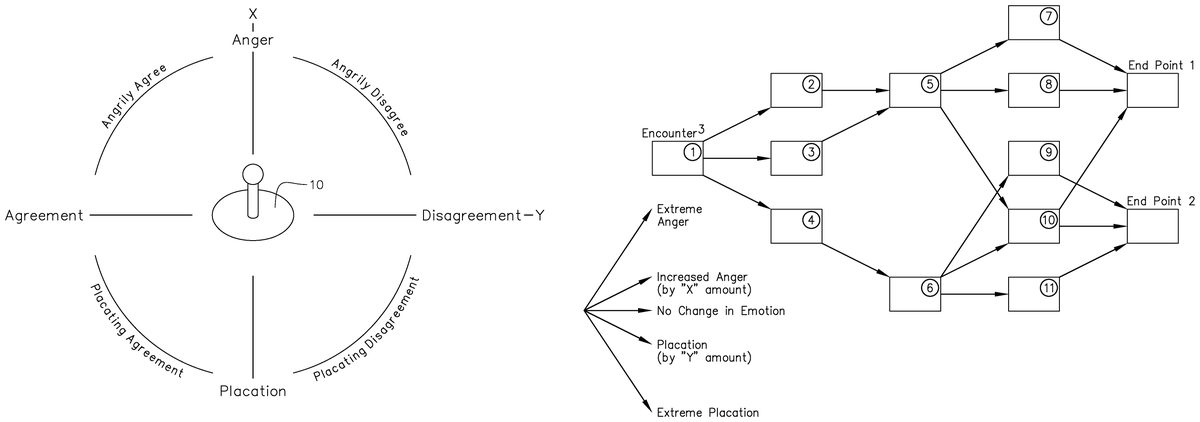
Referring toFIG. 2, an alternate embodiment of the present invention is shown wherein the emotional vertical x axis is intersected by a horizontal “y” axis, which is used to introduce, in this example, agreement or disagreement in a character dialog in a video game. Although not limited to just these two choices, in the example ofFIG. 2, agreement is located at the 9 o'clock position and disagreement is positioned at the 3 o'clock along the y axis. Other opposing responses could be used that are predicated upon beliefs, attitudes, experiences and personal knowledge, which are the typical the driving forces in these types of responses.
As shown inFIG. 2, joystick10can again be used to introduce the game player's character's choice of response. Although hash marks are not shown herein, it is understood that some definable number of levels of agreement and disagreement (or other responses) can be introduced from a number less than, equal to or greater than zero and any fraction thereof as described directly above. Such description is incorporated herein.
Still further toFIG. 2, it is shown that the intersection of the x axis and the Y axis creates four quadrants, which are a hybrid, or a mix, of the emotion that was introduced in combination with the agreement or disagreement choice injected into the character dialog of the video game. As can be appreciated, the number of dialog outcomes is expanded by a great number over that of the example inFIG. 1, wherein only emotion is introduced. In using the example ofFIG. 2, but with an understanding that other emotions could be used along the vertical x axis and that different response choices could be employed along the horizontal y axis, the four quadrants created are “Angrily Disagree” between 0-90 degrees (Quadrant I), “Angrily Agree” between 270-360 degrees (Quadrant II), “Placating Agreement” between 180-270 degrees (Quadrant III) and “Placating Disagreement” between 90-180 degrees (Quadrant IV). And, any degree between the ranges of degrees in each of the four quadrants could be introduced. So, by way of example, the game player's character could angrily disagree at 70 degrees, which would be a stronger disagreement than at 10 degrees (i.e., he is moving away from the 90 degree position of total disagreement along the horizontal y axis and moving more towards agreement located at 270 degrees, but with anger dictated by the movement forward (upward) along the vertical x axis with joystick10. Any of the four quadrants can be utilized in this manner to introduce a plurality of varying emotion in combination with the agreement/disagreement choice. Examples of the remaining quadrants will not be set provided as it is understood by this one example how the different quadrants operate.
Referring now toFIG. 3, a simplified flow diagram is shown wherein a first Encounter1dialog is represented by block1. As shown in an index ofFIG. 3(as well asFIGS. 4 and 5), all in the lower left hand corner of each figure, respectively, certain angled arrows represent different states of emotion, which can be introduced into a dialog sequence or “vignette.” The arrows themselves do not represent single numerical values that must be introduced when using a device such as a game controller to move from one vignette block to another, but instead represent threshold amounts of actual emotion that must be reached, which are aggregate within each vignette as well as throughout the entire encounter that are calculated by player input against individual vignette pre-programmed additives and exit multipliers and modifiers (to be more fully discussed in detail inFIGS. 10-12). The agreement and disagreement x and y axis will not be used in the example ofFIG. 3, nor in the examples ofFIGS. 4 and 5either, as it is well understood how they can be used by the description directly above.
In the index ofFIG. 3, a horizontal axis (not to be compared or confused with the description ofFIGS. 1 and 2) represents no change in emotion (no increase or decrease to the current aggregate level of emotion) or no response by the game player character. It is important to understand that the no change of emotion could be a “no change in anger” or a “no change in placation.” Nothing herein limits that the “no change of emotion” arrow means neither placation nor anger. Instead it just means that the current state of emotion, be it placation or anger, has not changed its numeric value due to no engagement of joystick10when presented with a question or statement by an NPC or other game character. Each block inFIG. 3is numbered sequentially and each represents a “vignette” or dialog sequence between two or more characters. However, in the preferred embodiment, the method of the present invention uses a dialog sequence between two characters in a video game. Further, nothing herein limits each vignette to one statement/question and one emotional response. Each vignette can contain numerous question/statements and emotional responses or just one set for each.
With continuing reference toFIG. 3, and by using the example that there is only one NPC question/statement and one game player character emotional response, for simplicity purposes, dialog Encounter1occurs. In response to a statement or question posed by an NPC, the game player character increases his anger to some amount wherein the aggregate amount of anger (some unknown threshold to the game player) leads him to vignette block number2. However, no change of emotion or no response moves the game player character to vignette block number3, while placation (lowering the level of anger or other current state of emotion by some unknown threshold number by the game player) takes the game player character to vignette block number4. Now in this example, depending on which vignette the game player character finds himself, it can be seen that he can never get to either End Point1or End Point2by passing through the yet unknown dialog that occurs in vignette block numbers7and9unless the game player character had placated to a threshold level at Encounter1that permitted him to move to vignette block4. This illustrates how a player may placate but may not necessarily go to a certain dialog pathway, because the placation did not reach the required threshold level. In other words, placation to some threshold number may take the player along a pathway wherein the changes of emotion will simply have no effect on the moving the game character out from said defined directional pathway until he reaches some required end point. For avoidance of doubt, moving from one vignette block to the next represents the movement along a single pass-through dialog sequence, of which there are a multitude of said sequences depending on what subsequent vignette block is reached each time the game player imparts pressure to joystick10on the computing input device.
Further toFIG. 3, if the game player character increased his anger to a certain aggregate threshold level, he would have moved to vignette block2, which can then lead him to End Point1by first not changing his emotion (or not responding) and then moving to vignette block5, and then thereafter placating to move to vignette block8and then finally increasing his anger again to move to End Point1, or a “no change in emotion” to move to End Point2. Or, he could have placated at vignette block2, which then moves him to vignette6; thereafter, his only choice is to maintain his emotion (or not respond), which moves him to vignette block8, whereby an increase in anger gets him to End Point1and no change in emotion takes him to End Point2. All of the above movements through the vignettes and through the dialog drama again presume that certain aggregate threshold levels have been reached, or have fallen there below, based upon the pressure exerted upon joystick10to impart a certain value in combination with pre-defined values for additives, multipliers and modifiers of each vignette block. To avoid any doubt, the emotional decisions being made are based on what the game player is hearing and seeing and how the drama is unfolding (i.e., the momentum of the game). If he feels angry all of sudden, and he has been placating, then he can shift his emotion, but that is based purely on the drama and of not knowing what vignette he is in and how close he is to reaching a specific end point (i.e., removal of meta-gaming). And, if a certain vignette does not allow a “higher” or “lower” move to another vignette, regardless of his attempt to add to his exiting aggregate anger or placation, then he will just move along horizontally until such time he reaches a defined end point or such aggregated anger or placation passes a threshold value that allows him to move to a vignette of increased anger (and therefore more challenged aesthetics, by way of example) or increased placation (and therefore more narrative aesthetics, by way of another example).
With continuing reference toFIG. 3, if the game player had not changed his emotion at Encounter1, he would then move to vignette block3, which only gives him the option to move to vignette block6, which again gives him only one option and that is move to vignette8, regardless of whether he completely placates or “freaks-out”. In this example, no “doors” are opened to other vignettes regardless of his emotional state or desire to change his current emotional state by use of the computing input device. At vignette8, however, he can either maintain his emotion (or no respond or placate) and move to End Point2or increase his anger to some threshold value, unknown to the game player while the drama is unfolding, and move to End Point1.
If however, the game player had placated to the proper threshold level at Encounter1, then he would have moved to vignette block4. Here, extreme anger can take him to vignette block5and provides him all of the options that are available, as previously described before at vignette block5. Or, the game player can maintain his emotion (or not answer or continue to placate) and he then moves to vignette block7and then again maintains his emotion (or introduces the other non-threshold exceeding emotional values) and thereby moves to vignette block9. But here, the game player character has found that he is in an interesting position wherein only increased anger (taking him to End Point2) and extreme anger (taking him to End Point1) can get him out of this encounter. The character can placate as much as he wants, but it will only take him to the lowest card in the subsequent column (not shown here, but will be fully described in the detailed description ofFIGS. 10-12).
Referring now toFIG. 4, another simplified flow diagram is shown where an Encounter2is carried through. In such encounter the game player character can introduce four different emotional states having certain threshold values. He can introduce extreme anger, which takes him to vignette block2, increased anger, which takes him to vignette block3, no change in emotion (or no response), which takes him to vignette block4or placation, which takes him to vignette block5. The remaining details of how the player reaches either End Point1or End Point2is understood by the above set forth logic and description that occurred inFIG. 3.FIG. 4merely represents a different encounter scenario.
Referring toFIG. 5, yet another example of a simplified flow diagram wherein an Encounter3is played out. In Encounter3, the details of the exact outcomes at each end point will again not be followed through like that ofFIG. 3, as it evident as to the previous explanations on how the dialog vignettes play-out. However, it should be noted thatFIG. 5(Encounter3) allows for an extreme placation move (vignette block5to10) to allow someone the possibility to reduce the confrontation by some great threshold value and encourage a more peaceful outcome through dialog and intellect, even though by doing so, the game player does not know that such extreme placation will “defuse” the situation. As can be seen inFIG. 5, once the player character reaches vignette block10, extreme anger still can be used if it appears that extreme placation did not diffuse the situation in a way that the player wanted it to. But again, the game player is unaware if such action will provide him a certain result, since searching for results (i.e., meta-gaming) is not encouraged in the present invention having the single pass-through dialog sequencing employed herein.
Referring toFIG. 6, a prior art video game character encounter with dialog is illustrated. In such encounter an avatar has encountered an NPC, who may be one of many different characters in which a dialog is programmed to occur there between and wherein a traditional dialog tree is used, but represented by emotions instead of actual sentence or word choices displayed across a video screen. This is distinguishable from the present invention wherein actual and real life emotions such as anger and placation, by way of example, of two opposed emotions, can be introduced into character dialog to make it a more fluid activity of the game and to allow the emotions of the game player to have a larger outcome of said dialog. This then operates to keep the game player affixed within the drama of the overall game and in each particular dialog encounter as they occur, thereby maintaining and increasing game momentum. This makes the game player more realistically feel the emotion of the video game by making the drama the reward, prize or fun of the game. My method and device of the present invention is also distinguishable from that which is seen inFIG. 6, because it directs the game player away from meta-gaming by keeping him focused on each encounter through the use of his emotions and not focused on a list of predefined responses, albeit inFIG. 6they are represented by one word emotional states, which are preprogrammed by the game developer. The prior art game ofFIG. 6encourages meta-gaming, its dialog is developed with a dialog tree, whereby looping can be practiced. This game does not employ single pass-through dialog encounters, such as my present invention.
Referring toFIG. 7, a typical dialog tree is shown, which is employed in typical prior art video game character dialog. As shown therein, the dialog tree is circular in nature (a loop) and only leads to one end point or “End Conversation.” This feature encourages meta-gaming. As further depicted underneath “Questions & Answers,” a minimum number of choices are provided to an avatar and he can choose each one, see where it leads him and then return to the same spot and “try again” to see where the other path leads him if he chooses one of the other limited, pre-programmed choices. This is clearly distinguishable from my invention (which will be more fully described herein below) in that once an emotion is inputted on the controller device the avatar must follow the pathway that directs him and he is unable to circle back around and see where another pathway may have lead him if he chooses a different emotional value. My method and device direct the game player's avatar into single pass-through dialog scenarios.
Referring now toFIG. 8, a typical game console controller12is shown having at least joystick10. As can be seen though, there are a plurality of other buttons available, which can be used in the method and device of the present invention. For instance, if joystick10is used to input an emotion (pushing forward along vertical x axis for anger for a positive numerical value like 0.5, 1.0, 2.0 or by pulling backwards along vertical x axis for placation for negative numerical value of −1.0, −1.5 or −2.0, to name just a few), then any of the other buttons can be programmed to “lock-in” the value of emotion so as to hold it there for a desired period of time chosen by the player, or for clearing an aggregate emotion value (or score) that has either accumulated during one given player character dialog sequence or one that has accumulated for a length of time in the video game so far, to name just a few examples. Nothing herein limits the use of any other of the buttons found on a typical game controller12. Further, game controller12resembles that which is used with the X-Box™. However, nothing herein limits the use of the present method and device with only the X-Box™, as it can be used with any of the well known gaming consoles, such as the Playstation 3™ and the Nintendo Wii™ or one of the other lesser known gaming consoles. Further, the present invention can be employed to operate on a standard PC or MAC™ or other like computing device or on-line in a MMORPG (or “Massively Multiplayer Online Role-Playing Game”). Further, nothing herein limits that the computing input device be a game console or any of the other aforementioned devices. The inputting of emotion or even mood can be done by other sources such as light or audio devices or could be imparted with the use of the newly advancing 3-D skeletal body movement reading devices such as that which is being released by Microsoft™ for their X-Box™, which is currently called “Project Natal™.” These devices, which are also being developed by other companies, are called Natural User Interface (NUI) and can be used with my method of the present invention and be the device that inputs the desired emotion. Referring now toFIGS. 9-9C, a simple, but preferred, single pass-through dialog sequence used in the present invention is shown. It is first noted that nothing herein limits any dialog sequence used in the present invention from being formed from only eight columns and having a maximum number of dialog cards in any given column to be five, as shown inFIGS. 9-9C. This has been done (and is carried throughout inFIGS. 10-12C) for the purposes of illustration only. Referring toFIGS. 9A-9C, the mechanics of each dialog card of this particular dialog encounter are shown. These mechanics include Node position and column designation (top left hand corner), card emotion value (top right hand corner), Exit Multipliers (Anger and Placate), Exit Additive Modifier as well as an indicator of the possible pathways leading from each card from the multitude of single pass-through dialog sequences, all predicated upon the player inputted emotion from the computing input device. The exact pathway that will be taken, which is unknown to the game player and therefore the player character, is determined by a “New Emotion Score” at each dialog card of the dialog sequence, which is a result of the game player's introduced emotion (i.e., anger or placation). However, unlike other prior art video games that permit meta-gaming, the introduction of emotion by the player character will not present him with an idea of where he is exactly going or more importantly, where does the programmer want him to go. Instead, his true, real-life emotion input will dictate the start and then the continuing pathway of the dialog (a single pass-through sequence) and thereby make it an integral component of the game being played, which maintains the desired momentum.
Referring now toFIGS. 10-10C, the same dialog as that which is shown inFIGS. 9-9Cis shown herein. However, in these figures, emotion values have been inputted at each Node or column (see the row of boxes along the top margins) to illustrate a one of 216 possible different pathways (seeFIG. 10C, card8-1) that could be taken in this particular dialog, wherein are each and every one is a single pass-through dialog sequence. In this example, all neutral, or 0.0 values, have been introduced at each Node. Therefore, with reference toFIG. 10, the dialog sequence can be seen to traverse the following pathway of individual dialog cards0-1,1-1,2-2,3-3,4-4,5-3,6-2,7-1and then finally to8-1(as shown by the black border highlights around each respective card).
With specific reference now toFIGS. 10A-10C, the inputting of a 0.0 emotion value at Node0(card0-1) with the computing input device, in combination with the appropriate Multiplier and the Modifier lead this particular dialog sequence to card1-1. Then at Node1(card1-1), the inputting of a 0.0 emotion value, again in combination with the appropriate Multiplier and the Modifier, lead the dialog sequence to card2-2. Thereafter, at Node2(card2-2), the inputting of a 0.0 emotion value, in combination with the appropriate Multiplier and the Modifier, lead the dialog sequence to card3-3. Then at Node3(card3-3), the inputting of a 0.0 emotion value, in combination with the appropriate Multiplier and the Modifier, lead the dialog sequence to card4-4. Next, at Node4(card4-4), the inputting of a 0.0 emotion value, in combination with the appropriate Multiplier and the Modifier, lead the dialog sequence to card5-3. Further, at Node5(card5-3), the inputting of a 0.0 emotion value, in combination with the appropriate Multiplier and the Modifier, lead the dialog sequence to card6-2. Then, at Node6(card6-2), the inputting of a 0.0 emotion value, in combination with the appropriate Multiplier and the Modifier, lead the dialog to card7-1. Finally, at Node7(card7-1), the inputting of a 0.0 emotion value, in combination with the appropriate Multiplier and the Modifier, lead the dialog sequence to card8-1, which is an end conversation node. In the preferred embodiment, an emotion value can be entered by the computing input device at Node8(or more specifically, the “End Conversation Card”). However, in alternate embodiments, no emotion value is inputted.
Referring now toFIGS. 11-11C, the same dialog as that which is shown inFIGS. 9-9Cis shown herein. However, in these figures, as was done inFIGS. 10-10C, emotion values have been inputted at each Node to illustrate a second of 216 possible different single pass-through dialog pathways that could be taken in this particular dialog encounter. In this example, various emotion input values are introduced by way of the computing input device. So, with reference first toFIG. 11, the dialog sequence can be seen to traverse the following pathway of dialog cards0-1,1-1,2-1,3-2,4-4,5-3,6-3,7-3and then finally to8-2(as shown by the black border highlights around each respective card).
With specific reference now toFIGS. 11A-11C, the inputting of a 1.0 anger emotion value at Node0(card0-1), in combination with the appropriate Multiplier and the Modifier lead the dialog sequence to card1-1. Then at Node1(card1-1), the inputting of another 1.0 anger emotion value, again in combination with the appropriate Multiplier and the Modifier, lead the dialog sequence to card2-1. Thereafter, at Node2(card2-1), the inputting of a 0.0 emotion value, in combination with the appropriate Multiplier and the Modifier, lead the dialog sequence to card3-2. Then at Node3(card3-2), the inputting of a −1.0 placate emotion value, in combination with the appropriate Multiplier and the Modifier, lead the dialog sequence to card4-4. Next, at Node4(card4-4), the inputting of a −2.0 placate emotion value, in combination with the appropriate Multiplier and the Modifier, lead the dialog sequence to card5-3. Further, at Node5(card5-3), the inputting of another −2.0 placate emotion value, in combination with the appropriate Multiplier and the Modifier, lead the dialog sequence to card6-3. Then, at Node6(card6-3), the inputting of a 0.0 emotion value, in combination with the appropriate Multiplier and the Modifier, lead the dialog sequence to card7-3. Finally, at Node7(card7-3), the inputting of a 2.0 anger emotion value, in combination with the appropriate Multiplier and the Modifier, lead the dialog sequence to card8-2, which is an end conversation node. Again, in the preferred embodiment, any emotion value can be entered by the player character by using the computing input device at Node8of the dialog (or more specifically, the “End Conversation Card”). However, in alternate embodiments, no emotion input value is necessary.
Referring now toFIGS. 12-12C, the same dialog as that which is shown inFIGS. 9-9Cis shown herein. However, in these figures, as was done inFIGS. 10-10Cand11-11C, emotion values have been inputted at each Node by the computing input device to illustrate a third of 216 possible different single pass-through dialog pathways that could be taken in this particular dialog. So, with reference first toFIG. 12, the dialog sequence can be seen to traverse the following pathway of dialog cards0-1,1-1,2-3,3-4,4-4,5-1,6-1,7-1and then finally to8-1(as shown by the black border highlights around each respective card).
With specific reference toFIGS. 11A-11C, the inputting of a −2.0 placate emotion value at Node0(card0-1), in combination with the appropriate Multiplier and the Modifier lead the dialog sequence to card1-1. Then at Node1(card1-1), the inputting of another −2.0 placate emotion value, again in combination with the appropriate Multiplier and the Modifier, lead the dialog sequence to card2-3. Thereafter, at Node2(card2-3), the inputting of yet another −2.0 placate emotion value, in combination with the appropriate Multiplier and the Modifier, lead the dialog sequence to card3-4. Then at Node3(card3-4), the inputting of a 2.0 anger emotion value, in combination with the appropriate Multiplier and the Modifier, lead the dialog sequence to card4-4. Next, at Node4(card4-4), the inputting of another 2.0 anger emotion value, in combination with the appropriate Multiplier and the Modifier, lead the dialog sequence to card5-1. Further, at Node5(card5-1), the inputting of a 0.0 emotion value, in combination with the appropriate Multiplier and the Modifier, lead the dialog sequence to card6-1. Then, at Node6(card6-1), the inputting of a −1.0 placate emotion value, in combination with the appropriate Multiplier and the Modifier, lead the dialog sequence to card7-1. Finally, at Node7(card7-1), the inputting of a 2.0 anger emotion value, in combination with the appropriate Multiplier and the Modifier, lead the dialog sequence to card8-1, which is an end conversation node. As before, in the preferred embodiment, any emotion value can be entered by a player character by using the computing input device at Node8of the dialog (or more specifically, the “End Conversation Card”). However, in alternate embodiments, no emotion input value is required.
Referring now toFIGS. 13A-13H, a series of calculation tables are shown that illustrate the manner in which a “New Emotion Score” is calculated for each card of a dialog vignette (like those seen inFIGS. 10-12), which then determines to which subsequent dialog card the character encounter will next flow after the game player imparts his emotion by way of the computing input device, like the gaming console controller12seen inFIG. 8.FIGS. 13A-13Hcorrespond to the dialog sequence ofFIGS. 11-11Cfor illustrative purposes. The calculation tables that would be used to determine the dialog sequence forFIGS. 10-10Cand12-12C would of course be different, even though the multipliers and additive modifiers in each dialog card of each column are the same in all three sets ofFIGS. 10-12. However, varying player input at each Node introduced with joystick10changes the “New Emotion Score” for each of the dialog sequences seen inFIGS. 10-12and thereby forges a different pathway (and as stated before, in this example, 216 different pathways). Further,FIGS. 10-12only show one simple example of a dialog sequence used in the present method and controlled by the device, and therefore the calculations for any other dialog sequence would be completely different. Still even further, a multitude of different pathways are available for the examples ofFIGS. 10-12. For instance, (referring back toFIGS. 10-12C) one can see that this particular dialog sequence allows for one pathway leading to cards0-1,1-1,2-1,2-2,2-3and3-1, two pathways for cards3-2,3-3,3-4and4-5, three pathways for card4-1, five pathways for cards4-2and4-3, six pathways for card4-4, eight pathways for card5-4, thirteen pathways for card5-3, nineteen pathways for cards5-1and5-2, twenty pathways for card6-3, thirty-seven pathways for card6-2, fifty-one pathways for card6-1, fifty-seven pathways for cards7-3and8-2, one hundred and eight pathways for cards7-1and7-2and two hundred and sixteen possible pathways for card8-1. Again it is noted that this is a simple dialog sequence, so it is not uncommon to have a more complex dialog sequence wherein the maximum number of possible pathways reaches into the thousands, clearly distinguishing the novel method and device for inputting emotion into a character dialog of a video game of the present invention from those of the prior art using dialog trees, wherein game player emotion, through his avatar and a computing input device, can be imparted into the game to affect the dialog sequence as it moves through a single pass-through sequence of a multitude of possible pathways.
Although not shown in any of three aforementioned examples ofFIGS. 10-12, there is a short circuit component that can be built into each and every dialog vignette. The purpose of the short circuit component is to traverse the entire dialog encounter regardless of where the game player's avatar is currently located within such vignette based upon aggregate emotion level (such as anger), which takes him straight out of the dialog encounter. Although many outcomes could be realized, a typical one would be the avatar killing the other character involved in the dialog encounter because his aggregate anger threshold has reached a level wherein the remaining dialog cards will not permit him to placate the encounter to a point to reach one of the “end conversation points.” He therefore prematurely exits from the encounter and in the preferred embodiment that exit would entail some form of violent confrontation for the anger emotion exit. The same is true for a placation “short circuit.” However, for placation, the threshold has reached a level so low, that no level of imparted anger can raise the avatar up from the place he finds himself and so he prematurely exits the encounter, by sulking away from the other character (for example) and having not gained anything.
With reference toFIG. 13A, the New Emotion Score of Node0is calculated by reading the player input of 1.0 (anger) and multiplying it by the Anger Exit Multiplier of 1.0 (the anger multiplier is used since an anger input was introduced), which gives you a value of 1.0. Then, the Exit Additive Modifier of 0.0 is added for an Adjusted Player Input of 1.0. This is then applied to the Previous Emotion Score of 0.0 providing a New Emotion Score of 1.0. Thereafter, looking atFIG. 11A, it is noted if any subsequent card in column1has an emotion score of 1.0. None do. Therefore, the dialog card having a value next lowest to the New Emotion Score is used, which in this case is card1-1. Then, with reference toFIG. 13B, the New Emotion Score of Node1is calculated by reading the player input of 1.0 and multiplying it by the Anger Exit Multiplier of 2.0, which gives you a value of 2.0. Then, the Exit Additive Modifier of 2.0 is added for an Adjusted Player Input of 4.0. This is then applied to the Previous Emotion Score of 1.0 providing a New Emotion Score of 5.0. Thereafter, looking atFIG. 11A, it is noted if any subsequent card in column2has an emotion score of 5.0. None do. Therefore, the dialog card having a value next lowest to the New Emotion Score is used, which in this case is card2-1. Next, with reference toFIG. 13C, the New Emotion Score of Node2is calculated by reading the player input of 0.0 and multiplying it by the Anger Exit Multiplier of 2.0 (the anger multiplier is used since the player character is in anger “state” at the moment), which gives you a value of 0.0. Then, the Exit Additive Modifier of 0.0 is added for an Adjusted Player Input of 0.0. This is then applied to the Previous Emotion Score of 5.0 providing a new Emotion Score of 5.0. Thereafter, looking atFIG. 11B, it is noted if any subsequent card in column3has an emotion score of 5.0. None do. Therefore, the dialog card having a value next lowest to the New Emotion Score is used, which in this case is card3-2.
Then, with reference toFIG. 13D, the New Emotion Score of Node3is calculated by reading the player input of −1.0 and multiplying it by the Placate Exit Multiplier of 4.0 (the placate multiplier is now used since the player placated with joystick10), which gives you a value of −4.0. Then, the Exit Additive Modifier of 3.0 is added for an Adjusted Player Input of −1.0. This is then applied to the Previous Emotion Score of 5.0 providing a new Emotion Score of 4.0. Thereafter, looking atFIG. 11B, it is noted if any subsequent card in column4has an emotion score of 4.0. None do. Therefore, the dialog card having a value next lowest to the New Emotion Score is used, which in this case is card4-4.
Then, with reference toFIG. 13E, the New Emotion Score of Node4is calculated by reading the player input of −2.0 and multiplying it by the Placate Exit Multiplier of 2.0, which gives you a value of −4.0. Then, the Exit Additive Modifier of 1.0 is added for an Adjusted Player Input of −3.0. This is then applied to the Previous Emotion Score of 4.0 providing a new Emotion Score of 1.0. Thereafter, looking atFIG. 11B, it is noted if any subsequent card in column5has an emotion score of 1.0. None do. Therefore, the dialog card having a value next lowest to the New Emotion Score is used, which in this case is card5-3.
Then, with reference toFIG. 13F, the New Emotion Score of Node5is calculated by reading the player input of −2.0 and multiplying it by the Placate Exit Multiplier of 2.0, which gives you a value of −4.0. Then, the Exit Additive Modifier of 2.0 is added for an Adjusted Player Input of −2.0. This is then applied to the Previous Emotion Score of 1.0 providing a new Emotion Score of −1.0. Thereafter, looking atFIG. 11C, it is noted if any subsequent card in column6has an emotion score of −1.0. None do. Therefore, the dialog card having a value next lowest than the New Emotion Score is used, which in this case is card6-3.
Next, with reference toFIG. 13G, the New Emotion Score of Node6is calculated by reading the player input of 0.0 and multiplying it by either the Placate or Anger Exit Multiplier of 3.0 and 2.0, respectively, (it makes no difference since you are multiplying by 0.0), which gives you a value of 0.0. Then, the Exit Additive Modifier of 2.0 is added for an Adjusted Player Input of 2.0. This is then applied to the Previous Emotion Score of −1.0 providing a new Emotion Score of 1.0. Thereafter, looking atFIG. 11C, it is noted if any subsequent card in column7has an emotion score of 1.0. None do. Therefore, the dialog card having a value next lowest to the New Emotion Score is used, which in this case is card7-3.
Next, with reference toFIG. 13H, the New Emotion Score of Node7is calculated by reading the player input of 2.0 and multiplying it by Anger Exit Multiplier of 1.0, which gives you a value of 2.0. Then, the Exit Additive Modifier of 0.0 is added for an Adjusted Player Input of 2.0. This is then applied to the Previous Emotion Score of 1.0 providing a new Emotion Score of 3.0. Thereafter, looking atFIG. 11C, it is noted if any subsequent card in column8has an emotion score of 3.0. None do. Therefore, the dialog card having a value next lowest to the New Emotion Score is used, which in this case is card8-2. This is an end point to the conversation of this dialog sequence. However, the player input can be read in the same manner such that with reference toFIG. 13I, the New Emotion Score of Node8is calculated by reading the player input of 0.0 and multiplying it either the Anger or Placate Exit Multiplier, which will give you a value of 0.0. Then, the Exit Additive Modifier of 0.0 is added for an Adjusted Player Input of 0.0. This is then applied to the Previous Emotion Score of 3.0 providing a new Emotion Score of 3.0. It should be noted that in this example the dialog card with the next lowest value to the New Emotion Score was used each time. However, if in the subsequent column any of the cards had the exact score, that card with said exact score would have been used to continue the dialog. The next lowest card is only used when no card has a value equal to the New Emotion Score.
In alternate embodiments of the present invention, the actual graphical representation of the game player's game character (the avatar) can be programmed to change his physical stance based upon the inputted emotional value (a so called “body language component”). For instance, if a low level of anger (i.e., aggravation) is inputted by the computing input device, the actual physical stance of the avatar on the display screen can be shown to pause when hears the answer that aggravates him, shift his body weight, quickly look to the side as he shakes his head in disagreement and takes a deep breath ors clear his throat before the audible response is given by the avatar. Or if a medium level of anger is inputted, the avatar can be shown to shift his body weight but towards the character that he is talking to, while his body tenses (such as his fists clenching) and his face shows an obvious state of agitation. Or, if an extreme level of anger is inputted, the avatar can tense up, grab for a weapon or another means of destructive force (i.e., summon a magical spell) or actually grab the other character and physically assault, hurt or kill him. The same can be true for placation, but wherein the typical body traits and actions associated with such emotion are imputed into the avatar's stance (i.e., dropping the shoulders, whining and slightly backing away from the other character, as one example of a multitude of placating stances.
Equivalent elements and steps of the method can be substituted for ones set forth herein to achieve the same results in the same way and in the same manner.
Claims
- A method for controlling character dialog in a video game displayed in a video game space, the steps of the method comprising: a) providing at least two game characters within said video game, b) displaying said at least two game characters in said video game space, c) permitting said at least two game characters in said video game space to interact in at least one dialog encounter, d) permitting a game player of said video game to control attributes of one of said at least two game characters, e) providing a computing input device in communication with said video game space, and f) activating said computing input device by said game player to control at least two opposing emotions of said one of said at least two game characters for affecting a sequence of character dialog events that occur between said at least two game characters during said at least one dialog encounter, the step of activating the computing input device by said game player triggering forward momentum of one of a plurality of single pass-through dialog sequences for said at least one dialog encounter, wherein each one of said plurality of single pass-through dialog sequences reaches at least one end point of said at least one dialog encounter by a different pathway, said sequence of character dialog events comprising a multiplicity of individual character dialog interactions, said step of activating said computing device to control said at least two opposing emotions occurring at each of said multiplicity of individual character dialog interactions of said at least one dialog encounter between said at least two game characters.
- The method of claim 1 , wherein said video game space is chosen from the group consisting of a gaming console and display screen, a personal computer, a hand held computing device, a laptop computer and a tablet computing device.
- The method of claim 2 , wherein said video game is executable within said video game space.
- The method of claim 3 , wherein said video game is executable within said video game space over a computing network chosen from the group consisting of a local area network, a wide area network or a world-wide system of interconnected networks.
- The method of claim 1 , wherein the step of displaying said at least two game characters in said video game space comprises the step of providing a display screen in communication with a computing device having a computer-readable medium, said computer-readable medium having computer-executable instructions for activating said video game.
- The method of claim 1 , wherein said computing input device is chosen from the group consisting of a gaming console controller, a computer keyboard, a computer mouse, a voice-activated response device, a heat or pressure sensitive control mechanism, a natural user interface and a 3-D body reactive imaging mechanism.
- The method of claim 6 , wherein said computing input device is a gaming console controller having at least one joystick moveable along at least one axis in a forward and backward direction.
- The method of claim 7 , wherein said at least two opposing emotions include anger and placation, said anger emotion inputted into said character dialog of said one of said at least two game characters by said game player by applying pressure in either said forward or said backward direction on said joystick, and said placation emotion inputted into said character dialog of said one of said at least two game characters by said game player by applying pressure on said joystick in said opposing direction to that of said anger emotion.
- The method of claim 1 , wherein said two opposing emotions include anger and placation.
- The method of claim 1 , wherein said step of activating said computing input device by said game player comprises the step of applying pressure on a mechanical device of said computing input device on at least a single axis of said mechanical device.
- The method of claim 1 , wherein each of said multiplicity of individual character dialog interactions has varying exit emotional multiplier values and exit additive modifier values, which are used to calculate an emotional score value in combination with a value attributed to said at least two opposing emotions activated by said game player with said computing input device, which controls said forward momentum of said one of a plurality of single pass-through dialog sequences from one of said multiplicity of individual character dialog interactions to a subsequent one of said multiplicity of individual character dialog interactions until said at least one end point is reached.
- A computer-readable storage medium having embodied thereon a video game program, said video game program executable by a computing device for performing steps of a method for controlling character dialog in said video game displayed in a video game space, the steps comprising: a) providing at least two game characters within said video game, b) displaying said at least two game characters in said video game space, c) permitting said at least two game characters in said video game space to interact in at least one dialog encounter, d) permitting a game player of said video game to control attributes of one of said at least two game characters, e) providing a computing input device in communication with said video game space, and f) activating said computing input device by said game player to control at least two opposing emotions of said one of said at least two game characters for affecting a sequence of character dialog events that occur between said at least two game characters during said at least one dialog encounter, the step of activating the computing input device by said game player triggering forward momentum of one of a plurality of single pass-through dialog sequences for said at least one dialog encounter, wherein each one of said plurality of single pass-through dialog sequences reaches at least one end point of said at least one dialog encounter by a different pathway, said sequence of character dialog events comprising a multiplicity of individual character dialog interactions, said step of activating said computing device to control said at least two opposing emotions occurring at each of said multiplicity of individual character dialog interactions of said at least one dialog encounter between said at least two game characters.
- The computer-readable storage medium of claim 12 , located within a computing device chosen from the group consisting of a gaming console, a personal computer, a hand held personal computing device, a laptop computer and a tablet computer.
- The computer-readable storage medium of claim 12 , wherein said computing input device is chosen from the group consisting of a gaming console controller, a computer keyboard, a computer mouse, a voice-activated response device, a heat or pressure sensitive control mechanism, a natural user interface and a 3-D body reactive imaging mechanism.
- The computer-readable storage medium of claim 12 , wherein said two opposing emotions include anger and placation.
- The computer-readable storage medium of claim 12 , wherein said computing input device is a gaming console controller having a mechanical joystick moveable along at least a single axis in a forward and backward direction.
- The computer-readable storage medium of claim 16 , wherein said at least two opposing emotions include anger and placation, said anger emotion inputted into said character dialog of said one of said at least two game characters by said game player by applying pressure in either said forward or said backward direction on said joystick, and said placation emotion inputted into said character dialog of said one of said at least two game characters by said game player by applying pressure on said joystick in an opposing direction to that of said anger emotion.
- The computer-readable storage medium of claim 12 , wherein each of said multiplicity of individual character dialog interactions has varying exit emotional multiplier values and exit additive modifier values, which are used to calculate an emotional score value in combination with a value attributed to said at least two opposing emotions activated by said game player with said computing input device, which controls said forward momentum of said one of a plurality of single pass-through dialog sequences from one of said multiplicity of individual character dialog interactions to a subsequent one of said multiplicity of individual character dialog interactions until said at least one end point is reached.
Disclaimer: Data collected from the USPTO and may be malformed, incomplete, and/or otherwise inaccurate.