U.S. Pat. No. 8,219,388
USER VOICE MIXING DEVICE, VIRTUAL SPACE SHARING SYSTEM, COMPUTER CONTROL METHOD, AND INFORMATION STORAGE MEDIUM
AssigneeKonami Digital Entertainment Co., Ltd.
Issue DateDecember 6, 2007
Illustrative Figure
Abstract
A sensation of presence of voice chat in a virtual space is enhanced. A user speech synthesizer used in a virtual space sharing system where information processing devices share the virtual space. The user speech synthesizer comprises a speech data acquiring section (60) for acquiring speech data representing a speech uttered by the user of one of the information processing devices, an environment sound storage section (66) for storing an environment sound associated with one or more regions defined in the virtual space, a region specifying section (64) for specifying a region corresponding to the user in the virtual space, and an environment sound synthesizing section (68) for acquiring the environment sound associated with the specified region from the environment sound storage section (66), combining the acquired environment sound and the speech data and synthesizing synthesized speech data.
Description
BEST MODE FOR CARRYING OUT THE INVENTION Hereinbelow, an embodiment of the present invention is described in detail with reference to the accompanying drawings. FIG. 1is a structural diagram of a network game system to which a virtual space sharing system using a user voice mixing device according to the embodiment of the present invention is applied. As shown in the drawing, the network game system according to the embodiment of the present invention includes game machines1-1to1-n(n is a natural number) and a server10. The game machines1-1to1-nand the server10are connected to one another through a network20such as the Internet so as to be able to communicate with one another. In this embodiment, the user voice mixing device is applied to the server10, but the game machine1may function as the user voice mixing device. In the network game system according to this embodiment, a network game is executed in which a plurality of players can participate. In the network game, game characters corresponding to the players exist in the same virtual space, where the plurality of game characters compete against one another or cooperate with one another, to pursue the game. For this reason, the game machines1-1to1-nshare a virtual space. Also, in the network game, the players can communicate with one another through voice chat. In this manner, a plurality of players can exchange information relating to the game and act with one another in a team, to thereby make the game more interesting. The game machine1shown inFIG. 1includes an information processing device constituting the network game system according to this embodiment, and executes a game in which the game machine1shares a virtual space with another game machine1which is capable of communicating with the game machine1through the network20. It should be noted that in this description, matters common to all of ...
BEST MODE FOR CARRYING OUT THE INVENTION
Hereinbelow, an embodiment of the present invention is described in detail with reference to the accompanying drawings.
FIG. 1is a structural diagram of a network game system to which a virtual space sharing system using a user voice mixing device according to the embodiment of the present invention is applied. As shown in the drawing, the network game system according to the embodiment of the present invention includes game machines1-1to1-n(n is a natural number) and a server10. The game machines1-1to1-nand the server10are connected to one another through a network20such as the Internet so as to be able to communicate with one another. In this embodiment, the user voice mixing device is applied to the server10, but the game machine1may function as the user voice mixing device.
In the network game system according to this embodiment, a network game is executed in which a plurality of players can participate. In the network game, game characters corresponding to the players exist in the same virtual space, where the plurality of game characters compete against one another or cooperate with one another, to pursue the game. For this reason, the game machines1-1to1-nshare a virtual space. Also, in the network game, the players can communicate with one another through voice chat. In this manner, a plurality of players can exchange information relating to the game and act with one another in a team, to thereby make the game more interesting.
The game machine1shown inFIG. 1includes an information processing device constituting the network game system according to this embodiment, and executes a game in which the game machine1shares a virtual space with another game machine1which is capable of communicating with the game machine1through the network20. It should be noted that in this description, matters common to all of the game machines1-1to1-nare described as a matter related to the game machine1.
The game machine1has a controller (not shown) connected thereto. In executing a game, a player performs various instructing operations using the controller, to thereby move a position coordinate of the player in the virtual space and give various commands. Also, the game machine1has a display for displaying a game screen necessary for the player. For example, the display displays an image representing how the virtual space can be viewed from a viewpoint of the game character corresponding to the player of the game machine1. Also, the game machine1may be an information processing device (computer) having a communication function, and includes a home-use game machine, a personal computer, a portable game machine, a mobile phone, or a personal digital assistant. The communication function is not limited to a wired communication function, and may include a radio communication function.
The server10shown inFIG. 1is a server to which the user voice mixing device according to the embodiment of the present invention is applied. The server10is configured by using, for example, a well-known server computer system. The server10controls a network game by inputting/outputting various information into/from the game machines1-1to1-nwhich are communicably connected to the server10through the network20. The server10receives, from each of the game machines1, a position coordinate and a direction in the virtual space of a game character corresponding to a player of the game machine1and transmits position coordinates and directions of other game characters of other players to each of the game machines1, so that the game machines1-1to1-naccessing the server10can share the virtual space. The virtual space is defined by a wide variety of objects such as a land and a building, and information on the objects is included in a game data in a game program. In the above-mentioned game, a player places a game character corresponding to the player in the virtual space provided by the server10and moves the game character virtually, to thereby enjoy the feeling as if the player were in the virtual space. The server10holds information necessary for communicating with the game machines1and game data or the like corresponding to the game machines1, to thereby manage a multiplayer network game. Specifically, the server10manages network addresses (to serve as a DHCP server or the like), manages game data, manages time, and manages participation in and withdrawal from the game of the players of the game machines.
FIG. 2is a hardware configuration diagram of the game machine1. The game machine1shown in the drawing includes a processor30, a memory32, a graphic interface34, a sound controller36, a network interface38, and a disk drive39, which are connected to one another through a bus46so as to be capable of performing data communications with one another. The game machine1uses the network interface38to exchange data with another game machine1or the server10through the network20. The graphic interface34is connected to a display40, and a game image is output through the display40. The sound controller36receives an input of a voice of a game player through a microphone42and creates voice data representing the voice. Then, the voice data is transmitted to the server10or another game machine1through the network20. Further, the sound controller36outputs a voice from a speaker44according to the voice data which has been received through the network20and temporarily stored in the memory32or the like. The disk drive39reads out data stored in a DVD-ROM41, and transfers the data to the processor30or the memory32.
In this embodiment, a game program or game data is stored in a computer-readable information storage medium such as a CD-ROM or a DVD-ROM, and the game program or the game data is read into the memory32as necessary. However, the game program or the game data downloaded from a remote site through the network20or another network may be stored in the memory32.
The processor30controls each of the sections of the game machine1based on a game program read out from a DVD-ROM41or the memory32which is read by an operating system stored in a ROM (not shown) or the disk drive39. The sections of the game machine1exchange addresses and data through the bus46. The memory32has a game program or game data written therein as necessary, which are read out from the memory32. The memory32is also used as a workspace for the processor30. The graphic interface34includes a VRAM (Video Random Access Memory). The graphic interface34receives image data transmitted from the processor30to render a game screen on the VRAM, and displays the contents thereof on the display40. The display40may include display means such as a CRT, a color LCD, a plasma display, a DLP projector, a built-in display, or a home television receiving set.
The sound controller36controls voice input through the microphone42and voice output to the speaker44. The microphone42and the speaker44may be provided internally to a main body of the game machine1, or may be provided to be externally connected to the game machine1. In a case of using a home television receiving set as a display speaker, the speaker44may be a built-in speaker of the home television receiving set.
The network interface38is formed of a well-known NIC (Network Interface Controller), and includes a wireless interface or a radio interface.
FIG. 3is a hardware configuration diagram of the server10. The server10shown in the drawing includes the processor30, the memory32, the network interface38, and the disk drive39, which are connected to one another through the bus46so as to be capable of performing data communications with one another. For convenience of description, the hardware constituent elements ofFIG. 3equal to the hardware constituent element of the game machine1ofFIG. 2are denoted by the same reference numerals. The processor30controls each of the sections of the server10based on a game program read out from the DVD-ROM41or the memory32which are read by an operating system stored in a ROM (not shown) or the disk drive39. The sections of the server10exchange addresses and data through the bus46. The memory32has a game program or game data written therein as necessary, which are read out from the memory32. The memory32is also used as a workspace for the processor30. The disk drive39reads out data stored in the DVD-ROM41and transfers the data to the processor30or the memory32.
FIG. 4is a diagram schematically showing how a virtual space is partitioned into regions in the network game according to this embodiment. In the drawing, there is assumed a case where game players have a voice chat with one another in the virtual space. The communications as described above allow each of the game players to find an opponent or an ally in a team competition, and to exchange information and interact with one another in various ways. As shown in the drawing, in one scene of the network game according to this embodiment, players (P1to Pn) executing a game on the game machines thereof exist in the virtual space. In this embodiment, the regions defined by the dashed lines in the virtual space are obtained by dividing the virtual space into four equal regions. However, the virtual space may be divided in a different manner. For example, the regions may be obtained by dividing the virtual space with reference to, for example, the range of the coordinates in the virtual space, attributes of the surrounding environment (including a wide variety of objects such as a land and a building), and a distance from the position coordinate of the player.
In the above-mentioned network game, sound effects are generally produced for entertainment along with a scene or an action taken by the character. Examples of the sound effects include a sound of wind and a sound of a crash, which are used to make the game more realistic. In the game according to this embodiment, in a case where the player has uttered a voice at the same time as the above-mentioned sound effects are produced, the voice and the sound effects are mixed to be output. Specifically, for example, in a case of a scene of strong wind, the sound of the wind overlaps the voice of the player. In this case, the sound of the wind and the voice of the player are mixed based on a rule that the sound of the wind is largely weighted such that the voice of the character is drowned out by the sound of the wind, and becomes hard to hear. The voice may be mixed based on a rule to produce a voice that is heard in a way similar to that in the actual world, or a rule to produce a voice that is heard in an unrealistic way which is characteristic to the virtual world.
Here, as shownFIG. 4, a case where P1has a chat with P2and P1has a chat with P3is described below. In the voice chat performed between P1and P2, the environmental sound for P1and P2may be the same because P1and P2are in the same region. On the other hand, as shown in the drawing, in a case where P1and P3exist at sites distant from each other and P1has a voice chat with P3through a transceiver, one or more environmental sounds are mixed in the voice chat. In other words, in order to make the above-mentioned voice chat performed between P1and P3through the transceiver more realistic, it is necessary that P3hears a sound obtained by mixing the environmental sound of P1and the environmental sound of P3. Accordingly, in the case of a voice chat performed between remote sites in the virtual space, it is necessary to convey the environmental sounds from one side to the other side and vice versa in order to make it more realistic. However, transmitting the environmental sound itself through a network increases a network load, and therefore is not desirable in a multiplayer network game. For this reason, according to the network system of the present invention, the environmental sound itself is not transmitted through the network, while the environmental sound is associated with region information of a game player in the virtual space so as to specify an environmental sound of each of the game players, to thereby reduce the network load.
In order to implement the above-mentioned processing, functions that should be provided to the game machine1and the server10are described below. First, a functional block diagram of the game machine1is shown inFIG. 5. As shown in the drawing, the game machine1includes a game executing section50, a voice data transmitting section52, a transfer destination identification data transmitting section54, and a mixed voice data receiving section56.
The game executing section50executes a game based on a network game program. Specifically, the game executing section50is implemented as described below by using the hardware of the game machine1. The game machine1receives an operational input from a controller of the player, and transmits information representing game data or an instruction given by the player to the server10through a network. Next, the game machine1receives, through the network, data processed in the server10, such as game data including information on the virtual space, positions of other players, or an occurrence of an event. Then, the processor30processes the game program based on the received information and game data held by the processor30, and displays, on the display40, an image drawn by the graphic interface34for illustrating a part of the virtual space viewed from a viewpoint of the user.
The voice data transmitting section52transmits voice data representing a voice uttered by a player operating the game machine1, to the server10through the network. The voice data transmitting section52is implemented as described below by using the hardware of the game machine1. The sound controller36converts a voice uttered by the player to be input through the microphone42into digital voice data. Then, the processor30transmits the digital voice data to the server10through the network interface38.
The transfer destination identification data transmitting section54transmits, to the server10, identification information representing a final transmission destination of the voice data transmitted by the voice data transmitting section52. The identification information includes an address of the transfer destination, an identifier on the network game system, or an identifier corresponding to a player in the game, but is not limited thereto as long as the identification information includes information capable of identifying a game machine1or a player thereof of transfer destination.
The mixed voice data receiving section56receives mixed voice data transmitted from the server10. The mixed voice data includes voice data mixed in the server, which is described later in detail. The mixed voice data receiving section56is configured by including the network interface38.
Next, a functional block diagram of the server10is shown inFIG. 6. As shown in the drawing, the server10includes a game control section58, a voice data acquiring section60, a transfer destination identification data receiving section62, a region specifying section64, an environmental sound storing section66, an environmental sound mixing section68, and a mixed voice data transmitting section70.
The game control section58controls an entire network game by performing various inputs and outputs with respect to the game machines1connected to the network game system. The game control section58includes a position coordinate acquiring section (not shown) for acquiring position coordinates of game characters corresponding to the players of the game machines1, in the virtual space. The game control section58is implemented by the processor30of the server10, which controls each of the sections of the server10based on a game program and game data stored in the DVD-ROM41which are read out through the disk drive39. Also, the above-mentioned position coordinate acquiring section is implemented as described below by using the hardware of the server10. The server10stores, in the memory32, a table storing position coordinates of the game players in the virtual space in association with identification information of the game players. Then, when a signal is transmitted from the game machine1indicating that the position of the player has changed, the processor30acquires a position coordinate of the player corresponding to the game machine1as a transmission source of the signal from the table, and updates a value of the position coordinate of the player in the table according to a moving amount indicated by the received signal.
The voice data acquiring section60acquires voice data transmitted from the game machine1. Specifically, the voice data acquiring section60receives voice data transmitted from the voice data transmitting section52of the game machine1so as to acquire the voice data, and is configured by including the network interface38.
The transfer destination identification data receiving section62receives data for identifying a game machine1as a final destination for transmitting the received voice data. The transfer destination identification data receiving section62receives transfer destination identification data transmitted from the transfer destination identification data transmitting section54of the game machine1, and is configured by including the network interface38.
The region specifying section64specifies a region corresponding to a game player in the virtual space. Specifically, the region specifying section64is implemented as described below by using the hardware of the game machine1. The server10reads out, through the disk drive39, a correspondence table including a range of position coordinates in the virtual space and region information which are associated with each other, and stores the correspondence table in the memory32. The correspondence table corresponds to game data included in the DVD-ROM41. Then, the processor30compares the position coordinate of the game player in the virtual space stored in the memory32with the above-mentioned table, to thereby specify a region at which the player is located in the virtual space. In this embodiment, the server10includes the region specifying section64, but the game machines1may each include the region specifying section64. In this case, a region of the game player specified by each of the game machines1may be received and acquired by the server10.
The environmental sound storing section66stores an environmental sound in association with each of the one or more regions defined in the virtual space. Specifically, the environmental sound storing section66holds a table in which regions in the virtual space and sound information are associated with each other. In the above-mentioned table, region IDs in the virtual space are associated with sound IDs as shown inFIG. 7. The above-mentioned table may be included in the game data stored in the DVD-ROM41. The region ID in the drawing includes information for identifying a region in the virtual space, and corresponds to a region specified by the region specifying section64. The sound information may include information for designating a sound ID as in this embodiment, or may include information for directly designating a sound file. The server10stores the above-mentioned table, so as to acquire an environmental sound to be mixed by specifying a region of each of the players, without having the game machines1transmit and receive the environmental sound itself.
The environmental sound mixing section68acquires, from the environmental sound storing section66, an environmental sound associated with a region specified by the region specifying section64, and mixes the acquired environmental sound and the voice data received by the voice data acquiring section60at a predetermined mixing ratio, to thereby create mixed voice data. Specifically, the environmental sound mixing section68is implemented as described below by using the hardware of the server10. The processor30refers to the memory32(environmental sound storing section66) based on a region of a player as a transmission source of voice data and a region of a player as a transfer destination corresponding to the received transfer identification data, to thereby acquire an environmental sound around the player at the transmission source of the voice data and an environmental sound around the player at the transfer destination. Then, the environmental sound mixing section68mixes two of the environmental sounds and the voice data items acquired from the voice data transmission source and the transfer destination as described above, at a predetermined mixing ratio, to thereby create mixed voice data. In this case, the predetermined mixing rate may be varied in accordance with a distance between a predetermined representative position of a region in the virtual space and a position coordinate of a user in the virtual space.
The mixed voice data transmitting section70transmits mixed voice data mixed in the environmental sound mixing section68, to the game machine1corresponding to the transfer destination identification data. Specifically, the mixed voice data transmitting section70is implemented as described below by using the hardware of the server10. The processor30refers to the memory32based on the received transfer destination identification data, to thereby acquire address information of the game machine1corresponding to the transfer destination. Then, the processor30transmits the mixed voice data to the acquired address through the network interface38. The game machine1, which has received the mixed voice data transmitted from the mixed voice data transmitting section70, outputs the mixed voice through the speaker44.
Hereinbelow, an operation of the game machine according to this embodiment is described in detail.
FIG. 8is a sequence diagram illustrating how voice data is transmitted between the game machines according to this embodiment. The drawing illustrates a case where the game machine1-1(P1) makes a remote site call to the game machine1-3(P3) in the virtual space through a transceiver or the like. In this case, P1is playing a game with the game machine1-1and P3is playing a game with the game machine1-3. The game machine1-1transmits voice data representing a voice uttered by P1, to the server10(S101). At this time, the game machine1-1transmits the voice data by designating P3as the transfer destination of the voice data. The server10, which has received the voice data, specifies regions in the virtual space in which P1and P3are located, based on the position coordinates of P1and P3(S102). Then, the server10refers to the table stored in the environmental sound storing section66in which regions and environmental sounds are associated with one another, based on the regions specified for P1and P3, so as to acquire an environmental sound for P1and an environmental sound for P3(S103), and mixes the environmental sounds and the voice data at a predetermined mixing ratio (S104), to thereby create mixed voice data. Then, the server10transmits the mixed voice data to the game machine1-3(S105). The game machine1-3receives the mixed voice data from the server10(S106), and outputs the received mixed voice data to the game player through the speaker44(S107).
Next, a second embodiment of the present invention is described below. According to the second embodiment of the present invention, the game machine1mixes a voice received from another game machine1.
FIG. 9is a functional block diagram of the game machine1according to the second embodiment of the present invention. The game machine1according to the second embodiment of the present invention is provided with a function on a transmitting side as well as a function on a receiving side of voice data. As shown in the drawing, the game machine1functionally includes the game executing section50, the voice data transmitting section52, the voice data acquiring section60, the region specifying section64, an environmental sound storing section66, an environmental sound mixing section68, a region identification data transmitting section72, and a region identification data receiving section74. In the drawing, the functional blocks denoted by the same reference numerals as the first embodiment have functions similar to those of the first embodiment, and therefore descriptions thereof are omitted. Hereinbelow, the region identification data transmitting section72and the region identification data receiving section74are described.
The region identification data transmitting section72transmits region identification data for identifying a region corresponding to a user in the virtual space, which is specified by the region specifying section64. The region identification data includes data for allowing the transmitting side of voice data to transmit a region specified by the region specifying section64to the receiving side of voice data, and may include information for uniquely defining a region in the virtual space. The region identification data transmitting section72is configured by including the network interface38.
The region identification data receiving section74receives region identification data for identifying a region corresponding to a user of a game machine1as a transmission source of voice data in the virtual space. The region identification data receiving section74receives the region identification data transmitted from the region identification data transmitting section72of the game machine1as the transmission source of voice data, and is configured by including the network interface38.
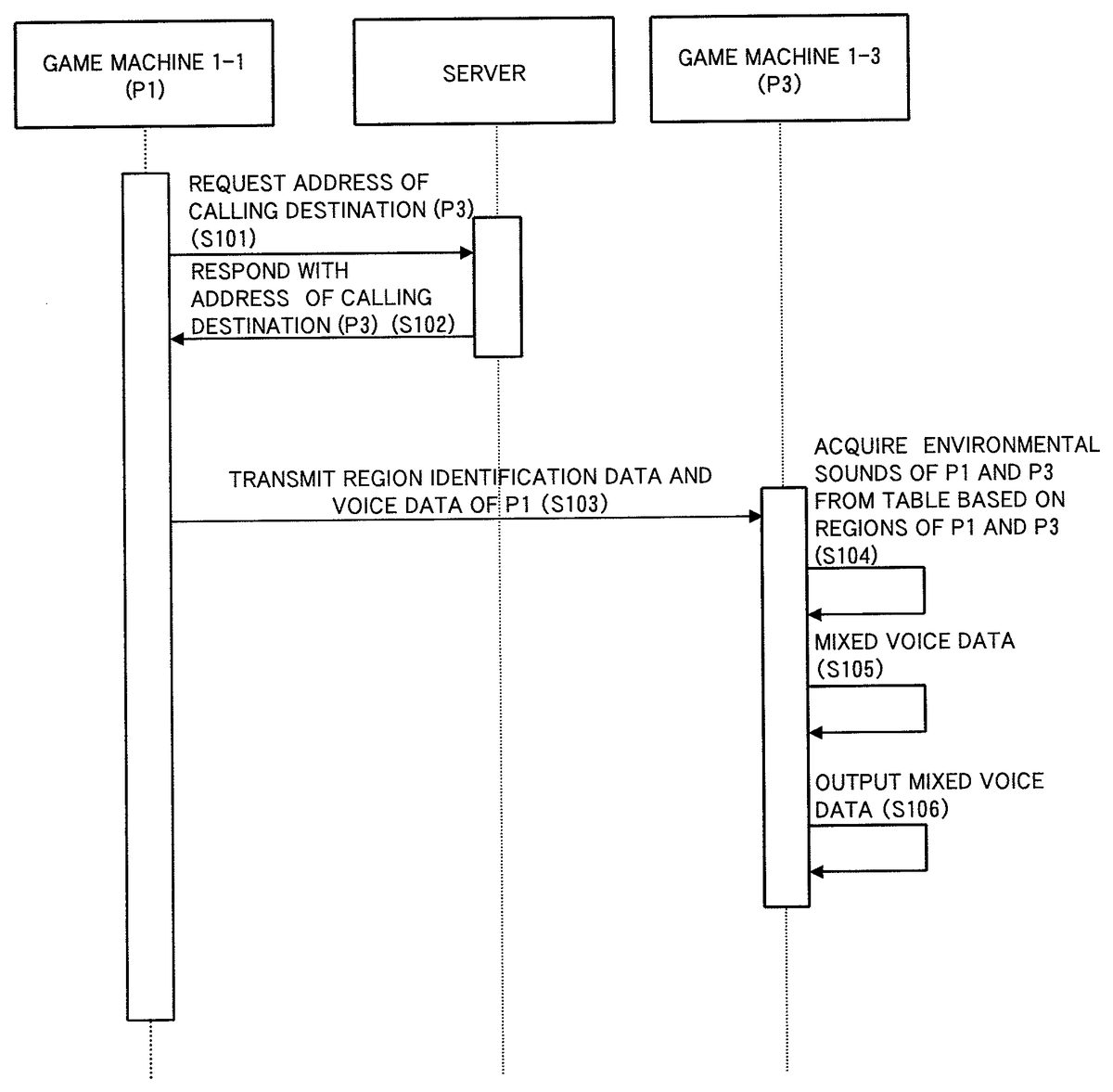
FIG. 10is a sequence diagram illustrating how voice data is transmitted between game machines1according to the second embodiment of the present invention. The drawing illustrates a case where the game machine1-1(P1) makes a remote site call to the game machine1-3(P3) in the virtual space through a transceiver or the like. The game machine1-1requests an address (such as an IP address) of the game machine1-3as a transmission source of a voice, from the server10of an address (S101), and receives a response from the server10(S102). Then, the game machine1-1transmits region identification data and voice data of P1to the received address of the game machine1-3(S103). The game machine1-3acquires an environmental sound of P1and an environmental sound of P3(S104) from the environmental sound storing section66in which regions and environmental sounds are associated with one another, based on a region corresponding to the region identification data of P1and a region of P3. Then, the game machine1-3mixes those environmental sounds and the voice data at a predetermined mixing ratio (S105), and outputs the mixed voice to the game player through a speaker (S106).
With the user voice mixing device according to the embodiments of the present invention as described above, it is possible to mix a voice generated at a remote site in a virtual space so as to make the voice more realistic, without increasing a network load.
It should be noted that the present invention is not limited to the above-mentioned embodiments.
For example, in the above-mentioned embodiments, the transmission source of voice data corresponds to the reception destination of voice data one by one, but the correspondence is not limited thereto. For example, a plurality of game machines for receiving voice data may be provided.
Claims
- A user voice mixing device used in a virtual space sharing system in which a plurality of information processing devices share a virtual space, said user voice mixing device comprising: means for receiving voice data representing a voice uttered by a first user of one of the plurality of information processing devices and a first region corresponding to a first position coordinate of the first the user in the virtual space;means for storing predetermined environmental sounds in association with each of one or more regions defined in the virtual space;means for acquiring a second position corresponding to a second user in the virtual space, who receives the voice data of the first at the user voice mixing device;means for specifying a second region corresponding to the second user according to the second acquired position coordinate, the second region being different from the first region;means for creating mixed voice data by acquiring a first predetermined environmental sound associated with the first region received by the means for receiving from the means for storing, and mixing the acquired first predetermined environmental sound and the voice data, and acquiring a second predetermined environmental sound associated with the second region corresponding to the second user, and mixing the voice data with the first predetermined environmental sound associated with the first region corresponding to the user and the second predetermined environmental sound associated with the second region corresponding to the second user;and means for outputting the mixed voice data, wherein said acquired first environmental sound is independent of the voice data and not directly associated with the acquired position coordinate of the user, and wherein, when said voice data, said first environmental sound and said second environmental sound occur at a same time, said voice data is mixed with said first and second environmental sounds to generate a modified output indicative of said first and second environmental sounds reducing the comprehensibility of said voice data.
- A user voice mixing device according to claim 1 , wherein: the user voice mixing device is communicably connected to the plurality of information processing devices through a communication network;the means for acquiring receives the voice data from the one of the plurality of information processing devices;the means for transmitting transmits the mixed voice data to another one of the plurality of information processing devices;and the other one of the plurality of information processing devices receives the mixed voice data and outputs the mixed voice data.
- A user voice mixing device according to claim 2 , further comprising means for receiving, from the one of the plurality of information processing devices, transfer destination identification data for identifying the other one of the plurality of information processing devices, wherein the means for transmitting the mixed voice data transmits the mixed voice data based on the transfer destination identification data.
- A user voice mixing device according to any one of claims 1 to 3 , further comprising means for receiving, from the one of the plurality of information processing devices, region identification data for identifying a region corresponding to the user in the virtual space, wherein the means for specifying specifies a region corresponding to the user in the virtual space based on the received region identification data.
- The user voice mixing device of claim 1 , further comprising a correlation table that provides a correlation between respective ones of said region and ones of said environmental sound.
- The user voice mixing device of claim 1 , wherein the predetermined environmental sounds are sound effects corresponding to a scene in a game.
- The user voice mixing device of claim 1 , wherein the predetermined environmental sounds are different from voice uttered by other users of the plurality of information processing devices.
- A control method for a computer used in a virtual space sharing system in which a plurality of information processing devices share a virtual space, the control method for a computer comprising: acquiring voice data representing a voice uttered by a user of one of the plurality of information processing devices;acquiring a first position coordinate corresponding to the user in the virtual space and acquiring a second position coordinate corresponding to a receiver of the voice data in the virtual space;specifying a first region corresponding to the user in the virtual space according to the first acquired position coordinate, and specifying a second region corresponding to the receiver of the voice data according to the second acquired position coordinate, second region being different from the first region;transmitting the first region and the voice data to the receiver;creating mixed voice data at the receiver by acquiring, with reference to storing predetermined environmental sounds in association with each of one or more regions defined in the virtual space, a first predetermined environmental sound associated with the first region specified in the specifying, and mixing the acquired first predetermined environmental sound and the voice data, and acquiring a second predetermined environmental sound associated with the second region corresponding to the receiver, and mixing the voice data with the first predetermined environmental sound associated with the first region corresponding to the user and the second predetermined environmental sound associated with the second region corresponding to the receiver;and outputting the mixed voice data at the receiver, wherein said acquired first environmental sound is independent of the voice data and not directly associated with the acquired position coordinate of the user, and wherein, when said voice data, said first environmental sound and said second environmental sound occur at a same time, said voice data is mixed with said first and second environmental sounds to generate a modified output indicative of said first and second environmental sounds reducing the comprehensibility of said voice data.
- The control method of claim 8 , further comprising a correlation table that performs correlation between respective ones of said region and ones of said environmental sound.
- The control method of claim 8 , wherein the predetermined environmental sounds are sound effects corresponding to a scene in a game.
- The control method of claim 8 , wherein the predetermined environmental sounds are different from voice uttered by other users of the plurality of information processing devices.
- A non-transitory information storage medium storing a program for causing a computer to function, the computer being used in a virtual space sharing system in which a plurality of information processing devices share a virtual space, the program causing the computer to function as: means for acquiring voice data representing a voice uttered by a user of one of the plurality of information processing devices;means for storing predetermined environmental sounds in association with each of one or more regions defined in the virtual space;means for acquiring a first position coordinate corresponding to the user in the virtual space and acquiring a second position coordinate corresponding to a receiver of the voice data in the virtual space;means for specifying a first region corresponding to the user in the virtual space according to the first acquired position coordinate, and specifying a second region corresponding to the receiver of the voice data according to the second acquired position coordinate, second region being different from the first region;transmitting the first region and the voice data to the receiver;means for creating mixed voice data at the receiver by acquiring a first predetermined environmental sound associated with the first region specified by the means for specifying from the environmental sound storing means, and mixing the acquired first predetermined environmental sound and the voice data, and acquiring a second predetermined environmental sound associated with the second region corresponding to the receiver, and mixing the voice data with the first predetermined environmental sound associated with the first region corresponding to the user and the second predetermined environmental sound associated with the second region corresponding to the receiver;and means for outputting the mixed voice data at the receiver, wherein said acquired first environmental sound is independent of the voice data and not directly associated with the acquired position coordinate of the user, and wherein, when said voice data, said first environmental sound and said second environmental sound occur at a same time, said voice data is mixed with said first and second environmental sounds to generate a modified output indicative of said first and second environmental sounds reducing the comprehensibility of said voice data.
- The non-transitory information storage medium of claim 12 , further comprising a correlation table that provides a correlation between respective ones of said region and ones of said environmental sound.
- The non-transitory information storage medium of claim 12 , wherein the predetermined environmental sounds are sound effects corresponding to a scene in a game.
- The non-transitory information storage medium of claim 12 , wherein the predetermined environmental sounds are different from voice uttered by other users of the plurality of information processing devices.
- A virtual space sharing system in which a plurality of information processing devices share a virtual space, comprising: means for acquiring voice data representing a voice uttered by a user of one of the plurality of information processing devices;means for storing predetermined environmental sounds in association with each of one or more regions defined in the virtual space;means for acquiring a first position coordinate corresponding to the user in the virtual space and acquiring a second position coordinate corresponding to a receiver of the voice data in the virtual space;means for specifying a first region corresponding to the user in the virtual space according to the first acquired position coordinate, and specifying a second region corresponding to the receiver of the voice data according to the second acquired position coordinate, the second region being different from the first region;means for transmitting the first region and the voice data to the receiver;means for creating mixed voice data at the receiver by acquiring a first predetermined environmental sound associated with the first region specified by the means for specifying from the means for storing, and mixing the acquired first predetermined environmental sound and the voice data, and acquiring a second predetermined environmental sound associated with the second region corresponding to the receiver, and mixing the voice data with the first predetermined environmental sound associated with the first region corresponding to the user and the second predetermined environmental sound associated with the second region corresponding to the receiver, and means for outputting the mixed voice data at the receiver;wherein said acquired first environmental sound is independent of the voice data and not directly associated with the acquired position coordinate of the user, and wherein, when said voice data, said first environmental sound and said second environmental sound occur at a same time, said voice data is mixed with said first and second environmental sounds to generate a modified output indicative of said first and second environmental sounds reducing the comprehensibility of said voice data.
- The virtual space sharing system of claim 16 , further comprising a correlation table that provides a correlation between respective ones of said region and ones of said environmental sound.
- The virtual space sharing system of claim 16 , wherein the predetermined environmental sounds are sound effects corresponding to a scene in a game.
- The virtual space sharing system of claim 16 , wherein the predetermined environmental sounds are different from voice uttered by other users of the plurality of information processing devices.
Disclaimer: Data collected from the USPTO and may be malformed, incomplete, and/or otherwise inaccurate.