U.S. Pat. No. 8,180,827
METHOD AND APPARATUS FOR ASSOCIATING GRAPHIC ICON IN INTERNET VIRTUAL WORLD WITH USER'S EXPERIENCE IN REAL WORLD
AssigneeSamsung Electronics Co Ltd
Issue DateOctober 10, 2008
Illustrative Figure
Abstract
A method and apparatus to associate a graphic icon representing a user in an Internet virtual world with the user's experience in the real world, the method including: logging data of an event occurring to the user in the real world; transmitting the logged data to a server; and updating the graphic icon in the virtual world according to the transmitted data. Accordingly, by associating the contents of the user's experience with a database (DB) and expressing the contents in the graphic icon, the user's experiences in the real world can be more realistically expressed in a virtual world.
Description
DETAILED DESCRIPTION OF THE EMBODIMENTS Reference will now be made in detail to the present embodiments of the present invention, examples of which are illustrated in the accompanying drawings, wherein like reference numerals refer to the like elements throughout. The embodiments are described below in order to explain the present invention by referring to the figures. FIG. 2is a flowchart illustrating a method of associating a graphic icon representing a user in an Internet virtual world with the user's experience in the real world, according to an embodiment of the present invention. Referring toFIG. 2, data of an event occurring to the user is logged in operation210. Then, the logged data is transmitted to a server in operation220, and the graphic icon is updated in the Internet virtual world based on the transmitted data in operation230. Specifically, in operation210, data of an event occurring to the user in the real world is logged. That is, information regarding various activities of the user in a general life is logged. For example, when the user performs an activity (such as shopping or watching a movie), the user can directly log data by writing a memo or taking a picture about the activity using a device having a data logging operation. This case is referred to as active logging. Data logging may be performed manually, as described above, or by a sensor or an automatic device even in a state in which the user is unaware. This latter case is referred to as passive logging. The event occurring to the user can include any type of information on a user's experiences in the real world. For example, the event occurring to the user can be an environmental change (such as moving to another place or traveling), an activity change (such as doing exercise ...
DETAILED DESCRIPTION OF THE EMBODIMENTS
Reference will now be made in detail to the present embodiments of the present invention, examples of which are illustrated in the accompanying drawings, wherein like reference numerals refer to the like elements throughout. The embodiments are described below in order to explain the present invention by referring to the figures.
FIG. 2is a flowchart illustrating a method of associating a graphic icon representing a user in an Internet virtual world with the user's experience in the real world, according to an embodiment of the present invention. Referring toFIG. 2, data of an event occurring to the user is logged in operation210. Then, the logged data is transmitted to a server in operation220, and the graphic icon is updated in the Internet virtual world based on the transmitted data in operation230.
Specifically, in operation210, data of an event occurring to the user in the real world is logged. That is, information regarding various activities of the user in a general life is logged. For example, when the user performs an activity (such as shopping or watching a movie), the user can directly log data by writing a memo or taking a picture about the activity using a device having a data logging operation. This case is referred to as active logging. Data logging may be performed manually, as described above, or by a sensor or an automatic device even in a state in which the user is unaware. This latter case is referred to as passive logging. The event occurring to the user can include any type of information on a user's experiences in the real world. For example, the event occurring to the user can be an environmental change (such as moving to another place or traveling), an activity change (such as doing exercise or homework), or an item change (such as changing a hairstyle or wearing glasses).
In operation220, the logged data is transmitted to the server. That is, in order for a graphic icon (hereinafter, avatar) expressing a user in a virtual world (such as Second Life) to be expressed as a figure and behavior of the user in the real world, data of an event (a place change, a motion change, an item change, etc.) occurring to the user in the real world is transmitted to the server. In this case, the user can directly transmit the data through a key input or automatically transmit the data through a service device. Alternatively, according to other aspects, an interactive service using an application program interface (API) operation can be used, which will be described in detail with reference toFIG. 3.
In operation230, the avatar is updated according to the transmitted data. If there is the same data stored in a DB included in the server as the transmitted data, then the matched data is read from the DB and applied to the avatar. For example, a search is performed on the DB of the server by using a value of the transmitted data as an index, and display of the avatar can be performed by mapping the matched graphic data value to a specific scene including the avatar. However, if there is no value in the DB matching the transmitted data, a new graphic data value is generated, and the DB is extended by adding the generated graphic data value to the DB.
According to the realization of a ubiquitous network concept and the development of Web 2.0 having a concept of participation and sharing, it is expected that a cyber world (such as blogs and social network services (SNS)) will be more popularized and developed. Thus, the real world and the cyber world will become more interconnected and identification of the real world and the cyber world will become ambiguous. Conventionally, a user's current experiences (e.g., buying a new handbag) are not reflected on an avatar (i.e., an experience in the real world is not linked to a virtual world), and the real world and the virtual world do not interwork. However, according to aspects of the present invention, an avatar more accurately reflecting a user's experience in the real world is provided, the user's experiences are realistically expressed in a virtual world, and a service of conveniently managing a cyberspace (such as a blog or a mini-homepage) is provided to express the contents of the user's experience on a real-time basis.
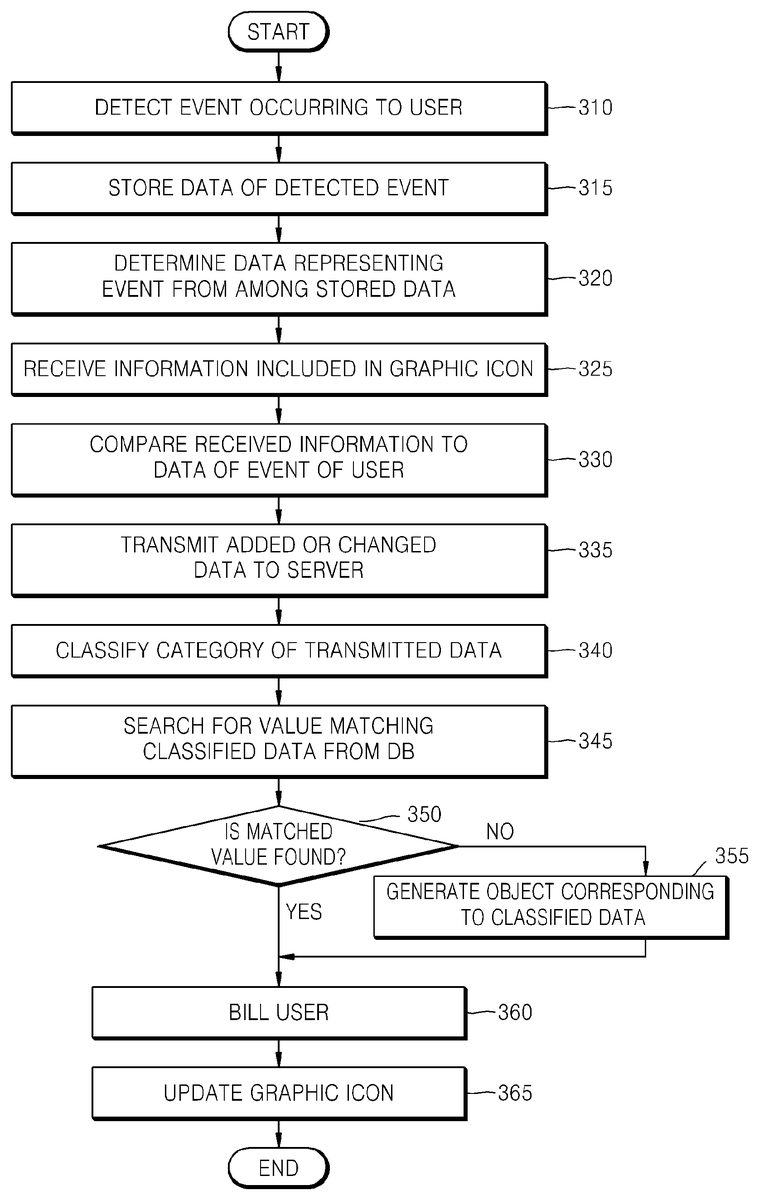
FIG. 3is a flowchart illustrating a method of associating a graphic icon representing a user in an Internet virtual world with the user's experience in the real world, according to another embodiment of the present invention. Referring toFIG. 3, an event occurring to the user is detected in operation310. Then, data with respect to the detected event is stored in operation315, and data representing the event from among the stored data is determined in operation320. Information included in the graphic icon (such as an avatar) is received in operation325, and compared to the data of the event of the user in operation330. Data added or changed according to the comparison result is transmitted in operation335, and a category of the transmitted data is classified in operation340. A value matching the classified data is searched in a database (DB) in operation345. Whether the matched value exists in the database is determined in operation350, and a new object is generated if the matched value does not exist in operation355. The user is billed in operation360and the avatar is updated in the virtual world in operation365.
Comparing the embodiment illustrated inFIG. 3to the embodiment illustrated inFIG. 2, the logging of data of an event occurring to the user (operation210) includes: detecting an event occurring to the user (operation310), storing data with respect to the detected event (operation315); and determining data representing the event from among the stored data (operation320). In the detecting of an event occurring to the user (operation310), the event may be detected via an external signal (such as a key input of the user) or in real-time. In this case, a specific device (such as a mobile blog (MB) caster) may be used, wherein the MB caster can synthetically compile and store data of the detected event (dress shopping, hairstyle changing, nail painting, exercising, etc.) and determine one or more essential pieces of data that represents the event by excluding duplicated data or minor data from among the compiled and stored data.
In operation220, the data of the event occurring to the user is transmitted to the server. In detail, this transmission may be performed via an external signal (such as a key input of the user) or in real-time, or the data may be interactively transmitted by using an API operation. For example, current information included in the avatar is requested and received by using getRecentPosts( ) in operation325, and the received information on the avatar is compared to the data of the event of the user in operation330. The information on the avatar can be configured in a tree pattern, and the event occurring to the user can be compared to the current configuration (denoting each node of the tree) of the avatar. According to the comparison, if the event occurring to the user corresponds to a new configuration that does not exist in the avatar, added or changed data is transmitted to the server by using editPost( ) in operation335.
The transmitted data is classified into one of a plurality of categories in operation340, and a search is performed in order to determine whether a value matching the classified data exists in the DB in operation345. According to the search, it is determined in operation350whether a value matching the classified data exists in the DB. If the same data is found in the DB, the matched data is read from the DB and applied to the avatar in operation365. That is, a search is performed by using a value of the transmitted data as an index, and an updated avatar can be expressed by mapping a matched graphic data value to a specific scene including the avatar. However, if the same data is not found in the DB (i.e., if the transmitted data is new data), a new object is generated in operation355. In the process of reflecting the user's experience in the real world on the avatar, a commission can be billed to the user in operation360(for example, via a mixed_reality broker). When the commission is billed, more money may be requested in the case where the DB is updated by generating an object corresponding to a new experience.
As described above, the method according to the current embodiment of the present invention can more closely connect the real world with a virtual world using a network by linking the contents of a user's current experience with a DB of a server without a specific action and expressing the contents in an avatar.
FIG. 4is a block diagram of an apparatus400to associate a graphic icon in an Internet virtual world with a user's experience in the real world, according to an embodiment of the present invention. Referring toFIG. 4, the apparatus400includes an event logging unit410to log data of an event occurring to the user, a transmitter420to transmit the logged data to a server, and an updating unit430to update the graphic icon in the Internet virtual world based on the transmitted data.
The event logging unit410logs data of an event occurring to the user in the real world. That is, the event logging unit410logs various kinds of information acquired by the user in everyday life. For example, when the user performs activities (such as traveling and watching movies), the user can log data by directly writing a memo or taking a picture about the activities (referred to as active logging) or through various sensors even in a state in which the user is unaware (referred to as passive logging).
The transmitter420transmits the logged data to the server. That is, in order for a graphic icon (such as an avatar) expressing a user in a virtual world (such as a mini-homepage or a blog) to be expressed as a figure and behavior of the user in the real world, the transmitter420transmits data of an event occurring to the user to the server. In this case, the data can be directly transmitted through a key input of the user or automatically transmitted through a service device. Alternatively, the data can be interactively transmitted by using an API operation.
The updating unit430updates the avatar according to the transmitted data. If the transmitted data is the same as data stored in a DB included in the server, the matched data is read from the DB and applied to the avatar to update the avatar. For example, a search is performed on the DB of the server by using a value of the transmitted data as an index, and display of the avatar can be performed by mapping the transmitted data value to a graphic data value matched to a specific scene including the avatar. However, if there is no value matching the transmitted data as a result of the DB search, a new graphic data value is generated, and the DB is extended by adding the generated graphic data value to the DB.
FIG. 5is a detailed block diagram of an apparatus to associate a graphic icon in an Internet virtual world with a user's experience in the real world, according to another embodiment of the present invention. Referring toFIG. 5, the event logging unit410includes an event detector411, a storage unit412and an event determiner413. The event detector411detects an event occurring to the user via an external signal or in real-time. The storage unit412stores at least one piece of data of the detected event, and the event determiner413determines data representing the event from among the at least one piece of stored data.
The transmitter420includes an interface unit421that includes a receiver421-1and a comparator421-2. The interface unit421transmits the data of the event logging unit410via an interactive service using an API operation. This is referred to as an embedded blog auto-sync agent. The receiver421-1receives information included in the graphic icon (such as an avatar), and the comparator421-2compares the received information to the logged data of the event of the user. The interface unit421transmits data added to or changed from the avatar according to the comparison result.
The updating unit430includes a classifier431, a search unit432, an object generator433and a billing unit434. The classifier431classifies a category of the transmitted data, and the search unit432searches for a value matching the classified data in a DB included in the server. The object generator433generates a new object of the classified data if there is no value matching the classified data in the DB according to the search result. The billing unit434bills the user according to the search result of the search unit432.
According to aspects of the present invention, more information of the real world can be reflected in virtual worlds. That is, aspects of the present invention more closely connect the real world with a virtual world using a network by transforming the contents of a user's experience to information (such as text, sound, photographs, images, etc.), linking the information to a DB of a server, and expressing the information in an avatar to more realistically express the user's experience in the virtual world.
Aspects of the present invention can also be embodied as computer-readable codes on a computer-readable recording medium. The computer-readable recording medium is any data storage device that can store data which can be thereafter read by a computer system. Examples of the computer-readable recording medium include read-only memory (ROM), random-access memory (RAM), CD-ROMs, magnetic tapes, floppy disks, and optical data storage devices. Aspects of the present invention may also be realized as a data signal embodied in a carrier wave and comprising a program readable by a computer and transmittable over the Internet.
According to aspects of the present invention, by implementing mixed reality by linking an Internet virtual world to current information experienced and felt by a user in a situation where an avatar expresses the user in the Internet virtual world, the user's experience can be easily expressed in cyberspaces (such as mini-homepages and blogs). In addition, the concept of a mixed reality broker suggested in aspects of the present invention creates a new opportunity in a mixed reality service.
Although a few embodiments of the present invention have been shown and described, it would be appreciated by those skilled in the art that changes may be made in this embodiment without departing from the principles and spirit of the invention, the scope of which is defined in the claims and their equivalents.
Claims
- A method of associating a graphic icon in a virtual world with a user's experience in a real world, the method comprising: storing correspondence information in a database, the correspondence information associating graphic data values of one or more events that have previously occurred to the user in the real world with an action of the graphic icon;logging data of an event currently occurring to the user in the real world;assigning a graphic data value representing the event currently occurring to the user based on the logged data;transmitting the graphic data value to the database;comparing the graphic data value representing the event currently occurring to the user with the correspondence information;when the comparison indicates that the event currently occurring to the user is the same as one of the one or more of the events that have previously occurred to the user, updating the graphic icon in the virtual world based on the correspondence information;and when the comparison indicates that the event currently occurring to the user is not the same as one of the one or more of the events that have previously occurred to the user, generating a new graphic icon representing the event currently occurring to the user, displaying the new graphic icon, and updating the correspondence information.
- The method as claimed in claim 1 , wherein the logging of the data of the event comprises detecting the event according to an external signal or in real-time.
- The method as claimed in claim 2 , wherein the logging of the data of the event further comprises: storing at least one piece of data corresponding to the detected event;and determining a predetermined number of pieces of data representing the event from among the stored at least one piece of data.
- The method as claimed in claim 1 , wherein the transmitting comprises transmitting the data to the server according to an external signal or in real-time.
- The method as claimed in claim 1 , wherein the transmitting comprises transmitting the data via an interactive service using an application program interface (API) operation.
- The method as claimed in claim 1 , wherein the updating of the graphic icon comprises: classifying a category of the transmitted data;and searching for a value matching the classified data from the database (DB), DB being included in the server.
- The method as claimed in claim 6 , wherein the updating of the graphic icon further comprises, if there is no value matching the classified data in the DB according to a result of the searching, generating an object of the classified data for the DB.
- The method as claimed in claim 7 , wherein the updating of the graphic icon further comprises billing the user according to the result of the searching.
- The method as claimed in claim 1 , wherein the graphic icon is an avatar.
- The method as claimed in claim 1 , wherein the logging of the data of the event comprises automatically detecting the event by a sensor and/or an automatic device.
- The method as claimed in claim 1 , wherein the virtual world is an Internet virtual world.
- The method as claimed in claim 1 , wherein the logging of the data of the event comprises logging the data of the event while the user is in an off-line mode.
- An apparatus to associate a graphic icon in a virtual world with a user's experience in a real world, the apparatus comprising: a database storing correspondence information, the correspondence information associating graphic data values of one or more events that have previously occurred to the user in the real world with an action of the graphic icon;an event logging unit to log data of an event currently occurring to the user in the real world;a processor to assign a graphic data value to the user representing the event currently occurring to the user based on the logged data;a transmitter to transmit the graphic data value to the database;a comparator to compare the graphic data value representing the event currently occurring to the user with the correspondence information;and an updating unit to update the graphic icon in the virtual world based on the correspondence information when the comparison indicates that the event currently occurring to the user is the same as one of the one or more of the events that have previously occurred to the user, and to generate a new graphic icon representing the event currently occurring to the user, display the new graphic icon, and update the correspondence information when the comparison indicates that the event currently occurring to the user is not the same as one of the one or more of the events that have previously occurred to the user.
- The apparatus as claimed in claim 13 , wherein the event logging unit comprises an event detector to detect the event according to an external signal or in real-time.
- The apparatus as claimed in claim 14 , wherein the event logging unit further comprises: a storage unit to store at least one piece of data corresponding to the detected event;and an event determiner to determine a predetermined number of pieces of data representing the event from among the stored at least one piece of data.
- The apparatus as claimed in claim 13 , wherein the transmitter transmits the data to the server according to an external signal or in real-time.
- The apparatus as claimed in claim 13 , wherein the transmitter comprises an interface unit to transmit the data via an interactive service using an application program interface (API) operation.
- The apparatus as claimed in claim 13 , wherein the updating unit comprises: a classifier to classify a category of the transmitted data;and a search unit to search for a value matching the classified data from the database (DB), the database being included in the server.
- The apparatus as claimed in claim 18 , wherein the updating unit further comprises an object generator to generate an object of the classified data if there is no value matching the classified data in the DB according to the search result.
- The apparatus as claimed in claim 19 , wherein the updating unit further comprises a billing unit to bill the user according to the search result.
- The apparatus as claimed in claim 13 , wherein the graphic icon is an avatar.
- The apparatus as claimed in claim 13 , wherein the event logging unit comprises an event detector to automatically detect the event.
- The apparatus as claimed in claim 13 , wherein the virtual world is an Internet virtual world.
- The apparatus as claimed in claim 13 , wherein the event logging unit logs the data of the event occurring to the user while the apparatus is in an off-line mode.
Disclaimer: Data collected from the USPTO and may be malformed, incomplete, and/or otherwise inaccurate.