U.S. Pat. No. 8,171,408
DYNAMIC LOCATION GENERATION WITHIN A VIRTUAL WORLD
AssigneeActivision Publishing Inc
Issue DateDecember 17, 2008
Illustrative Figure
Abstract
An approach is provided for dynamic loading and rendering of avatar's initial login environment. The approach consists of a method and a system for dynamically rendering locations from a preference list of locations most likely to be visited by an avatar. In one embodiment the method consists of creating a preference list of locations most likely to be visited by the avatar, rendering a dynamically built continuous environment populated from such preference list of locations most likely to be visited by the avatar, and caching and thereafter rendering at least one of the locations from the preference list of locations most likely to be visited by said avatar.
Description
The drawings are not necessarily to scale. The drawings are merely schematic representations, not intended to portray specific parameters of the invention. The drawings are intended to depict only typical embodiments of the invention, and therefore should not be considered as limiting the scope of the invention. In the drawings, like numbering represents like elements. DETAILED DESCRIPTION OF THE INVENTION To illustrate the idea suggested in the current invention the following example is considered: an experienced user has four main areas within the virtual world that he or she usually needs to teleport to. These areas are: an office space, a shopping mall, a personal space and a friend's personal space. As is known in the art, every time avatar logs into a VU, he or she is placed either in a default location, most often it is the personal space, or the last location visited. Upon each session within such VU, avatar usually wants to visit each of the four locations, which therefore presently requires at least three teleportations, which are very recourse and time consuming. Thus, there exists a need for a method and a system for dynamic loading of avatar's initial three dimensional environment, where such avatar is placed upon logging in to a virtual world, consistent of preferred, traditionally used set of locations, or locations most likely to be visited by the avatar, or portions thereof, to appear to be one continues single environment such that each of such locations can be accessed by walking or flying, and without the need to teleport. Accordingly, embodiments of the present invention are directed to a system and a method for dynamically loading a three dimensional environment to be displayed upon an avatar's login to a virtual world. An initial location of the avatar comprises a personalized combination of ...
The drawings are not necessarily to scale. The drawings are merely schematic representations, not intended to portray specific parameters of the invention. The drawings are intended to depict only typical embodiments of the invention, and therefore should not be considered as limiting the scope of the invention. In the drawings, like numbering represents like elements.
DETAILED DESCRIPTION OF THE INVENTION
To illustrate the idea suggested in the current invention the following example is considered: an experienced user has four main areas within the virtual world that he or she usually needs to teleport to. These areas are: an office space, a shopping mall, a personal space and a friend's personal space. As is known in the art, every time avatar logs into a VU, he or she is placed either in a default location, most often it is the personal space, or the last location visited. Upon each session within such VU, avatar usually wants to visit each of the four locations, which therefore presently requires at least three teleportations, which are very recourse and time consuming.
Thus, there exists a need for a method and a system for dynamic loading of avatar's initial three dimensional environment, where such avatar is placed upon logging in to a virtual world, consistent of preferred, traditionally used set of locations, or locations most likely to be visited by the avatar, or portions thereof, to appear to be one continues single environment such that each of such locations can be accessed by walking or flying, and without the need to teleport.
Accordingly, embodiments of the present invention are directed to a system and a method for dynamically loading a three dimensional environment to be displayed upon an avatar's login to a virtual world. An initial location of the avatar comprises a personalized combination of the current most desirable locations or portions thereof appearing as a single continuous environment such that each of such locations can be accessed by walking or flying, and without the need to teleport. The content used to build such initial location is based upon recent history, crowd-sourcing, users' personal preferences, and any other commonality or selection criteria as may be implemented
In the first embodiment, there is a description of a method for dynamically rendering locations from a preference list of locations most likely to be visited by an avatar. The described method comprises: creating a preference list of locations most likely to be visited by the avatar, rendering a dynamically built continuous environment populated from the preference list of locations most likely to be visited by the avatar, and caching and thereafter rendering at least one of the locations from said preference list of locations most likely to be visited by the avatar.
In the second embodiment, there is a description of a computer system for dynamically rendering locations from a preference list of locations most likely to be visited by an avatar. In this embodiment, the system comprises: at least one processing unit, memory operably associated with the at least one processing unit and a preference assessment tool storable in memory and executable by the at least one processing unit. The preference assessment tool comprises: a probability calculation component configured to calculate probability of the next visit to the location by the avatar, a prioritization component configured to compare the probabilities of the next visit to the location by the avatar to determine a priority of the locations to be displayed on the preference list and a rendering component configured to continuously render the set of locations in the virtual universe, where the locations are prioritized based on the probability of avatar's next visit.
In the third embodiment, there is a description of a computer-readable medium storing computer instructions, which when executed, enable a computer system to dynamically render locations from a preference list of locations most likely to be visited by an avatar in a virtual universe. In this embodiment, the computer instructions comprise: creating a preference list of locations most likely to be visited by the avatar, rendering a dynamically built environment populated from the preference list of locations most likely to be visited by the avatar, and caching and thereafter rendering at least one of the locations from the preference list of locations most likely to be visited by the avatar.
FIG. 1shows a high-level schematic diagram showing an existing hierarchy of locations within a sample Virtual Universe. As shown inFIG. 1, current virtual universe11is an island whose location is defined by island location coordinates11.1. Shown island11consists of at least one region12whose location is in turn also defined by coordinates12.1that are dependent on the set of coordinates11.1. Further, region12consists of at least one structure13, which structure is defined by location coordinates13.1. Structure13, in turn, consists of at least one building14which is defined by boundaries14.1that are dependent on coordinates13.1. As further illustrated byFIG. 1, building14consists of at least one room15, defined by location boundaries15.1that are dependent on boundaries14.1. Finally, the precise current location16of an avatar is defined by coordinates16.1that are dependent on the boundaries15.1.
This example hierarchy of locations within a sample Virtual Universe is only illustrative of some locations that may be found in a virtual region and is not limiting. Furthermore, the number of virtual regions12shown inFIG. 1is only for illustration purposes and those skilled in the art will recognize that there may be many more regions found in a typical virtual universe, or even only one region in a small virtual universe. As is illustrated by this example, precise location16of an avatar is dependent on the coordinates12.1of the region12location and therefore avatar's access to VU locations is limited by the highest level of hierarchical environment, i.e., the island11, which in essence is defined by the initial location16where avatar is placed upon login.
In a sample virtual world environment, currently illustrated byFIG. 1, one cannot travel from the current location to another location beyond the highest level of the hierarchical environment, i.e., island11inFIG. 1, by simply walking. Persons in physical world must employ alternative means of transportation such as ships or airplanes to reach other islands or continents. Similarly, an avatar must teleport when it wants to travel from one region to another.
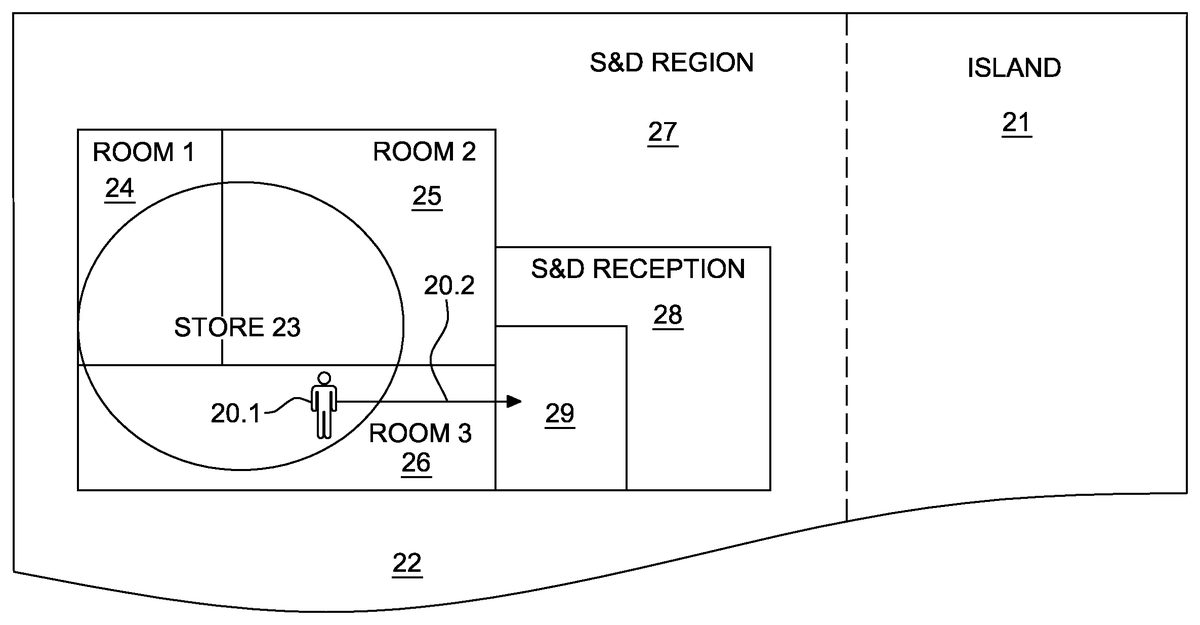
FIG. 2illustrates a sample avatar's login environment. In the shown example, upon successful login, the avatar is placed in a systems department26, which is located in a store23, which is located in a sales and distribution (S & D) complex located in an S & D region27, which is in turn located on an island21. When avatar successfully logs in, entire island21is not rendered for the avatar, as computation resources are at a premium and virtual worlds are very graphics intensive applications. Alternatively, a location based subset22of island21is loaded and in turn is cached. However, not the whole location based subset22is rendered and is visible to avatar20.1, but only the default load consisting of rooms24,25and26is rendered and displayed for the avatar20.1.
Areas outside of store23are not loaded upon avatar's log-in. Instead, they are rendered and cached real time only if avatar accesses these areas. As is shown inFIG. 2, as avatar20.1travels20.2out of store room26, data regarding the target environment S & D reception28is cached so that it can be rendered and displayed quickly upon arrival of avatar20.1. In one embodiment, a trailing area, equivalent in size to the newly cached area is dropped from the current rendering such that the new avatar view is comprised of the newly cached area and only a subset of the original environment. This process continues as avatar20.1traverses through various parts of the island21. However, if avatar20.1wishes to visit a location that is not part of the island21, then the avatar leaves the current structure and the current coordinate system behind and teleports to a new location.
FIG. 3illustrates existing method of loading default location and visiting preferred locations. The shown graphic depicts an example “zoom-in” view of the default location for avatar34.1within store31. As illustrated, avatar34.1is initially located in system p room34of store31. In the shown example, avatar34.1only visits system p room34and does not visit system z room35or PC rooms33.
As further illustrated byFIG. 3, another location regularly visited by avatar34.1is fiction section36of book store32located on another island39. Presently, avatar34.1must teleport34.2back and forth between these desired locations. Assuming, that rendering of each room of store31requires one full server cycle, (shown and discussed in details further) when avatar and his/her default environment are rendered, four—ninth of the server cycles are wasted when rendering locations that will not be visited by the avatar, i.e., system room z35and three pc rooms33.
Additionally, when avatar34.1teleports34.2to fiction section36of book store32, six-ninths of the server cycles are wasted for rendering sections of the book store32that the avatar does not frequent. Illustrated example is indicative of two problems: 1) system resources are wasted rendering data that is not required or desired by the avatar; 2) avatar's time is wasted teleporting from one location to another.
Preferred embodiment of the current invention continues to render a default area of the current size; however, it populates and manages the data in a more efficient manner.FIG. 4depicts an example preferred embodiment of this invention. AsFIG. 4illustrates, the default load in the preferred embodiment is the same relative size—nine blocks that represent the various system resources consumed, however only the areas of interest of avatar45are loaded within default environment40. Further illustrating the preferred embodiment, only system p41area is loaded when avatar executes a new login. The remaining resources, i.e., the remaining four blocks in the current example are rendered as other preferred locations for the given avatar45until the load space is exhausted.
Further, as demonstrated byFIG. 4, aside from the default location of system p room41, avatar's45rendered environment load includes fiction section42of the book store (not shown), and music section43of the Circuit City® like store (not shown). This rendering presents avatar45with the ability to quickly walk from one favorite location to another without the need to teleport and leave the previous environment behind. As further illustrated byFIG. 4, avatar45seamlessly walks45.1from system p room41to fiction section42of the book store (not shown).
FIG. 5illustrates additional advantage of the current embodiment, mentioned earlier in [0026] as it also provides increased performance in loading and rendering locations for a given avatar. As illustrated, such increased performance is achieved by employing plurality of servers when rendering location data. More specifically, rather than one SIM server51or server group (not shown) responsible for loading the area52, multiple servers53,55or groups of servers (not shown) simultaneously render data for the corresponding environments, i.e., fiction sections56of the book store (not shown) and music sections54of the Circuit City® like store.
In addition to the enhanced load and location rendering introduced by one embodiment of the current invention, a new caching and traversing algorithm is also introduced. Referring once again toFIG. 3andFIG. 4, the traditional method of caching and traversing loads reference section37of book store39as avatar45continues to traverse the current environment, as inFIG. 4, to the right.
FIG. 6illustrates connection between avatar's locations preference list and grid coordinates of servers controlling rendering of such locations. Preference list60consists of locations most likely to be visited by avatar in order of probability of such visit. System p room61is controlled by server(s) at grid coordinate67. Book store fiction room62is controlled by server(s) at grid coordinate68. Circuit City® like music room63is controlled by server(s) at grid coordinate69. Software room64is controlled by server(s) at grid location69.1. Business Innovation Center65is controlled by server(s) at grid location69.2. Next most likely location66is controlled by server(s) at next grid location69.3.
FIG. 7depicts the process of dynamically building an environment by illustrating loading of next most likely location for traversing avatar when such avatar extends beyond any of the currently loaded boundaries. As illustrated byFIG. 7, as avatar71exits Circuit City® like store's music department73, rather than caching and loading the next department in such store, which is what presently occurs, the method suggested by the current invention invokes the caching and loading of avatar's71next favorite location obtained from the preference list60, which, in the currently illustrated example, is software room74.
In another embodiment, as avatar71continues into open space75after exhausting preferred locations from preference list60, the algorithm loops back to the beginning of the list and reloads preference61. In another embodiment, a random location is loaded. In yet another embodiment, the owner of previous VU location selects the location to be loaded and the preference list to be used.
In the preferred embodiment, a location preference list for a given avatar is dynamically constructed based on, but not limited to, locations visited, number of times visited and duration of visits. Depending on these usage patterns, the default location and preference list of locations automatically updates. For instance, if an avatar spent most of the last 3 days in the business innovation center, it is likely that at the next login, avatar will end up there again. As a result of applying the method suggested by the current invention, such location would move up to the top of the preference list and bump down all the other locations on the preference list accordingly.
In one embodiment, an avatar manually edits default location and preference list. In another embodiment, preference list is a complete history of locations visited by the avatar.
In yet another embodiment, smaller regions or partial self contained fragments of locations, such as embodied by store aisles, are used. In such an embodiment, if an avatar visits aisles 1, 2, and 5 of one bookstore and aisles 3 and 12 of another bookstore, these aisles are automatically combined. This combination allows for a new rendering to be created that is an aggregate of aisles from plurality of different stores. Further, indicators are provided to avatars in these kinds of renderings that indicate the stores that originally contained the particular aisles.
To further illustrate such an embodiment, the following example is considered: one aisle in such aggregate rendering of aisles from different stores, has a visible unique descriptive logo, text, graphic, lighting, musical background, or audio message associated with the aisle that defines this aisle as being an aisle from a particular store. This aisle identification in such aggregate rendering further provides advertisement services for an entire store.
In another embodiment, the preference list is dynamically constructed and is updated based on locations for which a user has expressed a specific interest in. In such an embodiment, the user upon visiting a real life store and learning of a product, service or price that such user has specific interest in, and upon further learning that the store has presence in the virtual world, such user, while in the virtual world, requests that such store or a store's department or aisle that offers such product, service or price be included in the preference list.
In another embodiment, the preference list of locations is arranged based on crowd sourcing. In such an embodiment, users or communities of users offer their commentaries and ratings which amount to votes for locations, or fragments of such locations. Such stores or fragments of stores with the most votes are then added to the preference list of locations, and thereafter arranged according to their votes.
FIG. 8depicts a flow chart of the preferred embodiment of the method for dynamically rendering locations from a preference list of locations most likely to be visited by an avatar. The method begins at step801, at step802avatar continues to traverse current location so no new environment needs to be displayed. At step803it is determined whether avatar is exiting the current location. If “no” then avatar continues to traverse current location at802. If “yes” then at step804preference list of locations is checked, then at805first location from the preference list is cached. Further, at step806the location received from the preference list is rendered.
FIG. 9shows a schematic of an exemplary computing environment in which implemented system for dynamically rendering locations from a preference list of locations most likely to be visited by an avatar may operate. The exemplary computing environment100is only one example of a suitable computing environment and is not intended to suggest any limitation as to the scope of use or functionality of the approach described herein. Neither should computing environment100be interpreted as having any dependency or requirement relating to any one or combination of components illustrated inFIG. 9.
In the computing environment100there is a computer102, which is operational with numerous other general purpose or special purpose computing system environments or configurations. Examples of well known computing systems, environments, and/or configurations that may be suitable for use with exemplary computer102include, but are not limited to, personal computers, server computers, thin clients, thick clients, hand-held or laptop devices, multiprocessor systems, microprocessor-based systems, set top boxes, programmable consumer electronics, network PCs, minicomputers, mainframe computers, distributed computing environments that include any of the above systems or devices, and the like.
The exemplary computer102may be described in the general context of computer-executable instructions, such as program modules, being executed by a computer. Generally, program modules include routines, programs, objects, components, logic, data structures, and so on that perform particular tasks or implements particular abstract data types. The exemplary computer102may be practiced in distributed computing environments where tasks are performed by remote processing devices that are linked through a communications network. In a distributed computing environment, program modules may be located in both local and remote computer storage media including memory storage devices.
As shown inFIG. 9, computer102in the computing environment100is shown in the form of a general-purpose computing device. The components of computer102may include, but are not limited to, one or more processors or processing units104, a system memory106, and a bus108that couples various system components including system memory106to processor104.
Bus108represents one or more of any of several types of bus structures, including a memory bus or memory controller, a peripheral bus, an accelerated graphics port, and a processor or local bus using any of a variety of bus architectures. By way of example, and not limitation, such architectures include Industry Standard Architecture (ISA) bus, Micro Channel Architecture (MCA) bus, Enhanced ISA (EISA) bus, Video Electronics Standards Association (VESA) local bus, and Peripheral Component Interconnects (PCI) bus.
Computer102typically includes a variety of computer readable media. Such media may be any available media that is accessible by computer102, and it includes both volatile and non-volatile media, removable and non-removable media.
InFIG. 9, system memory106includes computer readable media in the form of volatile memory, such as random access memory (RAM)110, and/or non-volatile memory, such as ROM112. A BIOS114containing the basic routines that help to transfer information between elements within computer102, such as during start-up, is stored in ROM112. RAM110typically contains data and/or program modules that are immediately accessible to and/or presently operated on by processor104.
Computer102may further include other removable/non-removable, volatile/non-volatile computer storage media. By way of example only,FIG. 9illustrates a hard disk drive116for reading from and writing to a non-removable, non-volatile magnetic media (not shown and typically called a “hard drive”), a magnetic disk drive118for reading from and writing to a removable, non-volatile magnetic disk120(e.g., a “floppy disk”), and an optical disk drive122for reading from or writing to a removable, non-volatile optical disk124such as a CD-ROM, DVD-ROM or other optical media. The hard disk drive116, magnetic disk drive118, and optical disk drive122are each connected to bus108by one or more data media interfaces126.
The drives and their associated computer-readable media provide nonvolatile storage of computer readable instructions, data structures, program modules, and other data for computer102. Although the exemplary environment described herein employs hard disk116, a removable magnetic disk118and a removable optical disk122, it should be appreciated by those skilled in the art that other types of computer readable media which can store data that is accessible by a computer, such as magnetic cassettes, flash memory cards, digital video disks, RAMs, ROM, and the like, may also be used in the exemplary operating environment.
A number of program modules may be stored on hard disk116, magnetic disk120, optical disk122, ROM112, or RAM110, including, by way of example, and not limitation, an operating system128, one or more application programs130, other program modules132, and program data134. Each of operating system128, one or more application programs130other program modules132, and program data134or some combination thereof, may include an implementation of the networking environment10ofFIG. 1including server array14, virtual universe client24and pre-fetching tool53. In one embodiment, the one or more application programs130include components of pre-fetching tool53such as ranking component80, pre-fetching component82and rendering component88.
Further, a user may enter commands and information into computer102through optional input devices such as a keyboard136and a pointing device138(e.g., a “mouse”). Other input devices (not shown) may include a microphone, joystick, game pad, satellite dish, serial port, scanner, camera, or the like. These and other input devices are connected to processor unit104through a user input interface140that is coupled to bus108, but may be connected by other interface and bus structures, such as a parallel port, game port, or a universal serial bus (USB).
An optional monitor142or other type of display device is also connected to bus108via an interface, such as a video adapter144. In addition to the monitor, personal computers typically include other peripheral output devices (not shown), such as speakers and printers, which may be connected through output peripheral interface146.
Computer102may operate in a networked environment using logical connections to one or more remote computers, such as a remote server/computer148. Remote computer148may include many or all of the elements and features described herein relative to computer102.
Logical connections shown inFIG. 9are a local area network (LAN)150and a general wide area network (WAN)152. Such networking environments are commonplace in offices, enterprise-wide computer networks, intranets, and the Internet. When used in a LAN networking environment, computer102is connected to LAN150via network interface or adapter154. When used in a WAN networking environment, the computer typically includes a modem156or other means for establishing communications over WAN152. The modem, which may be internal or external, may be connected to system bus108via user input interface140or other appropriate mechanism.
In a networked environment, program modules depicted relative to computer102, or portions thereof, may be stored in a remote memory storage device. By way of example, and not limitation,FIG. 9illustrates remote application programs158as residing on a memory device of remote computer148. It will be appreciated that the network connections shown and described are exemplary and other means of establishing a communications link between the computers may be used.
An implementation of computer102may be stored on or transmitted across some form of computer readable media. Computer readable media can be any available media that can be accessed by a computer. By way of example, and not limitation, computer readable media may comprise “computer storage media” and “communications media.”
“Computer storage media” include volatile and non-volatile, removable and non-removable media implemented in any method or technology for storage of information such as computer readable instructions, data structures, program modules, or other data. Computer storage media includes, but is not limited to, RAM, ROM, EEPROM, flash memory or other memory technology, CD-ROM, digital versatile disks (DVD) or other optical storage, magnetic cassettes, magnetic tape, magnetic disk storage or other magnetic storage devices, or any other medium which can be used to store the desired information and which can be accessed by a computer.
“Communication media” typically embodies computer readable instructions, data structures, program modules, or other data in a modulated data signal, such as carrier wave or other transport mechanism. Communication media also includes any information delivery media.
The term “modulated data signal” means a signal that has one or more of its characteristics set or changed in such a manner as to encode information in the signal. By way of example, and not limitation, communication media includes wired media such as a wired network or direct-wired connection, and wireless media such as acoustic, RF, infrared, and other wireless media. Combinations of any of the above are also included within the scope of computer readable media.
In another embodiment, there is provided a business method that performs the process of the invention on a subscription, advertising, and/or fee basis. That is, a service provider, such as a Solution Integrator, could offer to provide the functionality described herein. In this embodiment, the service provider can create, maintain, support, etc., a computer infrastructure, similar to computer102that performs the process of the invention for one or more customers. In return, the service provider can receive payment from the customers under a subscription and/or fee agreement and/or the service provider can receive payment from the sale of advertising content to one or more third parties.
In still another embodiment, a computer-implemented method for performing the functionality described herein is provided. In this case, a computer infrastructure, such as computer infrastructure102, can be provided and one or more systems for performing the process of the invention can be obtained (e.g., created, purchased, used, modified, etc.) and deployed to the computer infrastructure. To this extent, the deployment of a system can comprise one or more of: (1) installing program code on a computing device, such as computer system102, from a computer-readable medium; (2) adding one or more computing devices to the computer infrastructure; and (3) incorporating and/or modifying one or more existing systems of the computer infrastructure to enable the computer infrastructure to perform the process of the invention.
As used herein, it is understood that the terms “program code” and “computer program code” are synonymous and mean any expression, in any language, code or notation, of a set of instructions intended to cause a computing device having an information processing capability to perform a particular function either directly or after either or both of the following: (a) conversion to another language, code or notation; and/or (b) reproduction in a different material form. To this extent, program code can be embodied as one or more of: an application/software program, component software/a library of functions, an operating system, a basic device system/driver for a particular computing and/or device, and the like.
In yet another embodiment, a data processing system suitable for storing and/or executing program code is provided hereunder that includes at least one processor communicatively coupled, directly or indirectly, to memory elements through a system bus. The memory elements can include, but are not limited to, local memory employed during actual execution of the program code, bulk storage, and cache memories that provide temporary storage of at least some program code in order to reduce the number of times code must be retrieved from bulk storage during execution. Input/output or device devices (including, but not limited to, keyboards, displays, pointing devices, etc.) can be coupled to the system either directly or through intervening device controllers.
While there have been shown and described what is considered to be preferred embodiments of the invention, it will, of course, be understood that various modifications and changes in form or detail could readily be made without departing from the spirit of the invention. It is therefore intended that the invention be not limited to the exact forms described and illustrated, but should be constructed to cover all modifications that may fall within the scope of the appended claims.
The invention can take the form of an entirely hardware embodiment, an entirely software embodiment or an embodiment containing both hardware and software elements. In a preferred embodiment, the invention is implemented in software, which includes but is not limited to firmware, resident software, microcode, etc.
The invention can take the form of a computer program product accessible from a computer-usable or computer-readable medium providing program code for use by or in connection with a computer or any instruction execution system. For the purposes of this description, a computer usable or computer readable medium can be any apparatus that can contain, store, communicate, propagate, or transport the program for use by or in connection with the instruction execution system, apparatus or device.
The medium can be an electronic, magnetic, optical, electromagnetic, infrared, or semiconductor system (or apparatus or device) or a propagation medium. Examples of a computer-readable medium include a semiconductor or solid state memory, magnetic tape, a removable computer diskette, a random access memory (RAM), a read only memory (ROM), a rigid magnetic disk and an optical disk. Current examples of optical disks include compact disk read only memory (CD-ROM), compact disk read/write (CD-R/W), and DVD.
The system and method of the present disclosure may be implemented and run on a general-purpose computer or computer system. The computer system may be any type of known or will be known systems and may typically include a processor, memory device, a storage device, input/output devices, internal buses, and/or a communications interface for communicating with other computer systems in conjunction with communication hardware and software, etc.
The terms “computer system” and “computer network” as may be used in the present application may include a variety of combinations of fixed and/or portable computer hardware, software, peripherals, and storage devices. The computer system may include a plurality of individual components that are networked or otherwise linked to perform collaboratively, or may include one or more stand-alone components. The hardware and software components of the computer system of the present application may include and may be included within fixed and portable devices such as desktop, laptop, and server. A module may be a component of a device, software, program, or system that implements some “functionality”, which can be embodied as software, hardware, firmware, electronic circuitry, or etc.
Claims
- A method for dynamically building and rendering a location environment, upon an avatar's login to a virtual world, from a preference list of locations most likely to be visited by an avatar, said method comprising: creating a preference list of locations most likely to be visited by said avatar, said creating a preference list of locations comprising: calculating a probability of a next visit to each of said locations by said avatar, and comparing said probabilities of a next visit to each of said locations by said avatar to determine a priority of said locations to be displayed on said preference list;combining at least two neighboring entries from said preference list of locations most likely to be visited by said avatar to dynamically build continuous location environment, and caching and thereafter rendering said dynamically built continuous location environment populated from said preference list of locations most likely to be visited by said avatar.
- The method according to claim 1 , said preference list dynamically constructed based upon the locations visited by said avatar during a most recent login.
- The method according to claim 1 , said preference list dynamically constructed based upon a number of times said locations were visited.
- The method according to claim 1 , said preference list dynamically constructed based upon a previous duration of each visit to said locations.
- The method according to claim 1 , said preference list further comprising self-contained fragments of locations most likely to be visited by said avatar, said rendering comprising said fragments, each fragment containing at least one indicator describing or advertising the original complete location of said fragment.
- The method according to claim 1 , said preference list dynamically constructed and updated based on avatar's requests for a set of locations or portions thereof to be included and prioritized in said preference list.
- The method according to claim 1 , said preference list dynamically updated based on crowd sourcing.
- The method according to claim 1 , further comprising dropping a plurality of locations from current rendering equivalent in number to the number of newly cached locations such that the new rendering is comprised of at least one of the locations from said preference list and a subset of the originally displayed environment.
- A computer system for dynamically rendering a locations environment, upon an avatar's login to a virtual world, from a preference list of locations most likely to be visited by an avatar, comprising: at least one processing unit;memory operably associated with the at least one processing unit;and a preference assessment tool storable in memory and executable by the at least one processing unit, the preference assessment tool comprising: a probability calculation component configured to calculate a probability of a next visit to each of locations by said avatar;a prioritization component configured to compare said probabilities of next visit to each of locations by said avatar to determine a priority of said locations to be displayed on said preference list;and a rendering component configured to continuously render the location environment in the virtual universe, said location environment cached and thereafter rendered based on the priority of said locations to be displayed on said preference list and based on a personalized combination of at least two neighboring entries from said preference list of locations most likely to be visited by said avatar.
- The preference assessment tool according to claim 9 , the probability calculation component further configured to raise said probability for locations visited by said avatar during a most recent login.
- The preference assessment tool according to claim 9 , the probability calculation component configured to raise said probability for locations visited the most number of times during a plurality of logins by said avatar.
- The probability calculation component according to claim 9 , further comprising a component to raise said probability for locations with longest durations of each visit during plurality of logins by said avatar.
- The probability calculation component according to claim 9 , further comprising a component to raise said probability for locations with longest durations of each visit during plurality of logins by said avatar.
- The prioritization component as in claim 9 , further comprising an interface for manually configuring the display order of locations in said preference list.
- The computer system as in claim 9 , further comprising a caching component configured to: identify a next location from the preference list of locations;and download and cache within a cache, said next location from said preference list of locations.
- A computer-readable medium storing computer instructions, which when executed, enable a computer system to dynamically build and render a location environment, upon an avatar's login to a virtual world, from a preference list of locations most likely to be visited by an avatar, in a virtual universe, the computer instructions comprising: creating a preference list of locations most likely to be visited by said avatar, said creating a preference list of locations comprising: calculating a probability of a next visit to each of said locations by said avatar, and comparing said probabilities of a next visit to each of said locations by said avatar to determine a priority of said locations to be displayed on said preference list;combining at least two neighboring entries from said preference list of locations most likely to be visited by said avatar to dynamically build continuous location environment, and caching and thereafter rendering said dynamically built continuous location environment populated from said preference list of locations most likely to be visited by said avatar.
- The computer-readable medium according to claim 16 , further comprising instructions for constructing said preference list based upon the locations visited by said avatar during a most recent login.
- The computer-readable medium according to claim 16 , further comprising instructions for constructing said preference list based upon a number of times said locations were visited during plurality of logins by said avatar.
- The computer-readable medium according to claim 16 , further comprising instructions for constructing said preference list based upon durations of each visit to said locations during plurality of logins by said avatar.
- A method for deploying a rendering tool for use in a computer system that provides building and rendering of a location environment from a preference list of locations most likely to be visited by an avatar in a virtual universe, said method comprising: providing a computer infrastructure operable to: create a preference list of locations most likely to be visited by said avatar, said creating a reference list of locations comprising: calculating a probability of a next visit to each of said locations by said avatar, and comparing said probabilities of a next visit to each of said locations by said avatar to determine a priority of said locations to be displayed on said preference list;combine at least two neighboring entries from said preference list of locations most likely to be visited by said avatar to dynamically build continuous location environment, and cache and thereafter render said dynamically built continuous location environment populated from said preference list of locations most likely to be visited by said avatar.
Disclaimer: Data collected from the USPTO and may be malformed, incomplete, and/or otherwise inaccurate.