U.S. Pat. No. 8,133,115
SYSTEM AND METHOD FOR RECORDING AND DISPLAYING A GRAPHICAL PATH IN A VIDEO GAME
AssigneeSony Computer Entertainment America LLC
Issue DateOctober 22, 2003
Illustrative Figure
Abstract
A system and method for recording and displaying a graphical path in a video game is provided. Upon initiation of a time-trial run, the player views a color-coded previous game path that dynamically changes color based upon a current elapsed time associated with the time-trial run, elapsed times associated with the previous game path, and character states associated with the previous game path. The previous game path may include, but is not limited to, a “best time” path, a “worst time” path, and an “average time” path. In one embodiment of the invention, the player may gauge game progress as measured against the “best time” path as displayed via a series of path markers, and subsequently varies player character input controls to optimize performance against a player character associated with the “best time” path.
Description
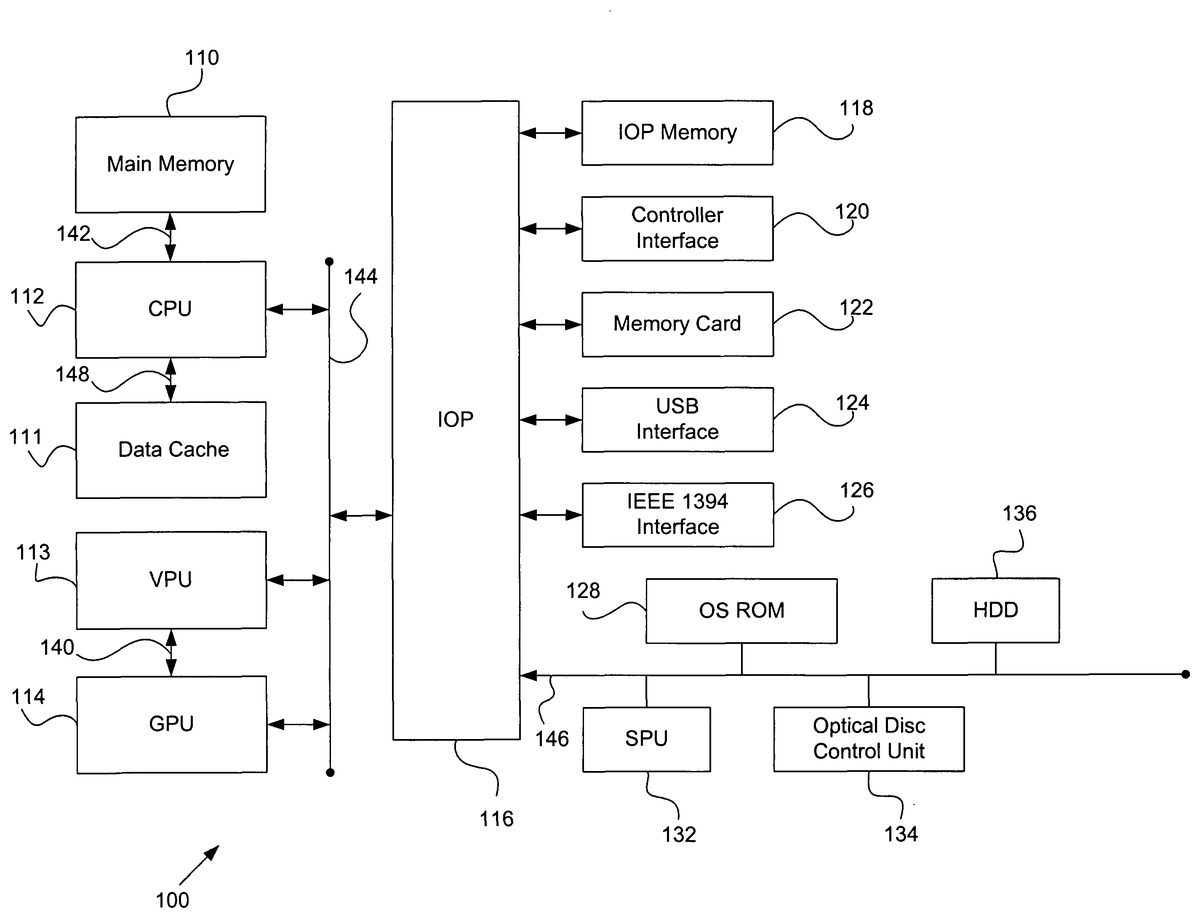
DETAILED DESCRIPTION OF THE DRAWINGS In a video game, a game player maneuvers a player character through a game environment from a starting point to an end point. For example, the player character traverses a racecourse in a time trial mode. Video game software records a path of the player character as it moves from the starting point to the end point. The path is recorded as a series of points represented by (x,y,z) Cartesian coordinates, for example. The game software also records a total time that it takes the player character to arrive at the end point, and an elapsed time to each point in the path. For example, the elapsed time may be measured from an initial starting time associated with the starting point. The game software may also record other data at each point along the player character's path including, but not limited to, a magnitude and a direction of each force acting on the player character, an instantaneous energy consumption by the player character, a total energy consumption by the player character, and a player character travel state. In one embodiment of the present invention, the player character travel state may indicate that the character is “airborne,” “on the ground,” or “crashed.” Other player character states may be utilized in further embodiments. FIG. 1is an exemplary block diagram of an electronic entertainment system100, according to one embodiment of the present invention. The system100comprises a main memory110, a central processing unit (CPU)112, a data cache111, a vector processing unit VPU113, a graphics processing unit (GPU)114, an input/output processor (IOP)116, an IOP memory118, a controller interface120, a memory card122, a Universal Serial Bus (USB) interface124and an IEEE 1394 interface126. The system100also comprises an operating system read-only memory (OS ROM)128, a sound processing unit (SPU)132, an optical disc control ...
DETAILED DESCRIPTION OF THE DRAWINGS
In a video game, a game player maneuvers a player character through a game environment from a starting point to an end point. For example, the player character traverses a racecourse in a time trial mode. Video game software records a path of the player character as it moves from the starting point to the end point. The path is recorded as a series of points represented by (x,y,z) Cartesian coordinates, for example. The game software also records a total time that it takes the player character to arrive at the end point, and an elapsed time to each point in the path. For example, the elapsed time may be measured from an initial starting time associated with the starting point. The game software may also record other data at each point along the player character's path including, but not limited to, a magnitude and a direction of each force acting on the player character, an instantaneous energy consumption by the player character, a total energy consumption by the player character, and a player character travel state. In one embodiment of the present invention, the player character travel state may indicate that the character is “airborne,” “on the ground,” or “crashed.” Other player character states may be utilized in further embodiments.
FIG. 1is an exemplary block diagram of an electronic entertainment system100, according to one embodiment of the present invention. The system100comprises a main memory110, a central processing unit (CPU)112, a data cache111, a vector processing unit VPU113, a graphics processing unit (GPU)114, an input/output processor (IOP)116, an IOP memory118, a controller interface120, a memory card122, a Universal Serial Bus (USB) interface124and an IEEE 1394 interface126. The system100also comprises an operating system read-only memory (OS ROM)128, a sound processing unit (SPU)132, an optical disc control unit134and a hard disc drive (HDD)136, which are connected via a bus146to the IOP116. The system100is preferably an electronic gaming console; however, the system100may also be implemented as any type of general-purpose computer, set-top box or hand-held gaming device. Alternative embodiments of the system100may comprise fewer, more, or other components.
A user of the system100provides instructions via the controller interface120to the CPU112. For example, the user may instruct the CPU112to store certain game information on the memory card122or may instruct a character in a game to perform some specified action. Other devices may be connected to the system100via the USB interface124and the IEEE 1394 interface126.
The CPU112, the VPU113, the GPU114and the IOP116communicate via a system bus144. The CPU112communicates with the main memory110via a dedicated bus142, and with the data cache111via a dedicated bus148. The VPU113and the GPU114may also communicate via a dedicated bus140. The CPU112executes programs stored in the OS ROM128and the main memory110. The main memory110may contain pre-stored programs and may also contain programs transferred via the IOP116from a CD-ROM, a DVD-ROM or other optical disc (not shown) using the optical disc control unit134. The IOP116controls data exchanges between the CPU112, the VPU113, the GPU114and other devices of the system100, such as the controller interface120. The SPU132executes instructions to produce sound signals that are output on an audio device (not shown). Alternative embodiments may provide different communication paths between the various components.
In one embodiment of the present invention, the CPU112stores and retrieves data associated with previous paths or runs (such as a “best time” run) in the data cache111. The data cache111is discussed further below in conjunction withFIG. 2. For example, the CPU112may retrieve data associated with a “best time” path generated by a developer of the game software and permanently stored on a game disc. The CPU112may instruct the optical disc control unit134to read the game disc. Thus, players may test themselves against the “best time” and learn an efficient path through the game environment. In addition, a player's “best time” path or any other paths may be stored on the memory card122, such as a removable flash card. The player then has an option, upon initiation of a new game session, of either racing against a “best time” path as stored on the memory card122, or any other recorded path to compete against.
When the player begins a new run of a racecourse, the game software retrieves recorded data associated with a selected previous run, and then displays the data on a game screen as the character moves through the game environment, allowing the player character to race against the previous run. The GPU114executes drawing instructions from the CPU112and the VPU113to produce images for display on a display device (not shown). Typically, the VPU113transforms objects from three-dimensional coordinates to two-dimensional coordinates, and sends the two-dimensional coordinates to the GPU114.
In one embodiment of the present invention, the game software displays the data associated with the previous run, such as previous run data, as a string of dynamically changing colored path markers situated in the game environment. In another embodiment of the present invention, the string of colored path markers displays a game developer's “best time” path through the game environment. In a further embodiment, the string of colored path markers displays a previous run path through the game environment by one game player from a group of game players.
In one embodiment of the present invention, a path marker's color conveys information. For example, when the player selects a racecourse, the game software retrieves recorded data associated with a “best time” path before the current player character begins a time trial run, and displays a string of path markers. Each path marker of the string of path markers is initially a color c0. In one embodiment of the present invention, the color c0is gray. However, any color may represent the color c0. In this embodiment, a path marker colored gray indicates that a player character associated with the “best time” run (hereinafter referred to as the “best time” player character) has not yet reached the path marker's position at a given elapsed time. Thus at any given elapsed time during game play, if the current player character is ahead of the “best time” player character, then the current player observes a string of path markers colored gray that represent the “best time” path.
However, if the current player character is behind the “best time” player character at any given elapsed time, then the current player observes path markers of a different color. For example, a path marker may change from the color c0to a color c1when the “best time” player character is positioned at the path marker and is traveling on the ground. In addition, a path marker may change from the color c0to a color c2when the “best time” player character is positioned at the path marker and is traveling in the air. Finally, a path marker may change from the color c0to a color c3when the “best time” player character is positioned at the path marker and is crashed. In exemplary embodiments of the present invention, the color c1is green, the color c2is blue, and the color c3is red. The scope of the present invention covers other colors for the above-described path markers. Further, other colored path markers may represent alternate player character states, such as an energy level, an applied force magnitude, and an applied force direction, for example.
FIG. 2is an exemplary block diagram of one embodiment of the data cache111ofFIG. 1. The exemplary data cache111comprises a previous sub-cache210and a current sub-cache220. The previous sub-cache210stores data associated with n path markers of a previous run, where n is an integer. In one embodiment of the invention, the previous sub-cache210is a “best time” sub cache which stores data associated with n path markers of a previous “best time” run. In contrast, the current sub-cache220stores data generated during a current time-trial run, where the data is associated with m path markers, and m is an integer. Using path marker 1 (i.e., Mrk 1) of the previous sub-cache210as an illustrative example of data associated with any path marker, the previous sub-cache210may store any of the following data: an x-position of path marker 1, a y-position of path marker 1, a z-position of path marker 1, an elapsed time t at path marker 1, a player character state at path marker 1, a player character speed and/or velocity at path marker 1, an x-component of a net resultant force (Fx) acting on the player character at path marker 1, a y-component of a net resultant force (Fy) acting on the player character at path marker 1, a z-component of a net resultant force (Fz) acting on the player character at path marker 1, and an instantaneous work performed by the net resultant forces (Fx, Fy, Fz) on the player character at path marker 1. The player character state at path marker 1 identifies a state of the player character. For example, player character states include, but are not limited to, on the ground, in the air, and crashed. Alternate embodiments of the previous sub-cache210may comprise more, less, and/or other data associated with any path marker. The current sub-cache220comprises similar data categories as the previous sub-cache210, and thus the current sub-cache220will not be described in detail. In a further embodiment of the present invention, the data cache111comprises a plurality of sub-caches (not shown) in which each sub-cache of the plurality of sub-caches may store data associated with previous game runs, which may include a “best time” run.
In an exemplary “best time” embodiment of the present invention, the CPU112(FIG. 1) executes the video game software. In this embodiment of the invention, the previous sub-cache210is a “best time” sub-cache210. The CPU112generates and records path markers based upon a distance a player character travels. For example, upon initiation of a time-trial run, when a “best time” path does not yet exist, the CPU112executes video game instructions that determine when a player character has traveled a predefined distance s from a starting point. The CPU112then generates a path marker 1 associated with the distance s, and may store the following data associated with the path marker 1 in the “best time” sub-cache210(FIG. 2): (x,y,z) coordinates of the path marker 1, an elapsed time t at the path marker 1, a player character state at the path marker 1, a player character speed at the path marker 1, net resultant forces (Fx,Fy,Fz) acting on the player character at the path marker 1, and an instantaneous work performed by the player character at the path marker 1. According to exemplary embodiments of the present invention, the player character state may indicate whether the player character is on the ground, in the air, or crashed at the path marker 1. Alternative embodiments may comprise additional or different states.
As the player character proceeds along the time-trial run for the above example, the CPU112repeats the above-described process of generating and storing data associated with new path markers in the “best time” sub-cache210. Preferably, each new path marker is located at a predefined player character travel distance s from a previous path marker position.
Continuing with the above example in one embodiment of the present invention, if the player character crashes before the player character travels the predefined distance s measured from the previous path marker, then the CPU112generates a path marker at or near the crash site, and stores the data associated with the crash site path marker in the “best time” sub-cache210.
In an alternate embodiment of the present invention, the CPU112generates and stores data associated with new path markers in the “best time” sub-cache210, where new path markers are separated by a predefined time interval.
In one embodiment, if the player decides to repeat the time-trial run, the CPU112retrieves the data from the “best time” sub-cache210, and displays a string of path markers on the display device (not shown). The string of path markers indicates the player character's path recorded during the “best time” run. In one embodiment of the present invention, the “best time” path markers initially have a color c0. As the current player character initiates the repeat time-trial run, the CPU112generates and records current path markers and data associated with the current path markers to the current sub-cache220.
Further, during the repeat time-trial run the CPU112compares a current elapsed time with an elapsed time t retrieved from the “best time” sub-cache210. For each “best time” path marker with an associated elapsed time t that is less than the current elapsed time, the CPU112changes the “best time” path marker color based upon the “best time” player character state associated with the “best time” path marker. For example, if the “best time” player character state indicates that the “best time” player character is on the ground at a given path marker, then the CPU112instructs the GPU114to change the color of the given path marker from c0to c1. Similarly, if the “best time” player character state indicates that the “best time” player character is in the air at the given path marker, then the CPU112instructs the GPU114to change the color of the given path marker from c0to c2. Finally, if the “best time” player character state indicates that the “best time” player character crashed at the given path marker, then the CPU112instructs the GPU114to change the color of the given path marker from c0to c3.
At the end of the repeat time-trial run, the CPU112compares an elapsed time t associated with the marker m from the current sub-cache220(also referred to as a total elapsed time) with an elapsed time t associated with the marker n from the “best time” sub-cache210(also referred to as a “best time” total elapsed time). If the total elapsed time from the repeat time-trial run is less than the “best time” total elapsed time, then the CPU112overwrites data of the “best time” sub-cache210with data of the current sub-cache220. Thus, data from the repeat time-trial run is now stored in the “best time” sub-cache210. Subsequently, data generated from subsequent time-trial runs and stored in the current sub-cache220are compared to data stored in the “best time” sub-cache210.
In an alternate embodiment, data associated with a “best time” run may already be stored or predetermined in the “best time” sub-cache210prior to initiation of the time-trial run. In this embodiment, upon initiation of the time trail run, the CPU112retrieves the data from the “best time” sub cache210and displays a string of path markers on the display device (not shown) that indicate a path of a “best time” player character.
FIG. 3Ais an exemplary illustration of path markers as displayed at a beginning of a time-trial run, according to one embodiment of the present invention. At the beginning of the time-trail run, a player character310is located at a starting position A, and path markers 1-13 represent a path of a “best time” run. In this embodiment of the present invention, the path markers 1-13 are represented by circles, however the scope of the invention covers markers of any shape or size. For descriptive purposes,FIG. 3Ais an aerial view of the path markers 1-13 and the player character310. However, during game play, a time-trial run's game environment is typically viewed from a perspective of the player character310. For example, the player character310may directly observe path markers 1-13. In theFIG. 3Aembodiment, since a game player has not yet initiated the time-trial run, path markers visible to the player character310(i.e., the path markers 1-13) are a color c0.
FIG. 3Bis an exemplary illustration of the path markers ofFIG. 3Aas displayed after an elapsed time t1from a beginning of a time-trial run. A player character310travels along a path designated by positions A-D, and at time t1, the player character310is located at the position D. However in this example, a “best time” player character (not shown) is located at a path marker 3 at time t1.
In one embodiment of the present invention, the CPU112(FIG. 1) instructs the GPU114(FIG. 1) to change the color of each path marker 1-13 from c0to another color, dependent upon a “best time” player character state associated with each path marker, if the elapsed time t associated with each respective path marker is less than or equal to the elapsed time t1. For example, in theFIG. 3Bembodiment, path markers 1-3 have elapsed times t that are less than or equal to the elapsed time t1, and the “best time” player character states associated with path markers 1-3 indicate that the “best time” player character is traveling on the ground. Therefore, the GPU114changes color of the path markers 1-3 from a color c0to a color c1. Consequently, the path markers 4-13 with elapsed times t greater than the elapsed time t1remain unchanged. In an alternate embodiment, the path markers 1-3 disappear from the display device (not shown), if the player character310is past the path markers 1-3.
FIG. 3Cis an exemplary illustration of the path markers ofFIG. 3Aas displayed after an elapsed time t2from a beginning of a time-trial run. The player character310travels along a path designated by positions A-D, and at time t2, the player character310is located at a position D. However in this example, a “best time” player character (not shown) associated with a “best time” path (represented by circular path markers 1-13) is located either between path markers 8 and 9, or at the path marker 8 at the elapsed time t2. Since the path markers 9-13 have elapsed times that are greater than the elapsed time t2, the path markers 9-13 remain unchanged. However, because the path markers 1-8 have elapsed times less than or equal to t2, the path markers 1-8 will change color. For example, since the path markers 1-5 and 8 have elapsed times that are less than or equal to the elapsed time t2and since the “best time” player character states associated with the path markers 1-5 and 8 indicate that the “best time” player character is traveling on the ground, the GPU114changes color of the path markers 1-5 and 8 from a color c0to a color c1. Furthermore, since the path markers 6-7 have elapsed times that are less than or equal to the elapsed time t2and the “best time” player character states associated with the path markers 6-7 in this example indicate that the player character is airborne, the GPU114changes color of the path markers 6-7 from a color c0to a color c2. In one embodiment of the present invention the color c1is green and the color c2is blue, although any color may be assigned to the path markers.
FIG. 3Dis an exemplary illustration of the path markers ofFIG. 3Aas displayed after an elapsed time t3from a beginning of a time-trial run. The player character310travels along a path designated by positions A-D, and at time t3, the player character310is located at a position D. However, the “best time” player character (not shown) associated with a “best time” path (represented by circular path markers 1-13) is located either between path markers 12 and 13, or at the path marker 12 in this example. Since the path marker 13 has an elapsed time that is greater than the elapsed time t3, the path marker 13 remains unchanged. However, because the path markers 1-12 have elapsed times less than or equal to t3, the path markers 1-12 will change color. Thus in this example, since the path markers 1-5, 8-10 and 12 have elapsed times that are less than or equal to the elapsed time t3and “best time” player character states associated with the path markers 1-5, 8-10 and 12 indicate that the “best time” player character is traveling on the ground, the GPU114changes color of the path markers 1-5, 8-10 and 12 from a color c0to a color c1. Furthermore, since the path markers 6-7 have elapsed times that are less than or equal to the elapsed time t3and the “best time” player character states associated with the path markers 6-7 indicate that the “best time” player character is airborne, the GPU114changes color of the path markers 6-7 from a color c0to a color c2. Finally, since the path marker 11 has an elapsed time that is less than or equal to the elapsed time t3and the “best time” player character state associated with the path marker 11 indicates that the “best time” player character crashed at a location represented by the path marker 11, the GPU114changes color of the path marker 11 from a color c0to a color c3. In one embodiment of the present invention the colors c1, c2, and c3are green, blue and red, respectively, although any color may be assigned to the path markers. It should be noted that in the examples ofFIGS. 3A-3D, not all player character states may be utilized during a trial run. For example, the “crashed” state associated with the color c3may not be displayed if the “best time” character did not crash during the “best time” run.
FIG. 3Eis a screen-shot of path markers as displayed at an elapsed time t4from a beginning of a time-trial run, according to one embodiment of the invention.FIG. 3Eincludes color-coded path markers 505-535 that represent a “best time” player character's “best time” path. At the elapsed time t4, the “best time” player character (not shown) is located either between path markers 530 and 535 or at the path marker 530. Thus, the path markers 505-530 have a color c1since, in this example, the “best time” player character is traveling on the ground at each of the path markers 505-530. In this exemplary embodiment, the color c1associated with the path marker 530 is brighter than the color c1associated with the path markers 505-525, indicating that the “best time” player character is located at or near the path marker 530 at the elapsed time t4. For example, the path markers 505-525 are colored green, and the path marker 530 is colored a bright green. Further, the path marker 535 has a color c0since an elapsed time t associated with the path marker 535 is greater than the elapsed time t4(i.e., the “best time” player character has not yet reached the path marker 535 at the elapsed time t4).
In operation, the present invention allows a player to view a color-coded “best time” path that dynamically changes color dependent upon (1) a current elapsed time t associated with a current time-trial run as compared to elapsed times recorded in a “best time” run and (2) “best time” player character states. Thus, the player can quickly gauge game progress as measured against a “best time”, and subsequently optimize variations on player character input controls as determined by viewing the “best time” player character state via color-coded path markers.
FIG. 4is an exemplary flowchart of method steps for recording and displaying a graphical path, according to one embodiment of the invention. In step405, a player of a video game loads the video game into the entertainment system100(FIG. 1), and selects a time-trial event via the controller interface120(FIG. 1). The CPU112(FIG. 1) then initiates parameters associated with the selected time-trial event. The parameters may include, though are not limited to, environmental parameters (e.g., scenery and weather), racecourse parameters (e.g., track layout and obstacles), and player character, clothing, and mode of transportation parameters (e.g., type of player and bicycle).
In step410, the player decides whether to race against a previous run via inputs to the controller interface120. If, in step410, the player decides to race against the previous run, then the CPU112retrieves previous run path data from the memory card122(FIG. 1) or the previous sub-cache210(FIG. 2). In one embodiment of the invention, the previous run is a “best time” run. Then, in step415, the CPU112instructs the GPU114(FIG. 1) to display the previous run path data, including path markers representing the previous run path, on a display device (not shown). In one embodiment of the present invention, the path markers initially have a color c0.
In step420, the player initiates game play in a time-trial mode, and the CPU112instructs the GPU114to dynamically change graphical content of the path markers as a player character traverses a course associated with the selected time-trial event. In one embodiment of the present invention, the graphical content of the path markers includes path marker coloration. For example, the CPU112compares an elapsed time of the time-trial event with elapsed times associated with the previous run path markers, and changes colors of those previous run path markers with elapsed times less than or equal to the elapsed time of the present time-trial event. According to one embodiment, the color of a given path marker changes from the color c0to a color c1if a player character associated with the previous run event (i.e., the previous run player character) is in contact with the ground at the given path marker. In another embodiment, the color of a given path marker changes from the color c0to a color c2if the previous run player character is airborne at the given path marker. In yet a further embodiment, the color of a given path marker changes from the color c0to a color c3if the previous run player character crashed at the given path marker.
In addition, the CPU112stores path data associated with the present time-trial event in the current sub-cache220(FIG. 2). The path data comprises (x,y,z) position of time-trial event path markers, elapsed time at each time-trial event path marker, player character state at each time-trial event path marker, and other data important to graphical path characterization. Path data may comprise other or different attributes depending on the nature of the game.
In step425, the CPU112compares a total elapsed time of the completed time-trial event with a total elapsed time of the previous run event. In step430, the CPU112records data associated with the completed event as previous run path data in the previous sub-cache210. In one embodiment in which the previous run event is a “best time” event, if the CPU112determines that the total elapsed time of the completed time-trial event is less than the total elapsed time of the “best time” event, then the CPU112transfers the path data of the completed time-trial event from the current sub-cache220to the previous sub-cache210, overwriting any “best time” data stored in the previous sub-cache210. Alternatively, the current run data may be stored as a previous run data in any of a plurality of previous “non-best time” sub-caches (not shown). Finally, the player decides whether to race again in step435. If the player decides to race again, then the method continues at step410. However, if the player decides to not race again, the method is complete.
Referring back to step430, in another embodiment of the present invention the player may instruct the CPU112to store the path data of the completed time-trial event on the memory card122(FIG. 1) to be retrieved at a later time when the player reloads the video game for another session. Finally, referring back to step410, if the player decides not to race against a previous run event, then in step440the player initiates and completes game play in a time-trial mode, and the CPU112stores path data collected during the time-trial event in the previous sub-cache210. The method then continues at step435.
The present invention has been described above with reference to exemplary embodiments. Other embodiments will be apparent to those skilled in the art in light of this disclosure. For example, the CPU112may store and retrieve data from “non-best time” sub-caches associated with “non-best time” game paths, including, but not limited to, “worst time” paths associated with a current player or any player, “average time” paths associated with a current player or any player, a previous path of a current player selected from one or more previous paths, or a previous path of another player selected from one or more of the other player's previous paths. The game software then displays the data stored in the “non-best time” sub-caches as a string of dynamically changing colored path markers in which each path marker's color conveys information. In one embodiment of the invention, if a current player chooses to race against a “worst time” path, data stored in the “worst time” sub-cache is overwritten with data from the current player's game run if the total elapsed game time associated with the current player's game run is greater than the total elapsed time stored in the “worst time” sub-cache. In other embodiments of the invention, a current player selectively chooses whether to save data associated with a completed current game run in any of the sub-caches. For example, a current player may selectively choose not to allow data associated with a completed current game run to be compiled with the data stored in an “average time” sub-cache.
The present invention may readily be implemented using configurations other than those described in the preferred embodiments above. In addition, the present invention may be utilized in any type of racing game such as, but not limited to, car racing, horse jumping, air racing, etc., and any type of non-racing video game, such as action and adventure video games, for example. Therefore, these and other variations upon the preferred embodiments are intended to be covered by the present invention.
Claims
- A method for displaying a graphical path in a video game, comprising: retrieving graphical path data associated with a previous run;displaying the graphical path data as a visual string of path markers;and determining a color for a displayed path marker of the visual string of path markers based upon an elapsed time from a starting point to a current location of a player character of a current video game session and an elapsed time from a starting point to the current location of the player character associated with the displayed path marker from the previous run and recorded for each point in the path, wherein the current location is after the starting line but prior to the finish line for a course being traversed in the current video game session.
- The method of claim 1 , wherein determining the color for a displayed path marker includes selecting a first color for the displayed path marker when the elapsed time associated with the displayed path marker is greater than the elapsed time of the current video game session.
- The method of claim 2 , wherein determining the color for a displayed path marker includes selecting a second color for the displayed path marker based upon a character state associated with the displayed path marker when the elapsed time associated with the displayed path marker is less than or equal to the elapsed time of the current video game session.
- The method of claim 3 , wherein the character state associated with the displayed path marker is an “on the ground” state.
- The method of claim 3 , wherein the character state associated with the displayed path marker is an “airborne” state.
- The method of claim 3 , wherein the character state associated with the displayed path marker is a “crashed” state.
- The method of claim 1 , wherein determining the color for a displayed path marker includes selecting a color based upon a character state associated with the displayed path marker.
- The method of claim 1 , wherein the previous run is a “best time” run.
- The method of claim 1 , wherein the previous run is a “worst time” run.
- The method of claim 1 , wherein the previous run is an “average time” run.
- The method of claim 1 , wherein the previous run is a run selected from one or more previous runs.
- The method of claim 1 , further comprising generating current graphical path data associated with the current video game session.
- The method of claim 12 , further comprising storing the current graphical path data as “best time” run graphical path data when a total elapsed time of the current video game session is less than a total elapsed time associated with a previous “best time” run.
- The method of claim 12 , further comprising storing the current graphical path data as “worst time” run graphical path data when a total elapsed time of the current video game session is greater than a total elapsed time associated with the previous run.
- The method of claim 12 , further comprising utilizing the current graphical path data in determining an “average time” run graphical path data.
- The method of claim 1 , wherein the visual string of path markers are generated at a substantially equal-distance from each other.
- The method of claim 1 , wherein retrieving graphical path data includes retrieving the graphical path data associated with the previous run from a data cache.
- The method of claim 1 , wherein retrieving graphical path data includes retrieving the graphical path data associated with the previous run from a memory card.
- A non-transitory computer readable storage medium having embodied thereon a program, the program being executable by a processor to perform a method for displaying a graphical path in a video game, the method comprising: retrieving graphical path data associated with a previous run;displaying the graphical path data as a visual string of path markers;and determining a color for a displayed path marker of the visual string of path markers based upon an elapsed time from a starting point to a current location of a player character of a current video game session and an elapsed time from a starting point to the current location of a player character associated with the displayed path marker from the previous run and recorded for each point in the path, wherein the current location is after the starting line but prior to the finish line for a course being traversed in the current video game session.
- The non-transitory computer readable storage medium of claim 19 , wherein determining the color for the displayed path marker includes selecting a first color for the displayed path marker when the elapsed time associated with the displayed path marker is greater than the elapsed time of the current video game session.
- The non-transitory computer readable storage medium of claim 20 , wherein determining the color for the displayed path marker includes selecting a second color for the displayed path marker based upon a character state associated with the displayed path marker when the elapsed time associated with the displayed path marker is less than or equal to the elapsed time of the current video game session.
- The non-transitory computer readable storage medium of claim 19 , further comprising generating current graphical path data associated with the current video game session.
- The non-transitory computer readable storage medium of claim 22 , further comprising storing the current graphical path data as the “best time” run graphical path data when a total elapsed time of the current video game session is less than a total elapsed time associated with a previous “best time” run.
- An electronic entertainment system for displaying a graphical path in a video game, comprising: a data cache configured to store graphical path data associated with a current video game session and a previous run;a processor configured to execute instructions stored in memory to: retrieve the graphical path data associated with the previous run, to generate a visual string of path markers, and to determine a color for a displayed path marker of the visual string of path markers based upon an elapsed time from a starting point to a current location of a player character of a current video game session and an elapsed time from a starting point to the current location of a player character associated with the displayed path marker from the previous run and recorded for each point in the path, wherein the current location is after the starting line but prior to the finish line for a course being traversed in the current video game session;and a display device configured to display the visual string of path markers.
- The electronic entertainment system of claim 24 , wherein the processor is configured to further execute instructions stored in memory to determine a color for a displayed path marker of the visual string of path markers based upon a character state associated with the displayed path marker.
- The electronic entertainment system of claim 24 , further comprising a memory card and coupled to the processor, the memory card configured to store graphical path data associated with the previous run.
- The electronic entertainment system of claim 24 , wherein the processor is configured to execute instructions stored in memory to: generate graphical path data of the current video game session;and store graphical path data of the current video game session in the data cache.
- The electronic entertainment system of claim 24 , wherein the processor is configured to further execute instructions stored in memory to store current graphical path data of the current video game session as “best time” run graphical path data when a total elapsed time of the current video game session is less than a total elapsed time associated with a previous “best time” run.
- A system for displaying a graphical path in a video game session, comprising: means for retrieving graphical path data associated with a previous video game session;means for displaying the graphical path data as a visual string of path markers;and means for determining a color of a displayed path marker of the visual string of path markers based upon an elapsed time from a starting point to a current location of a player character of the video game session, an elapsed time from a starting point to the current location of a player character associated with the displayed path marker from the previous run and recorded for each point in the path, and a character state associated with the displayed path marker, wherein the current location is after the starting line but prior to the finish line for a course being traversed in the current video game session.
Disclaimer: Data collected from the USPTO and may be malformed, incomplete, and/or otherwise inaccurate.