U.S. Pat. No. 8,105,164
COMPUTER GAME CONTROLLERS
AssigneeRobert James-Herbert
Issue DateOctober 31, 2007
Illustrative Figure
Abstract
A controller means for playing a compuler game where the player may brace themselves using handlebars, other means which may be grasped, and/or pedals and move a support means on which the player may sit, stand, or be supported, on a bearing means to input control signals to a control means. Movement of the game player provides the normal forwards and backwards and side to side control functions of the controller to control a sprite in the computer game being played. Resistance to movement provides physiotherapy-type exercise for the player. Where particular muscle groups or limbs of patient may need to be exercised, the controller means may be set up to provide that exercise as part of a computer game.
Description
DETAILED DESCRIPTION OF A PREFERRED EMBODIMENT Referring to the drawings,FIGS. 1 to 3show a computer game controller10which includes an external frame12which is typically square having a side length of approximately 1.2 m. The frame12is made up of four rods or bars14,16,18,20having a length of 1.2 m which are typically joined by hinges24at two corners and removable clamps26at the other two corners so that the frame12can be easily disassembled and folded up for storage, although other arrangements of folding frames are possible. Cross beams,22which extend upwards from the corners of the frame to a point above a point at or near the centre of the frame, are provided to brace the frame, provide support for a bearing and control means52and provide additional rigidity to the frame. As discussed above the bearing and (joystick type) control means52is mounted in the centre of the frame and its structure is described in more detail below. With reference toFIG. 4, mounted on top of the bearing and control means52is a plate54for supporting a seat/chair56. The plate/bearing54can be tilted backwards and forwards or side to side and may rotate about a vertical axis. Locking means, not shown inFIG. 4, may be provided to limit movement to tilting movement or rotational movement only. Control signals from movement of the bearing/plate are input to the controller system50. Signals from the controller are input to a game console/controller100, (refer toFIG. 4) which is shown as a separate controller such as an “X-Box”®, “PLAYSTATION”® or the like or which could be a dedicated controller or even incorporated into the game controller itself. Such game controllers are well known in the art and will not be described here in detail. Game software is typically downloaded into the game console via a cartridge or CD or DVD type disc. The seat56is mounted ...
DETAILED DESCRIPTION OF A PREFERRED EMBODIMENT
Referring to the drawings,FIGS. 1 to 3show a computer game controller10which includes an external frame12which is typically square having a side length of approximately 1.2 m. The frame12is made up of four rods or bars14,16,18,20having a length of 1.2 m which are typically joined by hinges24at two corners and removable clamps26at the other two corners so that the frame12can be easily disassembled and folded up for storage, although other arrangements of folding frames are possible. Cross beams,22which extend upwards from the corners of the frame to a point above a point at or near the centre of the frame, are provided to brace the frame, provide support for a bearing and control means52and provide additional rigidity to the frame.
As discussed above the bearing and (joystick type) control means52is mounted in the centre of the frame and its structure is described in more detail below. With reference toFIG. 4, mounted on top of the bearing and control means52is a plate54for supporting a seat/chair56. The plate/bearing54can be tilted backwards and forwards or side to side and may rotate about a vertical axis. Locking means, not shown inFIG. 4, may be provided to limit movement to tilting movement or rotational movement only. Control signals from movement of the bearing/plate are input to the controller system50. Signals from the controller are input to a game console/controller100, (refer toFIG. 4) which is shown as a separate controller such as an “X-Box”®, “PLAYSTATION”® or the like or which could be a dedicated controller or even incorporated into the game controller itself. Such game controllers are well known in the art and will not be described here in detail. Game software is typically downloaded into the game console via a cartridge or CD or DVD type disc.
The seat56is mounted on the support plate54on four rubber feet58of which only three are visible inFIG. 4. Thus, movement of the seat/seat plate causes control signals to be input to the controller52which can in turn be used to control the sprite, vehicle or the like in the computer game being played on the console100.
The game controller includes a control panel60and handle bars62which may include additional input means such as buttons63, levers (not shown), twist grips (particularly for the handle bars) and the like for supplying additional inputs to the control system. The control panel is supported at a suitable height from the base by four telescopically adjustable supporting struts64,6566, and67. Also provided are adjustable pedals70which are mounted from the front of the chair frame. The height, position and configuration of the control panel, handle bars, and pedals may be adjusted to suit the player and/or game being played. For example the controls for a game where the player rides a motorcycle may be arranged to that the speed of the motorcycle is controlled by twisting one handlebar whereas in a different game which involves, say driving a car, speed control may be via depression of one of the pedals70. The various controls are connected to the game console100.
A separate screen110may be mounted on the frame for displaying the game, via a strut68, however that is a relatively expensive option, and more typically a separate display screen such as a TV screen will be simply placed in front of the controller to display the game. Arcade versions of the machine will, however, typically have integral plasma screens.
FIGS. 5 and 6show the support bearing and control means52in more detail. The control means is mounted on a servo-assisted control means mounted in a housing105defining two cross beams101for translating a control unit106mounted on top of the servo-assisted control means in perpendicular directions, thus providing assisted side to side and back and forth movement. Also provided, but not illustrated, is a lift and drop mechanism which can raise the bearing52by 3 cm before allowing the bearing52to drop. At the centre of the control unit106is a joystick control means103(providing pan and tilt movements). A support means104is supported above the control means103by two struts107whose lower ends rotate in a bearing102including a tracked ball bearing race109to provide rotational movement about a vertical axis in directions of arrows A-A′. Tilting movement in direction B and B′ is provided by rotation of the support means about and axis108bpassing through the upper ends of the struts. Locking means, not shown are provided to lock the control means in position for either back and forwards or side to side movement, or rotation. It will be appreciated that the servo-assisted control means are optional and would normally only be provided on arcade version of the game controller although the option exists to provide them for home use game controllers or for physiotherapy applications, if desired. For home use, the control unit106alone is provided.
In use, as shown inFIG. 2, the controller10is configured to suit the game being played and the player120sits on the seat56and controls movements of the sprite/vehicle or the like in the computer game being played by bracing against the pedals and/or handle bars and moving the seat forwards and backwards and side to side and/or rotating the seat about a vertical axis. Biasing means may be provided for increasing the resistance to movement of the seat thereby increasing the effort required to operate the controller. The biasing means may be provided by hydraulic or pneumatic cylinders, electronically, using servo-motors or other means, or using elastic or elastomeric means, springs, braking systems or any other suitable means. Springs59are shown inFIG. 4as one exemplary biasing means.
By providing a floor based exercise system, the assembly, dismantling and storage of the controller10becomes easier than a suspension based system. It would however be best suited to lighter players particularly smaller children rather than adults as the control system will decrease in effectiveness as the player's weight increases.
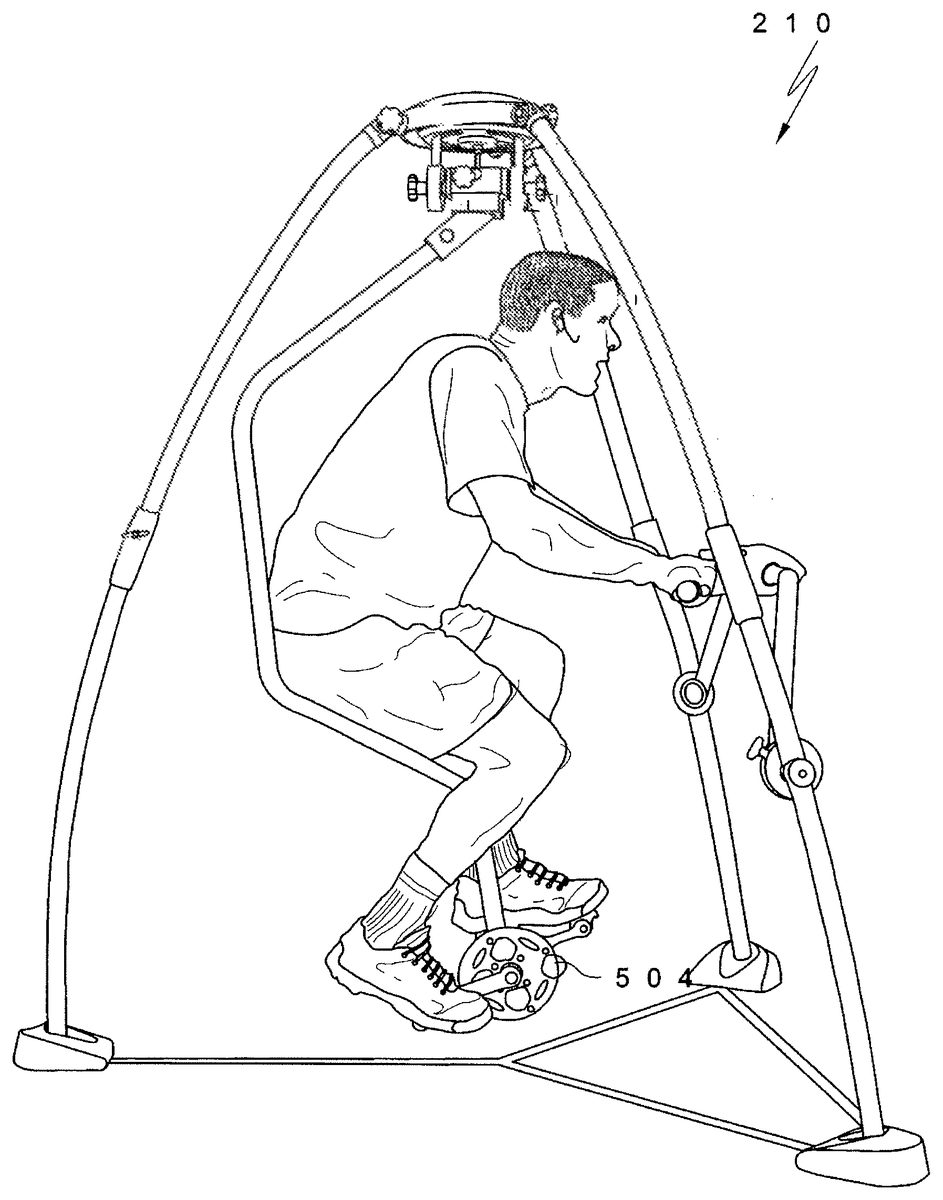
FIGS. 7 to 9illustrate improvements to the control means such as is described in PCT/AU2003/000754. As in the earlier application, the improved game controller210includes a frame in the form of a tripod212having two front legs214,216and one rear leg218. The top of each leg is connected to a top or head220of the tripod about respective pivots214a,216aand218aas shown in more detail inFIG. 12. The legs themselves, are gently curved and are hinged about their respective mid points214b,216b,218bso that they can be folded in two. The feet214c,216c,218cof each leg locates in and is locked in a cylindrical hole in a plastic moulding221fixed to a mat222on which the tripod sits.
A handlebar assembly224extends between the front two legs of the tripod. The handlebar assembly224is mounted to the front legs214,216by means of plastic fittings226which can be slid up or down the legs so that the height of the handlebar assembly is adjustable.
As shown inFIG. 7, the handlebar assembly224includes two co-axial stub portions230,232linked by two radial arm portions234,236to a central bar238extending parallel to the stub portions. The radial arm portions234,236pivot about the stub portions to enable adjustment of the position of the central bar238relative to the stub portions. A control console240including handle grips242,243(not shown) is attached to the central bar238.
A T bar250depends down from the head of the tripod. The T-bar250is suspended from the head of the tripod by a220bearing such that it can be swung backwards and forwards and side to side or rotated about a vertical axis108a. The head220is shown inFIGS. 8 and 9and is essentially the same as the bearing and control means shown inFIGS. 5 and 6but inverted. The bearing means202rotate on a tracked race206and the support means204can rotate about axis208bin directions B and B′ and about a vertical axis in directions A and A′. At the centre of the head220is a joystick control means203(providing pan and tilt movements). Locking means,270,272(seeFIG. 13) are provided to lock the control means in position for either back and forwards or side to side movement, or rotation. The addition of the servo assisted control means201allows the controller to be used in arcades and in other applications where assistance for player movement is required. This may include some physiotherapy applications.
As shown inFIG. 7, a chair252is removably attached to the T-bar250. The chair includes a foot rest254in the form of a bar which is mounted to the chair by a length adjustable member256which is pivoted to the chair252. Foot pedals258,260are removably attached to the foot rest254. Elastomeric straps280,282and284extend between the seat and the frame to increase resistance to movement of the seat.
In the configuration for use in simulating driving a car shown inFIG. 7, vertical rotation about the bearing about axis A is permitted and side to side and backward and forward movement is locked off. The player grasps the handle grips which are angled down to simulate a steering wheel and turns the vehicle by pushing on the handlebars and twisting their body. The pedals58,60typically control acceleration and braking as in a normal car. As described in PCT/AU2003/000754 resistance may be provided to movement about the top bearing220.
However, in a further improvement, resistance may also be provided to movement of the foot/leg and hand/arm operated controls. For example spring or servo-motor based biasing means300may be provided to depression of the pedals258and260. Alternatively instead of handlebars, two hand operated levers may be provided (not shown) which may be reciprocated back and forth against a resistance. Such a feature may be provided in, say, a boxing game or rowing simulation. Note also that the action need not necessarily correspond to a similar movement by a sprite of the like in a computer game, although it is preferable that there is some relationship between the two.
Other additional control means may include fixed handle bars, rotating wheels, finger and/or wrist controlled mechanisms, such as buttons handles and levers, foot pedals which may be depressed or rotated (as is the case with bicycle pedals), paddles which slide back and forward and push/pull foot braces, requiring a pumping action from the legs, or a treadmill to simulate walking. Some or all of the additional control means will be associated with resistance means to exercise the player's hands, feet, legs or arms. The resistance means may be provided by any suitable means including, but not limited to, hydraulic or pneumatic cylinders, electronically, using servo-motors or other means, or using elastic or elastomeric means, springs, braking systems etc. Note that these features may apply to the embodiment ofFIGS. 1 to 6and10and11, as well as that ofFIGS. 7 to 9.
In this way, the game controllers of the present invention may be used in physiotherapy applications. Where particular muscle groups or limbs of patient may need to be exercised, the controller means may be set up to provide that exercise as part of a computer game. Physiotherapy typically involves repetitive movement of particular limbs, muscle groups etc., which can be extremely tedious for the patient. Incorporating the exercise required into a computer game where repetitive movements are required for playing a game reduces patient boredom by immersing the patient in a whole of body gaming experience. Playing standard computer games using standard controllers such as joy pads or steering wheels involves a player making repetitive movements but because they are involved in playing a game, the repetition of these movements is not “boring”. In the present invention the player's/patient's immersion in the game is increased by involving whole body control, reducing the likelihood of boredom still further.
Although many different set-ups are possible for the game controller of the present invention for physiotherapy functions, examples where the player is suspended include games where a pushbike, or at least a frame configured to simulate a pushbike, from the support means/controller and, inter alia, providing resistance to turning of the pedals to determine a player's speed in a game, with a patient's leaning or rotation controlling direction, or for patients without use of their legs suspending them from the support means/controller either in a wheel chair or on a seat, and allowing them to brace with their hands/arms and twist their body to control a computer game. A similar arrangement could of course be provided with the support means/controller below the patient although, resistance to turning movement would be expected to be much greater in that arrangement. Resistance for physiotherapy reasons can be provided to extension of a patient's legs as the basis for a rowing simulation, or for skiing or walking. It will also be appreciated that whatever physiotherapy is provided it is not necessary for the game/simulation being provided to correspond to the exercise. Although it is possible for the machine to be set up to provide a simulation of the exercise e.g. cycling or rowing being carried out it is equally possible to exercise while piloting a simulation of a space ship whilst still exercising. The person skilled in the art will appreciate that either controller may be used to provide a wide range of different exercise and physiotherapy applications.
FIG. 10illustrates an embodiment of the present invention where the seat56has been removed and a surfboard400secured to the support plate. Clearly skateboards or other devices which may be ridden, may be used in place of the surfboard400. The hand operated controls may not be used in such an application but if they are required the telescopic legs64to67may be used to raise the control panel60so that it is accessible. In this version it is possible to provide a harness suspended from above the player to catch the player if they fall of the board400.
FIG. 10also illustrates an unrelated variant to the invention in which the pedals470are mounted on hydraulic cylinders472(although other resistance providing means could be used) to provide resistance to depression of the pedals which might be used in a rowing game or simulation. Hand operated levers474which may rotate back and forth in the direction C and C′ may also be provided and include a biasing means476to provide resistance to movement of the levers.
FIG. 11illustrates a below player game controller set up for a cycling simulation where a strut500and seat502is mounted to the support plate and a crank and pedals assembly504are provided including resistance means to provided resistance to turning of the cranks. A signal from the crank and pedals assembly corresponding to the speed of rotation of the assembly504is input to the console100. As shown the struts64to67are extended to raise the control panel and handlebars62. It will be appreciated that it is also possible to configure the above player controller ofFIGS. 7 to 9to simulate cycling.
FIG. 12illustrates the use of an above player game controller of the type shown inFIG. 7set up to play a cycling game or simulation.
FIG. 13illustrates use of an above player game controller of the type shown inFIG. 7set up to play a boarding game or simulation, such as skate boarding or surfing.
FIG. 14shows a yet further variant of the controller ofFIG. 7in which the depending T-bar is replaced by a depending box frame600. The depending box frame includes a short depending tube602, a cross piece604from ends of which depend two parallel legs606. Each leg606is cranked/bent twice into a generally concave shape. A cross piece608extends across the bottom of each leg. Each leg defines a hook610for hanging a chair (not shown inFIG. 14) thereon.
Game controllers embodying the present invention, whether the support and control means is located above or below the player, may be used to control a wide variety of games including driving, riding, “point of view” games, general children's character games and sports games.
Other variants and improvements, not shown may include the use of pneumatically operated airbags to effect braking and acceleration.
Driving games may include, but are not limited to, driving cars, boats, planes, trains, automobiles, motorbikes, war vehicles, space craft, helicopters and any automobile or vehicle.
Riding games may include, but are not limited to, riding motorbikes, jet skis, pushbikes, skateboards, quad bikes, snowboarding, surfing and the like.
Point of view games may include, but are not limited to, combat games, “shoot 'em up games”, such as “HALO”, “SPLINTERCELL”, “STAR WARS”, “JEDI KNIGHTS” and the like.
General children's character games may include, but are not limited to, games such as “DONKEY KONG”, “POKEMON”, “CRASH BANDICOOT”, 3 dimensional games and others.
Sports games may, by way of example, include, but are not limited to, tennis, soccer, Olympic games, wrestling, football, golf, baseball and cricket.
It will be appreciated by persons skilled in the art that numerous variations and/or modifications may be made to the invention as shown in the specific embodiments without departing from the spirit or scope of the invention as broadly described. The present embodiments are, therefore, to be considered in all respects as illustrative and not restrictive.
Claims
- A controller means for controlling a computer game, the controller means comprising: a support means, or seat on which a player may sit, stand or be supported;the support means being disposed on a bearing means incorporating or associated with a control means;handlebars or other means which may be grasped by the player and/or foot pedals against which the player may brace their feet, in use;and a resistance means for increasing the resistance to movement of the support means relative to the bearing means, thereby providing physiotherapy exercise for the player;wherein the arrangement is such that in use, the player may brace themselves using the handlebars and/or pedals and move the support means on the bearing means to input control signals to the control means, wherein the support means and control means may rotate, and tilt sideways, backwards and forwards, and wherein the controller may also slide backwards and forwards and side to side and including means for lifting and dropping the support means on the order of a few centimeters for gravity effects.
- A controller means for controlling a computer game as claimed in claim 1 arranged to operate in a similar manner to a joystick in which movement of the game player provides the normal forwards and backwards and side to side control functions of the joystick.
- A controller means for controlling a computer game as claimed in claim 1 wherein the support means includes, or has mounted upon it, a chair, saddle, cradle or other seat means.
- A controller means for controlling a computer game as claimed in claim 1 wherein the support means defines a plate on which a player may mount or fix their own surfboard, skateboard or the like to play a game.
- A controller means for controlling a computer game as claimed in claim 4 wherein the support means defines rubber pads, or is coated with an elastomer or other non-slip coating or material.
- A controller means for controlling a computer game as claimed in claim 4 wherein the support means is padded.
- A controller means for controlling a computer game as claimed in claim 1 wherein sliding and or lifting is assisted by the controller means.
- A controller means for controlling a computer game as claimed in claim 7 wherein the assistance is provided electronically by controlled servo-motors.
- A controller means for controlling a computer game as claimed in claim 1 wherein additional control means which may be operated by the player's hands, feet, legs, fingers or arms are provided.
- A controller means for controlling a computer game as claimed in claim 9 wherein the additional control means are selected from the group comprising fixed handle bars, rotating wheels, finger and/or wrist controlled mechanisms, including buttons handles and levers, foot pedals which may be depressed or rotated, paddles which slide back and forward and push/pull foot braces, requiring a pumping action from the legs, or a treadmill to simulate walking.
- A controller means for controlling a computer game as claimed in claim 10 wherein one or more of the additional control means are also associated with resistance means to exercise the players hands, feet, legs or arms.
- A controller means for controlling a computer game as claimed in claim 11 wherein the resistance means includes hydraulic or pneumatic cylinders, electronically operated means, servo-motors, elastic or elastomeric means, springs, or braking systems.
- A controller means for a computer gaming machine comprising a support platform, such as a seat, platform, chair harness or the like, on which a player may sit, stand, lie, be suspended via a bearing means incorporating a control means, and a resistance means for increasing the resistance to movement of the support platform relative to the bearing means, thereby providing physiotherapy exercise for the player;wherein additional control means are provided for operation by one or more of the player's limbs including legs, feet, arms, hands, or fingers, and wherein resistance to movement of one or more of the additional control means is provided, thereby providing physiotherapy type exercise for the player, and wherein the resistance to movement includes hydraulic or pneumatic cylinders, electronically operated means, servo-motors, elastic or elastomeric means, springs, or braking systems.
- A controller means for a computer gaming machine as claimed in claim 13 wherein a frame configured to simulate a pushbike, is suspended from the support means/controller and resistance is provided to turning of the pedals to determine a player's speed in a game, with a patient's leaning and/or rotation controlling direction.
- A controller means for a computer gaming machine as claimed in claim 13 suitable for patients without use of their legs including means for suspending the patient from the support means/controller either in a wheel chair or on a seat, and allowing the patient to brace with their hands/arms and twist their body to control a computer game.
- A computer game controller comprising means for suspending a player, in a support means such as a chair, or harness, from a bearing means, the bearing means including a control means for inputting position signals to a computer to control the movement of a sprite such as a vehicle or character, in a computer game, the bearing allowing side to side, forwards and backwards, and rotational movement of the player about the bearing and including selectively operable locking means for preventing either rotational movement or side to side and forwards and backwards movement, the arrangement being such that movement of the player's body may move the chair or harness to control the sprite in the computer game, the controller, further including resistance means for increasing the resistance to movement of the support means relative to the bearing, thereby providing physiotherapy exercise for the player, wherein the resistance means comprise an elastomeric strap extending between the frame and the support means.
- A computer game controller as claimed in claim 16 wherein the means for suspending a player comprises a frame and wherein a handlebar means which can be grasped by the player in use is attached to the frame.
- A computer game controller as claimed in claim 16 wherein the control means is of the joy stick type or of a rotational control wheel type.
- A computer game system for playing a computer game comprising a computer console, a display means for displaying a game being played on the computer game system, and a game controller as claimed in claim 16 wherein movement of the body of a player suspended from the game controller is arranged to cause movement of a sprite in the game being played.
Disclaimer: Data collected from the USPTO and may be malformed, incomplete, and/or otherwise inaccurate.