U.S. Pat. No. 8,070,603
NETWORK GAME SYSTEM, NETWORK GAME SERVER, AND NETWORK GAME TERMINAL
AssigneeSony Corporation
Issue DateAugust 27, 2002
Illustrative Figure
Abstract
Disclosed is a network game system in which a time lag is adjusted, using game terminal type information such as its ID number. A network game server comprises a lag adjusting program and a database to be referenced to execute the lag adjusting program. On the network, data from game terminals is transmitted in packets to the network game server where concentrated management is made of all packet data as user information. Different transmission time lags predetermined for the product types of the game terminals that are expected to connect to the server are stored into the database beforehand. When the server receives packet data from a terminal device having an EUI-64 identifier, the appropriate transmission time lag is read, based on the identifying information.
Description
DETAILED DESCRIPTION OF THE PREFERRED EMBODIMENTS The invention now is described fully hereinafter with reference to the accompanying drawings, in which preferred embodiments of the invention are shown. FIG. 1is a diagram showing the configuration of a network game system according to the invention. Network game terminals (hereinafter referred to as game terminals)10through40are connected to the same network game server50via a network60. The game terminals10through40each have different performance. Assume that the game terminal10is, for example, a game terminal product of type al supplied by manufacturer A, the game terminal20is, for example, a game terminal product of type b1supplied by manufacturer B, the game terminal30is, for example, a game terminal product of type c1supplied by manufacturer C, and the game terminal40is, for example, a game terminal product of type a2supplied by manufacturer A. The network game server50has a lag adjusting program51and a database52that is referenced to execute the lag adjusting program51. On the network60, data from the game terminals10through40is transmitted in packets to the network game server50where concentrated management is made of all packet data as user information. Data processed by the server is transmitted again across the network60to the game terminals10through40. On the network60, each of the game terminals10through40connected thereto is assigned a network address pursuant to the Internet Protocol version6(IPv6). Unlike the IPv4 addressing using four sets of three digits of decimal numbers, which has been applied as a standard Internet protocol, the IPv6 addressing has extended an IP address to 128 bits in length and thus can make the number of connectable nodes increase drastically. Although only four game terminals10through40are shown inFIG. 1, by the IPV6 addressing, 64 bits of an IP address are assigned for interface ID and it is possible to make address assignments to almost an unlimited number of terminal devices and connect them to ...
DETAILED DESCRIPTION OF THE PREFERRED EMBODIMENTS
The invention now is described fully hereinafter with reference to the accompanying drawings, in which preferred embodiments of the invention are shown.
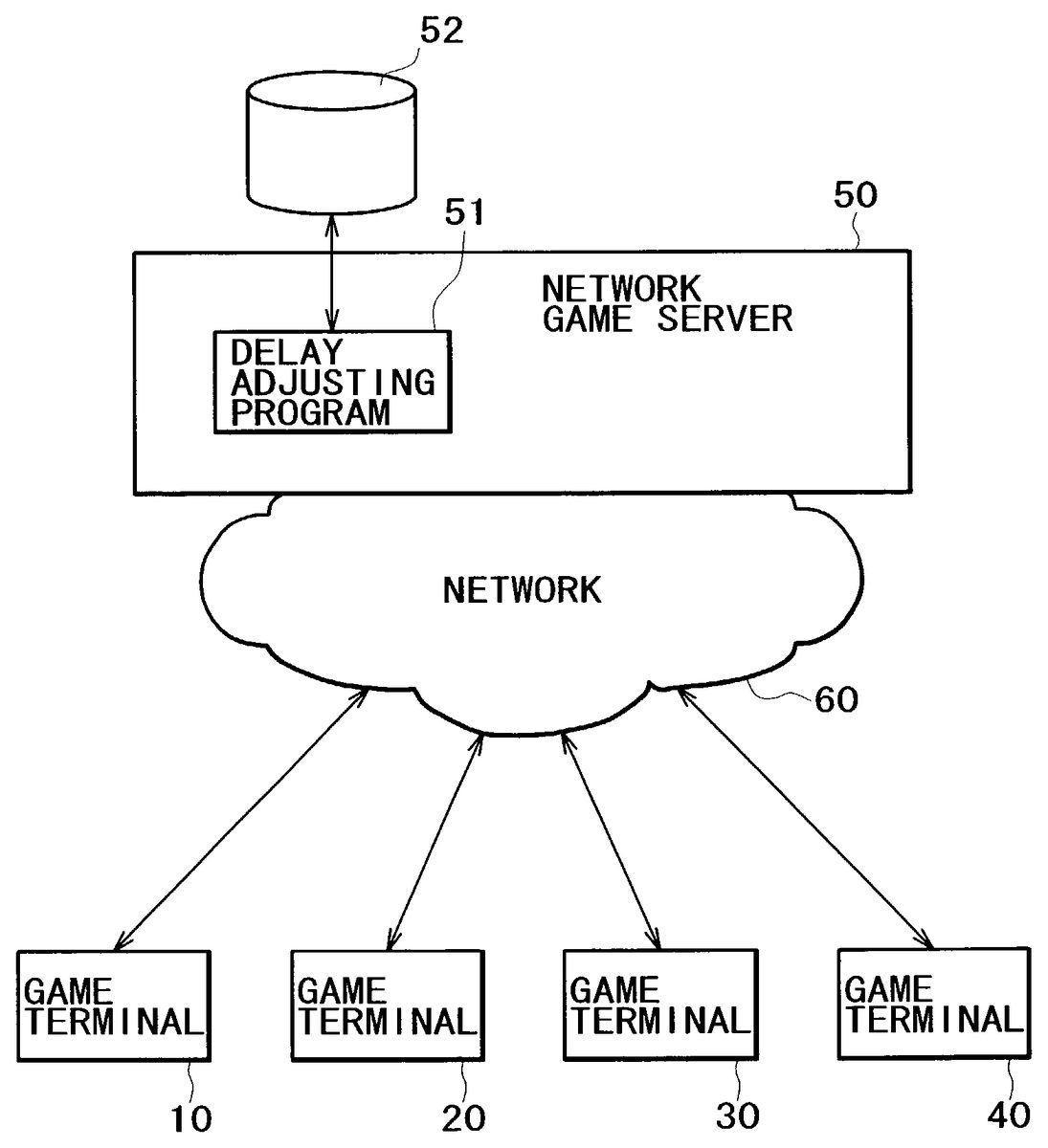
FIG. 1is a diagram showing the configuration of a network game system according to the invention. Network game terminals (hereinafter referred to as game terminals)10through40are connected to the same network game server50via a network60. The game terminals10through40each have different performance. Assume that the game terminal10is, for example, a game terminal product of type al supplied by manufacturer A, the game terminal20is, for example, a game terminal product of type b1supplied by manufacturer B, the game terminal30is, for example, a game terminal product of type c1supplied by manufacturer C, and the game terminal40is, for example, a game terminal product of type a2supplied by manufacturer A.
The network game server50has a lag adjusting program51and a database52that is referenced to execute the lag adjusting program51. On the network60, data from the game terminals10through40is transmitted in packets to the network game server50where concentrated management is made of all packet data as user information. Data processed by the server is transmitted again across the network60to the game terminals10through40.
On the network60, each of the game terminals10through40connected thereto is assigned a network address pursuant to the Internet Protocol version6(IPv6). Unlike the IPv4 addressing using four sets of three digits of decimal numbers, which has been applied as a standard Internet protocol, the IPv6 addressing has extended an IP address to 128 bits in length and thus can make the number of connectable nodes increase drastically. Although only four game terminals10through40are shown inFIG. 1, by the IPV6 addressing, 64 bits of an IP address are assigned for interface ID and it is possible to make address assignments to almost an unlimited number of terminal devices and connect them to the network game server50. As the interface ID of 64 bits, a 64-bit identifier EUI-64 of IEEE can be used.
The lag adjusting program51is a program for adjusting the transmission time lag per packet data, according to game terminal product type information that is transmitted as packet data from the game terminals10through40. For example, 24 bits of the EUI-64 identifier are set to designate a manufacturing company ID by which a game terminal product type can be identified. Accordingly, different transmission time lags predetermined for the product types of the game terminals that are expected to connect to the server are stored into the database52beforehand. When the server receives packet data from a terminal device to which an EUI-64 identifier was assigned, the appropriate transmission time lag can be read, based on the identifying information.
Then, the operation of the network game server will be explained.
FIG. 2is a flowchart for explaining the operation of the network game server.
At step S10, the network game server50starts operation. In step S12, the server receives an IP packet from any of the game terminals10through40across the network60. The source of the IP packet is identified by the IPv6 address on the Internet included in the packet. Upon the reception of the IP packet, in step S14, the server reads the device ID designated in the source EUI-64 identifier included in the packet and knows the manufacturing company name and the product number (identifying the model) of the game terminal that transmitted the packet data over the network60.
In step S16, the server accesses the location corresponding to the device ID on the database52and reads the transmission time lag stored in that location. In step S18, the server makes a lag adjustment of the received packet, according to the thus read transmission time lag. In step S20, the server executes a sequence of data processing by the appropriate network game application for the data in the received packet that was lag adjusted.
In step S22, the server generates reply data, according to the result of the processing by the network game application. In step S24, the server reads the device ID of a destination game terminal of the thus generated data. A specific terminal may be specified as the destination or a plurality of terminals may be specified as the destinations. Again, the server accesses the location corresponding to the device ID on the database52(step S26), reads the transmission time lag stored in that location, and makes a lag adjustment of the replay data packet to transmit, according to the thus read transmission time lag (step S28). If the reply data packet is sent back to the same terminal, this transmission time lag is equal to that retrieved in the step S16before the game processing. By temporarily storing the transmission time lag once retrieved, the step S26can be omitted.
Finally, in step S30, the server outputs the reply IP packet to the network60.
FIG. 3is a timing chart of exchanging packets between the network game server and the game terminals.
Now, assume that the game terminal10has the highest processing speed among the terminals connectable to the server and time t1in which the game terminal10processed data is shorter than time t2in which the game terminal20processed the corresponding data. Even if data is transmitted simultaneously from the network game server50to the game terminals10and20, because of the data processing time difference between t1and t2that are intrinsic to the game terminals10and20, respectively, the time to transmit the data from the game terminal20to the network game server50lags. To make the network game server50start processing the data from both game terminals10and20at the same time, under the control of the lag adjusting program51, the start of processing of the packet data from the game terminal10is delayed by a time lag td (equaling t2−t1) that is marked by a bold arrow. Thus, the network game server50starts to process the data from both game terminals at the same time.
Furthermore, when the server finally transmits the data processed by it to the game terminals10and20again, it reads the identification number information of the network game terminal10from the destination address of the packet data to transmit and determines the transmission time lag, so that the time to transmit the packet data to the game terminal10is delayed by a time lag td (equaling t2−t1) that is marked by a bold arrow. In this way, even if game players participate in a network game, using their terminals each having different processing speed, they can enjoy the game fairly.
Using the above-described network game server, it is sufficient to store only the processing speeds and associated time lags according to the limited types of terminal devices into the database52. Before starting the game service, it becomes unnecessary to measure the operation throughput of all terminals connectable to the server and map the ID per game player such as the IP address of its terminal to the adjustment time lag set for it for management, which prior art network game systems would do. Thus, the network game server need not to have a complex protocol for communicating game player ID and device throughput information. Even if game terminal products supplied by different manufacturers are used to play a game via a network, it is sufficient to register terminal type information and the adjustment time lag per type into the database52. Network game participants using different types of terminals each having different throughput can enjoy the same network game fairly.
The foregoing invention has been described in terms of preferred embodiments. However, those skilled, in the art will recognize that many variations of such embodiments exist. Such variations are intended to be within the scope of the invention and the appended claims.
Claims
- A network entertainment system comprising a plurality of first network apparatuses each having different performance characteristics, and a second network apparatus which runs a network application and processes packet data transmitted from said plurality of first network apparatuses, said first network apparatuses and said second network apparatus being connected via a network, wherein said second network apparatus includes a lag adjustment database in which lag adjustments for varying types of first network apparatuses are stored, and lag adjustment means for adjusting a time lag for processing and transmitting data packets, wherein each data packet received by the second network apparatus is processed by the second network apparatus only after storing information from the received data packet for an amount of time corresponding to the time lag determined by the lag adjustment means for the first network apparatus from which the received data packet was transmitted, the data packet is processed by the second network apparatus after waiting the amount of time determined by the lag adjustment means, the processing causing the generation of a data packet to be transmitted by the second network apparatus and further wherein the data packet to be transmitted by the second network apparatus is transmitted from the second network apparatus only after an amount of delay determined by the lag adjustment means for the first network apparatus to which the data packet is to be transmitted;wherein each first network apparatus transmits an identifier code to the second network apparatus identifying a type of network apparatus, and the time lag adjustment amount that the second network apparatus applies to packet data traveling to and/or from a particular first network apparatus is determined by retrieving time lag information from the database based exclusively on the identifier code designating a type of network apparatus from each first network apparatus, without analysis of any actual data transmission to and/or from the first network apparatus.
- The network entertainment system as claimed in claim 1 , wherein said lag adjusting means obtains the identification type data of one of said first network apparatuses from the source address of packet data received, determines the transmission time lag to apply to the packet data, and changes the time to start the execution of said network application on said second network apparatus accordingly.
- The network entertainment system as claimed in claim 1 , wherein said lag adjusting means obtains the identification type data of one of said first network apparatuses from the destination address of packet data to transmit, determines the transmission time lag to apply to the packet data so that packet data transmitted from said second network apparatus arrives at said first network apparatuses at substantially the same time.
- The network entertainment system as claimed in claim 1 , wherein each of said first network apparatuses has a network address pursuant to an Internet Protocol version 6(IPv6) including type identification information specific to a first entertainment apparatus product type.
- The network entertainment system of claim 1 , further wherein: said first network entertainment apparatuses each having a network address pursuant to the Ipv6 including type identification information specific to a first entertainment apparatus product type.
- The network entertainment system as claimed in claim 1 , wherein said lag adjustment means adjusts a time lag for data packets transferred from the first network apparatuses prior to processing of the data packets.
- The network entertainment system as claimed in claim 6 , wherein first network apparatuses having increased relative performance characteristics have their packet data subjected to increased lag adjustment relative to first network apparatuses having decreased relative performance characteristics, based on the performance characteristics of network apparatus types stored in the performance characteristics database.
- The network entertainment system as claimed in claim 1 , wherein said lag adjustment means adjusts a time lag for each packet data as it is transferred to each of said first network apparatuses.
- The network entertainment system as claimed in claim 1 , wherein first network apparatuses having increased relative performance characteristics have their packet data subjected to increased lag adjustment relative to first network apparatuses having decreased relative performance characteristics, based on the performance characteristics of network apparatus types stored in the performance characteristics database.
- A primary network entertainment apparatus which stores a network entertainment application and processes packet data transmitted from and/or to a plurality of first network entertainment apparatuses each having different performance characteristics, said primary network entertainment apparatus including: “a microprocessor executing machine instructions corresponding to a computer program stored in electronic memory of the primary network entertainment apparatus, which causes†adjusting of a time lag for processing and transmitting data packets such that a greater lag adjustment is applied to data packets received from and transmitted to a first network entertainment apparatus type which exhibits greater relative performance characteristics compared to a first network entertainment apparatus type which exhibits lower relative performance characteristics, and wherein the time lag is based exclusively on an identifier information designating a type of network apparatus that is transmitted from each first network apparatus, without analysis of any actual data transmission to and/or from the first network apparatus, wherein each data packet received by the primary network entertainment apparatus is processed by the primary network entertainment apparatus only after storing information from the received data packet for an amount of time . corresponding to the time lag determined by the lag adjustment means for the first network apparatus from which the received data packet was transmitted, and further wherein a data packet to be transmitted by the primary network apparatus is transmitted from the primary network apparatus only after an amount of delay determined by the lag adjustment means for the first network apparatus to which the data packet is to be transmitted.
- The primary network entertainment apparatus as claimed in claim 10 , wherein said computer program adjusts a time lag for each packet data as it is transferred to each of said first network apparatuses.
- The primary network entertainment apparatus as claimed in claim 11 , wherein said lag adjustment of outgoing packet data transferred to each of said first network apparatuses is effected by intentionally delaying the transmission of a packet data out of said second network apparatus.
Disclaimer: Data collected from the USPTO and may be malformed, incomplete, and/or otherwise inaccurate.