U.S. Pat. No. 8,065,702
NETWORK ADVERTISING AND GAME PLAYING
AssigneeBeneficial Innovations, Inc.
Issue DateFebruary 23, 2009
Illustrative Figure
Abstract
The a method and apparatus is disclosed for collecting information about network (Internet) users for determining advertising to be presented to the users. User profiles may be determined, and advertising is selectively provided by comparing user personal information in such profiles with a desired demographic profile. The advertising may be presented in combination with the users playing games. User responses to advertising are used for evaluating advertising effectiveness. Test marketing of products, and advertisements may be performed.
Description
DETAILED DESCRIPTION InFIG. 1, a block diagram is presented of a first embodiment of an electronic system10for the present invention for playing blackjack, wherein data flows are represented by solid arrows and control flows are represented by dashed arrows. In particular, the embodiment ofFIG. 1presents an architecture for the present invention for use on, for example, a local network within a casino, wherein low cost gaming stations may be utilized. Accordingly, the blackjack gaming system10includes a blackjack game controller14electronically connected to one or more potentially remote gaming stations18so that for each gaming station a player may play blackjack. In the blackjack gaming system10, the blackjack game controller14functions substantially as a dealer would in a manually operated blackjack game and each gaming station18provides a blackjack player with an electronic representation of a blackjack game wherein it may appear that the player (i.e., user) at the gaming station18is the only player playing against the dealer (i.e., “head-to-head” against the blackjack game controller14). Accordingly, each gaming station18, as will be discussed with reference toFIG. 2below, includes a display for displaying both the dealer's cards and the player's cards. Each gaming station18also includes player interaction capabilities for requesting additional cards, activating various blackjack player options at appropriate times, and potentially increasing various wagers at predetermined phases of a blackjack game. Further note that each gaming station18, when in operation, may request a security code be provided by a player for identifying himself/herself or, alternatively, the gaming station may request the player to insert an electronic card (not shown) into the gaming station18so that information electronically encoded upon the card is read at the gaming station and transferred to the blackjack controller14. Referring now to the internal structure of the blackjack game controller14, a gaming station interface22is provided for interfacing with each of the gaming ...
DETAILED DESCRIPTION
InFIG. 1, a block diagram is presented of a first embodiment of an electronic system10for the present invention for playing blackjack, wherein data flows are represented by solid arrows and control flows are represented by dashed arrows. In particular, the embodiment ofFIG. 1presents an architecture for the present invention for use on, for example, a local network within a casino, wherein low cost gaming stations may be utilized. Accordingly, the blackjack gaming system10includes a blackjack game controller14electronically connected to one or more potentially remote gaming stations18so that for each gaming station a player may play blackjack. In the blackjack gaming system10, the blackjack game controller14functions substantially as a dealer would in a manually operated blackjack game and each gaming station18provides a blackjack player with an electronic representation of a blackjack game wherein it may appear that the player (i.e., user) at the gaming station18is the only player playing against the dealer (i.e., “head-to-head” against the blackjack game controller14). Accordingly, each gaming station18, as will be discussed with reference toFIG. 2below, includes a display for displaying both the dealer's cards and the player's cards. Each gaming station18also includes player interaction capabilities for requesting additional cards, activating various blackjack player options at appropriate times, and potentially increasing various wagers at predetermined phases of a blackjack game. Further note that each gaming station18, when in operation, may request a security code be provided by a player for identifying himself/herself or, alternatively, the gaming station may request the player to insert an electronic card (not shown) into the gaming station18so that information electronically encoded upon the card is read at the gaming station and transferred to the blackjack controller14.
Referring now to the internal structure of the blackjack game controller14, a gaming station interface22is provided for interfacing with each of the gaming stations18. In particular, the gaming station interface22buffers data signals between the other components included within the blackjack game controller14and the gaming stations18. For example, the gaming station interface22may have speed matching buffers in order to adjust for differences in speed between the blackjack game controller14and the gaming stations18. A blackjack driver26exchanges data with the gaming station interface22. The blackjack driver26substantially coordinates the operation of the blackjack game controller14. In particular, the following capabilities are substantially provided by the blackjack driver26:(1.1) identifies each player requesting to play blackjack at one of the gaming stations18;(1.2) creates internal data structures for communication with other modules of the blackjack game controller14regarding each blackjack game being played; in particular, blackjack gaming data objects or records are (re)instantiated with each player request, such data objects providing sufficient information for the blackjack game controller14to properly respond to each received player request;(1.3) determines the output of the blackjack game controller14to each of the active gaming stations18;(1.4) distributes blackjack gaming data between other modules of the blackjack game controller14; and(1.5) provides card representations to gaming stations18.
In performing the above tasks, the blackjack driver26communicates with a blackjack player registration and playing status database28. The database system28maintains in persistent storage information regarding each blackjack player. In particular, the database system28maintains:(2.1) information identifying each player; e.g., a unique player identification code;(2.2) information regarding, for example, each blackjack player's financial status; in particular, a credit limit and a current amount of funds (either to be paid or received from the player);(2.3) for each person registered to play blackjack, information regarding the status or context of any game the player is presently playing; that is, sufficient information is stored so that the blackjack game controller14can retrieve this information and continue a blackjack game in response to receiving a player's request;(2.4) for each person registered to play blackjack, information regarding any blackjack tournament that the player is playing; in particular, since such a tournament typically requires a tournament player to complete a specified number of blackjack games in a predetermined amount of time and/or to complete a specified number of blackjack games out of a total number of blackjack games, the following types of information maybe stored: (a) information relating to the number of blackjack games completed by the player; (b) information related to the time and/or the number of games remaining in the tournament; and (c) information related to the amount of funds or points in the player's account for the tournament.
The blackjack driver26communicates with a wager accounting module30wherein the wager accounting module provides the following capabilities:(3.1) determines various wagering limit parameters for the next one or more blackjack games to be played (e.g., the wagering limit per game and the total wagering limit per player); and(3.2) performs wagering accounting for each player's wins and losses.
Thus, the wager accounting module30is instrumental in initializing a new blackjack game in that this module receives and maintains financial information related to each currently active player at a gaming station18. Thus, the wager accounting module30has a communication data channel with the blackjack player registration and playing status database28so that the wager accounting module30may retrieve information for determining whether the player has, for example, sufficient financial resources to cover potential wagering losses. Of course, to provide waging evaluation information to other controller14modules, the wager accounting module30receives identifying information from each such module requesting an evaluation.
The blackjack driver26also communicates with a blackjack player evaluator34. The blackjack player evaluator34receives, from each player (via instantiations of blackjack gaming data objects from the blackjack driver26), all blackjack player requests except the data from each player indicating an amount to be wagered. Thus, the blackjack player evaluator34:(4.1) determines each player's options during blackjack games; and(4.2) responds to player requests for hits or to, for example, split pairs.
Thus, the blackjack player evaluator34enforces the gaming establishment rules related to player options during a blackjack game. Note, however, that in responding to certain player requests, the blackjack player evaluator34communicates with the wager accounting module30to confirm that a proper wager accompanies the requested option and that the wager is acceptable to the wager accounting module30.
The blackjack player evaluator34is supplied with data corresponding to blackjack card representations from a card generator module38. The card generator module38generates, for example, an ordered collection or sequence of substantially random card representations and each such card representation is provided to the blackjack player evaluator34, wherein the blackjack player evaluator responds to each player's valid hit request by outputting the most recent card representation received from the card generator module38. That is, each player at a gaming station18receives a card representation according to when the player's request is received by the blackjack player evaluator34.
Further, note that the card generator module38also supplies the same card representations as supplied to the blackjack player evaluator34to a house blackjack playing module42, wherein this latter module plays the dealer's hand in each blackjack game. Thus, the house blackjack playing module42enforces the blackjack gaming rules on behalf of the gaming establishment. In particular, this module determines when and how insurance bets can be made related to the dealer's cards. Note, as with the blackjack player evaluator34, the house blackjack playing module42outputs, when required to provide the dealer's hand with another card representation at a gaming station18, the most recent card representation received from the card generator module38. Further note that the house blackjack playing module42provides control information to the blackjack driver26, particularly regarding activation of the blackjack insurance option. This information, in turn, is conveyed to the blackjack player evaluator34so that this latter evaluator may activate the insurance option for each player at an active gaming station18.
A blackjack hand evaluator46is also in communication with the blackjack driver26. The blackjack hand evaluator46evaluates each player's hand(s) in comparison to the dealer's blackjack hand for determining the win/loss/tie for each player's hand. Thus, the dealer's hand and the one or more hands played by each player at a gaming station18is supplied to the blackjack hand evaluator46. Subsequently, this evaluator outputs win/loss/tie results to the gaming stations18via the blackjack driver26and the gaming station interface22. Further, the blackjack hand evaluator46also outputs win/loss/tie results along with the identity of the player playing each hand to the wager accounting module30so that wager credits and debits for each player's account may be updated according to the last or most recent blackjack game results.
InFIG. 2, an embodiment of a gaming station18is illustrated. The gaming station18includes a player input area204wherein a player may press touch-sensitive portions of a thin film laminated with blackjack player operations and requests. Immediately above the player input area is a player output display area208for displaying blackjack gaming information related to the player. Optionally, each gaming station18may include a player identification card reader216so that a blackjack player may identify him/herself at a gaming station18by swiping a magnetic identification portion of a player identification card (not shown) through the card slot220thereby allowing the card reader216to transmit the player's encoded identification upon his/her card to the blackjack game controller14. However, it should be noted that other configurations of the gaming station18are also contemplated by the present invention. In particular, gaming station18may not have a card reader216. Instead, a blackjack player may be required to register either manually or automatically at a site remote from the gaming station18, or, alternatively personal identification numbers may be provided to players for identifying themselves via the player input area204wherein, for example, a numeric digit provided in the lower bottom portion of some of the touch-sensitive areas may be used by the player to input a personal identification number. Further, the arrangement of the touch-sensitive portions of the player input area204and the format of the display area208(both being discussed in detail below) may have other arrangements and still be within the scope of the present invention.
Describing in detail now the touch-sensitive portions of the player input area204, an activate/enter next game button220is provided. This button is used to initially activate the gaming station18so that a “request to play” signal is transmitted to the blackjack driver26. That is, assuming a player activates this button at a gaming station18, the blackjack driver26responds by requesting that the player input his/her identification via, for example, placing an identification card in the card reader216and/or a personal identification number via the player input area204. Additionally, note that the button220may be pressed at the end of a blackjack game for indicating that the player wishes to play another blackjack game. Note that in one embodiment of the present invention when consecutive games are played by a player, the player need only press the button220to commence a new game. That is, the player's identification need not be entered for each consecutive game played (assuming the button220is activated within a predetermined time after the last game has terminated).
The player input area204also includes a quit button224that a player may press to explicitly indicate the player's desire to terminate any further gaming at the gaming station18.
Additionally, buttons228through248provide the player with the capabilities to request the following blackjack gaming requests:(5.1) The “HIT” button228allows the player to request another card to be dealt to him/her.(5.2) The “STND” button232allows the player to stand on a current blackjack hand.(5.3) The “DBL” button236allows the player to double down under appropriate circumstances as determined by the blackjack player evaluator34.(5.4) The “SPLIT” button240allows the player to split the player's first two cards into two separate blackjack hands when these first two cards are identical.(5.5) The “INS” button244allows the player to request insurance under the circumstances where the dealer's single face-up card is an ace.(5.6) The “BET” button248allows the player to request that a bet or wager be entered during a blackjack game.
Note that subsequent to requesting a bet via the “BET” button248, the buttons252through264are activated so that the player may input various betting amounts. In particular, buttons252through264provide the player with the option to bet $5.00 (button252), $25.00 (button256), $100.00 (button260) and $500.00 (button264). Moreover, a sequence of the buttons252through264may be pressed for obtaining a bet not provided by a single button. For example, to bet $130.00, the player presses consecutively each of the buttons252,256and260(in any order) exactly once.
The player input area204also includes various confirm and cancel buttons268through276. The accept button268allows the user to accept a last input. For example, it is an aspect in the present embodiment of the invention that after each user input, the input is accepted either by the player explicitly pressing the accept button268or by allowing a predetermined amount of time to expire after the last player input. The “CANCEL BET” button272allows the user to cancel an immediately preceding bet that was input. However, note that if a time limit is exceeded for placing a bet due to, for example, the player pressing the “CANCEL” button272, then any minimum bet required will be automatically wagered on the player's behalf by the wager accounting module30. Further, the “CANCEL LAST” button276may be used by the player to cancel the immediately preceding wager of one of the dollar amount buttons252through264. Thus, if a player intended to bet $125.00 by pressing first the button260followed by the button256but instead pressed the button sequence260and264, then the player may press the button276for cancelling the $500.00 bet associated with button264and subsequently the player presses the button256to obtain the desired bet of $125.00. Note further that pressing the “CANCEL LAST” button twice in succession also cancels the entire bet.
A “SPEED OF PLAY” button280may be optionally provided on the player input area204. This button allows the player to specify to the blackjack driver26, for example, the predetermined amount of time after a player input to wait before each subsequent input is automatically accepted. In one embodiment of the present invention, the “SPEED OF PLAY” button280includes active areas at each end of the button, wherein if the user presses the “slower” end of the button280, then the predetermined time(s) for automatically accepting a player input is lengthened. Alternatively, if the player presses the “faster” end of the button280, then the predetermined default acceptance time(s) becomes shorter. However, it is important to note that the tempo of the blackjack game is, using the present invention, no longer as important as in typical blackjack gaming situations. That is, since each blackjack player using the present invention is not playing in sequence with other players, there is less concern about speedily playing so as not to delay other players.
Lastly, the player input area204includes a “HELP” button284for allowing the player to request assistance from, for example, the personnel of the gaming establishment providing the gaming station18.
Referring now to display area208, the screen display provided here is but one of a number of contemplated screen layouts for the present invention. In particular, the screen layout illustrated in display area208is a representative layout for use in playing tournament blackjack. Thus, when other modes of blackjack are played other than tournament blackjack, then it is within the scope of the present invention to modify the fields represented in the display area208according to the player needs for the type of blackjack being played. Further, it is important to note that in one embodiment, the display208is in color so that, for example, diamonds and hearts are in red and spades and clubs are in black, and various fields of the display area208may be highlighted for focusing a player's attention on the portion of the display providing information most relevant to the player's currently permissible options.
Describing now the fields currently presented in display208, at the top of the display is the house hand area288: (a) for providing a representation of the cards that have been dealt to the house; (b) for providing a status of the house hand (i.e. one of: “STND” for standing, “BUSTED”, when the value of the house hand exceeds 21, and “CONTINUING” when the house may take additional hits. That is, this field provides an annotation “house hand:” followed by a representation for at least one card that has been dealt to the house; i.e., an ace of hearts. In the player's hand area292of the display area208, there are five columns providing information related to each blackjack hand the player is currently playing in the blackjack game. The columns provide the following information:(6.1) The “PLAYER HAND(S)” column provides, in each row of this column, a different blackjack hand that is being played simultaneously by the player in the current blackjack game. Thus, two blackjack hands are presently represented as being played simultaneously by the player on the display area208. That is, an upper or first hand having a three of spades, king of hearts, and a five of spades, and, a lower or second blackjack hand having a three of clubs and an eight of diamonds. (Note, when a player chooses to double down, card representations in common between two blackjack hands may be displayed in a row between the remaining card representations for both hands. Alternatively, card representations in common between blackjack hands may be duplicated in the blackjack hands to which the common cards representations apply.)(6.2) A “STATUS” column for indicating the current status of each blackjack hand the player is playing. That is, for the first or upper hand that the player currently is playing the status is “STND” thereby indicating that the player has elected to stand on this hand. Alternatively, for the second or lower hand a status of “PICK OPTION” is provided thereby indicating that it is the player's turn to pick a blackjack playing option for this hand. Note that there are at least three possible values for the status field of each blackjack hand being played. That is, in addition to the two represented inFIG. 2, a “BUSTED” status value is output for indicating that the value of the related blackjack hand has exceeded 21.(6.3) The “OPTIONS” column provides, for each blackjack hand being played, an indication of the permissible blackjack plays that the player currently may select from for the related blackjack hand in the same row. Thus, for the first hand illustrated in area292, there are no options remaining for the player to play related to this hand. However, on the second hand, four permissible player inputs are displayed as options to the player. That is, the player may stand on the related hand (STND) by pressing button232, the player may request a hit (HIT) by pressing button228, the player may double down (DBL) by pressing button236and the player may bet an additional wager by pressing button248and subsequently putting a bet amount using buttons252through264.(6.4) The “LAST BET” column displays to the player his/her last bet for each blackjack hand the player is currently playing. In particular, for both the upper and lower hands shown in area292, the player's last bet was $50.00.(6.5) The “TOTAL BET” column displays to the player the total bet the player has wagered on the blackjack hand to which it relates. For example, inFIG. 2, in both the upper and lower player's blackjack hands displayed, the player has bet a total of $200.00.
Below the player hand area292is the player information area296wherein additional blackjack gaming information relating to the player is displayed. In particular, labeled line300displays the most recent bet amount that the player has requested along with a tag indicating the status (e.g., “ACCEPT/CANCEL”) of the most recent bet. Note that the status may be: (a) “ACCEPTED” for explicitly or implicitly indicating the acceptance of a displayed wager (via the player pressing the accept button268or by default due to a time limit expiring); (b) “CANCELLED” for explicitly indicating the cancellation of the last entered wager (via the player pressing either of the cancel buttons272or276); (c) “REJECTED”, this status being displayed due to the wager accounting module30rejecting the player's most recent bet; and (d) “ACCEPT/CANCEL” for indicating that the present invention is waiting a predetermined amount of time for the player to explicitly accept or cancel the most recent bet. Thus, in the example of line300inFIG. 2, the player has indicated a most recent bet of $30.00 and the blackjack driver26has output a status of “ACCEPT/CANCEL” as in (d) above. Further note that the blackjack hand(s) to which this most recent bet applies may be designated in any of a number of ways such as, for example, highlighting the row(s) in the player hand area292of the blackjack hand(s) to which the most recent bet of line300applies. Alternately, an indicator such as arrows302may be used as inFIG. 2to indicate to the player that the most recent bet is to be applied to both the upper and lower blackjack hand(s).
Additionally, note that line304displays the annotation “INSURANCE BET:” together with any insurance amount that has been bet by the player. Accordingly, the dollar amount on line304and the notation at the right end of the line pertain, respectively, to the amount that has been bet as insurance, and the status of this bet (i.e., one of “ACCEPTED”, “CANCELLED”, “REJECTED” or “ACCEPT/CANCEL” as in line300).
In line312of the player information area296, the total amount of funds available by the player for betting is displayed. For example, line312ofFIG. 2indicates that the player has a total amount for betting of $1,000.00. Note that the wager accounting module30maintains this total amount available for betting and updates it after each blackjack game.
The lower three lines320,324and328of the player information area296provide blackjack player information that is particularly useful when playing in a blackjack tournament. Thus, the information in these three lines may not be displayed when the present invention is used by players not in a tournament. In line320, two fields are provided for displaying playing time information. The leftmost field, annotated by the label “ELAPSED PLAYING TIME:”, displays the total amount of time the player has played blackjack (which in this case is 45 minutes). Alternatively, the rightmost field, annotated by the label “REMAINING PLAYING TIME:”, displays the time remaining in the tournament.
In line324an identifier for any tournament associated with the present blackjack game is displayed.
In line328, up to two additional fields are provided that are useful in tournament blackjack. The leftmost field having an annotation of “GAMES PLAYED:” displays to the player the number of blackjack games he/she has completed within a tournament. Note that in some blackjack tournaments each player is required to complete a certain predetermined number of games within a predetermined allotted time period. For example, a blackjack tournament may require each player to play50games within a predetermined interval (such as four days). Relatedly, but optionally, in blackjack gaming contexts where the total number of blackjack games in the tournament is meaningful, the rightmost field of line328, having the annotation “GAME NUMBER:”, displays to the player the total number of tournament games that have been completed thus far in the tournament. Accordingly, using at least the leftmost annotated field in line328and “REMAINING PLAYING TIME:” annotated field of line320, the player is able to determine the number of remaining games in the tournament that he/she must play.
Further note that other blackjack game values are contemplated by the present invention. For example, a field providing the number of games remaining that a player must play in the tournament may be added (or substituted for) in addition to the current values in the player information area296.
In a next display208lower area, denoted the rules area336, blackjack house rules are displayed. In particular, the house rules displayed in area336allow variations upon the typical blackjack rules that a player is likely to assume if not presented with information to the contrary. Note that by providing these additional rules on the display of gaming stations18, successive blackjack games may be provided with different house blackjack rules thereby creating an increased interest in each game by the players and requiring additional blackjack playing skills from the players. Note that three house rules are provided in the present display area336. That is, (a) insurance for the present blackjack game pays 3 to 1 odds (instead of the typical 2 to 1 odds); (b) the player may double down after splitting only once; and (c) the minimum bet is $25.00 for the current game.
Lastly, the display208includes a player identification area342for identifying the player currently playing blackjack at the gaming station18. The present player area342, includes a field having the current player's name (e.g., I. R. SMITH). However, other fields identifying the player are also contemplated by the present invention including, for example, a player identification number such as the number that may be encoded upon a player identification card used in conjunction with the card reader216for identifying the player.
FIG. 3presents a second embodiment of the blackjack gaming system of the present invention. In this embodiment, the blackjack game controller14is substantially the same as described hereinabove. However, this controller14is now accessible through an Internet web site308so that blackjack players at Internet client nodes318can play blackjack on the blackjack game controller14via the Internet324(or more particularly, via the World Wide Web).
Accordingly, describing the web site308in more detail, it includes an Internet interface332for receiving and supplying communications between the Internet324and the remainder of the web site308. The Internet interface332, in turn, communicates with World Wide Web server340: (a) for validating and/or initiating registration of web site users (e.g., blackjack players) at web site308; and (b) for interpreting Internet requests for routing and/or activating web site308modules that can fulfill such requests. Thus, the World Wide Web server340may access the database system28for determining the registration identity of, for example, a blackjack player. Additionally, upon receiving user registration confirmation regarding an Internet (e.g., World Wide Web) request, the World Wide Web server340activates instantiations of modules known as common gateway interface (CGI) scripts, each CGI script348instantiation (or, for simplicity, each such instantiation also being referred to as a CGI script348) being: (a) for interpreting and processing Internet requests according to the semantics of a web site308application associated with the CGI script; and (b) for constructing Internet responses from output from the associated application. Thus, there are one or more common gateway interface modules provided wherein each CGI script348(instantiation) invokes the blackjack game controller14to process a single Internet blackjack request from an Internet client node318where a player is playing blackjack, and subsequently the CGI script348constructs an appropriate Internet response from the output received from the blackjack game controller14.
Since the embodiment of the blackjack game controller14ofFIG. 3is substantially identical to that ofFIG. 1, a description of its internal structure is not repeated here. However, it is worthwhile to note that the embodiment ofFIG. 3is particularly appropriate when the blackjack game controller14executes on a different or remote processor from that of, for instance, the processor performing the CGI script(s)348. Further, note that if the blackjack game controller14executes on the same processor as the other web site308modules ofFIG. 3, then the communication interface22may be unnecessary, and additionally, much of the functionality of the other components of the blackjack game controller14may be incorporated into one or more CGI scripts348. Thus, for example, the blackjack player evaluator34functionality may be incorporated into one CGI script348while house blackjack playing module42functionality may be incorporated into another CGI script.
There are also noteworthy distinctions between the gaming stations18ofFIGS. 1 and 2and the Internet client nodes318ofFIG. 3as well as distinctions in blackjack play interactions. For example, the following distinctions may be provided:(7.1) Due to the potentially lengthy delays that occur on the Internet, the embodiment ofFIG. 3does not provide for automatic acceptance of a blackjack play (e.g., acceptance of an input bet or a default to a minimum ante) due to a time period expiring. Thus, the speed of play is determined by the responsiveness of each player and the responsiveness of the Internet.(7.2) Players may play blackjack in tournaments against one another on the Internet wherein, for each tournament entered by a player, he/she receives, without cost, a predetermined number of points to use for playing in the tournament. Note that prizes may be awarded to tournament winners as incentive to play in such blackjack tournaments. Further note that the time period to complete a tournament may be substantially more lengthy than the time periods for typical blackjack tournament play. For example, a tournament may extend for 90 days since players can play at their leisure.(7.3) The input keys of gaming station18ofFIG. 1may be also presented on the display screens of Internet client nodes318wherein the input buttons of gaming station18now become active buttons on a blackjack web page generated by the web site308and presented to a player at an Internet client node318. However, note that at least the speed of play key280is not necessary, as mentioned in reference to the embodiment ofFIGS. 1 and 2since the speed of play is of diminished importance.(7.4) There may be other types of information output to an Internet client node318in addition to the information displayed inFIG. 3. In particular, advertising information may be provided with each web site308response to a player regarding, for example, blackjack tournament sponsors and prizes.
InFIGS. 4A-4E, a flowchart is presented of the high level steps performed by the blackjack game controller14when processing player requests in either of the embodiments ofFIG. 1or3for playing a novel blackjack variation wherein new eligible card representations are generated periodically regardless of whether they are dealt in a blackjack game or not and wherein the blackjack players may play the game asynchronously from one another. In step408, the blackjack game controller14is initialized so that it may process blackjack player requests and output appropriate responses to each player's request. Subsequently, in step416, the card generator module38commences to output at regular intervals (e.g., less than two seconds such as every 0.5 seconds) random card representations to both the blackjack player evaluator34and the house blackjack playing module42. Thus, for as long as the blackjack game controller14is properly responding to blackjack player requests, the card generator module38continuously and regularly outputs card representations. Concomitantly with the actions in step416, the remaining steps ofFIGS. 4A-4Eare performed. Thus, in step424, the controller14waits for a (next) blackjack player input, such inputs being, for example, requests to enter a new blackjack tournament, requests to commence a new blackjack game within a tournament, requests to process a blackjack game play request, a request for information regarding the players account, and a request for help information (such as how to play blackjack).
Upon receiving a blackjack player request, in step430the communication interface22queues the request and subsequently transmits the request to the blackjack driver26. In step436, a determination is made as to whether the players request is related to a current blackjack game and/or current blackjack tournament. If not, then step448is encountered wherein an additional determination is made as to whether the player's request is to enter a new blackjack tournament. If so, then in step454the blackjack driver26determines a blackjack tournament and enters the player into the tournament. Note that in providing this function, the blackjack player26communicates with the wager accounting module30to confirm that the player is eligible to enter a new tournament. Thus, the blackjack driver26supplies the wager accounting module30with at least the player's identification and a specification of the tournament in which the player may be entered. Note that the tournament selection may be provided by the player in some embodiments of the present invention. Alternatively, the blackjack driver26may select a tournament for the player using tournament information stored in the database system28. Assuming that the wager accounting module30responds with a confirmation that the player may be entered into the selected tournament, in step458, the blackjack driver26creates a confirmation record identifying the blackjack tournament in which the player is entered. Subsequently, in step462the blackjack driver26outputs information in the confirmation record to the player at his/her Internet client node318(gaming station18). Thus, in the embodiment ofFIG. 3of the present invention, the output of step462(and all subsequent such outputs to a blackjack player) are output from the blackjack driver26to the communication interface22for queuing until the output can be transmitted to the CGI script348that initiated the player request to which this output is a response. Subsequently, the output is transmitted to the World Wide Web server340and to the Internet interface332for transmitting on the Internet324and thereby being routed to the Internet client node318where the player is playing blackjack.
Following step462, in step466, the blackjack driver26enters, into the database system28, information indicating the blackjack tournament in which the player has been entered. Note that the information entered here into the database system28is subsequently accessible both by the blackjack driver26and the wager accounting module30for determining the tournament(s) in which the player has been entered. Following this step, since the player's request has been processed, the flow of control loops back to step424to wait for the next player input from a player at an Internet client node318or alternatively a gaming station18.
Returning now to step448, if the player has not requested to enter a blackjack tournament then step470is encountered to process any miscellaneous blackjack player requests not related to a current blackjack game and/or blackjack tournament. For example, a player may request accounting information related to his/her blackjack gaming account. Assuming such requests are processed and responded to in this step, the flow of control again returns to step424to wait for a next player input.
Returning now to step436, if the player request is related to a current blackjack and/or blackjack tournament, then step476is encountered wherein the blackjack driver426uses the player's identification (ID) provided with the request for retrieving any status information from the database system28regarding any current blackjack game and/or blackjack tournament in which the player may be currently involved. Subsequently, in step480, a determination is made as to whether the player request is to commence a new blackjack game in a current tournament. If so, then in step484the blackjack driver26requests confirmation from the wager accounting module30that the player can commence with a new blackjack game in the current tournament. That is, the wager accounting module30determines whether the player has sufficient tournament credits to continue in the tournament. Following this, in step488, the blackjack driver26determines whether a confirmation has been received from the wager accounting module30. If no such confirmation is provided, then in step492, the blackjack driver26outputs a message to the player at his/her Internet client node318(gaming station18) indicating that no further blackjack games in the current tournament may be played by the player.
Alternatively, if in step488the blackjack driver26receives confirmation from the wager accounting module30, then in step494the blackjack driver26creates a blackjack game record for fulfilling the player's request. Note that in creating the new blackjack game data record, the blackjack driver26communicates with the wager accounting module30to both debit the player's account for any initial ante corresponding to commencing the new blackjack game and also to output to the blackjack driver26data of this transaction for subsequently outputting to the player. Following this step, in step496, the blackjack driver26requests the blackjack player evaluator34to provide an initial blackjack game configuration for the new blackjack game. Subsequently, in step500, the blackjack player evaluator34responds with an initial blackjack game configuration, wherein this configuration includes the initial card representation for the player's hand (as shown, for example, in area292ofFIG. 2). Note that this initial card representation is the most recent card representation provided to the blackjack player evaluator34by the card generator module38. Thus, note that if two player requests to commence a new blackjack game were transmitted to the blackjack driver26in rapid succession, then step500may be performed for each of the requests before the dealer module38outputs a new random card representation to the blackjack player evaluator34. Consequently, in such a case both players will be presented with an identical initial card representation for the player's hand. Subsequently, in step504, the blackjack driver26stores information regarding the identity and initial configuration of the new blackjack game for the player in the database system28. In particular, a blackjack game identifier for the new game is stored and associated with the identity of the blackjack player and the tournament to which the game is associated. Following step500, in step504, the blackjack driver26stores information regarding the new blackjack game for the player in the database system28. In particular, the following information is stored regarding the initial configuration of the new blackjack game: the player's identity, the identity of the tournament for which the new game corresponds, and identifier identifying the new game, and an initial configuration for the new blackjack game including card representations and any initial required bets. Further, note that throughout the course of each blackjack game played by a player, the blackjack driver26and the wager accounting module30update information in the database system28as the game configuration changes due to interactions between the player and the blackjack game controller14. Thus, for a blackjack game underway, each request from a player for continuing the game with a next play, need not provide the entire game configuration to the blackjack game controller14. Instead, only sufficient information is required in the request for the blackjack driver26and/or the wager accounting module30to retrieve information related to the blackjack game configuration corresponding to the player's request. Following step504, in step508, the blackjack driver26outputs an initial blackjack game configuration for the new game to the player at his/her Internet client node318(gaming station18). Subsequently, the flow of control once again returns to step424to await a next player input to the controller14.
Returning now to step480, if it is determined here that the player request is not to commence a new blackjack game in a current tournament, then step520is encountered wherein a determination is made as to whether the player request is related to a play in a currently active blackjack game. If not, then in step524the blackjack game controller14processes miscellaneous requests such as, for example, a request for special blackjack rules relating to a current game and/or tournament, the number of players remaining in the current tournament, the player's ranking in the current tournament, and the prizes for winners of the current tournament. Subsequently, assuming such miscellaneous requests are responded to, in step524, the flow of control for the present flowchart returns to424to await a next player input.
Alternatively, if in step520the player request is related to a play in a currently active blackjack game, then in step528a further determination is made as to whether the player request is for a new card representation. If so, then in step532, a determination is made as to whether the card request is for the house or for the player. If the card request is from the house, then in step536the blackjack driver26communicates with the house blackjack playing module42for obtaining a new blackjack game configuration for the current blackjack game, wherein the new game configuration includes the most recently output card representation from the card generator module38as the next card representation in the house hand for the blackjack game from which the current player's request came. Subsequently, in step542the house blackjack playing module42outputs blackjack game configuration information indicating the new house hand card representation and any player response(s) that the player may exercise in responding to the new blackjack game configuration.
Upon receiving the house blackjack playing module42output, in step546, the blackjack driver26determines whether there is a further player response in the present game by invoking one or both of the blackjack player evaluator34and the blackjack hand evaluator46. If there are additional possible player responses, then in step550the blackjack driver26outputs a blackjack game configuration to the player at his/her Internet client node318(gaming station18) so that the player may exercise one of his/her available game options. Subsequently, having processed the player's request the flow of control again loops back to step424to await a next player input. Alternatively, if in step546the blackjack driver26determines that there are no further possible player responses, then the current blackjack game is complete and the blackjack driver26in step556activates the blackjack hand evaluator46for evaluating the blackjack game hands so that the blackjack hand evaluator can activate the wager accounting module30to update the player's account (according to the results of the blackjack game) in the database system28. Following this step, in step560the wager accounting module30outputs to the blackjack driver26updated accounting information to be provided to the player. In step564, the blackjack driver26outputs the results of the blackjack game and the players updated account information to the player. Also, note that the blackjack driver26updates the database system28regarding the completion of the present blackjack game as well as any further status information related to the player and the tournament to which the present blackjack game is associated. Subsequently, having processed the player's request, the flow of control again loops back to step424to await a next player input.
Alternatively, if in step532it is determined that the player's request is for a new card representation for the player, then in step568the blackjack driver26activates the blackjack player evaluator34for obtaining a new blackjack game configuration for the current blackjack game, wherein the new game configuration includes the most recently output card representation from the card generator module38as the next card representation for the player's hand(s). Subsequently, in step572the blackjack player evaluator34determines the next blackjack play options the player may exercise for the present game and then outputs the new blackjack configuration with these options to the blackjack driver26. Following this, the steps546and subsequent steps are performed as described above.
Returning now to step528, if the player request is not for a new card representation then step576is encountered wherein the blackjack game controller14processes other blackjack player game requests such as requests for additional bets, cancellations of bets, a request to stand on a particular player hand, a request to split a pair of card representations, or a request for insurance. Assuming, that such requests as described above are processed, in step580the blackjack driver26subsequently outputs a new blackjack game configuration to the player according to the processing performed in step576. Also, note that the blackjack driver26updates the database system28with information relating to the new blackjack game configuration so that it may be retrieved upon a subsequent player request relating to the present game. Following this step, the flow of control for the present flowchart loops back to step424to again wait for another player input.
FIG. 5presents a simple example of the operation of the present invention for playing blackjack wherein four blackjack games are shown being played asynchronously with the blackjack game controller14. To describeFIG. 5in detail, note first that the row of numbers604across the top of the figure represents a sequence of values of successive card representations output by the card generator module38. That is, in a first time interval a card representation having a value of three is output, in a second time interval a card representation having a value of five is output, in a third time interval a card representation having a value of seven is output and so on across the row. Below row604are blackjack game rows606, wherein each blackjack game row606represents a series of events that occur in each blackjack game610through626over the course of time corresponding to the series of card values604. In particular, the numerical entries within each blackjack game row606correspond to the values of the player and house card hands as additional cards are added to the player and house hands of each blackjack game. For example, referring to blackjack game row610, assuming this blackjack game commences with the player's hand obtaining the card representation for the leftmost card value of the sequence604(i.e. the value three), the player's hand has a corresponding value of three. Subsequently, if the house blackjack playing module42is activated for this game to output (i.e. deal) an initial card representation to the house during the second time interval (i.e. the card generator module38has output a card representation of five), then the house hand initially has a value of five. Subsequently, if in the third interval the player for blackjack game610provides a request for another card, then the card representation corresponding to the value of seven in sequence604is provided to the player and therefore the player's hand has a total value of ten. Following the incorporation of the seven into the player's hand, this blackjack game is delayed so that the next time interval corresponding to the value of two in sequence604is not dealt to either the player or the house in blackjack game610. Note that it is an important aspect of the present invention that card representations generated by the card generator module38are only incorporated into a particular blackjack game when a request for such a card representation is made during the time the card representation is the most recent output from the card generator module38. Thus, one or more card representations output by the card generator module38during a blackjack game may not be used in the game. More precisely, it is typical (although not shown in the example ofFIG. 5) that substantially any length or subsequence of consecutive card representations output by the card generator module38may be ignored within a given blackjack game due to time delays occurring in the game. Thus, in some circumstances such delays could be as long as a number of days if the player, for example, did not request another hit during such a time interval.
Continuing now with the remaining plays of blackjack game610, note that in the fifth time interval the player requests a hit thereby obtaining a card representation having a value of nine and thus obtaining a player's hand value of nineteen. Subsequently, the house takes hits for the next two consecutive card representations having values eight and ten respectively. Thus, the house hand busted when the value of twenty-three was obtained for the house hand.
Blackjack game rows606for blackjack games614through626may be interpreted similarly to the description above for blackjack game610. Note however that each of these games commence at a different time interval in that each game commences with a different card representation taken as the first hit for the player's hand. That is, the first card representation dealt in each of the blackjack games610through626is different and further each of the card representations requested corresponding to values of the sequence604is different for each blackjack game. Therefore, substantially every blackjack game, even if played concurrently with other blackjack games, will have unique player hands and house hands. Thus, not only can a large number of asynchronous blackjack games be played simultaneously head-to-head with the house, but also there may be a greater degree of confidence by the blackjack players that the house is not manipulating card representations in that blackjack players may substantially determine the timing for substantially all hits in a blackjack game (for both the player hand and the house hand) and thereby reduce any suspicions that the card representations are being manipulated. Moreover, in one embodiment, the players may request the sequence of card representations that were generated during the course of a game.
Note that the present invention also may include other blackjack variations as well. In particular, referring to step416(FIG. 4A) again, instead of generating card representations at regular intervals, this step may simply activate the card generator module38so that it generates a substantially random card representation on demand whenever a request for a new card representation is made (e.g., steps536and568).
Additionally, in another blackjack variation, particularly suited for tournament blackjack where each player can be monitored, the players play each play for a blackjack game synchronously as blackjack is typically played with a human dealer in casinos. However, in the present variation, each player is provided with the identical card representations for their initial cards. Subsequently, each player hand and the house (i.e., dealer) hand varies between players only when players play their blackjack hands differently. That is, for each synchronously played blackjack game among a plurality of players, the same sequence of card representations is available to each player and the house blackjack playing module42so that, for example, the dealt card representations in each game between one of the players and the house blackjack playing module are identical for players playing the same sequence of plays throughout the game. Accordingly, as one skilled in the art will appreciate, for each blackjack game, it may be necessary for the card generator module38to maintain a predetermined sequence (or ordered collection) of card representations throughout the game so that layers playing differently may be dealt an appropriately sequenced card representation. Moreover, it may also be necessary for the house blackjack dealer playing module42to provide sufficient control information to the card generator module38so that the card generator module can respond with the appropriate card representation from the predetermined sequence.
Another embodiment of the present invention is presented inFIGS. 6A and 6B, wherein this embodiment is enhanced for presenting sponsor or advertiser product and/or service advertising to qualified players that adequately match a predetermined player profile such as a demographic profile of a particular group of players. Accordingly, inFIGS. 6A and 6B, there is a game/advertisement controller604for providing substantially the same functionality as the blackjack game controller14(FIG. 3) except that games other than blackjack may also be played (such as poker, craps, pai gow and roulette). Additionally, the game/advertisement controller604also performs functions related to matching particular advertising with the users (i.e., players) playing the various games provided by the game/advertisement web site308, wherein each user communicates with the web site308on a corresponding Internet client node318(alternatively interactive cable television node). That is, the presentFIGS. 6A and 6Bpresent the high level modules for matching players having desired user characteristics (e.g., profiles) with advertising from sponsors or advertisers requesting players with such user characteristics. In particular, only the players with such desired profiles qualify for receiving a particular advertisement and/or promotional (i.e., advertising) from a particular sponsor or advertiser. Accordingly, it is an aspect of the present invention that various criteria may be used to make such a determination as to which players (or, more generally, users) receive which advertising. For example, one or more of the following attributes may be used in matching users with advertising presentations:(8.1) age,(8.2) sex,(8.3) financial status,(8.4) location or residence,(8.5) education,(8.6) marital status,(8.7) amount of recreational time,(8.8) personal tastes and/or habits (e.g., smoker/non-smoker, preferences for sports, movies, liquor, foods, clothes, vacations, cars, etc.),(8.9) size of household,(8.10) number of children, and(8.11) categorizations of users according to network interactions such as the type of web sites accessed, the type of advertising for which the user seeks additional information, the risk tolerance in playing games such as blackjack.
To provide (or, match) particular users with particular advertising, data (or user information items) on each user is maintained in the form of a user profile in the user (player) database28which is an enhanced version of the blackjack player registration and playing status database28ofFIG. 3. The user profiles are populated with such user related information as in (8.1) through (8.11). This information is obtained when users register at the web site308when users respond to explicit questions subsequently asked of them, or by monitoring the network activities of users. Note that user profiles may vary in length, depending on the amount of information obtained on each user. Moreover, different types of information may be obtained for different types of users. For example, for users having assets of more than one million dollars, these users may be requested to enter their favorite vacation destination location since this may be important for certain advertisers. However, for users whose assets are less than forty thousand dollars, no such information may be obtained since the information would be likely irrelevant to any advertiser. Thus, in one embodiment of the user profiles, each user profile has a variable length section for storing user information items not uniform across all users. Moreover, in such an embodiment, each user information item stored in the variable length section may be considered as a pair, wherein the first component of each pair indicates or references a question, user attribute, or user classification to which the second component provides an answer or value related to the first component. Thus, for example, for a particular user, an information item may provide the pair: (4, “Madrid”), wherein “4” identifies the attribute: “favorite vacation destination location,” and “Madrid” is the value for this attribute, as one skilled in the art will understand.
Alternatively, data related to the advertisers or sponsors may reside in a different database, the advertiser database612. Accordingly, this database stores demographic profiles which, in one embodiment, have a data structure substantially identical to the user profile data structure. Such demographic profiles may have a variable length section for specifying requested values for user information items that may be provided in (potentially only a relatively small number of) user profiles. In some embodiments, a demographic profile includes a reference to the advertiser's or sponsor's identity, a reference to the advertising to be presented and a variable length section of demographic item pairs, wherein the first component of each pair has the same interpretation as the first component of a user information item pair and the second component of the pair specifies a desired value or range of values that the advertiser or sponsor prefers. Further, note that, in some embodiments, each demographic item pair may have additional information associated with it such as a perceived importance of the demographic item pair to the advertiser or sponsor. Thus, such additional information may be in the form of a normalized scalar value wherein a value of one indicates that the demographic item pair is of highest importance whereas a value of zero indicates that the demographic item is substantially irrelevant to the advertiser or sponsor. Accordingly, regardless of the particular embodiment of the demographic profiles, the users' demographic profiles are used to match (i.e., select) one or more corresponding advertising presentations with a particular target group of users that, presumably, are likely to purchase the product and/or service portrayed in such advertising presentations. Thus, since such advertising presentations may be provided to only users who are likely to be subsequent customers, advertisers and/or sponsors may provide to these users specifically targeted advertising having relatively expensive promotionals such as product or service discounts, free samples, or a trial usage.
Accordingly, to perform the selecting or matching of users with such demographic profiles, for each user, the user profiles stored in the user database28are compared with the demographic profiles by the advertising selection engine618. Note that there are numerous techniques for performing such a comparison for selecting a group of users. In particular, a precise match may be required between each demographic item pair and a corresponding user information item pair so that the second component of the user information item pair is (within) a desired range as specified in the corresponding demographic item pair. Alternatively, various weighting statistical techniques may be used for determining a “similarity” measurement when not all demographic pairs are required to precisely match a demographic profile. In one embodiment, the similarity measurement may be provided by a statistical analysis module that determines the users that most closely match the corresponding demographic profile for an advertising presentation. Thus, in order for a user to be selected, the similarity measurement between the user's profile and a corresponding demographic profile may be required to be above a predetermined threshold. Additionally, note that the advertising selection engine618may perform the matching of users with advertising presentations as a background or non-real time process so that, for example, for each user profile in the user database28, there is a related table identifying the advertising presentations that are candidates for presentation to the corresponding user when, for instance, this user communicates with the game/advertisement web site308.
Moreover, it is important to note that at least in one embodiment of the present invention, the advertising selection engine618may, for a particular demographic profile, periodically re-evaluate user profiles in the user database28for reselecting the group of users to which an advertising presentation is to be presented. Thus, users previously selected may be requalified or disqualified and users previously disqualified may be now qualified for selection due to, for example, an enhanced user profile.
Accordingly, the present invention may commence or cease transmitting a category of advertising to a user whose user profile is enhanced with additional information. For example, if a user indicates that he/she is currently considering the purchase of a new car, then advertising for purchasing a car may be transmitted to the user. Alternatively, once the present invention is notified that, for example, a car has been purchased or that no further car advertising is are desired, then a further enhancement of the user's profile may be performed so that no further advertising from the category of car advertising is transmitted to the user.
Note that the present invention provides for flexibly creating, deleting and modifying categories of advertisements by providing techniques for linking demographic item pairs that are similarly related to a category record or object. Thus, at least the following advertising categories may be provided by the present invention: sports categories (e.g., baseball, soccer, hockey, etc.), food related categories (e.g., restaurants, grocery stores, food items), exercise related advertising (e.g., bicycles, in-line skates, skiing), insurance related advertising (e.g., auto insurance, life insurance), political related advertising (e.g., for or against a particular political candidate), and geographical related advertising (e.g., for users living in a particular area such as the Denver metropolitan area). Thus, the advertising selection engine618supplies the selected advertising presentations to the HTML display engine622for translating this data so that it may subsequently be included in an HTML output to the user by the common gateway interface348.
More precisely, the selected advertisement data is joined in the HTML display engine622(at least in one operation of the present invention) with a token628representing, for example, a gaming card (for a current user game) that has been issued by the token generator (module)38, this generator being an enhanced version of the card generator module38ofFIG. 3. The generated token is supplied initially to the game play engine632for processing user gaming requests according to the rules of the game being played. That is, the game play engine632determines, for each available game: (a) how each token may be “played”; (b) who receives the token, for example, the user or the house playing module42; and (c) the result of playing the token. Note that in one embodiment, the token generator38generates tokens on request by, for example, the house playing module42and/or the player options evaluators34, wherein the tokens generated are appropriate to the game being played. Alternatively, in another embodiment, the token generator38may generate random tokens and the game play engine632transforms the tokens into appropriate randomized values for the games offered, as one skilled in the art will appreciate. Furthermore, other embodiments for supplying randomized tokens to a plurality of different games are within the scope of the present invention. Additionally, the game play engine632contacts the player database28to maintain the status of the user in relation to the particular game being played as well as the user's relationship to all of the other users (if, for example, the user is involved in a tournament offered at the game/advertisement web site308). Note that, as one skilled in the art will appreciate, in one embodiment of the game play engine632, its internal modules provide a similar architecture and functionality to the correspondingly labeled modules ofFIG. 3, albeit additionally, for games other than blackjack (e.g., “head-to-head” poker, craps, roulette, and pai gow).
The common gateway interface or CGI scripts348transfer data between the HTML display engine622and the World Wide Web server340which, as one skilled in the art will understand, may be a plurality of high level executable programs as discussed in the description of CGI scripts348forFIG. 3. The World Wide Web server340, in turn, transfers the data to the Internet TCP/IP stack332that interfaces with the Internet324for transferring the data to an intended Internet client node318having an appropriate World Wide Web browser640.
The present embodiment maintains information on the status of games being played and user responses to advertising in the user database28. Moreover, additional advertiser specific information (e.g., desired demographic profiles, advertisements, promotionals, and information related to user responses) is provided in the advertiser database612. Accordingly, as discussed above, the demographic profiles in the advertiser database612may include schemes or templates having fields for designating one or more of the attributes (8.1) through (8.11). Moreover, the databases28and612may maintain records of various types of pertinent statistics such as: (a) the advertising presentations presented to each user; (b) the time, date and number of presentations of a particular advertising presentation; and (c) the detected user responses to the advertising. Thus, this information may provide advertisers or sponsors with enhanced feedback as to the efficacy of their products, services and presentations thereof. Thus, by maintaining data regarding information on: (i) each game played, (ii) the users and (iii) the advertisers, the host computer10may maintain accurate records of every type of pertinent statistics such as: all advertisements seen by all users so that the time, date, and number of views are available to the advertiser to confirm and verify, e.g., (9.1) through (9.3) following, and additionally, an advertiser may be able to query the user and advertiser databases28and612to obtain such feedback as:(9.1) who has seen a particular advertisement;(9.2) when it was seen;(9.3) the number of times the advertisement was accessed:(a) by any particular user;(b) by all users; and(9.4) the number of favorable and/or unfavorable responses.
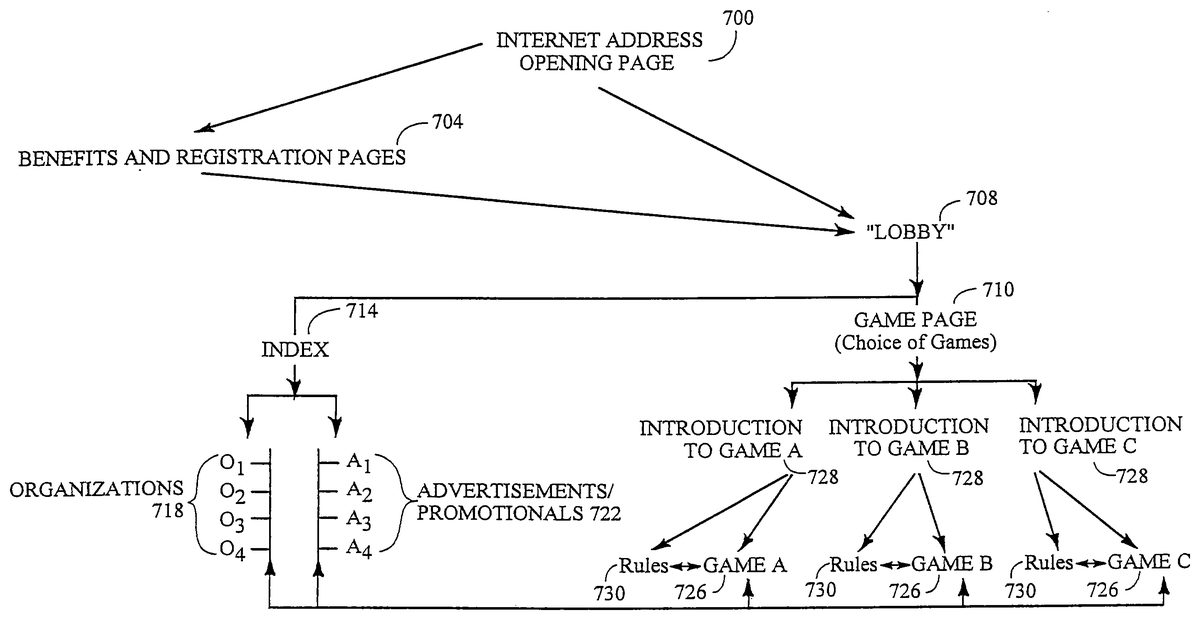
Referring now toFIG. 7, a diagram is presented providing one embodiment of the access routes or paths users navigate in accessing the features of the game/advertisement web site308. In particular, upon initiating Internet contact with the game/advertisement web site308, a user is first presented with the opening page700identifying the web site308. Subsequently, the user can access the benefits and registration pages704for viewing general information related to web site308and also for registering at the web site (as is discussed in further detail below). Alternatively, the user may access one or more “Lobby” pages708to view the gaming and information exchange capabilities as, for example, provided by advertisers. Assuming the user is registered at the game/advertisement web site308, the user may proceed from the LOBBY708to the game page710, wherein a game726or game rules730can be selected for playing, via the introduction to game pages728. Alternatively, the user may instead access one or more index pages714having, for example, listings of organizations to which the user may be allowed to access depending on the affiliations of the user (e.g., a member of a particular membership discount store chain). Additionally, from the index page(s)714substantially any user may access an advertisement or promotional provided by an advertiser on an advertiser page(s)722. However, it is an aspect of the present invention that information related to certain promotionals provided by advertisers or sponsors are restricted. That is, such promotionals may be only presented to users having a demographic profile that has been determined by the present invention to be sufficiently compatible with a desired user profile for the advertiser or sponsor to warrant providing such a promotional. Thus, the present invention provides access to certain advertiser promotionals only to “qualified” users who are, for example, considered likely subsequent purchasers of the advertiser's products and/or services. Additionally, such promotionals may also be presented to users who express an interest in a particular product or service advertised. For example, users who (a) request additional or supplemental information related to an advertised item, or (b) provide a favorable response to such advertising (by, for instance, indicating a preference for an advertised item), or (c) respond to a questionnaire related to personal information or marketing survey information may also be provided with information regarding promotionals. Thus, advertisers or sponsors may offer relatively substantial or expensive promotionals via the present invention to such users as well.
Moreover, the present invention may also utilize such demographic profiles to prohibit a user not sufficiently matching such a demographic profile from gaining access to a corresponding promotional. Accordingly, in one embodiment of the present invention, when the user accesses an advertiser page722, the user's profile (in the user database28) is compared with the demographic profiles in the advertiser data base612for determining any promotionals that can be presented to the user.
Moreover, from the index page714the user may be provided with the ability to link into various web sites or web site pages. That is, the user may be provided with the ability to link into another web site or web page at any time a link is made available (typically a hypertext link). Additionally, note that similar links may be accessible by users while playing a game726. However, these links may generally hyperlink the user to an advertiser page722within the game/advertisement web site308so that the user may be exposed to further information and/or presented with promotional options for an advertised item. For instance, certain advertising hyperlinks may be integrated into the presentation of plays of a game726. Accordingly, since an aspect of the present invention is to repeatedly integrate different advertising presentations (and any related hyperlinks) into the play of a game726, a user may repeatedly be enticed to seek out additional information about different products or services by activating the related hyperlinks. Moreover, it is also an aspect of the present invention that when such hyperlinks provide the user with access to a different web site, that at least a portion of the display of the user's Internet client node318maintains a graphical format associated with the game/advertisement web site308, and that the user may leave and return to the web site308without the user being aware of accessing another web site. Moreover, by monitoring user input related to an advertising presentation, the present invention is able to provide feedback to an advertiser as to, for example, the number of times the advertising presentation is accessed by users for such additional information about products or services.
Also note that some advertisements (presented via advertiser pages722or as part of a game play presentation) may be interactive with the user wherein the user may perform a transaction such as making a reservation (e.g., an airline or hotel reservation). Further, a user may be given the opportunity to provide positive and negative opinions or responses on, for example, various advertisements, promotionals and other related matters by expressing such responses upon accessing advertisement related information. Thus, it is an aspect of the present invention to be able to conduct “test marketing” in that statistically representative groups of users may be selected for determining:(10.1) the efficacy or appeal of one advertisement in comparison to another advertisement for a particular advertised item;(10.2) the profile of the users that are responsive to a particular advertising presentation; and/or(10.3) whether a particular group of users, for example, having similar user profiles favorably respond to a particular advertising presentation. For example, the present invention may determine such a response: (a) by detecting an activation of a hyperlink, (b) by detecting a response to questions presented, and/or (c) by determining the length of time the advertising presentation is displayed or visible.
Accordingly, input response data may be transmitted to the game/advertisement web site308and retained for subsequent statistical evaluation. Thus, resulting aggregate statistics can be made available to, for example, advertisers or sponsors, thereby preserving the privacy of the users. In particular, statistics may be made available for:(11.1) providing information about, for example, the efficacy of certain advertising presentations (e.g., the number of positive responses to such presentations and/or the number of advertised items sold directly through the advertisements at the game/advertisement web site308);(11.2) providing information related to the number and profile of users accessing certain advertising presentations;(11.3) determining measurements related to the number of different (groups of) users to which an advertising presentation has been presented;(11.4) determining the total number of presentations of a particular advertisement;(11.5) determining the cost of advertising presentations to the advertisers and billing the advertisers for such costs according to, for example, at least one of: (a) the number of users to which an advertisement is presented, (b) the number of promotionals requested or (c) the number of network user communications (i.e., hits) with the web site308;(11.6) determining if an advertising presentation should be discontinued because the advertiser's cost limits have been reached, such limits being, for example, related to a total number of presentations of an advertising presentation. Note that, in one embodiment, it is an aspect of the present invention to charge an advertiser for each presentation to a user; or(11.7) determining which of an advertising presentation and a different second advertising presentation (from the same advertiser) is most effective when both are provided to various selected (groups of) users, so that the advertiser or sponsor may then have a basis for choosing the most appropriate of the two advertising presentations in future advertising.
Additionally, it is an aspect of the present invention that it may also maintain statistics (and/or related information) for:(12.1) providing “real time” game rankings of users (players) involved in a gaming tournament provided by the game/advertisement web site308. Note that such rankings may be provided to a user so that he/she may know his/her standing and the number of players remaining in the tournament; and(12.2) providing a “style of personality” of the game playing users so that, for example, a risk tolerance of such users may be estimated and used to determine if a particular user might be interested in a particular product or service. Thus, such “style of personality” statistics for a user may be stored in the user's profile. For example, the information captured here may include: average size of wager, average size of wager in comparison to the total amount that could be wagered, length of time playing in a single session, the ratio of the number of wagers on high risk plays presented, and the skill of the player.
Accordingly, the following aspects of the present invention are noteworthy:(13.1) the user may be provided with free access or reduced cost access to other areas of the Internet324upon viewing the presentations of certain organizations and/or advertisers. Note that the ability to reduce the cost of accessing the Internet may act as a vehicle for attracting various users;(13.2) the index page714gives a user the opportunity to access a particular organization (e.g., organizations718) that the user may belong to or any particular advertiser (e.g., advertisers722) without going through any games although the user may be required to go through the “LOBBY” page(s)708and thereby be exposed to advertising and/or the opportunity to join a game;(13.3) a user may also be able to go from an initial organization page718to an introductory game page728(e.g., for a game726) but, unless authorized, may not be provided with further access to the organization's web pages or the game;(13.4) while playing a game726, the user has the ability to access further information related to an advertisement or promotional being presented;(13.5) during the playing of a game726(e.g., blackjack), the user may be allowed to review and/or stepwise replay a previous portion of a game726during a current gaming session;(13.6) when in a particular organization page718, the user may be required to return to the index page714before linking into an advertiser722unless a direct link has been provided for some reason on the particular organization web page. Moreover, the user may access the game page710from the index page714and vice versa;(13.7) a user may either go directly into playing a particular game726(as authorized) or to a rules section730for reviewing the rules for the corresponding game726. Note that a user may always access the rules section730during the corresponding game726;(13.8) there is a help feature for providing information such as:a) how to do some particular action or the reason for some action or the reason an action is blocked. For example, the reason for an inability to access a certain web page, the reason for an inability to make a particular game play, such as a bet, stand or hit in the game of blackjack and/or the reason for a particular result of a certain bet, hit, stand or other user play in a game such as blackjack;b) for contacting a gaming referee for resolving gaming conflicts. Such a referee will be available to resolve any dispute. Note that the user can notify the management operating the present invention of a problem via, for example, notification forms displayed when a notification button is activated.
Referring now substantially to an alternative embodiment of the present invention presented inFIGS. 8A and 8B, wherein the game/advertisement web site308coordinates with a third party Internet access service provider810(or interactive cable television provider) for providing Internet324(cable television) access to users on a reduced cost or free basis once a user has registered with the web server340(cable television provider). That is, the game/advertisement web site308contacts the user's Internet service provider810and arranges to subsidize the user's Internet service charges in return for the gaming advertisement web site308being able to repeatedly download to the user's Internet client node318(or alternatively, interactive cable television node), unrequested information such as advertising for presentation to the user.
Accordingly, a prospective user of the present invention can sign up or register with the game/advertisement web site308for reduced Internet service fees by dialing into an Internet service provider810with normal serial dialing and after gaining Internet access, subsequently log on to the web site308as a user identified by the generic user identifier “NEW.” Each user identified by “NEW” is forced into a connection with an enrollment or registration program so he/she can provide information requested by the present invention that can subsequently be used in determining which advertising to present to this user according to, for example, advertiser preferences. Thus, when registration is completed, the present embodiment of the invention downloads, for example, an ad viewer program812and a communications daemon (e.g., ad receiver daemon806) to the user's Internet client node318, wherein this daemon allows the game/advertisement web site308to download to the user's Internet client node318unrequested information such as advertising repeatedly. Accordingly, assuming the daemon806is installed, the user may access not only the gaming and advertisement services of the web site308, but also access substantially the entire Internet through the web site308at a reduced cost. Thus, whenever the end user processor318connects with the Internet service provider810, the game/advertisement web site308is alerted by the Internet service provider810and the DISPLAY ENGINE622starts up the downloaded daemon806via Internet communications with the user's Internet client node318. Subsequently, the DISPLAY ENGINE622periodically sends selected advertising to the daemon806. Accordingly, the daemon806utilizes the ad viewer program812to coordinate the display of the advertising presentation.
Note that various alternative embodiments related to the architecture and functionality ofFIGS. 8A and 8Bare also within the scope of the present invention. For example, instead of communicating with a plurality of third-party Internet service providers806for determining when users registered with the present invention are accessing the Internet via subsidized Internet connections, the game/advertisement web site308may include or be related to a dedicated Internet service provider806so that when a user registers with the present invention, the user is provided with a new Internet access code for the dedicated Internet service provider806and the user's Internet access fees may be subsidized.
However, regardless of how the present invention subsidizes Internet access, the game/advertisement controller604is notified whenever each subsidized user connects to the Internet or disconnects from the Internet. Additionally, certain reliability features are included in the daemon806and ad view program812for assuring that advertising is indeed presented to the user. For example, there may be periodic transmissions from each subsidized user's Internet client node318to the web site308verifying that both the daemon806and the ad view program812are active. Note that whenever any advertising is received at the user's Internet client node318, the daemon806transfers the advertising to the ad viewer program812which, in turn, converts the transmitted information to a displayable format and forces the display of the user's Internet client node318to present the advertising unobscured to the user.
An additional and/or alternative description of the embodiment of the present invention shown inFIGS. 8A and 8Bis as follows: users may use the present invention to access the INTERNET324on a reduced cost or free basis, by using whatever TCP/IP SLIP/PPP package they desire and registering with the web server308. That is, a user can sign up or register by dialing into a terminal server with normal serial dialing and log on as a user identified by the identifier “NEW.” User “NEW” is then forced into a connection to an enrollment or registration program so he/she can provide information requested by the present invention. When enrollment is completed, the present invention allows the user to download a communications daemon (e.g., ad receiver daemon806) to the user's Internet client node318. The user may then install the daemon on their machine (Internet client node318) and dial-up with their favorite TCP/IP package.
However, upon accessing the host308, the user accesses basic functionality of the DISPLAY ENGINE622that starts up the downloaded daemon806. The network host308periodically queries each active port on the terminal servers (e.g., Internet client node318) to get the IP addresses and then send a short message to the daemon806which is listening in on a specific port. The DISPLAY ENGINE622may also disable access by an end user machine318after a certain number of failures.
Note that the host308periodically sends an item to the downloaded daemon806to display. The daemon then displays the message (advertisement) in a window (of the WWW browser640) on the user's screen.
Additionally, note that in certain contexts the DISPLAY ENGINE622may transmit a message to an Internet Service Provider806indicating that no further Internet access will be subsidized due to a predetermined number of advertising presentation display failures.
The foregoing discussion of the invention has been presented for purposes of illustration and description. Further, the description is not intended to limit the invention to the form disclosed herein. Consequently, variation and modification commiserate with the above teachings, within the skill and knowledge of the relevant art, are within the scope of the present invention. The embodiment described hereinabove is further intended to explain the best mode presently known of practicing the invention and to enable others skilled in the art to utilize the invention as such, or in other embodiments, and with the various modifications required by their particular application or uses of the invention.
Claims
- A method for presenting advertisements on a network, comprising: for each player, P, of a plurality of players communicating with a first network node for playing one or more games, the steps (i) and (ii) following are performed: (i) combining advertising related data and game information for a corresponding one of the games, thereby resulting in combined data;wherein the advertising related data is for at least one advertiser;(ii) transmitting on the network, according to programmatic instructions performed at the first network node, the combined data to a node of the network for the player P when the player P plays the corresponding one game at the node for the player P;wherein a game instance presentation, including a presentation for presenting the game information and advertising corresponding to the advertising related data, is presented at the node for the player P, the advertising selectively determined from a plurality of advertisements so that the advertising is selected according to one or more criteria related to: (a) information indicative of the player P, or (b) a geographic location related to the player P;and wherein responsive data from an input by the player P to the game instance presentation is transmitted on the network;wherein at least a portion of the responsive data is used in providing the at least one advertiser with one of: (a) information related to corresponding advertising provided to the players, and (b) information for determining an effectiveness of the corresponding advertising.
- The method as claimed in claim 1 , wherein each of the players communicates with a game playing node on the network by using a network node spaced apart from each of the other of the players.
- The method as claimed in claim 1 , wherein one of the games played by at least one of the players includes a card game and further including the steps of: generating electronic card representations for playing the card game;receiving player identification information prior to the at least one player playing the card game, wherein the identification information is used to identify additional information related to the at least one player for use in subsequent instances of the card game;and first playing a first instance of the card game between the at least one player and a substantially electronic dealer module, wherein said dealer module is dealt a first sequence of said card representations.
- The method as claimed in claim 1 , wherein one of the games played by the at least one of the players includes a card game for playing electronically, further including the steps of: generating one or more card representations for playing the card game;first playing a first instance of the card game in a tournament between the at least one player and a dealer module, wherein the at least one player receives a first sequence of card representations;second playing the card game between a second of the players and the dealer module, wherein play by the at least one player and the second player overlap in time.
- The method as claimed in claim 1 , wherein the advertising is presented while the player P plays the game, further including the steps of: transmitting one or more advertising related presentations to the player P for presentation during a playing of the game, wherein for at least a duration of time between a pair of some of the player P plays, a first advertising related presentations is presented to the player P, wherein said first advertising related presentation was not presented to the player P during a different pair of some two of the player P plays of the game, and wherein for at least one of said advertising related presentations, (a) and (b) following hold: (a) the at least one advertising related presentation has associated therewith network linking information identifying a corresponding one of a plurality of nodes connected to the network, said network linking information being identical for transmissions of said at least one advertising related presentation to a plurality of the players;and (b) the at least one advertising related presentation is capable of providing a responsive transmission for transmitting on the network, the responsive transmission having corresponding data related to one or more responses by the player P to said at least one advertising related presentation.
- The method as claimed in claim 1 , further including the step of: transmitting from the first network node to the corresponding node of at least one of the players, the ranking of a second of the players, wherein said ranking is indicative of a proficiency of the second player in playing the game, and said ranking is updated to present a change in said ranking while the at least one player is playing the game.
- The method as claimed in claim 1 , wherein for at least one of the players, a presentation related to one of a product and a service is viewed during a playing of one of the games, further including: presenting a first advertising presentation to the at least one player, wherein the first advertising presentation is presented between two plays of the game, and wherein said first advertising presentation is capable of being replaced by a different second presentation without changing a play of the game;detecting an action, by the first network node in response to said first advertising presentation, by the at least one player.
- The method of claim 1 wherein the plurality of players communicate on the network for accessing a plurality of independently operated network nodes, wherein the plurality of independently operated network nodes includes the first network node, and wherein each of the independently operated network nodes has corresponding informational content available for presenting to the players when the players access the network on a corresponding network connection provided by one of a plurality of independently operated network connection providers;wherein each of the independently operated network nodes is: (A) accessible by corresponding network addressing information, and (B) the same corresponding network addressing information is used to access the independently operated network node regardless of the network connection provider used to obtain a network connection for accessing the network;wherein for each player, P, the steps (1) through (3) following are performed: (1) receiving, from the node for the player P, a corresponding request for access to the network via one of the network connection providers (ISP);(2) providing, via the network connection provider ISP, the player P's network node with a corresponding network connection (NC), wherein a termination of the connection NC disconnects the player P's network node from the network;wherein the game instance presentation presents together the game information and advertising corresponding to the advertising related data to the player P on the connection NC;and wherein at least a portion of data obtained from interactions by at least one of the players P with an activation of a corresponding one of the games is for providing the at least one advertiser with information for an advertising related purpose different from playing the corresponding game;(3) transmitting, on the connection NC and from the first network node, instances of advertising related information resulting in a display, on the player P's network node, of corresponding advertising from one or more advertisers;wherein the network is accessible via, the connection NC, for allowing the player P to navigate between the plurality of independently operated network nodes of the network as long as there are transmissions of various ones of the instances of advertising related information, substantially throughout the connection NC, for displaying the corresponding advertising on the player P's node concurrently with the corresponding informational content of the independently operated network nodes to which the player P navigates;and wherein the instances of advertising related information are displayed on the player P's node both without the player P selecting the instances of advertising related information for display, and without assistance from substantially all of the independently operated network nodes to which the player P navigates for viewing their corresponding informational content.
- The method of claim 1 , wherein the game information and the advertising corresponding to the advertising related data are displayed together at the node for the player P.
- A method for presenting advertisements on a network, comprising: for at least one advertiser, and for each player, P, of a plurality of players communicating with a first network node for playing one or more games, the steps (i) and (ii) are performed: (i) combining, for the first network node, advertising related data and game information for a corresponding instance of one of the games, thereby resulting in combined data;wherein the advertising related data is for the at least one advertiser;(ii) transmitting on the network, according to programmatic instructions performed at the first network node, the combined data to a node of the network for the player P when the player P plays the corresponding one game at the node for the player P;wherein a presentation for the game information is presented together with a presentation for the advertiser related data is presented together to the player P;and wherein at least a portion of data obtained from interactions by at least one of the players with an activation of a corresponding one of the games is for providing the at least one advertiser with one of: (a) information for an advertising related purpose different from playing the corresponding game, and (b) information for determining an effectiveness of advertising for the at least one advertiser.
- The method of claim 10 , wherein for at least one of the players, data obtained from game interactions is used in providing the at least one advertiser with one of: information indicative of the at least one player's interest in a product or service.
- The method of claim 10 , wherein for at least one of the players, data is obtained from an activated hyperlink associated with the presentation for the advertiser related data.
- The method of claim 10 , wherein for at least one of the players, further including a step of obtaining data from the at least one player's interactions with a corresponding one of the games, wherein the data obtained is used to determine an indication of a personality characteristic of the least one player.
- A method for presenting advertisements on a network, comprising: for at least one user, P, of a plurality of users having network access to a first network node for playing a game, wherein for playing the game, (i) through (iii) following hold: (i) advertising related data and game information is combined, thereby resulting in combined data;wherein the advertising related data is for at least one advertiser;(ii) the combined data is transmitted, via the network, to a communication device for the at least one user P;(iii) a game instance presentation, including concurrently presenting a presentation for the game information and a presentation of advertising corresponding to the advertising related data, at the communication device, the advertising selectively determined from a plurality of advertisements so that the advertising is selected according to one or more criteria related to: (a) information indicative of the at least one user P, or (b) a geographic location related to the at least one user P;and wherein responsive data from an input by the at least one user P to the game instance presentation is transmitted on the network;wherein at least a portion of the responsive data is used in providing the at least one advertiser with one of: (a) information related to corresponding advertising for the at least one advertiser, and (b) information for determining an effectiveness of the corresponding advertising for the at least one advertiser;wherein the plurality of users communicate on the network for accessing a plurality of independently operated network nodes of the network, wherein the plurality of independently operated network nodes includes the first network node, and wherein each of the independently operated network nodes has corresponding informational content available for presenting to the users when the users access the network on a corresponding network connection provided by one of a plurality of independently operated network connection providers;wherein each of the independently operated network nodes is: (A) accessible by corresponding network addressing information, and (B) the same corresponding network addressing information is used to access the independently operated network node regardless of the network connection provider used to obtain a network connection for accessing the network;wherein for each user Q of at least some of the plurality of the users, the steps (1) through (3) following are performed: (1) receiving, from a communication device for the user Q, a corresponding request for access to the network via one of the network connection providers (ISP);(2) providing, via the network connection provider ISP, the user Q's communication device with a corresponding network connection (NC), wherein a termination of the connection NC disconnects the user Q's communication device from the network;(3) transmitting, on the connection NC, instances of advertising related information resulting in a display, on the user Q's network communication device, of corresponding advertising from one or more advertisers;wherein the network is accessible via, the connection NC, for allowing the user Q to navigate between the plurality of independently operated network nodes of the network as long as there are transmissions of various ones of the instances of advertising related information, substantially throughout the connection NC, for displaying the corresponding advertising on the user Q's communication device concurrently with the corresponding informational content of the independently operated network nodes to which the user Q navigates;and wherein the instances of advertising related information are displayed on the user Q's communication device both without the user Q selecting the instances of advertising related information for display, and without assistance from substantially all of the independently operated network nodes to which the user Q navigates for viewing their corresponding informational content.
- An apparatus for presenting advertisements on a network, comprising: (1) network access request receiving equipment having network interface equipment associated therewith, the receiving equipment to receive a transmission on the network from a communication device for each user Q of a plurality of users, the transmission including a user request for access to the network via a network connection provider (ISP);wherein for at least one user, P, of the users, the user P obtains network access thereby allowing communication with a first network node for playing a game, wherein for playing the game, (i) through (iii) following hold: (i) advertising related data and game information is combined, thereby resulting in combined data;wherein the advertising related data is for at least one advertiser;(ii) the combined data is transmitted, via the network, to a communication device for the at least one user P;(iii) a game instance presentation, including concurrently presenting a presentation for the game information and a presentation of advertising corresponding to the advertising related data, is presented at the communication device, the advertising selectively determined from a plurality of advertisements so that the advertising is selected according to one or more criteria related to: (a) information indicative of the at least one user P, or (b) a geographic location related to the at least one user P;and wherein responsive data from an input by the at least one user P to the game instance presentation is transmitted on the network;wherein at least a portion of the responsive data is used in providing the at least one advertiser with one of: (a) information related to corresponding advertising for the at least one advertiser, and (b) information for determining an effectiveness of the corresponding advertising for the at least one advertiser;wherein the plurality of users communicate on the network for accessing a plurality of independently operated network nodes of the network, wherein the plurality of independently operated network nodes includes the first network node, and wherein each of the independently operated network nodes has corresponding informational content available for presenting to the users when the users access the network on a corresponding network connection provided by one of a plurality of independently operated network connection providers, including the network connection provider ISP;wherein each of the independently operated network nodes is: (A) accessible by corresponding network addressing information, and (B) the same corresponding network addressing information is used to access the independently operated network node regardless of the network connection provider used to obtain a network connection for accessing the network;(2) a data store to store, for each user Q of the plurality of the users, related identification information for a corresponding connection (NC) to the network, via the network connection provider ISP, with the user Q's communication device, wherein a termination of the corresponding connection NC disconnects the user Q's communication device from the network;(3) one or more computational machine modules for outputting, on the corresponding connection NC for each of the users Q, advertising related information for receipt by the communication device for the user Q, the advertising related information resulting in a display, on the user Q's network communication device, of corresponding advertising from one or more advertisers, the one or more computational machine modules including at least one of: a selector for selecting advertising, and a combiner for combining the advertising related information with other display information;wherein the network is accessible via, the user Q's corresponding connection NC, for allowing the user Q to navigate between the plurality of independently operated network nodes of the network as long as there are transmissions of various instances of the advertising related information, substantially throughout the corresponding connection NC, for displaying the corresponding advertising on the user Q's communication device concurrently with the corresponding informational content of the independently operated network nodes to which the user Q navigates;and wherein the instances of the advertising related information are displayed on the user Q's communication device both without the user Q selecting the instances of the advertising related information for display, and without assistance from substantially all of the independently operated network nodes to which the user Q navigates for viewing their corresponding informational content.
Disclaimer: Data collected from the USPTO and may be malformed, incomplete, and/or otherwise inaccurate.