U.S. Pat. No. 8,028,022
GENERATING CONTENT RECOMMENDATIONS FROM AN ONLINE GAME
AssigneeInternational Business Machines Corporation
Issue DateOctober 31, 2008
Illustrative Figure
Abstract
A content recommendation method can include retrieving contacts for a player of a content recommendation game and listing content associated with the retrieved contacts and prompting the player in response to a selection of a particular one of the listed content to identify a specific one of the retrieved contacts as a source associated with the particular one of the listed content. The particular one of the listed content can be recommended to the identified specific one of the retrieved contacts when the player has incorrectly identified the specific one of the retrieved contacts as a source associated with the particular one of the listed content. Otherwise, the player can be awarded points in the game to a game score for the player for having correctly identified the specific one of the retrieved contacts as a source associated with the particular one of the listed content.
Description
DETAILED DESCRIPTION OF THE INVENTION Embodiments of the present invention provide a method, system and computer program product for generating content recommendations from an online game. In accordance with an embodiment of the present invention, a game user interface can be generated for an end user to include a listing of content distributed about and accessible through a computer communications network. Further, meta-data related to the content can be rendered in association with the content. Game points can be awarded to the end user based upon the correct source identification of portions of the meta-data in order to incentivize the end user to actively attempt to identify the source of portions of the meta-data for specifically selected content. Accordingly, in the course of conduct of the online game, specific content in the listing can be selected in consequence of which the end user can be prompted to identify another end user as a source of at least one portion of the meta-data. Thereafter, in response to the identification of another end user, a notification referencing the selected content can be transmitted to the identified end user when the identified end user is determined not to have been the source of the portion of the meta-data. In this way, the human intelligence associated with the incorrect guess of the end user can be relied upon to learn a new end user likely to benefit from access to the selected content. In further illustration,FIG. 1is a pictorial illustration of a game interface for generating content recommendations from an online game. As shown inFIG. 1, an online game user interface100can provide a user interface to a content recommendation game for a player. A listing of content120A in the game user interface100can be generated from the contacts110of the player and the content120A can include, ...
DETAILED DESCRIPTION OF THE INVENTION
Embodiments of the present invention provide a method, system and computer program product for generating content recommendations from an online game. In accordance with an embodiment of the present invention, a game user interface can be generated for an end user to include a listing of content distributed about and accessible through a computer communications network. Further, meta-data related to the content can be rendered in association with the content. Game points can be awarded to the end user based upon the correct source identification of portions of the meta-data in order to incentivize the end user to actively attempt to identify the source of portions of the meta-data for specifically selected content.
Accordingly, in the course of conduct of the online game, specific content in the listing can be selected in consequence of which the end user can be prompted to identify another end user as a source of at least one portion of the meta-data. Thereafter, in response to the identification of another end user, a notification referencing the selected content can be transmitted to the identified end user when the identified end user is determined not to have been the source of the portion of the meta-data. In this way, the human intelligence associated with the incorrect guess of the end user can be relied upon to learn a new end user likely to benefit from access to the selected content.
In further illustration,FIG. 1is a pictorial illustration of a game interface for generating content recommendations from an online game. As shown inFIG. 1, an online game user interface100can provide a user interface to a content recommendation game for a player. A listing of content120A in the game user interface100can be generated from the contacts110of the player and the content120A can include, by way of example, bookmarks to Web sites, photos, videos and other content associated with the contacts110of the player. Additionally, meta-data120B can be included in the listing for the content120A and can include, for instance, a name, description and one or more tags for the content120A.
The player can select content120A in the listing in response to which the player can be presented with a context dialog130. The context dialog130can prompt the player to choose whether the selected content120A, or alternatively, meta-data120B for the selected content120A had been provided by one of the contacts110. For example, the context dialog130can prompt the player to specifically identify a particular one of the contacts providing the selected content120A, or to determine that the selected content120A had been provided by someone other than one of the contacts110.
Points can be awarded to the player for, within a threshold period of time, correctly identifying one of the contacts110as the source of the selected content120A (or the source of the meta-data120B associated with the selected content120A) and points can be subtracted for incorrectly identifying one of the contacts110as the source of the selected content120A (or the source of the meta-data120B associated with the selected content120A). To the extent that the player incorrectly identifies one of the contacts110as the source of the selected content120A (or the source of the meta-data120B associated with the selected content120A), the selected content120A can be recommended to the identified one of the contacts110, for example by way of a message140sent to the identified one of the contacts110with a suggestion to view the selected content120A.
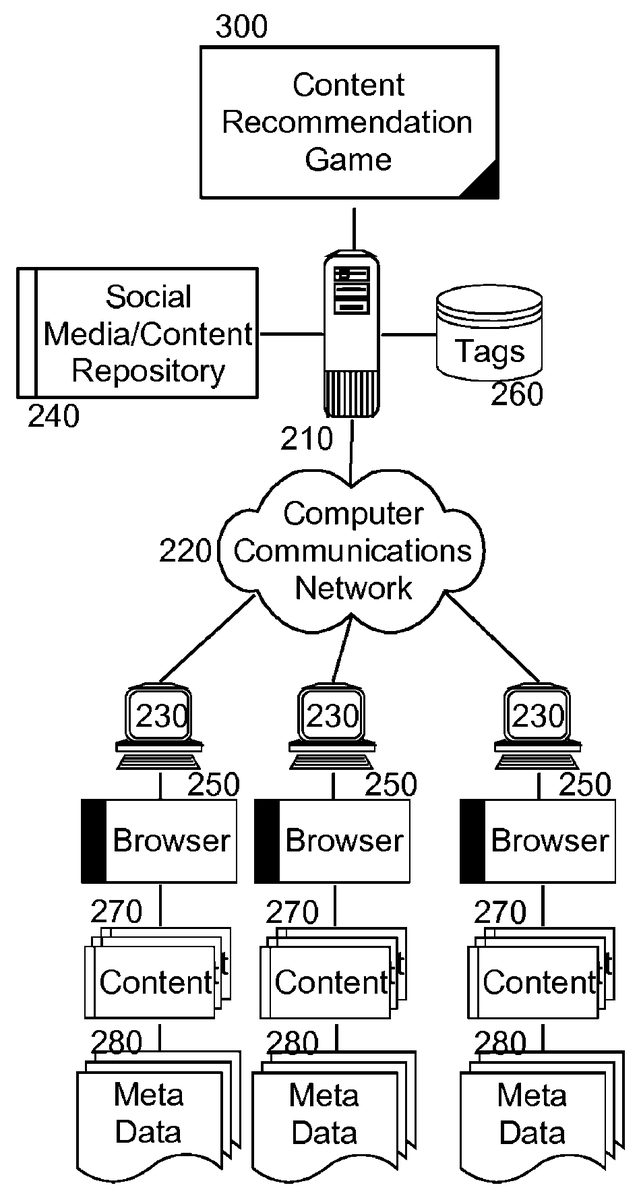
The content recommendation game ofFIG. 1can be implemented within a social media data processing system. In illustration,FIG. 2schematically shows a social media data processing system configured for generating content recommendations from an online game. The system can include a host computing platform210configured for communicative coupling to different clients230over computer communications network220. Each of the client230can include a content browser250through which end users can view and interact with content270such as Web sites, images, audio, video and audio-visual content. Further, the content270can include meta-data280such as a name, description and one or more tags applied by end users accessing corresponding content270.
The host computing platform210can include a social media/content repository240enabled to centrally apply tags260to content270accessed by end users and to share the tags260of end users sharing a common social network. Notably, the host computing platform210also can host the operation of a content recommendation game300. The content recommendation game300can be a computer program including program code enabled to identify contacts of a player and to list to the player content270and content meta-data280accessed by and therefore associated with the identified contacts of the player.
The program code further can be enabled in response to a selection of particular content270to prompt the player to specify an end user from which the particular content270had been associated. To the extent the player correctly specifies the end user from which the particular content270had been associated, the player can be awarded points for the game. However, if the player incorrectly specifies an end user from which the particular content270had not in fact been associated, the program code can be enabled to recommend to the specified end user the particular content270and corresponding meta-data280, for example by sending a message with a link to the particular content270, or by storing a link to the particular content270for subsequent access by the specified end user and notifying the specific end user of the storage of the link. In this way, the participation of the player in the content recommendation game300can provide a mechanism for recommending content270and corresponding meta-data280to end users likely to be interested in accessing the recommended content270.
In yet further illustration of the operation of the content recommendation game,FIG. 3is a flow chart illustrating a process for generating content recommendations from an online game. Beginning in block310, a player can log into the game and in block320, a listing of contacts can be retrieved for the player, for example by retrieving the contacts in the player's address book, or social network to name two possibilities. In block330, content accessed or created by the contacts in the list can be retrieved as content associated with the contacts in the list, including bookmarks to Web sites, audio, photos and video. Likewise, in block340meta-data can be retrieved for the content, for instance content names, descriptions and one or more tags. Thereafter, the content and meta-data can be rendered in a user interface to the game.
In block360, responsive to player user interface interactions with the content and meta-data, particular content can be selected for evaluation and in block370the player can be prompted to guess as to which contact is associated with the particular content as the source of the addition of the content to the game. For example, the player can select from a drop-down list of the contacts, or the player can manually specify a contact. In decision block380, if the player correctly guesses the contact as the source of the addition of the content to the game (within a threshold period of time), in block400the player can be awarded points in the game and the score for the player can be updated to reflect the added points.
However, in decision block380, if the player incorrectly guesses the source of the addition of the content to the game, in block390the content can be recommended to the incorrectly identified source, including providing to the source a link to the content and a specification also of the meta-data for the content. Subsequently, in block400the score of the player can be reduced to reflect the incorrect guess. Though not shown, if the player fails to respond to the prompt within the threshold period of time, in block400the score of the player can be reduced more so than if the player incorrectly guesses the source of the addition of the content to the game because the inaction of the player provides the least social benefit to the community participating in the content recommendation game.
Embodiments of the invention can take the form of an entirely hardware embodiment, an entirely software embodiment or an embodiment containing both hardware and software elements. In a preferred embodiment, the invention is implemented in software, which includes but is not limited to firmware, resident software, microcode, and the like. Furthermore, the invention can take the form of a computer program product accessible from a computer-usable or computer-readable medium providing program code for use by or in connection with a computer or any instruction execution system.
For the purposes of this description, a computer-usable or computer readable medium can be any apparatus that can contain, store, communicate, propagate, or transport the program for use by or in connection with the instruction execution system, apparatus, or device. The medium can be an electronic, magnetic, optical, electromagnetic, infrared, or semiconductor system (or apparatus or device) or a propagation medium. Examples of a computer-readable medium include a semiconductor or solid state memory, magnetic tape, a removable computer diskette, a random access memory (RAM), a read-only memory (ROM), a rigid magnetic disk and an optical disk. Current examples of optical disks include compact disk-read only memory (CD-ROM), compact disk-read/write (CD-R/W) and DVD.
A data processing system suitable for storing and/or executing program code will include at least one processor coupled directly or indirectly to memory elements through a system bus. The memory elements can include local memory employed during actual execution of the program code, bulk storage, and cache memories which provide temporary storage of at least some program code in order to reduce the number of times code must be retrieved from bulk storage during execution. Input/output or I/O devices (including but not limited to keyboards, displays, pointing devices, etc.) can be coupled to the system either directly or through intervening I/O controllers. Network adapters may also be coupled to the system to enable the data processing system to become coupled to other data processing systems or remote printers or storage devices through intervening private or public networks. Modems, cable modem and Ethernet cards are just a few of the currently available types of network adapters.
Claims
- A content recommendation method comprising: retrieving contacts for a player of a content recommendation game;listing content associated with the retrieved contacts;prompting the player in response to a selection of a particular one of the listed content to identify a specific one of the retrieved contacts as a source associated with the particular one of the listed content;and, recommending the particular one of the listed content to the identified specific one of the retrieved contacts when the player has incorrectly identified the specific one of the retrieved contacts as a source associated with the particular one of the listed content, and otherwise awarding points in the game to a game score for the player for having correctly identified the specific one of the retrieved contacts as a source associated with the particular one of the listed content.
- The method of claim 1 , wherein listing content associated with the retrieved contacts comprises listing content associated with the retrieved contacts and corresponding meta-data for the listed content.
- The method of claim 1 , wherein prompting the player in response to a selection of a particular one of the listed content to identify a specific one of the retrieved contacts as a source associated with the particular one of the listed content, comprises prompting the player in response to a selection of a particular one of the listed content to identify a specific one of the retrieved contacts as a source associated with the particular one of the listed content within a threshold period of time.
- The method of claim 3 , further comprising deducting points from the game score when the player fails to respond to the prompting within the threshold period of time.
- A social media data processing system configured for generating content recommendations from an online game, the system comprising: a host computing platform configured for communicative coupling to multiple different clients over a computer communications network, each of the clients comprising a browser providing access to interact with content and corresponding meta-data for the content;a social media/content repository coupled to the host computing platform managing tags applied through the clients to content viewed within respective ones of the browsers;and, a content recommendation game executing in the host computing platform, the game comprising program code enabled to retrieve contacts for a player of the game, to list content associated with the retrieved contacts, to prompt the player in response to a selection of a particular one of the listed content to identify a specific one of the retrieved contacts as a source associated with the particular one of the listed content, and to recommend the particular one of the listed content to the identified specific one of the retrieved contacts when the player has incorrectly identified the specific one of the retrieved contacts as a source associated with the particular one of the listed content, and otherwise to award points in the game to a game score for the player for having correctly identified the specific one of the retrieved contacts as a source associated with the particular one of the listed content.
- The system of claim 5 , wherein the content is a bookmark to a Web site.
- The system of claim 5 , wherein the content is an image.
- The system of claim 5 , wherein the content is a video.
- The system of claim 5 , wherein the content is audio.
- A computer program product comprising a computer storage device embodying computer usable program code for content recommendation, the computer program product comprising: computer usable program code for retrieving contacts for a player of a content recommendation game;computer usable program code for listing content associated with the retrieved contacts;computer usable program code for prompting the player in response to a selection of a particular one of the listed content to identify a specific one of the retrieved contacts as a source associated with the particular one of the listed content;and, computer usable program code for recommending the particular one of the listed content to the identified specific one of the retrieved contacts when the player has incorrectly identified the specific one of the retrieved contacts as a source associated with the particular one of the listed content, and otherwise awarding points in the game to a game score for the player for having correctly identified the specific one of the retrieved contacts as a source associated with the particular one of the listed content.
- The computer program product of claim 10 , wherein the computer usable program code for listing content associated with the retrieved contacts comprises computer usable program code for listing content accessed by the retrieved contacts and corresponding meta-data for the listed content.
- The computer program product of claim 10 , wherein the computer usable program code for prompting the player in response to a selection of a particular one of the listed content to identify a specific one of the retrieved contacts as a source associated with the particular one of the listed content, comprises computer usable program code for prompting the player in response to a selection of a particular one of the listed content to identify a specific one of the retrieved contacts as a source associated with the particular one of the listed content within a threshold period of time.
- The computer program product of claim 12 , further comprising computer usable program code for deducting points from the game score when the player fails to respond to the prompting within the threshold period of time.
Disclaimer: Data collected from the USPTO and may be malformed, incomplete, and/or otherwise inaccurate.