U.S. Pat. No. 8,026,913
IMAGE CAPTURE AND BUFFERING IN A VIRTUAL WORLD
AssigneeActivision Publishing Inc
Issue DateJuly 29, 2008
Illustrative Figure
Abstract
A technique is disclosed for detecting photo opportunities within a virtual environment. In response to detecting a photo opportunity, images of the virtual environment may be captured from perspectives not limited to the user's viewport. A variety of physiological and virtual world parameters are measured to determine when to capture an image of a user interacting with the virtual environment. To improve the quality of images, these parameters may be individually weighted by factors specified by the user. Captured images may be stored in a temporary buffer space, possibly replacing older images. The user may view the buffer contents and select ideal images to move to a permanent gallery. The user's image selections can in turn be used to further improve the quality of future images.
Description
DETAILED DESCRIPTION OF THE PREFERRED EMBODIMENTS A virtual world provides a simulated environment where users may be represented by avatars. An avatar may be used to “travel” through locations of the virtual world, such as virtual streets, buildings, rooms, etc. While in a given location, an avatar may also be used to interact with objects or other avatars present therein. For example, an avatar may be able to approach and interact with another avatar by communicating, performing commercial transactions, engaging in recreational activities, and the like. Thus, multiple users, although in different physical locations, may be present in the same virtual location and interact with one another using their respective avatars. In a virtual world, like in the real world, it is often desirable to capture moments and memories into pictures. Just like in the real world, many interactions in a virtual world may provide a potential “photo opportunity.” For instance, a user may be at a party with friends or on a virtual vacation. While it is rather trivial to take a screenshot, a user may not realize that a photo opportunity has occurred until the moment has passed. Additionally, a screenshot only captures a single camera angle; namely, that of the user's viewport, which may not result in an image the user wants. Although the user may be able to record their entire interaction with the virtual world and select individual images to save, this approach creates a video where the images would follow a path of the camera through the environment, and further, requires substantial storage space. Additionally, few users would want to wade through such a staggering number of pictures. As such, users may wish to automatically identify and save images at opportune moments while they interact with a virtual environment. Embodiments of the invention provide ...
DETAILED DESCRIPTION OF THE PREFERRED EMBODIMENTS
A virtual world provides a simulated environment where users may be represented by avatars. An avatar may be used to “travel” through locations of the virtual world, such as virtual streets, buildings, rooms, etc. While in a given location, an avatar may also be used to interact with objects or other avatars present therein. For example, an avatar may be able to approach and interact with another avatar by communicating, performing commercial transactions, engaging in recreational activities, and the like. Thus, multiple users, although in different physical locations, may be present in the same virtual location and interact with one another using their respective avatars.
In a virtual world, like in the real world, it is often desirable to capture moments and memories into pictures. Just like in the real world, many interactions in a virtual world may provide a potential “photo opportunity.” For instance, a user may be at a party with friends or on a virtual vacation. While it is rather trivial to take a screenshot, a user may not realize that a photo opportunity has occurred until the moment has passed. Additionally, a screenshot only captures a single camera angle; namely, that of the user's viewport, which may not result in an image the user wants.
Although the user may be able to record their entire interaction with the virtual world and select individual images to save, this approach creates a video where the images would follow a path of the camera through the environment, and further, requires substantial storage space. Additionally, few users would want to wade through such a staggering number of pictures. As such, users may wish to automatically identify and save images at opportune moments while they interact with a virtual environment.
Embodiments of the invention provide techniques for detecting good photo opportunities that may occur within a virtual environment, and, in response, capturing images from perspectives not limited to the user's viewport. In one embodiment, a variety of physiological and virtual world parameters are measured to determine when to capture an image of a user interacting with the virtual environment. To improve the quality of images, these parameters may be individually weighted by factors specified by the user. In another embodiment, captured images are stored into a temporary buffer space of a fixed size, possibly replacing older images. The user may view the buffer contents and select ideal images to move to a permanent gallery. The user's image selections can in turn be used to further improve the quality of future images.
In the following, reference is made to embodiments of the invention. However, it should be understood that the invention is not limited to specific described embodiments. Instead, any combination of the following features and elements, whether related to different embodiments or not, is contemplated to implement and practice the invention. Furthermore, in various embodiments the invention provides numerous advantages over the prior art. However, although embodiments of the invention may achieve advantages over other possible solutions and/or over the prior art, whether or not a particular advantage is achieved by a given embodiment is not limiting of the invention. Thus, the following aspects, features, embodiments and advantages are merely illustrative and are not considered elements or limitations of the appended claims except where explicitly recited in a claim(s). Likewise, reference to “the invention” shall not be construed as a generalization of any inventive subject matter disclosed herein and shall not be considered to be an element or limitation of the appended claims except where explicitly recited in a claim(s).
One embodiment of the invention is implemented as a program product for use with a computer system. The program(s) of the program product defines functions of the embodiments (including the methods described herein) and can be contained on a variety of computer-readable storage media. Illustrative computer-readable storage media include, but are not limited to: (i) non-writable storage media (e.g., read-only memory devices within a computer such as CD-ROM disks readable by a CD-ROM drive) on which information is permanently stored; (ii) writable storage media (e.g., floppy disks within a diskette drive or hard-disk drive) on which alterable information is stored. Such computer-readable storage media, when carrying computer-readable instructions that direct the functions of the present invention, are embodiments of the present invention. Other media include communications media through which information is conveyed to a computer, such as through a computer or telephone network, including wireless communications networks. The latter embodiment specifically includes transmitting information to/from the Internet and other networks. Such communications media, when carrying computer-readable instructions that direct the functions of the present invention, are embodiments of the present invention. Broadly, computer-readable storage media and communications media may be referred to herein as computer-readable media.
In general, the routines executed to implement the embodiments of the invention, may be part of an operating system or a specific application, component, program, module, object, or sequence of instructions. The computer program of the present invention typically is comprised of a multitude of instructions that will be translated by the native computer into a machine-readable format and hence executable instructions. Also, programs are comprised of variables and data structures that either reside locally to the program or are found in memory or on storage devices. In addition, various programs described hereinafter may be identified based upon the application for which they are implemented in a specific embodiment of the invention. However, it should be appreciated that any particular program nomenclature that follows is used merely for convenience, and thus the invention should not be limited to use solely in any specific application identified and/or implied by such nomenclature.
FIG. 1is a block diagram that illustrates a client server view of a virtual world computing environment100, according to one embodiment of the invention. As shown, virtual world computing environment100includes client computers120, a network160, and a server system140. In one embodiment, the computer systems illustrated in environment100may include existing computer systems, e.g., desktop computers, server computers, laptop computers, tablet computers, and the like. The computing environment100illustrated inFIG. 1, however, is merely an example of one computing environment. Embodiments of the present invention may be implemented using other environments, regardless of whether the computer systems are complex multi-user computing systems, such as a cluster of individual computers connected by a high-speed network, single-user workstations, or network appliances lacking non-volatile storage. Further, the software applications illustrated inFIG. 1and described herein may be implemented using computer software applications executing on existing computer systems, e.g., desktop computers, server computers, laptop computers, tablet computers, and the like. However, the software applications described herein are not limited to any currently existing computing environment or programming language, and may be adapted to take advantage of new computing systems as they become available.
As shown, each client computer120includes a central processing unit (CPU)122, which obtains instructions and data via a bus121from a client memory130and client storage123. CPU122is a programmable logic device that performs all the instruction, logic, and mathematical processing in a computer. Client storage123stores application programs and data for use by client computer120. Client storage123includes hard-disk drives, flash memory devices, optical media and the like. Client computer120is operably connected to the network160. Client memory130includes an operating system (OS)131and a virtual world client132. Operating system131is the software used for managing the operation of the client computer120. Examples of OS131include UNIX, a version of the Microsoft Windows® operating system, and distributions of the Linux® operating system. (Note: Linux is a trademark of Linus Torvalds in the United States and other countries.)
In one embodiment, the virtual world client132provides a software program that allows a user to connect to a virtual world server application146on the server140, and once connected, to perform various user actions. Such actions may include exploring virtual locations, interacting with other avatars, and interacting with virtual objects. Further, the virtual world client132may be configured to generate and display a visual representation of the user within the immersive environment, generally referred to as an avatar. The avatar of the user is generally visible to other users in the virtual world, and the user may view avatars representing the other users. The virtual world client132may also be configured to generate and display the immersive environment to the user and to transmit the user's desired actions to the virtual world server146. Such a display may include content from the virtual world determined from the user's line of sight at any given time. For the user, the display may present a third-person perspective, meaning a view from a location other than that of the user's avatar, and which may include the image of the user's avatar within the virtual world. Alternatively, the display may present a first-person perspective, meaning a view of the virtual world as would be seen through the eyes of the avatar representing the user.
As shown, client memory130also includes an image capture engine134. In one embodiment, the image capture engine134may provide a software application configured to detect photo opportunities and, in response, to capture images of the virtual environment at an opportune moment. The image may capture an image of the user's avatar or an image of what the avatar “sees” at the opportune moment. That is, the camera perspective is not limited to the user's viewport. Further, in one embodiment, the image capture engine134may capture three-dimensional scene data describing each object depicted in the virtual environment at an opportune moment. Doing so may allow two-dimensional images of a given moment in the virtual world to be created from any desired perspective. Once captured, the images may be stored in a temporary buffer space125. In one embodiment, the size of the buffer may be adjusted by the user. To select when an opportune moment may have occurred (or about to occur), the image capture engine134may extract real-time measurements133from the virtual world client132. These real-time measurements include any measurable physiological or virtual world parameter. This can include, e.g., changes in the vicinity of the user's avatar within the virtual world, as exposed by the virtual world server146to the virtual world client132. For example, assume that the user is hanging out with friends in the virtual world when fireworks suddenly light up the evening sky, causing the users to adjust their view of the virtual world to all focus on relatively the same place. The real-time measurements may also include, e.g., physiological parameters measured through input devices180and virtual reality interaction devices190. Continuing the example, the user may laugh into a microphone upon seeing the fireworks in the virtual world. Other examples of measurable physiological parameters include pulse, eye movement, brain activity, body temperature, pressure of grip on mouse, movement pattern of mouse, typing speed and pattern, typing pressure, facial features, perspiration, and head movement.
In one embodiment, the image capture engine134may be configured to maintain a database127of average measurements used to detect whether a photo opportunity has occurred. The real-time measurements of a given parameter may be evaluated against historical averages to determine whether a photo opportunity has occurred. For example, if a group of users are speaking to one another, an average volume of speech may be sampled and, if one user raises their voices above a specified threshold, then the image capture engine134may capture an image and store it in buffer space125. In one embodiment, the specified threshold can be weighted according to a user-specified weighting factor and stored as part of user settings124.
Further, learned measurements may be acquired by providing the user with the ability to select images from the buffer125to move to a permanent gallery126. When an image is moved to the permanent gallery126, a set of situational measurements may be stored in the measurements database127. For example, if the user has a history of selecting images be taken when microphone laughter was abundantly present, the image capture engine134may respond by increasing a weighting factor associated with a microphone laughter measurement. Similarly, if the user has a history of selecting images taken from a certain angle and distance, the image capture engine132may favor capturing images from similar or identical angles and distances.
The user may view the virtual world using a display device170, such as an LCD or CRT monitor display. And the user may interact with the virtual world client132using input devices180, e.g., a keyboard and mouse. Further, in one embodiment, the user may interact with the virtual world client132and the virtual world server146using a variety of virtual reality interaction devices190. For example, the user may don a set of virtual reality goggles that have a screen display for each lens. Further, the goggles could be equipped with motion sensors that cause the view of the virtual world presented to the user to move based on the head movements of the individual. As another example, the user could don a pair of gloves configured to translate motion and movement of the user's hands into avatar movements within the virtual reality environment. Of course, embodiments of the invention are not limited to these examples and one of ordinary skill in the art will readily recognize that the invention may be adapted for use with a variety of devices configured to present the virtual world to the user and to translate movement, motion, or other actions of the user into actions performed by the avatar representing that user within the virtual world.
As shown, the server system140includes a CPU142, which obtains instructions and data via a bus141from memory144and storage143. The processor142could be any processor adapted to support the methods of the invention. The memory144is any memory sufficiently large to hold the necessary programs and data structures. Memory144could be one or a combination of memory devices, including Random Access Memory, nonvolatile or backup memory (e.g., programmable or Flash memories, read-only memories, etc.). In addition, memory144and storage143may be considered to include memory physically located elsewhere in a server140, for example, on another computer coupled to the server140via bus141. The server system140may be operably connected to the network160, which generally represents any kind of data communications network. Accordingly, the network160may represent both local and wide area networks, including the Internet.
Of course, the embodiments described herein are intended to be illustrative and not limiting of the invention. And other embodiments are broadly contemplated. For example, the image capture engine134, user settings124, buffer space125, gallery126, and database of average and learned measurements127need not reside on the client as they are shown to inFIG. 1, and any or all of them may reside instead on the server system140. In another example, the functionality of the image capture engine134may be incorporated into the virtual world client132.
FIG. 2Aillustrates a user display200showing a viewport presented to a user interacting with a virtual world using a third-person perspective of the user, according to one embodiment of the invention. In this example, the primary user (i.e., the user viewing the user display200) is represented by avatar201and has just caught a wave202while surfing with a first and second avatar203. Further, the viewport shows the avatar201from behind, on the crest of the wave202with two avatars203further away, partially occluded by the wave. In this example, assume that the two avatars203are controlled by users that are friends with the primary user. Situations like the one depicted inFIG. 2Apresent a narrow window of opportunity for a capturing a memorable image of these avatars interacting with one another in the virtual environment. As shown inFIG. 2A, the primary user controlling the avatar201may not realize the opportunity until it is too late. In addition, even if the primary user were to capture a screenshot, the viewport shows only the back of the primary user's avatar201, the clipped heads of the two avatars203, and the backside of the wave202, leading to a less than ideal screenshot.
FIG. 2Billustrates a graphical user interface250for viewing the contents of the buffer125, according to one embodiment of the invention. Illustratively, interface250shows images of the situation depicted inFIG. 2A. In this example, assume the images inFIG. 2Bwere taken by image capture engine134of the display200at a point where an photo opportunity score exceeded a specified threshold. More specifically, the images may have been taken when a cumulative deviation of a set of measurements exceeded a specified threshold as a result of the proximity of the avatar201and the two avatars203, the user's avatar smiling upon catching the wave202, the two avatars203smiling at the avatar201, and the level of microphone laughter. Of course, the particular measurements and the threshold may be tailored to suit the preferences of a given user.
Illustratively, the four images shown inFIG. 2Binclude a side view252that shows the shape of the nice wave along with the avatar's poise, a front view253that shows the emotional expressions on all three avatars, an aerial view254that reveals the surrounding waters, and a portrait view255that captures an expression on the face of the avatar201. Because the image capture engine134captured images252,256,254, and255from a variety of angles, these images may provide the primary user with a much better remembrance of this event within the virtual world than the hastily captured screenshot shown inFIG. 2A. Further, the primary user (i.e., the user controlling the avatar201) may select one of operations256such as saving one of these four images into a permanent gallery126(accessible via a tab selection251) or deleting an unwanted image from the buffer125, freeing additional space for images captured by the image capture engine134.
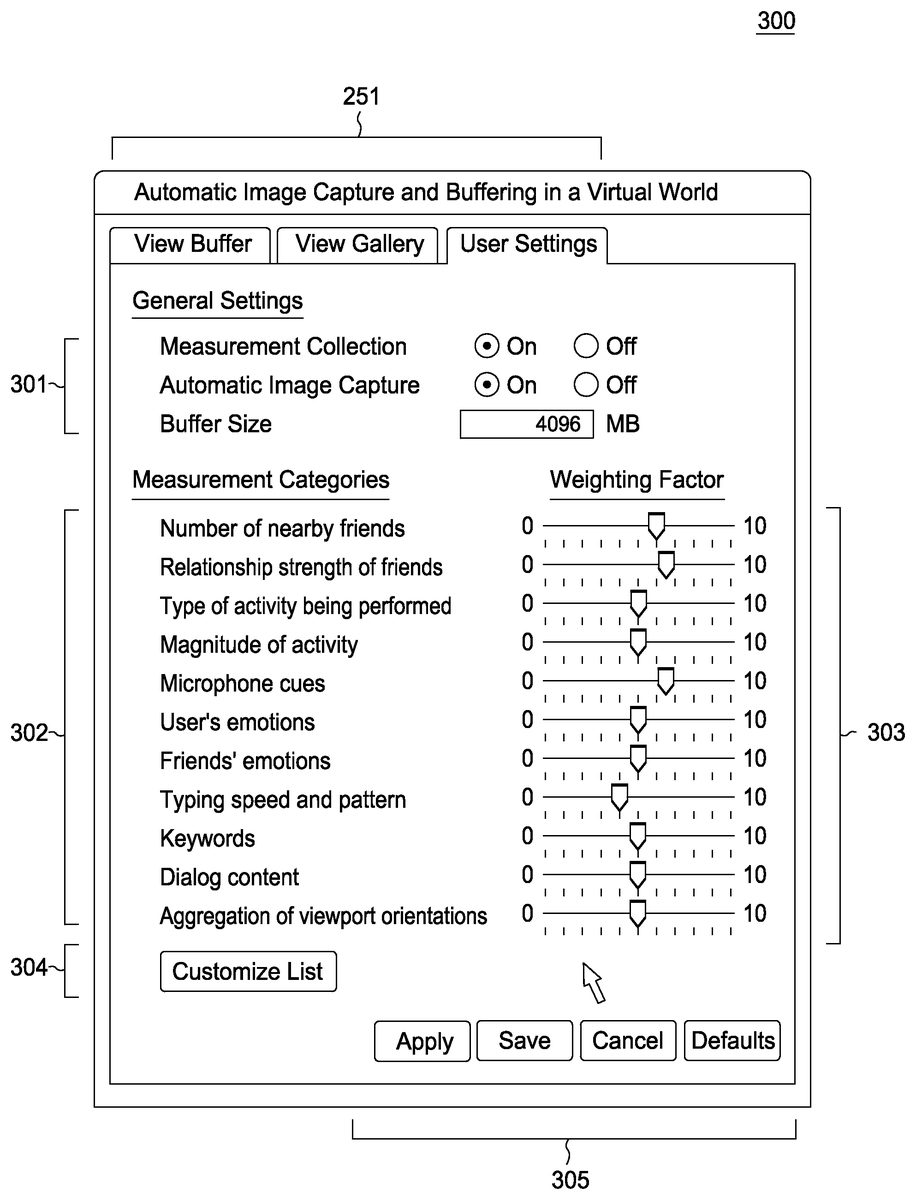
FIG. 3illustrates a graphical user interface300for configuring the user settings124of the image capture engine134, according to one embodiment of the invention. As shown, a set of general settings301may be used to specify a desired buffer size for storing images captured automatically on behalf of a user, as well as to activate or deactivate measurement collection and automatic image capture.
In one embodiment, a user may also customize a set of weighting factors303associated with a list of measurement categories302. Illustratively, a set of slider bars may be used to increase (or decrease) the weighting given to any particular factor. As shown, the weighting factors303range in value from 0 to 10, according no effect and maximum effect, respectively, to the associated measurement category. In this example, the list of displayed measurement categories302include number of nearby friends, relationship strength of friends, type of activity being performed (e.g., is the user skydiving for the first time?), magnitude of activity, microphone cues, “emoticons” included in instant message communications, “emoticons” received in instant message communications, typing speed and patterns, keywords (e.g., “this is fun/funny”, “LOL”), verbal dialogue content, and aggregation of viewport orientations (e.g., are a large number of users looking at the same person or object?). The particular measurement categories displayed to a user can be customized by clicking on a button304. Of course, one of skill in the art will recognize that the measurement categories may be tailored to include any measurable physiological or virtual world parameter (for example, the magnitude of scene change in the user's viewport, etc.). A set of buttons305allow the user to apply, save, or cancel the changes, or restore the default settings.
FIG. 4is a flow diagram illustrating a method400for improving the selection of images captured on behalf of a user in a virtual environment, according to one embodiment of the invention. More specifically,FIG. 4illustrates a method for learning a user's preferred perspectives and situational measurements used to select images captured while the user interacts with elements of the virtual environment. For the sake of illustration, method400is described in conjunction with the system ofFIG. 1. However, persons skilled in the art will understand that any system configured to perform the steps of the method400, in any order, is within the scope of the present invention.
As shown, the method400begins at step410, where a command to view the contents of the buffer for automatically captured images is received. For example, the user may click on a tab251for viewing the buffer125. At step420, the user may specify a selection of an image. For example, the user may select on an image253in the interface250ofFIG. 2B. At step430, the user may specify that the image selected at step420should be saved to a permanent gallery. For example, the user may click on a button256for saving a selected image253into the permanent gallery.
At step440, the image capture engine134may move the selected image from the buffer125to the permanent gallery126. For example, the selected image253is removed from the buffer and stored in the permanent gallery, which is accessible by clicking on the tab251for viewing the gallery contents.
At step450, the image capture engine134may determine a set of perspective and/or situational measurements from the image moved to the permanent gallery. For example, the captured image could be tagged with metadata providing dimensional coordinates related to the virtual environment. In one embodiment, such a list could include at least eight 3D-coordinates relative to the location of the user's avatar, sufficient to represent the frustum shaped viewing volume representing the perspective from which an image was captured. In addition, the situational measurements may provide metadata describing aspects of the virtual environment when the image was captured. Using the image253ofFIG. 2Bas an example, the number of nearby friends was two, and the avatars representing the friends in the virtual environment were both looking at the avatar of the primary user. Of course, the situational metadata captured with an image may be tailored to suit the needs of a particular case. After step450, the method400terminates.
FIG. 5is a flow diagram illustrating a method500for determining a good photo opportunity, based on user preferences, according to one embodiment of the invention. For the sake of illustration, method500is described in conjunction with the system ofFIG. 1. However, persons skilled in the art will understand that any system configured to perform the steps of the method500, in any order, is within the scope of the present invention.
As shown, the method500begins at step510, where the image capture engine134determines whether measurement collection is turned active. For example, as shown inFIG. 3, a radio button301allows the user to toggle whether measurement collection is active. If so, at step520, real-time physiological and virtual world measurements may be collected. For example, the number of friends the user is with and the laughter level on the microphone, among other measurements, may be recorded. At step530, the real-time measurements collected while a user interacts with the virtual environment may be compared to averages maintained in the database. The deviation from a current measurement and a historical average may be collected to identify when something interesting or unusual is occurring within the virtual environment. For example, as shown inFIGS. 2A and 2B, a primary user (represented by avatar201) is interacting with two friends (represented by avatar203). Assume for this example that this is more than one standard deviation from the average number of friends which the primary user typically interacts with in the virtual environment. Furthermore, assume that a laughter level on a microphone is more than 1.5 standard deviations from the average microphone laughter level.
At step540, the individual deviations may be scaled using the weighting factors303and averaged to determine a weighted average of the individual deviations. The weighted average provides a cumulative deviation score which may be used to determine whether something interesting or unusual may be occurring within the virtual environment, i.e., a photo opportunity score. For example, assume the user specifies to give twice the weight to a deviation in a volume level or laughter picked up over a microphone than to a deviation in the number of friends the user is with in the virtual environment. In the present example, the cumulative deviation score based on the assumed deviations listed above, would be 1.33 standard deviations.
At step550, the photo opportunity score determined in step540may be compared to a threshold score. In one embodiment, the threshold score is set to the score of lowest-scoring image in the buffer125. That is, if the photo opportunity score exceeds the lowest score of any image in the buffer, then this may be an opportune moment to capture an image of the virtual environment. If the buffer is empty, then the threshold may be set to a minimum value (or simply 0.0). If the photo opportunity score is greater than the threshold score (step560) the image capture engine134may capture a number of images of the virtual environment (step570). At step570, the real-time measurements collected in step520are used to update the average measurements in the database126. At step580, the method500terminates.
Of course, the embodiments described above are intended to be illustrative, and are not limiting of the invention. Other embodiments are broadly contemplated. For example, the comparison and computational steps530and540need not compute a weighted average as shown inFIG. 5and may be replaced with any appropriate statistical computation. For instance, deltas in measurements can be monitored to predict an upcoming photo opportunity (e.g., if measurements begin to change rapidly). This approach may allow images to be captured in advance of an anticipated photo opportunity to ensure that images of opportune moments are not missed in quickly changing situations.
FIG. 6is a flow diagram illustrating a method600for capturing an image, according to one embodiment of the invention. For the sake of illustration, method600is described in conjunction with the system ofFIG. 1. However, persons skilled in the art will understand that any system configured to perform the steps of the method600, in any order, is within the scope of the present invention.
As shown, the method600begins at step610, where the image capture engine134determines whether the buffer125is full. That is, whether the size of the buffer contents exceeds the user-specified maximum buffer size. At step620, if the buffer is full, the image capture engine134deletes the lowest-scoring image from the buffer125to make room available for a new image. At step630, a perspective, such as a side view or front view of the primary user's avatar from a suitable distance, is set and adjusted according to the learned measurements contained in the database126. Alternatively, the image capture engine134may capture a collection of three-dimensional scene data describing each object depicted in the virtual environment. Doing so may allow a 3D image to be captured, or two-dimensional images to be created from any desired perspective. At step640, an image is captured and stored in the buffer125from the perspective set in step630. At step650, measurements captured along with the image are stored into the buffer125. For example, information related to situational metadata (e.g., how many avatars are present, what they are looking at, camera or viewport position, volume levels etc.). After step650, the method600terminates.
While the foregoing is directed to embodiments of the present invention, other and further embodiments of the invention may be devised without departing from the basic scope thereof, and the scope thereof is determined by the claims that follow.
Claims
- A computer implemented method for capturing image data depicting a virtual world, comprising: monitoring a plurality of measurements related to a user interacting with the virtual word;computing, from all of the plurality of measurements by at least one computer processor, a current value for a photo opportunity score;comparing the current value for the photo opportunity score to a predefined threshold;and upon determining that the current value for the opportunity score exceeds the predefined threshold, capturing a set of image data of the virtual world.
- The method of claim 1 , wherein at least one of the plurality of measurements is weighted by a user-configurable weighting value.
- The method of claim 1 , further comprising, storing the captured image data of the virtual world in a buffer, wherein the buffer is configured to store a plurality of sets of image data and a photo opportunity score corresponding to each set of image data.
- The method of claim 3 , further comprising: receiving a selection of one of the sets of image data from the buffer;and copying the selected set of image data to a permanent photo gallery.
- The method of claim 1 , wherein the plurality of measurements includes at least one of a number of nearby friends, a relationship strength of friends, a type of activity being performed, a magnitude of activity, microphone cues, characters used in an instant message exchange, a typing speed, a typing pattern, a keyword used in an instant message exchange, dialogue content, and an aggregation of viewport orientations.
- The method of claim 1 , wherein the set of image data includes a plurality of images capturing an image of the virtual world, and wherein each image is captured from a distinct camera position.
- The method of claim 1 , wherein the set of image data include a set of three-dimensional scene data describing each object depicted in the virtual environment at when the set of image data is captured.
- A computer-readable storage medium containing a program which, when executed, performs an operation for capturing image data depicting a virtual world, comprising: monitoring a plurality of measurements related to a user interacting with the virtual word;computing, from all of the plurality of measurements, a current value for a photo opportunity score;comparing the current value for the photo opportunity score to a predefined threshold;and upon determining that the current value for the opportunity score exceeds the predefined threshold, capturing a set of image data of the virtual world.
- The computer-readable storage medium of claim 8 , wherein at least one of the plurality of measurements is weighted by a user-configurable weighting value.
- The computer-readable storage medium of claim 8 , wherein the operation further comprises, storing the captured image data of the virtual world in a buffer, wherein the buffer is configured to store a plurality of sets of image data and a photo opportunity score corresponding to each set of image data.
- The computer-readable storage medium of claim 10 , wherein the operation further comprises: receiving a selection of one of the sets of image data from the buffer;and copying the selected set of image data to a permanent photo gallery.
- The computer-readable storage medium of claim 8 , wherein the plurality of measurements includes at least one of a number of nearby friends, a relationship strength of friends, a type of activity being performed, a magnitude of activity, microphone cues, characters used in an instant message exchange, a typing speed, a typing pattern, a keyword used in an instant message exchange, dialogue content, and an aggregation of viewport orientations.
- The computer-readable storage medium of claim 8 , wherein the set of image data includes a plurality of images capturing an image of the virtual world, and wherein each image is captured from a distinct camera position.
- The computer-readable storage medium of claim 8 , wherein the set of image data include a set of three-dimensional scene data describing each object depicted in the virtual environment at when the set of image data is captured.
- A system, comprising: a processor;and a memory containing a program, which when executed by the processor is configured to perform an operation for capturing image data depicting a virtual world, comprising: monitoring a plurality of measurements related to a user interacting with the virtual word;computing, from all of the plurality of measurements, a current value for a photo opportunity score;comparing the current value for the photo opportunity score to a predefined threshold;and upon determining that the current value for the opportunity score exceeds the predefined threshold, capturing a set of image data of the virtual world.
- The system of claim 15 , wherein at least one of the plurality of measurements is weighted by a user-configurable weighting value.
- The system of claim 15 , wherein the operation further comprises, storing the captured image data of the virtual world in a buffer, wherein the buffer is configured to store a plurality of sets of image data and a photo opportunity score corresponding to each set of image data.
- The system of claim 17 , wherein the operation further comprises: receiving a selection of one of the sets of image data from the buffer;and copying the selected set of image data to a permanent photo gallery.
- The system of claim 15 , wherein the plurality of measurements includes at least one of a number of nearby friends, a relationship strength of friends, a type of activity being performed, a magnitude of activity, microphone cues, characters used in an instant message exchange, a typing speed, a typing pattern, a keyword used in an instant message exchange, dialogue content, and an aggregation of viewport orientations.
- The system of claim 15 , wherein the set of image data includes a plurality of images capturing an image of the virtual world, and wherein each image is captured from a distinct camera position.
- The system of claim 15 , wherein the set of image data include a set of three-dimensional scene data describing each object depicted in the virtual environment at when the set of image data is captured.
Disclaimer: Data collected from the USPTO and may be malformed, incomplete, and/or otherwise inaccurate.