U.S. Pat. No. 8,025,570
MASSIVELY MULTIPLAYER GAME METHOD AND SYSTEM
Issue DateOctober 10, 2006
Illustrative Figure
Abstract
The invention describes a method of implementing a massively multiplayer game. The method has the following steps: firstly, three or more players select an item from an ordered set of three or more items. Secondly, an item from the set is designated based on the number of players who selected that item. Lastly, whether each player's selected item wins over the designated item is determined based on a rule-set (examples of rule-sets are given in FIGS. 3 and 4). The method may be implemented using a client/server architecture such as that shown in FIG. 5. Alternatively, the server may be decentralized across all the devices such as shown in FIG. 6. The client devices may be wireless devices. A system and software for implementing the method are also disclosed.
Description
DETAILED DESCRIPTION OF PREFERRED EMBODIMENTS The present invention relates to a method and system for providing a massively multiplayer game. The method involves the selection of an item by each player from a set of items and determining which players have “won” by comparing their selection with the majority selection. Description of a First Possible Implementation of the Method The invention provides a method for ranking game-play choices of 3 or more players based on the choice made by the majority of players. An object of one implementation of the invention is for the player to ‘defeat’ the choice made by the majority of players. Consider the example of 3 potential player choices A, B, and C, where the rule-set provides that:A defeats B;B defeats C; andC defeats A Three or more individual players will each choose one of these options and their choices will be totaled. The option chosen by the majority of players is called the ‘Majority’ throw. If there is no Majority then the round is a draw for all players, and a new round begins. Individual choices are compared against the Majority throw. Those players who have chosen the single option that defeats the Majority throw have won the round, those who chose the same as the Majority are declared to have a draw, and those who chose the option defeated by the Majority are considered to have lost the round. FIG. 1shows an example of a round played by 6 players with the above conditions. In this round a majority1of players have chosen “C”. Therefore Player2has won. Players3,4, and6are drawn, and Players1and5have lost the round. Description of a Second Possible Implementation of the Method FIG. 2shows a screen-shot of one implementation of the method. In this implementation players are provided with three possible choices, this ...
DETAILED DESCRIPTION OF PREFERRED EMBODIMENTS
The present invention relates to a method and system for providing a massively multiplayer game. The method involves the selection of an item by each player from a set of items and determining which players have “won” by comparing their selection with the majority selection.
Description of a First Possible Implementation of the Method
The invention provides a method for ranking game-play choices of 3 or more players based on the choice made by the majority of players. An object of one implementation of the invention is for the player to ‘defeat’ the choice made by the majority of players.
Consider the example of 3 potential player choices A, B, and C, where the rule-set provides that:A defeats B;B defeats C; andC defeats A
Three or more individual players will each choose one of these options and their choices will be totaled. The option chosen by the majority of players is called the ‘Majority’ throw. If there is no Majority then the round is a draw for all players, and a new round begins.
Individual choices are compared against the Majority throw. Those players who have chosen the single option that defeats the Majority throw have won the round, those who chose the same as the Majority are declared to have a draw, and those who chose the option defeated by the Majority are considered to have lost the round.
FIG. 1shows an example of a round played by 6 players with the above conditions. In this round a majority1of players have chosen “C”. Therefore Player2has won. Players3,4, and6are drawn, and Players1and5have lost the round.
Description of a Second Possible Implementation of the Method
FIG. 2shows a screen-shot of one implementation of the method.
In this implementation players are provided with three possible choices, this time of color Red2, Blue3, and Green5.Red defeats Green;Green defeats Blue;Blue defeats Red.
Players use a device or plurality of devices, each of which displays a playing area. The centre of the area is a geometric shape or icon4that has as it primary purpose the display of the majority colour; that is the colour currently chosen by the majority of players during game-play. InFIG. 2the shape is a circle.
Players are each assigned a play token235represented by an appropriate shape or icon. The purpose of the icon is twofold—first, to display the colour currently chosen by a given player, and second, to indicate the player's position with respect to other players and the centre circle.
Players start from positions equidistant from the outer edge of the circle. When play begins each player separately chooses a colour for the opening round, and the icon235representing that player takes on that colour. The central circle4takes on the colour the majority3has chosen; if there is currently no majority its status remains unchanged.
If the colour chosen by the player wins over the colour currently in the centre, the player advances one unit towards the centre. If it matches the colour, the player remains at rest, and if his colour is beaten by the centre colour, the player retreats one unit away from the centre.
Play proceeds on a round by round basis until either all players have been eliminated by disappearing from the field of play, or one or more players have reached the centre circle.
A player may choose a new colour during any round, with the exception that any new colour choice persists for at least two rounds of play.
Possible Rule-Sets
Preferably, the rule-set has a rule such that every item wins over the same number of items bringing symmetry to the game.
With reference toFIG. 3, an example of a rule-set will be described:
rock6wins over scissors7, scissors7wins over paper8, and paper8wins over rock6.
This rule-set can be described as a rule such that for an ordered set of items {X1. . . Xn}, in this example {rock, scissors, paper}, Xkwins over Xk+1and Xnwins over X1for all k where k is some integer such that 0<k<n.
This rule-set with different elements is the rule-set used in the first two descriptions given.
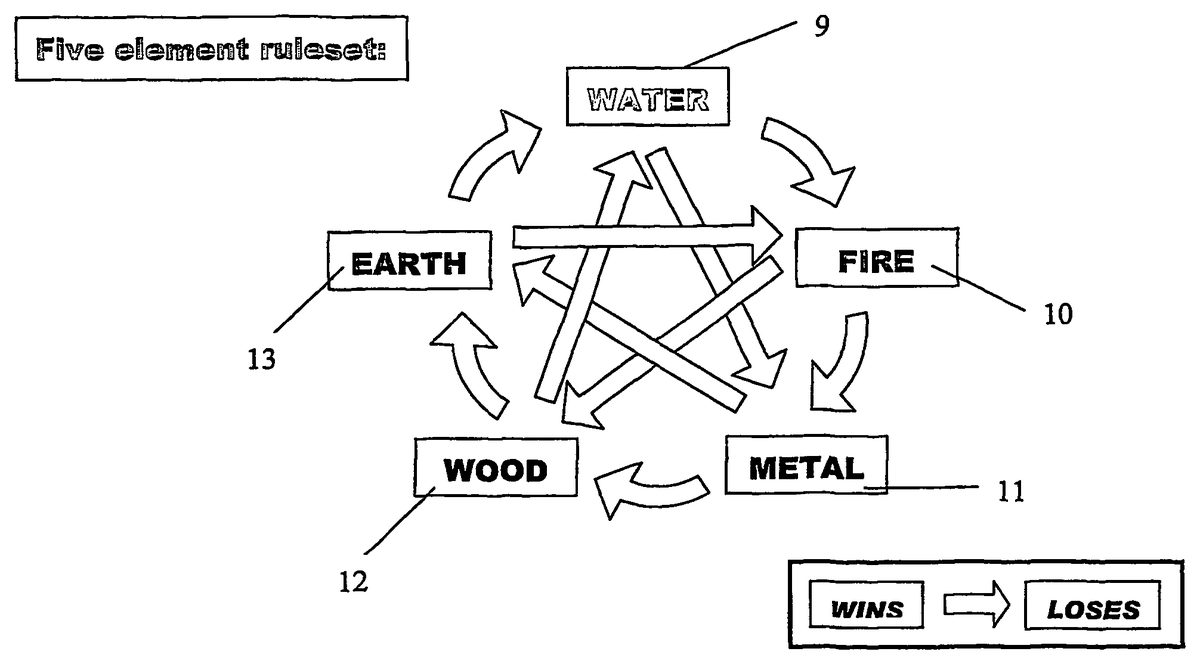
With reference toFIG. 4, an example of a rule-set will be described:
water9wins over fire10and metal11; fire10wins over metal11and wood12; metal11wins over wood12and earth13; wood12wins over earth13and water9; and earth13wins over water9and fire10.
The above rule-set can be described as a rule such that for an ordered set of items {X1. . . Xn}, in this example {water, fire, metal, wood, earth}, Xkwins over X(k+p) modulo nfor all k and all p where k is some integer such that 0<k<(n+1) and where p is some integer such that 0<p<(n+1/2). So in this example k will be 1, 2, 3, 4 and 5, and p will be 1 and 2. When k is 4 and p is 1 the function ((k+p) modulo n) will result in 5. When k is 5 and p is 1 the function ((k+p) modulo n) will result in 1.
Overview of Game-Play (Server/Client Model)
With reference toFIG. 5, a description of how the method operates on hardware using the server/client model will be given.
Wired/Wireless Client/Player View
Beginning play: Potential SMS players14initiate a session by sending15a throw message (rock, paper, or scissors) to a specific network location. Potential WAP players navigate to the appropriate WAP page using the menu structures available on their device, are presented with a throw selection dialog, and choose a throw.
Round enrollment: All players receive16a message with notification of the current round number, approximate time to round completion, and current number of players in round. Depending on level of ongoing player status (casual, subscriber, sponsored) additional promotional messages or game statistics may be forwarded or made available.
Round completion: All players receive a final message with notification of final throw as determined by a Global Core Server17. Depending of level of ongoing player status (casual, subscriber, sponsored) additional promotional messages or game statistics may be forwarded or made available.
Server View
Beginning play: The Global Core Server17generates a new, unique numerical identifier for the current round at predetermined intervals—for example, every 30 seconds—and forwards18the identifier, a round expiration timestamp, and any unique promotional or statistics messages to Edge Servers19.
Round enrollment: Upon receipt18of the new identifier and timestamp, Edge Servers19process pending and new requests for enrollment, and notify16players of round enrollment, expiration status, and any appropriate promotional or statistical messages based on player status. Edge Servers19aggregate player throws and forward20totals to the Global Core Server17.
Round completion: Upon reaching the time indicated in the expiration timestamp, the Global Core Server17sends18round closure notification to Edge Servers19, totals player throws, and sends18majority throw message to Edge Servers19. Edge Servers19format and send16majority throw messages (which could be in SMS or MMS format), including appropriate promotional or statistics messages, to players enrolled in round.
Overview of Game-Play (Distributed Processing Model)
With reference toFIG. 6, a description of how the method operates on hardware using the distributed processing model will be given.
A single device21—the 1st play device, defines a game session by broadcasting22a session name chosen by the 1st player at regular intervals via an established wired or wireless network transport and protocol23with extensions to support discovery of additional play devices. A plurality of additional play devices24initiate connection to all known play devices via the network23.
When all devices2124have successfully established connections, the 1st play device21sends22a start command to all devices2124, and begins broadcast22of a master clock pulse at an established, regular interval.
For each round of play, players choose from available play options—e.g. red, green, or blue—and their choices are broadcast2225to all known devices2124. When all devices2124have acknowledged receipt of every player choice, or time has expired as determined by the master clock, local displays are updated by the local application. The local application checks to see if the local player or any others have won—e.g. by reaching the center objective, and if so declares a win. The 1st play device21verifies any declared winners with one or more peers, and if there is agreement, declares final Winners, and ends the game. If there is no winner on the current round, a new round begins.
One of the advantages of the invention is that the game method provided is engaging as individual players are, in effect, trying to beat the majority, the zeitgeist, the collective unconscious.
Further, only single packets need travel in each direction to carry the player's throw and the server's response. A wireless packet is typically 128 bytes (1024 bits), yet only 2 bits are necessary to carry game-play information. Everything else—1022 bits—is available for other uses. This is especially significant in the server to client communications, because it allows the server to send text, objects, or even animation updates to the client application. The more a player wins, the more small objects or behaviours they can collect for that day.
A further advantage is it would typically cost less than 1 yen per throw to play, effectively removing the financial barrier. Players can enter or leave at any time. Continued play is rewarded with small digital collectable objects, and if the game is successful there might be an opportunity to upgrade to more substantial prizes—a free soft drink or a new graphic to download for 5 straight wins.
In addition, the application is simple and inexpensive to code and implement.
While the present invention has been illustrated by the description of the embodiments thereof, and while the embodiments have been described in considerable detail, it is not the intention of the applicant to restrict or in any way limit the scope of the appended claims to such detail. Additional advantages and modifications will readily appear to those skilled in the art. Therefore, the invention in its broader aspects is not limited to the specific details representative apparatus and method, and illustrative examples shown and described. Accordingly, departures may be made from such details without departure from the spirit or scope of applicant's general inventive concept.
Claims
- A method of implementing a multiplayer game including the steps of: i. selecting an item from a set of items by three or more players on three or more respective devices;ii. each device transmitting the player's selected item to a server;iii. the server designating an item based on all the selected items received;iv. the server determining whether each player's selected item wins over the designated item based on a rule-set;v. the server transmitting the result of each determination to its respective device;wherein the rule-set includes a rule such that for an ordered set of items {X 1 . . . Xn}, Xk wins over X(k+p) modulo n for all k and all p where k is some integer such that 0<k<(n+1) and where p is some integer such that 0<p<(n+½);and wherein the designated item is the item selected by a majority of players.
- A method as claimed in claim 1 wherein there are an odd number of items within the set.
- A method as claimed in claim 1 including the steps of: vi. the server determining whether each player's selected item wins over the remaining items in the set based on the rule-set;and vii. the server allocating points to each player based on the determinations in steps (iv) and (vi).
- A method as claimed in claim 1 wherein the devices are any of wireless devices, Internet-capable personal computers, or Interactive televisions.
- A method as claimed in claim 1 wherein the client and the server communicate using one of the set of Wireless Application Protocol, Multimedia Message Service and Short Message Service.
- A system for implementing a multiplayer game including: i. a plurality of devices;ii. a server;iii. each device responsive to user interaction to select an item from a set of items, and with the ability to transmit item selection to a server and receive result data from the server;and iv. the server containing a messaging application with the ability to receive item selection from devices and transmit result data to devices, and a processing application with the ability to designate an item from the set of items based on the selected items received, determine whether each selected item wins over the designated item based on a rule-set, and send this determination as result data to the messaging application to transmit to the selected item's respective device wherein the rule-set includes a rule such that for an ordered set of items {X 1 . . . Xn}, Xk wins over X(k+p) modulo n for all k and all p where k is some integer such that 0<k<(n+1) and where p is some integer such that 0<p<(n+½);and wherein the designated item is the item selected by a majority of players.
- A system as claimed in claim 6 wherein the devices are wireless devices.
- A system as claimed in claim 7 wherein the result data is transmitted as a single packet.
- A system as claimed in claim 8 wherein the processing application inserts a promotional message in the single packet for the result data.
Disclaimer: Data collected from the USPTO and may be malformed, incomplete, and/or otherwise inaccurate.