U.S. Pat. No. 7,993,201
ELECTRONIC GAME WITH OVERLAY CARD
AssigneeDisney Enterprises Inc
Issue DateFebruary 9, 2007
Illustrative Figure
Abstract
Systems and methods related to game consoles, game software and games for play on a game console having a touch screen interface. A card having a pattern defined therein is overlaid on the touch screen. The defined pattern is used to activate portions of the touch screen by guiding user interaction with a touch pad or touch screen. The activated portions of the touch pad or touch screen launch responsive activity in a computer program implemented on the game console.
Description
DETAILED DESCRIPTION FIG. 1shows an embodiment of a game device or console10suitable for use in conjunction with the present invention. Console10includes a main body12and a cover body14connected to each other along an upper edge of the main body12and a lower edge of the cover body14. In the implementation shown inFIG. 1, hinge elements on main body12mesh with hinge elements on the cover body14, with a hinge pin (not shown) extending through the aligned hinge elements. In the example ofFIG. 1a first display screen32is recessed within the upper face26of the main body12. Display screen32comprises, for example, a backlit, color liquid crystal display (LCD). Display screen32is touch sensitive and may be activated by a stylus71. Stylus71comprises a plastic pencil-shaped device with a rounded tip that is used to activate the touch screen32. The transition at the edge30of display screen32may be tapered, curved or abrupt. Edges30provide a convenient mechanism for registration of the overlay card31in accordance with the present invention by aligning edges33of overlay card31with edges30of display screen32. In the upper right corner of the main body12, there are side-by-side “start” and “select” buttons38,40, respectively, with X/Y/A/B buttons42located adjacent and below the “start” and “select” buttons. Buttons38,40and42are also used for game play control. A cross-shaped directional control button36is located adjacent and below the power button34, and is used for game play control. Additional control buttons may be located on the peripheral edge of main body12or at other desired locations on the upper face26. FIG. 2A-FIG.2D illustrate several exemplary implementations of overlay cards in accordance with the present invention.FIG. 2Aillustrates an embodiment similar to that shown inFIG. 1in which an overlay card31contains a pattern201. Overlay card31is constructed from a material such as paper, pressboard, cardboard, plastic, metal or the like. In a particular implementation overlay card31is roughly the thickness of a playing card, but ...
DETAILED DESCRIPTION
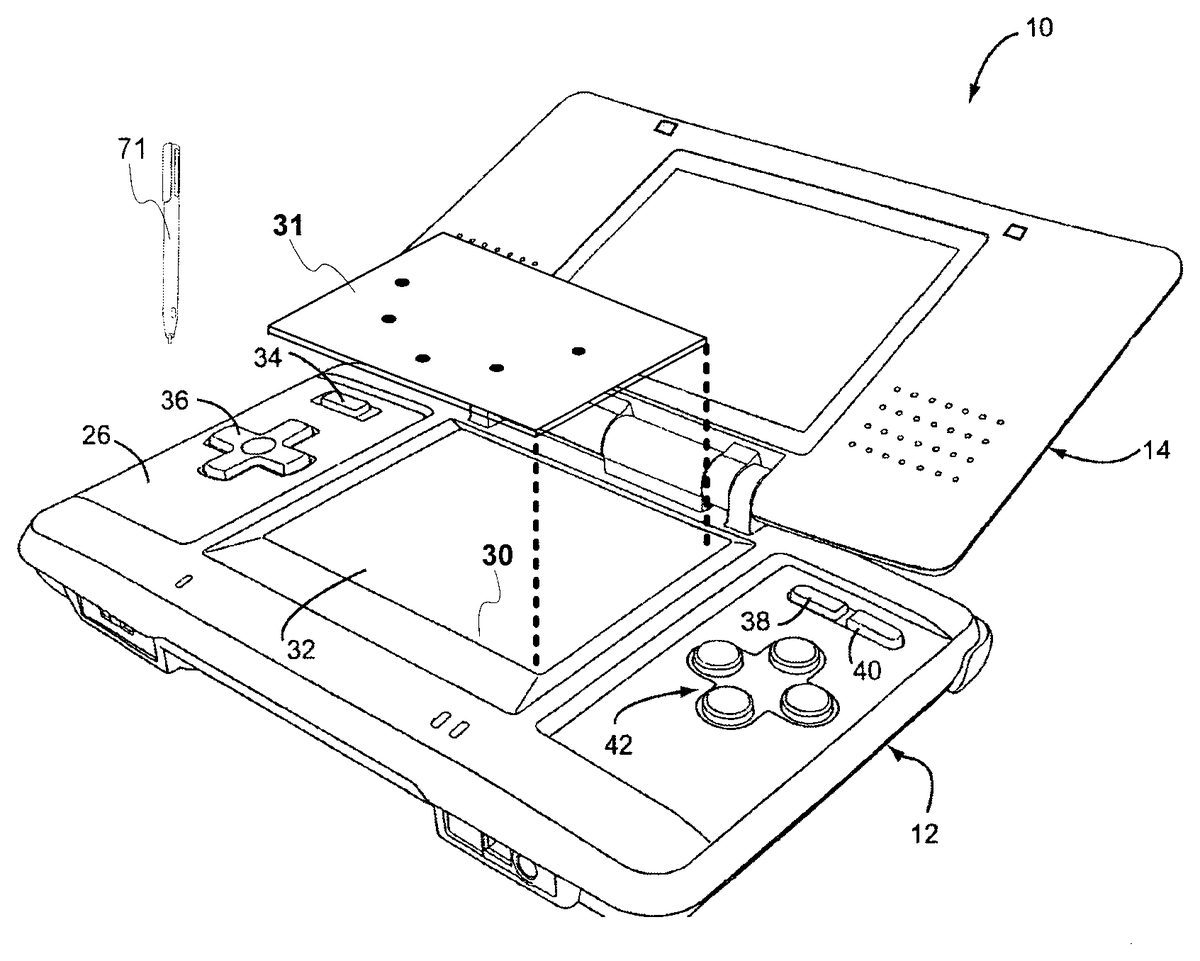
FIG. 1shows an embodiment of a game device or console10suitable for use in conjunction with the present invention. Console10includes a main body12and a cover body14connected to each other along an upper edge of the main body12and a lower edge of the cover body14. In the implementation shown inFIG. 1, hinge elements on main body12mesh with hinge elements on the cover body14, with a hinge pin (not shown) extending through the aligned hinge elements.
In the example ofFIG. 1a first display screen32is recessed within the upper face26of the main body12. Display screen32comprises, for example, a backlit, color liquid crystal display (LCD). Display screen32is touch sensitive and may be activated by a stylus71. Stylus71comprises a plastic pencil-shaped device with a rounded tip that is used to activate the touch screen32. The transition at the edge30of display screen32may be tapered, curved or abrupt. Edges30provide a convenient mechanism for registration of the overlay card31in accordance with the present invention by aligning edges33of overlay card31with edges30of display screen32.
In the upper right corner of the main body12, there are side-by-side “start” and “select” buttons38,40, respectively, with X/Y/A/B buttons42located adjacent and below the “start” and “select” buttons. Buttons38,40and42are also used for game play control. A cross-shaped directional control button36is located adjacent and below the power button34, and is used for game play control. Additional control buttons may be located on the peripheral edge of main body12or at other desired locations on the upper face26.
FIG. 2A-FIG.2D illustrate several exemplary implementations of overlay cards in accordance with the present invention.FIG. 2Aillustrates an embodiment similar to that shown inFIG. 1in which an overlay card31contains a pattern201. Overlay card31is constructed from a material such as paper, pressboard, cardboard, plastic, metal or the like. In a particular implementation overlay card31is roughly the thickness of a playing card, but may be substantially thicker or thinner in particular applications.
In one embodiment overlay card31is sized to fit snugly within the recess defined by edges30of a particular game console. In this manner, one face of card31contacts touch screen32and card31is registered with a relatively high degree of precision with touch screen32. In an alternative embodiment overlay card31may be sized smaller than touch screen32and some other means of registering card31with screen32is used. For example, touch screen32may display one or more alignment marks or images allowing card31to be aligned with touch screen32using the visible alignment marks. Card31may be larger than touch screen32by forming it of a sufficiently flexible material such as paper, foil, plastic film, and the like.
Pattern201is defined by punched holes201in the implementation ofFIG. 2A. Holes201may extend completely through card31as shown inFIG. 3Aor may extend partially through card31as shown inFIG. 3B. Alternatively, pattern201may be printed only, without punched or holes, when the material chosen for card31is sufficiently conformable so that activity of a stylus on the printed pattern is translated to touch screen32.
In this manner user input to touch screen32and in turn a game or other process executing on console10is guided by the pattern201. InFIG. 2Athe user places a cursor in or on each of the elements of pattern201and thereby specifies a sequence of inputs specified by that particular pattern201. A large number limitless number of patterns may be defined to fit the needs of a particular application. Because the pattern201is physically encoded into or on card201, the information is easy to enter as it does not require memorization of complex sequences of buttons or controls. Overlay card31can be manufactured and distributed efficiently and inexpensively, and the many materials available for overlay card31enable a wide range of product differentiation to further engage customers.
FIG. 2Billustrates an embodiment in which pattern201must be accessed by the user in a particular order indicated by printed indicia on a surface of card31. A simple sequence of numbers is shown inFIG. 2B, however, the indicia may comprise other printed symbols or images that guide or prompt a user to select the desired sequence.
In the examples ofFIG. 2AandFIG. 2Bthe pattern is defined by a collection of points or dots.FIG. 2Cshows an embodiment in which pattern201comprises a line, arc and/or two-dimensional shape. A one- or two-dimensional pattern may be a line or an area that guides a user to follow the pattern with a stylus once card31is placed in contact with screen32. In the case of an area such as the star shape inFIG. 2C, use of the card may require tracing the perimeter of the shape or may require the user to “fill in” the shape by scrubbing the area with a stylus. Additionally, a particular game may require the user to trace the card pattern201in a particular direction, or to trace the pattern multiple times such as back and forth. In any embodiment the game may require that a particular pattern be followed within specified time constraints.
Optionally an overlay card may be implemented as multiple pieces such as shown inFIG. 2D. Once the pieces are fit together they form a complete overlay card31that can be used to interact with a game. The pieces can be formed so as to fit together in jigsaw fashion if desired. Such an implementation may be useful when the card pieces are distributed as a part of a retail incentive program to encourage repeat business, or similar distribution scheme.
FIG. 3A-FIG.3C illustrate in cross section alternative mechanisms for implementing an overlay card in accordance with the present invention. In the embodiment ofFIG. 3Apattern201extends entirely through the thickness of card31. This can be accomplished by punching, die cutting, laser cutting, etching, or other technique suitable for a particular card material and production process. In the embodiment ofFIG. 3Athe card31can be used by placing a stylus71completely through the pattern201to contact the touch pad or touch screen. One or more elements of pattern201may be used as alignment marks as described hereinbefore.
In the embodiment ofFIG. 3Bpattern201comprises cavities that extend less than completely through card31to leave a thinner membrane portion. The membrane portion is sufficiently thin such that a touch pad or touch screen32can sense a stylus71. The implementation ofFIG. 3Bcan be formed by cutting patterns201partially through card31or by cutting a pattern201completely through card31and applying a layer of paper, plastic, or similar material to form the membrane portion. In this manner the pattern201can be obscured during distribution if desired to deter copying.
In the embodiment ofFIG. 3Ca pattern is formed by protrusions or bumps303on one surface of card31. Bumps303may be formed by screen-printing, adhesives, or other available technique. In the case of a pressure sensitive screen bumps303allow a user to input a pattern into a touch pad or touch screen by rubbing the upper surface (i.e., a surface that faces a user) of card32. This may allow a user to input complex patterns involving near simultaneous activation of a number of points on the touch screen32in a manner that would be difficult to perform using a stylus alone.
FIG. 4illustrates a card point area defined by software in a particular implementation of the present invention. In the embodiment ofFIG. 4the touch pad or touch screen writeable area is segmented into a 15×11 array. The granularity of this segmentation is a matter of design choice and is constrained only by the granularity permitted by the touch pad or touch screen mechanism. Less granular arrays may be easier to use and will be more forgiving to misalignment whereas more granular arrays allow more complex patterns to be defined and used. In operation the array may be fully populated such that all areas are active, or sparsely populated such that less than all of the areas are active. For example, if a game is at a point where only a certain card can be played, only elements corresponding to that card may need to be active. On the other hand, activating the entire array allows the program to detect when an incorrect sequence is entered indicating that an incorrect card has been played. Processes executing on the game console may take responsive action for incorrect use.
In operation a game program can be constructed such that a character obtains some benefit. For example, a character may grow stronger or more robust. A character may be given extra life or vitality, or be given new tools or weapons. A character may evolve or grow up more rapidly than permitted by normal game progression. Conversely, a card may signal a negative effect on a character such as weakening the character or stealing a tool or weapon.
Game developers program the effect of a particular card when designing a game. A particular effect is dormant until a particular pattern is applied to the touch pad or touch screen32. The game may define specific times at which a card pattern may be applied such as at the beginning of a game or round. Alternatively or in addition a game may be designed to prompt a user to use a card if available.
Card31can be distributed entirely separate from the particular game with which it is associated. Moreover, a specific card31may be useful in more than one game. A game designer will publish, sell, or license the information about various features that can be activated by a game card, and any entity with sufficient rights in the pattern201for a particular game can manufacture and distribute cards31as desired. This separation of the game and card overlay is not required, but enables great flexibility in providing auxiliary products for a game that enhance the overall user experience.
It is apparent that the present invention is useful in a variety of applications other than computer games. The card overlay is generally useful for entering information using touch pad or touch screen input devices to computers where it is desirable for the user to trace a pattern or activate a sequence of points on the touch screen. Such operation might be useful in activating software or activating features in a software program.
Although certain illustrative embodiments and methods are disclosed herein, it will be apparent from the foregoing disclosure to those skilled in the art that variations and modifications of such embodiments and methods may be made without departing from the true spirit and scope of the art disclosed. Accordingly, it is intended that the art disclosed shall be limited only to the extent required by the appended claims and the rules and principles of applicable law.
Claims
- A method of implementing a computer-implemented game on a console having a touch-sensitive pointing device, the method comprising: providing a user with an overlay card having a pattern formed therewith;detecting activity of the touch-sensitive pointing device;determining whether the activity of the touch-sensitive pointing device corresponds to a pre-selected pattern of portions of the touch-sensitive pointing device corresponding to the pattern formed in the overlay card that indicates the user has activated the touch-sensitive pointing device using the overlay card by physically placing the overlay card over the touch-sensitive pointing device;and prior to the detecting step and during the computer-implemented game, displaying a prompt on the touch-sensitive pointing device to physically overlay the overlay card over the touch-sensitive pointing device, wherein the determining is performed during a time period associated with the prompt displaying.
- The method of claim 1 further comprising altering some aspect of the game play based upon detecting that the activity of the touch-sensitive pointing device corresponds to use of the overlay card.
- The method of claim 1 further comprising altering some aspect of the game play based upon detecting that the activity of the touch-sensitive pointing device does not correspond to use of the overlay card.
- The method of claim 1 wherein the card is provided with the computer-implemented game.
- The method of claim 1 wherein the overlay card is provided separately from the computer-implemented game.
- A game system comprising: a game console having a touch-sensitive pointing device including a touch screen for displaying images associated with a game executing in the game console;and a card having a first surface configured to overlay the touch-sensitive pointing device, wherein the card is shaped to register with the touch screen;a pattern formed with the card, wherein the pattern corresponds to a pattern recognized by the game executing in the game console to affect a user's game play and wherein material of the card defines portions of the touch screen that can be activated by the user corresponding to the game-recognized pattern, wherein the card comprises multiple pieces each including a subset of the pattern, whereby the pattern is defined as a physical overlay over the touch screen only when all the pieces of the card are positioned to be registered with the touch screen.
- The card of claim 6 wherein the pattern comprise one or more cavities extending completely through the card.
- The card of claim 6 wherein the pattern comprise one or more cavities extending partially through the card.
- The card of claim 6 wherein the pattern comprise one or more protrusions extending from one surface of the card.
Disclaimer: Data collected from the USPTO and may be malformed, incomplete, and/or otherwise inaccurate.