U.S. Pat. No. 7,976,388
ORAL CARE GAMING SYSTEM WITH ELECTRONIC GAME
AssigneeUmagination Labs LP
Issue DateMarch 23, 2007
Illustrative Figure
Abstract
An oral care gaming system and methods are provided for promoting and rewarding proper oral care techniques and behaviors and for controlling an electronic and/or video game. The system and methods enable a user to play an electronic and/or video game while performing certain oral care activities. The efficacy of a user's oral care techniques enables the user to improve their game play and to achieve the goals of the game. The system includes an oral care tool configured as a game enabler/controller and a base unit configured as an electronic gaming apparatus. Using the oral care tool, a user performs oral care and interacts with an electronic and/or video game the base unit implements and runs. The base unit includes a video display that displays video outputs of an electronic and/or video game. The oral care tool is actuated to enable an electronic and/or video game, and includes sensors for detecting characteristics of a user's oral care techniques and behaviors that serve as inputs to an electronic and/or video game.
Description
DETAILED DESCRIPTION OF THE INVENTION Embodiments of the invention provide an oral care gaming system for implementing one or more electronic and/or video games and for enabling a user of the system to control the play of an electronic and/or video game by performing oral care activities. The system enables one or more electronic and/or video games wherein achieving goals of a game and enhancing game performance are possible by a user's oral care techniques and behaviors. The system provides a user with feedback regarding the efficacy of their techniques and behaviors during oral care sessions through enhanced or improved game performances and achievement of game goals. By permitting a user to play an electronic and/or video game during oral care, the system entertains the user and motivates and reinforces the user to strive to achieve proper oral care techniques and ultimately optimal oral care. Exemplary embodiments of the oral care gaming system and method comprise an oral care tool for performing various oral care functions and for serving as a game enabler/controller. The system further comprises a base unit operatively coupled to the oral care tool which serves as an electronic gaming apparatus disposed remotely from the oral care tool and configured to run and to display one or more electronic and/or video games. Using the oral care tool for oral care functions, a user of the system engages and interacts with an electronic and/or video game the base unit runs. The oral care tool comprises one or more sensors for detecting a user's orientations of the oral care tool and for sensing, detecting and/or measuring the user's oral care techniques and behaviors. When activated, the sensors communicate with the base unit and therein activate the base unit to implement, initiate, play and/or display a game. More particularly, the ...
DETAILED DESCRIPTION OF THE INVENTION
Embodiments of the invention provide an oral care gaming system for implementing one or more electronic and/or video games and for enabling a user of the system to control the play of an electronic and/or video game by performing oral care activities. The system enables one or more electronic and/or video games wherein achieving goals of a game and enhancing game performance are possible by a user's oral care techniques and behaviors. The system provides a user with feedback regarding the efficacy of their techniques and behaviors during oral care sessions through enhanced or improved game performances and achievement of game goals. By permitting a user to play an electronic and/or video game during oral care, the system entertains the user and motivates and reinforces the user to strive to achieve proper oral care techniques and ultimately optimal oral care.
Exemplary embodiments of the oral care gaming system and method comprise an oral care tool for performing various oral care functions and for serving as a game enabler/controller. The system further comprises a base unit operatively coupled to the oral care tool which serves as an electronic gaming apparatus disposed remotely from the oral care tool and configured to run and to display one or more electronic and/or video games. Using the oral care tool for oral care functions, a user of the system engages and interacts with an electronic and/or video game the base unit runs. The oral care tool comprises one or more sensors for detecting a user's orientations of the oral care tool and for sensing, detecting and/or measuring the user's oral care techniques and behaviors. When activated, the sensors communicate with the base unit and therein activate the base unit to implement, initiate, play and/or display a game. More particularly, the sensors provide sensor feedback outputs as inputs into a microprocessor and/or a microcomputer system contained in the oral care tool and/or the base unit, respectively. The microprocessor and/or microcomputer system is programmed to analyze the sensor feedback inputs and to compute one or more ratings of the efficacy of the user's oral care techniques and behaviors. The system is programmed to translate a user's efficacy ratings into enhanced or improved game performances, game scoring and/or achieving one or more game goals.
The oral care tool further includes means for hard wired and/or wireless communication with the base unit, and can further include one or more manual input switches to generate signals as game inputs and game control commands for transmission to the base unit. The base unit includes hard wired and/or wireless communication means for communication with the oral care tool. The base unit further includes a video display for providing video images of an electronic and/or video game and one or more speakers for producing audio feedback of an electronic and/or video game. The base unit includes a microcomputer system including one or more power supplies, a timer or a real-time clock, and addressable memory or interchangeable memory that incorporates electronic computer software for implementing and for running one or more electronic and/or video games. The base unit can also include one or more manual input switches for selecting a mode of operation of the system and for generating game inputs and game control commands. The base unit can further include one or more external communication ports configured to permit interconnection of the base unit with one or more other components that can be incorporated with the system including, but not limited to, one or more other input devices, e.g., one or more computers, internet communication devices and/or computing devices, remotely disposed relative to the oral care tool and including one or more inputs for generating game inputs and game control commands. Alternatively, the base unit can be configured and programmed to provide wireless communication with such other input devices. The one or more external communication ports can also be configured to permit interconnection with the internet, and/or to provide a docketing station for receiving external memory cartridges, and/or to provide the ability to download external software. In addition, the base unit can be programmed to communicate with at least a second oral care tool to receive game inputs and control commands and sensor feedback inputs from the second oral tool to thereby configure the system and method as a multi-user or multi-player system.
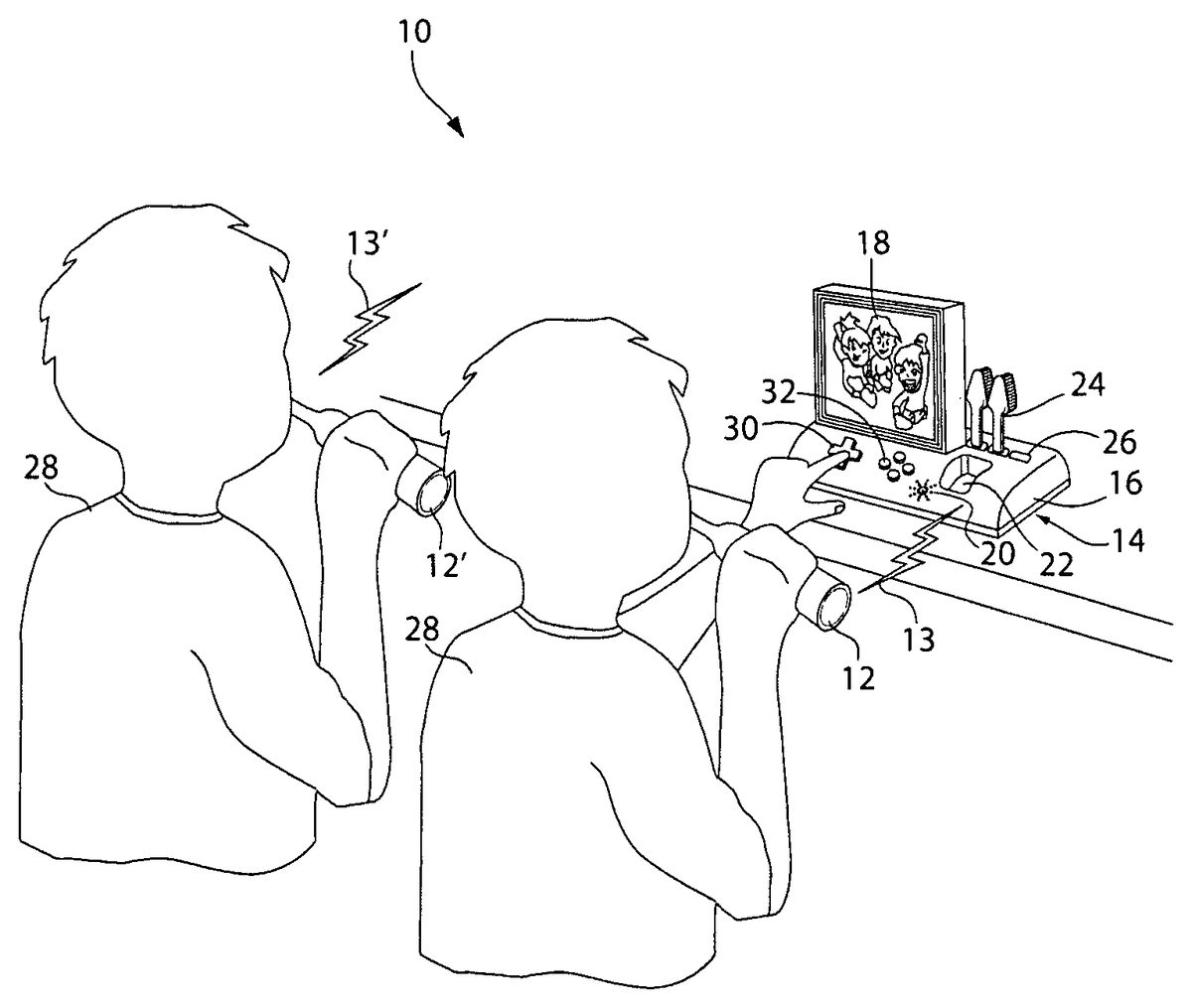
Referring toFIG. 1, in an aspect, the invention provides an oral care gaming system10including an oral care tool12and a base unit14. The oral care tool12is constructed and arranged for maintenance or treatment of the mouth, gums and/or teeth and is further designed and configured as a game enabler/controller to communicate with the base unit14and to interact with an electronic and/or video game of the base unit14. The oral care tool12can include, but is not limited, to a toothbrush, a flossing device, a gum stimulating instrument, a water-jet device or an implement configured as any combination thereof, and is configured to perform one or more oral care functions or activities, e.g., brushing, flossing, massaging or water-jet motions. For purposes of disclosure of the invention, the oral care tool12is described below with reference to a toothbrush12and within the context of tooth brushing. Those of ordinary skill in the art will recognize that the invention is not limited to the toothbrush12illustrated and described and envisions the oral care tool12can include other oral care devices and instruments, such as, but not limited to, those mentioned above, for performing any of a variety of oral care functions.
The base unit14is designed and configured as an electronic gaming apparatus including, as will be described below, electronics for interacting and communicating with the oral care tool12and for enabling one or more electronic and/or video games. The base unit14includes a housing16and a video display18, e.g., a video monitor or an LCD screen, connected to the housing16and configured to display video images of one or more electronic and/or video games the base unit14implements, initiates, plays and/or displays. The base unit14further includes one or more speakers20to produce audio feedback generated during implementation, initiation and play of one or more games.
The housing16can further define a receptacle22configured to receive and to thereby mount the tool12to the base unit12when it is not in use. As will be described below, the oral care tool12can be configured to removably receive a multiple of replaceable oral care tool heads24, e.g., tooth brush heads, such that the tool12can be used by a multiple of users. The oral care tool12can also be configured to removably receive a multiple of different and replaceable oral care tool heads24wherein each head24is configured to perform a specific oral care function, e.g., tooth brushing, flossing, gum massaging or water-jetting teeth.
In one embodiment of the system10configured for multiple users, the housing16can define a multiple of tool head receptacles26, each configured to receive and to thereby mount to the housing16a tool head24for each individual user of the system10. In another embodiment of the system10configured for performing multiple oral care functions, the housing16can define a multiple of receptacles26, each configured to receive and to thereby mount to the housing16one or more different tool heads24, such as a tooth brush head, a flossing device head, a gum stimulating tip and/or a water-jetting head, for each oral care function the system10is configured to perform.
The base unit14can further include one or more manual input switches30and32operatively coupled with electronics of the base unit14, as will be described below. The switches30and32are disposed along the housing16to permit a user28to access the one or more switches30and32to provide game inputs and game control commands to the base unit14, to select operating modes of the base unit14, and to play and/or to control an electronic and/or video games of the base unit14.
As shown inFIG. 1, in a preferred embodiment of the system10, the oral care tool12and the base unit14are operatively coupled for wireless communication13. A user28communicates with the base unit14by manually holding and manipulating the tool12to perform oral care functions, and by actuating one or more manual input switches (not shown) along the tool12and/or by actuating the one or more manual input switches30and32of the base unit14, to select an operating mode of the system10and to provide game inputs and game control commands to the base unit12to thereby activate the base unit14to implement, initiate, play and/or display an electronic and/or video game.
Referring toFIG. 2, and with further reference toFIG. 1, a schematic diagram illustrates an exemplary oral care tool12including a tool head24and a handle25. In a preferred embodiment of the invention, the tool head24is a tooth brush head24including a plurality of bristles23. The tool12further includes one or more sensors34and36, one or more manual input switches38, a printed circuit board (PCB)40and associated electronics, an internal communication module41, one or more power sources42and one or more speakers44.
The tool head24is configured to house within its interior one or more sensors34, and the handle25is configured to house within its interior one or more sensors36. The sensors34and36can include various sensors for detecting, sensing, and/or measuring one or more physical parameters of oral care activities as variables, characteristics and behaviors of oral care that are being performed with the oral care tool12. When one or more of the sensors34and36are activated during oral care activities, the communication module41wirelessly communicates sensor outputs to the base unit14to activate the base unit14to implement, initiate, play and/or display an electronic and/or video game. A user of the system10can thereby interact through their performance of oral care functions, as detected by the one or more sensors34and36, with the game content the base unit14runs.
The sensors34of the tool head24can include one or more pressure transducers configured to detect pressure the brush bristles23and/or the brush head24apply to a user's mouth and/or teeth, and/or one or more accelerometers configured to sense movements or brushing accelerations of the brush head24, and/or one or more temperature or thermal sensors configured to measure temperatures of a user's mouth or oral cavity during brushing. As will be described below, the outputs of the temperature or thermal sensors34help to ensure that brushing with the brush head24is occurring in a user's mouth rather than the user simply simulating brushing to play and to score a game.
The one or more sensors36disposed within the handle25interior can include one or more strain gauges, load cells, force transducers, accelerometers, gravity sector sensors, gyroscopes and/or other motion or load sensing devices or sensors.
The sensors34and36are activated by oral care activities and generate sensor outputs to implement, initiate, play and control an electronic and/or video game of the base unit14. For instance, in the preferred embodiment wherein the oral care tool12is a toothbrush, while a user brushes their teeth with the tool12, certain brushing techniques and behaviors, such as appropriate toothbrush pressure, brushing motion with respect to uniformity and direction, tooth surfaces brushed, e.g., top, bottom, inside, outside surfaces, and brushing duration, e.g., for a predetermined period of time, are detected or measured by one or more of the sensors34and36. The sensor34and36outputs are analyzed by a microprocessor46of the oral care tool12and/or a microcomputer system50of the base unit14, as will be described below, to produce efficacy ratings and to translate the sensor outputs, representing a user's tooth brushing techniques and behaviors, into game control, game scoring, and improved or enhanced play of an electronic and/or video game. The potentials for achieving enhanced or improved game performance, higher game scoring and one or more game goals are thereby tied to a user's actual brushing and to their tooth brushing techniques and behaviors.
In the preferred embodiment of the invention, the brush head24contains within its interior one or more temperature or thermal sensors34for detecting temperatures of a user's28mouth while the user28brushes their teeth with the tool12. The temperature and thermal sensor34outputs enable a user28to play a game of the base unit14using the tool12and, as mentioned, ensure that the user28plays the game by brushing their teeth with the tool12in their mouth as opposed to the user28simulating tooth brushing in order to play the game. In addition, the temperature or thermal sensor34outputs can be used to measure the duration of tooth brushing, e.g., for a predetermined period of time the base unit14is preset and/or programmed to track and to control. If the temperature or thermal sensor34outputs indicate a cessation of tooth brushing with the tool12in a user's mouth before the expiration of a period of time, the base unit14can be programmed to respond to the brushing cessation in a number of different ways, as describe below, including, for instance, suspending game play if the interval of brushing cessation exceeds a preset or programmed limit or time interval.
In addition, the microprocessor46of the oral care tool12and/or the microcomputer system50of the base unit14can analyze sensor outputs, such as, sensor outputs produced from one or more pressure transducers34and36, representing detected pressures the brush bristles23and the brush head24apply to a user's teeth, and/or sensor outputs from one or more accelerometers34and36, representing the brush head24motions/movements with respect to direction, uniformity and/or accelerations. As will be described below, the microprocessor46and/or the microcomputer system50can analyze sensor outputs of the temperature or thermal sensors34, the pressure transducers34and36and/or the accelerometers34and36, individually, as separate variables or parameters, and/or in conjunction with one another or with other sensor outputs received from other sensors34and36to help to produce efficacy ratings of a user's tooth brushing techniques and behaviors. For instance, the outputs of the temperature or thermal sensors34can be analyzed in conjunction with the outputs of the pressure transducers36to provide efficacy ratings with respect to the duration of a user's tooth brushing and uniformity of the user's brushing technique during a brushing session.
The brush head24of the oral tool12may be non-powered or powered, and either powered or non-powered brush heads24can be used with any of the above-noted sensors34and36. In the preferred embodiment, the brush head24is powered by the one or more power sources42. The power sources42reside within the handle25and include self-contained power sources42such as, but not limited to, batteries, fuel cells, photovoltaic cells, chemical power cells or any other self-contained electrical energy power source.
In addition, the oral tool12is configured to removably receive multiple brush heads24. Each brush head24is configured for removable attachment to the tool12to thereby configure the system10as a multi-user or multi-player system10. As will be described below, in the preferred embodiment, each brush head24is programmed and/or is encoded80to identify a specific user28associated with the brush head24such that the base unit14, e.g., a microcomputer50of the base unit14, identifies the brush head24to thereby identify the specific user28of the system10when the brush head24is attached to the oral care tool12. As will be described below with reference toFIG. 5, the programmed and/or encoded80brush heads24help to configure the system10as a multi-user or multi-player system10.
In the preferred embodiment, the tool12further includes the one or more manual input switches38disposed along the handle25such that each switch38is actuated from an area external to the handle25. Each switch38is further disposed and is configured to operatively couple with electronics of the printed circuit board (PCB)40contained within the handle25interior. Actuation of the one or more switches38produces output signals transmitted to and received by the PCB40as game inputs and game control commands which the communication module41communicates wirelessly to the base unit14. In the preferred embodiment, actuation of the one or more switches30and32located at the base unit14and/or actuation of the one or more switches38disposed along the tool handle25provide game input and game control command signals to the base unit14for enabling initiation, play and control of an electronic and/or video game.
In addition, the one or more switches38of the oral care tool12can, upon actuation, implement and/or activate certain operating modes of the system10, including, but not limited to, a video play mode, a display mode and/or a non-video mode. For instance, the video play mode, when activated, enables a user to play an electronic and/or video game using the oral care tool12. In the display mode, the system10displays at the video display18, for instance, a user's game data, e.g., game status, game results, game standings, achievement of game goals, and other information related to a user's game performance. In addition, the system10displays at the video display18a user's oral care data including, for instance, efficacy ratings and prescribed oral care regimens. Such game data and oral care data can be recorded and stored by the system10and thereafter displayed by the system10at the video display18as current, cumulative and/or historical compilations, files and records. When activated, the non-video mode of the system10permits a user to use the oral care tool12for oral care functions without playing an electronic and/or video game.
The one or more switches38located along the handle25can define any of a variety of configurations and structures including, but not limited to, force-sensitive touch pads, small joysticks, discrete buttons, toggle switches, slider switches, any combination thereof, and other input configurations and structures suitable for enabling input and command control signals.
As shown inFIG. 2, in the preferred embodiment, the PCB40is operatively coupled to the one or more switches36of the tool12and is also operatively coupled to the one or more power sources42disposed within the handle25interior. In the preferred embodiment, the PCB40includes the microprocessor46configured for, as mentioned, analyzing sensor output signals the microprocessor46receives as inputs from the one or more sensors34and36, and for analyzing and/or receiving game inputs and game control commands it receives from the one or more switches38of the tool12.
In addition, the PCB40is operatively coupled to the internal communication module41configured for creating a wireless link13between the oral care tool12and the base unit14. The communication module41enables wireless communication13of output signals that the microprocessor46provides as a result of analyzing sensor feedback and analyzing and/or receiving game inputs and game control commands from the switches38. The communication module41comprises one or more transmitting devices configured and programmed to establish the wireless link13for communicating any of the outputs of the microprocessor46, the sensors34and36and the one or more manual input switches38of the oral care tool12to the base unit14. The transmitting devices of the communication module41can include, but are not limited to, infrared or laser LED devices, 802.11 interfaces, Bluetooth® connections, other infrared (RF) transmission devices and systems, and any combination thereof.
With further reference toFIG. 2, the tool12includes one or more speakers44configured to produce audio output from audio feedback the base unit14generates as a result of implementing, initiating and/or playing an electronic and/or video game. In the preferred embodiment, the one or more speakers44are contained within the interior of the handle25and are operatively connected to the PCB40and the communication module41to receive audio feedback from the base unit14.
Referring toFIG. 3, and with further reference toFIGS. 1 and 2, an exemplary schematic system design of the base unit14is illustrated. In the preferred embodiment, the base unit14is configured and programmed to serve as an electronic gaming apparatus comprising the microcomputer system50, the video display18, the one or more speakers20, a power supply52, a timer or real-time clock54, addressable memory or interchangeable memory56, the one or more manual input switches30and32, an internal communication module58, and one or more external communication ports60.
The microcomputer system50is operatively coupled to the power supply52, the video display18, e.g., a video monitor or an LCD screen, the one or more manual input switches30and32, the one or more speakers20and the timer or real-time clock54. The one or more manual input switches30and32provide input signals to the microcomputer system50to implement and/or to activate certain operating modes of the system10, including, but not limited to, a video play mode, a display mode and/or a non-video mode, as described above. In addition, the input signals from the manual input switches30and32implement, initiate, play and/or display an electronic and/or video game residing in the base unit14.
Video outputs of the microcomputer system50and of the timer or real-time clock54are produced to the video display18, which is configured to display video outputs to provide video images of an′ electronic and/or video game the base unit14runs, and to provide video images of the base unit's14interactions with the oral care tool12. In addition, audio feedback outputs of the microcomputer system50are produced to the one or more speakers20, which are configured to play audio feedback outputs to produce sound of an electronic and/or video game the base unit14runs.
In addition, the microcomputer system50is operatively coupled to the addressable memory or interchangeable memory56which incorporates electronic computer software for one or more electronic and/or video games to configure and to program the base unit14
Further, the microcomputer system50is operatively coupled to the internal communication module58. In the preferred embodiment, the internal communication module58is configured and is programmed to create the wireless communication link13between the base unit14and the oral care tool12. The communication module58comprises one or more transmitting devices to establish the wireless link13between the base unit14and the oral care tool12, including, but not limited to, infrared or laser LED devices, 802.11 interfaces, Bluetooth® connections, other infrared (RF) transmission devices and system, and any combination thereof.
The microcomputer system50is also operatively coupled to the one or more external communication ports60. The one or more external communication ports60can include ports configured to permit interconnection of the base unit14with one or more other components62that can be incorporated with the system10including, but not limited to, one or more other input devices, e.g., one or more desk top and/or lap top computers, an internet communication device and/or other computing device, remotely disposed relative to the oral care tool12, and configured and programmed for generating game inputs and game control commands and for transmitting such inputs and commands to the base unit14. In one embodiment, the internal communication module41of the base unit14can be configured and programmed to provide a wireless communication link13′ between the base unit14and one or more other components62.
The one or more external communication ports60can also include ports configured to permit interconnection with the internet, and/or to provide a docketing station for receiving external memory cartridges, and/or to provide the ability to download external software.
As will be described below with reference toFIG. 5, many of the components of the base unit14, and, in particular, the microcomputer system50, the internal communication module58, memory56, the video display18and/or the speakers20, can be configured and programmed to establish a wireless communication link13′ with at least a second oral care tool12′ to enable the base unit14to receive and to process game inputs and game control commands from the second oral tool12′, as well as sensor feedback outputs from sensors of the second oral tool12′, to configure the system10as a multi-user or multi-player system10.
The base unit14includes, as mentioned, addressable memory or interchangeable memory56and optionally can be operatively coupled via one or more of the external communication ports60and/or the internal communication module58to an external and/or remote memory65. Memory56of the base unit14incorporates electronic computer software for enabling one or more electronic and/or video games with the system10. In addition, memory56can include preset, preprogrammed and/or programmable sets of instructions that cause the system10to implement and to enable oral care sessions, e.g., specific for a particular user28of the system10and/or specific to a particular oral care activity or function, as well as to cause the system10to implement and to enable prescribed oral care regimens comprising multiple oral care sessions, e.g., specific for a particular user28of the system10and specific for particular oral care activities or functions.
Memory56of the base unit14, and/or external memory65, are configured to record, compile and store sensor feedback provided by the sensors34and36of the one or more oral care tools12and12′, the efficacy ratings the microprocessor41and/or the microcomputer system50produce, and/or game data, such that, the base unit14can generate and display, or provide by other means, current, cumulative and/or historical files, records and reports of a user's brushing techniques and behaviors, efficacy ratings as well as the user's game performances and game goals achieved.
Referring toFIG. 4, an exploded perspective and partial internal view of an exemplary oral care tool12is illustrated wherein the tool12is constructed and arranged as a toothbrush in accordance with the invention. The oral care tool12includes the brush head24configured with the plurality of bristles13at a distal end24A of the brush head24. The tool12further includes, as described above, the one or more sensors36contained within the interior of the handle25, the one or more manual input switches38, the PCB40operatively coupled to the microprocessor46and to the communication module41, the one or more power sources42and the one or more speakers44.
In the preferred embodiment, the brush head24is electrically powered and is constructed and arranged for tool-less and removable connection and detachment to the handle25. In the preferred embodiment, the brush head24is removably connected and detached from the handle25via a quick-connection and lock70constructed and arranged at a proximal end24B of the brush head24as a mechanical connection or an electro-mechanical coupling. The mechanical quick-connection and lock70can include any of a variety of mechanical connections including, but not limited to, a screw thread connection, a bayonet connection, a quarter-turn connection, a ball detent mechanism, a snap-lock connection and any other mechanical construction or configuration to provide quick and locking connection of the brush head24to a receiver72, as will be described below, to thereby connect at least a portion of the brush head24to the handle25. Alternatively, the quick-connection and lock70can be an electromechanical coupling that includes electrically-conductive connection points, e.g., disposed along or within its distal portion70A and/or its proximal portion70B, that are complementary to electrically-conductive connection points, e.g., disposed within the brush head25, to help to support the conduction of electrical signals between the handle25and the brush head25.
The tool12further includes the receiver72constructed and arranged to receive at least a portion of the proximal end70B of the quick-connection and lock70and to receive at least a portion of a distal end24of the handle25to removably connect the brush head24with the handle25. The receiver72can be constructed and arranged as an elastomeric receiver72, e.g., constructed of one or more elastomeric or similar materials, to incorporate one or more sensors36with the receiver72. As described above, such sensors36can include one or more strain gauges, load cells, force transducers, accelerometers, gravity sector sensors, gyroscopes and/or other motion or load sensing devices or sensors. The elastomeric receiver72enables forces applied to the oral care tool12to be translated to the sensors36for detection or measurement of, for instance, motions or loads of the tool12.
Alternatively, or additionally, the receiver72can be an electromechanical coupling that includes electrically-conductive connection points, e.g., disposed along a distal portion72A, that are complementary to the electrically-conductive connection points, e.g., disposed along the distal and/or proximal portions70A and70B of the quick-connection and lock70, to help to support the conduction of electrical signals between the handle25and the brush head25. The receiver72can also include electrically-conductive connection points, e.g., disposed along its proximal portion72B, that are complementary to the electrically-conductive connection points, e.g., disposed along the distal end24, of the handle25to help to support the conduction of electrical signals between the handle25and the brush head24.
Further, as noted above, in the preferred embodiment, the brush head24is constructed and arranged as an encoded attachment80of the oral care tool12that provides identification or encoded signal(s) to the electronics of the handle25, including the PCB40and the microprocessor40, and/or to the electronics of the base unit14, including the microcomputer system50, such that the system10electronics in conjunction with programmed logic or software of the system10identify the individual brush head24to thereby identify the user associated with that particular brush head24. In this manner, the system10is configured as a multi-user or multi-player system10that tracks use of individual brush heads24to track use of the system10by each individual user28.
In addition, computer software of the system10can be programmed and/or can be programmable to incorporate and to recognize identification or encoded signal(s) of a brush head24for use as a password or software key that is recognizes by the system10, e.g., the microcomputer50of the base unit10, that causes the base unit14to run one or more electronic and/or video games in accordance with a set of rules of engagement and/or of play that are specific to the identification and encoded signal(s) that the system10identifies for a particular user28. The system10can thereby provide electronic and/or video games that are individualized for specific users28of the system10.
Software is a component in some or all of the embodiments of the system10. In the preferred embodiment of the invention, software is stored in memory56of the base unit14and is designed for enabling a variety of electronic and/or video games. In addition, software is designed to enable oral care regimens, e.g., for oral maintenance or treatment, which are specific to each user28of the system10and/or, as will be described below with reference toFIG. 5A, are specific to each oral care activity the system10is configured to perform.
Electronic and/or video games of the system10are designed and programmed to provide entertainment and to motivate a user to practice proper oral care techniques and behaviors by encouraging and by reinforcing proper techniques and behaviors through feedback the system10provides to the user, while the user employs the oral care tool12to perform oral care activities and to play an electronic and/or video game of the base unit14. Such feedback comprises, but is not limited to, enhanced or improved game play, game scoring and/or achievement of one or more game goals in response to the characteristics of the user's oral care techniques and behaviors that the system10senses and analyzes. In addition, the system10motivates a user to adhere to oral care regimens that the system10software enables, as will be described below.
In general, as the sensors34and36of the oral care tool12detect various oral care activities and/or characteristics of such activities, the sensor34and36outputs activate electronics of the base unit14to implement, initiate, play and/or display an electronic and/or video game in accordance with the system10software. For instance, in the preferred embodiment wherein the oral care tool12is configured as a toothbrush as described above, the temperature or thermal sensors34of the brush head24detect the presence of the brush head24in a user's mouth and thereby detect actual brushing occurring in the user's mouth with the oral care tool12as opposed to simulated tooth brushing with the oral care tool12. The outputs of the temperature or thermal sensors34are analyzed by the microprocessor46of the tool12and/or the microcomputer system50of the base unit14to provide indications to the system10that tooth brushing is occurring in the user's mouth such that the system10software initiates, implements, plays and/or displays an electronic and/or video game. In addition, outputs from other sensors36are analyzed by the microprocessor46and/or the microcomputer system50to provide feedback to the system10representing characteristics of a user's oral care techniques and behaviors such that the system10software implements, initiates, plays and/or displays an electronic and/or video game. Further, game inputs and game control commands provided through actuation of the one or more input switches30,32and38are received as inputs and are analyzed by the microprocessor46and/or the microcomputer system50to provide game inputs and commands to the system10such that the system10software implements, initiates, plays, and/or displays an electronic and/or video game. The system10software also implements, controls and/or modifies the content of an electronic and/or video game that the base unit14is running.
In addition, the microprocessor46and/or the microcomputer system50can, in accordance with the system10software, analyze and compute from the sensor34and36outputs efficacy ratings representing adequacy, appropriateness and/or sufficiency of a user's oral care techniques and behaviors. The system10software can employ a user's efficacy ratings, such as, for instance, temperature ratings (incidences of brushing in mouth), brushing duration ratings, brushing pressure ratings related to movement and direction of the tooth brush12, and/or other ratings related to tooth brushing characteristics, alone or in any combination, to enhance or to improve the user's game play and, more particularly, the user's control of the game, game performance, scoring, game progress and achievement of game goals. In addition, during play of an electronic and/or video game, the system10software implements, controls and/or modifies the content of the game in response to such efficacy ratings. The system10thereby enables a user's game performance to serve as feedback that motivates and reinforces the user to continue with their oral care activity, e.g., for the duration of an oral care session as described below, and to modify or to improve their oral care techniques.
In the preferred embodiment, the outputs of the temperature or thermal sensors34are used by the system10software residing in the base unit14memory56to initiate, implement, play and/or display an electronic and/or video game. As mentioned above, the outputs of the temperature or thermal sensors34ensure tooth brushing is occurring in a user's mouth to avoid the user simply simulating tooth brushing to play a game. In addition, the system10software can be designed to employ the outputs of the temperature or thermal sensors34to implement an oral care session during which the base unit14runs an electronic and/or video game for a specific duration of time as long as a user employs the toothbrush12in their mouth for brushing their teeth.
The oral care sessions that the system10software enables can be preset or preprogrammed by the system10manufacturer(s) or by a physician, dentist, parent or other person, e.g., using the base unit14and its one or more manual input switches30and32and/or using another component62, as described above, such as a desk top computer, a lap top computer or other computing device. In addition, or alternatively, the system10software can be programmable to create, modify and/or alter oral care sessions. For instance, the system10software can be preset or preprogrammed and/or can be programmable to permit a user to play an electronic and/or video game for a preferred number of oral care sessions per day, e.g., three sessions per day, with each session having a preferred duration, e.g., two minutes, to encourage continuous and regular tooth brushing. Brushing sessions can be scheduled over a specific period of time, e.g., over a 12 or 24 hour period, for a given user with enforced inactivity periods between sessions during which the base unit14for that user is disarmed to prevent tooth brushing between scheduled sessions. Scheduled brushing sessions and enforced inactivity periods thereby encourage the user to brush their teeth at regular intervals, such as after meals, and to prevent the user from initiating one brushing session after another simply to play a game.
In general, the system10software enables oral care sessions in accordance with sets of instructions stored in memory56of the base unit14that are programmable and/or are preset or preprogrammed as described above. Programming oral care sessions and inactivity periods in accordance with sets of instructions enables the system10to incorporate the oral care sessions into a prescribed oral care regimen that is specific for a user. The system10software implements and/or controls such regimens in accordance with the preset, preprogrammed and/or programmable sets of instructions stored in memory56to enable a prescribed oral care regimen for a specific user28of the system10. In addition, as will be described below with reference toFIG. 5A, the system10software can enable a prescribed oral care regimen for a specific oral care activity whereby the system10software implements and/or controls, in accordance with preset, preprogrammed and/or programmable sets of instructions stored in memory56, a prescribed oral care regimen for a specific care activity, including, but not limited to, tooth brushing, flossing, gum massaging and/or water-jetting teeth. Preset, preprogrammed and/or programmable oral care sessions and regimens help the system10to inhibit misuse of the system10and to encourage each user of the system10to adhere to prescribed oral care regimens.
In the context of tooth brushing, the outputs of the temperature or thermal sensors34are used by the system10software to detect whether a user has ceased brushing their teeth with the toothbrush12in their mouth before the expiration of a brushing session. For instance, if the temperature or thermal sensors34detect an interruption or cessation of brushing activity in a user's mouth during the brushing session and before the expiration of the preset, preprogrammed and/or programmable duration of the session, e.g., two minutes, the system10software will cause the base unit14to pause or stop the play of an electronic and/or video game, and to resume the game if the temperature or thermal sensors34detect the resumption of the brushing activity in the user's mouth within a defined interval of time, e.g., 3 or 5 seconds. If the sensors34detect an interruption or cessation of the tooth brushing in the user's mouth for a period longer than the defined interval, the system10software prohibits the base unit14from restarting the game until the next scheduled brushing session.
The outputs of the temperature or thermal sensors34can be coupled with the outputs of other sensors34and36of the toothbrush12, such as, for instance, the outputs of one or more pressure transducers34and36and/or one or more accelerometers34and36. As described above, one or more pressure transducers34and36can reside in the toothbrush12to detect the pressures the brush bristles23and the brush head24apply to a user's teeth when the user is brushing their teeth with the tooth brush12to thereby detect contact of the tooth brush12with surfaces of the user's teeth. The system10can analyze the outputs of the pressure transducers34and36alone as separate variables or in conjunction with the outputs of the temperature or thermal sensors34to produce efficacy ratings, as described above. Analyzing the pressure transducer34and36outputs, alone or in conjunction with the temperature or thermal sensor34outputs, can help the system10to determine whether tooth brushing is occurring in a user's mouth and to detect the cessation of tooth brushing, as well as to detect whether a user is applying the toothbrush12to most surfaces of their teeth to effect adequate tooth brushing as opposed to the user simply holding or placing the toothbrush12in their mouth and/or against one area of their teeth to play a game.
In addition, one or more accelerometers34and36can reside in the toothbrush12to detect the motions or movements of the brush head24and/or the toothbrush12, to assess the direction and uniformity of the motions or movements, and/or to measure the accelerations of the brush head24and/or the toothbrush12. The system10can analyze the outputs of the accelerometers34and36alone as separate variables or in conjunction with the outputs of the temperature or thermal sensors324to produce efficacy ratings, as described above. Analyzing the accelerometers34and36outputs, alone or in conjunction with the temperature or thermal sensors34outputs, can help the system10to determine whether tooth brushing is occurring in a user's mouth and to detect the cessation of tooth brushing, as well as to detect whether a user is moving the toothbrush12with sufficient speed over tooth surfaces and whether the user is applying the toothbrush12to most surfaces of their teeth to effect adequate tooth brushing as opposed to the user simply holding or placing the toothbrush in their mouth and/or against one area of their teeth to play a game.
In this manner, the system10can employ the outputs of the temperature or thermal sensors34, alone or in conjunction with the outputs of the one or more pressure transducers34and36and/or the one or more accelerometers34and36to help the system10ensure a user is properly employing the tooth brush12to effect adequate tooth brushing.
Referring toFIG. 5, in another aspect, the invention provides an oral care gaming system10including at least a second oral care tool12′ constructed and arranged for maintenance or treatment of the mouth, gums and/or teeth. The second oral care tool12′ is further designed and configured as a game enabler/controller, as described above with reference toFIGS. 1-4, to communicate with the base unit14and to interact with an electronic and/or video game of the base unit14. The second oral care tool12′ permits the system10to be configured as a multi-user or multi-player system10wherein the system10enables each of two or more users of the system10to enable and to play the same or a different electronic and/or video game of the base unit14, either alone or simultaneously with other users during the same oral care session, while the users are engaged in oral care activities using the oral care tools12and12′.
Referring toFIG. 5A, and with further reference toFIGS. 1-4, in another aspect, the invention provides the system10designed and configured to perform multiple oral care functions whereby the system10and its users28can perform different oral care functions using the oral care tool12. As described above, the oral care tool12is configured to receive and to removably connect to a multiple of different tool heads24,24′,24″ with each tool head24,24′,24″ configured for removable connection to the tool12to help to configure the system10as a multi-function system. Each tool head24,24′,24″ is designed and is configured to perform one or more oral care functions and can include, but is not limited to, a tooth brush head24, a flossing device head24′, a gum stimulating head24″, a water-jetting head and/or an implement configured as any combination thereof, to perform an oral care function, including, but not limited to, tooth brushing, flossing, gum massaging and/or water-jetting teeth.
As described above, each tool head24,24′,24″ of the multi-function system10is programmed and/or is encoded80to identify a specific user28associated with the tool head24,24′,24″ such that, when the tool head24,24′,24″ is attached to the oral care tool12, the base unit14, e.g., the microcomputer50, identifies the tool head24,24′,24″, e.g., using identification or encoded signal(s) received from the tool head24,24′,24″, to thereby identify the specific user28of the system10. In addition, each tool head24,24′,24″ of the multi-function system10is further programmed and/or is further encoded80to identify one or more specific functions of the tool head24,24′,24″ such that, when the tool head24,24′,24″ is attached to the oral care tool12, the base unit14, e.g., the microcomputer50, identifies the oral care function(s) that the tool head24,24′,24″ is to perform, e.g., using identification or signal(s) received from the tool head24,24′,24″.
For instance, upon connection of the flossing tool head24′ to the oral care tool12, the base unit14, e.g., the microcomputer50, identifies the specific user28and also identifies that an oral care function to be performed is flossing.
Recognition of a specific user28of the tool head24,24′,24″ and oral care function(s) of the tool head24,24′,24″ by the base unit14causes the system10software to enable oral care sessions that are preset or preprogrammed and/or are programmable in accordance with one or more sets of instructions stored in the base unit14memory56. As described above, as the user28performs oral care activities with the oral care tool12, the system10software causes the base unit14to enable one or more electronic and/or video games during an oral care session as long as the user28is properly employing the oral care tool12. For instance, upon recognition of the tooth brush head24and a specific user28of that head24, the system10software causes the base unit14to enable an electronic and/or video game during an oral care session for tooth brushing. Upon expiration of an oral care session for tooth brushing, the base unit14ceases enabling the game. Thereafter the user28may replace the tooth brush head24with another tool head, such as, for instance, the flossing head24′. Upon recognition of the flossing head24′ and the specific user28by the base unit14, the system10software causes the base unit14to enable the same or a different electronic and/or video game during a flossing session. Similarly, upon expiration of the flossing session, the user28can replace the flossing head24′ with the gum stimulating head24′ and the system10software similarly causes the base unit14to enable the same or a different electronic and/or video game to proceed during a gum massaging session as programmed for that particular user28. The various oral care sessions that the system10software implements in response to the recognition of a tool head24,24′,24″ and a specific user28of the oral care tool12enables the system10to implement an oral care regimen comprising different oral care sessions that are prescribed for that user28. For instance, the set(s) of instructions may be programmed to prescribe a tooth brushing session to have a specific duration, e.g., two minutes, for a specific user28and may similarly prescribe a flossing session and/or a gum massaging session for that particular user28to each have a specific duration. In this manner, the system10permits the user28to play one or more electronic and/or video games over period of time, e.g., the total duration of specific oral care sessions, that is satisfactory to the user28and that allows or motivates the user28to practice each of the oral care functions of a prescribed oral care regimen.
Referring toFIG. 6, and with further reference toFIGS. 1-5, an exemplary process by which a user28interacts with the oral care gaming system10includes the stages shown. The process is exemplary only and not limiting, and may be modified, e.g., by adding, removing, and/or rearranging the stages shown.
At stage100a user28selects and attaches an oral care tool head24to the oral care tool12. In the context of a multi-user system10, the user28selects a tool head24that is designated or dedicated to that particular user28. In the context of a multi-function system10, the user28selects a tool head24,24′,24″ that is designated or dedicated to that particular user28and that is appropriate for the oral care function or activity that the user28will perform.
At stage110the user28powers up or turns on the base unit14and selects an operating mode using one or more of the input switches30and32. The user28turns on the oral care tool12using one or more of the input switches38along the handle25and/or the switches30and32on the base unit14. A user28may load an electronic and/or video game into the base unit14using one or more of the external communication ports60to provide one or more new and/or additional games.
At stage115, the base unit14, e.g., the microcomputer50, identifies the user28of the system10, e.g., using identification or encoded signal(s) received from the programmed and/or encoded80tool head24in the context of the multi-user system10, and further identifies the oral care function or activity to be performed by the system10, e.g., using identification or enclosed signals(s) received from any one of different programmed and/or encoded80tool heads24,24′,24′ of a multi-function system10.
At stage120one or more types of sensors34and36in the oral care tool12detect oral care activities and, more particularly, characteristics of a user's oral care techniques and behaviors. In the preferred embodiment, one or more temperature or thermal sensors34detect temperatures in the user's mouth. In addition, the system10may include one or more pressure transducers34and36, which detect the pressures the oral care tool12is applying to the user's teeth and/gums, and/or may include one or more accelerometers, which detect the direction and uniformity of the motions or movements and/or the accelerations of the oral care tool12.
At stage130the outputs of the sensors34and36are transmitted as signals representing data to the base unit14through a hard-wired connection and/or a wireless communication link established between the tool12and the base unit14.
At stage140the base unit14receives the signals and communicates with the microcomputer system50.
At stage150the microcomputer system50, in response to receipt of the signals, implements, initiates, plays and/or displays, via the video display18, one or more electronic and/or video games residing in the base unit14memory56and/or downloaded by the user28from an external source through the communication port60. On an ongoing basis, the microcomputer system50analyzes the signal data provided from the one or more of the sensors34and36to produce and to update oral care efficacy ratings of the user28. The microcomputer system50employs one or more of the oral care efficacy ratings to create modified activities of the game being played and displayed based upon the one or more ratings. The oral care efficacy ratings are stored temporarily and/or permanently in memory56to provide current, cumulative and/or historical files and records of oral care efficacy ratings, signal data, oral care activities performed, and/or user game performances.
In some embodiments, at stage160the game ensues and the user28interacts with outputs the microcomputer system50produces to the video display18and uses the one or more input switches38to provide game inputs and game control commands to the base unit14to thereby interact with the displayed game content, and/or the user28uses the tool12via oral care activities, as detected, senses and/or measured by the one or more sensors34and36, to interact with the displayed game content.
At stage170the game inputs and game control commands, and/or the oral care activities of the tool12, are transmitted to the base unit14.
At stage180the microcomputer system50acts upon the game inputs and game control commands and/or the oral care activities the tool12is performing to create selected responses and actions in the context of the electronic and/or video game the base unit14is running and displaying.
At stage190game play progresses until the time or real-time clock54counts a preset, preprogrammed and/or programmable value, e.g., that represents a duration of an oral care session, whereby the base unit14suspends the game play until the next oral care session.
Other embodiments are within the scope and spirit of the invention. For instance, the system10described with reference toFIG. 1,5or5A can be configured and oriented to motivate users other than young children, such that, the base unit14enables one or more electronic and/or video games, e.g., a crossword puzzle, a word anagram or other word game, that is designed and configured for older children, adolescents and/or adults. In addition, the system10can be configured for and, in particular, the base unit14can include means to receive, data or information streaming from one or more sources via wireless, cable, satellite and/or internet communication in order to receive information and data oriented toward use of the system10by older children, adolescents and adults. For instance, the system10can be configured to receive, on an ongoing basis and/or intermittently, data or information streams related to any of a variety of phenomena, including, but not limited to, weather forecasts, stock performances, and publications of daily, weekly and monthly newspapers and magazines, whereby data or information are received, and optionally permanently or temporarily stored in memory56, and displayed at the video display18of the base unit14. In this context, a user's28employment of the oral care tool12for oral care activities and/or the sensor34and36outputs and/or the inputs provided to the system10via the input switches30,32and38, enable, activate, manipulate and/or modify the content of the data or information streams that are displayed at the video display18. For instance, a user28can view a daily newspaper the system10receives via a data stream and displays at the video display18, while the user28is employing the oral care tool12, e.g., for tooth brushing. The sensor34and36outputs can maintain the display of the daily newspaper at the video display18while the outputs are continuously provided to the system10, or, in other words, for the duration of the user28employing the oral care tool12for tooth brushing, e.g., as detected by the sensors34and36. In addition, the user28can manipulate or modify the content displayed at the video display18by actuating any of the input switches30,32and38, such that, in the context of the displayed newspaper, the user28can turn pages of the newspaper, e.g., by activating a horizontal and/or a vertical scroll function of the video display18.
In addition, the system10software can be configured to analyze, compile and/or store sensor34and36outputs, efficacy ratings the microprocessor46and/or the microcomputer system50produce, user game performance data and any other information related to the system10and/or a user's interaction with the system10to produce current, cumulative, and/or historical compilations, records and reports related to oral care activities and game performance. In addition, the system10can be further configured, as note above, for use in a display mode wherein current, cumulative and/or historical compilations, records and reports that the system10software analyzes, compiles and/or stores can be displayed at the video display18. Further, the system10can download such current, cumulative, and/or historical compilations, records and reports, e.g., via one or more of the external communication ports60.
In other instances, any current, cumulative and/or historical compilations, record and reports of game data or oral care data that the system10creates and maintains can be transmitted to the remote external memory65, and/or can be transmitted, either through a hard-wired connection or more preferably through a wireless communication link13′, to one or more other components62incorporated with the system10, e.g., a remote desk top or lap top computer, for display and/or storage of such data.
In another instance, the oral care tool12and the base unit14can be operatively connected via a hard-wired connection or linkage as an alternative to, or in addition to, the wireless communication link13and13′ established between the tool12and12′ and the base unit14via the internal communication modules41and58. The hard-wired connection or linkage can be implemented with one or more cables between the tool12and12′ and the base unit14that are configured to conduct electrical signals between the tool12and12′ and the base unit14. In addition, the one or more cables would include both signal lines to the base unit14and power lines from the base unit14to provide electrical power to the tool12and12′. A hard-wired connection or linkage helps to reduce the processing electronics residing in the tool12.
Having thus described at least one illustrative embodiment of the invention, various alterations, modifications and improvements will readily occur to those skilled in the art. Such alterations, modifications and improvements are intended to be within the scope and spirit of the invention. The invention can be implemented through microprocessors and/or microcomputer systems and associated software that instructs such computing devices to conduct various operations and functions. Due to the nature of software and such computing devices, one skilled in the art will readily recognize that the invention can be embodied in hardwiring hardware, firmware, and/or software or combinations of any of these. Accordingly, the foregoing description is by way of example only and is not intended as limiting. The invention's limit is defined only in the following claims and the equivalents thereto.
Claims
- An oral care gaming system comprising: a) a first oral care tool configured for maintenance or treatment of a condition in a mouth or organs therein, the first oral care tool comprising: one or more sensors for detecting temperatures of a user's mouth;a speaker;communication means for communicating with another component operatively coupled with the first oral care gaming system;a removeable, reattachable head portion, wherein the head portion is encoded with identification data;and b) an electronic gaming apparatus operatively coupled with the first oral care tool, the electronic gaming apparatus comprising: communication means for communicating audio feedback of an electronic game to the first oral care tool;a processor configured to receive the identification data;identify a user of the first oral care tool based upon the identification data;identify a type of the head portion based upon the identification data;configure the electronic game based upon both the user and the type of the head portion;and control the electronic game, wherein the electronic game provides the audio feedback, and the audio feedback of the electronic game is responsive to inputs received from the one or more sensors for detecting temperatures.
- The system of claim 1 , wherein the communication means of the first oral care tool and the communication means of the electronic gaming apparatus includes one or more electrical conductors that operatively couple the first oral care tool to the electronic gaming apparatus.
- The system of claim 1 , wherein at least one of the communication means of the first oral care tool and the communication means of the electronic gaming apparatus includes a wireless transmission system configured to establish a wireless communication link between the first oral care tool and the electronic gaming apparatus.
- The system of claim 1 , wherein the electronic gaming apparatus further includes memory operatively coupled with the processor and storing at least one set of instructions for implementing at least one regimen of oral care maintenance or treatment.
- The system of claim 4 , wherein the audio feedback of the electronic game is implemented in accordance with the at least one set of instructions.
- The system of claim 1 , wherein the electronic gaming apparatus further includes at least one external communication port for interconnection with at least one input device disposed remotely relative to the electronic gaming apparatus or the first oral care tool.
- The system of claim 6 , wherein the at least one input device includes at least one of a computer, a computing device and an internet communication device configured to provide inputs to the processor.
- The system of claim 6 , wherein the electronic gaming apparatus further includes means to establish a wireless communications link between the electronic gaming apparatus and the at least one input device disposed remotely relative to the electronic gaming apparatus or the first oral care tool.
- The system of claim 1 , further comprising a timer to determine a duration of use of the first oral care tool for an oral care session.
- The system of claim 9 , wherein the audio feedback of the electronic game ceases upon the processor receiving inputs from the one or more sensors for detecting temperatures, the inputs indicating a cessation of use of the first oral care tool before an expiration of the oral care session.
- The system of claim 10 , wherein the audio feedback of the electronic game resumes upon the processor receiving inputs from the one or more sensors for detecting temperatures, inputs indicating a resumption of use of the first oral care tool before the expiration of a given interval of time.
- The system of claim 1 , wherein the another component operatively coupled with the oral care gaming system includes at least the electronic gaming apparatus.
- The system of claim 1 , further comprising at least a second oral care tool configured for maintenance or treatment of a condition in the mouth or organs therein, the second oral care tool comprising one or more sensors for detecting temperatures of the user's mouth, and communication means for communicating with the another component operatively coupled with the oral care gaming system, wherein the another component includes at least the electronic gaming apparatus.
- The system of claim 13 , wherein the inputs received from the one or more sensors for detecting temperatures of the first and the second oral care tools are coupled onto the audio feedback of the electronic game.
- The system of claim 13 , wherein inputs received from the one or more sensors for detecting temperatures of the second oral care tool are coupled onto the audio feedback of a second electronic game.
- The system of claim 13 , wherein the first and the second oral care tools each include a device selected from a group consisting of a tooth brush, a flossing device, a gum stimulating instrument, a water jet device, an implement configured as any combination thereof, and any combination thereof.
- The system of claim 1 , wherein the first oral care tool includes a device selected from a group consisting of a tooth brush, a flossing device, a gum stimulating instrument, a water-jet device, an implement configured as any combination thereof, and any combination thereof.
- The system of claim 1 , wherein the first oral care tool further comprises one or more sensors for detecting pressures which the first oral care tool applies to at least one of the user's mouth and teeth in the user's mouth, and wherein the audio feedback of the electronic game being responsive to one or more inputs received from the one or more sensors for detecting pressures.
- The system of claim 1 , wherein the first oral care tool further comprises one or more sensors for detecting at least one of movement, direction and acceleration of the first oral care tool within the user's mouth and along teeth in the user's mouth, and wherein the audio feedback of the electronic game being responsive to inputs received from the one or more sensors for detecting at least one of movement, direction or acceleration.
- The system of claim 1 , wherein the electronic gaming apparatus further comprises a video display for displaying images of the electronic game.
Disclaimer: Data collected from the USPTO and may be malformed, incomplete, and/or otherwise inaccurate.