U.S. Pat. No. 7,955,168
AMUSEMENT RIDE AND VIDEO GAME
AssigneeDisney Enterprises, Inc.
Issue DateJune 24, 2005
Illustrative Figure
Abstract
An amusement system has a first path extending through an amusement attraction. Vehicles moving along the path have simulated weapons. Riders in the vehicles shoot at targets along the paths or on the vehicles. A game play system allows remote players to participate in a concurrent simulation of an amusement park or theme park ride, activity or event as the amusement park or theme park ride, activity or event is occurring. The system gathers input from sensors located at the amusement park or theme park ride or activity or event, preprocesses this input, and transfers it to a computer system, which uses this input to create a concurrent simulation of the amusement park or theme park ride or activity or event. A remote game player can then interact with the concurrent simulation by providing input to the concurrent simulation through a user interface. This system combines the excitement of a highly interactive video game with the amusement park or theme park ride or activity or event. Remote game players may additionally compete against each other.
Description
DETAILED DESCRIPTION The disclosure is further described with reference to an example. The system integrates an amusement ride and video game for simulating on a video game, events on a ride, and effecting interactions between the ride and video game. There is a path for a ride, and vehicles move along the path. The vehicles including a chassis, a motor for moving the vehicles along the path, and a passenger position in the vehicles. There is a simulated weapon associated with the passenger position; and a target on the vehicles or adjacent to the path. A detector detects an emission from the weapon as operated by a passenger of the ride; and a controller detects an emission from the weapon associated with the vehicles for determining whether the emission hits or misses the target. The theme park event is connected through a communications link to a video game on a computer system. The video game on the computer system is remotely located relative to the ride. There is a display representing the ride, and the display has a plurality of simulated features corresponding to events in the ride, which correspond to the activities of at least one participant in the ride. Event inputs are gathered from at least one sensor located at the ride; and these events are communicated to the video game. The display of the video game changes according to the sensed events. The video game display is also changed according to user inputs received from an interface at the video game. Communications from the video game to the ride acts to permit changing characteristics of the ride according to the input from the user of the video game. The simulated weapon is for shooting a light bream at moving targets. In a computer system with a user ...
DETAILED DESCRIPTION
The disclosure is further described with reference to an example.
The system integrates an amusement ride and video game for simulating on a video game, events on a ride, and effecting interactions between the ride and video game.
There is a path for a ride, and vehicles move along the path. The vehicles including a chassis, a motor for moving the vehicles along the path, and a passenger position in the vehicles. There is a simulated weapon associated with the passenger position; and a target on the vehicles or adjacent to the path.
A detector detects an emission from the weapon as operated by a passenger of the ride; and a controller detects an emission from the weapon associated with the vehicles for determining whether the emission hits or misses the target.
The theme park event is connected through a communications link to a video game on a computer system. The video game on the computer system is remotely located relative to the ride. There is a display representing the ride, and the display has a plurality of simulated features corresponding to events in the ride, which correspond to the activities of at least one participant in the ride.
Event inputs are gathered from at least one sensor located at the ride; and these events are communicated to the video game. The display of the video game changes according to the sensed events. The video game display is also changed according to user inputs received from an interface at the video game.
Communications from the video game to the ride acts to permit changing characteristics of the ride according to the input from the user of the video game.
The simulated weapon is for shooting a light bream at moving targets.
In a computer system with a user interface there is a method for simulating interaction with an amusement park or theme park ride, activity or event. This method comprises generating a display representing the amusement park or theme park ride, activity or event in the computer system. The display includes a plurality of events corresponding to events experienced by participants in the amusement park or theme park ride, activity or event. The events are movable and changeable by both the participants in the theme park ride, activity or event and by persons operating the computer system.
The computer system is remotely located from the amusement park or theme park ride, activity or event theme park. The event input gathers data from at least one sensor located at the amusement park or theme park ride or activity or event. This is transmitted as an input or a modification of that input to the computerized system. This modifies the display of the computerized system according to the event input.
A user input is received from the user interface of the computerized system; and the display is modified according to the user input.
The display includes a display of a plurality of events corresponding to events experienced by participants in the amusement park or theme park ride, activity or event. These events are movable and changeable by both the participants in the theme park ride, activity or event and by persons operating the computer system.
Periodically synchronization of the display with a broadcast of the event input is possible from the amusement park or theme park ride or activity or event. As such the event input, which is broadcast is reflected in the display. The display appears to react to be substantially simultaneous with the broadcast of the event input to a user of the computer system.
Apparatus for simulating interaction with a amusement park or theme park ride, activity or event and a video game comprises at least one sensor for gathering event input from the amusement park or theme park ride or activity or event. There is a computer system including a user interface for playing the video game.
There is a display; and a communication network connects at least one sensor to the computer system for transferring the event input to the computer system. The computer system generates a display representing the amusement park or theme park ride or activity or event.
The display comprises the ability to display a plurality of events corresponding to activities of participants in the amusement park or theme park ride, activity or event and at least one video game player playing a game which relates to the amusement park or theme park ride or activity or event. The computer system periodically modifies the display according to the user input and the event input at the amusement park or theme park ride, activity or event. Positions in the display of the plurality of events relate to the participants and the video game user inputs.
A communications network permits communication between multiple participants in the amusement park or theme park ride or activity or event and multiple video game players at multiple different remote locations from each other and remote locations from the amusement park or theme park ride or activity or event. As such the multiple participants and the video game players can play with each other in relation to events at the amusement park or theme park ride or activity or event.
The disclosure is further described, as an example only, with reference to an attraction at Disneyland, namely the Buzz Lightyear ride (Disney, Disneyland, Buzz Lightyear, Evil Emperor Zurg are trademarks of Disney, Inc.).
Players in the amusement or theme park of Disneyland are riders in a car along a track. The participants play a laser-tag game shooting at targets in the ride. There is a real-time connection and interaction with people playing a similar game at home. The players at home may play individually or in teams with, or against, players on the actual ride. Through a video camera, the players at home can see and participate in the amusement park or theme park ride or activity action in the ride.
The user at home downloads the software first. These users then ride in a virtual spaceship that looks like the spaceship in the real ride. The at-home players have the ability to control some things that happen in the real world ride. For example, the at home users may be able to move something in the ride. Also, when the at-home player hits a virtual target, the real target inside the real ride may light up and change the scoreboard on the car in the actual ride.
Features of the game include for instance: Spin, Blast, Score, and Repeat. Elaboraton of these features for example means that a player in the amusement park ride or in the virtual video game experience can:
Blast off to “infinity and beyond” as a player joins Buzz Lightyear in an interactive and intergalactic battle against the Evil Emperor Zurg. This is further represented in the game as “The fate of the universe is in your hands as you pilot your Star Cruiser through the treacherous terrain while zapping enemy targets and racking up points.”
Further the riders or virtual players can “Spin your Star Cruisers 360 degrees while you fire moveable, hand-held laser cannons.”
Further the riders or virtual players can “Blast enemy targets and amass points, then compare your high-score with other Space Rangers or go for a personal best.”
Further the riders or virtual players can “Climb up the Space Ranger ranks as your scores soar to astronomical heights each time you play.”
Further the riders or virtual players can “Save the galaxy, then e-mail your Astro Blaster score home and wow your friends and family.”
Further the riders or virtual players can “Join the battle online and team up with a Guest playing amusement park or theme park ride or activity in Disneyland® park.”
The program which is downloaed on the remote computer system permtis for player at home to register to be a remote video game player who interacts with the game in the theme park. In this manner there is created an on-line player. The software can include different hints, tutorials, instructions and the like on how to play the on-line game.
Different awards, rewards and scores can be achieved by the on-line player and the particpant in the theme park. There can be a record of these sucesses and failures (misses) and like represented on the display as required.
The on-line player and the particpant in the theme park can choose different weapons and different targets for the ride activity and the video game respectively. There can be different levels of diffilculty and the participant and the players can choose according to different skill levels, and there can be different configurations and settings for the game.
It is also possible for players and or participants to set up teams and buddies so that they can enhance the game experience. It is possible for different players to play against each other even when there are no participants in the ride.
Hardware and System
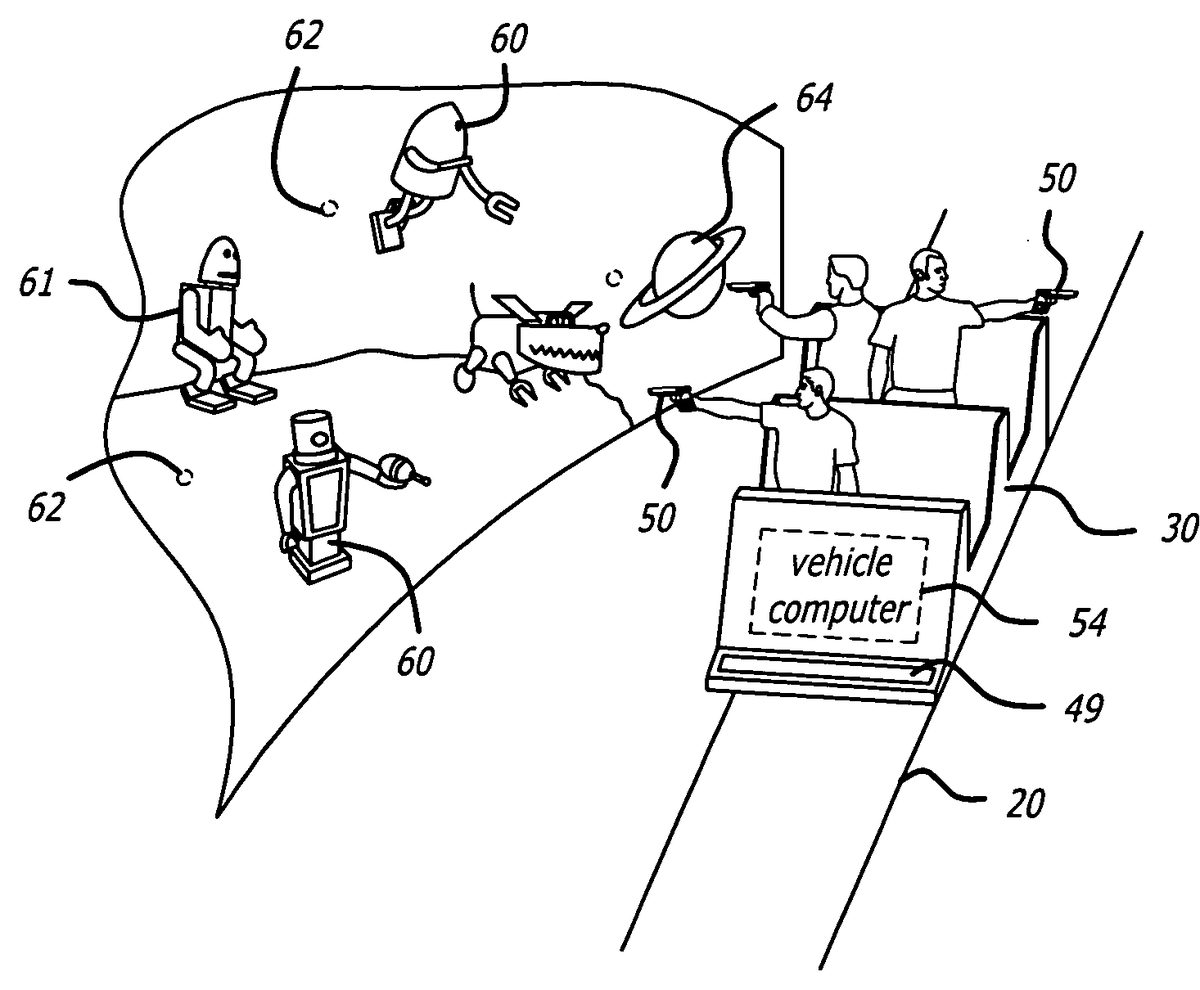
A control computer in a control room, is linked to track sensors56along the paths20to monitor the positions of the vehicles30, and to control various events occurring in the amusement system10. The control computer72is also linked to the animatedFIGS. 60and to the detectors62to control movement of the animatedFIGS. 60and moving targets64, to detect when a target is hit, and to record a score for the player or vehicle scoring the hit. The control computer72is also linked to the vehicle computer54, either via the bus bar58, or through wireless techniques. As shown inFIG. 2, multiple first and second vehicles move along spaced apart on the track.
In use, riders board the vehicles30and32at the load/unload platform24. The vehicles30and32then move into the game room or scene18. Various animated figures move about in the game room or scene18, with some moving towards the vehicles30and32to seemingly threaten the riders. The riders shoot at the animatedFIG. 60or at the fixed and moving targets61and64, using the weapons50. The light beam emitted from each weapon50is preferably modulated, so that the detectors62and control computers72can identify each weapon50and the rider who successfully “hit” any of the targets or figures.
The control computer72preferably provides instructions to the vehicle computer54, which control the vehicle, drive motor49. For example, if in one or more of the game rooms or scenes18, the riders in the “first” vehicle30outscore the riders in the “second” vehicle32by a preset amount (scoring achieved by successfully hitting a target with a light beam from the weapon50) then the control computer72instructs the vehicle computer54to change a movement profile of vehicle by causing the vehicle2to slow down, by slowing the drive motor49. The control computer72and vehicle computer54control all aspects of the amusement system, such as vehicle, animated figure, and target movement and position, sound and lighting effects, simulated gun and scoring characteristics.
Other aspects of the ride, in addition to vehicle movement, can also be changed based on the occurrence or non-occurrence of an event. The vehicle computer54and the control computer72communicate with each other in real time. Any device or activity controlled by the vehicle computer54or the control computer72(e.g., vehicle movement; guns; targets; animation; sound; lighting; special effects, etc.) can be started, stopped, or changed, based on preprogrammed instructions, events occurring during the ride, or both.
FIG. 4is a functional block diagram of functional components in a system for simulating participation with an amusement park or theme park ride, event activity or game. Sensors110at various locations in an amusement park or theme park ride, activity or event100gather data to be used in remote simulations of amusement park or theme park ride, activity or event100. These sensors110connect to preprocessor120, which assembles the data collected from sensors110for transmission across a network130. The network130connects the preprocessor120to a collection of remote computer systems140,142and144. These remote computer systems140,142and144contain separate amusement park or theme park ride, activity or events simulations150,152, and154, respectively. Game players160,162, and164, sit at computers140,142, and144and interact with the amusement park or theme park ride, activity or events simulations150,152, and154. For instance the player160interacts with the amusement park or theme park ride, activity or events simulation150on the remote computer system140. The player162interacts with amusement park or theme park ride, activity or events simulation152on remote computer system142. The player164interacts with amusement park or theme park ride, activity or events simulation154on remote computer system144.
The amusement park or theme park ride, activity or event100can be any type of competitive or participatory event in which remote participants can participate. In the example of this disclosure this is a shooting gallery where there are laser type guns directed at targets along ride. A variety of sensors110are located within amusement park or theme park ride, activity or event100. The position sensor200detects the position of a vehicle or a participant in amusement park or theme park ride, activity or event100. There can be position and location sensors, speed sensors for participants in amusement park or theme park ride, activity or event100. There can be target tally sensors in the form of internal monitors of tallies of targets hit by laser guns of different participants at the amusement park ride or activity. Other types of sensors collect sensory data, such as light sensors that can measure the intensity of lighting at different areas of the amusement park or theme park ride, activity or event100.
One or more video cameras can gather video images from different locations within amusement park or theme park ride, activity or event100. Video cameras can be mounted on cars or above the track of the amusement park or theme park ride, activity or event. Multiple video cameras are located at various strategic positions with the track of the amusement park or theme park ride, activity or event100. Participants in the amusement park or theme park ride, activity or event100may wear helmet cameras, which provide participant perspectives on amusement park or theme park ride, activity or event100.
A microphone can monitor sound from amusement park or theme park ride, activity or event100. This sound can be added to amusement park or theme park ride, activity or events simulation150to enhance the reality of amusement park or theme park ride, activity or events simulation150. For example, a large collection of microphones located at strategic positions within amusement park or theme park ride, activity or event100creates a sound mapping of amusement park or theme park ride, activity or event100. This sound mapping is used to accurately reproduce sounds at different locations as a simulated participant navigates within amusement park or theme park ride, activity or event100.
The sensors connect to the preprocessor. The preprocessor120performs a number of operations on the data gathered through sensors110, including, for example: extraction of position information from a video signal through image recognition software, and compression of data collected through sensors110in preparation for transport across network130to remote computer systems140,142and144. The preprocessor120alternatively may have limited computing power, and provides simple data routing elements, which transmit raw data from sensors110to computers140,142and144. Alternatively the preprocessor120provides compression and filtering functions, requiring special purpose hardware for digital signal processing, as well as a central processing unit connected to a full computational system. The preprocessor120can also buffers data from sensors110. This allows data collected from sensors110to be assembled and temporarily stored before transmission across network130. The preprocessor120can include dedicated hardware to convert analog signals from sensors110into digital form for transport over the network130.
The network130, which can include a WAN, LAN or Internet connections transports data from preprocessor120to computers140,142and144. The network130comprises a computer network, such as the Internet, used to transmit a stream of data from preprocessor120to remote computer systems140,142and144. This stream of data includes a digitized video signal. The network130can include a wireless computer network, and/or a broadcast television network, which transmits a video signal and other data, and/or a dedicated cable television network, and/or a collection of telephone lines.
The remote computer system140contains software and a program to simulate an amusement park or theme park ride, activity or event simulation150. The remote computer system140can include a central processing unit (CPU) connected to bus, connected to an appropriate disk drive, display and memory. The memory contains executable computer code and data340for the amusement park or theme park ride, activity or events simulation150. The bus also connects the CPU to a number of data input devices including, for instance a mouse, joystick, keyboard, a microphone with voice recognition software, and/or a video camera with image recognition software.
In some forms, at least part of the virtual amusement park or theme park ride, activity or event simulation takes place with at a central computer system, and other parts of the amusement park or theme park ride, activity or event simulation150,152, and154, take place in remote computer systems140,142and144. In another system, the entire amusement park or theme park ride, activity or event simulation takes place at central computer system, and remote computer systems140,142and144function as display and data input devices, such as computer terminals. According to another embodiment of the present disclosure, the amusement park or theme park ride, activity or event simulation is divided into multiple pieces and these pieces are executed across a number of nodes of a distributed computing system.
An amusement park or theme park ride, activity or event simulation150operates with a computer system140to generate a display of an amusement park or theme park ride, activity or event100, which is viewed by player160. Event100is reflected through sensors110. The event input is used to modify display to properly reflect the current state of amusement park or theme park ride, activity or event100. The computer system140receives “user” input from player160. This user input is used to update the display to reflect the effect of user commands on an amusement park or theme park ride, activity or event simulation150.
The display of the amusement park or theme park ride, activity or event100contains data corresponding to both simulated participants and real participants in the amusement park or theme park ride, activity or event100. Rules encoded in the amusement park or theme park ride, activity or event simulation150govern how the simulated and theme park entities interact with each other in amusement park or theme park ride, activity or event simulation150. For example, a rule specifies that a simulated entity cannot occupy the same physical space as a real entity. If a player attempts to move a simulated entity into the same physical space as a real entity, the simulated entity will move a close as possible to the real entity, but will be prevented from occupying the same physical space as the real entity in amusement park or theme park ride, activity or event simulation150.
Different types of interactions are regulated by amusement park or theme park ride, activity or event simulation150: These can be interactions between simulated participants; and interactions between participants at the theme park event or game and simulated participants. There is flexibility in specifying rules governing interactions between simulated participants, and the amusement park or theme park ride, activity or event simulation participants. The game designer can develop a customized set of rules to govern interactions between participants in the amusement park or theme park ride, activity and/or event simulation150.
Amusement park or theme park ride, activity or event simulation150is synchronized with amusement park or theme park ride, activity or event100so that display of amusement park or theme park ride, activity or event simulation150appears to be substantially simultaneous with amusement park or theme park ride, activity or event100to a player160of amusement park or theme park ride, activity or event simulation150. Synchronization between amusement park or theme park ride, activity or event100and amusement park or theme park ride, activity or event simulations150,152and154at remote computer systems140,142and144, is accomplished in a number of ways. There can be television signal transmissions of information between amusement park or theme park ride, activity or event100and computers140,142and144, and synchronization information is encoded in the television signal by modulation or by transmitting it during the vertical blanking interval (VBI) of the television signal. Periodic transmissions over the computer network130are used to synchronize amusement park or theme park ride, activity or event simulation150with amusement park or theme park ride, activity or event100.
There can be a facility to collect scoring information from amusement park or theme park ride, activity or event simulations150,152and154. A communication channel through network130is used to gather scoring information from remote amusement park or theme park ride, activity or event simulations150,152, and154at a central location. The scoring information is tabulated, and competitors can thus be determined for remote simulations and participants at the theme park.
In one embodiment, the video game in the system and method described above is played at home remotely from the theme park. In another embodiment, the video game in the system and method described above is played in the theme park itself. One of ordinary skill in the art will recognize that the video game can be played in any location with a gaming console and a video display.
Thus, a novel amusement system has been shown and described. Various modifications may of course be made without departing from the spirit and scope of the disclosure. The disclosure, therefore, should not be limited, except to the following claims, and their equivalents. While the apparatus and method have been described in terms of what are presently considered to be the most practical and preferred embodiments, it is to be understood that the disclosure need not be limited to the disclosed embodiments. It is intended to cover various modifications and similar arrangements included within the spirit and scope of the claims, the scope of which should be accorded the broadest interpretation so as to encompass all such modifications and similar structures. The present disclosure includes any and all embodiments of the following claims.
Claims
- A system of integrating an amusement ride and a video game, and providing interactions between the amusement ride and the video game, the system comprising: the amusement ride having a vehicle movable along a path, a passenger position in the vehicle;a simulated weapon associated with the passenger position;a target;a detector for detecting an emission from the simulated weapon as operated by a passenger of the vehicle;a controller for determining whether the emission hits or misses the target;a communications link to the video game on a computer system, the video game on the computer system being remotely located relative to the amusement ride and comprising a display representing the amusement ride, the display having a plurality of simulated features corresponding to events at the amusement ride which correspond to the activities of the passenger of the vehicle, and wherein the computer system is configured to gather event inputs from at least one sensor associated with the amusement ride and communicate the event inputs to the video game, and to change the display of the video game according to the event inputs gathered from the at least one sensor, and further configured to change the video game display according to user inputs received from an interface of the video game, and further configured to communicate the user inputs from the video game to the amusement ride for changing characteristics of the amusement ride according to the user inputs from a user of the video game.
- The system of claim 1 wherein the simulated weapon is shooting a light bream at moving targets.
- The system of claim 2 further comprising a communications network for providing the communication link between the passenger in the vehicle and multiple video game players at multiple different remote locations from each other and remote locations from the amusement ride, such that the passenger and the video game players can play with each other in relation to the events at the amusement ride.
- The system of claim 1 further comprising a communications network for providing the communication link between the passenger in the vehicle and multiple video game players at multiple different remote locations from each other and remote locations from the amusement ride, such that the passenger and the video game players can play with each other in relation to the events at the amusement ride.
- A method of providing interactions between an amusement ride and a video game, the method comprising: detecting activities by a passenger of a vehicle of the amusement ride, the vehicle being movable along a path;communicating information relating to the activities of the passenger to a video game on a computer system remotely located relative to the amusement ride, the computer system comprising a display representing the amusement ride, the display having a plurality of simulated features corresponding to events at the amusement ride which correspond to the activities of the passenger of the vehicle;receiving user inputs received by an interface of the video game from the computer system;and changing characteristics of the amusement ride according to the user inputs from the user of the video game.
- The method of claim 5 wherein the activities by the passenger include shooting a light bream at moving targets using a simulated weapon in the vehicle.
- The method of claim 5 further comprising: communicating the information relating to the activities of the passenger to a second video game on a second computer system remotely located relative to the amusement ride, the second computer system comprising a display representing the amusement ride, the display having a plurality of simulated features corresponding to events at the amusement ride which correspond to the activities of the passenger of the vehicle and the user inputs from the first computer, receiving second user inputs received by an interface of the second video game from the second computer system;and changing characteristics of the amusement ride according to the second user inputs from a second user of the second video game.
- A system for providing interactions between an amusement ride and a video game, the system comprising: at least one sensor for detecting activities by a passenger of a vehicle of the amusement ride, the vehicle being movable along a path;a controller for communicating information relating to the activities of the passenger to a video game on a computer system remotely located relative to the amusement ride, the computer system comprising a display representing the amusement ride, the display having a plurality of simulated features corresponding to events at the amusement ride which correspond to the activities of the passenger of the vehicle;the controller configured to receive user inputs received by an interface of the video game from the computer system, and further configured to change characteristics of the amusement ride according to the user inputs from the user of the video game.
- The system of claim 8 wherein the activities by the passenger include shooting a light bream at moving targets using a simulated weapon in the vehicle.
- The system of claim 8 , wherein: the controller is further configured to communicate the information relating to the activities of the passenger to a second video game on a second computer system remotely located relative to the amusement ride, the second computer system comprising a display representing the amusement ride, the display having a plurality of simulated features corresponding to events at the amusement ride which correspond to the activities of the passenger of the vehicle and the user inputs from the first computer;and the controller configured to receive second user inputs received by an interface of the second video game from the second computer system, and further configured to change characteristics of the amusement ride according to the second user inputs from a second user of the second video game.
Disclaimer: Data collected from the USPTO and may be malformed, incomplete, and/or otherwise inaccurate.