U.S. Pat. No. 7,924,152
INTERACTIVE VIDEO GAMING FOOTWEAR INCLUDING MEANS FOR TRANSMITTING LOCATION INFORMATION TO A REMOTE PARTY
Issue DateFebruary 1, 2007
Illustrative Figure
Abstract
An article of footwear contains an integrated video gaming apparatus, a cellular phone, and a GPS receiver, whereby the footwear is able to encode and transmit its own location to a central monitoring station, along with a cell phone number (or other unique identifier) of a remote person. Using the encoded location information of the wearer of the footwear, and the encoded cell phone number of the remote person, the central monitoring station is able to look up the nearest street address corresponding to the location of the wearer and send an SMS text message with that address to the remote person. If the remote person is wearing the inventive footwear, the central monitoring station can send the remote person the street address of the wearer, or route information, with or without map data, for display on their video gaming device, such that they can “intercept” to meet up with one another.
Description
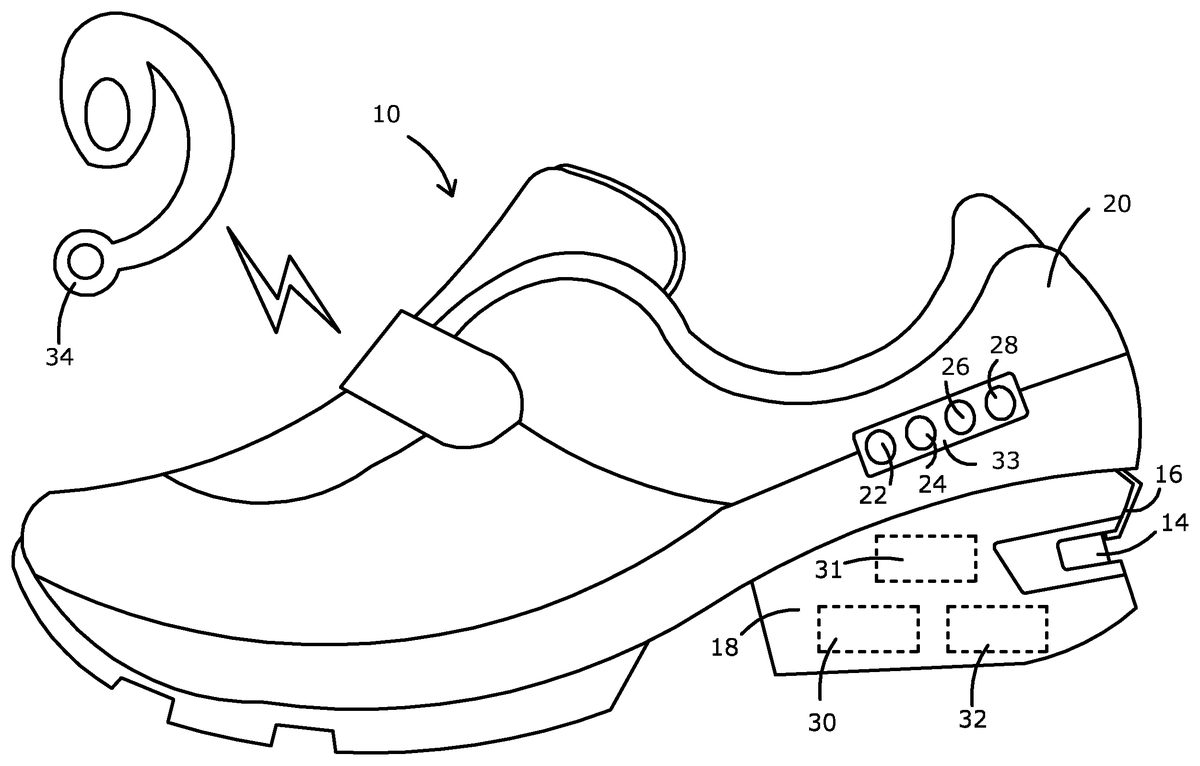
DETAILED DESCRIPTION OF THE PREFERRED EMBODIMENTS Referring toFIG. 1, the present invention relates to an article of footwear, preferably in the form of athletic footwear, such as the running shoe10shown. The shoe10differs from a standard running shoe in that it has been designed to include means for interactive communication with a video gaming device, particularly a handheld electronic video gaming device12, such as a Sony PSP. As will be understood by those skilled in the art, interactive communication between the footwear10and the gaming device12can be accomplished by any of a variety of means, such as by Wi-Fi communications, as used in the preferred embodiment of the invention, as the Sony PSP is inherently capable of Wi-Fi communication. The article of footwear10preferably includes removable storage means14, which can be in the form of a memory card or miniature hard drive unit, depending on the amount of storage needed. In the preferred embodiment of the invention, the storage means14comprises a hard drive, which provides several gigabytes of storage whereby numerous programs, including games, as well as data, can be stored. When a hard drive is used as the removable storage means, a mechanical locking structure16can be provided to insure that the hard drive14remains firmly seated in the heel portion18of the footwear10. As illustrated inFIG. 1, the article of footwear10further includes an upper portion20which is shown to have a series of push-button switches22,24,26,28which are covered, in the preferred embodiment, with a protective clear cover33. Referring now toFIG. 2, the present invention includes means for determining its own location, such as a GPS receiver30, which provides the footwear10with its present position (latitude, longitude, elevation). The present invention also contemplates the inclusion of a cellular telephone transceiver32which is preferably mounted in the heel18, along with the GPS receiver30. The cellular telephone transceiver32allows the user to ...
DETAILED DESCRIPTION OF THE PREFERRED EMBODIMENTS
Referring toFIG. 1, the present invention relates to an article of footwear, preferably in the form of athletic footwear, such as the running shoe10shown. The shoe10differs from a standard running shoe in that it has been designed to include means for interactive communication with a video gaming device, particularly a handheld electronic video gaming device12, such as a Sony PSP. As will be understood by those skilled in the art, interactive communication between the footwear10and the gaming device12can be accomplished by any of a variety of means, such as by Wi-Fi communications, as used in the preferred embodiment of the invention, as the Sony PSP is inherently capable of Wi-Fi communication.
The article of footwear10preferably includes removable storage means14, which can be in the form of a memory card or miniature hard drive unit, depending on the amount of storage needed. In the preferred embodiment of the invention, the storage means14comprises a hard drive, which provides several gigabytes of storage whereby numerous programs, including games, as well as data, can be stored. When a hard drive is used as the removable storage means, a mechanical locking structure16can be provided to insure that the hard drive14remains firmly seated in the heel portion18of the footwear10.
As illustrated inFIG. 1, the article of footwear10further includes an upper portion20which is shown to have a series of push-button switches22,24,26,28which are covered, in the preferred embodiment, with a protective clear cover33.
Referring now toFIG. 2, the present invention includes means for determining its own location, such as a GPS receiver30, which provides the footwear10with its present position (latitude, longitude, elevation). The present invention also contemplates the inclusion of a cellular telephone transceiver32which is preferably mounted in the heel18, along with the GPS receiver30. The cellular telephone transceiver32allows the user to communicate by voice with other players, or, alternatively, it allows the wearer of the footwear10to signal a distress situation, as described in the parent application. When the cellular transceiver32is used for voice, it is preferably connected to a headpiece34via Bluetooth, as is well known in the art.
As explained more fully in the parent applications referenced above, the invention is designed to be able to communicate its location information to a central monitoring location. Accordingly, in a situation in which the wearer of the shoe10is in danger, he can covertly initiate an alarm signal to the central monitoring station where trained personnel will dispatch emergency assistance to the wearer's location, as set forth in the encoded alarm system. The functionality between the GPS module30and the transceiver32is administered by an encoder and control module31, which typically includes a programmed microprocessor, and which is able to control both the GPS functions and the cell phone functions in response to either remote commands received by radio or local commands which are input by the user. As the specific functionality of the encoder and control module31is well within the skill of those in the art who have been made aware of the present inventive concept, no detailed explanation is needed, other than to state that the encoder and control module31provides a means for accomplishing the functions described herein.
The present invention is also capable of performing more mundane operations, such as providing the wearer's location to someone else, e.g., a friend who the wearer is talking to on the cell phone32or to someone with whom the wearer is playing a video game using the gaming device12, provided, of course that in the case of the friend with the cell phone, the friend's cell phone is able to accept text messages, typically in the form of SMS text messages, which are generally available on cell phones. In the case of the person playing a video game, additional capabilities can be provided, as explained below.
First, though, with reference toFIG. 3, assuming that the wearer40of the shoe of the present invention10is speaking on the cell phone32with a friend50who is on a conventional cell phone52which has SMS text messaging capability, then the cell phone32will generally already “know” the phone number of the cell phone52of the friend50, either because the call was made to the friend50, in which case the cell phone32will have stored the last number called, or, alternatively, if the friend50called the wearer from his cell phone52, the cell phone32will have the last incoming phone number from the “caller id” function of the cell phone network. From the GPS information available from the GPS module30in the invention10the invention10also knows (or can readily determine) its own location which it is able to encode on a signal which it transmits, on demand of the user40, who can command the transmission using buttons on the video gaming device12or buttons on the shoe10to thereby transmit the user's40location to a central monitoring station54. Unlike an alarm signal however, this type of signal is also encoded with the number of the cell phone52of the friend50, so that the monitoring equipment in the central monitoring station54does not alert the personnel there to take action, but, instead, converts the encoded latitude-longitude (“lat-long”) location information received from the user's40shoe10into the nearest street address of the wearer40of the shoe10. This is accomplished at the central monitoring station54where a computerized database uses the lat-long location data to obtain the nearest street address, which it then converts into a text message, which is sent to the cell phone52of the friend50, using the encoded phone number provided on the encoded signal. This transmission, from the central monitoring station54to the friend's50cell phone52can generally be accomplished using the Internet, or, alternatively, it can be accomplished using the cell phone network. Thus, when the wearer40tells his friend50that he40is waiting to meet the friend50at the place where the wearer40is then located, it is not necessary for the wearer40to even know the street address where he40is located.
Referring now toFIG. 4, in another embodiment of the invention, where the friend60is wearing a shoe100which also includes the invention, a number of additional features are available, as the central monitoring station54can track both the location of the user40and the location of the friend60. In this situation, the following additional features become available. First, the central monitoring station54can send a text message to the friend60, as described above, but in this case the text message can be displayed on the screen of the friend's video gaming device112. Alternatively, the central monitoring station54can create and transmit to the friend60, a detailed list of directions to direct the friend60from his own present position to the location of the user40. These directions can be displayed either as a route, or as a map, or as a joint map and route display with turn-by-turn instructions on the video gaming device112of the friend60. Finally, if the two parties40,60decide to remain in motion, the central monitoring station54is able to continuously update and transmit “intercept” data to the friend's60gaming device112even while the user40is moving. Unlike a standard GPS navigation system which uses a fixed location from a database to provide a user with directions to that fixed location from the user's “present position”, when the present invention is used in the “intercept” mode it continuously updates the destination (i.e., the location of the user40) as it is able to simultaneously monitor both the location of the user40(who may be in motion), along with the location of the friend60. Obviously, in this mode, the location information of the friend60can also be displayed on the video gaming unit12of the user40, whereby they can simultaneously alter their positions to speed up their “intercept” of one another.
As will be understood by those skilled in the art, the variety of games which can be played using the present invention is not limited by the hardware herein described but only by the imagination of the software developers.
While the invention has been described in connection with specific embodiments and applications, the inventor does not intend to restrict the description to the examples shown. Persons skilled in the art will recognize that the above apparatus and methods may be modified or changed without departing from the general scope of the present description, the intention of the inventor being to include all such modifications and alterations in so far as they come within the scope of the appended claims or the equivalents thereof.
Claims
- An article of footwear intended to be worn by a wearer, including therein: (a) a location determining apparatus for determining location information of the wearer;(b) a communication means having at least transmitter capability;(c) an encoding and control means for encoding the location information of the wearer of said article of footwear and for causing a location encoded signal to be transmitted by the communication means to a central monitoring station, said encoded signal also including a remote user identifier designated by the wearer of said footwear, said central monitoring station including a database for converting said location information into a street address;and (d) means for transmitting said location information of said wearer from said encoding and control means to said central monitoring station by using said remote user identifier, said means for transmitting said location information of said wearer being included within said article of footwear and, further, including means within said central monitoring station for communicating said location of said wearer to a remote user.
- The article of footwear of claim 1 , wherein said communication means comprises a cellular telephone.
- The article of footwear of claim 2 , wherein said location determining apparatus comprises a GPS receiver.
- The article of footwear of claim 3 , wherein said remote user identifier is a cell phone number.
- The article of footwear of claim 4 , wherein said central monitoring station includes means for translating said location information into a street address as a text message and means for transmitting said street address to said remote user by sending a text message with said street address to said cell phone number.
- The article of footwear of claim 5 , wherein said means for transmitting said street address within said central monitoring station includes means for converting said text message into an SMS message.
- The article of footwear of claim 6 wherein said means for transmitting said street address uses the internet to transmit said SMS message.
- The article of footwear of claim 6 wherein said means for transmitting said street address uses a cellular telephone network to transmit said SMS message.
Disclaimer: Data collected from the USPTO and may be malformed, incomplete, and/or otherwise inaccurate.