U.S. Pat. No. 7,905,779
VIDEO GAME INCLUDING EFFECTS FOR PROVIDING DIFFERENT FIRST PERSON EXPERIENCES OF THE SAME VIDEO GAME WORLD AND A STORAGE MEDIUM STORING SOFTWARE FOR THE VIDEO GAME
AssigneeNintendo Co., Ltd.
Issue DateMay 10, 2005
Illustrative Figure
Abstract
In a video game, various effects are used to convey the experience of a game world of different kinds of game characters and game objects. For example, if a game character is a dog, a visual effect may be used to convey a dog's red-green color blindness. If a game character is a mouse, another visual effect may be used convey a mouse's blurry vision.
Description
DETAILED DESCRIPTION OF EXAMPLE EMBODIMENTS FIG. 1shows an example interactive 3D computer graphics system50on which the video game described herein may be played. System50can be used to play interactive 3D video games with interesting stereo sound. It can also be used for a variety of other applications. In this example, system50is capable of processing, interactively in real time, a digital representation or model of a 3D world. System50can display some or all of the world from any arbitrary viewpoint. For example, system50can interactively change the viewpoint in response to real time inputs from handheld controllers52a,52bor other input devices. This allows the game player to see the world through the eyes of someone within or outside of the world. System50can be used for applications that do not require real time 3D interactive display (e.g., two-dimensional (2D) display generation and/or non-interactive display), but the capability of displaying quality 3D images very quickly can be used to create very realistic and exciting game play or other graphical interactions. To play a video game or other application using system50, the user or player first connects a main unit54to his or her color television set56or other display device by connecting a cable58between the two. Main unit54produces both video signals and audio signals for controlling color television set56. The video signals control the images displayed on the television screen59, and the audio signals are played back as sound through television stereo loudspeakers61L,61R. The user also needs to connect main unit54to a power source. This power source may be a conventional AC adapter (not shown) that plugs into a standard home electrical wall socket and converts the house current into a lower DC voltage signal suitable for powering the main unit54. Batteries could be used in other implementations. The user may use hand controllers52a,52bto supply inputs to ...
DETAILED DESCRIPTION OF EXAMPLE EMBODIMENTS
FIG. 1shows an example interactive 3D computer graphics system50on which the video game described herein may be played. System50can be used to play interactive 3D video games with interesting stereo sound. It can also be used for a variety of other applications. In this example, system50is capable of processing, interactively in real time, a digital representation or model of a 3D world. System50can display some or all of the world from any arbitrary viewpoint. For example, system50can interactively change the viewpoint in response to real time inputs from handheld controllers52a,52bor other input devices. This allows the game player to see the world through the eyes of someone within or outside of the world. System50can be used for applications that do not require real time 3D interactive display (e.g., two-dimensional (2D) display generation and/or non-interactive display), but the capability of displaying quality 3D images very quickly can be used to create very realistic and exciting game play or other graphical interactions.
To play a video game or other application using system50, the user or player first connects a main unit54to his or her color television set56or other display device by connecting a cable58between the two. Main unit54produces both video signals and audio signals for controlling color television set56. The video signals control the images displayed on the television screen59, and the audio signals are played back as sound through television stereo loudspeakers61L,61R.
The user also needs to connect main unit54to a power source. This power source may be a conventional AC adapter (not shown) that plugs into a standard home electrical wall socket and converts the house current into a lower DC voltage signal suitable for powering the main unit54. Batteries could be used in other implementations.
The user may use hand controllers52a,52bto supply inputs to main unit54. Controls60a,60bcan be used, for example, to specify the direction (up or down, left or right, closer or further away) that a character displayed on television56should move within a 3D world. Controls60a,60bcan also be used to provide input for other applications (e.g., menu selection, pointer/cursor control, etc.). Controllers52can take a variety of forms. In this example, controllers52each include controls60such as joysticks, push buttons and/or directional switches. Controllers52may be connected to main unit54by cables or wirelessly via electromagnetic (e.g., radio or infrared) waves.
Each controller52may also contain one or more vibration devices (not shown) that are selectively driven in accordance with control signals from main unit54. When driven, these vibration units produce vibrations that are transmitted to the hand(s) of the player holding the controller. In this way, tactile sensations may be provided to players when vibration generating events occur during game play. Examples of vibration generating events include collisions, movement over a rough surface, accelerations, etc. Additional details of example controllers using vibration devices may be found in U.S. Pat. No. 6,676,520 and application Ser. No. 09/814,953, the contents of each of which are incorporated herein in their entirety.
To play an application such as a game, the user selects an appropriate storage medium62storing the video game or other application he or she wants to play, and inserts that storage medium into a storage medium receiving portion64in main unit54. Storage medium62may, for example, be a specially encoded and/or encrypted optical and/or magnetic disk. Of course, in other implementations of the graphics system other memory devices such as semiconductor memories may be used. In still other implementations, the user may connect over a communication network such as the Internet to a remote computer storing game software. In theFIG. 1implementation, the user may operate a power switch66to turn on main unit54and cause the main unit to begin running the video game or other application based on the software stored in the storage medium62. The user may operate controllers52to provide inputs to main unit54. For example, operating a control60may cause the game or other application to start. Moving other controls60can cause animated characters to move in different directions or change the user's point of view in a 3D world. Depending upon the particular software stored within the storage medium62, the various controls60on the controller52can perform different functions at different times.
Example Electronics of Overall System
FIG. 2shows a block diagram of example components of system50. The primary components include a main processor (CPU)110, a main memory112and a graphics and audio processor114. In this example, main processor110(e.g., an enhanced IBM Power PC750) receives inputs from handheld controllers52(and/or other input devices) via graphics and audio processor114. Main processor110interactively responds to user inputs, and executes a video game or other program supplied, for example, by external storage media62via a mass storage access device106such as an optical disk drive. As one example, in the context of video game play, main processor110can perform collision detection and animation processing in addition to a variety of interactive and control functions.
In this example, main processor110generates 3D graphics and audio commands and sends them to graphics and audio processor114. The graphics and audio processor114processes these commands to generate interesting visual images on display59and interesting stereo sound on stereo loudspeakers61R,61L or other suitable sound-generating devices.
Example system50includes a video encoder120that receives image signals from graphics and audio processor114and converts the image signals into analog and/or digital video signals suitable for display on a standard display device such as a computer monitor or home color television set56. System50also includes an audio codec122that compresses and decompresses digitized audio signals and may also convert between digital and analog audio signaling formats as needed. Audio codec122can receive audio inputs via a buffer124and provide them to graphics and audio processor114for processing (e.g., mixing with other audio signals the processor generates and/or receives via a streaming audio output of mass storage access device106). Graphics and audio processor114in this example can store audio related information in an audio memory126that is available for audio tasks. Graphics and audio processor114provides the resulting audio output signals to audio codec122for decompression and conversion to analog signals (e.g., via buffer amplifiers128L,128R) so they can be reproduced by loudspeakers61L,61R.
Graphics and audio processor114has the ability to communicate with. various additional devices that may be present within system50. For example, a parallel digital bus130may be used to communicate with mass storage access device106and/or other components. A serial peripheral bus132may communicate with a variety of peripheral or other devices including, for example a programmable read-only memory and/or real time clock134, a modem136or other networking interface (which may in turn connect system50to a telecommunications network138such as the Internet or other digital network from/to which program instructions and/or data can be downloaded or uploaded), and flash memory140.
A further external serial bus142may be used to communicate with additional expansion memory144(e.g., a memory card) or other devices. Connectors may be used to connect various devices to busses130,132,142.
Example Graphics and Audio Processor
FIG. 3is a block diagram of an example graphics and audio processor114. Graphics and audio processor114in one example may be a single-chip ASIC (application specific integrated circuit). In this example, graphics and audio processor114includes a processor interface150, a memory interface/controller152, a 3D graphics processor154, an audio digital signal processor (DSP)156, an audio memory interface158, an audio interface and mixer160, a peripheral controller162, and a display controller164.
3D graphics processor154performs graphics processing tasks. Audio digital signal processor156performs audio processing tasks. Display controller164accesses image information from main memory112and provides it to video encoder120for display on display device56. Audio interface and mixer160interfaces with audio codec122, and can also mix audio from different sources (e.g., streaming audio from mass storage access device106, the output of audio DSP156, and external audio input received via audio codec122). Processor interface150provides a data and control interface between main processor110and graphics and audio processor114.
Memory interface152provides a data and control interface between graphics and audio processor114and memory112. In this example, main processor110accesses main memory112via processor interface150and memory interface152that are part of graphics and audio processor114. Peripheral controller162provides a data and control interface between graphics and audio processor114and the various peripherals mentioned above. Audio memory interface158provides an interface with audio memory126.
Example Graphics Pipeline
FIG. 4shows a more detailed view of an example 3D graphics processor154. 3D graphics processor154includes, among other things, a command processor200and a 3D graphics pipeline180. Main processor110communicates streams of data (e.g., graphics command streams and display lists) to command processor200. Main processor110has a two-level cache to minimize memory latency, and also has a write-gathering buffer for uncached data streams targeted for the graphics and audio processor114. The write-gathering buffer collects partial cache lines into full cache lines and sends the data out to the graphics and audio processor114one cache line at a time for maximum bus usage.
Command processor200receives display commands from main processor110and parses them—obtaining any additional data necessary to process them from shared memory112. The command processor200provides a stream of vertex commands to graphics pipeline180for 2D and/or 3D processing and rendering. Graphics pipeline180generates images based on these commands. The resulting image information may be transferred to main memory112for access by display controller/video interface unit164—which displays the frame buffer output of pipeline180on display56.
FIG. 5is a logical flow diagram of graphics processor154. Main processor110may store graphics command streams210, display lists212and vertex arrays214in main memory112, and pass pointers to command processor200via bus interface150. The main processor110stores graphics commands in one or more graphics first-in-first-out (FIFO) buffers210it allocates in main memory110. The command processor200fetches: (1) command streams from main memory112via an on-chip FIFO memory buffer216that receives and buffers the graphics commands for synchronization/flow control and load balancing, (2) display lists212from main memory112via an on-chip call FIFO memory buffer218, and (3) vertex attributes from the command stream and/or from vertex arrays214in main memory112via a vertex cache220.
Command processor200performs command processing operations200athat convert attribute types to floating point format, and pass the resulting complete vertex polygon data to graphics pipeline180for rendering/rasterization. A programmable memory arbitration circuitry130(seeFIG. 4) arbitrates access to shared main memory112between graphics pipeline180, command processor200and display controller/video interface unit164.
FIG. 4shows that graphics pipeline180may include: a transform unit300, a setup/rasterizer400, a texture unit500, a texture environment unit600, and a pixel engine700.
Transform unit300performs a variety of 2D and 3D transforms and other operations300a(seeFIG. 5). Transform unit300may include one or more matrix memories300bfor storing matrices used in transformation processing300a. Transform unit300transforms incoming geometry per vertex from object or model space to homogenous eye space using a Modelview Matrix, and (after clipping300din clip space if desired) performs perspective scaling and screen coordinate conversion to provide resulting screen space (x, y, z) triplets for rasterization. Transform unit300also transforms incoming texture coordinates and computes projective texture coordinates (300c). Lighting processing300ealso performed by transform unit300bprovides per vertex lighting computations for up to eight independent lights in one example embodiment. Transform unit300can also perform texture coordinate generation (300c) for embossed type bump mapping effects.
Setup/rasterizer400includes a setup unit which receives vertex data from transform unit300and sends triangle setup information to one or more rasterizer units (400b) performing edge rasterization, texture coordinate rasterization and color rasterization.
Texture unit500(which may include an on-chip embedded DRAM texture memory (TMEM)502) performs various tasks related to texturing including for example: retrieving color and z textures504from main memory112; texture processing (500a) including, for example, multi-texture handling, post-cache texture decompression, texture filtering (e.g., resampling to provide non-uniform and/or non-linear texture mapping), embossing, shadows and lighting through the use of projective textures, and BLIT with alpha transparency and depth; bump map processing for computing texture coordinate displacements for bump mapping, pseudo texture and texture tiling effects (500b); and indirect texture processing (500c). Generally speaking, texturing modifies the appearance of each location of a surface using some image, function or other data. As an example, instead of precisely representing the geometry of each brick in a brick wall, a two-dimensional color image of a brick wall can be applied to the surface of a single polygon. When the polygon is viewed, the color image appears where the polygon is located.
Texture unit500outputs filtered texture values to the texture environment unit600for texture environment processing (600a). Texture environment unit600blends polygon and texture color/alpha/depth, and can also perform texture fog processing (600b) to achieve inverse range based fog effects. Texture environment unit600can provide multiple stages to perform a variety of other interesting environment-related functions based for example on color/alpha modulation, embossing, detail texturing, texture swapping, clamping, and depth blending. Briefly, texture environment unit600in the example embodiment combines per-vertex lighting, textures and constant colors to form the pixel color and then performs fogging and blending including z blending for z textures. In an example embodiment, the color and alpha components have independent texture environment unit circuitry with independent controls. One set of texture environment color/alpha-combiners implemented in hardware can be reused over multiple cycles called texture environment stages (each having independent controls) to implement multi-texturing or other blending functions.
Pixel engine700stores color and depth data into an embedded (on-chip) DRAM (1TSRAM) frame buffer memory702including a color frame buffer and a depth buffer. Pixel engine700performs depth (z) compare (700a) and pixel blending (700b). Z compares700a′ can also be performed at an earlier stage in the graphics pipeline180(i.e., before texturing) depending on the rendering mode currently in effect (e.g., if alpha thresholding is not required). However, it is desirable, although not necessary, to provide z buffering at the end of the pipeline. The pixel engine700includes a copy operation700cthat periodically writes on-chip frame buffer702to main memory112for access by display/video interface unit164. This copy operation700ccan also be used to copy embedded frame buffer color or z information to textures in the main memory112for dynamic color or z texture synthesis. Anti-aliasing and other filtering can be performed during the copy-out operation. The color frame buffer output of graphics pipeline180(which is ultimately stored in main memory112) is read each frame by display/video interface unit164. Display controller/video interface164provides digital RGB pixel values for display on display102.
Additional details of example graphics system50may be found in U.S. Pat. Nos. 6,707,458 and 6,609,977, the contents of each of which are incorporated herein in their entirety.
Example Video Game
The discussion below is in the context of an example first person ghost game that may be played using example graphics system50. In an illustrative embodiment, the instructions for this video game are stored on a storage medium62that is operatively coupled to graphics system50. Of course, the techniques and methods described herein are not limited to the example ghost game or the example graphics system and it will be readily recognized that these techniques and methods are readily applicable to many different types of video games and graphics systems. By way of example, not limitation, other graphics systems having a programmable texture combiner and the ability to capture frame and depth buffers to textures may be used to implement some of the visual effects described herein. These other graphics systems are not limited to console systems as shown inFIG. 1and may include hand-held devices, personal computers and emulators running on hand-held devices or personal computers. For example, an emulator may provide a hardware and/or software configuration (platform) that is different from the hardware and/or software configuration (platform) of graphics system50. The emulator system might include software and/or hardware components that emulate or simulate some or all of hardware and/or software components of the system for which the application software was written. For example, the emulator system could comprise a hand-held device or a general purpose digital computer such as a personal computer which executes a software emulator program that simulates the hardware and/or firmware of graphics system50.
The example ghost game is a first person game in which the player plays the game as if looking out of his or her own eyes. In the example ghost game, players search for a physical body, which is mysteriously being kept alive somewhere in an enormous compound. Players can explore the compound as a ghost which can travel through the human world virtually unseen, using its abilities to slip through cracks, interfere with electronics, move objects and the like. The ghost can “possess” a plurality of different characters or objects (“hosts”), thereafter using the hosts′ weapons, equipment, skills, and even memories, to complete the goals. For example, the ghost may possess a soldier character in order to fight other characters or may possess an animal such as a dog or mouse to gain access to areas that might be inaccessible to human characters. The ghost may also possess objects such as weapons or machine controls so that these objects can be controlled to achieve game objectives. Thus, in the example game, the player is a ghost and the ghost “possesses” or inhabits hosts such as game characters and game objects in order to accomplish game objectives. When the ghost possesses a host, the game view is shifted to the view of the possessed host.
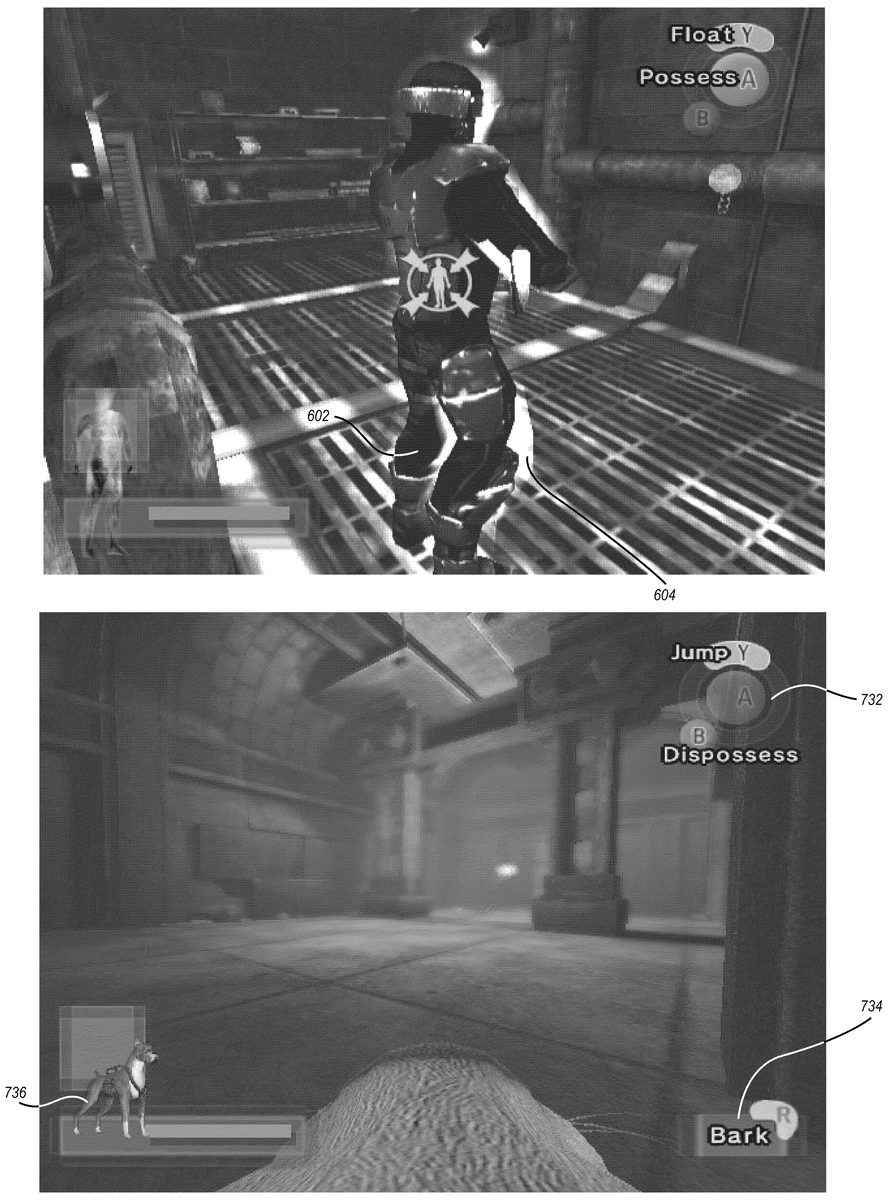
Generally speaking, the ghost may possess a host when the host has a predetermined “aura.” In the case of game characters, these auras indicate the emotional state(s) of the characters. In the example game, when the player is in ghost form, the ghost can see the emotional states of potentially possessible characters by the colors of their auras. Auras visually surround at least part of a possessible host.FIG. 6Ashows a character602having a white aura604;FIG. 6Bshows a character612having a yellow aura614; andFIG. 6Cshows a character622having a red aura624. As noted above, the color of a character's aura indicates the emotional state of that character. For example, the white aura604indicates that character602has a confident emotional state. The yellow aura614indicates that character612has a wary emotional state. The red aura624indicates that character622has a frightened emotional state.
Of course, these colors and emotional states are provided by way of example, not limitation. In addition, although three emotional states are described, different numbers of emotional states may be used. For example, characters may be limited to having either confident or frightened emotional states and auras of two different colors may be used to represent these two different emotional states. Alternatively, in the case of two different emotional states, an aura may be provided only when the character is in one or the other of the emotional states. In a still further example, different characters may have different numbers and/or types of auras.
The ghost can posses a host by frightening the potential character to change its aura from white or yellow to red. By way of example, the potential host may be character612shown inFIG. 6Bwho may initially have a white (confident) aura. The ghost may cause steam to be emitted from a steam pipe as shown inFIG. 6Bby, for example, possessing or inhabiting the steam pipe. This will cause the aura of character612to become yellow, indicating that the character is now in a wary emotional state. The inability of the character to stop the steam emission or escape from the chamber in which the steam is being emitted may subsequently cause the aura to become red, at which point the ghost may possess the character. By way of further example, a potential host may be a character may be typing at a laptop computer. The unseen ghost may, for example, possess or inhabit the laptop and thereafter close or turn off the laptop while the character is typing, frightening the character and changing the color of the character's aura from white to yellow. The character may then try to escape from the room in which the character was working. If the ghost has locked the door, the character's aura may change from yellow to red. At this point, the ghost may posses the character.
The character preferably maintains a yellow or red aura only for a predetermined period of time. For example, if the steam emission were to be stopped after the aura of character612turned yellow, the aura would preferably revert to white after some predetermined time period (e.g., ten seconds). Similarly, a red aura would revert back to a yellow aura after a predetermined period of time.
As noted above, objects such as weapons, computers, steam meters, etc. may also be possessed in order to frighten host characters. In some cases, these objects may always be possessible, in which case they could always have a red aura or could have no aura at all. In other cases, certain objectives and/or goals may need to be achieved in order to make an object possessible. In this case, the aura of the object may be changed from one color (e.g., white) to another color (e.g., red) to indicate that the object is possessible after the objectives or goals are attained. Thus, in the case of objects, auras would not typically be indicative of an “emotional state”, but rather whether the object was possessible or not.
Possession may be accomplished in one example implementation by selecting the character to be possessed using the positioning controls of the controller52to position a cursor or other indicator on the character and then pressing a “possess” key of the controller. As shown inFIG. 6C, for example, the upper right-hand portion of the game display may provide guidance information which indicates that pressing the “A” key on the controller52will cause the ghost to possess character622. Guidance information may be context sensitive so that it is relevant to actions currently available to the player. Thus, guidance information for possessing a host may be displayed when there is a host capable of being possessed. Guidance information for “dispossessing” a host may be displayed when a host is possessed.
When the ghost possesses a host, the game view is shifted to that of the possessed host. That is, the player sees the game world through the eyes or viewpoint of the possessed host. In order to allow the player to feel more like the host that has been possessed, the example video game enables the player to see the world based on the vision characteristics of the possessed host. For example, dogs have more rods than cones in the retina. Thus, dogs generally have good night vision and motion detection. The smaller number of cones limits color vision to two areas of the visible spectrum, red-yellow-green and blue-violet. Thus red, orange and yellow-green all look much the same to a dog but can be distinguished from blue or violet. The colors between green and blue are likely seen as gray. The field of vision of dogs is much greater than that of humans, 250 to 270 degrees as compared to 170 to 180 degrees. Thus, if the ghost possesses a dog, a visual effect is used so that the player sees the world as someone, for example, that has red-green color blindness and a wide field of vision would see it. By way of further example, the vision of a mouse is, among other things, blurry. Thus, if the ghost possesses a mouse, a visual effect is used so that the player sees the world as someone with blurry vision would see it. In the case of possessing the dog, graphics system50may be controlled by the program for the video game to combine the red and green channels to simulate the red-green color blindness. In the case of a mouse, graphics system50may be controlled by the program for the video game use a blur to blur the world to simulate near-sightedness. The game program for the video game may control graphics system50to use additional effects such as enhancing or reducing contrast, performing image warping, texturing, lighting, fog and the like.
FIGS. 7A-7Dshow the same scene in the game world as it is viewed by different possessed hosts.FIG. 7Ashows the scene as viewed by the ghost. The vision of the ghost is characterized in the example implementation by high contrast, some blurriness, a lack of color and overbrightness. Guidance information702is provided in the upper right-hand portion of the screen and indicates that the ghost can be made to float by pressing a “Y” key on controller52. The lower left-hand portion of the screen includes a three-dimensional ghost character704which helps the player feel more like the character and see what the character is doing. Character704is fully animated and its movements and position permit the player “view” himself/herself during game play.
InFIG. 7B, the ghost has possessed a guard character andFIG. 7Bshows the scene ofFIG. 7Aas viewed by the guard. The guard's view is a normal human view and thus this view may be considered to be without any visual effects. Of course, it is possible to provide the guard with certain vision characteristics such as color blindness, near-sightedness, far-sightedness and the like if desired. In this case, a visual effect may be applied to implement these characteristics. Guidance information722is provided in the upper right-hand portion of the screen. Guidance information722indicates that the guard character may be made to sprint by depressing the “Y” key on controller52and that the ghost may be made to dispossess the guard character (returning to the ghost character) by depressing the “B” key on controller52. The screen ofFIG. 7Bincludes additional guidance information724at the lower right-hand portion thereof. The lower left-hand portion of the screen includes a fully animated, three-dimensional image726of the guard character. The movements and position of image726let the player view the actions of the guard character during game play.
InFIG. 7C, the ghost has possessed a dog character andFIG. 7Cshows the scene ofFIG. 7Aas viewed by the dog.FIG. 7Cshows the dog's nose as it would be seen by the dog. The vision of the dog in the example implementation is characterized by a wider field of view than, for example, the guard view) and red-green color blindness. Guidance information732is provided in the upper right-hand portion of the screen. This guidance information indicates that the dog may be made to jump by pressing the “Y” key on controller52and that the ghost may be made to dispossess the dog by pressing the “B” key on the controller. Guidance information734at the lower right-hand portion of the screen indicates that the dog may be made to bark by pressing an “R” key on controller52. The lower left-hand portion of the screen includes a fully animated, three-dimensional image736of the dog character. The movements and position of image736let the player view the actions of the dog character during game play.
InFIG. 7D, the ghost has possessed a mouse andFIG. 7Dshows the scene ofFIG. 7Aas viewed by the mouse character. The vision effect for the mouse is characterized in this example implementation by a very monochromatic greenish view, a wide field of view and blurriness. Guidance information742is provided at the upper right-hand portion of the screen. This guidance information indicates that the mouse may be made to jump by pressing the “Y” button on controller52and that the ghost may dispossess the mouse by pressing the “B” key on controller52. The lower left-hand portion of the screen includes a fully animated, three-dimensional image744of the mouse character. The movements and position of image744let the player view the actions of the mouse character during game play.
InFIG. 7E, the ghost has possessed a gun turret andFIG. 7Eshows a scene in the game world as viewed from the turret. This view is provided with an overlay showing various turret controls (locked, enable, fire, etc.). The scene may be otherwise viewed with human vision characteristics. Guidance information752is provided at the upper right-hand portion of the screen showing that the ghost may dispossess the turret by pressing the “B” key on controller52. Guidance information754is provided at the lower right-hand portion of the screen and indicates that the player may zoom the turret view by pressing the “L” key on controller52. The lower left-hand portion of the screen includes a fully animated, three-dimensional image756of the turret object. The movements and positioning of image756let the player “view” the actions of the turret during game play.
FIGS. 7F and 7Gshow the effect of using the zoom implemented by pressing the “L” key on the controller from the view ofFIG. 7E. As shown in these Figures, the zoomed-in view becomes pixelated and visual effects are provided for implementing this pixelated view.
In an example implementation, the software program for the example video game is stored on storage medium62. The program includes data and/or instructions for each host that determines the visual effects to be implemented when the ghost possesses that host. Thus, in the case of the dog, the program contains data and/or instructions, for example, for combining the red and green color channels and for specifying the size of the field of view to be used. In the case of the mouse, the program contain data and/or instructions that specify, among other things, blur the scene to simulate the mouse's blurry vision.
In the example ghost video game running on graphics system50, certain of the visual effects are “post effects” applied after three-dimensional rendering is complete. More specifically, the frame buffer and/or the z-buffer (depth buffer) are captured to a texture. Generally speaking, if z-buffering is enabled, a depth value as well as a color value is stored for each pixel. Depth can be thought of as the distance from the viewer's eye to the pixel. Whenever a drawing routine tries to update a pixel, it first checks the current pixel's “depth” or “z-value” and will only update that pixel with new values if the new pixel is closer than the current pixel. The region of memory that stores the z-values is referred to as the z-buffer. The captured texture is sent to the game system's graphics processor where it is affected by the Texture Environment (TEV) stages. The TEV stage parameters determine how the texture, depth buffer and other textures are blended to produce various visual effects. Blending of textures in the context of graphic system50is described in U.S. Pat. No. 6,664,958, the contents of which are incorporated herein by reference.
The graphics pipeline180of the example graphics system50supports combining a color texture and a depth (“z”) texture to facilitate image-based rendering in which the frame buffer702is a composite of smaller color and depth images, like sprites with depth.FIG. 8shows an example z texturing operation using a color texture tcand a z texture tz, to form a sprite with depth. In this context, a sprite may be regarded as a texture map or image with or without alpha (transparency) rendered onto a planar surface. The corresponding z texture tzprovides a z displacement or an absolute depth for each image element (texel) in the texture map or image—which z displacements can be different for each different image element. In theFIG. 8simplified diagram, texture coordinate generation500(1) performed by transform unit300generates texture coordinates used to look up and map color texture tc. The resulting color texels (which may be filtered using standard texture filtering techniques) are blended or otherwise applied to a primitive surface by texture environment unit600. The resulting pixels are stored in an embedded color frame buffer702cfor imaging and/or further processing.
Texture coordinate generation500(1) also generates texture coordinates for use in z texture mapping/resampling. Texture memory502can store z texture tzin a variety of different formats, and texture unit500can look up and map z texture tzusing the same or different texture coordinates used for color texture mapping (e.g., using a non-linear or non-uniform mapping). The resulting z texels output by texture unit500are applied to a z blender600z. Z blender600zblends the z texel depth values with the depth of the surface the z texture is being mapped onto or replaces the surface depth with the z texel depth values. The pixel depth values resulting from the z blending operation are applied to a hidden surface removal operation using z compare700a(seeFIG. 5) operating in conjunction with an embedded z buffer702z. The hidden surface removal operation in conjunction with the z buffer allows the z texture tzto control whether parts of the texture mapped image are occluded by other objects in the scene.
FIG. 9Ashows an example color texture tc, for a sprite with depth andFIG. 9Bshows an example corresponding z texture tzfor the sprite with depth. The color texture tcinFIG. 9Aprovides a two-dimensional image of a bush. Example z texture tzofFIG. 9Bprovides a two-dimensional absolute or displacement map of this same bush. InFIG. 9B, for example, z1, corresponding to the depth (displacement) z1of a front part of the bush can be defined having a z value that is closer to the selected viewpoint than depth (displacement) values z2, z3, z4, z5and z6corresponding to rearward portions of the bush. Using this auxiliary z texture depth information, it becomes possible for other objects in the scene to occlude parts of theFIG. 9Acolor image of the bush while being occluded by other parts of this color texture image. For example, a bird defined at a depth position between z2and z3could appear to “fly through” the bush. The front portions of the bush z1, z2could occlude the bird as it passes “behind” those portions of the bush. In contrast, the bird could occlude portions z3, z4, z5and z6of the bush as it flies “in front of” those portions of the bush. Hence, a substantial degree of occlusion complexity can be realized at low cost using mechanisms in system50shared with color texturing operations. While theFIG. 9Bexample z texture shows depth encoding by region, this is accomplished in the example embodiment by storing a different depth (displacement) value in each of the various z texel locations of the z texture to provide arbitrarily complex occlusion visualization.
The above-described concepts for texturing can be used to implement certain of the visual effects for the possessed hosts described above. For example, the concepts can be used to implement the visual effects for the ghost, the dog and the mouse. Thus, for example, near-sightedness and far-sightedness can be realized by using textures that blur objects in accordance with distance from the viewer.
The methodology for generating the vision effects described above is described below with reference toFIG. 10. At ST1000, the frame is rendered as a normal scene in the frame buffer and/or z-buffer. The scene may have character-specific view parameters such as field of view and possibly depth, fog and color. At ST1002, the scene is made into a texture using the frame buffer and/or z-buffer. At ST1004, this texture is optionally combined with other textures and at ST1006certain other visual effects (e.g., combining color channels) may be implemented. For example, in the case of a vision effect for dog character, the red and green color channels may be combined to simulate a dog's red-green color blindness. The result of ST1006is then blended with the original frame buffer at ST1008. As indicated inFIG. 10, this process is optionally repeated one or more times. Any display objects without vision effects are then rendered at ST1010and the result is displayed at ST1012.
As mentioned with reference to ST1010, certain display objects may be rendered without visual effects, for example, to facilitate game play. Suppose a game included a stop light. In the visual effects for a dog character, the stop light would appear as gray rather than red, perhaps confusing the player. Accordingly, this stop light may be rendered without visual effects so that it appears as red even though the rest of scene is viewed with the red-green color blindness. The auras of hosts may also be rendered without the visual effects applied thereto. Of course, the game developer may nonetheless wish to apply effects to such objects in order to complicate game play for a player.
The video game may be designed to permit the user to change certain effects prior to or during game play. For example, in the case of the telescope object, the player may be provided with various filter options (e.g., infrared, heat mapping, X-ray, nightvision, etc.) for filtering what is being viewed. When the user, chooses one of these filters, the game program causes the scene to be viewed taking into account the use of the filter. Also the video game may permit the user to specify certain aspects of the vision of one or more characters or objects prior to or during game play. For example, the player may be able to set the size of the field of view, the degree of near-sightedness, far-sightedness, etc. of one or more characters.
The visual effects may be time dependent. Thus, the visual effects may change over time while the user possesses a host. For example, a character that is waking up may have vision that is initially blurry and then clears up as the character becomes more awake. Similarly, as a game character tires, his/her vision may become more blurry.
The visual effects may also be used in a multi-player split screen mode as shown inFIG. 11. In thisFIG. 11, the upper portion1102of the screen1100is the player1view and the lower portion1104of the screen1100is the player2view. Each of these portions1102and1104may simultaneously utilize different visual effects depending on the respective characters possessed by the different players.
The concepts described above are not limited to visual effects. That is, other effects may be used so that the player can experience the game world as the possessed host. For example, when a ghost possesses a host, audio effects (e.g., pitch, volume, stereo, frequency range of sounds that can be heard, etc.) may be used so that the player can experience sounds like the possessed host would experience those sounds. Thus, if the host is a dog, audio effects may be used to convey a sense of how a dog hears. For example, for low frequency sounds, humans hear as well or better than dogs. Dogs, however, hear higher frequencies much better than humans. This enables them to hear the ultrasonic sounds of birds, mice, and bats. Similarly, if the host is a mouse, other audio effects may be used to convey a sense of how a mouse hears. These audio effects may be provided in combination with or separately from the above-described vision effects. As with the visual effects, the audio effects may be time-dependent and/or may be at least partly user configurable. In addition, certain sounds may be unaffected by the audio effects.
By way of further example, the vibration devices in the controllers may be used to convey to a player how a particular host might experience certain forces applied thereto. For example, a mouse and a human would sense the same force differently and the game system can take these differences into account when generating tactile sensations. As with the visual and audio effects, the tactile effects may be time-dependent and/or may be at least partly user configurable. In addition, certain forces may be unaffected by the tactile effects.
While the invention has been described in connection with what is presently considered to be the most practical and preferred embodiment, it is to be understood that the invention is not to be limited to the disclosed embodiment, but on the contrary, is intended to cover various modifications and equivalent arrangements included within the spirit and scope of the appended claims.
Claims
- A video game system comprising: an input device;and an image processing system receiving input signals based on inputs supplied to the input device and, based at least in part on the input signals, producing displays for a video game for display on a display device, the video game comprising: a possessing game character capable of possessing a plurality of different host game characters during game play;and visual effects provided so that different first person displays of a same game world scene are produced for display on the display device depending on an intrinsic characteristic of the eyes of the host game character possessed by the possessing game character.
- The video game system according to claim 1 , wherein the video game further comprises audio effects provided so that different sounds for a same sound-generating event are produced depending on hearing characteristics of the host game character possessed by the possessing game character.
- The video game system according to claim 1 , wherein the possessed host game character comprises an animal character.
- The video game system according to claim 1 , wherein the possessed host game character comprises a human character.
- The video game system according to claim 1 , wherein the visual effects are time dependent during the time that the possessing game character possesses a particular one of the plurality of different host game characters.
- The video game system according to claim 1 , wherein the visual effects are at least partly user-configurable.
- The video game system according to claim 1 , wherein one or more game world objects are not changed by the visual effects.
- The video game system according to claim 1 , wherein the possessing game character is a ghost.
- The video game system according to claim 1 , wherein the visual effects convey color blindness of the possessed host game character.
- The video game system according to claim 1 , wherein the visual effects convey near-sightedness of the possessed host game character.
- The video game system according to claim 1 , wherein the visual effects convey far-sightedness of the possessed host game character.
- The video game system according to claim 1 , wherein the visual effects convey a wide field of view of the possessed host game character.
- The video game system according to claim 1 , wherein the visual effects convey a narrow field of view of the possessed host game character.
- The video game system according to claim 1 , wherein the visual effects convey a monochrome vision of the possessed host game character.
- The video game system according to claim 1 , wherein the visual effects are obtained using textures.
- A non-transitory storage medium storing video game instructions executable by a graphics system to play a video game, the video game comprising: a possessing game character capable of possessing different host game characters during game play;and visual effects provided so that different first person displays of a same game world scene are produced depending on an intrinsic characteristic of the eyes of the host game character possessed by the possessing game character.
- The storage medium according to claim 16 , wherein the video game instructions are executable by a hand-held graphics system.
- The storage medium according to claim 16 , wherein the video game instructions are executable by a game console.
- The storage medium according to claim 16 , wherein the video game instructions are executable by a personal computer.
- The storage medium according to claim 16 , wherein the video game instructions are executable by a personal computer running an emulator program.
- A video game method performed using an image processing system, the video game method comprising: controlling, based at least in part on inputs to an input device, a possessing game character to possess a plurality of different host game characters during game play;and producing, by the image processing system for display on a display device, different first person displays of a same game world scene depending on an intrinsic characteristic of the eyes of the host game character possessed by the possessing game character.
- The video game method according to claim 21 , further comprising producing different sounds for a same sound-producing event in the game world depending on the hearing characteristics of the host game character possessed by the possessing game character.
- The video game method according to claim 21 , further comprising producing different tactile sensations for a same tactile-sensation-producing event in the game world depending on tactile-response characteristics of the host game character possessed by the possessing game character.
- The video game method according to claim 21 , wherein the possessed host game character comprises an animal character.
- The video game method according to claim 22 , wherein the possessed host game character comprises a human character.
- The video game method according to claim 21 , wherein the possessing game character is a ghost.
- The storage medium according to claim 16 , wherein the visual effects are time dependent during the time that the possessing game character possesses a particular one of the plurality of different host game characters.
- The storage medium according to claim 16 , wherein the visual effects are at least partly user-configurable.
- The storage medium according to claim 16 , wherein one or more game world objects are not changed by the visual effects.
- The storage medium according to claim 16 , wherein the possessing game character is a ghost.
- The storage medium according to claim 16 , wherein the visual effects convey color blindness of the possessed host game character.
- The storage medium according to claim 16 , wherein the visual effects convey near-sightedness of the possessed host game character.
- The storage medium according to claim 16 , wherein the visual effects convey far-sightedness of the possessed host game character.
- The storage medium according to claim 16 , wherein the visual effects convey a wide field of view of the possessed host game character.
- The storage medium according to claim 16 , wherein the visual effects convey a narrow field of view of the possessed host game character.
- The storage medium according to claim 16 , wherein the visual effects convey a monochrome vision of the possessed host game character.
- The storage medium according to claim 16 , wherein the visual effects are obtained using textures.
- A non-transitory storage medium storing video game instructions executable by a graphics system to play a video game, the video game comprising: a possessing game character capable of possessing different host game characters during game play;and visual effects provided to produce a display of a game world scene when the possessing game character does not possess one of the host game characters and to produce a different display of the same game world scene when the possessing game character possesses one of the host game characters, wherein the different display is a first person display based on an intrinsic characteristic of the eyes of the host game character possessed by the possessing game character.
Disclaimer: Data collected from the USPTO and may be malformed, incomplete, and/or otherwise inaccurate.