U.S. Pat. No. 7,901,288
EMBEDDED ADVERTISING ENHANCEMENTS IN INTERACTIVE COMPUTER GAME ENVIRONMENTS
AssigneeInternational Business Machines Corporation
Issue DateApril 20, 2006
Illustrative Figure
Abstract
Advertisements may be selected for display to a user in a computer game environment based at least in part on one or more of a personality trait of the user as determined from monitoring a behavior of the user as the user is participating in the computer game environment, a user affinity for a subject of another advertisement as determined from monitoring activity of the user after the user views the other advertisement while the other advertisement is displayed in the computer game environment, and a characteristic of the user as determined from a username selected by the user.
Description
DETAILED DESCRIPTION The embodiments discussed hereinafter improve the targeting of advertisements in a computer game environment based upon the input of a user of the computer game environment. An advertisement, in this regard, may be considered to be any presentation of content to a user for the purpose of advertising a product or service. An advertisement may include text, graphics, animation, video and/or audio, or practically any other form of electronic content. Furthermore, an advertisement may constitute a product placement where a product to be advertised is displayed in the computer game environment, and optionally additionally capable of being interacted with or otherwise manipulated by a user. An advertisement may also be a virtual representation of a real world advertisement in the computer game environment, e.g., a billboard, store signage, a newspaper advertisement, a television advertisement, a radio advertisement, an advertisement on a computer screen displayed in a computer game environment, etc. An advertisement may be associated with a subject, which is typically a product or service, or relatedly, a particular brand or provider of a product or service. The implementations discussed below generally focus on advertisements that are specifically associated with products; however, it will be appreciated that any reference to a product herein may also be considered to apply to a service or other suitable subject for an advertisement. The selection of advertisements as described herein may utilize a number of techniques. For example, in some embodiments of the invention, an advertisement to be displayed to a user in a computer game environment may be selected based upon a personality trait of the user as determined from monitoring a behavior of the user as the user is participating in the computer game environment. As an example, consider two users playing the same computer game, e.g., a strategic life ...
DETAILED DESCRIPTION
The embodiments discussed hereinafter improve the targeting of advertisements in a computer game environment based upon the input of a user of the computer game environment. An advertisement, in this regard, may be considered to be any presentation of content to a user for the purpose of advertising a product or service. An advertisement may include text, graphics, animation, video and/or audio, or practically any other form of electronic content. Furthermore, an advertisement may constitute a product placement where a product to be advertised is displayed in the computer game environment, and optionally additionally capable of being interacted with or otherwise manipulated by a user. An advertisement may also be a virtual representation of a real world advertisement in the computer game environment, e.g., a billboard, store signage, a newspaper advertisement, a television advertisement, a radio advertisement, an advertisement on a computer screen displayed in a computer game environment, etc.
An advertisement may be associated with a subject, which is typically a product or service, or relatedly, a particular brand or provider of a product or service. The implementations discussed below generally focus on advertisements that are specifically associated with products; however, it will be appreciated that any reference to a product herein may also be considered to apply to a service or other suitable subject for an advertisement.
The selection of advertisements as described herein may utilize a number of techniques. For example, in some embodiments of the invention, an advertisement to be displayed to a user in a computer game environment may be selected based upon a personality trait of the user as determined from monitoring a behavior of the user as the user is participating in the computer game environment. As an example, consider two users playing the same computer game, e.g., a strategic life simulator. One user plays the game by having his or her character live a “normal” life, obeying laws and generally being good to other characters. The other user's character is a cheat and a thief. Through monitoring the behavior of each user, the former user may be deemed to have a “nice” personality trait, and as a result, may be targeted for advertisements appropriate for such a person. In contrast, the latter user may be deemed to have a “mean” personality trait, and as a result, may be targeted for advertisements appropriate for such a person.
Likewise, in a first person shooter game, behavior monitoring may be used to distinguish, for example, between an individual who judiciously attempts to protect and avoid civilians and bystanders from one who goes around shooting everything in sight.
In other embodiments of the invention, an advertisement to be displayed to a user in a computer game environment may be selected based upon a user affinity for a subject of another advertisement as determined from monitoring activity of the user after the user views the other advertisement while the other advertisement is displayed in the computer game environment. For example, in a first person shooter game, monitoring of a user's interaction with a billboard displaying an advertisement for a certain product may identify a user having a high or low affinity for the product. If the user chooses to shoot or punch the billboard, the monitoring may determine a low affinity. Otherwise, if the user walks closer to the billboard, walks around other objects to get closer or get a clearer view of the billboard, or stops “scanning” the horizon to focus on a billboard, the monitoring may determine a high affinity. Furthermore, interactions with products or objects associated with products may be monitored to determine user affinity, e.g., to detect a user shooting or blowing up a vending machine, or to detect a user walking to get closer to a particular brand of automobile displayed in the environment.
In addition, such monitoring may incorporate monitoring the communications of a user after viewing an advertisement. As an example, many computer game environments permit users to communicate audibly and/or send text messages to each other within the game. By monitoring such communications, high or low user affinity for a particular advertisement or product or product type associated with the advertisement may often be ascertained.
In other embodiments, an advertisement to be displayed to a user when the user is interacting with the computer game environment may be selected based upon a characteristic of the user as determined from a username selected by the user. For example, in some embodiments, the user's gender can be ascertained from the selection of a gender-specific username. In still other embodiments, the user's affinity for a particular artistic work or genre may be ascertained from the selection of a particular username, providing insight into the possible likes or dislikes of that user for the purposes of targeting advertisements to that user. In the latter instance, in many cases users will select usernames from movies or books for which they have an affinity. Thus, for example, if a user selects a username based upon a character from theLord of the Ringsseries, advertisements may be selected on the assumption that the user likes the Tolkien series, as well as the fantasy genre.
It will be appreciated that the advertisement selection services described herein may be utilized in a wide variety of computer game environments. In this regard, a computer game environment may be considered to correspond to any interactive environment created in a computer, a game console, a handheld game, etc., and within which a user plays a game. A computer game environment is typically a virtual environment within which a user interacts, with the user typically taking the role of a character in that environment. The environment may be a single player or stand-alone environment, within which the user participates alone, or may be a multiplayer or online environment within which multiple users participate. Such users may be accessing the same computer, different computers networked via a private network and/or different computers networked via the Internet or another public network. A computer game environment may be disposed solely within a single computer, or may be distributed among multiple computers, and as such, the invention is not limited to any particular implementation of computer game environment.
One exemplary environment within which an advertisement selection service consistent with the invention may be implemented is an online strategic life simulator where users control characters that “live” in a virtual world. In this game players can do just about anything, which could include walking the city streets and seeing virtual billboards, having their character go to a movie or watch TV in which commercials would air, or having them read a virtual newspaper with ads in it. Another exemplary environment is first person shooter game, where a user walks around a virtual world and blows things up. In some of these virtual worlds there are cityscapes complete with billboards where ads are displayed and where objects are disposed throughout the environment, providing the possibility for product placements throughout the environment. Other environments, e.g., gambling games, card games, driving games, arcade games, sports games, role-playing games, war/history simulations, educational games, strategy games, etc. may also utilize the various techniques described herein.
Turning now to the Drawings, wherein like numbers denote like parts throughout the several views,FIG. 1illustrates an apparatus10within which an advertisement selection service consistent with the invention may be implemented. Apparatus10in the illustrated embodiment is implemented as a device such as a single user computer or a game console that is coupled via a network12to one or more servers, e.g, an online game server14and an ad server15. For the purposes of the invention, each device10,14,15may represent practically any type of computer, computer system or other programmable electronic device, e.g., a handheld game, a mobile phone, a PDA, a game console, etc. Moreover, each device10,14,15may be implemented using one or more networked computers, e.g., in a cluster or other distributed computing system. In the alternative, device10may be fully implemented within a single computer or other programmable electronic device, and may lack network connectivity.
Apparatus10typically includes a central processing unit16including at least one microprocessor coupled to a memory18, which may represent the random access memory (RAM) devices comprising the main storage of apparatus10, as well as any supplemental levels of memory, e.g., cache memories, non-volatile or backup memories (e.g., programmable or flash memories), read-only memories, etc. In addition, memory18may be considered to include memory storage physically located elsewhere in apparatus10, e.g., any cache memory in a processor in CPU16, as well as any storage capacity used as a virtual memory, e.g., as stored on a mass storage device20or on another device coupled to apparatus10. Apparatus10also typically receives a number of inputs and outputs for communicating information externally. For interface with a user or operator, apparatus10typically includes a user interface22incorporating one or more user input devices (e.g., a keyboard, a mouse, a game controller, a trackball, a joystick, a touchpad, and/or a microphone, among others) and a display (e.g., a CRT monitor, an LCD display panel, and/or a speaker, among others). Otherwise, user input may be received via another computer or terminal. In the case of a game console implementation of apparatus10, the display of information to a user may be performed by an external television or similar display.
For additional storage, apparatus10may also include one or more mass storage devices20, e.g., a floppy or other removable disk drive, a hard disk drive, a direct access storage device (DASD), an optical drive (e.g., a CD drive, a DVD drive, etc.), and/or a tape drive, among others. Furthermore, apparatus10may include an interface24with one or more networks12(e.g., a LAN, a WAN, a wireless network, and/or the Internet, among others) to permit the communication of information with other computers and electronic devices. It should be appreciated that apparatus10typically includes suitable analog and/or digital interfaces between CPU16and each of components18,20,22and24as is well known in the art. Other hardware environments are contemplated within the context of the invention.
Apparatus10operates under the control of an operating system26and executes or otherwise relies upon various computer software applications, components, programs, objects, modules, data structures, etc., e.g., one or more computer game environments30. Moreover, various applications, components, programs, objects, modules, etc. may also execute on one or more processors in another device coupled to apparatus10via network12, e.g., in a distributed or client-server computing environment, whereby the processing required to implement the functions of a computer program may be allocated to multiple computers over a network.
In general, the routines executed to implement the embodiments of the invention, whether implemented as part of an operating system or a specific application, component, program, object, module or sequence of instructions, or even a subset thereof, will be referred to herein as “computer program code”, or simply “program code”. Program code typically comprises one or more instructions that are resident at various times in various memory and storage devices in a computer, and that, when read and executed by one or more processors in a computer, cause that computer to perform the steps necessary to execute steps or elements embodying the various aspects of the invention. Moreover, while the invention has and hereinafter will be described in the context of fully functioning computers and computer systems, those skilled in the art will appreciate that the various embodiments of the invention are capable of being distributed as a program product in a variety of forms, and that the invention applies equally regardless of the particular type of computer readable media used to actually carry out the distribution. Examples of computer readable media include but are not limited to tangible, recordable type media such as volatile and non-volatile memory devices, floppy and other removable disks, hard disk drives, magnetic tape, optical disks (e.g., CD-ROMs, DVDs, etc.), among others, and transmission type media such as digital and analog communication links.
In addition, various program code described hereinafter may be identified based upon the application within which it is implemented in a specific embodiment of the invention. However, it should be appreciated that any particular program nomenclature that follows is used merely for convenience, and thus the invention should not be limited to use solely in any specific application identified and/or implied by such nomenclature. Furthermore, given the typically endless number of manners in which computer programs may be organized into routines, procedures, methods, modules, objects, and the like, as well as the various manners in which program functionality may be allocated among various software layers that are resident within a typical computer (e.g., operating systems, libraries, API's, applications, applets, etc.), it should be appreciated that the invention is not limited to the specific organization and allocation of program functionality described herein.
To implement advertisement selection consistent with the invention, apparatus10includes an advertisement selection service32that is utilized in connection with computer game environment30to both monitor user activity in environment30and to select advertisements to be displayed in environment30. Service32may be implemented, for example, as a library or framework, or alternatively as a middleware-type service, which can interact with environment30. In other embodiments, service32may be implemented directly within environment30.
In the implementation illustrated inFIG. 1, computer game environment30may be implemented as a client for an online game, e.g., as supported by an online game server14. Furthermore, advertisement selection service32may be configured to access an ad server15to retrieve ads based upon a particular profile developed for a user of the computer game environment. In other implementations, however, environment30may be a stand-alone game, and may not access an online server. Similarly, in some implementations, available advertisements may be resident in service32, whereby no separate access to an ad server15may be required. In still other implementations, servers14and15may be combined.
As will become more apparent below, the principal functions of advertisement selection service32may be partitioned into three principle components. A user monitor component may be used to monitor user activity in the computer game environment, while an analysis engine component may be used to analyze the monitored activity of a user to identify characteristics, traits and/or affinities for a user with respect to particular products, product types, etc. An advertisement selection engine component may be used to select advertisements based at least in part upon the analysis provided by the analysis engine component. It will be appreciated that different numbers of components may be used to implement an advertisement selection service consistent with the invention, and that the monitoring, analysis and/or selection functions may be combined or partitioned in other manners.
In the illustrated implementation ofFIG. 1, all three components of service32are implemented locally in apparatus10. In other embodiments, however, the components of service32may be implemented in one or more central servers. In addition, as illustrated inFIGS. 2 and 3, in some implementations the different components of an advertisement selection service may be distributed among multiple entities.FIG. 2, for example, illustrates a service32′ where a personal computer or game console40is interfaced with one or more central servers42, with a user monitor component44and an analysis engine component46resident in the personal computer or game console40, and an advertisement selection engine48resident in central server(s)42. On the other hand,FIG. 3illustrates a service32″ where a personal computer or game console40′ is interfaced with one or more central servers42′, with user monitor component44resident in the personal computer or game console40′, and the analysis and advertisement selection engines46,48resident in central server(s)42′. Practically any other partitioning of functionality between various devices in a computer system may be used consistent with the invention.
Those skilled in the art will recognize that the exemplary environments illustrated inFIGS. 1-3are not intended to limit the present invention. Indeed, those skilled in the art will recognize that other alternative hardware and/or software environments may be used without departing from the scope of the invention.
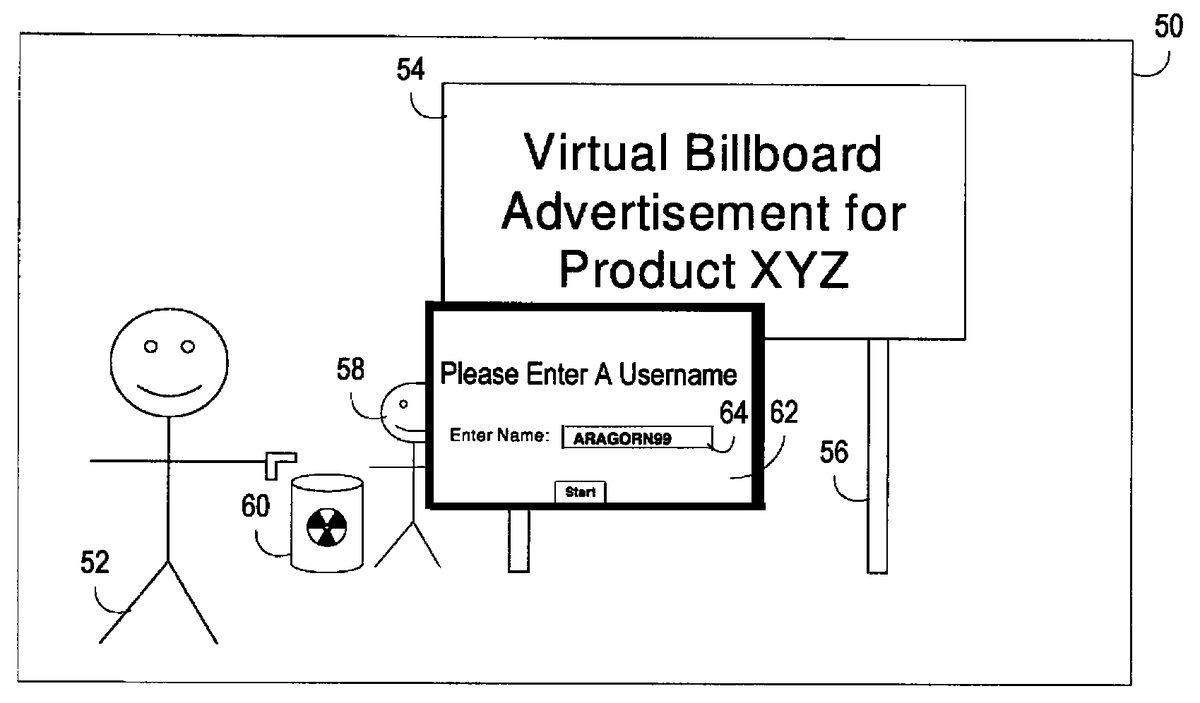
FIG. 4illustrates an exemplary display50for a computer game environment incorporating an advertisement selection service consistent with the invention, and used to facilitate an understanding of the various functions of the advertisement selection service described below. Display50illustrates a user-controlled character52, as well as an advertisement54displayed at a location56(or ad placement opportunity) in the computer game environment. As is also illustrated inFIG. 4, the computer game environment may also include one or more other characters58, which may be computer-controlled and/or controlled by other users, as well as one or more objects60.FIG. 4also illustrates a dialog box62that may be displayed prior to initiation of game play by a user to enable a user to input a username, e.g., as illustrated at64. It will be appreciated that the display illustrated inFIG. 4is merely exemplary in nature, and that the invention is not limited to any of the particular display configurations illustrated therein.
As noted above, one function supported by an advertisement selection service consistent with the invention is that of monitoring the behavior of a user and determining therefrom a personality trait for the user that is used at least in part in the selection of advertisements to display to that user.FIG. 5, for example, illustrates a flowchart of a user personality trait analysis routine70capable of being executed by advertisement selection service32ofFIG. 1.
In routine70, as well as the other routines discussed hereinafter, it is assumed that, for each user for which advertisements are selected, an ad profile is created for that user and is used in the selection of advertisements to be presented to that user. In this regard, an ad profile for the user may be implemented using any suitable data structure. Moreover, the ad profile for a user may be stored locally in the personal computer or game console used by that user, or alternatively, may be stored at a central location. Moreover, it will be appreciated that the user's ad profile may be based upon a single game, or alternatively, may be compiled based upon the monitoring of user activity in association with multiple games. It will also be appreciated that the use and access to a user's ad profile may be restricted as desired to address user privacy concerns.
Routine70begins in block72by monitoring user actions in connection with the playing of a game in the computer game environment. For each such action, routine70determines whether the action is “positive” in nature (block74) and/or “negative” in nature (block76). If an action is determined to be “positive”, block74passes control to block78to increase a user's “karma” in an ad profile established for the user. Likewise, if the user's action is determined to be “negative” in nature, block76passes control to block80to decrease that user's “karma” in the ad profile for that user. If an action is determined to neither be “positive” nor “negative”, no update is required for the user's ad profile.
As noted above, routine70is based upon the concept of an ad profile established for each user. The profile may be implemented using any suitable data structure, and in this implementation, tracks a personality trait of the user related to how “good” or “bad” (or alternatively, how “nice” or “mean”) the user is in connection with interacting in the computer game environment. The user's personality trait is thus encoded in a “karma” variable representing how “good”/“nice” the user is when interacting in the computer game environment. In this regard, the “karma” variable functions as a personality score for the user. As such, when advertisements are selected for this user, advertisements that match the profile of a “good” or a “bad” user may be appropriately selected for the given user (e.g., to distinguish nice, introverted individuals from nice, outgoing individuals).
The types of actions that may be monitored in routine70may vary in different embodiments. For example, the behavior of a user may be monitored to detect, among other actions, actions indicative of ethical conduct, unethical conduct, passive conduct, aggressive conduct, friendly conduct, unfriendly conduct, serious conduct, unserious conduct, generous conduct, selfish conduct, respectful conduct, rude conduct, deceitful conduct, honest conduct, creative conduct, shy conduct, bold conduct, helpful conduct, curious conduct, cooperative conduct, etc. In addition, rather than computing a personality score for a user that grades the user along a scale between “good” and “bad”, it will be appreciated that different personality traits may be collected for a given user to further quantify the behavior of that user, and facilitate the selection of more targeted advertisements for that user (e.g., to distinguish nice, introverted individuals from nice, outgoing individuals). Any number of character or personality traits may be collected for a user, e.g., various traits such as absent-minded, ambitious, awkward, boastful, bossy, brave, calm, careless, care-free, cautious, changeable, charming, clever, confused, contented, cooperative, courageous, cowardly, cruel, hard-working, curious, daring, demanding, dependable, determined, dreamy, dull, fearful, fierce, forgetful, forgiving, friendly, fussy, generous, gentle, gloomy, greedy, helpful, honest, intelligent, jolly, kind, lazy, loud, loyal, mischievous, nagging, neat, obedient, organized, outspoken, patient, playful, pleasant, polite, quarrelsome, quick-tempered, quiet, reasonable, reckless, relaxed, restless, rude, self-centered, selfish, sensitive, sentimental, serious, sharp-witted, shiftless, shrewd, shy, sneaky, soft-hearted, spunky, stern, stingy, stubborn, superstitious, suspicious, talkative, timid, tough, trusting, understanding, unfriendly, unkind, wise, withdrawn, witty, zany, etc.
In addition, the actions monitored for a user may be based upon interaction of the user with other characters, including characters controlled by other users, and/or the user's interaction with objects within the computer game environment. For example, as shown inFIG. 4, a “negative” action might be detected when monitoring the behavior of the user controlling character52if the user chooses to shoot an innocent bystander such as character58, or to blow up character58by shooting an object such as barrel60.
Furthermore, while the analysis of the behavior of the user in routine70predominantly consists of increasing or decreasing a personality score for the user based upon the detection of “positive” or “negative” actions, it will be appreciated that in other embodiments, the analysis can incorporate more sophisticated determination of personality traits based upon a data set of user behavior in connection with a user's interaction with various types of objects and/or characters. Other variations will be apparent to one of ordinary skill in the art having the benefit of the instant disclosure.
As noted above, an advertisement selection service consistent with the invention may also determine a user affinity between a user and a particular advertisement and/or product/service or product/service type associated with an advertisement, based upon the activity of a user after viewing a particular advertisement. In some implementations, the activity of the user that is monitored may be the interaction of the user with the advertisement itself.FIG. 6, for example, illustrates a user affinity analysis routine85capable of being executed by the advertisement selection service32ofFIG. 1.
Routine85begins in block86by processing each user interaction with a particular advertisement displayed to the user in a computer game environment. Blocks88and90respectively detect whether a given interaction is “positive” or “negative”. If an interaction is “positive”, block88passes control to block92to increase the user affinity for the product associated with the advertisement in the user's ad profile. Likewise, if the interaction is “negative”, block90passes control to block94to decrease the user's affinity to the product in the user's ad profile. If the interaction is neither “positive” nor “negative”, the affinity is not altered.
Of note, the user interaction with an advertisement, and its resulting effect on the user's affinity to the product associated with that advertisement, does not generally affect selection of the advertisement being interacted with. Instead, the determined user affinity for a particular advertisement or product will typically affect the selection of future advertisements, e.g., future advertisement displayed at the same location, or alternatively, future advertisements displayed in other locations. As a result, for example, if a user is determined to have interacted with the advertisement in a “negative” fashion, a low user affinity will be determined for the subject of that advertisement, such that selection of another advertisement will typically result in the selection of an advertisement that is dissimilar in nature to the subject of the advertisement with which the user has interacted. The dissimilar subject may be, for example, a different brand of the same product or service as that for the advertisement with which the user has interacted, or alternatively, a subject may be dissimilar in that an advertisement may be selected for a completely different product type or category. Likewise, in response to the detection of “positive” actions directed to an advertisement by a user, typically a high user affinity will be determined, resulting in future advertisements being selected for subjects that are similar to that of the advertisement with which the user has interacted. Such similarity may include the display of different advertisements for the same product, as well as repeating the same advertisement at a later time and/or in a different location.
The types of interactions that may be detected may vary in different embodiments. For example, as illustrated inFIG. 4, a “negative” interaction may be detected in response to the user controlling character52shooting advertisement54, and as a result, may indicate a low user affinity for that user with the advertisement, for a product XYZ that is the subject of the advertisement, or even for the product type or category for product XYZ. In contrast, a “positive” interaction may be detected, for example, if the user controlling character52pauses to look at advertisement54for an extended period of time. It will be appreciated that a wide variety of interactions, both “positive” and negative in nature, may be envisioned depending upon the type of computer game environment, advertisement, product, etc. Moreover, it will be appreciated that a user affinity may be represented in a number of manners in an ad profile, e.g., via scores associated with specific products, brands, product categories, etc. Other variations will be apparent to one of ordinary skill in the art.
Another type of user activity that may be used to determined a particular user affinity between a user and the subject of an advertisement may be based upon communications between a user and another user of a computer game environment after the user is presented with a particular advertisement.FIG. 7, for example, illustrates a text message affinity analysis routine100capable of being executed by advertisement selection service32ofFIG. 1, which searches text messages communicated between users in a computer game environment to identify “positive” or “negative” references to the subjects of advertisements being presented to a user.
Routine100begins in block102by processing each user text message. For each such message, block104determines whether a reference is present in the text message to an advertised product or other subject. If not, no further activity is performed with respect to the text message. Otherwise, control passes to blocks106and108to respectively determine whether a reference to an advertised product is “positive” or “negative”. If a “positive” product reference is detected, block106passes control to block110to increase the user's affinity to the product in the user's ad profile. Similarly, in response to the detection of a “negative” interaction, block108passes control to block112to decrease the user's affinity to the product in the user's ad profile.
Detection of a product reference may vary in different embodiments. For example, a product reference may require identification of a reference to the name of the product in a text message, or may additional look for references to the advertisement itself, or pronouns that can be attributed back to the product or the advertisement. Furthermore, the identification of “positive” or “negative” references may be based upon detecting any number of keywords associated with “positive” or “negative” impressions of a subject. For example, a text message that is sent after a user views a video clip advertisement might be detected as a “positive” reference if the text message stated “that was really cool”, while a text message might be determined to be a “negative” reference if the message included keywords such as “boring”, “stupid”, “lame”. It will be appreciated that any number of suitable text analysis technologies may be utilized to determine “positive” and “negative” references to an advertised product consistent with the invention. It will also be appreciated that an advertisement selection service consistent with the invention may monitor other types of messages, e.g., voice messages, or conversations between users interacting in a computer game environment. Other modifications will be apparent to one of ordinary skill in the art.
Yet another type of user input that may be monitored and utilized in connection with the selection of advertisements is based upon a username selected by a user of a computer game environment. As shown inFIG. 4, for example, a user may be presented with a dialog box62that permits the user to enter a username as shown at64. The user may be prompted to enter the username upon the initial setup of the computer game environment, or alternatively, during the creation of a new game instance or upon the creation of a new profile for a user of the computer game environment. A user may also be permitted to change a username during an existing game. Furthermore, it will be appreciated that other manners of receiving a username for a user may be used in other embodiments. For example, a user may be permitted to create a user profile on a game console that is shared by multiple computer game environments.
Since the username is typically selected by a user with few restrictions placed upon what the user can enter (e.g., to prohibit duplicate usernames), this username may be suitable for use in determining a characteristic of a user that is helpful in advertisement selection. For example, some names are gender-specific, and indicate with a relative degree of probability the gender of the user that has selected the username. In addition, usernames are often chosen by users in honor of certain artistic works (e.g., movies, books, television programs, web sites, etc.) with which those users have an affinity. As such, the identification of characters or other references to a particular artistic work may be suitable for identifying an affinity between a user and a particular artistic work or even the genre with which the artistic work is associated. It will be appreciated that other types of information may be ascertained from a username, and as such, the username may be utilized to determine other characteristics of a user suitable for a use in selecting advertisements for that user. Of note, analysis of a username often can ascertain information about a user without requiring a direct query to the user (e.g., without requiring a user to specify his or her gender). In some instances, such analysis may render more accurate results, e.g., if a user purposely enters false personal information.
FIG. 8illustrates a username analysis routine120capable of being executed by advertisement selection service32ofFIG. 1. Routine120begins in block122by obtaining the username as input by a user. Block124then determines whether the gender can be estimated from the username. If so, control passes to block126to add the gender of the user to the user's ad profile. Control then passes to block128to determine whether the username is associated with a particular artistic work. Such an association may be based upon a reference to the artistic work, e.g., as to the name of the work, the name of a character or object in the work, the name of a location in the work, the name of an author or creator of a work, the name of a chapter in the work, etc. If the name is not associated with any particular artistic work, routine120is complete. Otherwise, if an association is detected, block128passes control to block130to add an affinity to the specific artistic work to the user's ad profile. In addition, block132may be executed to additionally add an affinity to the genre of the artistic work to the user's ad profile. Upon completion of block132, routine120is complete.
It will be appreciated that routine120may be utilized in connection with a wide variety of artistic works, e.g., movies, books, television programs, web sites, etc. It will also be appreciated that various suitable text analysis techniques may be utilized to detect references to artistic works and/or gender affiliations within a username.
As an example of the operation of routine120,FIG. 4illustrates an entered username “ARAGORN99” at64. From the detection of the term “ARAGORN” within the username, a number of characteristics may be determined. First, “ARAGORN” is commonly recognized as a character in theLord of the Ringsseries by J. R. R. Tolkien. As such, based upon the username, the advertisement selection service may determine an affinity for the user with theLord of the Ringsbooks and movies, as well as the fantasy genre in general. In addition, given that “ARAGORN” is a male character, an estimation may also be made that the user is a male.
The creation of an ad profile for a user, as illustrated generally in connection withFIGS. 4-8, may be used by an advertisement selection service to select advertisements to be placed within a computer game environment.FIG. 9, for example illustrates an advertisement selection routine140capable of being executed by advertisement selection service32. In this implementation, it is assumed that a set of advertisements is made available for a particular ad placement opportunity, or alternatively, for all ad placement opportunities in a computer game environment. For each ad placement opportunity, each advertisement is then scored at least in part upon the information collected in the routines illustrated inFIGS. 4-8. The score for each ad may be computed in a number of manners consistent with the invention, e.g., by scaling each type of information differently and computing a composite score. In addition, certain information in a user's profile may be used to eliminate particular advertisements completely from consideration, e.g., where a user interaction with an advertisement was “negative” in nature, it may be highly unlikely that the user would favorably receive future advertisements associated with the same product.
In addition, each advertisement will typically have its own profile established therefor, e.g, as input by an advertiser or other provider of the advertisements. The type of information stored in a profile for an advertisement will depend upon the types of information being monitored by the advertisement selection service. It is generally through the comparison of the profile of each advertisement and the ad profile of the user that the appropriateness of a particular advertisement for display to a particular user can be ascertained.
Routine140begins in block142by processing each ad placement opportunity. It will be appreciated that routine140may run continuously, e.g., to replace existing advertisements on a periodic basis, or to select new advertisements as a user progresses through a game and encounters new ad placement locations. In the alternative, routine140may be used to select an advertisement for each ad placement opportunity only once and terminate once all advertisements have been selected.
For each ad placement opportunity, block142passes control to block144to determine whether the gender of the user is known to a high probability, typically based upon the username of the user. If so, control passes to block146to increase the score for each advertisement tailored to the user's gender. Upon completion of block146, or if the gender is not known in block144, control passes to block148to determine whether a particular genre has been identified as being associated with the username. If so, control passes to block150to increase the score for any advertisements having affinity to the particular genre associated with the user's name. Upon completion of block150, or if no genre is associated with the user's name, control passes to block152to determine whether a particular artistic work is associated with the username. If so, control passes to block154to increase the score for any advertisements having an affinity to the identified artistic work. Upon completion of block154, or if no artistic work is identified, control passes to block156to adjust the score for each advertisement based upon a particular product or subject affinity. Put another way, the scores for advertisements directed to subjects with which a user has a high affinity will be increased, while the scores for the advertisements associated with subject for which a low user affinity has been established will be decreased.
Next, block158adjusts the advertisement scores based upon the user's “karma” or other personality trait. Put another way, advertisements that are established as being affiliated with users of a particular personality type may be scored higher or lower based upon the particular personality traits of the user at issue.
Upon completion of block158, control then passes to block160to select an advertisement for the current placement opportunity. Selection of an advertisement may vary in different embodiments. For example, in one embodiment, the available advertisements may be sorted based upon their respective scores, with the top scoring advertisement being selected. In the alternative, block160may select the N highest scoring advertisements and then select from among those N advertisements based upon any number of suitable algorithms, e.g., round robin, random, etc. Additional factors may be used to determine what ad is selected, e.g., to ensure that advertisements are not repeated too frequently, to ensure that all advertising quotas are met, etc. Additional factors, e.g., parental controls, user location, user language, etc., may also play a part in selecting advertisements in connection with the information collected using the advertisement selection service described herein.
In addition, it will be appreciated that in other implementations, the scores of advertisements need not be re-computed for each ad placement opportunity. For example, it may be desirable to periodically update the scores for advertisements based upon changes to the ad profile for a given user, but to otherwise select future advertisements based upon previously-computed scores.
Various modifications may be made to the illustrated embodiments without departing from the spirit and scope of the invention. For example, the implementation described above in connection withFIGS. 4-9utilizes information gathered from monitored behavior of a user, monitored user interaction with an advertisement, and monitored message traffic, along with analysis of a username. It will be appreciated, however, that each of these techniques may be used independently from one another in other implementations.
It will also be appreciated that an advertisement selection service consistent with the invention may be provided as an add-on service to computer game developers and publishers, and managed by an entity other than that which develops or publishes a computer game environment, and/or other than that which provides online gaming functionality in connection with a computer game environment. In particular, user ad profiles may be maintained and updated at a central location and used in the selection of advertisements in multiple computer game environments. In such an implementation, functionality within a computer game environment may upload monitored activities of a user to a remote service to enable the remote service to process the activities and update the user's ad profile, with additional functionality in the computer game environment used to download the user's ad profile and/or one or more advertisements for display to the user, with the selection of appropriate advertisements performed either by the remote service or locally by the computer game environment.
Various additional modifications to the herein-described embodiments will be apparent to one of ordinary skill in the art having the benefit of the instant disclosure. Therefore, the invention lies in the claims hereinafter appended.
Claims
- A computer-implemented method of generating an advertisement in a virtual world interactive computer game environment, the method comprising: monitoring a behavior of a user participating in a virtual world interactive computer game environment using at least one hardware-implemented processor, wherein monitoring the behavior includes monitoring interaction of a user-controlled character within the virtual world interactive computer game environment;determining a personality trait of the user from the monitored behavior;and selecting an advertisement to display to the user in the virtual world interactive computer game environment based upon the determined personality trait of the user.
- The method of claim 1 , wherein monitoring the behavior of the user includes monitoring for at least one of ethical conduct, unethical conduct, passive conduct, aggressive conduct, friendly conduct, unfriendly conduct, serious conduct, unserious conduct, generous conduct, selfish conduct, respectful conduct, rude conduct, deceitful conduct, honest conduct, creative conduct, shy conduct, bold conduct, helpful conduct, curious conduct, or cooperative conduct.
- The method of claim 1 , wherein monitoring the behavior of the user includes monitoring interaction of the user with another user participating in the virtual world interactive computer game environment.
- The method of claim 1 , wherein monitoring the behavior of the user includes monitoring interaction of the user-controlled character with another character in the virtual world interactive computer game environment.
- The method of claim 1 , wherein monitoring the behavior of the user includes monitoring interaction of the user-controlled character with an object in the virtual world interactive computer game environment.
- The method of claim 1 , wherein monitoring the behavior of the user includes detecting a positive action undertaken by the user, wherein determining the personality trait includes increasing a personality score for the user based upon the detected positive action.
- The method of claim 1 , wherein monitoring the behavior of the user includes detecting a negative action undertaken by the user, wherein determining the personality trait includes decreasing a personality score for the user based upon the detected negative action.
- An apparatus, comprising: at least one processor;and program code configured to be executed by the at least one processor to select an advertisement to be displayed to a user in a virtual world interactive computer game environment based upon a personality trait of the user determined from monitoring a behavior of the user as the user is participating in the virtual world interactive computer game environment, wherein the program code is configured to monitor the behavior of the user by monitoring interaction of a user-controlled character within the virtual world interactive computer game environment.
- The apparatus of claim 8 , wherein the program code is further configured to monitor the behavior of the user as the user is participating in the virtual world interactive computer game environment.
- The apparatus of claim 8 , wherein the program code is further configured to determine the personality trait of the user from the monitored behavior.
- A program product, comprising: program code configured to select an advertisement to be displayed to a user in a virtual world interactive computer game environment based upon a personality trait of the user determined from monitoring a behavior of the user as the user is participating in the virtual world interactive computer game environment, wherein the program code is configured to monitor the behavior of the user by monitoring interaction of a user-controlled character within the virtual world interactive computer game environment;and a recordable medium bearing the program code.
- A computer-implemented method of generating an advertisement in a virtual world interactive computer game environment, the method comprising providing an advertisement selection service that selects an advertisement to be displayed to a user in a virtual world interactive computer game environment based upon a personality trait of the user determined from monitoring a behavior of the user as the user is participating in the virtual world interactive computer game environment using at least one hardware-implemented processor, wherein the advertisement selection service is configured to monitor the behavior of the user by monitoring interaction of a user-controlled character within the virtual world interactive computer game environment.
- A computer-implemented method of generating an advertisement in a virtual world interactive computer game environment, the method comprising: monitoring activity of a user participating in a virtual world interactive computer game environment, including monitoring activity of the user after the user views an advertisement displayed within the virtual world interactive computer game environment using at least one hardware-implemented processor;determining a personality trait of the user from the monitored behavior;determining a user affinity for a subject of the advertisement based upon the monitored activity;and selecting another advertisement to display to the user in the virtual world interactive computer game environment based upon the determined personality trait of the user and the determined user affinity.
- The method of claim 13 , wherein selecting the other advertisement includes selecting a different advertisement to be displayed in a same location in the virtual world interactive computer game environment as the advertisement viewed by the user.
- The method of claim 13 , wherein selecting the other advertisement includes selecting an advertisement to be displayed in a different location in the virtual world interactive computer game environment from the advertisement viewed by the user.
- The method of claim 13 , wherein monitoring the user activity includes monitoring for a message communicated from the user to another user of the virtual world interactive computer game environment that references the subject of the advertisement viewed by the user.
- The method of claim 16 , wherein the message includes a text message.
- The method of claim 13 , wherein monitoring the user activity includes monitoring interaction of a character controlled by the user with the advertisement within the virtual world interactive computer game environment.
- The method of claim 18 , wherein monitoring interaction of the character controlled by the user with the advertisement includes detecting a negative action directed to the advertisement by the user through the user-controlled character, wherein determining the user affinity includes determining a low user affinity for the subject of the advertisement, and wherein selecting another advertisement includes selecting an advertisement for a subject that is dissimilar to the subject of the advertisement viewed by the user based upon the determined low user affinity.
- The method of claim 19 , wherein selecting the advertisement for the subject that is dissimilar to the subject of the advertisement viewed by the user includes selecting an advertisement for a subject having at least one of a different brand and a different product category from that of the subject of the advertisement viewed by the user.
- The method of claim 18 , wherein monitoring interaction of the character controlled by the user with the advertisement includes detecting a positive action directed to the advertisement by the user through the user-controlled character, wherein determining the user affinity includes determining a high user affinity for the subject of the advertisement, and wherein selecting another advertisement includes selecting an advertisement for a subject that is similar to the subject of the advertisement viewed by the user based upon the determined high user affinity.
- An apparatus, comprising: at least one processor;and program code configured to be executed by the at least one processor to select an advertisement to be displayed to a user in a virtual world interactive computer game environment based upon a personality trait of the user determined from monitoring a behavior of the user as the user is participating in the virtual world interactive computer game environment and based upon a user affinity for a subject of another advertisement determined from monitoring activity of the user after the user views the other advertisement while the other advertisement is displayed in the virtual world interactive computer game environment.
- The apparatus of claim 22 , wherein the program code is further configured to monitor the activity of the user after the user views the other advertisement.
- The apparatus of claim 22 , wherein the program code is further configured to determine the user affinity for the subject of the advertisement based upon the monitored activity.
- A program product, comprising: program code configured to select an advertisement to be displayed to a user in a virtual world interactive computer game environment based upon a personality trait of the user determined from monitoring a behavior of the user as the user is participating in the virtual world interactive computer game environment and based upon a user affinity for a subject of another advertisement determined from monitoring activity of the user after the user views the other advertisement while the other advertisement is displayed in the virtual world interactive computer game environment;and a recordable medium bearing the program code.
- A computer-implemented method of generating an advertisement in a virtual world interactive computer game environment, the method comprising providing an advertisement selection service that selects an advertisement to be displayed to a user in a virtual world interactive computer game environment based upon a personality trait of the user determined from monitoring a behavior of the user as the user is participating in the virtual world interactive computer game environment and based upon a user affinity for a subject of another advertisement determined from monitoring activity of the user after the user views the other advertisement while the other advertisement is displayed in the virtual world interactive computer game environment using at least one hardware-implemented processor.
- A computer-implemented method of generating an advertisement in a virtual world interactive computer game environment, the method comprising: determining a characteristic of a user who interacts with a virtual world interactive computer game environment from a username selected by the user;monitoring a behavior of the user as the user is participating in the virtual world interactive computer game environment;determining a personality trait of the user from the monitored behavior;and selecting an advertisement to display to the user when interacting with the computer game environment based upon the determined personality trait of the user and the determined characteristic using at least one hardware-implemented processor.
- The method of claim 27 , wherein determining the characteristic includes: identifying at least a portion of a gender-affiliated name in the username;and determining a gender of the user based upon the identified gender-affiliated name.
- The method of claim 27 , wherein determining the characteristic includes identifying a reference to an artistic work from the username.
- The method of claim 29 , wherein the artistic work is selected from the group consisting of a movie, a book, a television program, or a web site.
- The method of claim 29 , wherein determining the characteristic includes determining a user affinity to the artistic work.
- The method of claim 29 , wherein determining the characteristic includes determining a user affinity to a genre associated with the artistic work.
- An apparatus, comprising: at least one processor;and program code configured to be executed by the at least one processor to select an advertisement to be displayed to a user when the user is interacting with a virtual world interactive computer game environment based upon a personality trait of the user determined from monitoring a behavior of the user as the user is participating in the virtual world interactive computer game environment and based upon a characteristic of the user determined from a username selected by the user.
- The apparatus of claim 33 , wherein the program code is further configured to determine the characteristic of the user from the username selected by the user.
- A program product, comprising: program code configured to select an advertisement to be displayed to a user when the user is interacting with a virtual world interactive computer game environment based upon a personality trait of the user determined from monitoring a behavior of the user as the user is participating in the virtual world interactive computer game environment and based upon a characteristic of the user determined from a username selected by the user;and a recordable medium bearing the program code.
- A computer-implemented method of generating an advertisement in a virtual world interactive computer game environment, the method comprising providing an advertisement selection service that selects an advertisement to be displayed to a user when the user is interacting with the virtual world interactive computer game environment based upon a personality trait of the user determined from monitoring a behavior of the user as the user is participating in the virtual world interactive computer game environment and based upon a characteristic of the user determined from a username selected by the user using at least one hardware-implemented processor.
Disclaimer: Data collected from the USPTO and may be malformed, incomplete, and/or otherwise inaccurate.