U.S. Pat. No. 7,887,403

METHOD AND SYSTEM FOR CONTROLLING A GAME INVOLVING BATTLES

AssigneeSony Interactive Entertainment Inc.

Issue DateSeptember 13, 2006

Patent Arcade analysis Read the full post

U.S. Patent No. 7,887,403: Method and system for controlling a game involving battles

U.S. Patent No. 7,887,403: Method and system for controlling a game involving battles

Issued February 15, 2011, to Sony Interactive Entertainment, Inc.
Priority Date October 14, 2005

Summary:
U.S. Patent No. 7,887,403 (the ‘403 Patent) describes an RPG battle system where player characters and enemies share magic points (MP). Traditionally, in an RPG every character is given their own MP. MP can be used for magic attacks that may have different effects than a standard attack. When a character no longer has any MP, that character may not cast any magic attacks. The ‘403 Patent describes a battle system where both sides share MP. Sharing MP could change a player’s strategy in battle. Typically, players try to maintain their MP so their characters can keep performing magic attacks. With shared MP, a player may find it more beneficial in some situations to entirely drain the MP so an enemy character cannot cast any magic attacks of their own.

Abstract:
In a game system, a PC control unit controls an attack on an enemy character by a player’s character. An enemy character control unit controls an attack on the player’s character by the enemy character. An MP management unit stores, in an MP storage, a current value of a magic point indicative of the power required for a magic attack and manages an increase and decrease in the current value of the magic point. The magic point stored in the MP storage is used commonly by the player’s character and the enemy character. When the player’s character attacks the enemy character and the enemy character attacks the player’s character, the MP management unit subtracts a value required for the attack, from the current value of the magic point.

Illustrative Claim:
6. A game system comprising: a player’s character control unit which controls an action of a player’s character in a battle between the player’s character and an enemy character; an enemy character control unit which controls an action of the enemy character in the battle; and a first point management unit which stores, in a first point storage, a current value of a first point indicative of a power required for achieving a specific ability in the battle and which manages an increase and decrease in the current value of the first point; and a second point management unit which stores, in a second point storage, a current value of a second point indicative of a vitality of the player’s character and the enemy character and manages an increase and decrease in the current value of the second point, wherein when one character attacks on the other character, said second point management unit subtracts a predetermined value, as a damage caused by the attack, from the current value of the second point, said first point management unit adds a value calculated according to the damage caused by the attack, to the current value of the first point, the first point stored in the first point storage is shared by the player’s character and the enemy character, and wherein when the player’s character exercises the specific ability or the enemy character exercises the specific ability, said first point management unit subtracts a value required for the exercise of the specific ability, from the current value of the first point; and wherein when an action has been executed by a first character and thereafter the first character is attacked by a second character during a time duration until the action by the first character is completed, said first program code module which controls the action of the player’s character and said second program code module which controls the action of the enemy character cancel the action by the first character and when the first point in the first point storage has been reduced by the action by the first character, said first program code module which controls the action of the player’s character and said second program code module which controls the action of the enemy character restore the value by adding an value equivalent to the amount subtracted.

Illustrative Figure

Abstract

In a game system, a PC control unit controls an attack on an enemy character by a player's character. An enemy character control unit controls an attack on the player's character by the enemy character. An MP management unit stores, in an MP storage, a current value of a magic point indicative of the power required for a magic attack and manages an increase and decrease in the current value of the magic point. The magic point stored in the MP storage is used commonly by the player's character and the enemy character. When the player's character attacks the enemy character and the enemy character attacks the player's character, the MP management unit subtracts a value required for the attack, from the current value of the magic point.

Description

DETAILED DESCRIPTION OF THE INVENTION The invention will now be described by reference to the preferred embodiments. This does not intend to limit the scope of the present invention, but to exemplify the invention. A game apparatus according to an embodiment of the present invention realizes a role-playing game (RPG) in which a player's character (PC) played by a player explores a game field. When a PC encounters an enemy placed on a game field, a battle starts between the enemy character and the PC. A hit point (HP) indicative of stamina is set to the PC and the enemy characters. When the HP becomes zero or smaller than a predetermined value, the battle is considered lost. In a battle, the fighters can use attacks with weaponry or attacks by magic or special skill as well as special abilities such as recovery. When the attack is successful, a predetermined point according to the kind of attack can be subtracted from the HP of the opposing fighter. Special abilities that are exercised by magic or special skill come in such types as attack, defense, recovery, and changing of attributes and conditions. For example, whenever a magic is used, a magic point (MP) predetermined according to the type of magic used is consumed. The total of MP increases or decreases during a battle, and any magic requiring an MP higher than the current value of MP cannot be exercised. In a conventional RPG, MP is set for each character in the same way as HP. The player devises strategies to attack enemy characters effectively while protecting his/her friends or helping them recover by making occasional use of magic within the range of MP usable by the PC and his/her friends. Contrary to this, according to the present embodiment, MP is shared by ...

DETAILED DESCRIPTION OF THE INVENTION

The invention will now be described by reference to the preferred embodiments. This does not intend to limit the scope of the present invention, but to exemplify the invention.

A game apparatus according to an embodiment of the present invention realizes a role-playing game (RPG) in which a player's character (PC) played by a player explores a game field. When a PC encounters an enemy placed on a game field, a battle starts between the enemy character and the PC. A hit point (HP) indicative of stamina is set to the PC and the enemy characters. When the HP becomes zero or smaller than a predetermined value, the battle is considered lost. In a battle, the fighters can use attacks with weaponry or attacks by magic or special skill as well as special abilities such as recovery. When the attack is successful, a predetermined point according to the kind of attack can be subtracted from the HP of the opposing fighter. Special abilities that are exercised by magic or special skill come in such types as attack, defense, recovery, and changing of attributes and conditions. For example, whenever a magic is used, a magic point (MP) predetermined according to the type of magic used is consumed. The total of MP increases or decreases during a battle, and any magic requiring an MP higher than the current value of MP cannot be exercised.

In a conventional RPG, MP is set for each character in the same way as HP. The player devises strategies to attack enemy characters effectively while protecting his/her friends or helping them recover by making occasional use of magic within the range of MP usable by the PC and his/her friends. Contrary to this, according to the present embodiment, MP is shared by both the fellow and enemy characters. MP therefore does not belong to each specific character, but is stored, in a sense, as field energy, which is shared by all the characters participating in the battle. Hence, there naturally results a fight for MP between the friends (also referred to as “fellow characters”) and the enemies (also referred to as “enemy characters”). The use of a new battle system like this creates a new pleasure of devising strategies with a new level of game entertainment.

FIG. 1illustrates a structure of a game system according to an embodiment of the present invention. The game system10is comprised of an input unit30, a control unit40, a parameter storage unit60, an image processing unit66and a display apparatus68. In terms of hardware components, each of elements in the above-mentioned structure can be realized by a CPU (Central Processing Unit), a memory, memory-loaded program and so forth, but drawn and described herein are function blocks that are realized in cooperation with those. Hence, it is understood by those skilled in the art that these function blocks can be realized in a variety of forms such as by hardware only, software only or the combination thereof.

The input unit30receives a control signal inputted from a controller20operated by a player. The control unit40runs a game program based on an instruction received from a user so as to proceed on the game. The parameter storage unit60stores parameters indicative of character attributes, such as the HP indicative of the stamina of the character, weapons and items possessed by the character and the type of magic that the character has mastered. The image processing unit66generates an image of the game controlled by the control unit40and displays it on the display apparatus68.

The control unit40controls the progress of the game on the game field. When the PC meets the enemy character on the game filed, the control unit40has a battle control unit42start a battle. The battle control unit42controls the battle between the PC and the enemy character. The battle control unit42includes a PC control unit44, an enemy character control unit46, a decision unit48, an MP management unit50and an HP management unit52.

When the battle is started by the battle control unit42, the MP management unit50stores the current value of MP and the maximum value of MP in the MP storage51. The current value of MP at the start of the battle is set to zero. The maximum value of MP is determined in accordance with the number of characters participating in the battle. For instance, 100 points are assigned to each character, so that 400 points are set as the maximum value when four characters take part in the battle. Subsequently, the MP management unit50manages the increase and decrease in the MP used commonly by the PC and enemy characters. The HP management unit52manages the increase and decrease in the HP for each character. According to the present embodiment, when the HP of the enemy characters or fellow characters decreases due to a damage caused by the attack, a value calculated according to the damage is, in turn, added to the MP. That is, the energy accumulates in a battlefield every time the damage is given to each other. This accumulated energy takes effect on the magic. Note that the maximum value of MP may increase if a character clears a predetermined event or acquires a predetermined items so as to raise a level.

The PC control unit44receives an instruction on the action of PC from a player via the controller20. The PC control unit44reads out the weapons possessed by the PC, the type of magic acquired by the PC and so forth from the parameter storage unit60. Then the PC control unit44presents the list of selectable actions to the display apparatus68and receives from the player the instruction as to its selection. At this time, the PC control unit44refers to the current value of MP stored in the MP storage51and prohibits the selection of a magic that consumes the MP higher than the current value of MP. The PC control unit44may eliminate a magic that consumes the MP higher than the current value of MP, from the list of actions presented to the player, or may display the magic in a grayed-out manner. Since the current value of MP is reset to zero at the start of the battle, all magics are then in the unselectable state. However, at the instant when the MP is accumulated along the progress of the battle and then the MP has been accumulated which is higher than the MP consumed by the magic acquired by a PC, the magic become selectable.

The enemy character control unit46determines the action of the enemy character according to a predetermined thinking routine. The enemy character control unit46selects an action, using an artificial intelligence technique, for example, according to attribute values and capacities, such as the HP for the fighter itself and the opposing fighter, the current value of MP and so forth. The thinking routine may be changed depending on the type of the enemy character. Similarly to the PC control unit44, the magic that consumes the MP higher than the current value of MP stored in the MP storage51cannot be selected in the enemy character control unit46.

The PC control unit44and the enemy character control unit46have a timer45and a timer47, respectively. The timers45and47measure the passage of time after the character executes an action. The PC control unit44and the enemy character control unit46prohibit the character's next move unless a predetermined passage of time has elapsed, and enable the next action after the predetermined length of time has elapsed. Even during a period in which the player is selecting an action from among the presented list, the timers45and47continue to measure the time and time continues to pass. Thus, if the other characters become capable of making a move even during the time when the player selects the action of PC, it is possible to suffer an attack. Accordingly, a battle system of real timeliness instead of a turn system is implemented in the present embodiment. Hence, a worry or intensity that the magic might be used by the enemy before the PC uses is created, thus further enhancing the entertainment of the game.

When the PC control unit44and the enemy character control unit46receive the selection of the attack by weapons or the use of magic, they convey the received selection to the decision unit48. The decision unit48determines the success and failure of the attack and the magic according to the type of the attack and magic, the attribute of characters and the like.

When the decision unit48determines that the attack by weapons has been successful, the decision unit48conveys to the HP management unit52an HP to be subtracted and then calculates the value of MP to be added, based on the value of HP to be subtracted. The value of HP to be subtracted may be determined according to the type of attack and may also be calculated in consideration of additional factors such as the degree of success in attack. The value of MP to be added may be the same as the value of HP to be subtracted or may be calculated using a predetermined equation, based on the value of HP to be subtracted. The HP management unit52reduces, by the notified value, the HP of a character which has suffered damage wherein the HP is stored in the parameter storage unit60. The MP management unit50increases, by the notified value, the current value of MP stored in the MP storage51.

When it is determined that the use of magic has been successful, the decision unit48notifies the MP management unit50of MP to be subtracted. The value of MP to be subtracted may be not only determined based on the type of magic but also calculated in terms of how the magic has been successful. The MP management unit50reduces, by the notified value, the current value of MP stored in the MP storage51.

When the decision unit48receives the use of magic, the decision unit48stands by for the length of time required for the chanting of the magic. If the character using the magic encounters an attack during the waiting time, the decision unit48may disable the magic. At this time, if the value of MP has been decreased, the decision unit48may instruct the MP management unit50so that this value increases to restore the original value. For example, when a character selects the execution of magic, moving pictures for chanting the magic are presented. And if the character is attacked from other characters during a period until the moving pictures are over, the magic may be cancelled. As a result, the sense of imminence which is the unique aspect of a real-time battle system can be enjoyed, thus improving the gaming capability.

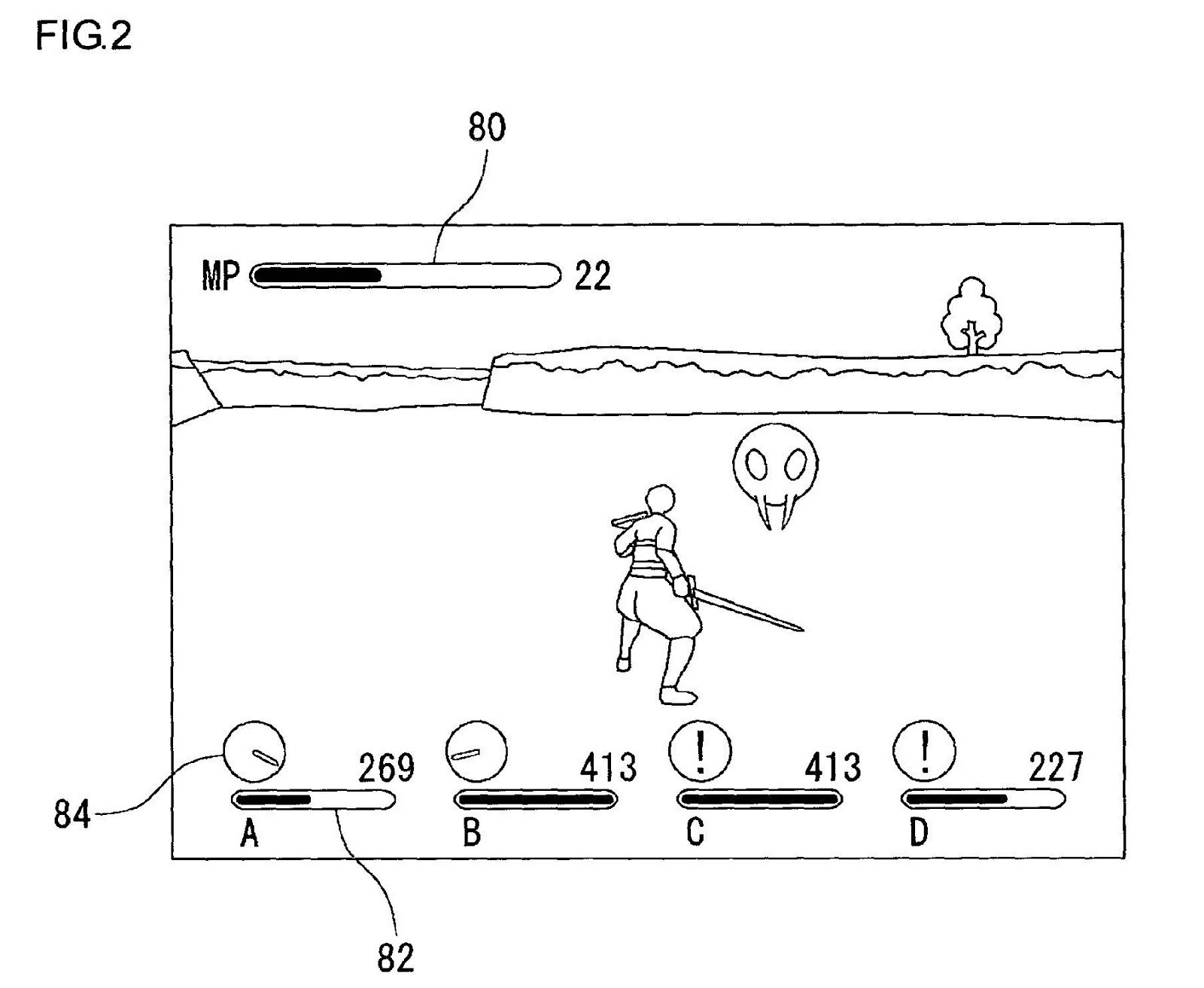
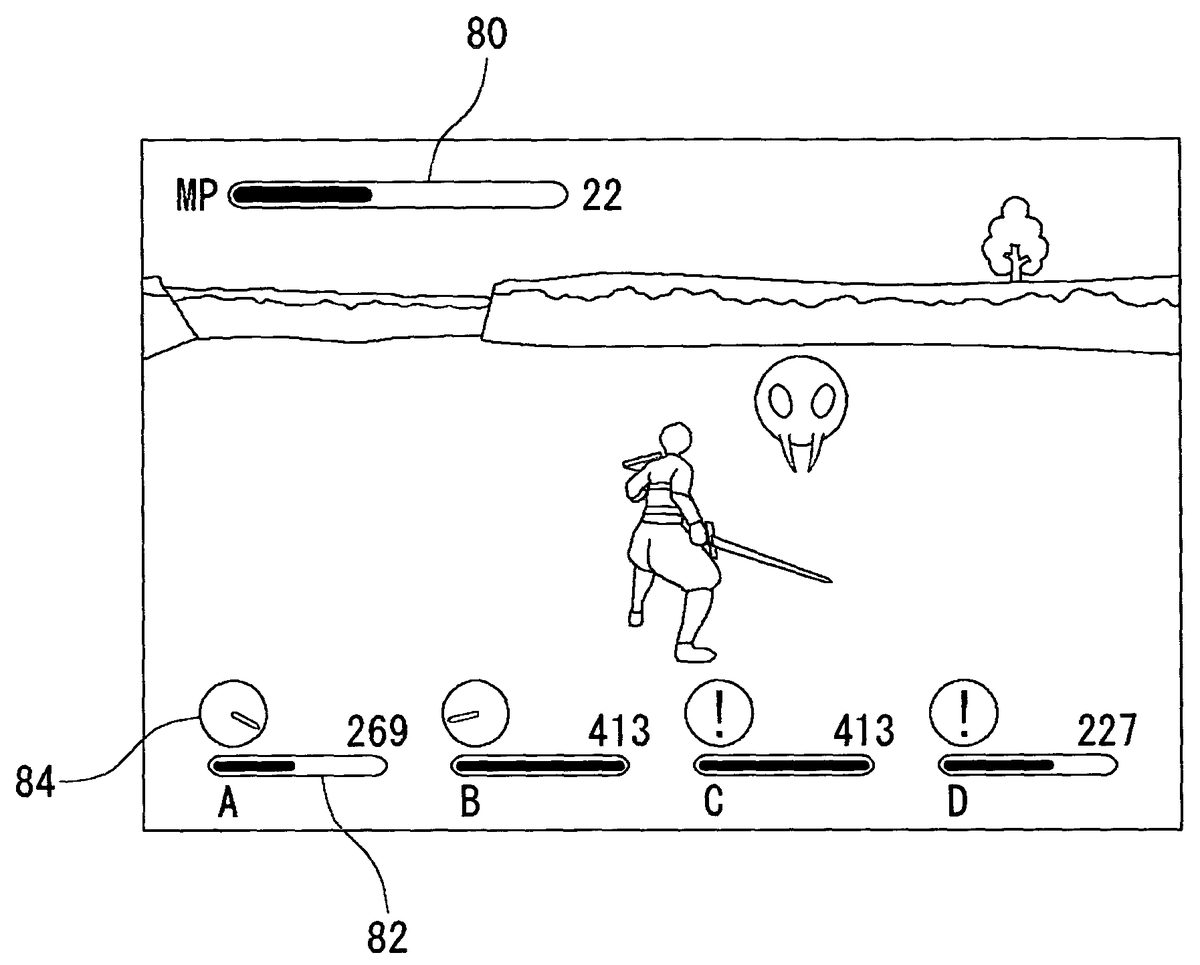
FIG. 2illustrates an exemplary image on screen showing a battle in progress. The screen ofFIG. 2shows an MP meter80, an HP meter82, a time meter84and so forth. The MP meter80indicates the current value and the maximum value of MP. A player grasps MP accumulated so far, and seeks a chance for PC to use a magic. The time meter84indicates the length of time required until a character becomes able to make an action. After the character made a certain move, the next action will be prohibited until the time meter84goes around once completely. When the pointer of the time meter84makes a complete turn to display “!” mark, the next action is allowed.

In the example shown inFIG. 2, PC sides with fellow characters to form a party and a plurality of characters incorporating with one another fight against enemy characters. In this manner, when there are other fellow characters besides PC, the player may operate those characters as well. Or, an artificial intelligence unit may operate those fellow characters. In the former case, the user may have a pleasure of finding and deciding a strategy by creatively using and ingeniously selecting the magics among a plurality of characters.

In the latter case, the battle control unit further includes an artificial intelligence unit which controls the actions of fellow characters. The artificial intelligence unit may be provided such that a strategy in accordance with a battle system in a game according to the present embodiment is adopted. For example, if the enemy character has powerful magic, a magic may be used to reduce the MP, even though the use of magic is not particularly necessary, in order for the enemy character not to be able to use the powerful magic. When the enemy character selects the powerful magic, a strategy may be employed where the fellow character attacks the enemy character using the powerful magic, during the time when said magic is being chanted, so as to invalidate said magic. In this case, in order that a fellow character can attack right after the enemy character selects the magic, the fellow character may stand ready until such a time when the enemy character selects the magic even if the fellow character itself is already at the timing when it is capable of performing an action.

In this manner, according to the techniques employed in the present embodiments, the battle control is performed using a novel battle rule where the magic points required for the magic attack are shared both by the fellow characters and the enemy characters. Hence, the game player can benefit from the enjoyment in which a new and unique strategy that has never existed before can be produced. Also, the amusingness of the game is further enhanced by employing the real-time battle system.

The present invention has been described based on the preferred embodiments. These embodiments are merely exemplary. It is therefore understood by those skilled in the art that various modifications to the combination of each component and process thereof are possible and such modifications are also within the scope of the present invention.
Claims

  1. A computer program embedded in a computer readable medium, comprising: a first program code module which controls an action of a player's character in a battle between the player's character and an enemy character;a second program code module which controls an action of the enemy character in the battle;a third program code module which stores, in a first point storage, a current value of a first point indicative of a power required for achieving a specific ability in the battle and manages an increase and decrease in the current value of the first point;and a fourth program code module which stores, in a second point storage, a current value of a second point indicative of a vitality of the player's character and the enemy character and manages an increase and decrease in the current value of the second point, wherein when one character attacks on the other character, said program code module which manages the increase and decrease in the current value of the second point subtracts a predetermined value, as a damage caused by the attack, from the current value of the second said program code module which manages the increase and decrease in the current value of the first point adds a value calculated according to the damage caused by the attack, to the current value of the first point, the first point stored in the first point storage is shared by the player's character and the enemy character, and when the player's character exercises the specific ability or the enemy character exercises the specific ability, said program code module which manages the change in the current value of the first point subtracts a value required for the exercise of the specific ability, from the current value of the first point;and wherein when an action has been executed by a first character and thereafter the first character is attacked by a second character during a time duration until the action by the first character is completed, said first program code module which controls the action of the player's character and said second program code module which controls the action of the enemy character cancel the action by the first character and when the first point in the first point storage has been reduced by the action by the first character, said first program code module which controls the action of the player's character and said second program code module which controls the action of the enemy character restore the value by adding an value equivalent to the amount subtracted.
  1. A computer program embedded in a computer readable medium according to claim 1 , wherein said first program code module which controls the action of the player's character and said second program code module which controls the action of the enemy character prohibit the exercise of a specific ability that requires a value greater than the current value of the first point.
  2. A computer program embedded in a computer readable medium according to claim 1 , wherein said first program code module which controls the action of the player's character and said second program code module which controls the action of the enemy character allow the execution of a next action when a predetermined duration of time has elapses after the action has been executed, and allow the passage of time while the player is selecting a next action of the player's character.
  3. A recording medium, readable by a computer, which stores a program executable by a computer, the program including program code modules for: controlling an action of a player's character in a battle between the player's character and an enemy character;controlling an action of the enemy character in the battle;storing, in a first point storage, a current value of a first point indicative of a power required for achieving a specific ability in the battle and managing an increase and decrease in the current value of the first point;and storing, in a second point storage, a current value of a second point indicative of a vitality of the player's character and the enemy character and managing an increase and decrease in the current value of the second point, wherein when one character attacks on the other character, said managing the increase and decrease in the current value of the second point subtracts a predetermined value, as a damage caused by the attack, from the current value of the second point, said managing the increase and decrease in the current value of the first point adds a value calculated according to the damage caused by the attack, to the current value of the first point, the first point stored in the first point storage is shared by the player's character and the enemy character, and when the player's character exercises the specific ability or the enemy character exercises the specific ability, said module for managing the change in the current value of the first point subtracts a value required for the exercise of the specific ability, from the current value of the first point;and wherein when an action has been executed by a first character and thereafter the first character is attacked by a second character during a time duration until the action by the first character is completed, said first program code module which controls the action of the player's character and said second program code module which controls the action of the enemy character cancel the action by the first character and when the first point in the first point storage has been reduced by the action by the first character, said first program code module which controls the action of the player's character and said second program code module which controls the action of the enemy character restore the value by adding an value equivalent to the amount subtracted.
  4. A method for controlling a game by a computer, the method comprising: controlling by the computer an action of a player's character in a battle between the player's character and an enemy character;controlling by the computer an action of the enemy character in the battle;storing, in a first point storage memory, a current value of a first point indicative of a power required for achieving a specific ability in the battle and managing an increase and decrease in the current value of the first point;and storing, in a second point storage memory, a current value of a second point indicative of a vitality of the player's character and the enemy character and managing an increase and decrease in the current value of the second point, wherein when one character attacks on the other character, said managing the increase and decrease in the current value of the second point subtracts a predetermined value, as a damage caused by the attack, from the current value of the second point, said managing the increase and decrease in the current value of the first point adds a value calculated according to the damage caused by the attack, to the current value of the first point, the first point stored in the first point storage is shared by the player's character and the enemy character, and when the player's character exercises the specific ability or the enemy character exercises the specific ability, said managing the change in the current value of the first point subtracts a value required for the exercise of the specific ability, from the current value of the first point;and wherein when an action has been executed by a first character and thereafter the first character is attacked by a second character during a time duration until the action by the first character is completed, said first program code module which controls the action of the player's character and said second program code module which controls the action of the enemy character cancel the action by the first character and when the first point in the first point storage has been reduced by the action by the first character, said first program code module which controls the action of the player's character and said second program code module which controls the action of the enemy character restore the value by adding an value equivalent to the amount subtracted.
  5. A game system comprising: a player's character control unit which controls an action of a player's character in a battle between the player's character and an enemy character;an enemy character control unit which controls an action of the enemy character in the battle;and a first point management unit which stores, in a first point storage, a current value of a first point indicative of a power required for achieving a specific ability in the battle and which manages an increase and decrease in the current value of the first point;and a second point management unit which stores, in a second point storage, a current value of a second point indicative of a vitality of the player's character and the enemy character and manages an increase and decrease in the current value of the second point, wherein when one character attacks on the other character, said second point management unit subtracts a predetermined value, as a damage caused by the attack, from the current value of the second point, said first point management unit adds a value calculated according to the damage caused by the attack, to the current value of the first point, the first point stored in the first point storage is shared by the player's character and the enemy character, and wherein when the player's character exercises the specific ability or the enemy character exercises the specific ability, said first point management unit subtracts a value required for the exercise of the specific ability, from the current value of the first point;and wherein when an action has been executed by a first character and thereafter the first character is attacked by a second character during a time duration until the action by the first character is completed, said first program code module which controls the action of the player's character and said second program code module which controls the action of the enemy character cancel the action by the first character and when the first point in the first point storage has been reduced by the action by the first character, said first program code module which controls the action of the player's character and said second program code module which controls the action of the enemy character restore the value by adding an value equivalent to the amount subtracted.

Disclaimer: Data collected from the USPTO and may be malformed, incomplete, and/or otherwise inaccurate.