U.S. Pat. No. 7,846,022
GAME INPUT DEVICE, GAME METHOD AND GAME SYSTEM USING THE SAME
AssigneeKonami Digital Entertainment, Inc.
Issue DateAugust 6, 2007
Illustrative Figure
Abstract
The objective of present invention is to provide a game input device which allows a player to enjoy the feeling of actually playing a musical instrument along with a rhythm of music, a game method and a game system using such a game input device. The present invention is a game input device having a moving portion and a neck portion, the moving portion has at least two or more inputs, the moving portion is provided onto the neck portion, and the position of the moving portion is movable on the neck portion. The present invention is also a game method and a game system using the game input device.
Description
DETAILED DESCRIPTION OF INVENTION Embodiments according to the present invention will hereinafter be explained in detail. In addition, configurations of the present invention are explained below, however, these are specific examples to show only a portion of the present invention and the present invention is not limited to these. FIG. 1is a configuration diagram illustrating an example of a guitar-shaped game input device according to the present invention (hereinafter referred as a mock guitar1). The mock guitar1consists of a neck portion4and a main body portion7. A moving portion3is provided to the neck portion4. A first signal input2A, a second signal input2B, and a third signal input2C are provided to the moving portion3. Also the main body portion7has a timing input means5and a rotary switch6. The first signal input2A, the second signal input2B, and the third signal input2C are attached on the moving portion3to select an object according to an instruction of a game console. The moving portion3is slidably attached on the neck4to enable the first signal input2A, the second signal input2B, and the third signal input2C to move on the neck portion4. The timing input means5is attached on the center of body portion to confirm an input of selection after selecting an object with the input. The rotary switch6is arranged below the timing input means5to switch to additional modes, such as a echo mode (same types of sound staggered and outputted) or a chorus mode (different types of sound output simultaneously). Means to confirm an input of selection after selecting an object with an input is not limited to the timing input means5. For example, the first signal input2A, the second signal input2B, and the third signal input2C may be used as a means for confirming an input of selection, and any other means may be also used. Also, the ...
DETAILED DESCRIPTION OF INVENTION
Embodiments according to the present invention will hereinafter be explained in detail. In addition, configurations of the present invention are explained below, however, these are specific examples to show only a portion of the present invention and the present invention is not limited to these.
FIG. 1is a configuration diagram illustrating an example of a guitar-shaped game input device according to the present invention (hereinafter referred as a mock guitar1).
The mock guitar1consists of a neck portion4and a main body portion7. A moving portion3is provided to the neck portion4. A first signal input2A, a second signal input2B, and a third signal input2C are provided to the moving portion3. Also the main body portion7has a timing input means5and a rotary switch6.
The first signal input2A, the second signal input2B, and the third signal input2C are attached on the moving portion3to select an object according to an instruction of a game console. The moving portion3is slidably attached on the neck4to enable the first signal input2A, the second signal input2B, and the third signal input2C to move on the neck portion4.
The timing input means5is attached on the center of body portion to confirm an input of selection after selecting an object with the input. The rotary switch6is arranged below the timing input means5to switch to additional modes, such as a echo mode (same types of sound staggered and outputted) or a chorus mode (different types of sound output simultaneously).
Means to confirm an input of selection after selecting an object with an input is not limited to the timing input means5. For example, the first signal input2A, the second signal input2B, and the third signal input2C may be used as a means for confirming an input of selection, and any other means may be also used.
Also, the number of input is not limited to three, as long as there are two or more. Preferably, there may be three, four, or five inputs. A player holds the body portion of the mock guitar1with one hand while supporting the neck portion4of the mock guitar1with the other hand and operates the mock guitar1. Therefore, the number of fingers that can operate the inputs provided to the moving portion3is normally three or four. Based on this standpoint, three or four are the most preferable number of inputs.
Further, the mock guitar1may be provided with components not described above. The mock guitar1may be provided with, for example, a speaker, a vibratory device, a band for positioning the guitar1closer to a player's body, or a start button and a select button to proceed with a game.
Normally, the first signal input2A, the second signal input2B, the third signal input2C, and the moving portion3provided to the neck portion4of mock guitar1correspond to a input means for a left hand. Meanwhile, the timing input means5and the rotary switch6provided to the main body portion7of mock guitar1correspond to an input mean for a right hand. However, in the mock guitar1, these input means for a right hand and left hand and may be opposite. That is, the means normally used for a left hand may be used as an input means for a right hand, also the means normally used for a right hand may be used as input means for a left hand.
Also, the game input device according to the present invention is not limited to a guitar shape. The game input device according to the present invention may be, for example, in a shape of a ukulele.
FIG. 2is an enlarged view of the neck portion4of the mock guitar1. The neck portion4is provided with a moving portion3. Also, a first signal input2A, a second signal input2B and a third signal input2C are provided to the moving portion3.
The moving portion3is slidably attached on the neck portion4. The moving portion3is able to move to a slide level1position, a slide level2position, or a slide level3position.
The slide level1position is a position on the neck portion4and the farthest away from the main body portion7(hereinafter referred as the left end of neck portion4). The slide level2position is a position sliding one level from the left end of neck portion (hereinafter referred as the center of neck portion4). The slide level3position is a position sliding two levels to the main body portion7from the left end of neck portion (hereinafter referred as the right end of neck portion4).
Also, the moving portion3located on the slide level1position can be moved to the slide level3position without stopping at the slide level2position. Also, it is possible to perform the opposite operation.
The moving portion3can move to any position on the neck portion4and is not limited to the slide level1position, the slide level2position, or the slide level3position. For example, the moving portion3can also move to a slide level4position (not shown), that is, a position sliding three levels to the main body portion7from the left end of neck portion (hereinafter referred as the extreme right end of neck portion4).
The moving portion3may be movably attached on the neck portion4. For example, the moving portion3may slide on the fixed neck portion4. Alternatively, the neck portion4may slide on the fixed moving portion3. In such case, the neck portion4may be attached so as to slide parallel to the arrangement of signal input portions provided to the moving portion3. Also, the neck portion4may be attached slidably to the moving portion3perpendicular to the direction which the neck portion4extends.
Also the moving portion3may be slidably attached on the neck portion4while the first signal input2A, the second signal input2B or the third signal input2C is depressed.
FIG. 3shows an outline of game system9according to the present invention. The game system9according to the present invention is provided with a controller10, platform11, and a display12.
The controller10is, for example, having a configuration similar to that of the mock guitar1described above. The platform11is provided with an input data evaluation portion13and a memory14. The memory14contains game result judgment data and game execution data. The display12has a display screen.
The game result judgment data is data to determine whether a player's input operation is appropriately performed according to the instructions of the game machine. The game result judgment data includes, for example, (1) data indicating a timing of a player's input operation relative to an object, (2) data indicating the shortest distance that should be taken for a player's slide operation relative to an object, (3) data to indicate a color that should be input by a player according to an object, (4) a normal sliding operation for a player to input an object. The game execution data is the data to conduct a game from the beginning to the end.
The controller10and the input data evaluation portion13are connected through the input/output terminal. Through this input/output terminal, the operation data input to the controller10is transmitted to the input data evaluation portion13.
The input data evaluation portion13receives the game result judgment data from the memory14, as well as receives the operation data from the controller10. The input data evaluation portion13compares the operation data and the game result judgment data based on judgment parameters, and evaluates the input operation of a player. The judgment parameters include timing of input operation, slide distance of the moving portion, consistency of the color of input and the color of a selected object, continuity of a player's appropriate input operation, and a difficulty of a slide operation. However, the judgment parameters are not limited to this.
Comparison and evaluation of timing for input operations are performed as follows: First, compare the timing of an input operation contained in the operation data and above (1) timing of a player's input operation relative to an object contained in the game result judgment data. The closer the timing of both, the player receives a higher evaluation.
Comparison and evaluation for the sliding distance of the input moving device are performed as follows. First, compare the sliding distance of the moving portion contained in operation data and above (2) the shortest distance should be taken for a player's sliding operation relative to an object contained in the game result judgment data. When the sliding distance is longer than the minimum distance for the sliding operation, the player receives a high evaluation.
Comparison and evaluation for consistency of the color of input and the color of a selected object are performed as follows. Compare the color of an input contained in the operation data and above (3) the color that should be input by a player according to an object contained in the game result judgment data. When both are matched, a high evaluation is provided, when not matched, a low evaluation is provided.
Evaluation for the continuity of a player's appropriate input operation is performed by determining how many input operations are determined to be appropriate based on the above comparison and evaluation, are performed in a row. When the degree of continuity is high, the player obtains a high evaluation, and when the degree of continuity is low, the player obtains a low evaluation.
Comparison of a sliding operation for the moving portion and evaluation of its difficulty are performed as follows. First, compare input sliding data contained in the operation data and above (4) normal sliding operation for a player to input an object contained in the game result judgment data.
When an input sliding operation is determined to be difficult to perform compared to the normal sliding operation, a high evaluation is given to a player. When both operations are the same, no specific evaluation is given. When an input sliding operation is determined to be easy to perform compared to the normal sliding operation, a low evaluation is given to the player. Judgment of difficulty for this sliding operation is hereinafter explained in detail referring to the embodiments described inFIGS. 9 to 13below.
Also, the display12and the memory14are connected through an input/output terminal. Through this input/output terminal, the game execution data stored in the memory14is transmitted to the display12.
As a display12, for example, a liquid display device and a plasma display device can be considered but not limited to this.
Also, in the game system according to the prevent invention, a controller10or a display12may be provided to the platform11and these may be integrated.
FIG. 4shows an example of a display screen19provided to the display12of the game system according to the present invention.
The display screen19has an object lane20, a lateral bar graph23, and a presentation display31. The object lane20has object buttons21move downward on the object lane, and an input guide line22.
The object buttons21are to instruct input operations to a player. The object lane20is to indicate a route of an object button21moving from the upper end to the lower end of the object lane. When the object button21moves downward and reaches the input guide line22on the object lane20is when the timing occurs. In this case, the object button only moves downward, and does not move, for example, sideways or upward.
The number of lanes for the object lane20is not limited to a specific number and may be any number. However, the number of object lanes is preferably five or six due to the standpoint of experiencing the game aggressively, such as by completing the game techniques. Further, the number of object buttons21moving on the object lane20is not limited to a specific number and may be any number.
Also, the lateral bar graph23indicates a game score and an amount of gage. The game score is the points obtained by a player as a result of game play. The amount of gage is a parameter to continue the game and is the parameter that disables continuation of the game when it is lost. The presentation display31is to display a player's game.
The display screen according to the present invention may be different from the screen described above as long as it instructs input operations to a player. For example, the object button21may be in other shapes (such as a star shape, a triangle shape, or a square shape) instead of a button shape. Also, the direction of the object button21moving on the object lane20may be sideways or a diagonal direction. Also, the display screen19may be without the object lane20thereby an object instructing a player for an input operation suddenly appears on the display screen.
The lateral bar graph23may indicate more information other than a player's game score or a gage amount. For example, the lateral bar graph23may indicate a player's personal data. Also, for example, a game score or a gage amount for an opponent playing against via a network may be indicated. The presentation display31may display any presentation, for example, fire-work like shapes may be displayed simultaneously with the player's input operation.
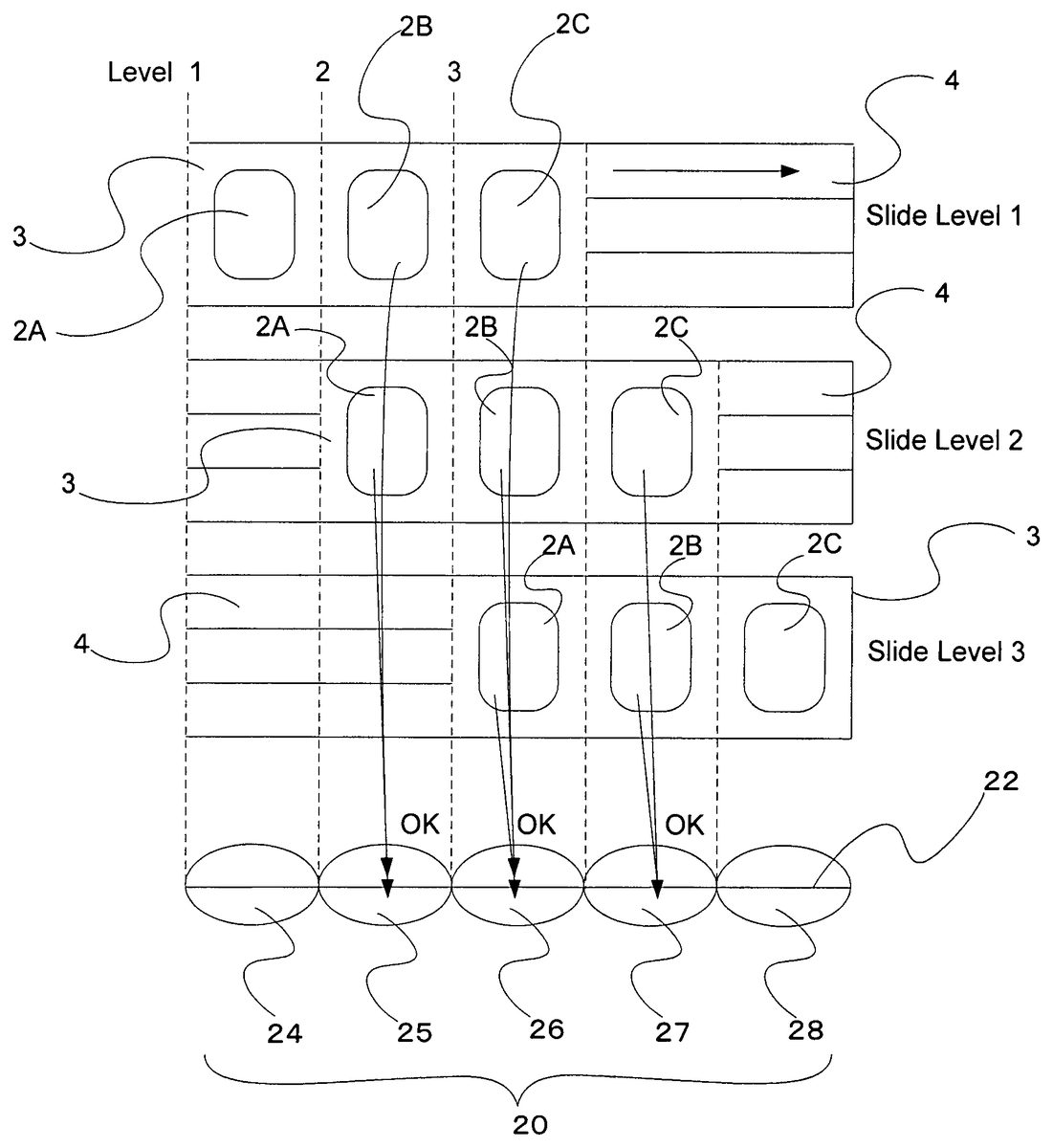
FIG. 5is a diagram showing an object lane20existing on the display screen19. AlsoFIG. 5shows object buttons21on the display screen, which may be selected by the input on each slide level of the mock guitar1above.
InFIG. 5, the neck portion4shows a neck portion provided to the mock guitar1above. A moving portion3is attached to the neck portion4. The moving portion3has a first signal input2A, a second signal input2B and a third signal input2C. Slide levels1,2, and3are the same as explained inFIG. 2above.
Also inFIG. 5, a first object lane24, a second object lane25, a third object lane26, a fourth object lane27, and a fifth object lane28indicate each lane in the object lane20of the display screen19above. The object lane has the input guide line22as explained inFIG. 4above.
FIG. 5shows a case of five object lanes20and three inputs. As shown in this figure, when the position of the moving portion3is on the slide level1, the first object lane24to the third object lane26may be selected by the input. That is, the first signal input2A can select the first object lane24. Also, the second signal input2B can select the second object lane25. Further, the third signal input2C can select the third object lane26.
Also, when the position of the moving portion3is on the slide level2, the second object lane25to the forth object lane27may be selected by the input. That is, the first signal input2A can select the second object lane25. Also, the second signal input2B can select the third object lane26. Further, the third signal input2C can select the fourth object lane27.
Further, when the position of the moving portion3is on the slide level3, the third object lane26to the fifth object lane28may be selected by the input. That is, the first signal input2A can select the third object lane26. Also, the second signal input2B can select the fourth object lane27. Further, the third signal input2C can select the fifth object lane28.
As apparent from above, the selection of the first object lane24can be made in one way. And, the selection of the second object lane25can be made in two ways. Also, the selection of the third object lane26can be made in three ways. Further, the selection of the fourth object lane27can be made in two ways. Still further, the selection of the fifth object lane28can be made in one way.
As described above, the moving portion3provided with inputs is arranged across the object lane and can be selected by the inputs before moving (In this case, this means the first object lane24to the third object lane26. Hereinafter referred as a first input region) and the region adjacent to the first input region (In this case, this means the fourth object lane and the fifth object lane. Hereinafter referred as a second input region), and is able to receive input.
FIG. 6shows an object lane20existing on the display screen19. AlsoFIG. 6shows a display screen that has object buttons21existing on the object lane in a linear form (hereinafter referred as a linear form object button30).
InFIG. 6, the display screen19has an object lane20, a lateral bar graph23and a presentation display31as explained inFIG. 4. The object lane20has a first object lane24, a second object lane25, a third object lane26, a fourth object lane27, a fifth object lane28, and an input guide line22. Further, there is a linear shaped object button30which moves downward on the object lane and is straddled between the first object lane24and the second object lane25. The linear shaped object button30is also an input instruction to a player.
The method for player's input operation according to the input instruction of linear shaped object button30is hereinafter explained. First is to move the position of above moving portion3on the mock guitar1to above slide level1. And select the first signal input2A above provided on the moving portion3. While selecting the first signal input2A, perform selection confirmation input with the timing input means5when the lower end of linear shaped object button30reaches the input guide line22.
By continuing the selection confirmation input and the selection of first signal input2A, the length of the linear shaped object button30gradually shortens. As the player moves the position of the moving portion3from above slide level1to above slide level2when the linear shaped object button30is shortened to the position moved from the first object lane24to the second object lane25. This operation is performed while continuing with the selection confirmation input and the selection of first signal input2A.
The player continues with the selection confirmation input and the selection of the first signal input2A until all the linear shaped object button30has disappeared at the end. By operating this way, the linear shaped object button30can be input.
Further, the linear shaped object button30may straddle from the first object lane24to the second object lane25existing on the display screen19. A linear shaped object button30may straddle from any lane of object lane20to any other existing lane.
For example, a linear shaped object button30may straddle from the third object lane26to the fifth object lane28. The input operation to this linear shaped object button30is the same as above, except that the first signal input2A replaces the third signal input2C.
FIG. 7is a flow chart showing a game configuration according to the present invention. The game configuration according to present invention is hereinafter explained in detail referring toFIG. 7. In addition, the present invention is not limited to the flowchart below.
First, game execution data is output to the display12from the memory14, game information is displayed on the display screen19of the display12, and a musical performance game is begun (step1).
The player selects a specific difficulty level and a music number from alternatives of game difficulty and music numbers displayed on the display screen19when the game is begun (step2).
Selections of difficulty levels are displayed on the display screen19, for example, choose one play level from three levels, such as advanced (expert), intermediate (normal), beginner (practice). Also, selection of music number is to choose one song from multiple selections of music numbers displayed on the display screen. After these selections, the musical performance game is started (step3).
When the musical performance game is begun, a plurality of object lanes20are displayed on the display screen19and a plurality of object buttons21move on each lane over time.
The player uses a game input device (such as the mock guitar1) or the controller10for input operations according to the object buttons21. The input operations select the object button21by an input when the object buttons21moving on the object lane20reach the input guide line22and to confirm the selection by the timing input means5while selected.
When a player's input operation is performed as above, the game input device (such as the mock guitar1) or the controller10obtains input operation data, and the operation data is transmitted to the input data evaluation portion13through the input/output terminal.
The input data evaluation portion13receives game result judgment data from the memory14and calculates the game score and the gage amount by comparing the operation data and the game result judgment data (step12).
The game score and the gage amount are calculated as follows. First is to judge whether there was a input operation by the timing input means5according to the object button21displayed on the display screen19(step4). When there was no input operation, the game score and the gage amount are calculated (step12).
When there is an input operation by the timing input means5, the degree of consistency for the timing of input by the timing input means5and the input timing of timing input means5contained in the game result judgment data is calculated (step5). When the timings for both agree completely, the player receives maximum score and maximum gage amount.
Also, when the player input was slightly deviated from the input timing of timing input means5contained in the game result judgment data, the smaller the deviation, the player can obtain a high game score and gage amount. When the deviation is large and exceeding a certain value contained in the game result judgment data, the player can not obtain the game score and the gage amount is decreased.
Further, when there was input operation by the timing input means5, judgment is made whether the color of selected input and the color of object button21were matched or not (step6). Each object has a color such as red blue or green, and each object lane has the same color as each object. Further, each input also has a color like red, blue, or green respectively.
When the color of the selected input and the color of the selected object are matched, the player receives a high score and a high gage amount. On the other hand, when they are not matched, the player can not obtain a score and the gage amount is decreased.
Further, when there was an input operation by the timing input means5, the continuity of an appropriate input operation is calculated (step7). That is, a calculation of how many of the above input operations determined to be appropriate based on the game result judgment data is performed. The longer the continued appropriate input operations, the player obtains a high score and a high gage amount.
Next is to judge whether the position of moving portion3has slid or not (Step8). When it was not slid, music and image are output after steps4to7above (step11), and the game score and the gage amount are calculated (step12).
When the position of moving portion3is slid, calculation for the difficulty of the sliding operation will be performed (step9). When the difficulty is high, the player receives a high score and a high gage amount.
When the position of the moving portion3is slid, calculation for the distance of the sliding for the moving portion3will be performed (step10). When the distance is longer, the player receives a high score and a high gage amount.
When a player's input operation is judged as above, sound and image are output according to the result (step11), and the game score and the gage amount are calculated (step12).
When the game score and the gage amount are calculated as above, the game score and the gage amount are updated based on the calculation result (step13). That is, the game score and the gage amount calculated in the input data evaluation portion13are transmitted to the memory14, added to the game score and the gage amount cumulated in the memory14, and stored in the memory14. Stored game score and gage amount are transmitted to the display12and displayed in the lateral bar graph23located on upper left on the display screen19of the display12.
And, the memory14determines the updated gage amount (step14), and displays “Game Over” on the screen of display12when there is no gage amount (step15).
When a gage amount still remains, the memory14determines whether the presentation is finished, and returns to the step3to perform the series of process (step3to14) according to the object output next when the presentation is determined to be not finished (step16). This process is repeated until the end of the presentation is detected. When the memory14determines the end of the presentation, the musical performance is evaluated based on the calculation result of score, and the stage result is displayed on the screen of display12(step17).
Thereafter, the memory14determines whether a certain clear condition is reached at the completed stage (for example, score reached 100 points or more), and the number of music number can be selected for the next game will be increased when the clear condition has reached (step19). When the condition is not reached, the player chooses whether to continue the game or not (step20). When the player chooses to continue, return to step1and the series of actions described above is repeated. When the player chooses not to continue, the game will be finished (step21).
And, when the number of music can be selected in the game is increased (step19), the player also chooses whether to continue the game (step20). When the player chooses to continue, return to the step1and repeat the series of actions with an increased number of music number. When the player chooses not to continue, the game will be finished (step21).
FIG. 8shows an object lane20existing on the display screen19. TheFIG. 8also shows an object button21on the display screen which can be selected by the input on each slide level of the mock guitar1above.
InFIG. 8, the neck portion4describes a neck portion provided to the mock guitar1above. A moving portion3is attached to the neck portion4. The moving portion3has a first signal input2A, a second signal input2B and a third signal input2C. The slide levels1,2,3, and4are the same as those explained above.
Also inFIG. 8, the first object lane24, the second object lane25, the third object lane26, the forth object lane27, the fifth object lane28, and the sixth object lane29indicate each lane of the object lane20. The object lane20has an input guide line22.
FIG. 8describes the case of six object lanes and three inputs. As shown in this figure, when the position of moving portion3is on the slide level1, the first object lane24to the third object lane26can be selected with the input. That is, the first signal input2A can select the first object lane24. Also, the second signal input2B can select the second object lane25. Further, the third signal input2C can select the third object lane26.
And, when the position of moving portion3is on the slide level2, the second object lane25to the fourth object lane27can be selected with the input. That is, the first signal input2A can select the second object lane25. Also, the second signal input2B can select the third object lane26. Further, the third signal input2C can select the fourth object lane27.
Further, when the position of moving portion3is on the slide level3, the third object lane26to the fifth object lane28can be selected with the input. That is, the first signal input2A can select the third object lane26. Also, the second signal input2B can select the fourth object lane27. Further, the third signal input2C can select the fifth object lane28.
Still further, when the position of moving portion3is on the slide level4, the fourth object lane27to the sixth object lane29can be selected with the input. That is, the first signal input2A can select the fourth object lane27. Also, the second signal input2B can select the fifth object lane28. Further, the third signal input2C can select the sixth object lane29.
As is evident from above, there is one way to select the first object lane24. And, there are two ways to select the second object lane25. Also, there are three ways to select the third object lane26. Further, there are three ways to select the fourth object lane27. Still further, there are two ways to select the fifth object lane28. Still further, there is one way to select the sixth object lane29.
Next, embodiments of judgment for the difficulty of the sliding operation is hereinafter explained in detail based onFIGS. 9 to 13.
FIGS. 9 and 10show an example of player's input method (1) to three objects moving on the object lane20. Also,FIGS. 11 to 13show an example of player's input method (2) to similar objects. The example of input method (1) and the example of input method (2) are different input methods.
FIGS. 9 to 13show embodiments of a game according to the present invention.FIGS. 9 to 13also show the display screen19and the neck portion4.
The display screen19has an object lane20, a lateral bar graph23and a presentation display31. The object lane20has an object button21moving downward on the object lane and an input guide line22. Also the object lane20consists of six lanes (first object lane24to sixth object lane29). The neck portion4is provided with a moving portion3. The moving portion3is provided with a first signal input2A, a second signal input2B and third signal input2C.
InFIG. 9, the player first selects and inputs the object button21on the first object lane24that has reached the input guide line22. That is, moving the position of moving portion3to the position of slide level1above. And selecting the object button21on the first object lane24with the first signal input2A provided to the moving portion3. While continuing the selection, a player selects and confirms the object button21that has reached the input guide line22with the timing input means5.
Next, inFIG. 10, the player selects and inputs the object button21on the second object lane25that has reached the input guide line22. That is, moving the position of moving portion3to the position of slide level2above. And selecting the object button21on the second object lane25with the first signal input2A provided to the moving portion3. While continuing the selection, a player selects and confirms the object button21has reached the input guide line22with the timing input means5.
And next, the player selects and inputs the object button21on the third object lane26that has reached the input guide line22. That is, selecting the object button21on the third object lane26with the second signal input2B provided to the moving portion3positioned on the slide level2above. While continuing the selection, the player selects and confirms the object button21that has reached the input guide line22with the timing input means5. Above is an example of player's input method (1).
Meanwhile, as shown inFIG. 11, the player first selects and inputs the object button21on the first object lane24which has reached the input guide line22. That is, moving the position of moving portion3to the position of slide level1above. And selecting the object button21on the first object lane24with the first signal input2A provided to the moving portion3. While continuing the selection, the player selects and confirms the object button21that has reached the input guide line22with the timing input means5.
Next, inFIG. 12, the player selects and inputs the object button21on the second object lane25that has reached the input guide line22. That is, moving the position of moving portion3to the position of slide level2above. And selecting the object button21on the second object lane25with the first signal input2A provided to the moving portion3. While continuing the selection, the player selects and confirms the object button21that has reached the input guide line22with the timing input means5.
Next, the player selects and inputs the object button21on the third object lane26that has reached the input guide line22. That is, moving the position of moving portion3to the position of slide level3above. And selecting the object button21on the third object lane26with the first signal input2A provided to the moving portion3. While continuing the selection, the player selects and confirms the object button21that has reached the input guide line22with the timing input means5. Above is an example of player's input method (2).
Both of input methods (1) and (2) above are the input methods for an object moving in a same form. The input method (2) is more difficult for a player to perform compared to the input method (1). In such case, the player obtains a high score and a high gage amount when performing the input method (2).
The judgment of difficulty for the sliding operation is not limited to those based on the above embodiments. The judgment of difficulty is performed when one input instruction from a game exists and there are input methods less and more difficult compared to that input instruction.
The present invention is not limited to the above embodiments, and changes can be made. For example, the mock guitar1is explained as a controller10, however, the controller10is not limited to a guitar. The controller10may be configured to various shapes, such as a piano/key board shape, a trumpet shape, or a mat shape.
Further, in addition to the shapes described in the figures of the present invention, various shapes can be applied to the moving portion3. For example, another moving means can further be layered onto the moving portion3.
Also, the object lane20and the object21can be changed to various forms. For example, the object lane20can be arranged vertically and the object21may move from left to right of the display.
Further, the object lane20may be in a display not considering the depth and the object21may drop from the top to the bottom of the screen. In addition, the input guide line22may be in a form of a vehicle, such as an airplane or an automobile instead of a fixed line, moving from side to side and up and down to pick up the object21.
Claims
- A game input device comprising a main body portion, a neck portion extending from said main body portion, and a moving portion movably attached to said neck portion, the moving portion including a plurality of signal input portions, where a position of one of the plurality of the signal input portions at a first slide level is configured to overlap with a position of another of the plurality of the signal input portions at a second slide level;and wherein a controller located in the game input device outputs a positioning signal or a moving motion signal on said moving portion and an input signal on at least one of said plurality of signal input portions.
- The game input device according to claim 1 , wherein said moving portion is slidably coupled to said neck portion.
- The game input device according to claim 2 , wherein said moving portion is slidably coupled to said neck portion while a portion of said signal input portions is depressed.
- The game input device according to claim 1 , wherein said moving portion is attached slidably in a direction perpendicular to the extension of said neck portion.
- The game input device according to claim 1 , wherein the number of said plurality of signal inputs is three.
- The game input device according to claim 1 , wherein the number of said plurality of signal inputs is four.
- The game input device according to claim 1 , wherein the number of said plurality of signal inputs is five.
- The game input device according to claim 1 , wherein said game input device comprises a guitar shape.
- A game system comprising a controller and a platform, wherein said controller has an moving portion and a neck portion, the moving portion comprises an input means having at least two inputs, said moving portion is coupled to said neck portion, and a position of said moving portion is movable on said neck portion;said platform comprises an input data evaluation portion, and a memory containing game result judgment data;said controller and said input data evaluation portion are connected through an input/output terminal;and said controller obtains an operation data input by a player, said operation data is transmitted to said input data evaluation portion through the input/output terminal, said input data evaluation portion receives said game result judgment data, and compares said operation data and said game result judgment data with a plurality of judgment parameters including the timing of an input operation and a sliding distance of said moving portion, thereby evaluating an input operation performed by the player.
- The game system according to claim 9 , wherein said controller and said platform are integrated.
- The game system according to claim 9 , further comprising a display communicating with said memory through the input/output terminal;and game execution data is transmitted from said memory to said display.
- The game system according to claim 11 , wherein a number of a plurality of object lanes is larger than a number of a plurality of inputs by one when an object lane is displayed on a display screen of said display.
- The game system according to claim 11 , wherein said plurality of judgment parameters includes a color consistency of an input for the input operation and a color of a selected object when an object lane and an object are displayed on the display screen of said display.
- The game system according to claim 9 , wherein said plurality of judgment parameters includes a continuity of an appropriate input operation performed by the player.
Disclaimer: Data collected from the USPTO and may be malformed, incomplete, and/or otherwise inaccurate.