U.S. Pat. No. 7,841,943
VIDEO GAME PROCESSING APPARATUS, A METHOD AND A COMPUTER PROGRAM PRODUCT FOR PROCESSING A VIDEO GAME
AssigneeKabushiki Kaisha Square Enix
Issue DateApril 27, 2007
Illustrative Figure
Abstract
An added value is set to a battle tool for customizing the battle tool stored as battle tool information in a battle tool information managing table in response to customization request by operations of a player. A plurality of battle tools are stored in the battle tool information managing table. A player character can be equipped with any of the battle tools among the plurality of battle tools. When the battle tool information Is read out from the battle tool information managing table in response to display request of a battle tool, a display apparatus is caused to display one or more battle tool in a battle screen. The battle tool information thus read out indicates the one or more battle tool. The player character is equipped with a battle tool with which the player character can be equipped among the one or more battle tool thus displayed.
Description
DETAILED DESCRIPTION OF THE INVENTION Preferred embodiments of a video game processing apparatus, a method and a computer program product for processing a video game according to the present invention will now be described in detail with reference to the appending drawings. FIG. 1is a block diagram that illustrates a configuration of a video game apparatus100to which an embodiment of the present invention is applied. However, those skilled in the art will readily recognize that other devices may be used without departing from the spirit or scope of the present invention. As shown inFIG. 1, a video game apparatus100of the present embodiment includes a video game apparatus main body10, a display device50, and a sound output device60. The video game apparatus main body10is constituted from a video game system that is put on the market, for example. Further, the display device50is constituted from, for example, a television apparatus, a liquid crystal display device, a micro-mirror device, a holographic display device, or any combination thereof. The display device50is provided with an image display screen51. However, those skilled in the art will readily recognize that any device capable of generating or reproducing an image may be used without departing from the scope or spirit of the present invention. The video game apparatus main body10includes a control section11, a RAM (Random Access Memory)12, a HDD (hard disk drive)13, a sound processor14, a graphics processor15, a DVD/CD-ROM drive16, a communications interface17, an interface section18, a frame memory19, a memory card slot20, and an input interface section21. Each of the control section11, the RAM (Random Access Memory)12, the HDD (Hard Disk Drive)13, the sound processor14, the graphics processor15, the DVD/CD-ROM drive16, the communications interface17and the interface section18is connected to an internal bus22. The control section11includes a CPU (Central Processing Unit), ROM (Read Only Memory) and ...
DETAILED DESCRIPTION OF THE INVENTION
Preferred embodiments of a video game processing apparatus, a method and a computer program product for processing a video game according to the present invention will now be described in detail with reference to the appending drawings.
FIG. 1is a block diagram that illustrates a configuration of a video game apparatus100to which an embodiment of the present invention is applied. However, those skilled in the art will readily recognize that other devices may be used without departing from the spirit or scope of the present invention. As shown inFIG. 1, a video game apparatus100of the present embodiment includes a video game apparatus main body10, a display device50, and a sound output device60. The video game apparatus main body10is constituted from a video game system that is put on the market, for example. Further, the display device50is constituted from, for example, a television apparatus, a liquid crystal display device, a micro-mirror device, a holographic display device, or any combination thereof. The display device50is provided with an image display screen51. However, those skilled in the art will readily recognize that any device capable of generating or reproducing an image may be used without departing from the scope or spirit of the present invention.
The video game apparatus main body10includes a control section11, a RAM (Random Access Memory)12, a HDD (hard disk drive)13, a sound processor14, a graphics processor15, a DVD/CD-ROM drive16, a communications interface17, an interface section18, a frame memory19, a memory card slot20, and an input interface section21.
Each of the control section11, the RAM (Random Access Memory)12, the HDD (Hard Disk Drive)13, the sound processor14, the graphics processor15, the DVD/CD-ROM drive16, the communications interface17and the interface section18is connected to an internal bus22.
The control section11includes a CPU (Central Processing Unit), ROM (Read Only Memory) and the like. The control section11executes control processes of the whole video game apparatus100in accordance with control programs stored in the HDD13and/or a storage medium70. The control section11includes an internal timer used to generate a timer interruption. The RAM12is used as a work area for the control section11. The HDD13is a storage area for storing the control programs and various data.
The sound processor14is connected to a sound output device60, which includes a speaker, for example, but may include any other device capable of generating or reproducing an audible signal. The sound processor14outputs a sound signal to the sound output device60in accordance with a sound outputting command from the control section11that executes a process according to the control programs. In this regard, the sound output device60may be embedded in the display device50or the video game apparatus main body10, or may be affixed to a vibrating surface that may be caused to generate the audible signal.
The graphics processor15is connected to the display device50including the image display screen51on which an image is displayed. However, those skilled in the art will readily recognize that the graphics processor may be coupled to other known types of display devices, such as a head-mounted display, a holographic three-dimensional display or the like, without departing from the spirit or scope of the present invention. The graphics processor15develops an image on the frame memory19in accordance with a drawing or graphics command from the control section11, and outputs video signals for displaying the image on the image display screen51to the display device50. A switching time for images to be displayed according to the video signals is set to 1/30 seconds per frame (for NTSC type displays), for example. However, the switching time may be any other frame rate (for example, 1/25 second per frame (for PAL type displays)) as those skilled in the art will appreciate without departing from the spirit or scope of the present invention.
A storage medium70such as a DVD-ROM medium or a CD-ROM medium, or equivalent, in which control programs for a video game are stored is mounted in the DVD/CD-ROM drive16. The DVD/CD-ROM drive16executes a process for reading out various data such as control programs from the storage medium70.
The communications interface17is connected to a communication network80such as the Internet, a local area network (LAN), a wide area network (WAN), or the like, in a wireless or wired manner. The video game apparatus main body10carries out communication with, for example, another computer via the communication network80using a communication function of the communications interface17.
Each of the input interface section21and the memory card slot20is connected to the interface section18. The interface section18causes instruction data from the input interface section21to be stored in the RAM12on the basis of operation(s) of a controller device such as a keypad30by a player of the video game apparatus100. In response to the instruction data stored in the RAM12, the control section11executes various arithmetic processing.
The video game apparatus main body10is connected to the controller device such as the keypad30as an operation input section (controller) via the input interface section23. However, other types of controllers may be used without departing from the scope or spirit of the present invention.
As shown inFIG. 1, for example, a cross key31, a group of buttons32, a left joystick38and a right joystick39are arranged on the upper surface of the keypad30. The cross key31includes an upper key31a, a lower key31b, a right key31cand a left key31d. The group of buttons32includes a circle button32a, an X button32b, a triangle button32cand a square button32d. Further, a select button35is arranged at a connecting portion between a base on which the cross key31is arranged and a base on which the group of buttons32are arranged. In addition, multiple buttons such as an R1 button36and an L1 button33are arranged at the side surface of the keypad30.
The keypad30is provided with multiple switches respectively connected to the cross key31, the circle button32a, the X button32b, the triangle button32c, the square button32d, the select button35, the R1 button36and the L1 button33. When pressing force is applied to any button, the corresponding switch is turned on. A detected signal in accordance with on/off of the switch is generated in the keypad30, and detected signals are generated, respectively, corresponding to inclined directions of the left joystick38and the right joystick39in the keypad30.
The two types of detected signals generated in the keypad30are outputted to the control section11via the input interface section21(through wired or wireless connection), by which detected information indicating that any button on the keypad30is pressed and detected information indicating the state of each of the left joystick38and the right joystick39are generated. In this way, operation instruction(s) by a user (player) using the keypad30, for example, is supplied to the video game apparatus main body10(that is, the control section11).
Further, the interface section18executes, according to the command(s) from the control section11, a process to store data indicative of the progress of the video game stored in the RAM12into the memory card90installed in the memory card slot20. The interface section18also executes processes to read out data on the video game stored in the memory card90at the time of suspending the video game and to transfer such data to the RAM12, and the like.
Various data, such as control program data for performing the video game with the video game apparatus100, are stored in the storage medium70, for example. The various data, such as the control program data stored in the storage medium70, are read out by the DVD/CD-ROM drive16in which the storage medium70is installed. The data thus read out are loaded onto the RAM12. The control section11executes, in accordance with the control program loaded on the RAM12, various processes such as a process to output the drawing or graphics command to the graphics processor15, and a process to output the sound outputting command to the sound processor14. In this regard, the interim data generated in response to the progress of the video game (for example, data indicative of scoring of the video game, the state of a player character and the like) are stored in the RAM12used as a work memory while the control section11executes processing.
It is assumed that a three-dimensional video game according to an aspect of the present embodiment is a video game wherein multiple characters, including a player character (that is, a character that moves in accordance with the operation of the keypad30by the player), move on a field provided in a virtual three-dimensional space, by which the video game proceeds. In this regard, it is assumed that the virtual three-dimensional space in which the field is formed is indicated by coordinates of the world coordinate system. The field is defined by multiple surfaces, and coordinates of vertexes of the respective constituent surfaces are shown as characteristic points.
Next, an operation of the video game apparatus100according to an aspect of the present embodiment will now be described.
Here, in order to simplify the explanation of the operation of the video game apparatus100, it is assumed that only a single player character and multiple non-player characters (which are moved in accordance with control processes of the video game apparatus100(more specifically, control processes of the control section11), and hereinafter, referred to simply as “NPC”) exist as objects that are movable in the virtual three-dimensional space. However, the explanations for any process other than the processes relating to the present invention are omitted, in particular. In this regard, in the present embodiment, video game control for a RPG is executed, but those skilled in the art will recognize and appreciate that changes to the present invention can be made without departing from the scope or spirit of the present invention.
FIG. 2is a flowchart that illustrates an example of a main process of the video game apparatus100according to the present embodiment. The main process is a process for generating an image for one frame and a process required for the control of the video game. The process is executed in accordance with a timer interruption at every 1/30 second. However, it is to be noted that timing of “at every 1/30 second” is only one example, as mentioned above. Instead, for example, the main process may be executed in accordance with a timer interruption at every single field period (every 1/60 second) or at every two frame periods (every 1/15 second), or any other appropriate field rate that may be recognized by those skilled in the art to be appropriate without departing from the scope or spirit of the present invention.
In the present embodiment, a video game (that is, a RPG game) proceeds in a common field (that is, a single field where a battle field and a movement field are not distinguished from each other) in which various actions (such as a battle action and/or a movement action), including the movement of the player character and a battle by the player character, are allowed. In the case where a predetermined object in the field is accomplished, one stage may be terminated and the processing may proceed to another stage executed in a next field. Further, in the present embodiment, a same time base is applied to the respective characters existing in such a field. Once a NPC enters the stage in the field, the NPC moves on the field or stands still on the field in accordance with the same time base until a hit point (which is a value indicating life force, and hereinafter, referred to simply as “HP”) thereof becomes zero. In this case, a portion displayed on the image display screen51as a character image is a portion that exists within the field of view of a virtual camera in the field.
In the main process, the control section11determines whether an instruction to start a video game is generated through an operation of the keypad30, via manipulation of the controller30by the player or not in the case where the state is still before the video game start. Alternatively, once the video game has started or is in progress, the control section11determines whether a timing state is reached to change the scene (for example, change the field) or not in the case where the state is during execution of the video game (Step S101). The timing state to change the scene is, for example, the time at which a virtual three-dimensional space illustrating a new scene is displayed on the image display screen51in order to finish the scene that has been displayed on the image display screen51until that point (for example, a scene displayed by means of a virtual three-dimensional space, and a scene displayed by means of a directorial moving image) and to switch the displayed scene to the new scene.
In the case where it is determined that an instruction to start a video game is generated or that the timing state reaches a state to change the scene (“Yes” at Step S101), the control section11determines an initial screen (an initial screen shown at the time of a start of the video game, or an initial screen shown at the time of a change in the scene) in accordance with the control program (Step S102). In this case, various data, such as image data used for the video game and characters, are stored in the storage medium70. At Step S102, an initial display position of the player character in an initial screen or a scene after a scene change (for example, a new stage in the RPG), a non-player character or non-player characters to be displayed, an initial display position of each of the non-player characters (NPCs) to be displayed and the like are determined in accordance with the control program.
Subsequently, the control section11determines a viewpoint position of a virtual camera, a direction of a visual axis, and a size of a visual angle in accordance with the control program. The control section11then executes an initial setup for the virtual camera to execute a perspective transformation (Step S103). Then, the processing flow proceeds to Step S115.
On the other hand, in the case where it is determined that the video game is executed, and it is not time to change the scene (“No” at Step S101), the control section11receives instruction data in accordance with the operation of the keypad30by the player (Step S104). Namely, the control section11determines whether or not instruction data for executing movement of the player character or the like are inputted from the keypad30via the input interface section21. In the case where effective instruction data (that is, it means that such effective instruction data are instruction data that is allowed to be received by the control section11) are inputted, the control section11receives the effective instruction data.
In the case where the control section11receives instruction data for instructing an action of the player character relating to the movement of the player character (that is, movement instruction data; a movement instruction by a movement command or the cross key (directional instruction key)) in accordance with the operation of the keypad30relating to the movement of the player character (movement operation) at Step S104(“Yes” at Step S105), the control section11executes a movement process in accordance with the movement instruction data thus received (Step S106). In the movement process, the control section11causes the position of the player character to be moved in a virtual space (on the present field) in accordance with the received movement instruction data. In this regard, such a movement command may include a dash instruction command, for example. The dash instruction command is a command to move the player character quickly, and a command for supplying an instruction that the player character goes away (or runs away) from a battle area quickly if the player character is in a melee, for example.
Subsequently, the control section11generates movement information on the basis of the position information of the player character derived along with the movement process (Step S107). Namely, in accordance with the movement of the position of the player character by means of the movement process, the control section11updates necessary data among data on the viewpoint position of the virtual camera, data on the direction of a visual axis, data on the size of a visual angle, and the like. The control section11then changes the setting content of the virtual camera. The movement information includes various kinds of information on the movement such as the position of the player character after the movement, the viewpoint position of the virtual camera, the direction of the visual axis, and the size of the visual angle changed along with the movement of the player character as well as the information on the movement of the player character. Then, the processing flow proceeds to Step S113.
In the case where the control section11receives instruction data for instructing an action for the player character relating to a battle (that is, battle instruction data: a battle command) in accordance with the operation of the keypad30by the player for instructing the action of the player character relating to a battle (a battle operation) at Step S104(“Yes” at Step S108), the control section11executes a battle process in accordance with the received battle instruction data (Step S109). In the battle process, the control section11executes, for example, a process to determine a battle result and/or battle development between an enemy character (that is, a non-player character to battle against) and the player character, and the like.
Subsequently, the control section11generates battle information on the basis of the battle result and/or battle development determined by means of the battle process (Step S110). Namely, in accordance with the battle result and/or battle development by the battle process, the control section11updates and sets necessary information. The set information may include, for example, the name of the player character that battles an enemy character in the battle process, the name of the enemy character, battle development information, battle result information, a parameter (or parameters) that defines the ability (or abilities) of the player character, and the like The battle information includes various kinds of information on the battle, such as the name of the player character that battles the enemy character, the name of the enemy character, battle development, battle result thereof, and a parameter that defines the ability of the player character. Then, the processing flow proceeds to Step S113.
In the case where the control section11receives instruction data for other instructions (that is, other instruction data: an other command) in accordance with the operation of the keypad30for executing other instruction (other operation) at Step S104(“No” at Step S105, “No” at Step S108, and “Yes” at Step S111), the control section11executes a process (for example, a conversation between characters, a purchase action, a pick up action, and the like) in accordance with the other instruction data thus received (Step S112). The other information corresponding to the process result at Step S112is then generated, and the processing flow proceeds to Step S113.
The control section11updates the current position of the player character by storing the movement information generated at Step S107in a predetermined data area of the RAM12at Step S113. Further, the control section11memorizes and stores various action histories of the player character by storing the battle information generated at Step S110and the other information generated after Step S112in a predetermined data area of the RAM12at Step S113.
Subsequently, the control section11executes an action estimate process on the basis of the information indicating the action histories of the player character once stored in the RAM12(Step S114). More specifically, information required to be digitized is digitized using conversion tables prepared in advance. Further, with respect to information required to be weighted, a score is calculated by multiplying predetermined numerical values and summing these multiplied numerical values. The calculated score is added to a previous score stored in a predetermined data area of the RAM12, and the added score is again stored in the predetermined data area. In this way, the score is updated as estimate information.
Then, the control section11perspectively transforms the virtual three-dimensional space including the player character and the non-player characters to be displayed from the virtual camera onto the virtual screen in accordance with the setting contents of the virtual camera and the like. The control section11then executes a display process to generate a two-dimensional image to be displayed on the image display screen S1(Step S115). When the display process is terminated, this main process is also terminated. Then, when a timer interruption is generated at the time of a start of a next frame period, a next main process is executed (that is, the main process is repeated). By repeatedly executing the main process, a character image is switched or shifted every frame period, and a moving image (animation) is resultantly displayed on the image display screen51.
Now, the display process at Step S115will be briefly described. At Step S115, the control section11first transforms at least the coordinates of the vertexes of respective polygons included within a range to be perspectively transformed on the virtual screen among the coordinates of the vertexes of polygons constituting the virtual three-dimensional space, in which the player character and the three-dimensional non-player characters are included, from the coordinates of the world coordinate system to the coordinates of the viewpoint coordinate system. Subsequently, the control section11transmits the coordinates of the vertexes of the polygons of the player character and the non-player characters in the viewpoint coordinate system to the graphics processor15, thereby outputting a drawing or graphics command to the graphics processor15.
When the drawing or graphics command is inputted to the graphics processor15, the graphics processor15updates, on the basis of the coordinates of the viewpoint coordinate system, the content of the Z buffer so that data on the points that reside at the front side are retained with respect to each of points constituting respective surfaces. When the content Of the Z buffer is updated, the graphics processor15develops image data on the points that reside at the front side on the frame memory19. Moreover, the graphics processor15executes some processes such as a shading process and a texture mapping process with respect to the developed image data.
Then, the graphics processor15in turn reads out the image data developed on the frame memory19, and generates video signals by adding a sync signal to the image data to output the video signals to the display device50. The display device50displays an image corresponding to the video signals outputted from the graphics processor15on the image display screen51. By switching images displayed on the image display screen51every single frame period, the player can see images including the state in which the player character and/or the non-player characters are moved on the field and perceive the images as moving images.
FIG. 3is an explanatory drawing that shows an example of a weapon information managing table. The weapon information managing table is a table for setting multiple kinds of customizing items prepared in advance for each of various types of weapons with which the player character can be equipped.
Six types of weapons, that is, a sword (long), a sword (short), an axe, a handgun, a machine gun, and a spear are prepared in the present embodiment. Further, multiple kinds of items (customizing items) are prepared for customizing each of the various types of weapons.
As shown inFIG. 3, a weapon name indicating the type of weapon, a plurality of customizing items that can be set for customization, offensive power, and defensive power are set for each of the various types of weapons in the weapon information managing table so as to correspond to each other.
Next, a customization setting process for setting customization of each of the weapons on the basis of input from the player will now be described with reference toFIG. 4.FIG. 4is a flowchart that illustrates an example of the customization setting process that the video game apparatus100of the present embodiment may execute.
In the customization setting process, the control section11first causes the display device50to display the weapon information managing table on the image display screen51in response to a predetermined input operation to request customization setup by the keypad30from the player (Step S201) Subsequently, the control section11determines whether specification to set or release a customizing item is inputted or not (Step S202). In the case where it is determined that specification to set or release a customizing item is inputted by an input operation by the keypad30from the player, the control section11executes to set or release a customizing item thus specified (Step S203). On the other hand, in the case where it is determined that specification to set or release a customizing item is not inputted, the processing flow proceeds to Step S204. The control section11then determines whether or not termination to set or release the customization item is requested by the keypad30from the player (Step S204). In the case where it is determined that termination to set or release the customization item is requested, the control section11terminates the customization setting process. On the other hand, in the case where it is determined that termination to set or release the customization item is not requested, the processing flow returns to Step5202, and the control section11repeatedly executes the same processes.
In this case, a customizing item that is in a setup state, and a customizing item that is in a release state (that is, in a non-setup state) are distinguishably displayed in the weapon information managing table at Step S203. For example, they may be distinguishably displayed with color classification. Here, the “customizing item” is an item for applying an added value to a weapon. Such an item includes an item for improving ability of a weapon such as offensive power and defensive power, and an item for applying a decoration to a weapon in order to heighten the beauty of the weapon. For example, the player can obtain such an Item during progress of the video game. In the present embodiment, by utilizing such a customizing item, the player can customize the corresponding weapon.
Next, a weapon arrangement pattern setting process for setting an arrangement pattern of weapons in advance will be described with reference toFIG. 5.FIG. 5is a flowchart that illustrates an example of the weapon arrangement pattern setting process.
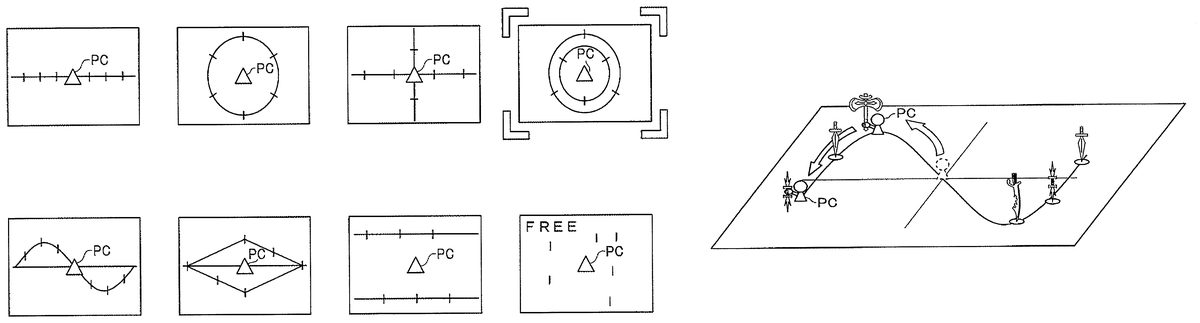
In the weapon arrangement pattern setting process, the control section11first causes the display device50to display a weapon arrangement pattern selecting screen shown inFIG. 6on the image display screen51in response to a predetermined input operation to request of setup of a weapon arrangement pattern by keypad30from the player (Step S301). In the present embodiment, as shown inFIG. 6, eight types of weapon arrangement patterns are prepared, and a sample of each of the weapon arrangement patterns is displayed for indicating how weapons are arranged. More specifically, the eight types of weapon arrangement patterns include a weapon arrangement pattern in which weapons are arranged on a straight line, a weapon arrangement pattern in which weapons are arranged on a circle, a weapon arrangement pattern in which weapons are arranged on two circles, a weapon arrangement pattern in which weapons are arranged on a wavy line, a weapon arrangement pattern in which weapons are arranged on a rhomboid line, and a weapon arrangement pattern in which weapons are arranged at random. In the present embodiment, as shown inFIG. 6, a display position of each of six kinds of weapons and a display position of the player character PC are clearly demonstrated.
In the case where it is determined that any one of the weapon arrangement patterns is selected (“Yes” at Step S301), the control section11causes the display device50to display a weapon arrangement setting screen as shown inFIG. 7, for example, on the image display screen51on the basis of the selected weapon arrangement pattern (Step S303). The control section11then changes the display positions of each of the weapons on the weapon arrangement setting screen in response to an operation to set positions by the keypad30from the player, and sets details of the display position of each of the weapons (that is, a concrete position of each weapon) (Step S304). In this case, at Step S304, only arrangement of the plurality of weapons may just be set, or an arrangement position may be set for each of the types of weapons. Further, at Step S304, the size of each of the shapes on which the weapons can be arranged, which are initially set as samples, may be adjusted appropriately.
As described above, in the present embodiment, the player is caused to select a basic arrangement pattern among sample models, and the player further makes fine adjustments for the weapons based on the sample models thus displayed. The player can set an arrangement pattern of each of the weapons in this manner.
In this regard, in the present embodiment, when the player character executes a predetermined operation such as an operation of a specific button, a battle scene may be interrupted, and a battle screen may be changed to a weapon arrangement setting screen including simple map data of the battle scene. It is preferable that geographic information of the battle scene (such as slant and difference of elevation of the ground) and information on covered objects such as a building and a big rock are reflected in the weapon arrangement setting screen. Further, information on how any enemy character is arranged (where any enemy character is positioned) may be displayed on the weapon arrangement setting screen at the same time. Moreover, a display symbol of an enemy character to be displayed may be changed in accordance with strength and/or a rank of the enemy character. More specifically, for example, as shown inFIG. 8, with respect to a so-called boss character B, a method of displaying the boss character B with a specific display state or with a specific mark is thought so that the boss character B can be distinguished from any other enemy character than the boss character B. Since the display state of the enemy character is displayed in accordance with strength and/or a rank thereof, the player is allowed to consider more strategic weapon arrangement.
Further, a weapon selection menu may be displayed along with the weapon arrangement setting screen at the same time. A weapon whose arrangement is next set is selected by moving a cursor or the like in the weapon selection menu. In this case, as shown inFIG. 9, the weapon specified by the cursor may be widely displayed compared with other weapons, by which the player can easily view detailed part of the displayed weapon. Further, main information on the displayed (specified) weapon such as a weapon name and offensive power may be displayed at the same time.
When the player select a weapon for which an arrangement setup is to be executed on the weapon selection menu, the cursor is displayed on the map in the weapon arrangement setting screen. The player operates this cursor arbitrarily to determine an arrangement position of the selected weapon. When the arrangement position is determined for the selected weapon, the selected weapon may be simplified and displayed as an icon at the arrangement position. By constructing the weapon arrangement setting screen in this manner, the player is allowed to recognize what type of weapon is arranged at any position to an extent only by viewing the map of the weapon arrangement setting screen. Thus, this makes it possible to improve operational efficiency of the player.
Further, in the case where the weapons that have been arranged as described above are not simplified and displayed, information for specifying a weapon (such as a weapon name, an ID number, a symbol and the like) may be displayed in the vicinity of the arranged weapon in order for the player to grasp a relationship between a weapon and an arrangement position thereof. Alternatively, such information may be displayed temporarily at least when a weapon (or an arrangement position thereof) is pointed out by the cursor. Moreover, the player may be allowed to revise an arrangement position of a weapon even in the case where the player determined the arrangement position of the weapon.
Next, a battle scene process when the video game shifts to a battle scene in the present embodiment will be described with reference toFIG. 10.FIG. 10is a flowchart that illustrates an example of the battle scene process. In this regard, since the battle scene process shown inFIG. 10is used to explain a process of changing equipped weapon to another weapon, other processes of the battle scene are omitted.
In the battle scene process, the control section11first determines whether a predetermined input operation indicating request to display weapons by the keypad30from the player is received or not (Step S401). In the case where it is determined that the predetermined input operation is received, the control section11causes the display device50to display the respective weapons on the Image display screen51(Step S402). In this case, the respective weapons are displayed with the set weapon arrangement pattern, and customization information set in the weapon information managing table is added to each of the weapons.
Subsequently, the control section11continues to display the respective weapons on the image display screen51until the control section11receives a predetermined input operation indicating request to terminate display of the weapons by the keypad30from the player (Step S402).
In the state where the weapons are displayed on the image display screen51, the control section11determines whether or not a predetermined input operation indicating request to equip the player character with a weapon is received by means of the keypad30from the player (Step $404). In the case where it is determined that the predetermined input operation is received, the control section11further determines whether there is a weapon with which the player character can be equipped or not (Step S405). In the case where it is determined that there is a weapon with which the player character can be equipped, the control section11causes the player character to be equipped with the weapon (Step S406). In this case, the request to equip the player character with the weapon by operations of the player is specifically an operation signal inputted from an operation input device by means of an operation of a specific button (the same is true in request on the basis of operations of other player).
At Step S405, for example, the control section11determines that the player character can be equipped with a predetermined weapon in the case where the predetermined weapon is displayed within a predetermined distance from a display position (display standard position) of the player character and is the nearest weapon from the display position of the player character. Namely, such a predetermined weapon is determined to be a weapon with which the player character can be equipped. In this case, a standard point of the display position (that is, the display standard position) of the player character is a predetermined point such as a specific point on a central axis of the player character and a point at which a specific part of the player character such as the tip of a finger of a dominant hand is positioned.
The control section11may execute the process at Step S405before the process at Step $404. In this case, the control section11may inform (or announce) the player of a weapon so that the player can recognize such a weapon can be equipped for the player character. Then, when the control section11receives request to equip the player character with such a weapon at Step S404, the processing flow may proceed to Step S406. For example, by highlighting, flashing such a weapon, or changing the color of a weapon, or displaying identification (or indication) in the vicinity of a weapon to indicate that the player character can be equipped with the weapon, a display state of the weapon with which the player character can be equipped may be differentiated from display states of other weapons. Alternatively, such a weapon may be informed by means of a voice. Further, a weapon with which the player character cannot be equipped may be informed so that the player can recognize such a situation (for example, by displaying such a weapon in a dotted line, or displaying a dotted line so as to enclose such a weapon).
Subsequently, the control section11calculates a display position of each of the weapons based on the display position of the player character (Step S407). The control section11then changes the display position of each of the weapons in accordance with the calculated results (Step S408). At Step S407, the control section11refers to the weapon arrangement pattern thus set, and calculates the display position of each of the weapons in consideration of a distance between the player character and each of the weapons and a direction from the display standard position of the player character to a display position of each of the weapons.
In this regard, the processes at Steps S407and S408are executed in the case where a predetermined display method is set so that the display position of each of the weapons is moved along with movement of the player character. However, in the case where another display method is set so that the display position of each of the weapons is fixed regardless of movement of the player character, the processes at Steps S407and S408are not executed. Such a display method may be set in accordance with setup request of a display method by the keypad30from the player during the weapon arrangement pattern setting process, for example.
In the case where a display method is set so that the display position of each of the weapons is fixed regardless of movement of the player character, the processes as shown inFIG. 11may be executed. Namely, it is assumed that the player character PC moves from the display state shown inFIG. 11Ato the display state shown inFIG. 11B, for example. The displayed weapons lay in a fixed position in the virtual space without causing the display position of each of the weapons to be moved as shown inFIG. 111. For this reason, the player can be equipped with any weapon only moving to an arrangement position of the weapon that the player desires to use.
On the other hand, in the case where another display method is set so that the display position of each of the weapons is moved along with movement of the player character, the processes as shown inFIG. 12may be executed. Namely, it is assumed that the player character PC moves from the display state shown inFIG. 12Ato the display state shown inFIG. 12B, for example. As shown inFIG. 12B, the displayed weapons are moved along with movement of the player character while a distance between the player character and each of the displayed weapons and a direction from the player character are maintained (that is, while a positional relationship between the player character and each of the displayed weapons is maintained). Thus, in an arrangement pattern in which this display method can be selected, each of the weapons are arranged near the display position of the player character PC (that is, within a distance at which it is determined that the player character can be equipped with a weapon).
As described above, in the embodiment described above, the video game apparatus100is constructed as follows. Namely, the control section11sets an added value to a weapon for customizing the weapon stored as weapon information in a weapon information managing table in response to customization request by operations of the player. In this case, a plurality of weapons are stored in the weapon information managing table, and the player character can be equipped with any of the weapons among the plurality of weapons. The control section11reads out the weapon information from the weapon information managing table in response to display request of a weapon by operations of the player, and then causes the display device50to display one or more weapon in a battle screen displayed on the image display screen51. In this case, the weapon information thus read out indicates the one or more weapon. The control section11equips the player character with a weapon with which the player character can be equipped among the one or more weapon thus displayed. Thus, it is possible to select a weapon without displaying a menu screen and this makes it possible to use the selected weapon in real time and immediately. Further, it is possible to heighten realism in a battle scene in the video game such as a RPG, and this makes it possible to improve interest of the player in the video game. Moreover, it is possible to reflect the weapon customized by the player in the battle screen, and this makes it possible to increase interest of the player in the video game.
Further, for example, in the scene to select a weapon in the battle screen of the RPG, it is possible to select a weapon and exchange weapons more rapidly without setting a weapon to be equipped on a dedicated menu screen. This makes it possible to increase realism of the battle scene. In addition, the player can consider strategy of a weapon arrangement (for example, which weapon is displayed and where such a weapon is displayed), and this makes it possible to heighten interest of the player in the video game.
Moreover, in the embodiment described above, the video game apparatus100is constructed so that the control section11causes the display device50to display a plurality of weapons in the battle screen at the same time in which multiple kinds of weapon information stored in the weapon information managing table respectively indicate the plurality of weapons. In the conventional video game apparatus, the number of weapon that the player can select at one attack is limited to only one kind, and the player is required to instruct to change weapons on the menu screen in the case where the weapon is to be changed to another. However, since the plurality of weapons are displayed on the battle screen a the same time in the video game apparatus100of the present invention, it is possible to shift (change) a weapon to another weapon smoothly without bringing up the menu screen. This makes it possible to heighten realism (realistic sensation) of the video game.
Furthermore, in the embodiment described above, the video game apparatus100is constructed so that the control section11sets an arrangement pattern of the weapons when the weapons are displayed in the battle screen in response to request to set an arrangement pattern of weapons by operations of the player, and causes the display device50to display the weapons in the battle screen with the arrangement pattern thus set. Thus, not only it is possible to bring up the plurality of weapons in the battle screen at the same time, but also the player can arbitrarily execute a setup as to “in what display state the weapons are displayed”.
Further, in the embodiment described above, the video game apparatus100is constructed so that the control section11determines an arrangement pattern to be utilized among a plurality of arrangement patterns for specifying an arrangement position of each of the weapons, and causes the display device50to display the plurality of weapons in the battle screen on the basis of the arrangement pattern indicating that the plurality of weapons are displayed in the battle screen with a predetermined positional relationship. Thus, the player can arbitrarily execute a setup as to in what arrangement pattern the weapons are displayed. Therefore, by arranging the weapons in advance in accordance with a battle style desired by the player, it is possible to cause the player character to act in the battle scene effectively, and this makes it possible to heighten interest of the player in the video game.
Moreover, in the embodiment described above, the video game apparatus100is constructed so that the control section11causes the display device50to display the plurality of weapons at respective display positions in the battle screen based on a display position of the player character in accordance with the arrangement pattern thus determined, and then to maintain the respective display positions of the plurality of weapons even in the case where the player character moves in the battle screen. Thus, the player can equip the player character with any weapon to battle an enemy character by appropriately changing one another in the plurality of weapons displayed in the battle screen in accordance with the arrangement pattern selected by the player himself. Therefore, for example, the player character can battle enemy characters while changing the weapons by moving between the plurality of displayed weapons. In particular, a skilled player can enjoy close direction effect of sword fight,
Furthermore, in the embodiment described above, the video game apparatus100is constructed so that the control section11causes the display device50to display the plurality of weapons at respective display positions in the battle screen based on a display position of the player character in accordance with the arrangement pattern thus determined, and then to move the respective display positions of the plurality of weapons along with movement of the player character when the player character moves in the battle screen. Thus, it is possible to constantly arrange the weapons near the player character even when the player character moves, and this makes it possible to increase variation of the video game.
In this regard, arrangement position information is set in each of the plurality of arrangement patterns in the embodiment described above. In this case, the arrangement position information indicates an arrangement position (that is, a distance and a direction from the player character) of each of the plurality of weapons based on a display position of the player character. The display position of each of the weapons is determined on the basis of the arrangement position information.
Further, in the embodiment described above, the video game apparatus100is constructed so that the control section11calculates a display position of each of the plurality of weapons based on the display position of the player character in the battle screen in accordance with the arrangement position information set in the arrangement pattern. Thus, it is possible to determine (derive) the display position of each of the weapons on the basis of the display position of the player character.
Moreover, in the embodiment described above, the video game apparatus100is constructed so that a standard point of the display position of the player character is set to a point at which a specific part of the player character such as the tip of a finger of a dominant hand is positioned. In this case, when the player character extends his hand to grab a weapon, the weapon nearest from the tip of a finger of the extended hand is selected and equipped for the player character. This makes it possible to expect an image having reality.
Furthermore, in the embodiment described above, the video game apparatus100is constructed so that the control section11announces that the player character can be equipped with a predetermined weapon in the case where the predetermined weapon is displayed within a predetermined distance from a display position of the player character and is the nearest weapon from the display position of the player character, and the player character is equipped with the weapon when equipment request of the announced weapon is received as the equipment request of a weapon with which the player character can be equipped. Thus, the player character can be equipped with the weapon that is displayed within a predetermined distance from a display position of the player character and is the nearest weapon from the display position of the player character.
Further, although the present invention has been explained using the weapons as an example of the battle tool in the embodiment described above, the video game apparatus100may be constructed so that the control section11sets other battle tools such as a protector and controls them in the similar manner.
Moreover, although the video game apparatus main body10and the display device50are constructed from separate components in the embodiment described above, the display device50may be incorporated in the video game apparatus main body10, as will be readily apparent to those skilled in the art, without departing from the scope of spirit of the present invention.
Furthermore, although one example of the video game control for the RPG has been explained in the embodiment described above, there is no wonder that the technique of the present invention can be applied to similar video games such as a gun action RPG. In addition, the technique of the present invention can also be applied to other kinds of video games appropriately, as will be readily apparent to those skilled in the art, without departing from the scope of spirit of the present invention.
Further, although an aspect of the present invention has been described with the video game apparatus100as an example in the embodiment described above, the present invention is not limited thereto. The present invention can be applied to various apparatuses such as a personal computer, a cellular phone terminal, a portable game apparatus and the like as long as such an apparatus has an image generating function. In this regard, in the case where the present invention is applied to a portable game apparatus or the like, a small-sized storage medium such as a semiconductor memory card may be used as the storage medium70described above in place of a CD-ROM or DVD-ROM, or any other type of storage medium as those skilled in the art will appreciate without departing from the scope or spirit of the present invention.
Moreover, in the embodiment described above, it has been described that game data for causing the video game apparatus main body10(video game apparatus100) to execute the various processes described above (that is, various data such as control program data used for the video game) are stored in the storage medium70. However, the present invention is not limited thereto. The video game data may be delivered by a server apparatus such as a network server (WWW server), or other computer device connected (either wired or wireless) to a network, such as the Internet, a local area network, a wide area network, or the like, or any combination thereof. In this case, the video game apparatus main body10may obtain the video game data delivered by the server apparatus via the communication network80, and store the video game data in the HDD13. The video game data may be used by being loaded on the RAM12from the HDD13. In this regard, although the video game data are explained in the embodiment described above, such data may include at least control program data for causing a computer to execute the image generating process in the embodiment as described above.
The present invention can be applied to a video game machine, a personal computer, a cellular phone terminal, a portable game apparatus or the like, or any combination thereof that causes an image display apparatus to display a player character on an image display screen, and controls progress of a video game by controlling an action of the player character displayed on the image display screen in response to an operation by a player. Therefore, the present invention is useful.
Claims
- A video game processing apparatus that causes an image displayer to display a player character to be movable on a field of a video game displayed on an image display screen of the image displayer, the video game processing apparatus controlling progress of a video game by controlling an action of the player character to be displayed on the image display screen in accordance with operations by a player, the video game processing apparatus comprising: a storage area that stores a battle tool information managing table in which battle tool information showing a plurality of battle tools with which the player character is to be equipped is set, the battle tools including at least one of a weapon and a protector;a battle tool display position calculator that, in response to a display state set request based on the operations of the player, calculates in what positional relationship the plurality of battle tools is set by determining which one of a plurality of arrangements patterns is used, calculates in which arrangement positions of the determined arrangement pattern the images of the battle tools are displayed, and calculates display position information of each of the plurality of battle tools based on the arrangement positions of the images of the battle tools in the determined arrangement pattern;a display state setter that sets a display state of the images of the plurality of battle tools to be displayed on a battle screen based on the display position information calculated by the battle tool display position calculator;a battle tool display controller that reads out the battle tool information set to the battle tool information managing table in response to a display request by the operations of the player, the battle tool display controller causing the image displayer to display the images of the battle tools indicated by the battle tool information thus read out with the display state determined by the display state setter, the images of the battle tools being displayed on the battle screen with reference to a display position of the player character;an equipment request receiver that determines the battle tools which are able to be equipped by the player character by determining the battle tools that are displayed in the determined arrangement pattern within a predetermined distance from the display position of the player character on the battle screen, and that receives an equipment request by the operation of the player with respect to the battle tools capable of being equipped;and a battle tool equipper that equips the player character with one of the battle tools in response to the equipment request receiver receiving the equipment request, wherein the display state setter is configured to change the arrangement positions of the images of the battle tools with respect to one another in the determined arrangement pattern in accordance with the display state set request based on the operations of the player, wherein the player character moves, on the battle screen in accordance with the operations of the player, toward one of the images of one of the battle tools for decreasing a distance between the player character and the one of the images for determining, with the equipment request receiver, that the player character is able to be equipped with the one of the battle tools, and wherein the player character has previously possessed, during the progress of the video game, at least one of the plurality of battle tools that is displayed in the determined arrangement pattern that is set based on the operations of the player, the player character being able to be equipped with the previously possessed one of the plurality of battle tools by moving within the predetermined distance of the corresponding one of the images of the previously possessed one of the battle tools.
- The video game processing apparatus according to claim 1 , wherein the battle tool display controller causes the image displayer to display the images of the plurality of battle tools shown by the battle tool information stored in the battle tool information management table at the same time.
- The video game processing apparatus according to claim 1 , wherein the battle tool display controller causes the image displayer to display the images of the battle tools on the battle screen based on the display position of the player character displayed on the battle screen in accordance with the arrangement pattern determined by the display state setter, and to maintain display positions of the images of the plurality of battle tools on the battle screen even when the player character moves in the battle screen.
- The video game processing apparatus according to claim 1 , wherein a standard point of the display position of the player character includes a specific point on a central axis of the player character and a point at which a predetermined part of the player character is positioned.
- The video game processing apparatus according to claim 1 , wherein the equipment request receiver causes the image displayer to accept the battle tools to which the image is displayed at a position nearest to the position where the player character is displayed as the equipment request of the battle tools capable of being equipped.
- The video game processing apparatus according to claim 1 , further comprising: an equipped possible battle tool annunciator that announces the battle tools which are able to be equipped by the player character, wherein the equipment request receiver receives only equipment requests of a battle tool announced by the equipped battle tool annunciator as the equipment request.
- The video game processing apparatus according to claim 1 , wherein the battle tool information includes a customizing item to customize the battle tools, and further comprises a customizing setter that sets the customizing item to the battle tool information in order to customize the battle tools shown by the battle tool information in accordance with a predetermined request customization operation by the operation of the player.
- The video game processing apparatus according to claim 2 , wherein the battle tool display controller causes the image displayer to display the images of the battle tools on the battle screen based on the display position of the player character displayed on the battle screen in accordance with the arrangement pattern determined by the display state setter, and to maintain display positions of the images of the plurality of battle tools on the battle screen even when the player character moves in the battle screen.
- The video game processing apparatus according to claim 2 , wherein a standard point of the display position of the player character includes a specific point on a central axis of the player character and a point at which a predetermined part of the player character is positioned.
- The video game processing apparatus according to claim 3 , wherein a standard point of the display position of the player character includes a specific point on a central axis of the player character and a point at which a predetermined part of the player character is positioned.
- The video game processing apparatus according to claim 2 , wherein the equipment request receiver causes the image displayer to accept the battle tools to which the image is displayed at a position nearest to the position where the player character is displayed as the equipment request of the battle tools capable of being equipped.
- The video game processing apparatus according to claim 3 , wherein the equipment request receiver causes the image displayer to accept the battle tools to which the image is displayed at a position nearest to the position where the player character is displayed as the equipment request of the battle tools capable of being equipped.
- The video game processing apparatus according to claim 2 , further comprising: an equipped possible battle tool annunciator that announces the battle tools which are able to be equipped by the player character, wherein the equipment request receiver can receive only equipment requests of a battle tool announced by the equipped battle tool annunciator as the equipment request.
- The video game processing apparatus according to claim 3 , further comprising: an equipped possible battle tool annunciator that announces the battle tools which are able to be equipped by the player character, wherein the equipment request receiver can receive only equipment requests of a battle tool announced by the equipped battle tool annunciator as the equipment request.
- The video game processing apparatus according to claim 2 , wherein the battle tool information includes a customizing item to customize the battle tools, and further comprising a customizing setter that sets the customizing item to the battle tool information in order to customize the battle tools shown by the battle tool information in accordance with a predetermined request customization operation by the operation of the player.
- The video game processing apparatus according to claim 3 , wherein the battle tool information includes a customizing item to customize the battle tools, and further comprising a customizing setter that sets the customizing item to the battle tool information in order to customize the battle tools shown by the battle tool information in accordance with a predetermined request customization operation by the operation of the player.
- The video game processing apparatus according to claim 1 , wherein the images of the battle tools are fixedly displayed on the battle screen irrespective of changes in the display position of the player character.
- The video game processing apparatus according to claim 2 , wherein the images of the battle tools are fixedly displayed on the battle screen irrespective of changes in the display position of the player character.
- A non-transitory computer readable storage medium that stores a program for processing a video game, progress of the video game being controlled by causing an image displayer to display a player character moveable on the field of the video game displayed on an image display screen of the image displayer, and controlling an action of each character to be displayed on the image display screen in accordance with operations by a player, the computer readable medium comprising: a storing code segment that stores a battle tool information managing table in which battle tool information showing a plurality of battle tools with which the player character is to be equipped is set, the battle tools including at least one of a weapon and a protector;a display position calculating code segment that, in response to a display state set request based on the operations of the player, calculates in what positional relationship the plurality of battle tools is set by determining which one of a plurality of arrangements patterns is used, calculates in which arrangement positions of the determined arrangement pattern the images of the battle tools are displayed, and calculates display position information of each of the plurality of battle tools based on the arrangement positions of the images of the battle tools in the determined arrangement pattern;a setting code segment that sets a display state of the images of the plurality of battle tools to be displayed on a battle screen based on the display position information calculated by the display position calculating code segment;a reading code segment that reads out the battle tool information set to the battle tool information managing table in response to a display request by the operations by the player, a battle tool displayed controller causing the image displayer to display the images of the battle tools indicated by the battle tool information thus read out with the display state determined by the setting code segment, the images of the battle tools being displayed on the battle screen with reference to a display position of the player character;a judging code segment that determines the battle tools which are able to be equipped by the player character by determining the battle tools that are displayed in the determined arrangement pattern within a predetermined distance from the display position of the player character on the battle screen, and that receives an equipment request by the operation of the player with respect to the battle tools capable of being equipped;and an equipping code segment that equips the player character with one of the battle tools in response to an equipment request receiver receiving the equipment request, wherein the setting code segment is configured to change the arrangement positions of the images of the battle tools with respect to one another in the determined arrangement pattern in accordance with the display state set request based on the operations of the player, wherein the player character moves, on the battle screen in accordance with the operations of the player, toward one of the images of one of the battle tools for decreasing a distance between the player character and the one of the images for determining, with the judging code segment, that the player character is able to be equipped with the one of the battle tools, and wherein the player character has previously possessed, during the progress of the video game, at least one of the plurality of battle tools that is displayed in the determined arrangement pattern that is set based on the operations of the player, the player character being able to be equipped with the previously possessed one of the plurality of battle tools by moving within the predetermined distance of the corresponding one of the images of the previously possessed one of the battle tools.
- The computer readable medium according to claim 19 , wherein the images of the battle tools are fixedly displayed on the battle screen irrespective of changes in the display position of the player character.
Disclaimer: Data collected from the USPTO and may be malformed, incomplete, and/or otherwise inaccurate.