U.S. Pat. No. 7,824,265
VIRTUAL CAMERA CONTROL METHOD IN THREE-DIMENSIONAL VIDEO GAME
AssigneeKabushiki Kaisha Square Enix
Issue DateJanuary 20, 2004
Illustrative Figure
Abstract
A central position of each character participating in a battle is obtained as a fixation point, and multiple temporary points are set on a hemisphere around the fixation point. Each temporary viewpoint position is set on a straight line connecting the fixation point to each temporary point. Each temporary viewpoint position is a position from which all characters can be projected on a virtual screen when perspective transformation is executed at a predetermined visual angle and a distance to the fixation point is shortest. Points are given to each temporary viewpoint position based on the result of a distance evaluation, an angle evaluation, an overlap evaluation, and a height difference evaluation. The top scoring temporary viewpoint positions are selected as positions where the viewpoint of a virtual camera should be moved.
Description
DETAILED DESCRIPTION OF PREFERRED EMBODIMENT An embodiment of the present invention will be specifically described with reference to the drawings. FIG. 1is a block diagram illustrating a configuration of a video game apparatus100for executing a three-dimensional game according to this embodiment. As illustrated in the figure, a video game apparatus100includes a video game main body101. The video game main body101includes a control section103, a RAM (Random Access Memory)105, a hard disk drive (HDD)107, a sound processor109, a graphics processor111, a DVD/CD-ROM drive113, a communications interface115, and an interface section117. The control section103, the RAM105, the HDD107, the sound processor109, the graphics processor111, the DVD/CD-ROM drive113, the communications interface115, and the interface section117are connected to an internal bus119. The sound processor109of the video game main body101is connected to a sound output device125, which is a speaker, and the graphics processor111is connected to a display device121having a display screen122. A storage medium (DVD-ROM or CD-ROM)131can be attached to the DVD/CD-ROM drive113. The communications interface115is connected to a network151. An input section (controller)161and a memory card162are connected to the interface section117. The control section103includes a CPU (Central Processing Unit), a ROM (Read Only Memory), etc., and executes a program stored on the HDD107or the storage medium131to control the video game apparatus100. The control section103has an internal timer. The RAM105is a work area for the control section103. The HDD107is a storage area for storing a program and data. In the case where a program executed by the control section103instructs the sound processor109to output a sound, the sound processor109interprets the instruction and outputs a sound signal to the sound output device125. The graphics processor111develops an image onto the frame memory112and outputs a video signal, which displays the image on the display screen122of the display device121according to a drawing command output from the control section103. It ...
DETAILED DESCRIPTION OF PREFERRED EMBODIMENT
An embodiment of the present invention will be specifically described with reference to the drawings.
FIG. 1is a block diagram illustrating a configuration of a video game apparatus100for executing a three-dimensional game according to this embodiment. As illustrated in the figure, a video game apparatus100includes a video game main body101. The video game main body101includes a control section103, a RAM (Random Access Memory)105, a hard disk drive (HDD)107, a sound processor109, a graphics processor111, a DVD/CD-ROM drive113, a communications interface115, and an interface section117. The control section103, the RAM105, the HDD107, the sound processor109, the graphics processor111, the DVD/CD-ROM drive113, the communications interface115, and the interface section117are connected to an internal bus119.
The sound processor109of the video game main body101is connected to a sound output device125, which is a speaker, and the graphics processor111is connected to a display device121having a display screen122. A storage medium (DVD-ROM or CD-ROM)131can be attached to the DVD/CD-ROM drive113. The communications interface115is connected to a network151. An input section (controller)161and a memory card162are connected to the interface section117.
The control section103includes a CPU (Central Processing Unit), a ROM (Read Only Memory), etc., and executes a program stored on the HDD107or the storage medium131to control the video game apparatus100. The control section103has an internal timer. The RAM105is a work area for the control section103. The HDD107is a storage area for storing a program and data. In the case where a program executed by the control section103instructs the sound processor109to output a sound, the sound processor109interprets the instruction and outputs a sound signal to the sound output device125.
The graphics processor111develops an image onto the frame memory112and outputs a video signal, which displays the image on the display screen122of the display device121according to a drawing command output from the control section103. It is assumed that one frame time of the image included in the outputting video signal is, for example, 1/30 sec. The DVD/CD-ROM drive113reads the program and data from the storage medium131. The communications interface115is connected to the network151to perform communications with other computers.
The interface section117outputs input data sent from the input section161to the RAM105, and the control section103interprets it to carry out arithmetic processing. The input section161includes a directional key and multiple operation keys. The directional key is used to move a cursor and input a message. The interface section117forwards data, indicative of the progress of the game stored in the RAM105, to the memory card162based on the instruction from the control section103. The interface section117reads data of the game stored in the memory card162at the time of suspending the game, and transfers the read data to the RAM105.
The program and data for performing the game by the video game apparatus100are first stored on, for example, the storage medium131. The program and data are read by the DVD/CD-ROM drive113and loaded onto the RAM105at the time of execution. The control section103processes the program and data loaded onto the RAM105, outputs a drawing command to the graphics processor111, and outputs an instruction of a sound output to the sound processor109. Intermediate data is stored in the RAM105while the control section103performs processing.
A three-dimensional video game according to this embodiment will be next explained. This three-dimensional video game is a role playing game (RPG). A player operates the input section161to advance the game while moving the player characters on a map (field). When the player characters move to a predetermined point on the map, a battle between the player characters and enemy characters is started. When the player characters win the battle, they return onto the normal map and the progress of the game restarts.
FIG. 2is a view illustrating an example of a display screen122at a battle between the player characters and the enemy characters. The battle is performed on a battle map, which is different from a normal map. The battle map is set to have a predetermined size (larger than at least a range where the characters can move). The size predetermined on the battle map corresponds to the size of a range where a viewpoint position of a virtual camera (to be described later) is movable.
The example ofFIG. 2shows a case in which three player characters201to203battle with three enemy characters204to206. During this battle, the player characters and enemy characters (hereinafter both referred to simply as characters)201to206act according to an instruction from the player or a program, and move to an arbitrary position on the battle map. The characters201to206may not move back to the original position after the action.
On the display screen122at the battle time, an image in which the battle map where the characters201to206exist is perspective-transformed and displayed. On the display screen122at the battle time, an action selecting section211and a status displaying section212are displayed at a front side of the image on the battle map where the characters201to206exist. The action selecting section211selects an action to be instructed to the player characters201to203, and the status selecting section212displays a current status of each of the characters201to203.
The respective positions (including the positions of the characters201to206) on the battle map illustrated inFIG. 2are shown by coordinates (X, Y, Z) of a world coordinate system to be described later. The characters201to206are polygonal-shaped, and shown by coordinates (x, y, z) of a local coordinate system. In the case of performing perspective transformation, coordinates (X′, Y′, Z′) of a viewpoint coordinate system and coordinates of a screen coordinate system are used.
FIG. 3is a view illustrating an example of the characters201to206appearing at the battle time. Nine reference points300to308are set to the characters201to206. At the time of deciding the viewpoint position of the virtual camera to be described later, only reference points301and302are used as positions of the characters201to206. Characteristic points of the characters201to206(vertexes of the respective polygons) are shown by, for example, the coordinates (x, y, z) of the local coordinate system using the reference point300, showing the center of gravity, as an origin. Each direction of the characters201to206is shown by an angle which each axis of the local coordinate system forms with each axis of the world coordinate system. At the time of performing perspective transformation, the coordinates of the characteristic points of the characters201to206are transformed to the coordinates of the world coordinate system.
The state that the player characters201to203battle with the enemy characters204to206is displayed on the display screen122by perspective-transforming a virtual three-dimensional space which the battle map is formed and recognized by each player.FIG. 4schematically illustrates the state of the perspective transformation. A virtual camera401is placed in the virtual three-dimensional space and an image projected on a virtual screen402is displayed on the display screen122. The position of the virtual camera401is a viewpoint403, the direction of the virtual camera401is a visual axis (optical axis)404, and an angle that is formed by two straight lines obtained by connecting the viewpoint403to a diagonal vertex of the virtual screen402is a visual angle405.
A coordinate system used to project an image on the virtual screen402is a viewpoint coordinate system (X′, Y′, Z′), and the direction of the visual axis404is a Z′ axis of the viewpoint coordinate system. The coordinates of the world coordinate (including coordinates transformed from coordinates of the local coordinate system) are transformed to the coordinates of the viewpoint coordinate system. The coordinates X′ and Y′ of the viewpoint coordinate system are further transformed to the coordinates of the screen coordinate system. In order to generate an image projected on the virtual screen402by the perspective transformation, there is a need to perform hidden surface removal that removes a surface hidden by another object placed in the front. A Z buffer method is used as the hidden surface removal method. However, since this is not related to the present invention, the specific explanation is omitted.
On the precondition that the perspective transformation is performed, there is a need for determining the position of the viewpoint403of the virtual camera401, the direction of the visual axis404and the size of the visual angle405. When the position of the viewpoint403, the direction of the visual axis404and the size of the visual angle405are decided, the position of the virtual screen402is inevitably determined. The direction of the visual axis404is always directed to a fixation point500calculated as a central position of each of the characters201to206to be described later. The size of the visual angle405is set to be basically the same except for the case that adjustment is made as described later.
The position of the viewpoint403is decided for each fixed time according to the progress of the battle and moved to the decided position. At the time of deciding the position of the viewpoint403, multiple temporary points are set with reference to the fixation point500. Multiple temporary viewpoint positions are set on a straight line that connects each temporary point to the fixation point500. Among the multiple temporary viewpoint positions, the position of the viewpoint403is decided based on scores obtained by performing a distance evaluation, an angle evaluation, an overlap evaluation, and a height evaluation to be described later.
The following will explain processing in the three-dimensional video game according to this embodiment. In the three-dimensional video game according to this embodiment, when the player characters move on the normal map and reach a predetermined position, they start to battle with the enemy characters, and when the battle ends, they return to the normal map. This operation is repeated, so that the game progresses. When the player characters move on the normal map, processing relating to the present invention is not executed. The following will explain only the battle processing where the processing relating to the present invention is executed. When the battle starts, the battle map appears, and control processing of the virtual camera401, which is unique to the battle time, and perspective transformation processing (which is not unique to the battle time) are executed in parallel with each other.
FIG. 5is a flowchart illustrating battle processing between the player characters and the enemy characters. In the battle processing, the control section103arranges multiple player characters201to203on the battle map (step S101). The control section103selects the kind of enemy character and the number of enemy characters according to the location where the battle occurred, and arranges the selected enemy characters204to206on the battle map (step S102). The player characters201to203and the enemy characters204to206arranged on the map become movable for each fixed time set by its status. The player characters201to203may be prevented from becoming movable until another player character, which previously became movable, starts to act.
When the player characters201to203and the enemy characters204to206are arranged, the control section103judges whether any one of the enemy characters becomes movable (step S103). When there is an enemy character that becomes movable, the control section103selects an action of the enemy character and causes the enemy character to execute the selected action. The control section103also causes the player characters201to203and the other enemy characters to execute predetermined actions as required according to the result of this action (step S104). The actions of the characters include movement of position on the map. The positions of characters may differ before and after their actions, respectively (the same is applied to step S107to be described later). Then, the processing flow proceeds to step S108.
When there is no enemy character that becomes movable, the control section103judges whether any one of the player characters201to203becomes movable (step S105). When there is no player character that becomes movable, the processing flow goes back to step S103. When there is a player character that becomes movable, the control section103causes the display section122to display the action selecting section211. The control section103judges whether an action is instructed to the movable player character (step S106). When no action is instructed, the processing flow goes back to step S103.
When the action is instructed, the control section103causes the player character to execute the instructed action. The control section103also causes the enemy characters204to206and the other player characters to execute predetermined actions as required based on the result of the action (step S107). Then, the processing flow proceeds to step S108. In step S104or S107, a character becomes in a battle impossible state when a predetermined parameter (for example, HP) is 0. The control section103removes an enemy character that is in a battle impossible state from the battle map.
In step S108, the control section103judges whether all enemy characters204to206are in a battle impossible state and the player characters201to203defeat the enemy characters204to206as a result of the battle. When the player characters201to203do not defeat all of the enemy characters, the control section103judges whether all player characters201to203are in a battle impossible state and all player characters201to203are defeated by the enemy characters204to206as a result of the battle (step S109). When all player characters201to203are not defeated by the enemy characters204to206, the processing flow goes back to step S103.
When the player characters201to203defeat all of the enemy characters in step S108, the control section103executes a predetermined battle victory processing (step S110). The control section103ends battle processing, and returns onto the normal map to restart the progress of the game. When all player characters201to203are defeated by the enemy characters204to206in step S109, the game is over and processing ends.
FIG. 6is a flowchart illustrating control processing of the virtual camera401at the battle time. At the time other than the battle time such as the time when each player character moves on the normal map, different control processing of the virtual camera401is executed.
In control processing of the virtual camera401at the battle time, the control section103obtains central positions of all characters (including the player characters and the enemy characters) participating in the battle as the fixation point500(step S201). Coordinates (Xp, Yp, Zp) of the fixation point500can be obtained by the equation (1) shown below. (Xk, Yk, Zk) indicate coordinates of the world coordinate system of the reference point301placed below the feet of the kth character participating in the battle. It is assumed that the number of characters participating in the battle is n.
(Xp,Yp,Zp)=(∑k=1nXkn,∑k=1nYkn,∑k=1nZkn)(1)
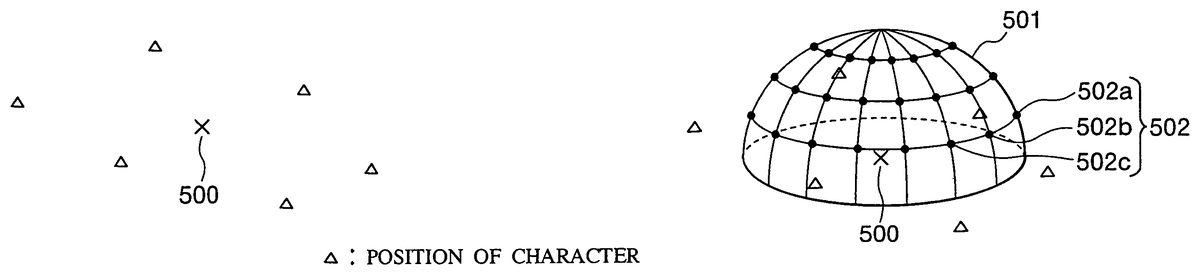
The control section103provides a virtual hemisphere in the virtual three-dimensional space around the fixation point500obtained in the step S201, and sets multiple temporary points with predetermined intervals on polar coordinates around the fixation point500on the hemisphere (step S202). The control section103sets a temporary viewpoint position on each straight line that connects the fixation point500to each temporary point. A position from which all characters can be projected on the virtual screen402and a distance to the fixation point500is shortest is set as the temporary viewpoint position, when the visual angle405is set to a predetermined size and the virtual three-dimensional space is perspective-transformed. The control section103also obtains a distance between the fixation point500and each temporary viewpoint position (step S203).
The following will explain the processing including the decision of the fixation point500in step S201to the decision of the temporary viewpoint position in step S203with reference toFIGS. 7A to 7C. As illustrated inFIG. 7A, when it is assumed that six characters are present on the battle map, the central position of the characters is obtained as the fixation point500. As illustrated inFIG. 7B, a virtual hemisphere501is drawn around the fixation point500. The hemisphere501has multiple temporary points502(502a,502b,502c, . . . ). A direction to each temporary point502from the fixation point500is predetermined by the polar coordinates around the fixation point500.
As illustrated inFIG. 7C, when the position of the viewpoint403of the virtual camera401is placed on a straight line connecting the fixation point500to each temporary point502, a position where all characters can be projected on the virtual screen402and a distance from the fixation point500is shortest is set as the temporary viewpoint position. The control section103judges whether each character can be projected on the virtual screen402based on only the reference point301placed below the feet and a reference point302above the head.
When the temporary viewpoint points are set, the control section103evaluates a distance from each temporary viewpoint position to the fixation point500and executes a distance evaluation processing that gives a score corresponding to the evaluation result to each temporary viewpoint position (step S204). The distance evaluation processing will be specifically explained with reference to the flowchart ofFIG. 8.
In the distance evaluation processing, the control section103sorts the respective temporary viewpoint positions in ascending order from the shortest distance to the fixation point500(step S301). The control section103obtains a difference between the longest distance from the temporary viewpoint position to the fixation point500and the shortest distance. The control section103divides a value a (a is a constant) given as a maximum score of the distance evaluation by the obtained difference to calculate a change rate (step S302). Each value of the constants a, β, γ and d (described later) is determined according to the importance of the corresponding evaluation.
The control section103stores the maximum value a as a score of the temporary viewpoint position having the shortest distance (step S303). The control section103executes loop processing by changing the processing temporary viewpoint positions in order from the second shortest distance to the second longest distance (steps S304to S304′).
In the loop processing, the control section103obtains a difference between the distance from the processing temporary viewpoint position to the fixation point500and the shortest distance. The control section103multiplies the obtained difference by the change rate obtained in the step S302, and adds the result to the score of the processing temporary viewpoint position (step S305). When the loop processing of all temporary viewpoint positions ends, the control section103ends the distance evaluation processing. Since the temporary viewpoint position having the longest distance to the fixation point500is not processed in the loop processing, a score for the temporary viewpoint in the distance evaluation processing is 0.
When the distance evaluation processing ends, the processing flow goes back to the flowchart ofFIG. 6and the control section103executes angle evaluation processing that evaluates an angle formed by a straight line connecting each temporary viewpoint position to the fixation point500and a straight line connecting the current position of the viewpoint403to the fixation point500to give a score corresponding to the evaluation result to each temporary viewpoint position (step S205). The angle evaluation processing will be specifically explained with reference to the flowchart ofFIG. 9.
In the angle evaluation processing, the control section103executes loop processing by changing the processing temporary viewpoint positions sequentially (step S401to S401′). In the loop processing, the control section103obtains an angle θ1formed by the line from the current position of the viewpoint403of the virtual camera401to the position of the fixation point500and the line from the processing temporary viewpoint position to the position of the fixation point500(step S402). The control section103obtains β cos θ1(βis a constant) and adds it to the score of the processing temporary viewpoint position (step S403). When the loop processing of all temporary viewpoint positions ends, the control section103ends the angle evaluation processing.
When the angle evaluation processing ends, the processing flow goes back to the flowchart ofFIG. 6and the control section103executes overlap evaluation processing that evaluates to what degree the characters are displayed on the virtual screen402in an overlapping state when perspective transformation is executed from each temporary viewpoint position to give a score corresponding to the evaluation result to each temporary viewpoint position (step S206). The overlap evaluation processing will be specifically explained with reference to the flowchart ofFIG. 10.
In the overlap evaluation processing, the control section103first executes loop1processing as changing the processing temporary viewpoint positions sequentially (step S501to S501′). In the loop1processing, the control section103executes loop2processing as changing the processing character existing from rear to front (steps S502to S502′). The positions where the characters exist can be judged based on only the value of the Z′ coordinate of the reference point300of the center of gravity of each character.
In the loop2processing, when it is assumed that perspective transformation is executed from the temporary viewpoint position, the control section103projects reference points301to308of the processing character except for the center of gravity thereof on the virtual screen to draw a polygon (step S503). The control section103obtains an area of a portion where the drawn polygon overlaps with the previously drawn polygon (when the drawn polygon overlaps with two or more polygons, each area is obtained), and adds it as an overlapping area of the relevant viewpoint position (step S504). When the loop2processing of all characters ends, a temporary viewpoint position to be processed in the loop1processing becomes a next temporary viewpoint position. When the loop1processing of all temporary viewpoint positions ends, the control section103evaluates the overlapping area of each temporary viewpoint position.
The control section103sorts the respective temporary viewpoint positions in ascending order from the obtained smallest overlapping area (step S505). The control section103obtains a difference between the smallest overlapping area and the largest overlapping area. The control section103divides a value γ (γ is a constant) given as a maximum score of the overlap evaluation by the obtained difference to calculate a change rate (step S506).
The control section103adds the maximum value γ to the score of the temporary viewpoint position having the smallest overlapping area (step S507). The control section103executes loop3processing by changing the processing temporary viewpoint positions in order from the second smallest overlapping area to the second largest overlapping area (steps S508to S508′).
In the loop3processing, the control section103obtains a difference between the overlapping area of the processing temporary viewpoint position and the smallest overlapping area of all temporary viewpoint positions. The control section103multiplies the obtained difference by the change rate obtained in the step S506, and adds the result as a score of the processing temporary viewpoint position (step S509). When the loop3processing of all temporary viewpoint positions ends, the control section103ends the overlap evaluation processing. Since the temporary viewpoint position having the largest area is not processed in the loop processing3, a score for the temporary viewpoint position in the distance evaluation processing is 0.
When the overlap evaluation processing ends, the processing flow goes back to the flowchart ofFIG. 6and the control section103executes height evaluation processing that evaluates a height of each temporary viewpoint position according to a difference in height between the characters to give a score corresponding to the evaluation result to each temporary viewpoint position (step S207). The height evaluation processing will be specifically explained with reference to the flowchart ofFIG. 11.
In the height evaluation processing, the control section103judges whether a difference in height between the characters participating in the battle (difference between the maximum height and the minimum height) is more than a predetermined value (step S601). When the difference in height is more than the predetermined value, the control section103executes loop1processing by changing the processing temporary viewpoint positions sequentially (step S602to S602′). When the difference in height is not more than the predetermined value, the control section103executes loop2processing by changing the processing temporary viewpoint positions sequentially (step S605to S605′).
In the loop1processing, the control section103obtains an angle θ2which a straight line connecting the processing temporary viewpoint position to the fixation point500forms with a horizontal surface (a surface where the Y coordinate of the world coordinate system is 0) (step S603). The control section103obtains d cos θ2(d is a constant) and adds it to the score for the processing temporary viewpoint position (step S604). When the loop1processing of all temporary viewpoint positions ends, the control section103ends the height evaluation processing.
In the loop2processing, the control section103obtains an angle θ2which a straight line connecting the processing temporary viewpoint position to the fixation point500forms with a horizontal surface (step S606). The control section103obtains d sin θ2(d is a constant) and adds it to the score for the processing temporary viewpoint position (step S607). When the loop2processing of all temporary viewpoint positions as processing objects ends, the control section103ends the height evaluation processing.
When the height evaluation processing ends, a total score of each temporary viewpoint position is obtained. The control section103extracts temporary viewpoint positions including the top 4 total scores (step S208). The control section103selects the extracted four temporary viewpoint positions as positions of the viewpoint403of the virtual camera401in the order of 1st place→2nd place→3rd place→4th place→1st place . . . The position that is first selected as the position of the viewpoint403is the temporary viewpoint position whose total score ranks first (step S209).
When the position of the viewpoint403of the virtual camera401is selected, the control section103judges whether the selected position of the viewpoint403is within an effective range of the battle map in which the virtual camera401is movable and no obstacle exists between the viewpoint403and the fixation point500or between the viewpoint403and each character (step S210). When the selected position of the viewpoint403is in the effective range, the processing directly proceeds to step S213.
When the selected position of the viewpoint403is not in the effective range, the control section103moves the position of the viewpoint403to the fixation point500until the position enters the effective range (step S211). When perspective transformation is executed at the moved position of the viewpoint403, the control section103adjusts the visual angle405of the virtual camera401such that all characters are projected on the virtual screen402(step S212). Then, the processing proceeds to step S213.
In step S213, the control section103judges whether the battle processing ofFIG. 5ends. When the battle processing does not end, the control section103judges whether a fixed time has passed since the position of the viewpoint403of the virtual camera401was recalculated (step S214). When the fixed time has not passed, the control section103judges whether a specified time, which is longer than the fixed time, has passed since the position of the viewpoint403of the virtual camera401was changed (step S215). When the specified time has not passed, the processing goes back to step S213.
When the specified time has passed in step S215, the processing goes back to step S209and the control section103reselects a next temporary viewpoint position as the position of the viewpoint403of the virtual camera401. When the fixed time has passed in step S214, the processing goes back to step S201and the control section103executes processing again from the decision of the position of the fixation point500. When the battle processing ends in step S213, the processing of this flowchart ends. When the battle processing ends, the processing is shifted to control processing of the virtual camera401that is different from the flowchart ofFIG. 6.
In parallel with the aforementioned battle processing and control processing of the virtual camera401, perspective transformation processing is executed by timer interruption occurring every frame period.FIG. 12Aillustrates processing that is executed by the control section103in the perspective transformation processing, andFIG. 12Billustrates processing that is executed by the graphics processor111. Regarding the perspective transformation processing, the same processing is executed regardless of whether the progress of the game is in a battle. The perspective transformation processing may be executed every two frame periods depending on the amount of processing that is required for the perspective transformation processing, and the same image may be displayed on the display screen122for two frame periods.
As illustrated inFIG. 12A, the control section103transforms the coordinates of the local coordinate system of the characteristic points of all characters into coordinates of the world coordinate system (step S701). The control section103transforms the coordinates of the points, which form the respective surfaces constituting the characters included in the range of the perspective transformation and the map, into the coordinates of the viewpoint coordinate system according to the coordinates of the world coordinate system of the viewpoint403and the direction of the visual axis404(step S702). The control section103transforms X′ and Y′ coordinates of the viewpoint coordinate system transformed in step S702into the coordinates of the screen coordinate system (step S703).
The control section103sends the coordinates of the points constituting the respective surfaces transformed into the screen coordinate system (including Z′ coordinates of the viewpoint coordinate system) to the graphics processor111, and outputs a drawing command to the graphics processor111(step S704). By the output of the drawing command, processing, which the control section103executes for perspective transformation, ends. Processing for drawing the image projected on the virtual screen402to output to the display device122as a video signal is executed by the graphics processor111.
As illustrated inFIG. 12B, the graphics processor111executes loop processing as changing the processing polygon from the rear side to the front side based on the Z′ coordinate of the screen coordinate system that was received together with the drawing command (steps S751to S751′). In the loop processing, the graphics processor111updates the contents of a Z buffer to leave data of a point existing in the front (small value of Z′ coordinate) (step S752). When the contents of the Z buffer are updated, the graphics processor111develops image data of the polygon onto the frame memory112. The graphics processor111also executes processing such as shading, texture mapping and the like to developed image data (step S753).
When processing of all polygons ends, loop processing finishes. The graphics processor111reads image data developed onto the frame memory112sequentially, adds a synch signal to generate a video signal, and outputs it to the display device121(step S754). Accordingly, the processing by the graphics processor111ends. The display device121displays an image corresponding to the video signal output from the graphics processor111on the display screen122. By switching the display screen122every single frame period, the player can view the image of the battle between the player characters201to203and the enemy characters.
The following will explain the change in the display screen122at the battle time in the three-dimensional video game according to this embodiment based on specific examples. The change in the display screen122at the battle time occurs when the position of the viewpoint403of the virtual camera401is moved according to the positions of the characters and the kinds of the characters.FIGS. 13A to 13Care views illustrating examples of the display screen122according to the positions of the characters and the kinds of the characters.
FIGS. 13A and 13Billustrate the display screen122at the battle of the same time. However, the positions of the player characters201to203and the enemy characters204to206change with the progress of the battle. Accordingly, since the position of the viewpoint403of the virtual camera401is also changed, a change in the display screen122appears as in the figure.
In the examples ofFIGS. 13A and 13B, the heights of the enemy characters204are not much different from those of the player characters201to203. For this reason, since a high score is given to the temporary viewpoint position placed at the higher position, an image in which the position of the viewpoint403of the virtual camera401is set at a relatively high position is displayed in many cases. In contrast to this, inFIG. 13Cillustrating the battle of another time, the heights of the enemy characters207and208are largely different from those of the player characters201to203and a high score is given to the temporary viewpoint position placed at a low position. As a result, an image in which the position of the viewpoint403of the virtual camera401is set at a relatively low position is displayed in many cases.
As explained above, in the three-dimensional video game according to this embodiment, though the position of each character changes with the progress of the battle, the position of the viewpoint403of the virtual camera401is obtained according to the change in the position of the character. Accordingly, an image perspective-transformed by the virtual camera401placed at an appropriate position is displayed on the display screen122.
The viewpoint403of the virtual camera401is selected among the temporary viewpoint positions decided as the positions where all characters can be projected on the virtual screen402. Therefore, all characters participating in the battle are displayed on the display screen122. Moreover, the visual axis404of the virtual camera401is always directed to the fixation point500which is used to decide the temporary viewpoint position. For this reason, all characters participating in the battle are arranged on the display screen122in a well-balanced manner.
The evaluation of each temporary viewpoint position for selecting the position of the viewpoint403of the virtual camera401is executed using four types of processing, namely, the distance evaluation processing, the angle evaluation processing, the overlap evaluation processing, and the height evaluation processing. In the distance evaluation processing, the shorter the distance from the temporary viewpoint position to the fixation point500is, the higher the score is for the temporary viewpoint position. Accordingly, the size of the character displayed on the display screen122can be large. In the angle evaluation processing, the smaller the angle θ1is, the higher the score is for the temporary viewpoint position. Accordingly, the amount of movement of the viewpoint403can be reduced, thereby making it possible to prevent the player from feeing a sense of incompatibility with the change in the display screen122.
In the overlap evaluation processing, the smaller the character overlapping area is, the higher the score is for the temporary viewpoint position. Accordingly, the player can easily view each character on the display screen122. Processing for obtaining the character overlapping area in the overlap evaluation process can suppress the amount of processing by use of a simple method. Since the overlapping area obtained here is used to simply decide only the position of the viewpoint403of the virtual camera401, there is no problem in the practical use even if a correct value cannot be obtained by the simple method.
In the height evaluation processing, when the difference in height between the characters is small, the higher the temporary viewpoint position is placed in terms of the angle, the higher the score is for the temporary viewpoint position. When the difference in height between the characters is large, the lower the temporary viewpoint position is placed in terms of the angle, the higher the score is for the temporary viewpoint position. Accordingly, the image can be displayed on the display screen122so that the player can easily recognize the size of the character.
On the battle map, the effective range where the position of the viewpoint403of the virtual camera401can be moved is set, and when the position of the viewpoint403exceeds this range, the characters cannot be displayed on the display screen122by perspective transformation. In such a case, the position of the viewpoint403of the virtual camera401is moved to the fixation point500and the visual angle405is adjusted such that all characters can be projected on the virtual screen402. Accordingly, the temporary viewpoint position can be set to the position out of the effective range on the battle map to execute the evaluation. Even if the total score of the temporary viewpoint position out of the effective range becomes large, it is possible to generate substantially the same image as the image obtained when the position of the viewpoint403of the virtual camera401is placed at the temporary viewpoint position out of the effective range.
Though the total scores of the temporary viewpoint positions are calculated by the distance evaluation processing, the angle evaluation processing, the overlap evaluation processing and the height evaluation processing, the temporary viewpoint positions including the four highest scores are selected as positions where the viewpoint403of the virtual camera401should be moved. The position of the viewpoint403of the virtual camera401is moved by switching at the selected four temporary viewpoint positions every predetermined time. Accordingly, an image that is rich in a change can be displayed on the display screen122.
In the three-dimensional video game according to this embodiment, the position of each character at the battle gradually changes. When the battle time becomes long, there is a case that the position of each character is largely different from the position at the battle start time. Even if the battle time becomes long and the position of the character greatly changes, the position of the viewpoint403of the virtual camera401is newly decided every fixed time. This makes it possible to set the position of the viewpoint403of the virtual camera401at a suitable position according to the change in the position of the characters at the battle.
The present invention is not limited to the aforementioned embodiment and various modifications and applications may be possible. The following will explain some modifications of the above embodiment that are applicable to the present invention.
According to the aforementioned embodiment, in the angle evaluation processing, at the time of obtaining the score of each temporary viewpoint position, the angle θ1, which the straight line connecting each temporary viewpoint position to the fixation point500formed with the straight line connecting the current position of the viewpoint403of the virtual camera401to the fixation point500, was obtained. In the height evaluation processing, the angle θ2, which the straight line connecting each temporary viewpoint position to the fixation point500formed with the horizontal surface, was obtained.
However, θ1and θ2showing the angle values themselves may not be obtained depending on the computing equation used to obtain the score that evaluates each temporary viewpoint position. Numerical values uniquely defined are obtained in the course of the computation according to angles such as a sine value, a cosine value or a tangent value, so that a final score may be obtained. In this way, obtaining numerical values uniquely defined according to angles such as a sine value, a cosine value or a tangent value is substantially the same as the case in which the angles θ1and θ2are obtained.
In the aforementioned embodiment, the temporary viewpoint positions having the top4scores were selected as the positions of the viewpoint403of the virtual camera401, and the position of the viewpoint403was automatically switched between the selected four temporary viewpoint positions every predetermined time. In contrast to this, the position of the viewpoint403may be switched such that the time for which the position of the view point403is placed increases as the total score of the temporary viewpoint position increases.
Every time when the player inputs a predetermined operation from the input section161, the control section103switches the temporary viewpoint positions having the top four scores sequentially, so that the position of the viewpoint403of the virtual camera401may be moved. In this case, the player can display his/her favorite image as an image showing the progress of the game on the display device121to make it easier to advance the progress of the game.
The player inputs a predetermined operation from the input section161, so that the control section103may move the position of the viewpoint403of the virtual camera401regardless of the total score. In this case, the viewpoint403of the virtual camera401may be moved to only the temporary viewpoint position selected with reference to the fixation point500(regardless of the value of the total score). The position of the viewpoint403may be moved to all positions within the effective range regardless of the temporary viewpoint positions. In this way, the position of the viewpoint403of the virtual camera401can be freely moved, thereby making it easier for the player to advance the game according to the display screen122adjusted to his/her favorite.
In the aforementioned embodiment, every time when the fixed time passed in the battle processing, the total score of each temporary viewpoint position selected with reference to the fixation point500was obtained and the position of the viewpoint403of the virtual camera401was decided. In contrast to this, every time when a character that is newly movable occurs among the player characters201to203, the total score of each temporary viewpoint position selected with reference to the fixation point500may be obtained and the position of the viewpoint403of the virtual camera401may be decided. In this case, the player can provide instructions for action to the movable player characters201to203after viewing the display screen122perspective-transformed from the viewpoint403placed at the position suitable for the current state.
In the aforementioned embodiment, the fixation point500was set to a central position of all characters (including the player characters and enemy characters) participating in the battle. In contrast to this, when there are variations in the size of the characters and the importance of the battle, weight may be assigned to the position of each character according to the variations to obtain the position of the fixation point500. This makes it possible to select a suitable position according to the characters participating in the battle as the position of the viewpoint403of the virtual camera401.
There can be considered the character, which does not exert an influence onto the progress of the game even if it is not projected on the display screen122, such as a character that is in a battle impossible state for a fixed time. Such a character may be excluded when obtaining the fixation point500. Such a character may be excluded when obtaining the temporary viewpoint positions. This makes it possible to select a suitable position according to the battle state as the position of the viewpoint403of the virtual camera401.
In the aforementioned embodiment, regarding each temporary viewpoint position selected with reference to the fixation point500, the scores were added thereto in each of the distance evaluation processing, the angle evaluation processing, the overlap evaluation processing and the height evaluation processing, so that the total scores were obtained. However, when at least the distance evaluation processing is applied to calculate the total score of each temporary viewpoint position, it is possible to arbitrarily select whether the angle evaluation processing, the overlap evaluation processing and the height evaluation processing should be applied. The total score of each temporary viewpoint position may be obtained by further adding scores that evaluate each temporary viewpoint position by methods other than the distance evaluation processing, the angle evaluation processing, the overlap evaluation processing and the height evaluation processing.
The aforementioned embodiment explained the case in which the present invention was applied to project the image of the battle between the player characters and the enemy characters. However, the present invention can be applied to the general three-dimensional video games in which multiple characters exist in the virtual three-dimensional space and at least one character moves. The characters are not limited to the aforementioned shapes such as human, animals, robots, and the like, and it is possible to include general objects (for example, automobile, air plane, and the like) that are movable in the virtual three-dimensional space in connection with the progress of the game.
In the aforementioned embodiment, the video game apparatus100, which was a special-purpose machine, was used as a platform where the three-dimensional video game was executed. In contrast to this, any apparatus such as a general-purpose computer may be used if the apparatus includes the same structural components as those of the video game main body101. Moreover, a portable video game apparatus, which contains the display device121in the same cabinet as that of the video game main body101, may also be used.
A semiconductor memory card may be used as the storage medium131in place of a DVD-ROM or CD-ROM. In the video game apparatus main body101or the portable game apparatus, a card slot for inserting the memory card may be formed in place of the DVD/CD-ROM drive113. In the case of the general-purpose personal computer, the program and data relating to the present invention may be prestored to the HDD107instead of being stored to the storage medium131. Regarding the storage medium for storing the program and data relating to the present invention, any storage medium may be used according to the physical form of hardware and the distribution thereof.
The program for executing the video game of the present invention may be stored on a fixed disc apparatus provided in a Web server apparatus existing on the network151. The Web server apparatus may convert the program and data stored in the fixed disc apparatus to a signal and superimpose the signal on a carrier wave, and distribute it to the video game main body101via the network151. The program, which the communications interface115received from the Web server apparatus, can be stored in the HDD107and loaded to the RAM105at an executing time.
Although the invention has been described with reference to several exemplary embodiments, it is understood that the words that have been used are words of description and illustration, rather than words of limitation. Changes may be made within the purview of the appended claims, as presently stated and as amended, without departing from the scope and spirit of the invention in its aspects. Although the invention has been described with reference to particular means, materials and embodiments, the invention is not intended to be limited to the particulars disclosed; rather, the invention extends to all functionally equivalent structures, methods, and uses such as are within the scope of the appended claims.
Claims
- A three-dimensional video game apparatus that perspective-transforms a virtual three-dimensional space where multiple characters exist onto a virtual screen based upon a virtual camera having a viewpoint position moved in response to positions of the multiple characters, comprising: a character mover that moves at least one of the characters in the virtual three-dimensional space;a central position calculator that calculates a central position of the characters in the virtual three-dimensional space;a temporary point setter that sets multiple temporary points at once in the virtual three dimensional space with reference to the calculated central position;a temporary viewpoint position setter that sets a temporary viewpoint position on each straight line, connecting each of the temporary points to the central position, where all of the characters can be projected on the virtual screen with a predetermined visual angle;a distance calculator that calculates a distance between each of the set temporary viewpoint positions and the calculated central position;a viewpoint position evaluator that evaluates each temporary viewpoint position based on each calculated distance;a viewpoint position selector that selects a position where the viewpoint of the virtual camera should be moved among the temporary viewpoint positions based on the evaluation result;a viewpoint position mover that moves the viewpoint position of the virtual camera to the selected position;and a perspective transformer that perspective-transforms the three-dimensional space onto the virtual screen based upon the virtual camera where the viewpoint position is moved: wherein the temporary points are set around the central position and a direction to each of the temporary points from the central position is predetermined based on polar coordinates of the central position.
- The three-dimensional video game apparatus according to claim 1 , further comprising an angle calculator that calculates an angle formed by a straight line connecting a current viewpoint position of the virtual camera to the calculated central position and each straight line connecting each of the temporary viewpoint positions to the central position, wherein said viewpoint position evaluator further evaluates each temporary viewpoint position based on the calculated angle.
- The three-dimensional video game apparatus according to claim 1 , further comprising an overlap degree calculator that calculates an overlap degree of the characters when the viewpoint of the virtual camera is set to each of the temporary viewpoint positions and perspective transformation is executed, wherein said viewpoint position evaluator further evaluates each temporary viewpoint position based on the calculated overlap degree.
- The three-dimensional video game apparatus according to claim 3 , wherein multiple reference points are assigned to the multiple characters, and said overlap degree calculator calculates the overlap degree of the characters according to an overlapping area of polygons drawn by connecting the reference points projected on the virtual screen in connection with each of the multiple characters.
- The three-dimensional video game apparatus according to claim 1 , further comprising a height difference determiner that determines a height difference between the characters, wherein said viewpoint position evaluator further evaluates each temporary viewpoint position based on the determination result of the height difference.
- The three-dimensional video game apparatus according to claim 5 , wherein said height difference determiner includes a judger that judges whether the height difference between the characters is more than a predetermined value, and said viewpoint position evaluator evaluates each temporary viewpoint position such that the higher the temporary viewpoint position is placed, the more highly the temporary viewpoint position is rated when the height difference between the characters is not more than the predetermined value, the lower the temporary viewpoint position is placed, the more highly the temporary viewpoint position is rated when the height difference between the characters is more than the predetermined value.
- The three-dimensional video game apparatus according to claim 1 , wherein said viewpoint position selector selects multiple viewpoint positions among the temporary viewpoint positions according to the evaluation result, and said viewpoint position mover switches the viewpoint of the virtual camera to the selected viewpoint positions sequentially.
- The three-dimensional video game apparatus according to claim 7 , wherein said viewpoint position mover includes a controller that controls switching of the viewpoint position of the virtual camera every time a predetermined time period passes.
- The three-dimensional video game apparatus according to claim 7 , wherein said viewpoint position mover includes a controller that controls switching of the viewpoint position of the virtual camera according to the evaluation result of the selected multiple positions.
- The three-dimensional video game apparatus according to claim 7 , further comprising a viewpoint switching director that directs switching of the viewpoint position of the virtual camera by a player's operation, wherein said viewpoint position mover includes a controller that controls switching of the viewpoint position of the virtual camera every time switching is directed from said viewpoint switching director.
- The three-dimensional video game apparatus according to claim 1 , wherein a range limit where the viewpoint position of the virtual camera can be moved is fixed in the virtual three-dimensional space, and the three-dimensional video game apparatus further includes a range limit judger that judges whether the selected viewpoint position of the virtual camera is within the range limit, a viewpoint position adjustor that moves the viewpoint position of the virtual camera to a central position within the range limit when the selected viewpoint position of the virtual camera is not within the range limit, and a visual angle adjustor that changes the visual angle of the virtual camera such that all of the characters are projected on the virtual screen.
- The three-dimensional video game apparatus according to claim 1 , further comprising a viewpoint moving director that directs movement of the viewpoint position of the virtual camera by a player's operation, wherein said viewpoint mover moves the viewpoint position of the virtual camera according to the direction of the movement.
- The three-dimensional video game apparatus according to claim 12 , wherein said viewpoint position mover moves the viewpoint position of the virtual camera regardless of whether the viewpoint position is the position selected from the temporary viewpoint positions.
- The three-dimensional video game apparatus according to claim 1 , further comprising a time counter that counts elapse of a fixed time interval, and a starter that starts said central position calculator, said temporary point setter, said distance calculator, and said viewpoint position evaluator every time the fixed time interval elapses.
- The three-dimensional video game apparatus according to claim 1 , wherein the characters include multiple player characters that move in the virtual three-dimensional space by player's instructions, and said three-dimensional video game apparatus further comprises a player character switcher that sequentially switches a player character that can receive a player's instruction and a starter that starts said central position calculator, said temporary point setter, said distance calculator, and said viewpoint position evaluator every time the player character that can receive the player's instruction is switched.
- The three-dimensional video game apparatus according to claim 1 , wherein said central position calculator assigns weight to each of the characters existing in the three-dimensional space to calculate the central position of the multiple characters.
- The three-dimensional video game apparatus according to claim 1 , further comprises a character selector that selects a character to be used to decide the viewpoint position of the virtual camera among the characters existing in the three-dimensional space according to the progress of the game.
- A three-dimensional video game apparatus that perspective-transforms a virtual three-dimensional space where multiple characters exist onto a virtual screen based upon a virtual camera having a viewpoint position moved in response to positions of the multiple characters, comprising a memory that stores a game program, a processor that executes said game program, and a displayer that displays a processing result of said processor, wherein the game program is stored in said memory and causes said processor to execute: moving at least one of the characters in the virtual three-dimensional space;calculating a central position of the characters in the virtual three-dimensional space;setting multiple temporary points at once in the virtual three-dimensional space with reference to the calculated central position;setting a temporary viewpoint position on each straight line, connecting each of the temporary points to the central position, where all of the characters can be projected on the virtual screen with a predetermined visual angle;calculating a distance between each of the set temporary viewpoint positions and the calculated central position;evaluating each temporary viewpoint position based on each calculated distance;selecting a position where the viewpoint of the virtual camera should be moved among the temporary viewpoint positions based on the evaluation result;moving the viewpoint position of the virtual camera to the selected position;and perspective-transforming the three-dimensional space onto the virtual screen based upon the virtual camera where the viewpoint position is moved: wherein the temporary points are set around the central position and a direction to each of the temporary points from the central position is predetermined based on polar coordinates of the central position.
- The three-dimensional video game apparatus according to claim 18 , wherein the game program further calculates an angle formed by a straight line connecting a current viewpoint position of the virtual camera to the calculated central position and each straight line connecting each of the temporary viewpoint positions to the central position, and each temporary viewpoint position is further evaluated based on the calculated angle.
- The three-dimensional video game apparatus according to claim 19 , wherein the game program further calculates an overlap degree of the characters when the viewpoint of the virtual camera is set to each of the temporary viewpoint positions and perspective transformation is executed, and each temporary viewpoint position is further evaluated based on the calculated overlap degree.
- The three-dimensional video game apparatus according to claim 18 , wherein the game program further determines a height difference between the characters, and each temporary viewpoint position is further evaluated based on a determination result of the height difference.
- A computer-implemented method for controlling a viewpoint position of a virtual camera based on positions of multiple characters existing in a virtual three dimensional space in a three-dimensional video game that perspective-transforms the virtual three-dimensional space onto a virtual screen based upon the virtual camera, comprising: moving, with a computer, at least one of the characters in the virtual three-dimensional space;calculating, with the computer, a central position of the characters in the virtual three dimensional space;setting, with the computer, multiple temporary points at once in the virtual three dimensional space with reference to the calculated central position;setting, with the computer, a temporary viewpoint position on each straight line, connecting each of the temporary points to the central position, where all of the characters can be projected on the virtual screen with a predetermined visual angle;calculating, with the computer, a distance between each of the set temporary viewpoint positions and the calculated central position;evaluating, with the computer, each temporary viewpoint position based on each calculated distance;selecting, with the computer, a position where the viewpoint of the virtual camera should be moved among the temporary viewpoint positions based on the evaluation result;moving, with the computer, the viewpoint position of the virtual camera to the selected position;and perspective-transforming, with the computer, the three-dimensional space onto the virtual screen based upon the virtual camera where the viewpoint position is moved: wherein the temporary points are set around the central position and a direction to each of the temporary points from the central position is predetermined based on polar coordinates of the central position.
- The method according to claim 22 , wherein an angle formed by a straight line connecting a current viewpoint position of the virtual camera to the calculated central position and each straight line connecting each of the temporary viewpoint positions to the central position is further calculated, and each temporary viewpoint position is further evaluated based on the calculated angle.
- The method according to claim 22 , wherein an overlap degree of the characters is further calculated when the viewpoint of the virtual camera is set to each of the temporary viewpoint positions and perspective transformation is executed, and each temporary viewpoint position is further evaluated based on the calculated overlap degree.
- The method according to claim 22 , wherein a height difference between the characters is further determined, and each temporary viewpoint position is further evaluated based on a determination result of the height difference.
- A non-transitory computer-readable storage medium on which a game program for executing a video game that perspective-transforms a virtual three-dimensional space where multiple characters exist onto a virtual screen based upon a virtual camera having a viewpoint position moved in response to positions of the multiple characters, the game program causing a computer apparatus to execute: moving at least one of the characters in the virtual three-dimensional space;calculating a central position of the characters in the virtual three-dimensional space;setting multiple temporary points at once in the virtual three-dimensional space with reference to the calculated central position;setting a temporary viewpoint position on each straight line, connecting each of the temporary points to the central position, where all of the characters can be projected on the virtual screen with a predetermined visual angle;calculating a distance between each of the set temporary viewpoint positions and the calculated central position;evaluating each temporary viewpoint position based on each calculated distance;selecting a position where the viewpoint of the virtual camera should be moved among the temporary viewpoint positions based on the evaluation result;moving the viewpoint position of the virtual camera to the selected position;and perspective-transforming the three-dimensional space onto the virtual screen based upon the virtual camera where the viewpoint position is moved, wherein the temporary points are set around the central position and a direction to each of the temporary points from the central position is predetermined based on polar coordinates of the central position.
Disclaimer: Data collected from the USPTO and may be malformed, incomplete, and/or otherwise inaccurate.