U.S. Pat. No. 7,803,055
WALL-MOUNTABLE VIDEO GAME
AssigneeColumbia Amusement, Inc.
Issue DateJuly 1, 2004
Illustrative Figure
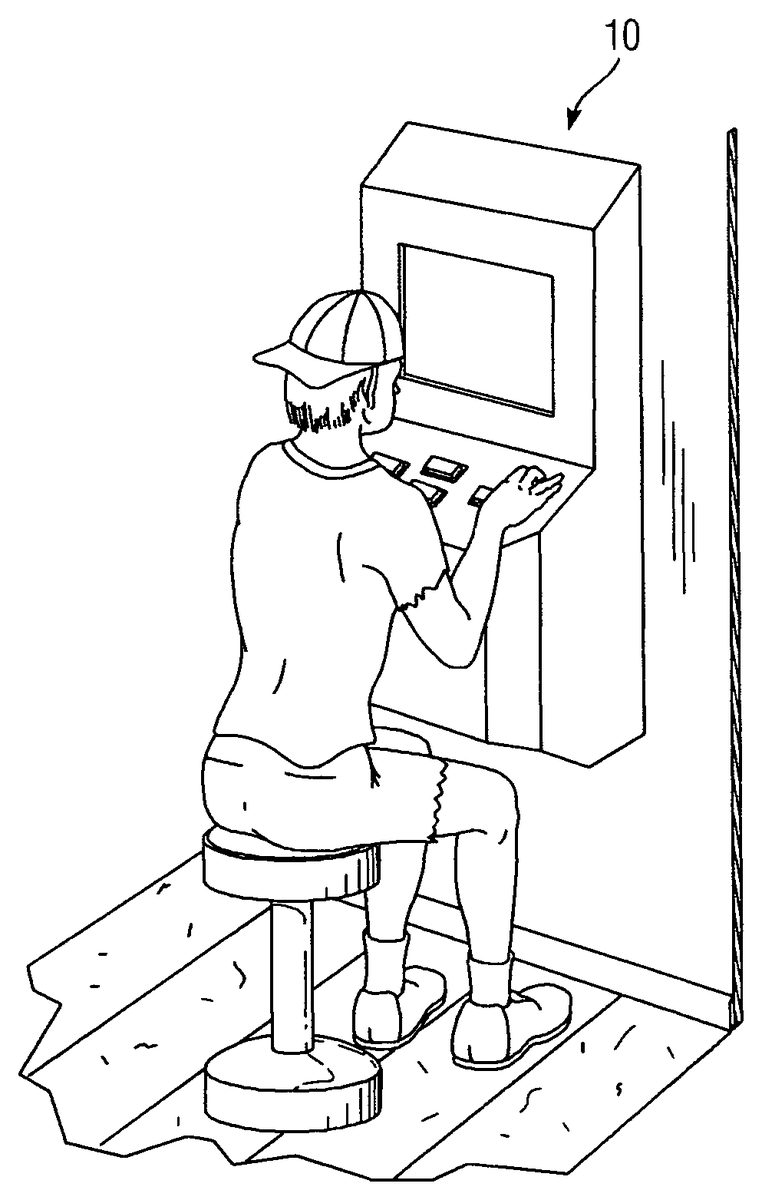
Abstract
A wall mounted video game has a cabinet. A relatively thin monitor is received in the upper portion of the cabinet. The lower portion of the cabinet is deeper than the upper portion. Manual controls are set in the lower portion. The cabinet has a back hingedly connected to the body of the cabinet. The back of the cabinet is mounted on the wall and the cabinet is locked in a closed position mounted on the wall. Circuitry for the video game is connected to the back of the cabinet and is in the interior of the cabinet, connected by an electrical harness to the controls and the monitor.
Description
DESCRIPTION OF THE PREFERRED EMBODIMENTS Referring now to the drawings,FIG. 1shows the prior art. The video game has a picture tube in the upper portion to display the game. The device is relatively large and occupies much floor space in a game arcade or other location. As seen inFIGS. 2-5, the video game10of the present invention is a compact device which has a cabinet having an upper portion12, a stepped lower portion14, a right side16, a left side18, a top ledge20, a bottom22and a back24. Preferably, the lower portion14has a top ledge28which is slanted forwardly at an acute angle. Manually manipulated controls30are disposed on the slanted ledge28. The controls30may be a plurality of push buttons. The lower portion14has a bottom ledge32which is rearwardly slanted downwardly at an acute angle. When the video game is mounted on a wall, as will be described, the rearwardly slanted bottom ledge32provides space for the player to be seated in front of the game10such that the player's knees are below the bottom ledge32. The player is close enough to the video game10to comfortably operate the controls30while occupying a minimum amount of space. The overall depth of the lower portion14, at its deepest dimension, is approximately twelve (12) inches. The upper portion12of the cabinet has a top ledge20which is slanted forwardly. In the upper portion of the front of the cabinet there is a monitor34for the player to view the game. The monitor34in the present invention is a compact liquid crystal display (LCD) which is approximately two (2) inches in depth as compared to a conventional picture tube monitor which is approximately 15-20 inches in depth. The overall depth of the upper portion12of the cabinet is approximately six (6) inches. It is preferred that a break-resistant plastic shield36be mounted in front of the monitor34to prevent damage ...
DESCRIPTION OF THE PREFERRED EMBODIMENTS
Referring now to the drawings,FIG. 1shows the prior art. The video game has a picture tube in the upper portion to display the game. The device is relatively large and occupies much floor space in a game arcade or other location.
As seen inFIGS. 2-5, the video game10of the present invention is a compact device which has a cabinet having an upper portion12, a stepped lower portion14, a right side16, a left side18, a top ledge20, a bottom22and a back24. Preferably, the lower portion14has a top ledge28which is slanted forwardly at an acute angle. Manually manipulated controls30are disposed on the slanted ledge28. The controls30may be a plurality of push buttons. The lower portion14has a bottom ledge32which is rearwardly slanted downwardly at an acute angle. When the video game is mounted on a wall, as will be described, the rearwardly slanted bottom ledge32provides space for the player to be seated in front of the game10such that the player's knees are below the bottom ledge32. The player is close enough to the video game10to comfortably operate the controls30while occupying a minimum amount of space. The overall depth of the lower portion14, at its deepest dimension, is approximately twelve (12) inches.
The upper portion12of the cabinet has a top ledge20which is slanted forwardly. In the upper portion of the front of the cabinet there is a monitor34for the player to view the game. The monitor34in the present invention is a compact liquid crystal display (LCD) which is approximately two (2) inches in depth as compared to a conventional picture tube monitor which is approximately 15-20 inches in depth. The overall depth of the upper portion12of the cabinet is approximately six (6) inches. It is preferred that a break-resistant plastic shield36be mounted in front of the monitor34to prevent damage to the monitor34.
The back of the cabinet is attached to the side16of the cabinet by hinges (FIGS. 5 and 6). Preferably, the back24of the cabinet is secured to a vertical wall in the arcade or room in which the video game is to be played. As shown inFIGS. 7-10, one method of securing the cabinet to the wall is by a French cleat. Exteriorly, at the top of the back24, a first panel40is connected. The first panel extends the width of the back24. The bottom edge of the first panel, distal from the back24, is beveled upwardly at an angle of approximately 45° across the entire width of the panel. A corresponding second panel42, having an upper edge beveled at approximately 45° is mounted on the wall such that the beveled edge extends upwardly distal from the wall. The cabinet is placed against the wall and lowered until the upward facing 45° edge on the second panel42cooperates with the downward facing 45° edge on the first panel40connected to the back24of the cabinet. Fasteners such as screws are then connected to the inner face of the back24of the cabinet such that the fasteners firmly secure together the back24of the cabinet and the second panel42mounted on the wall. The entire cabinet of the video game10is supported against the wall in this manner.
The above describes a preferred method of mounting the cabinet to the wall. Other methods known to persons skilled in the art may be used. Also, the cabinet may be mounted on legs or be free standing if desired.
As noted above, the back24of the cabinet is hinged to the side of the cabinet in the manner of a door. A lock means44connects the back24of the cabinet to the body of the cabinet. The lock means may be a threaded shaft mounted in the body of the cabinet which is received in a cooperating threaded receiver on the back of the cabinet. A key or similar locking device secures the threaded shaft. Thus, when the cabinet is locked, access is prevented to the back of the cabinet and it is not possible to remove the cabinet from the second panel42which is attached to the wall. As a result the video game of the present invention is permanently hung on the wall and can be removed only when the lock means44is opened and the fasteners removed from the inside of the back24.
Also, the circuitry to operate the video game10is mounted internally on the back24(FIG. 6) and is inaccessible without having access to the key to the lock means44. The circuitry includes a filter46, a power supply48, a game pc board50, a converter52, an audio speaker54and a monitor power supply62. A flexible electrical harness56connects the circuitry mounted on the back24with the monitor34and the controls30. The converter52converts Color Graphics Adapter (CGA) to Video Graphics Array (VGA) which uses analog signals and has greater resolution and more colors.
As shown inFIG. 3, a currency acceptor58is mounted on the front of the body of the video game10, preferably on the lower portion14. The currency acceptor58may be set to receive coins, chips, vouchers or paper currency. For paper currency, a stacking receptacle60is mounted interiorly of the cabinet aligned with the currency receptor58. The currency acceptor58is electrically connected to the circuitry such that the video game is activated when the predetermined currency is deposited in the currency receptor58by a player of the game.
Obviously, many modifications may be made without departing from the basic spirit of the present invention. Accordingly, it will be appreciated by those skilled in the art that within the scope of the appended claims, the invention may be practiced other than has been specifically described herein.
Claims
- A wall-mounted video game, comprising a cabinet including an upper portion housing a relatively-thin monitor and further including a lower portion having the controls to be manipulated by a player, the cabinet further including a main body having a front and a back, a single separate door hingedly connected to the back of the main body, the door being anchored to a wall in a video arcade or other establishment, thereby taking up a minimum of floor space in the arcade while being convenient and comfortable for a player;circuitry for operation of the video game being mounted internally on the door, providing access to the circuitry when the main body of the cabinet is swung outwardly from the door;the circuitry having a converter to convert color graphics adapter (CGA) to video graphics array (VGA);locking means extending from the front of the main body to the door anchored to the wall, a key being provided to unlock the locking means, the locking means securing the main body to the door and preventing removal of the cabinet from the wall, the locking means preventing access to the circuitry.
- The wall-mounted video game of claim 1 , wherein the locking means has a handle on the front of the main body, the handle being connected to a shaft extending from the front of the main body to the door, the shaft having an end cooperating with a receiving means in the door.
- The wall-mounted video game of claim 1 , wherein the cabinet is stepped in side profile, such that the upper portion of the cabinet is thinner than the lower portion thereof, the lower portion of the stepped cabinet having a ledge which is slanted rearwardly downwardly at an acute angle, and wherein space is provided beneath the wall-mounted video game so a player may be comfortably seated in front of the video game.
- The wall-mounted video game of claim 1 , wherein the circuitry comprises a filter, a power supply game pc board, a CGA converter, an audio speaker and a monitor power supply.
- A wall-mounted video game, comprising a cabinet including an upper portion housing a relatively-thin monitor and further including a lower portion having the controls to be manipulated by a player, the cabinet further including a main body having a front and a back, a single separate door hingedly connected to the back of the main body, the separate door being anchored to a wall in a video arcade or other establishment, thereby taking up a minimum of floor space in the arcade while being convenient and comfortable for the player;wherein circuitry for operation of the video game is mounted internally on the door, the circuitry comprising a filter, a power supply, a game pc board, a converter to convert GCA to VGA, an audio speaker, and a monitor power supply, access to the circuitry being provided only when the main body of the cabinet is swung outwardly from the door;locking means having a handle on the front of the main body, the handle being connected to a shaft extending from the front of the main body to a cooperating receiver in the door anchored to the wall, a key being provided to unlock the locking means, the locking means securing the main body to the door and preventing removal of the cabinet from the wall, the locking means providing access to the circuitry mounted internally on the door;wherein the cabinet is stepped in side profile, such that the upper portion of the cabinet is thinner than the lower portion thereof;and wherein the lower portion of the stepped cabinet has a ledge which is rearwardly slanted downwardly at an acute angle, and wherein space is provided beneath the wall mounted game so a player may be comfortably seated in front of the video game.
Disclaimer: Data collected from the USPTO and may be malformed, incomplete, and/or otherwise inaccurate.