U.S. Pat. No. 7,785,201
BACKGROUND IMAGE ACQUISITION METHOD, VIDEO GAME APPARATUS, BACKGROUND IMAGE ACQUISITION PROGRAM, AND COMPUTER-READABLE MEDIUM CONTAINING COMPUTER PROGRAM
AssigneeSega Corporation
Issue DateSeptember 2, 2005
Illustrative Figure
Abstract
A background image acquisition technique is disclosed for acquiring a background image that is required for calculating a background difference in a video game that uses an input image supplied by a camera while enabling command input through image recognition of a player image. The background image acquisition technique involves compositing a button item for responding to an operation of a player with a portion of an image captured by the camera which captured image includes a player image representing the posture of the player, displaying the composite image on a monitor screen, guiding the player into position such that the player image is accommodated within said portion of the captured image, and acquiring an image of a region of the captured image other than said portion as the background image.
Description
DETAILED DESCRIPTION OF THE PREFERRED EMBODIMENTS In the following, preferred embodiments of the present invention are described with reference to the accompanying drawings. FIG. 1is a block diagram showing a configuration of a video game apparatus according to an embodiment of the present invention. The video game apparatus shown inFIG. 1includes a video game apparatus main body1and a camera2, a display monitor3such as a television monitor, and a speaker4that are connected to the video game apparatus main body1via a USB (Universal Serial Bus) cable, for example. It is noted that the camera2does not necessarily have to be directly connected to the video game apparatus main body1, and may be connected thereto via a network, for example. The video game apparatus main body1includes a program storage device11such as a CD-ROM or a DVD in which game software (program) is stored, a CPU12that executes overall control processes of the video game apparatus1, a main memory13that temporarily stores programs and data used in executing control processes, a graphics memory (storage)14that stores image data, an image processing unit15that generates and controls an image according to game content, an audio processing unit16that generates and controls audio, an image output unit17that outputs an image signal to the display monitor3, and an audio output unit18that outputs audio to the speaker4. FIG. 2is a flowchart illustrating steps of a background image acquisition process for acquiring a background image that is required for calculating a background difference in the video game apparatus shown inFIG. 1. It is noted that the illustrated background image acquisition process may be executed by the CPU12of the video game apparatus main body1using relevant programs. In the illustrated example ofFIG. 2, when a game is started, a game selection menu is displayed on the display monitor3shown inFIG. 1(step S1), and a game to be played ...
DETAILED DESCRIPTION OF THE PREFERRED EMBODIMENTS
In the following, preferred embodiments of the present invention are described with reference to the accompanying drawings.
FIG. 1is a block diagram showing a configuration of a video game apparatus according to an embodiment of the present invention.
The video game apparatus shown inFIG. 1includes a video game apparatus main body1and a camera2, a display monitor3such as a television monitor, and a speaker4that are connected to the video game apparatus main body1via a USB (Universal Serial Bus) cable, for example. It is noted that the camera2does not necessarily have to be directly connected to the video game apparatus main body1, and may be connected thereto via a network, for example.
The video game apparatus main body1includes a program storage device11such as a CD-ROM or a DVD in which game software (program) is stored, a CPU12that executes overall control processes of the video game apparatus1, a main memory13that temporarily stores programs and data used in executing control processes, a graphics memory (storage)14that stores image data, an image processing unit15that generates and controls an image according to game content, an audio processing unit16that generates and controls audio, an image output unit17that outputs an image signal to the display monitor3, and an audio output unit18that outputs audio to the speaker4.
FIG. 2is a flowchart illustrating steps of a background image acquisition process for acquiring a background image that is required for calculating a background difference in the video game apparatus shown inFIG. 1. It is noted that the illustrated background image acquisition process may be executed by the CPU12of the video game apparatus main body1using relevant programs.
In the illustrated example ofFIG. 2, when a game is started, a game selection menu is displayed on the display monitor3shown inFIG. 1(step S1), and a game to be played is determined according to a selection made by a player (step S2). It is noted that in the present example, it is assumed that plural mini games are included in one set of game software; however, in a case where the game software includes only one game, steps S1and S2may be omitted.
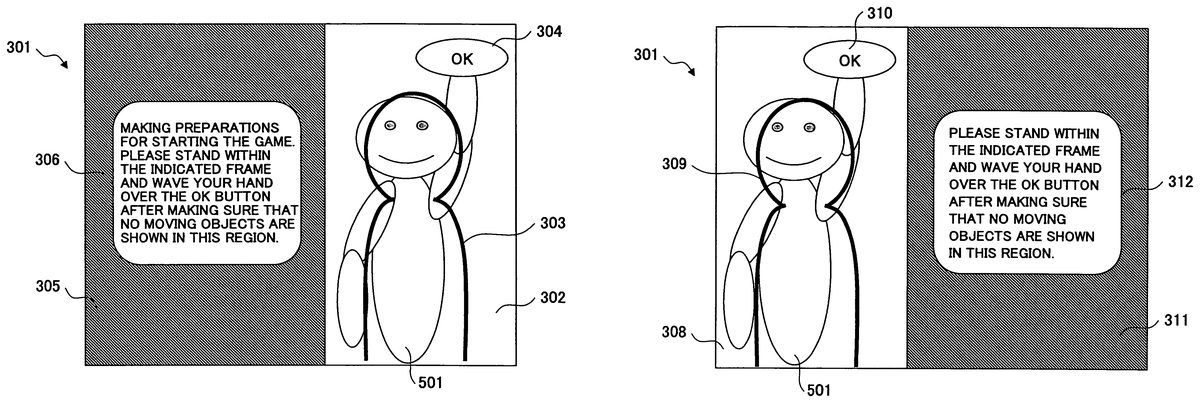
Then, guidance for acquiring a left side background image is displayed on the display monitor3(step S3).FIG. 3is a diagram showing an exemplary screen that may be displayed upon performing a left side background image acquisition process. InFIG. 3, a frame303indicating a standing position outline for a player501and a button item304that is to be operated by the player501are displayed at a right side operation region302on the right side of a monitor screen301, and a message306indicating, “MAKING PREPARATIONS FOR STARTING THE GAME. PLEASE STAND WITHIN THE INDICATED FRAME AND WAVE YOUR HAND OVER THE OK BUTTON AFTER MAKING SURE THAT NO MOVING OBJECTS ARE SHOWN IN THIS REGION.” is displayed at a left side background acquisition region305on the left side of the monitor screen301. It is noted that the left side background acquisition region305is arranged to be slightly larger than half the monitor screen301so that an overlapping portion with a right side background acquisition region311(seeFIG. 5) may be provided as is described below. In this way, influence from noise generated at the dividing portion between the left and right background acquisition regions305and311may be reduced, and a determination may be made as to whether the camera has been moved during acquisition of the background image based on the image difference between the overlapping portions of the left and right background acquisition regions305and311.
Referring back toFIG. 2, a determination is made as to whether the OK button is activated (step S4). If the OK button is not activated, the guidance for left side background image acquisition continues to be displayed (step S3). If the OK button is activated, a determination is made as to whether there is any moving object included in the left side background acquisition region305based on the frame difference (i.e., difference in pixel information between pixels of frames) detected within the region305(step S5). It is noted that if a moving object is included in a background acquisition region, its corresponding image cannot be used as a background image for calculating the background difference; therefore, the existence of a moving object is checked for before acquisition of the background image in order to improve efficiency.
When it is determined in step S5that a moving object exists, an error screen is displayed on the monitor careen301for a predetermined period of time (step S6).FIG. 4is a diagram showing an exemplary error screen that may be displayed when the left side background image acquisition process fails. InFIG. 4, a message307indicating, “A MOVING OBJECT IS DETECTED IN THE LEFT SIDE REGION OF THE SCREEN. THE MOVING OBJECT IS INDICATED BY BLUE DOTS. PLEASE AVOID SHOWING ANY MOVING OBJECTS AND TRY AGAIN.” is displayed on the monitor screen301.
Referring back toFIG. 2, when it is determined in step S5that a moving object is not included in the left side background acquisition region305, the image of the background acquisition region305is acquired as a background image (step S7).
Then, guidance for acquiring a right side background image is displayed on the display monitor3(step S8).FIG. 5is a diagram showing an exemplary screen that may be displayed upon performing a right side background image acquisition process. InFIG. 5, a frame309indicating a standing position outline for the player501and a button item310to be operated by the player501are displayed at a left side operation region308on the left side of the monitor screen301, and a message312indicating, “PLEASE STAND WITHIN THE INDICATED FRAME AND WAVE YOUR HAND OVER THE OK BUTTON AFTER MAKING SURE THAT NO MOVING OBJECTS ARE SHOWN IN THIS REGION.” is displayed at a right side background acquisition region311on the right side of the monitor screen301.
Then, referring back toFIG. 2, a determination is made as to whether the OK button is activated (step S9). If the OK button is not activated, the guidance for right side background image acquisition continues to be displayed (step S8). If the OK button is activated, a determination is made as to whether a moving object is included in the right side background acquisition region311based on a frame difference detected in this region311(step S10).
When it is determined in step S10that a moving object is included in the right side background acquisition region311, an error screen is displayed for a predetermined period of time (step S11).FIG. 6is a diagram showing an exemplary error screen that may be displayed when the right side background image acquisition process fails. InFIG. 6, a message313indicating, “A MOVING OBJECT IS DETECTED IN THE RIGHT SIDE REGION OF THE SCREEN. THE MOVING OBJECT IS INDICATED BY BLUE DOTS. PLEASE AVOID SHOWING ANY MOVING OBJECTS AND TRY AGAIN.” is displayed on the monitor screen301.
Referring back toFIG. 2, when it is determined in step S10that no moving objects are included in the right side back ground acquisition region311, the image of the right side background acquisition region311is acquired as a background image (step S12).
Then, a determination is made as to whether a color difference above a predetermined level is detected between overlapping portions of the left side background image and the right side background image (step S13). If such a color difference above the predetermined level is detected, an error screen is displayed (step S14), and the operation goes back to the step of displaying the guidance for left side background image acquisition (step S3).FIG. 7is a diagram showing an exemplary screen that may be displayed in a case where the camera is moved from the time of acquiring the left side background image to the time of acquiring the right side background image. InFIG. 7, a message314indicating, “CAMERA HAS BEEN MOVED. PLEASE REINITIATE PREPARATIONS FOR STARTING THE GAME.” is displayed on the monitor screen301.
Referring back toFIG. 2, in a case where a color difference exceeding a predetermined level is not detected between the overlapping regions of the left side background image and the right side background image, the background image acquisition process is ended and the game is started (step S15).
FIG. 8is a diagram showing an exemplary screen that may be displayed when only images of left and right side edge regions are acquired in the background image acquisition process. In the process described with reference toFIGS. 2 through 7, a background image of the entire region that is captured by the camera is acquired; however, in some games, the background difference may only be required for certain portions of the region being captured. In this case, the background images of such portions may be acquired.
In the example shown inFIG. 8, background images of background acquisition regions315and316corresponding to left and right side edge regions with predetermined widths are arranged to be acquired. In this case, a frame318indicating a standing position outline for the user501and a button item319to be operated by the player501are displayed at a central operation region317, and a message320indicating, “MAKING PREPARATIONS FOR STARTING THE GAME. PLEASE WAVE YOUR HAND OVER THE OK BUTTON AFTER MAKING SURE THAT NO MOVING OBJECTS ARE SHOWN IN THE LEFT AND RIGHT SIDE REGIONS.” is displayed.
It is noted that the messages for providing information and guidance to the user as is described in the above examples do not necessarily have to be output in the form of a display screen, and for example, one or more messages may alternatively be output in the form of a voice message.
According to an aspect of the present invention, in acquiring a background image necessary for calculating a background difference, a button item that responds to an operation of a player is composited with a portion of an image captured by a camera which captured image includes an image of the posture of a player to generate a composite image to be displayed on a monitor screen, the player is guided so that the player image is accommodated within the portion of the captured image, and an image of a region of the captured image other than the portion is acquired as a background image. In this way a background image may be acquired while enabling command input based on image recognition of the player image, and the player may be relieved of inconveniences such as having to use a game controller.
The following descriptions relate to pose detection that is realized using a background image acquired through the background image acquisition process as is described above.
FIG. 9is a block diagram showing a functional configuration for realizing pose detection. According to the illustrated example, pose detection may rely on functional parts pertaining to background difference including a background image storage part101for storing a background image acquired from the camera2, a background difference calculating part102for calculating a difference (background difference) between a current image captured by the camera2and the background image stored by the background image storage part101, and a background difference determining part103for determining whether there is a background difference in a predetermined region.
Also, pose detection according to the present example may rely on functional parts pertaining to frame difference including a previous frame image storage part104for storing a previous frame image captured by the camera2, a frame difference calculating part105for calculating a difference (frame difference) between a current image captured by the camera2and the previous frame image stored by the previous frame image storage part104, a frame difference center calculating part106for calculating a frame difference center position within a predetermined region, and an analog stick input conversion part107for converting an input command into a signal corresponding to an analog stick signal from a game controller based on the center position of the frame difference calculated by the frame difference center calculating part106. Further, pose detection according to the present example may rely on a functional part for integrating the background difference detection result and the frame difference detection result which functional part is embodied by an operations information conversion part108for generating operations information for a game character based on the determination result of the background difference determining part103and the analog stick signal from the analog stick input conversion part107.
FIG. 10is a diagram illustrating an exemplary image processing operation for realizing pose detection using the functional parts shown inFIG. 9.
In the illustrated example ofFIG. 10, the frame difference calculating part105calculates the frame difference for a captured image201captured by the camera2, and the frame difference center calculating part106calculates frame difference centers204and205corresponding to the positions of the hands (arms) of the player501detected within regions202and203corresponding to left and right side regions, respectively, with predetermined widths.
Specifically, center positions206and207corresponding to height positions of the frame difference centers204and205of the regions202and203are calculated, respectively, and a difference (height difference)208between the left and right side center positions206and207and an average value (average height value)209of the calculated left and right side center positions206and207are calculated.
The analog stick input conversion part107outputs a value obtained by multiplying the difference208between the centers206and207by a predetermined coefficient as a left/right direction signal of an analog stick signal, and outputs a value obtained by multiplying the average value209of the centers206and207by a predetermined coefficient as an up/down direction signal of the analog stick signal.
Also, the background difference calculating part102calculates the background difference for the captured image201. The background difference determining part103determines whether there are background differences in the left and right side regions202and203as well as a region210. It is noted that in a case where pose detection is limited to detecting poses based on the positions of centers204and205for the left and right hands of the player501(e.g., spreading arms (hands) in left-right directions and simultaneously raising/lowering arms, or alternatingly raising/lowering left and right arms), the determination of whether a background difference is detected in the region210may be unnecessary. However, when the pose detection is arranged to detect a pose with both hands (arms) directed downward to signal a “HALT” command, or a pose with both hands directed upward to signal an “ABRUPTLY ACCELERATE” command, for example, the pose detection relies on the existence of background differences in the regions202and203as well as the region210(it is noted that a detection region for detecting the existence of hands in a lower side region is not provided since such positioning of the hands of the player501is difficult to detect owing to the fact that the image of the hands may not be easily distinguished from the image of the body). Specifically, when the left and right hands of the player501are directed upward or downward, the centers204and205for the left and right hands of the player501may not be detected in which case no background differences would be detected in the regions202and203. In this case, when no background difference is detected in the region210, it may be determined that the hands of the player501are directed downward. Also, when no background differences are detected in the regions202and203, and a background difference is detected in the region210, it may be determined that the hands of the player501are directed upward.
In the above described example, the centers204and205of the hands of the player501are detected based on background difference; however, in another example, the detection may be realized based on frame difference. In such an example, a frame difference may not be detected when there is no movement in the hands of the player501, and a previous detection state is maintained in such a case. The detection based on background difference has an advantage in that a pose may be detected even when there is no movement in the hands of the player501. Also, it is noted that frame difference may be used in place of background difference in the detection region210as well; however, background difference is preferably used in order to realize more accurate image recognition.
FIG. 11is a diagram showing an exemplary screen that may be displayed on a monitor screen upon performing pose detection. InFIG. 11, a game screen is displayed on the monitor screen331of the display monitor3(seeFIG. 1), and an operations confirmation screen335for realizing pose detection is displayed at a portion of the monitor screen331. In the illustrated game screen, a boat333that is driven by a game character (e.g., monkey) is maneuvered along a winding course332to catch items (e.g., bananas334) provided along the course332.
As is shown in the enlarged operations confirmation screen335ofFIG. 11, in regions336and337for detecting the positions of the hands (arms) of the player501, the detected positions of the hands are arranged to be indicated by markers338and339.
FIGS. 12A through 12Eare diagrams illustrating exemplary poses that may be detected in pose detection for the game shown inFIG. 11.FIG. 12Ashows a pose with both hands spread out and raised that represents a “SLOW DOWN” command;FIG. 12Bshows a pose with both hands spread out in horizontal directions that represents a “SLIGHTLY ACCELERATE” command;FIG. 12Cshows a pose with both hands spread out and lowered that represents an “ACCELERATE” command;FIG. 12Dshows a pose with the left hand being raised and the right hand being lowered that represents a “TURN RIGHT” command; andFIG. 12Eshows a pose with the right hand being raised and the left hand being lowered that represents a “TURN LEFT” command. It is noted that in the present example, the intermediate (transitional) states of the poses are also detected, and operations information is generated in an analog fashion.
FIG. 13is a diagram showing another exemplary screen that may be displayed on a monitor screen upon performing pose detection. InFIG. 13, a game screen is displayed on the monitor screen341of the display monitor3, and an operations confirmation screen343for realizing pose detection is displayed at a portion of the monitor screen341. In the illustrated game screen, a game character342is arranged to fly in the displayed region.
As is shown in the enlarged operations confirmation screen ofFIG. 13, in regions344and345for detecting the positions of the hands (arms) of the player501, the detected positions of the hands are indicated by markers346and347. Also, in the illustrated operations confirmation screen, a dash button348for abruptly increasing the flying speed is displayed at an upper region. It is noted that this dash button348is an example of the region210shown inFIG. 10.
FIGS. 14A through 14Iare diagrams illustrating exemplary poses that may be detected in pose detection for the game shown inFIG. 13.FIG. 14Ashows a pose with both hands spread out and raised that represents an “ASCEND WHILE MOVING FORWARD” command;FIG. 14Bshows a pose with both hands spread out in horizontal directions that represents a “LEVEL OFF” command;FIG. 14Cshows a pose with both hands spread out and lowered that represents a “DESCEND WHILE MOVING FORWARD” command;FIG. 14Dshows a pose with the left hand being raised and the right hand being lowered that represents a “TURN RIGHT WHILE MOVING FORWARD” command;FIG. 14Eshows a pose with the right hand being raised and the left hand being lowered that represents a “TURN LEFT WHILE MOVING FORWARD” command;FIG. 14Fshows a pose with both hands raised that represents an “ABRUPTLY ACCELERATE” command;FIG. 14Gshows a pose with the left hand being directed downward and the right hand being directed horizontally that represents a “TURN RIGHT IN HALT STATE” command;FIG. 14Hshows a pose with the right hand being directed downward and the left hand being directed horizontally that represents a “TURN LEFT IN HALT STATE” command; andFIG. 14Ishows a pose with a “HALT” command. It is noted that in the present example, intermediate (transitional) states of the poses are also detected, and operations information is generated in an analog fashion.
According to an aspect of the present invention, a player does not have to move out of the view of a camera in acquiring a background image that is required for calculating a background difference, and the background image may be acquired while enabling command input through image recognition of the player image so that a game controller does not have to be used in the background image acquisition.
It is noted that embodiments within the scope of the present invention include a background image acquisition method, a video game apparatus, a background image acquisition program, and computer-readable medium containing a computer program. The background image acquisition program may be embodied in any computer-readable medium for carrying or having computer-executable instructions or data structures stored thereon. Such a computer-readable medium can be any available medium which can be accessed by a general purpose or a special purpose computer. By way of example, and not limitation, such a computer-readable medium can comprise a physical storage medium such as a RAM, a ROM, an EEPROM, a CD-ROM, other optical disk storage devices, other magnetic storage devices, or any other medium which can be used to carry or store desired program code means in the form of computer-executable instructions or data structures and which can be accessed by a general purpose or special purpose computer. Such a medium may include a wireless carrier signal, for example. When information is transferred or provided over a network or other communications connection (either hard-wired, wireless, or combinations thereof) to a computer, the computer properly views the connection as a computer-readable medium. Thus, any such connection is properly termed a computer-readable medium. Combinations of the above should also be included within the scope of the computer-readable medium. Computer-executable instructions comprise, for example, instructions and data which cause a general purpose computer, a special purpose computer, or a processing device to perform a certain function or a group of functions.
Although the present invention is shown and described with respect to certain preferred embodiments, it is obvious that equivalents and modifications will occur to others skilled in the art upon reading and understanding the specification. The present invention includes all such equivalents and modifications, and is limited only by the scope of the claims.
The present application is based on and claims the benefit of the earlier filing date of Japanese Patent Application No.2004-255947 filed on Sep. 2, 2004, the entire contents of which are hereby incorporated by reference.
Claims
- A background image acquisition method for acquiring a background image that is required for calculating a background difference in a video game that uses an input image supplied by a camera, the method comprising the steps of: compositing a button item for responding to an operation of a player with a portion of a frame image captured by the camera which captured frame image includes a player image representing a posture of the player;displaying the composite image on a monitor screen;defining a first region and a second region of the captured frame image to be acquired as the background image;wherein the first region includes a first section and the second region includes a second section, guiding the player into position such that the player image is accommodated within said portion of the captured frame image;overlapping a section of one region with a section of the second region for making a determination as to whether the camera has moved or a moving object has been captured in the background image based on the extent of any image difference between the overlapping sections of the two regions with the determination of movement being made before acquiring an image of a region of the captured image as the background image other than said portion, wherein the method further comprises the steps of: determining if the camera has moved and/or if movement of an object captured in the region for the background image has occurred by determining whether a color difference above a predetermined level is detected between the overlapping sections of the two regions;and if it is determined that movement has resulted from either of the movement of the camera or the movement of an object captured in the region for the background image, displaying an error indicative of a detected movement on the monitor screen such that the background difference can be calculated without detected movement.
- The background image acquisition method as claimed in claim 1 , further comprising the step of: acquiring a first image of the first region and a second image of the second region as the background image.
- The background image acquisition method as claimed in claim 2 , further comprising the step of: outputting a message for prompting reinitiation of the background image acquisition upon determining that the camera has moved from a time of acquiring the first image of the first region to a time of acquiring the second image of the second region.
- The background image acquisition method as claimed in claim 1 , further comprising the step of: determining whether the camera has moved based on an image difference between the first section of the first region and the second section of the second region.
- The background image acquisition method as claimed in claim 1 , wherein the region of the captured image other than said portion includes a right side region and a left side region of the captured image;and a right side image of the right side region and a left side image of the left side region are acquired as the back ground image.
- The background image acquisition method as claimed in claim 1 , further comprising a step of: halting the background image acquisition and outputting a message for prompting reinitiation of the background image acquisition upon determining that a moving object is included in the region of the captured image for acquiring the background image.
- The background image acquisition method as claimed in claim 6 , further comprising a step of: determining whether a moving object is included in the region of the captured image for acquiring the background image based on a frame difference of the image of the region.
- A video game apparatus that is configured to execute a video game that uses an input image supplied by a camera, the apparatus comprising: a background image storage part for storing a background image acquired from the camera;a background difference calculation part for calculating a background difference between a current image presently captured by the camera and the background image previously stored in the image storage part;a background difference determining part for determining whether there is a background difference in a predetermined region;an operations part for compositing a button item for responding to an operation of a player with a portion of a frame image captured by the camera in the image storage part which captured frame image includes a player image representing a posture of the player, displaying the composite image on a monitor screen, wherein said background difference calculation part includes a part for defining a first region and a second region of the captured frame image to be acquired as the background image in which the first region includes a first section and the second region includes a second section;a part for guiding the player into position such that the player image is accommodated within said portion of the captured frame image;wherein said background difference determining part includes a movement determining part for overlapping a section of one region with a section of the second region for making a determination as to whether the camera has moved or a moving object has been captured in the background image based upon detecting whether a color difference above a predetermined level is detected between the overlapping sections of the two regions;and a background acquiring part for acquiring an image of a region of the captured image as the background image other than said portion based on the image difference between the overlapping sections of the two regions, wherein the apparatus further comprises: an error displaying part responsive to said movement determining part for displaying an error on the monitor screen if it is determined that the detected movement has resulted from either of the movement of the camera or the movement of an object captured in the region for the background image.
- The video game apparatus as claimed in claim 8 , wherein a first image of the first region and a second image of the second region are acquired as the background image.
- The video game apparatus as claimed in claim 8 , wherein the region of the captured image other than said portion includes a left side region and a right side region of the captured image, and a left side image of the left side region and a right side image of the right side region are acquired as the background image.
- A non-transitory computer readable medium containing a program run on a computer for acquiring a background image that is required for calculating a background difference in a video game that uses an input image supplied by the camera, the program being executed by the computer to realize the functions of: compositing a button item for responding to an operation of a player with a portion of a frame image captured by the camera in a background image storage part of the computer for storing a background image acquired from the camera which captured image includes a player image representing a posture of the player, displaying the composite image on a monitor screen, defining a first region and a second region of the captured frame image to be acquired as the background image, and guiding the player into position such that the player image is accommodated within said portion of the captured frame image;overlapping a section of one region with a section of the second region for making a determination as to whether the camera has moved or a moving object has been captured in the background image based upon detecting a color image difference between the overlapping sections of the two regions above a predetermined level and before acquiring an image of a region of the captured image as the background image other than said portion, wherein the program further comprises the functions of: determining from the detected movement whether the detected movement has resulted from movement of the camera and/or movement of an object captured in the region for the background image;and if it is determined that the detected movement has resulted from either of the movement of the camera or the movement of an object captured in the region for the background image, displaying an error on the monitor screen.
- The computer-readable medium as claimed in claim 11 , wherein a first image of the first region and a second image of the second region are acquired as the background image.
- The computer-readable medium as claimed in claim 11 , wherein the region of the captured image other than said portion includes a left side region and a right side region of the captured image, and a left side image of the left side region and a right side image of the right side region are acquired as the background image.
Disclaimer: Data collected from the USPTO and may be malformed, incomplete, and/or otherwise inaccurate.