U.S. Pat. No. 7,771,280
GAME CONSOLE CONNECTOR AND EMULATOR FOR THE GAME CONSOLE
AssigneeNintendo Co., Ltd.
Issue DateMay 12, 2005
Illustrative Figure
Abstract
A portable game system includes two display screens, at least one of which is touch-sensitive. A memory card or other device is selectively connectable to the portable game system via in insertable connection port.
Description
DETAILED DESCRIPTION OF EXAMPLE EMBODIMENTS Overall Exemplary Illustrative System Referring toFIGS. 1 and 2, in an illustrative example embodiment the game system or console10includes a main body12and a cover body14hingedly connected to each other along an upper edge of the main body12and a lower edge of the cover body14(references herein to terms such as “upper” and “lower” and “forward” and “rearward” are for ease of understanding and are made relative to an orientation of the game device where the cover body14is in an open position and the game is being held by a user in a normal operating position). Hinge elements16,18and20on the main body12mesh with hinge elements22and24on the cover body, with a hinge pin (not shown) extending through the aligned hinge elements in conventional fashion. Note that because hinge elements16,18and20extend from the upper (or inner) face26of the main body12, the cover body14overlies the upper face26when the cover body14is closed over the main body. When the cover body14is in its fully open position, it is substantially parallel to the main body12but lies in a substantially parallel, offset plane. The main body12also has a lower (or outer) face28(FIG. 2) and a peripheral edge30. A first display screen32is recessed within the upper face26of the main body12with dimensions of approximately 2½ inches in length and 1⅞ inches in width, yielding a diagonal screen dimension of 3 inches. The screen in the example embodiment is a backlit (e.g., 40 candelas), color liquid crystal display (LCD) with a display resolution of 256×192 dots (aspect ratio 4:3). This screen is touch sensitive and may be activated by a stylus, described further herein. A power button34is located in the upper left corner of face26and is used to turn the game console on and off. A cross-shaped directional control button36is located adjacent and below the power button34, and is ...
DETAILED DESCRIPTION OF EXAMPLE EMBODIMENTS
Overall Exemplary Illustrative System
Referring toFIGS. 1 and 2, in an illustrative example embodiment the game system or console10includes a main body12and a cover body14hingedly connected to each other along an upper edge of the main body12and a lower edge of the cover body14(references herein to terms such as “upper” and “lower” and “forward” and “rearward” are for ease of understanding and are made relative to an orientation of the game device where the cover body14is in an open position and the game is being held by a user in a normal operating position). Hinge elements16,18and20on the main body12mesh with hinge elements22and24on the cover body, with a hinge pin (not shown) extending through the aligned hinge elements in conventional fashion. Note that because hinge elements16,18and20extend from the upper (or inner) face26of the main body12, the cover body14overlies the upper face26when the cover body14is closed over the main body. When the cover body14is in its fully open position, it is substantially parallel to the main body12but lies in a substantially parallel, offset plane. The main body12also has a lower (or outer) face28(FIG. 2) and a peripheral edge30.
A first display screen32is recessed within the upper face26of the main body12with dimensions of approximately 2½ inches in length and 1⅞ inches in width, yielding a diagonal screen dimension of 3 inches. The screen in the example embodiment is a backlit (e.g., 40 candelas), color liquid crystal display (LCD) with a display resolution of 256×192 dots (aspect ratio 4:3). This screen is touch sensitive and may be activated by a stylus, described further herein. A power button34is located in the upper left corner of face26and is used to turn the game console on and off. A cross-shaped directional control button36is located adjacent and below the power button34, and is used for game play control.
More specifically, display screen32includes a resistive-membrane touch panel that allows coordinates to be obtained in dot units. The touch panel can be operated with a finger or a stylus. The touch panel input data includes x-coordinate (e.g., 8 bits); y-coordinate (e.g., 8 bits); touch determination flag (e.g., 1 bit); and data validity flag (e.g., 2 bits). In the example portable game system, the touch panel must be pressed down with a force that exceeds a specified value, e.g., 80 g, for the location to be detected. The details of the input data for the touch panel are shown below:x-coordinate, y-coordinate x-coordinate: 0-255 (dots) y-coordinate: 0-191(dots)touch determination flag 0: the touch panel is not being touched 1: the touch panel is being toucheddata validity flag 00: both the x-coordinate and y-coordinate are valid 01: the x-coordinate is invalid 10: the y-coordinate is invalid 11: both the x-coordinate and y-coordinate are invalid
FIGS. 2(a) and2(b) show an example touch panel structure which includes an upper film902, a lower film904, transparent conducting membranes906,908and dot spacers910. As shown inFIG. 2(a), normally, the space formed between the upper and lower films902,904, each of which is respectively coated with a transparent conducting membrane906,908(such as an indium-tin-oxide (ITO) membrane), prevents current from being conducted. When a finger or stylus presses on the panel as shown inFIG. 2(b), the pressure causes the upper and lower films to touch and conduct current. The dot spacers910prevent erroneous input and the example portable game system from being continuously on.
In the example portable game system, the touch panel structure extends over all or substantially all of the display screen. It is of course possible, if desired, to provide the touch input only over a portion of the display screen.
In the upper right corner of the main body12, there are side-by-side “start” and “select” buttons38,40, respectively, with X/Y/A/B buttons42located adjacent and below the “start” and select” buttons. Buttons38,40and42are also used for game play control. A microphone44(which may, for example, be an omni-directional condenser microphone) is located below the left edge of screen32for use with specially designed games or other applications (e.g., voice chat) having a microphone feature. A battery recharge indicator LED46and a power indicator LED48are also located on the upper face26, adjacent the lower edge thereof, below the right edge of screen32.
With reference now especially toFIG. 3, a lower or forward portion50of the peripheral edge30(closest to the user) is provided with a volume control slide52and headphone and microphone connectors54,56on either side of a first game slot58. In the example portable game system, slot58is especially designed for larger game cartridges or cards originally designed for use with the assignee's Game Boy Advance® game system. Of course, slot28may be otherwise designed and the invention is not limited in this respect.
As best seen inFIG. 2, an upper or rearward portion60of the peripheral edge30is provided with an external extension connector62that permits connection to an AC adapter for recharging the internal battery (not shown), or for operating the game using household power. A second game slot64in edge portion60is designed for receiving memory or game cards especially designed for this example game system. The second game slot64is smaller than the first game slot58, reflecting the different sizes of the game cards. Openings66,68form an elbow-shaped through slot adapted for securing a wrist strap (not shown), thereby enabling the user to secure the game system to the body and thus minimize the potential for losing, misplacing or dropping the game system. A stylus port or holder, in the form of a blind bore70is located adjacent the wrist-strap mount for holding a stylus71(FIG. 5) before or after use.
The stylus71is a plastic pencil-shaped device with a rounded tip73and is used to activate the touch screen32.
A pair of left, right control buttons (or shoulder buttons)72,74are located on the peripheral edge30, at the corners where the upper portion60of the peripheral edge30meets the side portions76,78of the peripheral edge. The location of these buttons and the location of previously described buttons34,36and42facilitate manipulation game control by the user's thumbs and index fingers when the game is held with two hands in a natural and intuitive manner.
The lower (or outer) face28of the main body is provided with a battery cover80(FIG. 2) for accessing a rechargeable battery pack located within the main body.
The cover body14also has an upper (or inner) face82(FIG. 1) and a lower (or outer) face84(FIG. 2) connected by a peripheral edge86. The upper face60incorporates a second display screen88of substantially the same dimensions as screen32. Screen88is also a backlit color LCD. The cover body14also incorporates a pair of stereo speakers, with speaker grills90,92located on opposite sides of the screen88. Dimples or pads94,96may be located above and laterally of screen88. The dimples may be made of a compressible polymer or other suitable material and serve to dampen engagement of the inner surface82of the cover body14with the inner surface26of the main body12when the cover body is closed over the main body. In this example portable game system, screen88is not provided with a touch panel structure. Of course, the invention is not limited in this respect and screen88may, if desired, be provided with a touch panel structure that extends over all, substantially all, or a part of the display screen.
Exemplary External Device Interface
Exemplary system10includes external interfaces in the form of slot64that can accept a connector to an additional device including but not limited to a game memory. As already noted, external game card slot58is sized and adapted to receive a conventional game card designed for the by now well known Nintendo Gameboy Advance System® or any other device compatible therewith. The game slot on system10is, as described herein, disposed within an insertion port and designed to receive an insertable memory device such as a non-volatile ROM card, but could accept and/or interface with any of a variety of other types of peripheral or other devices including but not limited to communications adapters (wireless, wired, Ethernet, broadband, etc.), processors (DSPs, microprocessors, graphics processors, etc.), input/output devices (e.g., keyboards, pointing devices, etc.), digital camera devices, printing or other imaging devices, music players or portions thereof, radio receivers, satellite receivers, television receivers, or any other peripheral device imaginable.
An exemplary new game or memory card or other device100designed especially for use with this game device is shown inFIGS. 6,7and8.
One exemplary illustrative game or memory card100that may be used with system10is preferably of molded plastic or other construction and has substantially planar or other upper and lower surfaces102,104, respectively, a forward edge106, rearward edge108and side edges110,112. The forward end of the upper surface102may be formed with a rectangular recess114in which a plurality of terminal strips116can be located, extending from a rear wall118of the recess to the forward edge106of the card. The rearward wall115of the recess may be substantially perpendicular to the upper and lower surfaces102,104but, as a practical matter, can be sloped by no more than about 3 degrees to facilitate removal of the card from the mold during manufacture of the card. The terminal strips116are parallel to each other and are separated by raised ribs120that also extend from the rear wall118to the forward edge106. The free ends122of the ribs120can be chamfered as best seen inFIG. 8to facilitate sliding entry of the card into the slot58in the main body12. Ribs120also protect the terminal strips116from contact with the users' hands or other objects. The recess114and array of terminal strips116can be centered along the forward edge106of the card, or, in one exemplary illustrative implementation, offset laterally toward the side edge112for a purpose explained in greater detail below. Terminal strips116need not be adjacent—in some implementations certain strips can be omitted for example.
In one specific exemplary illustrative implementation shown inFIGS. 6-8, an enlarged radius124is formed at forward corner126where the side edge110meets forward edge106. A first notch128is formed in corner126, defined by a vertical notch side wall130, a vertical notch back wall132and a flat notch bottom wall134. The latter is parallel to the upper and lower card surfaces102,104, while notch side wall130is parallel to side edges110,112, and notch back wall is perpendicular to the notch side wall130and parallel to the card forward edge106. The depth of the notch can be about half the approximate ⅛ inch thickness of the card, and the length of the notch is about ¼ inch, which in turn, is about half the length of the recess114. Rearwardly of the notch128, along the card side edge110, there is formed a second notch136that opens to the side of the card, defined by parallel side walls140,142and a back wall144. Side walls140,142are parallel to forward and rearward card edges106,108while back wall144is parallel to card side edges110,112. An angled surface145connects back wall144to the edge110. Here again, the depth of the notch is about half the thickness of the card, and the length of the notch is about ⅛ inch.
Notches128and136may cooperate with components of a “push-push” mechanism inside the game slot64to provide controlled, spring-loaded movement of the game card during insertion and ejection.
The opposite forward corner146of the card where side edge112meets forward edge106is defined by a smaller radius than radius124. Note that the forward surfaces148,150of the card on either side of the recess114are also chamfered to substantially the same degree as the chamfer on ribs120.
Side edge112is stepped along its entire length in the upper plane of the card only, as defined by horizontal shoulder152that is parallel to upper and lower surfaces102,104and a recessed edge portion shoulder154that is parallel to the side edges110,112. This shoulder insures correct orientation of the card when inserted into a game system slot.
The rearward edge108of the card is substantially uniform in profile from side edge110to side edge112, with both rearward corners156,158rounded by a radii similar to the radius at corner146.
The dimensions of the card may be matched to the game system entry slot, and in the exemplary embodiment, the card100is substantially square, with a length dimension (front-to-back) of 1⅜″, and a width dimension (side-to-side) of 1¼″. Thus, system10may define a game slot that closely matches the outside dimensions of the card100and into which the card is at least in part inserted. However, other, non-insertable devices could be coupled to the system10by inserting a connector portion into the same slot.
When inserted into the game system entry slot, card100is electrically connected via the terminal strips116to the processing circuitry of the example portable game system (seeFIGS. 8A and 8B). In this way, the processing circuitry can access the electrical components on the card. For example, if the card includes a memory, the processing circuitry can read data from and/or write data to the memory on the card. The electrical components on the card are of course not limited a memory.
More specifically, when card100is inserted into the game system entry slot of the example portable game system, the terminal strips116electrically contact or mate with corresponding electrical contacts within example portable game system. This action electrically connects the electrical components to the electronics within the example portable game system. The electrical components of card100may include any electrical or electronic device, such as a memory device, a processing device, etc. In one example implementation, a ROM is used that stores instructions and other information pertaining to a particular video game. The ROM for one card100may, for example, contain instructions and other information for an adventure game while the ROM of another card100may contain instructions and other information for a car race game, an educational game, etc. To play a game, a user of the example portable game system need only connect an appropriate card100into slot58—thereby connecting the card's ROM (and any other circuitry it may contain) to the example portable game system. This enables the electronics of the example portable game system to access information contained within the ROM, which information controls the game system to play the appropriate video game by displaying images and reproducing sound as specified under control of the ROM game program information.
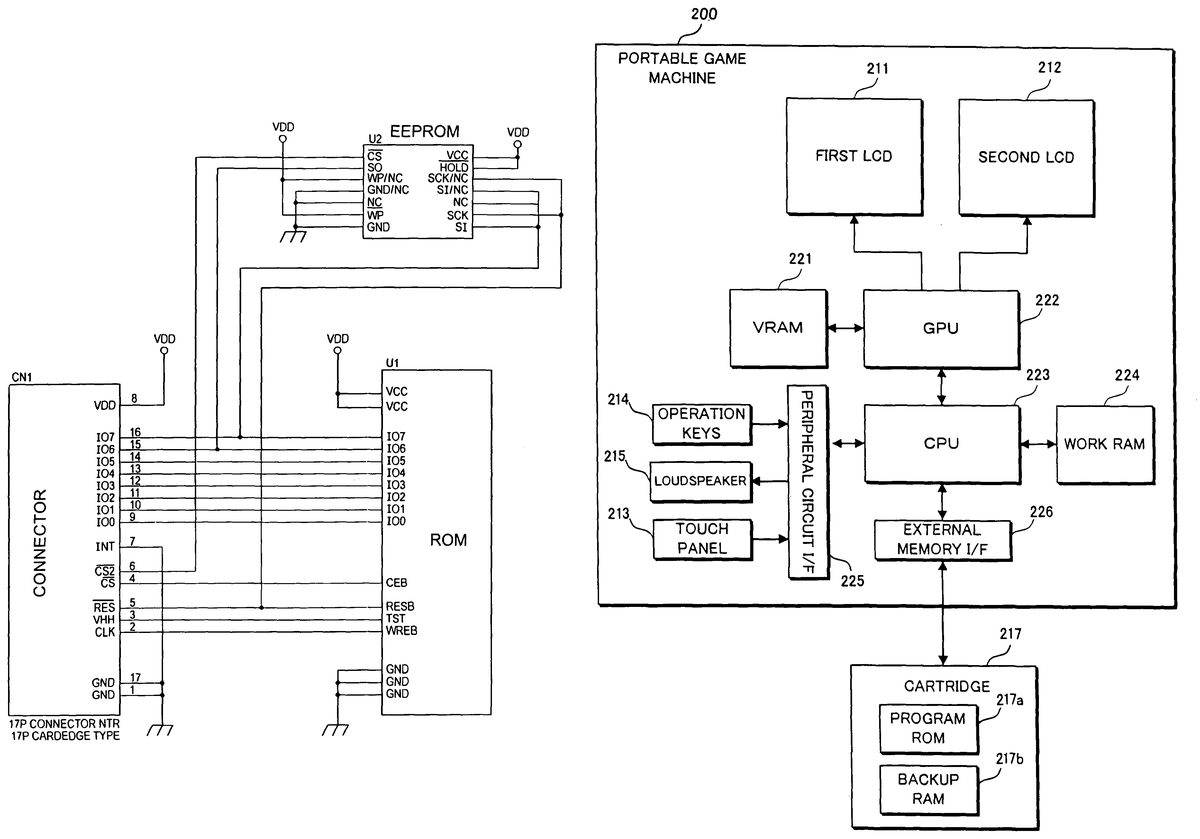
FIG. 8Ais a block diagram showing example components for an exemplary game card or other device ofFIGS. 6-8. Game card100shown inFIG. 8Aincludes a 17-pin connector CN1, a ROM U1 (e.g., 44P TSOP2) and an EEPROM U2 (e.g., 8/14P TSSOP). Pins2and23of ROM U1 are connected to VDD and pins3,22and41are connected to ground. ROM U1 is reset at start-up by a signal provided by the/RES (reset) terminal. In this exemplary illustrative implementation, when/CS is low, ROM U1 of card100is accessed in a parallel bus mode via terminals IO0to IO7and when/CS2 is low, EEPROM U2 of card100is accessed in SPI (serial peripheral interface) mode in which terminal IO7is a serial input terminal and terminal IO6is a serial output terminal.
FIG. 8Bshows an example arrangement of terminal strips interface116for card100(and also corresponding terminal strips within the iunterface slot of system10). The following table summarizes an exemplary terminal arrangement:
1GND2CLK3VHH4/CS15/RES (reset)6/CS27INT (interrupt)8VDD9IO010IO111IO212IO313IO414IO515IO616IO717GND
Exemplary Illustrative More Detailed Implementation
FIG. 9is a further illustrative embodiment of a portable game machine200. As with the prior embodiment, a further example game machine physically including two display screens with one of the display screens being covered with a touch panel is exemplarily described. In the present embodiment, a game image is displayed on at least the display screen covered with the touch panel. Also, a non-portable video game machine, an arcade game machine, a portable terminal, a cellular phone, or a personal computer may be used as the game machine.
FIG. 9is an external view of the portable game machine200. As shown inFIG. 9, the portable game machine200includes two display screens, that is, a first display screen211aand a second display screen212a. The surface of the second display screen212ais covered with a touch panel213. Also, to the right of the second display screen212a, the game machine includes an A button214a, a B button214b, and an R switch214c, which are operable by the right hand of the player, and a loudspeaker215for producing game music. To the left of the second display screen212a, the game machine includes a cross key214d, a start button214e, a select button214f, and an L switch214g, which are operable by the left hand of the player. Also, the portable game machine200includes a removable stylus216for input to the touch panel213. Furthermore, the portable game machine200has, removably inserted therein, a cartridge217, which is a storage medium having stored therein a game program of the illustrative embodiments. Note that, in the present embodiment, the touch panel213is exemplarily provided as an input unit, but this does not restrict the present invention.
FIG. 10is a block diagram showing the portable game machine200. It should be understood that the hardware/software and operational description which follows is applicable to the illustrative embodiment shown inFIGS. 1-8as well as the illustrative embodiment shown inFIG. 9. As shown inFIG. 10, the portable game machine200includes a CPU (central processing unit)223, which is an example of a computer for executing the game program, and other components. The CPU223includes a work RAM (working storage unit)224, a GPU (graphic processing unit)222, and a peripheral circuit I/F (interface)225that are electrically connected to one another. The work RAM224is a memory for temporarily storing, for example, the game program to be executed by the CPU223and calculation results of the CPU223. The GPU222uses, in response to an instruction from the CPU223, a VRAM221to generate a game image for display output to a first LCD (liquid crystal display unit)211and a second LCD212, and causes the generated game image to be displayed on the first display screen211aof the first LCD211and the second display screen212aof the second LCD212. The peripheral circuit I/F225is a circuit for transmitting and receiving data between external input/output units, such as the touch panel213, the operation keys214, and the loudspeaker215, and the CPU223. The touch panel213(including a device driver for the touch panel) outputs coordinate data corresponding to a position input (specified) with the stylus216.
Furthermore, the CPU223is electrically connected to the external memory I/F226, in which the cartridge217is inserted. The cartridge217is a storage medium for storing the game program and, specifically, includes a program ROM217afor storing the game program and a backup RAM217bfor rewritably storing backup data. The game program stored in the program ROM217aof the cartridge217is loaded to the work RAM224and is then executed by the CPU223. In the present embodiment, an exemplary case is described in which the game program is supplied from an external storage medium to the portable game machine200. However, the game program may be stored in a non-volatile memory incorporated in advance in the portable game machine200, or may be supplied to the portable game machine200via a wired or wireless communication circuit.
An example geometry engine has the following features:operates at 33.514 MHzmaximum 4 million vertices/second6-plane clippingLighting (4 parallel light sources)matrix stacktexture coordinate conversionbox culling test
An example rendering engine has the following features:operates at 33.514 MHzmaximum 120 thousand polygons/secondmaximum 30 million pixels/secondtriangular and quadrilateral renderingtexture format: 4-, 16-, and 256-color palette formats bitmap format 4×4 texel compression formattranslucent (A315, A513) formattexture size: 8×8 to 1024×1024alpha blendingalpha testfogtoon shadingedge markinganti-aliasing
Example Emulator System
Some or all of the above-described system components could be implemented as other than the hand-held system configurations described above.
An emulator system, for example, might include software and/or hardware components that emulate or simulate some or all of hardware and/or software components of the system for which the application software was written. For example, the emulator system could comprise a general-purpose digital computer such as a personal computer, which executes a software emulator program that simulates the hardware and/or firmware of the system. The emulator could also comprise a personal digital assistant (PDA) that simulates the hardware and/or firmware of the system. An emulator may execute the game software so that a particular game functions and/or appears somewhat differently from how it functions and/or appears on its intended platform. Thus, the emulator may show a color game in monochrome or a play a game without its accompanying sound. Emulation as used herein is intended to include emulation that results in these and other such differences in function and appearance.
Some general purpose digital computers (e.g., IBM or MacIntosh personal computers and compatibles) are equipped with 3D graphics cards that provide 3D graphics pipelines compliant with DirectX or other standard 3D graphics command APIs. They may also be equipped with stereophonic sound cards that provide high quality stereophonic sound based on a standard set of sound commands. Such multimedia-hardware-equipped personal computers running emulator software may have sufficient performance to approximate the graphics and sound performance of the system. Emulator software controls the hardware resources on the personal computer platform to simulate the processing, graphics, sound, peripheral and other capabilities of the portable game system platform for which the game programmer wrote the game software. Similarly, PDAs and other hand-held communication devices such as mobile telephones running emulator software may have sufficient performance to approximate the graphics and sound performance of the system.
U.S. Pat. No. 6,672,963 (the contents of which are incorporated herein in their entirety) discloses a software emulator that maintains high-quality graphics and sound in real time across a wide variety of video games and other applications. The emulator disclosed in the '963 patent achieves this through a unique combination of features and optimizations including, for example:use of a virtual liquid crystal display controller (state machine) to maintain real time synchronization with events as they would occur on the native platform,use of a hardware-assisted bit BLIT memory transfer operation to efficiently transfer graphics information into video memory,pre-computed translation table for translating native platform graphics character formats into formats more compatible with standard graphics adapters,emulation of native platform color palette information to provide compatibility with games and other applications that change color palettes within a frame,emulation of major registers and other hardware-based memory structures within the native platform in RAM under software control,use of a jump table able to efficiently parse incoming binary instruction formats,use of a unique page table to control memory access by remapping memory access instructions into different memory locations and/or function calls,availability of a ROM protection function to eliminate ROM overwriting during emulated operations,responsive to video game compatibility modes and registration data,models native platform using state machine defining search, transfer, horizontal blank and vertical blank states,cycle counter to determine when a modeled state has expired and transition to a new state is desired,selective frame display update skipping while maintaining execution of all instructions to maintain state information while minimizing game play slowdowns,optional NOP loop look ahead feature to avoid wasting processing time in NOP loops,redundant emulated RAM and ROM storage to optimize execution efficiency,separate page tables for read and write operations,modeling of native microprocessor registers as a union of byte, word and long register formats,modeling native instruction CPU flags to allow efficient updating after operations are performed by target platform microprocessor,mapping emulated program counter into target platform microprocessor general purpose register,reads and writes via index register go through pointer tables to increase execution efficiency,adaptable input controller emulator to provide user inputs from a variety of different user input devices,emulated object attribute memory, anduse of screen memory buffers larger than screen size to increase paging efficiency by eliminating clipping calculations and using the hardware BitBlt to transfer a subset of the memory buffer to displayed video memory.
It will be recognized that some or all of the various features and optimizations described in the '963 patent are applicable to emulate the example portable game systems described herein.
As described below, an emulator for the example portable game system described above may run on a hand-held computing system such as a PDA or a hand-held communication device such as a mobile telephone. Such devices typically have a single display screen and thus the emulator will need to determine how to present Display Output A and Display Output B (see, e.g.,FIG. 25) on this single display screen.
For example, the emulator could effectively divide the single display screen into two display areas and respectively provide Display Output A and Display Output B in each of these display areas. These display areas need not be the same size and the emulator may provide the “main” display output to a larger one of the display areas.
In still other instances, the emulator may provide only one of the Display Outputs A and B to the screen of the hand-held computing system or hand-held communication device. The one output that is provided to the screen need not be the same throughout the game. Thus, for example, Display Output A may be provided at some times and Display Output B may output at other times.
In addition, the display area on the single display screen for Display Output A and the display area on the single display screen for Display Output B may be oriented differently (e.g., one horizontally oriented and the other vertically oriented). This may facilitate display of the two Display Outputs at the same time.
In other instances, one of the Display Outputs A and B may be provided to the screen while the other one is made to be accessible upon supplying a predetermined input or inputs to the hand-held computing system or hand-held communication device. Thus, for example, a player may provide a predetermined input (such as a key press or a touch screen input) to switch between one Display Output and the other.
In addition, as described above, one of the display screens of the example portable game system is touch-sensitive. If the display screen of the hand-held computing system or hand-held communication device is divided into two display areas, the emulator may configure one of the display areas to receive touch inputs during game play. Preferably, this one of the display areas would be the display area displaying the output that would be displayed on the touch screen of the example portable game system. Touch inputs to the other one of the display areas would preferably be ignored.
If the emulator outputs only one of Display Output A and Display Output B at a time to the single screen display of the PDA or hand-held communication device, touch inputs may be supplied by the player when the Display Output output to the touch screen of the example portable game system is displayed. If this screen is subsequently switched to the other of the two screens, touch inputs may be ignored.
Because there will likely be differences between the size of the touchscreen of the example portable game system and the size of the screen of the hand-held computing system or hand-held communication device, the emulator will need to appropriately scale the touch screen inputs.
An emulator of the example portable game systems may implement some or all of the following:flipping back and forth between displays for each of the two screens of the original platformframe skipping to keep up with displayemulation of two processors (e.g., ARM7 and ARM 9 cores)emulation of touch screen of original platform with target platform touch screen (including, e.g, conversion or scaling for differently sized screen)emulation of some or all of the graphics pipeline (even if the target platform has some hardware graphics capability, the emulator may provide some conversion from the original platform graphics API to the target platform graphics API)
FIG. 11Aillustrates an example overall emulation process using a host platform1201, an emulator component1303, and a game software executable binary image provided on a storage medium62. Host1201may be a general or special purpose digital computing device such as, for example, a personal computer, a laptop computer, a palm-top computer, a video game console, a portable game system, a personal digital assistant, an internet appliance, a set-top box, or any other platform with sufficient computing power. Emulator1303may be software and/or hardware that runs on host platform1201, and provides a real-time conversion of commands, data and other information from storage medium62into a form that can be processed by host1201. For example, emulator1303fetches “source” binary-image program instructions intended for execution by portable game system10from storage medium62and converts these program instructions to a target format that can be executed or otherwise processed by host1201.
As one example, in the case where the software is written for execution on a platform using a specific processor and the host1201is a personal computer using a different (e.g., Intel) processor, emulator1203fetches one or a sequence of binary-image program instructions from storage medium62and converts these program instructions to one or more equivalent Intel binary-image program instructions. The emulator1203also fetches and/or generates graphics commands and audio commands and converts these commands into a format or formats that can be processed by hardware and/or software graphics and audio processing resources available on host1201. As one example, emulator1303may convert these commands into commands that can be processed by specific graphics and/or or sound hardware of the host1201(e.g., using standard DirectX, OpenGL and/or sound APIs).
An emulator1303used to provide some or all of the features of the video game system described above may also be provided with a graphic user interface (GUI) that simplifies or automates the selection of various options and screen modes for games run using the emulator. In one example, such an emulator1303may further include enhanced functionality as compared with the host platform for which the software was originally intended.
FIG. 11Billustrates one example emulation host system1201suitable for use with emulator1303. System1201includes a processing unit1203and a system memory1205. A system bus1207couples various system components including system memory1205to processing unit1203. System bus1207may be any of several types of bus structures including a memory bus or memory controller, a peripheral bus, and a local bus using any of a variety of bus architectures. System memory1207includes read only memory (ROM)1252and random access memory (RAM)1254. A basic input/output system (BIOS)1256, containing the basic routines that help to transfer information between elements within personal computer system1201, such as during start-up, is stored in the ROM1252. System1201further includes various drives and associated computer-readable media. A hard disk drive1209reads from and writes to a (typically fixed) magnetic hard disk1211. An additional (possible optional) magnetic disk drive1213reads from and writes to a removable “floppy” or other magnetic disk1215. An optical disk drive1217reads from and, in some configurations, writes to a removable optical disk1219such as a CD ROM or other optical media. Hard disk drive1209, magnetic disk drive1213, and optical disk drive1217are connected to system bus1207by a hard disk drive interface1221, a magnetic disk drive interface1223, and an optical drive interface1225, respectively. The drives and their associated computer-readable media provide nonvolatile storage of computer-readable instructions, data structures, program modules, game programs and other data for personal computer system1201. In other configurations, other types of computer-readable media that can store data that is accessible by a computer (e.g., magnetic cassettes, flash memory cards, digital video disks, random access memories (RAMs), read only memories (ROMs) and the like) may also be used.
A number of program modules including emulator1303may be stored on the hard disk1211, removable magnetic disk1215, optical disk1219and/or the ROM1252and/or the RAM1254of system memory1205. Such program modules may include an operating system providing graphics and sound APIs, one or more application programs, other program modules, program data and game data. A user may enter commands and information into personal computer system1201through input devices such as a keyboard1227, pointing device1229, microphones, joysticks, game controllers, satellite dishes, scanners, or the like. These and other input devices can be connected to processing unit1203through a serial port interface1231that is coupled to system bus1207, but may be connected by other interfaces, such as a parallel port, game port, Fire wire bus or a universal serial bus (USB). A monitor1233or other type of display device is also connected to system bus1207via an interface, such as a video adapter1235.
System1201may also include a modem1154or other network interface means for establishing communications over a network1152such as the Internet. Modem1154, which may be internal or external, is connected to system bus123via serial port interface1231. A network interface1156may also be provided for allowing system1201to communicate with a remote computing device1150(e.g., another system1201) via a local area network1158(or such communication may be via wide area network1152or other communications path such as dial-up or other communications means). System1201will typically include other peripheral output devices, such as printers and other standard peripheral devices.
In one example, video adapter1235may include a 3D graphics pipeline chip set providing fast 3D graphics rendering in response to 3D graphics commands issued based on a standard 3D graphics application programmer interface such as Microsoft's DirectX 7.0 or other version. A set of stereo loudspeakers1237is also connected to system bus1207via a sound generating interface such as a conventional “sound card” providing hardware and embedded software support for generating high quality stereophonic sound based on sound commands provided by bus1207. These hardware capabilities allow system1201to provide sufficient graphics and sound speed performance to play software stored in storage medium1305.
FIG. 11Cillustrates another example emulation host system1201′ suitable for use with emulator1303. The emulation host system inFIG. 30Cis generally configured along the lines of a personal digital assistant such as those available from palmOne Inc., Hewlett-Packard, Handspring, Dell, Sony and others and running an operating system such as Windows CE, EPOC, PalmOS, Microsoft Mobile PocketPC, or Windows Mobile. Typically, such personal digital assistants provide capabilities for a diary/scheduler, to-do lists, phone/address books and the like. System1201′ includes a processing unit1503and memory1505. A system bus1507couples various system components including memory1505to processing unit1503. Memory1505includes read only memory (ROM) and random access memory (RAM). Memory1505may also include external memory in the form of memory cards or memory sticks inserted into a suitable port provided in the housing for the components of system1201′. A touch-sensitive display screen (e.g., a touch-sensitive liquid crystal display screen)1509is also connected to system bus1507via an interface1511. Inputs via touch-sensitive screen1509are typically made using a stylus. Other input devices1513such as pushbuttons, switches, pointing devices and the like are also connected to system bus1507via an interface1515. The input devices may also include external keyboards or game control devices (e.g., joystick, game controller). The input devices may be used as game controls (e.g., starting the game, character movement, character action, etc.) when system1201′ is used with emulator1303. Games may be written to memory1505using communication circuit1521which may take the form of a modem for downloading the game from the Internet, for example, or of a cradle (e.g., a USB cradle) for connecting system1201′ to a personal computer.
One or more speakers1517are connected to system bus1507via an audio interface1519to output sounds. A communication circuit1521is connected to system bus1507via a communications interface1523to permit communication with other devices. By way of illustration, communication circuit1521may, for example, be a modem and communications interface1523may be a serial port. Generally speaking, communication circuit1521may be configured for wired or wireless communication in accordance with any conventional communication protocol. A power supply1525provides power for the components of system1201′.
The contents of any technical documents or patent documents referenced above are incorporated herein in their entirety.
As one embodiment of the present invention, the portable game machine having a hardware structure as shown inFIGS. 10 and 11has been described. However, the present invention is applied not only to the portable game machine having such a hardware structure, but to the one having the above hardware structure achieved by the CPU and software. Also, the portable game machine according to the present embodiment can be emulated by a computer system, such as a personal computer or a portable information terminal. In this case, a game program that causes the computer system to achieve each hardware function of the portable game machine according to the present embodiment is supplied to the computer system. With this, the present invention can be applied also to a general-purpose computer system.
While the invention has been described in connection with what is presently considered to be the most practical and preferred embodiment, it is to be understood that the invention is not to be limited to the disclosed embodiment, but on the contrary, is intended to cover various modifications and equivalent arrangements included within the spirit and scope of the appended claims.
Claims
- A memory card adapted for at least partial insertion into a memory card slot of a hand-holdable video game system, said memory card including first and second memories and a connector for electrically connecting the memories to the video game system so that contents of the memories are selectively accessible to a processor of the video game system, the connector comprising a plurality of linearly-arrayed terminal strips that connect to corresponding electrical contacts of the video game system disposed within the memory card slot, the terminal strips including: a first terminal strip for, in use, connecting to a first ground terminal of the video game system;a second terminal strip for, in use, connecting to a clock terminal of the video game system;a third terminal strip for, in use, connecting to a first high voltage terminal of the video game system;a fourth terminal strip for, in use, connecting to a first chip select terminal of the video game system;a fifth terminal strip for, in use, connecting to a reset terminal of the video game system;a sixth terminal strip for, in use, connecting to a second chip select terminal of the video game system;a seventh terminal strip for, in use, connecting to an interrupt terminal of the video game system;an eighth strip terminal for, in use, connecting to a second high voltage terminal of the video game system;ninth through sixteenth terminal strips for, in use, connecting to a bus of the video game system;and a seventeenth terminal strip for, in use, connecting to a second ground terminal of the video game system, wherein the first memory of the memory card is accessed in a parallel bus mode via the ninth through sixteenth terminal strips when a chip select signal having a specified level is applied to the fourth terminal strip via the first chip select terminal, and wherein the second memory of the memory card is accessed in a serial peripheral interface mode in which first and second ones of the ninth through sixteenth terminal strip are respectively used as a serial input terminal and a serial output terminal when a chip select signal having a specified level is applied to the sixth terminal strip via the second chip selection terminal.
- The memory card according to claim 1 , wherein the memory card is substantially square-shaped.
- The memory card according to claim 1 , wherein the first memory device comprises a read-only memory storing a video game program.
- The memory card according to claim 1 , wherein the second memory comprises an EEPROM.
- The memory card according to claim 1 , wherein the linearly-arrayed terminal strips are disposed in a recess provided in a surface of the memory card.
- The memory card according to claim 1 , further comprising: ribs arranged between adjacent ones of the linearly-arrayed terminal strips.
Disclaimer: Data collected from the USPTO and may be malformed, incomplete, and/or otherwise inaccurate.